The Nature Videographer's Handbook
Master the Art and Craft of Capturing Wildlife and Landscapes on Film
You're about to discover how to transform your nature videography from competent to captivating.
207 pages9 chaptersNov 27, 2025Video Production
About this book
This handbook guides you through the complete process of creating professional-quality wildlife and landscape films—from the moment you conceive an idea to the final frame your audience sees. You'll learn the technical foundations that separate amateur footage from broadcast-quality content, including camera settings, lens selection, and stabilization techniques that work in unpredictable natural environments. Beyond equipment, you'll master the creative strategies that documentary filmmakers use to capture authentic animal behavior, build visual narratives, and work with challenging lighting conditions. This book addresses the unique challenges of nature filming: how to anticipate wildlife movement, adapt to weather changes, and maintain ethical standards while pursuing compelling shots. Whether you're filming a backyard bird feeder or planning an expedition to remote landscapes, you'll gain practical frameworks for planning shoots, managing risk, and solving problems in the field. The result is a comprehensive resource that bridges the gap between knowing your camera and knowing how to tell stories that move people.
Table of contents
- IntroductionWhy Nature Videography Matters, What You'll Learn in This Book, How to Use This HandbookRead below
- Chapter 1: Foundations of Nature VideographyUnderstanding the Medium: Video vs. Photography, The Nature Filmmaker Mindset, Ethical Principles in Nature Filming, Genres and Styles of Nature Content
- Chapter 2: Essential Camera Equipment and SettingsChoosing the Right Camera for Nature Work, Lenses and Focal Lengths for Wildlife and Landscapes, Stabilization Techniques: Tripods, Gimbals, and Handheld Methods, Audio Equipment Essentials for Nature Filming
- Chapter 3: Mastering Exposure and Light in Natural EnvironmentsUnderstanding Natural Light Patterns and Quality, Exposure Metering Strategies for Variable Conditions, Working with Challenging Light: Backlighting, Shadows, and Harsh Sun, Golden Hour and Seasonal Light Advantages
- Chapter 4: Wildlife Behavior and Capture TechniquesObserving and Predicting Animal Behavior, Tracking and Following Subjects Smoothly, Capturing Authentic Moments Without Interference, Working Safely with Wildlife: Distance and Respect
- Chapter 5: Landscape Cinematography and Environmental StorytellingComposition Principles for Landscape Cinematography, Capturing Scale and Grandeur in Vast Environments, Environmental Storytelling Through Landscape, Seasonal and Weather Dynamics as Visual Elements
- Chapter 6: Planning and Scouting Your Nature ShootsResearch and Location Scouting Strategies, Timing and Seasonal Planning for Optimal Conditions, Creating Shot Lists and Storyboards, Logistics and Risk Management in the Field
- Chapter 7: Advanced Filming Techniques and Creative ApproachesSlow Motion and Time Lapse: Revealing Hidden Rhythms, Macro and Micro Cinematography for Detail Work, Drone and Aerial Perspectives in Nature Filming, Creative Transitions and Visual Effects for Nature Content
- Chapter 8: Post-Production Workflow for Nature ContentOrganizing and Managing Large Footage Libraries, Color Grading for Nature Films: Enhancing Without Distorting, Sound Design and Audio Mixing for Immersion, Editing for Pacing and Narrative Impact
- Chapter 9: Building Your Nature Videography PracticeDeveloping Your Unique Voice and Style, Building a Portfolio That Showcases Your Best Work, Continuous Learning and Growth in the Field
- ConclusionYour Next Steps as a Nature Videographer
- Glossary of Nature Videography Terms
- Further Reading and Resources
Introduction
Nature videography stands at the intersection of technical mastery and profound patience. You've already learned the fundamentals of video production—how to operate a camera, understand exposure, and edit footage into coherent sequences. Now you're ready to apply those skills to one of the most challenging and rewarding specializations in the field. Capturing wildlife in motion and landscapes that shift with every passing cloud requires more than technical knowledge. It demands an understanding of animal behavior, weather patterns, light quality, and the ability to anticipate moments that may never repeat themselves. This handbook will guide you through that transformation from general videographer to nature storyteller.
The natural world doesn't wait for perfect camera settings or ideal conditions. A wolf pack hunting at dawn won't pause while you adjust your white balance. A storm rolling across a mountain range won't hold its dramatic lighting until you're ready. This reality separates nature videography from controlled studio work or even documentary filming with human subjects. You must develop the ability to work quickly, adapt constantly, and make critical decisions in seconds while maintaining the highest production standards. The footage you capture will compete with content produced by filmmakers with decades of experience and substantial budgets. Your success depends on combining technical excellence with field craft, creative vision with scientific understanding, and ambition with ethical responsibility.
This book addresses the specific challenges you'll face in natural environments. You'll learn how to protect your equipment in extreme weather, how to approach wildlife without causing stress or danger, and how to find compelling stories in ecosystems that might initially seem static or empty. Beyond the practical techniques, you'll discover how to develop the observational skills that distinguish exceptional nature videographers from those who simply point cameras at animals. The difference between adequate footage and extraordinary footage often comes down to understanding what you're filming—recognizing the subtle signs that a bird is about to take flight, knowing which weather conditions will produce dramatic skies, or anticipating where a river otter will surface next. These skills can't be learned from equipment manuals alone.
Why Nature Videography Matters
Nature videography serves purposes that extend far beyond entertainment or aesthetic appreciation. In an era when many people experience the natural world primarily through screens, your work becomes a bridge between human audiences and ecosystems they may never visit in person. A well-crafted film about coral reef ecosystems can inspire conservation efforts that protect those habitats. Footage of endangered species can raise awareness and funding for preservation programs. Time-lapse sequences showing glacial retreat provide visual evidence of climate change that statistics alone cannot convey. Your camera becomes a tool for education, advocacy, and connection. This responsibility should inform every decision you make in the field, from the subjects you choose to film to the narratives you construct around them.
The demand for high-quality nature content has never been greater. Streaming platforms, educational institutions, conservation organizations, and media companies constantly seek compelling wildlife and landscape footage. Social media has created new distribution channels where short-form nature content can reach millions of viewers within days. Tourism boards need promotional videos showcasing natural attractions. Scientific researchers require documentation of animal behavior and environmental changes. This expanding market creates opportunities for videographers who can deliver professional-quality content consistently. However, the same accessibility that creates opportunities also increases competition. Your technical skills must be impeccable, your creative vision distinctive, and your understanding of natural subjects deep enough to capture moments that others miss.
Nature videography also offers profound personal rewards that transcend professional success. Spending extended periods observing wildlife teaches patience and mindfulness that transform how you perceive the world. You'll witness behaviors that few humans ever see—the intricate courtship dances of birds, the cooperative hunting strategies of predators, the quiet determination of a seedling breaking through forest floor debris. These experiences create a connection to the natural world that enriches your life beyond your work. Many nature videographers describe their practice as a form of meditation, requiring complete presence and attention to the moment. The technical challenges force continuous learning and problem-solving. The unpredictability keeps every shoot fresh and exciting. The beauty you encounter daily provides constant inspiration and perspective on what matters in life.
Your work contributes to a visual archive of the natural world at a critical moment in history. Species are disappearing at unprecedented rates. Ecosystems are changing faster than at any point in human history. Glaciers that have existed for millennia are melting. Migration patterns are shifting. The footage you capture today may document behaviors, landscapes, or even entire species that future generations will only know through recordings. This archival function gives your work lasting significance beyond its immediate impact. Decades from now, researchers, educators, and audiences may study your footage to understand what was lost or how ecosystems functioned before further changes occurred. This perspective should inspire both humility and determination in your practice.
The field also pushes the boundaries of visual storytelling and technical innovation. Nature videographers pioneered many techniques now standard across the industry—remote camera traps, extreme slow motion, time-lapse photography, and specialized underwater housings all emerged from the unique demands of filming wildlife. Working in natural environments forces creative problem-solving that advances the craft for everyone. You might develop new mounting systems for cameras in trees, discover innovative ways to capture audio in windy conditions, or create lighting solutions for nocturnal subjects. These innovations contribute to the broader videography community while solving your immediate challenges. The technical limitations you face become opportunities for creativity rather than obstacles to overcome.
Finally, nature videography matters because it cultivates wonder and curiosity in audiences increasingly disconnected from natural systems. A child watching your footage of wolves playing might develop a lifelong interest in wildlife biology. An adult seeing your time-lapse of a flower blooming might notice the plants in their own neighborhood with new appreciation. Your work can shift perspectives, challenge assumptions, and inspire people to engage with the natural world more thoughtfully. This impact extends beyond conservation messaging or environmental advocacy. Simply showing the beauty, complexity, and drama of natural systems reminds viewers that they're part of something larger than human concerns. In a world dominated by human-centered narratives, nature videography offers a different perspective—one where humans are observers rather than protagonists, where other species have their own stories worth telling.
The combination of these factors—professional opportunity, personal fulfillment, historical documentation, technical innovation, and cultural impact—makes nature videography a uniquely meaningful specialization. Your work matters in ways that extend far beyond the immediate project or client. Every hour you spend in the field, every technique you master, and every story you tell contributes to a larger purpose. This handbook will help you develop the skills to make that contribution as effectively as possible, while maintaining the ethical standards and respect for subjects that the work demands.
What You'll Learn in This Book
This handbook provides a comprehensive framework for nature videography, organized around the complete production process from initial concept to final delivery. You'll begin with foundational principles that distinguish nature filming from other video work—the mindset required for success, the ethical considerations that guide responsible practice, and the different genres and styles within the field. Understanding these foundations ensures that your technical skills serve meaningful purposes and that your work respects both subjects and audiences. You'll learn why patience matters more than expensive equipment, how observation skills develop over time, and what separates footage that merely documents from footage that truly communicates.
The technical sections cover equipment selection, camera settings, and filming techniques specific to natural environments. You'll discover which camera features matter most for wildlife work, how to choose lenses for different subjects and situations, and which stabilization methods work best in various field conditions. The book addresses practical questions you'll face immediately:
- How do you configure autofocus systems to track erratically moving animals?
- Which frame rates and shutter speeds capture motion most effectively?
- What backup systems prevent equipment failure from ruining critical shoots?
- How do you protect cameras from rain, dust, and extreme temperatures?
- Which audio recording techniques capture clean nature sounds despite wind and distance?
You'll develop expertise in working with natural light, which presents both the greatest challenge and the most powerful creative tool in nature videography. The book explains how light quality changes throughout the day and across seasons, how to meter exposure in high-contrast situations, and how to use difficult lighting conditions creatively rather than fighting against them. You'll learn specific strategies for filming in harsh midday sun, deep forest shade, and rapidly changing weather. These skills separate videographers who can only work in ideal conditions from those who consistently capture compelling footage regardless of circumstances. Understanding light also means recognizing when conditions won't produce quality footage, saving you wasted effort and helping you plan shoots more effectively.
The wildlife behavior sections teach you how to anticipate and capture authentic animal moments. You'll learn to read body language that signals imminent action, understand territorial and feeding patterns that predict movement, and recognize the subtle signs of stress that indicate you're too close or too intrusive. This knowledge comes from both scientific understanding and practical field experience. The book provides frameworks for observing behavior systematically, predicting what might happen next, and positioning yourself to capture those moments without interference. You'll also learn safety protocols for working near potentially dangerous animals, techniques for remaining undetected, and ethical guidelines that protect wildlife welfare above all other considerations.
Landscape cinematography receives dedicated attention, covering composition principles that create visual impact, techniques for conveying scale and grandeur, and methods for using environmental elements as narrative tools. You'll discover how to film landscapes that feel dynamic rather than static, how to incorporate weather and seasonal changes as story elements, and how to reveal the relationships between landscapes and the wildlife they support. The book addresses specific challenges like filming in extreme environments, capturing aerial perspectives safely and legally, and working with time-lapse and motion control systems that reveal landscape changes invisible to real-time observation.
Planning and preparation chapters provide systematic approaches to scouting locations, researching subjects, and organizing shoots for maximum efficiency. You'll learn how to:
- Research animal behavior patterns and seasonal movements before arriving on location
- Scout locations effectively to identify the best vantage points and lighting conditions
- Create shot lists that balance ambitious goals with realistic expectations
- Develop contingency plans for weather changes and unexpected circumstances
- Manage logistics like permits, access, and equipment transport
- Assess and mitigate risks in remote or challenging environments
Advanced technique chapters explore specialized approaches like slow motion, time-lapse, macro cinematography, and aerial filming. You'll learn when each technique serves the story effectively rather than simply showing off technical capability. The book provides specific settings, equipment recommendations, and workflow considerations for each approach. You'll discover how to reveal hidden aspects of nature through extreme slow motion, compress long processes into compelling time-lapses, and capture intimate details through macro work. These advanced techniques expand your creative palette and enable you to show audiences perspectives they cannot experience with unaided human perception.
Post-production chapters address the complete workflow from ingesting footage through final delivery. You'll learn organizational systems that keep large footage libraries manageable, color grading approaches that enhance natural beauty without creating artificial looks, sound design techniques that increase immersion, and editing strategies that build narrative momentum. The book emphasizes workflows specifically designed for nature content, where you might work with hundreds of hours of footage to find the perfect moments, where color accuracy matters more than stylistic grading, and where natural sound often carries more impact than music. You'll also learn how to work efficiently with high-resolution formats and large file sizes that nature videography typically generates.
Throughout the book, you'll find practical examples drawn from real filming situations. These case studies illustrate how principles apply in actual field conditions, demonstrate problem-solving approaches for common challenges, and show how technical decisions affect final results. You'll see examples of what works and what doesn't, learn from mistakes that others have made, and understand the reasoning behind specific approaches. The book also includes troubleshooting guidance for common problems—what to do when autofocus fails, how to recover from exposure errors, how to work around equipment limitations, and how to adapt when conditions don't match your plans.
The final chapters help you develop your unique voice and build a sustainable practice. You'll learn how to identify your distinctive perspective, create a portfolio that showcases your strengths, and continue developing your skills over time. The book addresses the business aspects of nature videography—finding clients, pricing your work, managing rights and licensing, and building relationships with conservation organizations, media companies, and other potential collaborators. You'll also discover resources for continued learning, communities of practice where you can connect with other nature videographers, and strategies for staying current with evolving technology and techniques.
How to Use This Handbook
This book is designed as both a comprehensive guide you can read cover-to-cover and a reference resource you'll return to repeatedly as you encounter specific challenges. If you're new to nature videography, reading the chapters in sequence provides a logical progression from foundational concepts through advanced techniques. Each chapter builds on previous material, introducing concepts in an order that matches how you'll likely develop your skills. The early chapters establish the mindset and ethical framework that should guide all your work, while later chapters assume you've internalized those principles and are ready for more complex technical and creative challenges. Reading sequentially ensures you don't miss important foundational concepts that later material assumes you understand.
However, you don't need to master every chapter before beginning field work. Nature videography is learned primarily through practice, and you'll benefit most from alternating between reading and filming. A practical approach involves reading the foundational chapters first, then moving to the equipment and basic technique chapters before your first dedicated nature shoots. After gaining some field experience, return to the more advanced chapters with specific questions and challenges in mind. You'll find that concepts make more sense and techniques become more relevant once you've encountered the problems they solve. The book is structured to support this iterative learning process, with each chapter standing alone enough that you can jump to specific topics as needed.
Pay special attention to the examples and case studies throughout the book. These practical illustrations show how principles apply in real situations and often reveal nuances that general explanations cannot convey. When you encounter a technique or concept that seems abstract, look for the accompanying examples to see it in action. Many readers find it helpful to mark or bookmark examples that resonate with their specific interests or challenges. You might also consider keeping a notebook where you record your own experiences applying the techniques described, creating a personalized supplement to the handbook that reflects your unique learning journey and the specific environments where you work.
The book includes technical specifications, settings recommendations, and equipment suggestions throughout. Treat these as starting points rather than absolute rules. Technology evolves rapidly, and what's current as this book is published may be outdated within a few years. More importantly, the specific settings that work in one situation may fail completely in another. Use the recommended settings as baselines, then adjust based on your specific conditions, equipment, and creative goals. The principles behind the recommendations matter more than the exact numbers. Understanding why a particular shutter speed works for a certain subject teaches you how to make appropriate adjustments when circumstances change, while memorizing specific settings without understanding the reasoning leaves you helpless when those settings don't work.
Consider creating a personal action plan as you read. Each chapter concludes with key concepts and techniques you can implement immediately. Rather than trying to apply everything at once, identify two or three specific skills or approaches from each chapter that address your current challenges or interests. Practice those deliberately on your next few shoots before moving to additional techniques. This focused approach builds competence more effectively than attempting to implement dozens of new ideas simultaneously. You might structure your action plan like this:
- Immediate practice: One technique you'll try on your very next shoot
- Short-term development: Two or three skills you'll focus on over the next month
- Long-term goals: Larger capabilities you're working toward over the next season or year
- Equipment considerations: Gear you might acquire as your skills and needs develop
Use the book's organization to quickly find information when you're planning specific shoots. The detailed table of contents and chapter structure make it easy to locate relevant sections when you need guidance on particular challenges. Before a wildlife shoot, review the behavior observation and tracking sections. When planning a landscape expedition, revisit the composition and environmental storytelling chapters. If you're trying a new technique like time-lapse or slow motion, consult those specific sections for settings and workflow guidance. The book becomes more valuable over time as you build familiarity with its structure and can quickly locate the information you need in the field or during planning sessions.
Don't skip the ethical considerations and conservation principles woven throughout the book. These aren't optional additions to the technical content—they're fundamental to responsible practice. Nature videography carries real responsibilities to the subjects you film and the ecosystems you enter. Understanding these ethical dimensions helps you make better decisions in the field, protects the wildlife and environments that make your work possible, and ensures your footage contributes positively rather than causing harm. Many of the most successful nature videographers attribute their access to sensitive locations and rare subjects to their reputation for ethical, respectful work. Building that reputation starts with internalizing the principles discussed throughout this handbook.
Finally, recognize that this book provides frameworks and principles, but your own experience will be your most valuable teacher. Every environment is different, every species presents unique challenges, and every shoot offers lessons that no book can fully anticipate. Use this handbook as a foundation, but remain open to discovery, experimentation, and learning from both successes and failures. Keep notes on what works in your specific locations and with your particular equipment. Share experiences with other nature videographers and learn from their approaches. The field evolves constantly as new technologies emerge, as our understanding of animal behavior deepens, and as creative filmmakers discover innovative techniques. This handbook gives you the foundation to participate in that ongoing evolution, developing your own expertise and perhaps contributing innovations that future videographers will learn from.
Your journey as a nature videographer will be uniquely your own, shaped by the environments you access, the subjects that fascinate you, and the stories you feel compelled to tell. This handbook provides the tools, techniques, and principles you need to tell those stories effectively. The rest depends on your dedication, patience, and willingness to spend countless hours observing, waiting, and learning from the natural world itself. That investment of time and attention will reward you with footage that moves audiences, experiences that transform your own perspective, and the satisfaction of mastering one of the most challenging and meaningful specializations in videography. Now let's begin building the specific skills that will make that possible.
This is the end of the free sample. The full book has 9 chapters.
Want this book written for you?
Tell us your goals and background, and get your own version of this book, tailored by AI to you.


Benefits of AI-tailored books
- Read one book, not ten:
- all the Video Production knowledge you need, gathered into a single book.
- Save days of learning:
- tell us your goals, choose your topics, and the whole book is built around them.
- Learn effortlessly:
- Video Production book written for your specific background and expertise.
- Understand at a glance:
- includes charts, tables, timelines, checklists, decision trees, and more.
- Stay current:
- written the day you order it, not years ago.
- Trust what you read:
- every book is checked for accuracy, with real research when your subject needs it.
Create your unique book in 3 steps
- 1. Select your focus
Select the focus of your Video Production book and share your background
- 2. Personalize your book
Specify your goals and choose sub-topics to include
- 3. Get your tailored book
Your book is ready in 10 minutes. Read it online, download as EPUB or PDF, or send to Kindle.

Frequently asked questions
- What is TailoredRead?
TailoredRead creates complete, full-length nonfiction ebooks, written specifically for you. Tell us what you want to learn and why, and TailoredRead writes you a complete ebook on it, with charts, tables, and diagrams throughout. Read it online, on Kindle, or on any e-reader, or download it as a PDF or EPUB. Every book is written fresh the day you order it.
- How is the book tailored to me?
Before anything is written, you answer a few short questions about your goals, your background, and the topics you care about. Your book is then planned around your answers: written at your level, focused on your goals, and covering the topics you chose, instead of the one-size-fits-all book a store sells everyone.
- Will it read like generic AI content?
No. Your book isn't a chat transcript: it's planned chapter by chapter before a single word is written, told in a clear book voice, and explains ideas visually with charts, tables, and diagrams. After writing, every book goes through an editorial pass that polishes chapters so the book reads consistent from start to finish. Judge for yourself: browse thousands of sample books on our Explore Books page.
- How accurate is the content?
Our AI first checks whether your subject needs live research. Niche and fast-moving subjects are researched before writing, and the book plan and chapters are grounded in what it finds. After writing, every book goes through a quality pass that checks its facts and consistency, and researched books list their sources in a Notes section at the back.
- How long is the book?
You choose the length: Comprehensive (250-300 pages), Detailed (150-200 pages), Essential (70-100 pages), or Short (30-50 pages).
- Does the book include visuals?
Yes. Every book includes charts, tables, and diagrams: timelines, checklists, step-by-step guides, decision trees, comparison tables, matrices, and bar charts. A typical book includes dozens of these visual elements.
- Can I read it on Kindle? What formats can I download?
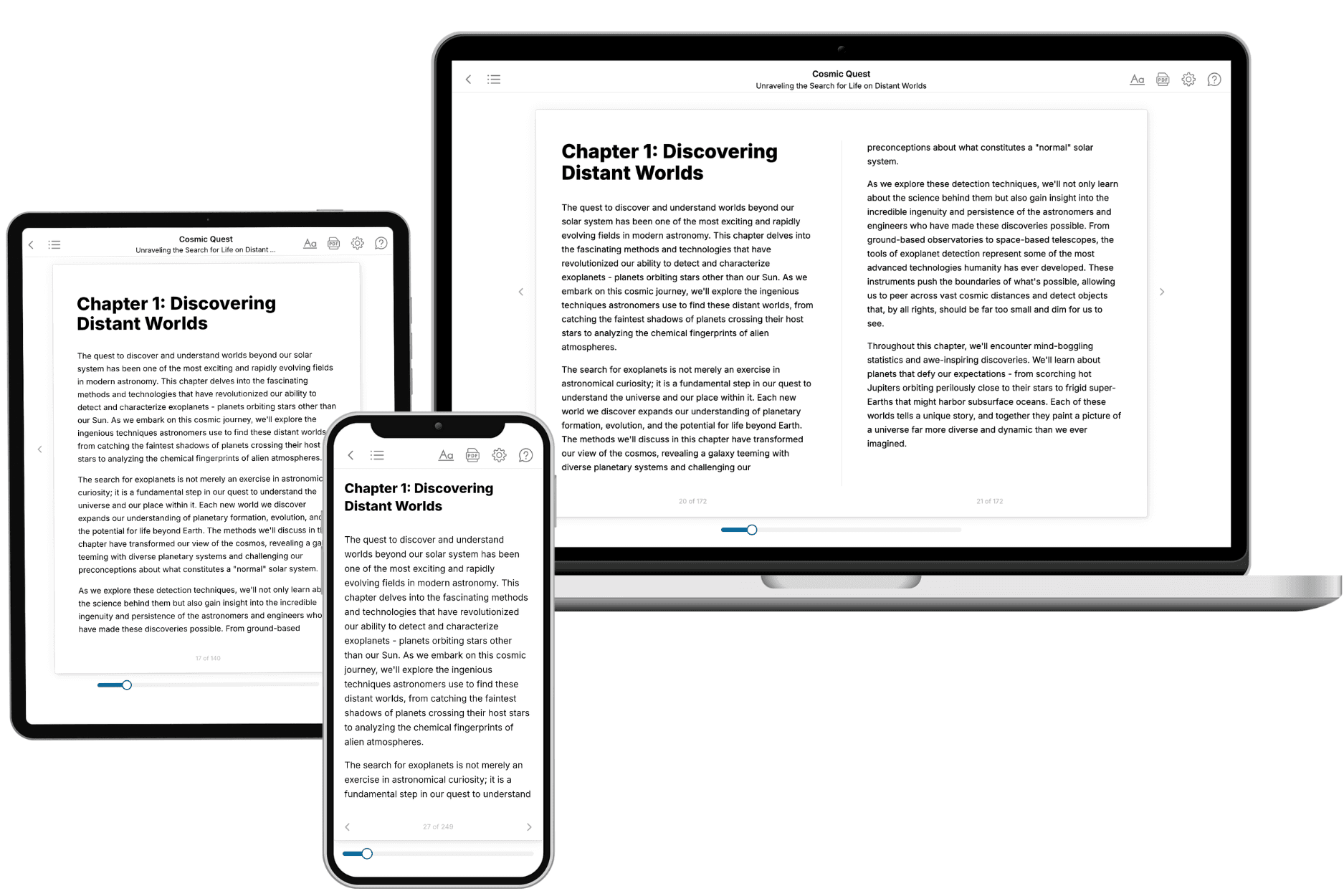
Yes. Every book can be read in our online reader or downloaded as a PDF or EPUB. The EPUB can be opened with Kindle, Apple Books, Kobo, and any e-reader. The Commercial and Author licenses also include an editable Word (DOCX) and Markdown download.
- How much does it cost?
About the price of a regular ebook. The exact price depends on your book's length and complexity, from $2 for the shortest books to $35 for the most comprehensive, and it's shown when you review your book, before you commit to anything. Each book is a one-time purchase, yours to keep, no subscription. Licenses that let you share, teach, or publish your book range from $35.99 to $49.99.
- Can I preview the book before purchasing?
Before you pay, you'll see what your book will cover: the title, a detailed description, the estimated length, and the complete chapter-by-chapter table of contents, so you know what you're getting before you decide. The full text itself is written after you purchase.
- How long does it take to create a book?
About 10 minutes. You can start reading the opening chapters while the rest is still being written.