Neural Networks Demystified
A Practical Guide to Understanding and Building Deep Learning Models
What if the key to building powerful AI models isn't about understanding complex mathematics, but rather grasping the intuitive principles behind how neural networks learn?
222 pages10 chaptersFeb 16, 2026Neural Networks
About this book
This book strips away the intimidation factor and reveals the practical logic underlying neural network architectures. You'll discover why certain architectures excel at image recognition while others dominate natural language processing, and how to select the right model for your specific challenge. Through clear explanations, real-world examples, and hands-on insights, you'll move from theoretical understanding to practical implementation. Whether you're building your first deep learning model or optimizing existing systems, this guide equips you with the knowledge to make informed architectural decisions, troubleshoot training issues, and leverage modern techniques like transfer learning. Master the architectures reshaping AI and data science today.
Table of contents
- IntroductionWhy Neural Networks Matter in Modern AI, What You'll Learn in This Book, How to Use This Guide, Prerequisites and AssumptionsRead below
- Chapter 1: The Foundations of Neural NetworksFrom Biology to Mathematics: The Neuron Concept, The Perceptron: Where It All Began, Activation Functions and Non-linearity, Building Networks: Layers and Connections
- Chapter 2: How Neural Networks LearnForward Propagation: Making Predictions, Loss Functions: Measuring Prediction Error, Backpropagation: The Learning Algorithm, Gradient Descent and Optimization
- Chapter 3: Feedforward and Dense NetworksMulti-Layer Perceptrons: The Foundation, Universal Approximation and Network Capacity, When and Why to Use Dense Networks
- Chapter 4: Convolutional Neural Networks for VisionThe Convolution Operation Explained, Pooling, Filters, and Feature Maps, Classic CNN Architectures: LeNet to ResNet, Real-World Image Classification and Detection
- Chapter 5: Recurrent Neural Networks for SequencesProcessing Sequential Data, RNN Mechanics and Hidden States, LSTMs and GRUs: Solving the Vanishing Gradient Problem, Time Series, Language, and Sequence Prediction
- Chapter 6: Attention Mechanisms and TransformersThe Attention Mechanism: Focus Where It Matters, Self-Attention and Multi-Head Attention, The Transformer Architecture, How Transformers Revolutionized NLP
- Chapter 7: Specialized Architectures and VariantsAutoencoders for Unsupervised Learning, Generative Models: VAEs and GANs, Graph Neural Networks for Structured Data
- Chapter 8: Training, Optimization, and RegularizationOptimizers: SGD, Adam, and Beyond, Regularization: Dropout, Batch Norm, and L1/L2, Hyperparameter Tuning and Model Selection, Best Practices for Stable and Efficient Training
- Chapter 9: Building and Deploying ModelsPopular Frameworks: TensorFlow, PyTorch, and Keras, Data Preparation and Preprocessing, Transfer Learning and Fine-Tuning Pre-trained Models, Deployment, Inference, and Production Considerations
- Chapter 10: Diagnosing and Fixing Common ProblemsIdentifying and Addressing Overfitting and Underfitting, Debugging Training Issues and Convergence Problems, Improving Model Performance and Inference Speed
- ConclusionKey Takeaways and Your Next Steps, The Future of Neural Network Architectures
- Glossary of Terms
- Further Reading and Resources
Introduction
Neural networks have transformed from academic curiosities into the driving force behind some of the most impactful technological breakthroughs of our time. They power the voice assistants on your phone, recommend what you watch next on streaming platforms, enable self-driving cars to navigate complex environments, and help doctors detect diseases from medical images with unprecedented accuracy. Yet despite their ubiquity and power, neural networks remain shrouded in mystery for many practitioners. The mathematics can seem daunting, the architectures bewilderingly complex, and the choices overwhelming. This book cuts through that complexity to reveal the intuitive principles that make neural networks work, helping you understand not just the what but the why behind these remarkable models.
The journey from basic machine learning to deep learning represents more than just an incremental improvement in techniques. It marks a fundamental shift in how we approach problem-solving with data. Traditional machine learning required extensive feature engineering, where domain experts manually crafted the representations that algorithms would use. Neural networks, by contrast, learn these representations automatically from raw data. This capability has unlocked solutions to problems that were previously intractable, from understanding natural language to generating photorealistic images. Understanding how different neural network architectures accomplish these feats is no longer optional knowledge for data science practitioners. It has become essential expertise that separates those who can merely apply pre-built solutions from those who can design, optimize, and innovate.
This book is designed for practitioners who have moved beyond the basics of machine learning and are ready to dive deeper into neural networks. You likely understand concepts like training and testing sets, overfitting, and basic model evaluation. Perhaps you've even built simple neural networks using high-level libraries. Now you're ready to understand the architectural choices that determine whether a model succeeds or fails, to diagnose training problems with confidence, and to select or design the right architecture for your specific challenges. This guide will take you from foundational concepts through modern architectures, always maintaining a focus on practical understanding and real-world application. By the end, you'll possess both the conceptual framework and practical knowledge to work effectively with neural networks across diverse domains.
The approach taken here emphasizes intuition over mathematical rigor without sacrificing accuracy. While we won't shy away from the mathematics when it illuminates understanding, we'll always ground concepts in practical examples and visual intuition. Each architecture is presented not as an abstract mathematical construct but as a solution to specific types of problems. You'll learn to recognize the patterns in your data and challenges that suggest particular architectural approaches. More importantly, you'll develop the diagnostic skills to understand when models aren't working and the practical knowledge to fix them. This is a guide for builders, not just students—for those who need to deliver working solutions, not just pass exams.
Why Neural Networks Matter in Modern AI
The resurgence of neural networks over the past decade represents one of the most significant developments in the history of artificial intelligence. While the fundamental concepts date back to the 1940s and 1950s, it wasn't until the convergence of three critical factors that neural networks truly came into their own. First, the explosion of available data from digital sources provided the fuel these models need to learn effectively. Second, advances in computational power, particularly the adaptation of graphics processing units (GPUs) for general-purpose computing, made training large networks feasible. Third, algorithmic innovations in architecture design, optimization techniques, and training procedures unlocked capabilities that earlier researchers could only dream of. Together, these factors created a perfect storm that propelled neural networks from academic curiosities to the foundation of modern AI systems.
What makes neural networks particularly powerful is their ability to learn hierarchical representations of data. Consider image recognition as an example. Early layers in a convolutional neural network learn to detect simple features like edges and corners. Middle layers combine these into more complex patterns like textures and shapes. Deep layers recognize high-level concepts like eyes, wheels, or specific objects. This hierarchical learning happens automatically through training, without explicit programming of what features to look for. The network discovers the relevant representations by optimizing its performance on the task at hand. This capability extends far beyond vision to language, audio, time series data, and even structured data like graphs and molecules.
The practical impact of neural networks spans virtually every industry and domain. In healthcare, convolutional neural networks analyze medical images to detect cancers, diabetic retinopathy, and other conditions with accuracy matching or exceeding human specialists[1]. In finance, recurrent networks and transformers predict market movements, detect fraudulent transactions, and automate trading strategies. Natural language processing powered by transformer architectures enables machine translation, sentiment analysis, document summarization, and conversational AI that can engage in remarkably human-like dialogue. Autonomous vehicles rely on neural networks to perceive their environment, predict the behavior of other road users, and make split-second driving decisions. These aren't futuristic applications—they're deployed systems affecting millions of people today.
Beyond these established applications, neural networks continue to push into new frontiers. They're accelerating drug discovery by predicting molecular properties and protein structures. They're revolutionizing creative fields, generating art, music, and text that challenges our notions of creativity. They're optimizing complex systems from data center cooling to traffic flow management. Graph neural networks are uncovering patterns in social networks, recommendation systems, and biological pathways. Reinforcement learning combined with neural networks has achieved superhuman performance in games and is now being applied to robotics, resource allocation, and strategic planning. The breadth of applications continues to expand as researchers discover new ways to apply these flexible, powerful models to diverse challenges.
Understanding neural networks matters because they represent a fundamentally different approach to problem-solving with computers. Traditional programming involves explicitly coding rules and logic. Machine learning involves selecting features and algorithms. Deep learning with neural networks involves designing architectures and learning procedures that allow models to discover their own solutions. This shift requires a different mindset and skill set. You need to think about data flow, gradient propagation, and architectural inductive biases. You need to diagnose problems by examining loss curves, activation distributions, and learned representations rather than stepping through code line by line. These skills are increasingly valuable as more organizations recognize that competitive advantage comes from effectively leveraging AI and machine learning.
The democratization of neural networks through frameworks like TensorFlow, PyTorch, and Keras has made these powerful tools accessible to a broad audience. You no longer need a PhD in machine learning to build and deploy neural networks. However, this accessibility comes with a caveat: it's easy to apply these tools without understanding what's happening under the hood. This can lead to poor architectural choices, training failures, and models that work in development but fail in production. The goal of this book is to ensure you have the understanding necessary to use these tools effectively, to make informed decisions about architecture and training, and to diagnose and fix problems when they inevitably arise. Neural networks are powerful, but they're not magic—they're sophisticated mathematical models that follow predictable principles once you understand them.
The competitive landscape in data science and AI increasingly favors those who understand neural networks deeply. Job postings for machine learning engineers and data scientists routinely list experience with deep learning frameworks and knowledge of various architectures as requirements. Research papers across domains from biology to physics increasingly incorporate neural network methods. Startups and established companies alike are building products around deep learning capabilities. Whether you're looking to advance your career, contribute to cutting-edge research, or build innovative products, a solid understanding of neural networks has become essential. This book aims to provide that understanding in a practical, accessible way that bridges the gap between theoretical knowledge and real-world application.
What You'll Learn in This Book
This book is structured to build your understanding progressively, starting with fundamental concepts and advancing through increasingly sophisticated architectures and techniques. You'll begin by exploring the basic building blocks of neural networks: neurons, layers, and activation functions. These foundational concepts are crucial because they underpin everything that follows. You'll learn how individual artificial neurons process information, how they're connected into layers, and how layers are stacked to create networks capable of learning complex patterns. More importantly, you'll understand why these components are designed the way they are and what role each plays in the network's ability to learn.
The learning process itself—how neural networks actually acquire knowledge from data—forms the next major focus. You'll dive deep into forward propagation, the process by which networks make predictions, and backpropagation, the algorithm that enables learning by computing gradients. Understanding these mechanisms is essential for diagnosing training problems and making informed decisions about architecture and hyperparameters. You'll explore different loss functions and understand when to use each one. You'll learn about gradient descent and its variants, discovering why certain optimizers work better for specific problems. This isn't just theoretical knowledge—you'll see concrete examples of how these concepts manifest in practice and learn to recognize the signatures of common issues like vanishing gradients or exploding gradients.
With the fundamentals established, you'll explore the major neural network architectures that dominate modern applications. Each architecture chapter follows a consistent pattern: understanding the problem the architecture was designed to solve, learning how it works mechanically, seeing real-world applications, and understanding when to choose it for your own projects. You'll start with feedforward networks, the simplest and most versatile architecture. Then you'll move to convolutional neural networks (CNNs), discovering why they excel at image processing and how concepts like convolution, pooling, and feature maps enable them to learn spatial hierarchies. The journey continues through recurrent neural networks (RNNs) and their more sophisticated variants like LSTMs and GRUs, which handle sequential data like time series and text.
The book dedicates substantial attention to attention mechanisms and transformers, the architecture that has revolutionized natural language processing and is increasingly applied across domains. You'll understand the elegant simplicity of the attention mechanism—allowing models to focus on relevant parts of their input—and how transformers build on this to achieve remarkable performance. You'll learn about self-attention, multi-head attention, and positional encoding. More importantly, you'll understand why transformers have largely displaced RNNs for many sequence tasks and when you might still prefer recurrent architectures. This section includes practical guidance on working with pre-trained transformer models, a critical skill given the dominance of transfer learning in modern NLP.
Beyond the major architectures, you'll explore specialized variants designed for specific tasks. Autoencoders learn compressed representations of data and enable applications from dimensionality reduction to anomaly detection. Variational autoencoders (VAEs) and generative adversarial networks (GANs) generate new data samples, opening up creative applications and data augmentation possibilities. Graph neural networks extend deep learning to non-Euclidean data structures, enabling applications in social network analysis, molecular chemistry, and recommendation systems. For each architecture, you'll see concrete examples and understand the types of problems where they excel. This breadth ensures you can recognize when a specialized architecture might offer advantages over more common approaches.
Training neural networks effectively requires more than just understanding architectures. You'll learn about the optimization landscape, exploring different optimizers and understanding their trade-offs. The book covers regularization techniques in depth, including dropout, batch normalization, L1 and L2 regularization, and data augmentation. You'll understand not just how to apply these techniques but why they work and when each is most appropriate. Hyperparameter tuning, often treated as a black art, is demystified with practical strategies for systematic exploration. You'll learn to recognize the signs of overfitting and underfitting and develop a toolkit of interventions to address each. These practical skills often make the difference between models that work in theory and models that work in production.
The book includes extensive coverage of practical implementation considerations. You'll get guidance on choosing between popular frameworks like TensorFlow and PyTorch, understanding their different philosophies and when each might be preferable. Data preparation and preprocessing receive detailed attention because even the best architecture will fail with poorly prepared data. You'll learn about transfer learning and fine-tuning, techniques that allow you to leverage pre-trained models and achieve strong results even with limited data. The deployment section covers considerations for moving models from development to production, including inference optimization, model serving, and monitoring. These practical topics are often overlooked in academic treatments but are crucial for practitioners building real systems.
Finally, you'll develop diagnostic and troubleshooting skills that separate experienced practitioners from beginners. You'll learn to read loss curves and understand what different patterns indicate about your training process. You'll discover how to diagnose whether poor performance stems from optimization issues, architectural limitations, or data problems. The book provides systematic approaches to debugging training failures, improving model performance, and optimizing inference speed. These skills are developed through examples of common problems and their solutions, giving you a mental library of patterns to recognize and interventions to try. By the end, you'll approach neural network development with confidence, knowing you have the tools to diagnose and fix issues as they arise.
How to Use This Guide
This book is designed to be read sequentially, with each chapter building on concepts introduced in previous ones. If you're new to neural networks or want a comprehensive understanding, reading from beginning to end provides the most coherent learning experience. The early chapters establish foundational concepts that are referenced throughout the book. Skipping ahead to advanced architectures without understanding backpropagation and gradient descent, for example, will leave you with gaps in understanding that make later material harder to grasp. The progression is intentional, moving from simple to complex, from fundamental to applied, ensuring you build a solid conceptual foundation before tackling sophisticated architectures and techniques.
However, the book is also structured to serve as a reference for experienced practitioners. Each chapter on specific architectures (CNNs, RNNs, Transformers, etc.) is relatively self-contained, allowing you to jump directly to the architecture relevant to your current project. If you're already comfortable with neural network fundamentals and need to understand transformers for an NLP project, you can start with Chapter 6. Each architecture chapter includes a brief recap of necessary prerequisites, though you may need to refer back to earlier chapters for deeper understanding of referenced concepts. The troubleshooting chapter is designed to be consulted when you encounter specific problems, with clear sections addressing common issues like overfitting, convergence failures, and performance optimization.
Throughout the book, you'll find different types of content designed to support different learning styles and needs:
- Conceptual explanations provide intuitive understanding of how and why techniques work, often using analogies and visual descriptions
- Technical details dive into the mathematics and mechanics when necessary for complete understanding
- Practical examples show real-world applications and use cases for each concept and architecture
- Implementation guidance offers concrete advice on applying concepts in your own projects
- Troubleshooting tips help you diagnose and fix common problems
- Best practices distill lessons learned from practitioners and researchers
To get the most from this book, consider supplementing your reading with hands-on practice. While the book provides conceptual understanding and practical guidance, there's no substitute for actually building and training models. After reading about an architecture, try implementing it on a simple dataset. Experiment with the hyperparameters and architectural choices discussed. Deliberately introduce problems like overfitting or poor initialization and practice diagnosing them using the techniques described. Many concepts that seem abstract when reading become clear when you see them in action. The book references popular frameworks like TensorFlow and PyTorch, and working through tutorials in these frameworks alongside your reading will reinforce the concepts and build practical skills.
The footnotes throughout the book serve multiple purposes. Some cite research papers that introduced key concepts or architectures, allowing you to trace ideas to their sources if you want deeper understanding. Others reference studies demonstrating the effectiveness of particular approaches or providing empirical evidence for claims. Still others point to additional resources for readers who want to explore topics in greater depth. You don't need to follow every footnote to understand the main content, but they're there for readers who want to dig deeper or verify claims. The further reading section at the end provides curated recommendations for continuing your learning journey beyond this book.
As you read, pay attention to the connections between concepts. Neural networks are not a collection of isolated techniques but an interconnected system of ideas. The same principles of gradient-based optimization underpin all architectures. Regularization techniques apply broadly across different network types. The challenges of vanishing gradients appear in both very deep feedforward networks and recurrent networks, leading to innovations like residual connections and LSTM cells. Recognizing these connections helps you transfer knowledge between domains and understand new architectures more quickly. When you encounter a new technique or architecture, ask yourself how it relates to concepts you've already learned and what problems it's designed to solve.
Finally, remember that neural networks are a rapidly evolving field. While the fundamental concepts covered in this book are stable and unlikely to change, new architectures and techniques emerge regularly. The goal here is not to provide an exhaustive catalog of every architecture ever proposed, but to give you the foundational understanding and conceptual frameworks to understand new developments as they arise. When you read about a new architecture in a research paper or blog post, you'll be able to understand it in terms of the building blocks and principles covered here. You'll recognize familiar patterns and understand the innovations. This book aims to make you not just knowledgeable about current techniques, but prepared to learn and adapt as the field continues to evolve.
Prerequisites and Assumptions
This book assumes you have foundational knowledge of machine learning concepts and are comfortable with basic programming. You should understand the distinction between supervised and unsupervised learning, be familiar with concepts like training and test sets, and know what overfitting means. You don't need to be an expert in traditional machine learning algorithms, but you should have at least conceptual familiarity with the machine learning workflow: preparing data, training models, evaluating performance, and making predictions. If terms like "cross-validation," "feature," and "label" are completely unfamiliar, you may want to start with an introductory machine learning resource before diving into this book. However, you don't need deep expertise—a basic understanding is sufficient.
Mathematical prerequisites are kept as minimal as possible while maintaining accuracy and completeness. You should be comfortable with basic algebra and have some familiarity with calculus concepts, particularly derivatives. You don't need to be able to derive complex equations from scratch, but you should understand what a derivative represents (the rate of change of a function) and be comfortable with the chain rule at a conceptual level. Linear algebra concepts like matrices, vectors, and matrix multiplication appear throughout, as they're fundamental to how neural networks process data. Again, deep expertise isn't required, but you should understand what these operations do conceptually. When mathematical concepts are introduced, they're explained with intuition and examples, not just equations.
Programming experience is essential, though you don't need to be an expert in any particular language. Most examples and concepts in this book are language-agnostic, focusing on ideas rather than specific syntax. However, neural network frameworks like TensorFlow and PyTorch use Python, so familiarity with Python is highly beneficial if you plan to implement the concepts discussed. You should be comfortable with basic programming concepts like variables, functions, loops, and conditionals. Experience with NumPy, the numerical computing library for Python, is helpful but not strictly required. The book focuses on conceptual understanding rather than code implementation, but being able to read and understand code examples will enhance your learning.
No prior experience with neural networks is assumed, though if you've experimented with them before, you'll find the early chapters provide valuable formalization of concepts you may have encountered informally. The book starts from first principles, explaining what artificial neurons are and how they're connected into networks. If you've used high-level APIs like Keras to build simple neural networks without fully understanding what's happening under the hood, this book will fill in those gaps. If you've never worked with neural networks at all, the progressive structure will guide you from basics through advanced topics. The key is having the foundational machine learning knowledge and mathematical comfort to engage with the material.
In terms of computational resources, you don't need access to expensive hardware to benefit from this book. The focus is on understanding concepts and architectures, not on training state-of-the-art models on massive datasets. If you want to experiment with implementations alongside your reading, a standard laptop is sufficient for small-scale experiments and learning. Many of the examples and use cases discussed involve models that can be trained on modest hardware or using free cloud resources like Google Colab. For working with large pre-trained models or training complex architectures on substantial datasets, cloud computing resources or specialized hardware like GPUs become necessary, but these aren't required to understand the concepts presented here.
The book assumes you're motivated by practical application rather than purely theoretical interest. While we cover the theory necessary for understanding, the emphasis is always on how concepts apply to real-world problems. You're expected to be thinking about how these techniques might apply to your own projects and challenges. The examples and use cases are chosen to illustrate practical applications across diverse domains. If you're primarily interested in the theoretical foundations of deep learning or the mathematical proofs underlying various properties, you may want to supplement this book with more theoretically focused resources. However, if your goal is to understand neural networks well enough to apply them effectively to real problems, this book is designed for you.
Finally, this book assumes you're willing to engage actively with the material rather than passively reading. Understanding neural networks requires thinking through examples, considering why certain design choices make sense, and mentally working through how information flows through networks. The most effective way to use this book is to pause periodically and ensure you understand not just what is being described but why it works that way. Ask yourself questions: Why does this architecture use convolution instead of dense layers? What would happen if we removed this component? How would I diagnose this problem in my own project? Active engagement with the material will lead to much deeper understanding than passive reading, and the book is structured to encourage this kind of thinking throughout.
Notes
Introduction
- 1. A. Esteva and others, "Dermatologist-level classification of skin cancer with deep neural networks," Nature, 2017
This is the end of the free sample. The full book has 10 chapters.
Want this book written for you?
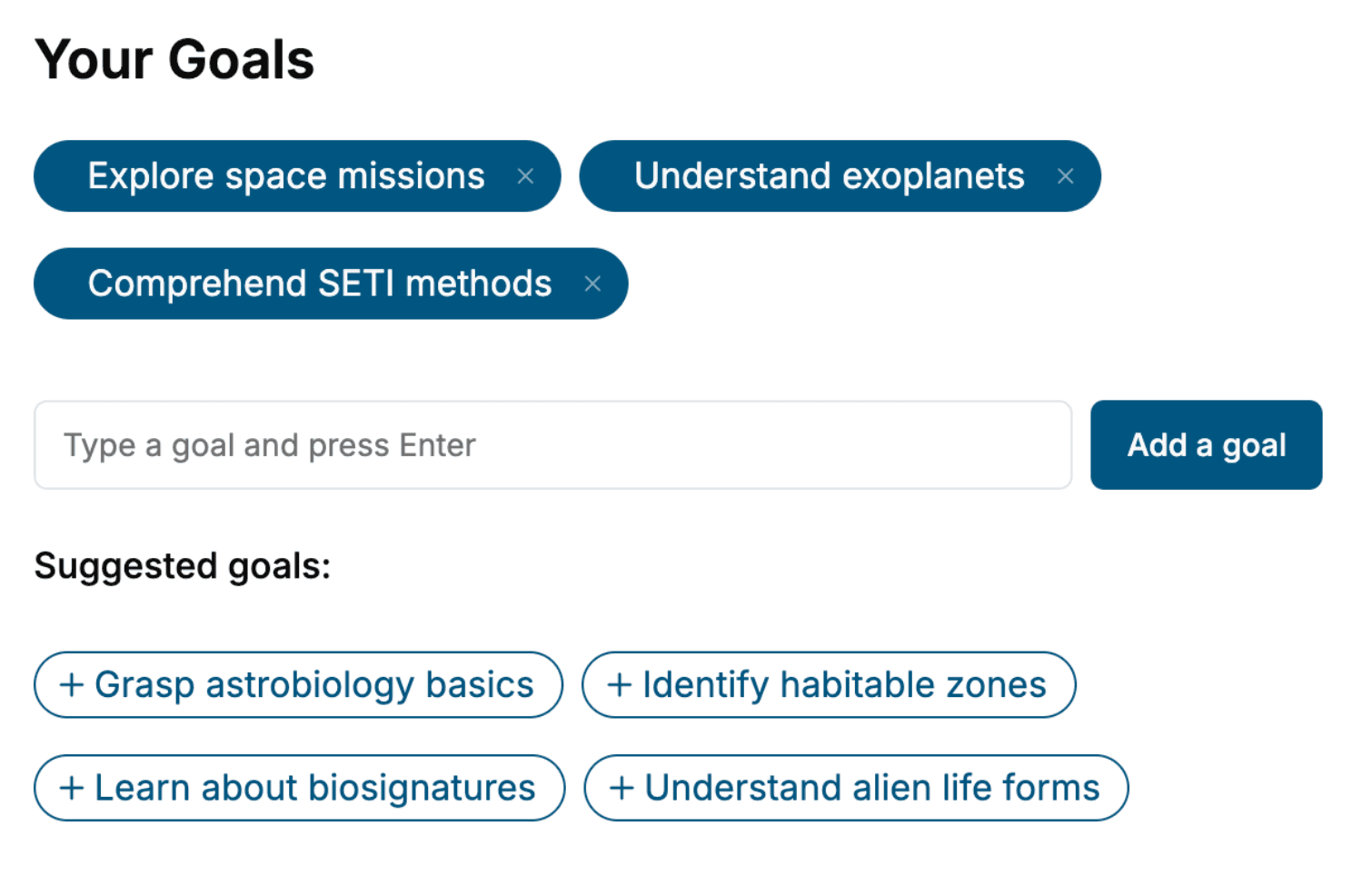
Tell us your goals and background, and get your own version of this book, tailored by AI to you.


Benefits of AI-tailored books
- Read one book, not ten:
- all the Neural Networks knowledge you need, gathered into a single book.
- Save days of learning:
- tell us your goals, choose your topics, and the whole book is built around them.
- Learn effortlessly:
- Neural Networks book written for your specific background and expertise.
- Understand at a glance:
- includes charts, tables, timelines, checklists, decision trees, and more.
- Stay current:
- written the day you order it, not years ago.
- Trust what you read:
- every book is checked for accuracy, with real research when your subject needs it.
Create your unique book in 3 steps
- 1. Select your focus
Select the focus of your Neural Networks book and share your background
- 2. Personalize your book
Specify your goals and choose sub-topics to include
- 3. Get your tailored book
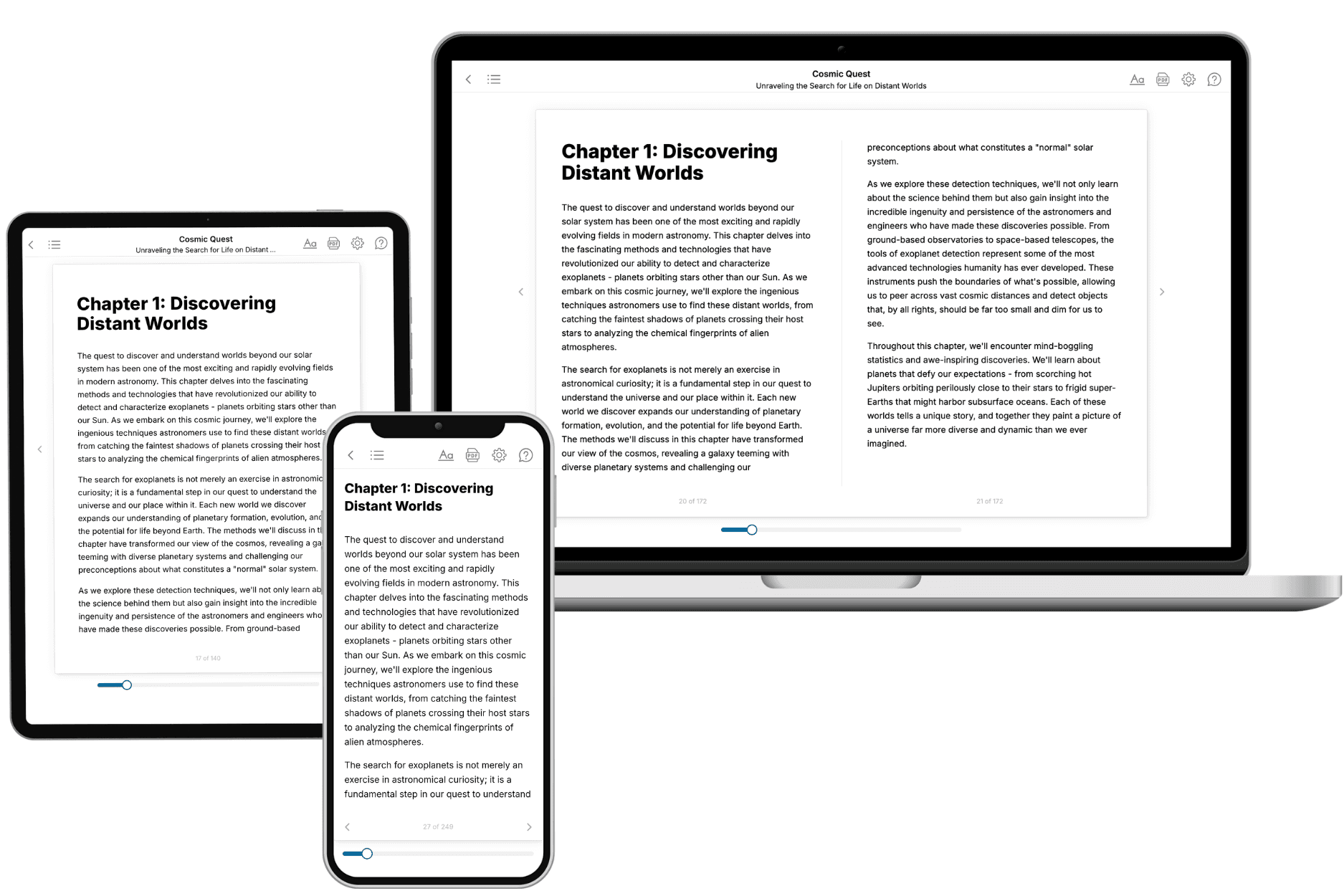
Your book is ready in 10 minutes. Read it online, download as EPUB or PDF, or send to Kindle.

Frequently asked questions
- What is TailoredRead?
TailoredRead creates complete, full-length nonfiction ebooks, written specifically for you. Tell us what you want to learn and why, and TailoredRead writes you a complete ebook on it, with charts, tables, and diagrams throughout. Read it online, on Kindle, or on any e-reader, or download it as a PDF or EPUB. Every book is written fresh the day you order it.
- How is the book tailored to me?
Before anything is written, you answer a few short questions about your goals, your background, and the topics you care about. Your book is then planned around your answers: written at your level, focused on your goals, and covering the topics you chose, instead of the one-size-fits-all book a store sells everyone.
- Will it read like generic AI content?
No. Your book isn't a chat transcript: it's planned chapter by chapter before a single word is written, told in a clear book voice, and explains ideas visually with charts, tables, and diagrams. After writing, every book goes through an editorial pass that polishes chapters so the book reads consistent from start to finish. Judge for yourself: browse thousands of sample books on our Explore Books page.
- How accurate is the content?
Our AI first checks whether your subject needs live research. Niche and fast-moving subjects are researched before writing, and the book plan and chapters are grounded in what it finds. After writing, every book goes through a quality pass that checks its facts and consistency, and researched books list their sources in a Notes section at the back.
- How long is the book?
You choose the length: Comprehensive (250-300 pages), Detailed (150-200 pages), Essential (70-100 pages), or Short (30-50 pages).
- Does the book include visuals?
Yes. Every book includes charts, tables, and diagrams: timelines, checklists, step-by-step guides, decision trees, comparison tables, matrices, and bar charts. A typical book includes dozens of these visual elements.
- Can I read it on Kindle? What formats can I download?
Yes. Every book can be read in our online reader or downloaded as a PDF or EPUB. The EPUB can be opened with Kindle, Apple Books, Kobo, and any e-reader. The Commercial and Author licenses also include an editable Word (DOCX) and Markdown download.
- How much does it cost?
About the price of a regular ebook. The exact price depends on your book's length and complexity, from $2 for the shortest books to $35 for the most comprehensive, and it's shown when you review your book, before you commit to anything. Each book is a one-time purchase, yours to keep, no subscription. Licenses that let you share, teach, or publish your book range from $35.99 to $49.99.
- Can I preview the book before purchasing?
Before you pay, you'll see what your book will cover: the title, a detailed description, the estimated length, and the complete chapter-by-chapter table of contents, so you know what you're getting before you decide. The full text itself is written after you purchase.
- How long does it take to create a book?
About 10 minutes. You can start reading the opening chapters while the rest is still being written.