The Neuroscience of Emotional Narrative
Master Your Brain's Story to Lead, Heal, and Influence with Emotional Intelligence
Discover how to harness your brain's emotional architecture to craft narratives that inspire, heal, and transform.
222 pages10 chaptersJun 23, 2026NeuroscienceCreated by Dr. Ari
About this book
This practical guide bridges neuroscience and storytelling, showing you exactly how your limbic system processes narrative and why traditional logic-based communication often fails. You'll learn to construct emotional arcs that regulate your nervous system, prevent amygdala hijacking, and activate neuroplasticity for lasting change. Whether you're building a company, coaching clients, or leading teams through uncertainty, this book provides step-by-step frameworks to sequence stories that leverage dopamine, oxytocin, and vagal tone regulation. Master the neuroscience of emotional narrative and develop the evidence-based storytelling skills that separate exceptional leaders and clinicians from the rest. Build emotional intelligence, strengthen resilience, and learn to influence through the language your brain actually understands.
Table of contents
- IntroductionWhy Your Brain Processes Story Before Logic, How to Use This Book for Maximum Integration, The Three Pillars: Brain, Story, and TransformationRead below
- Module 1: The Emotional Brain ArchitectureMapping Your Limbic System: The Narrative Processing Center, Understanding Amygdala Function and Emotional Memory, The Prefrontal Cortex: Your Narrative Leadership Center, Integrating Your Three-Brain System for Coherent Storytelling
- Module 2: Neurotransmitters and Story SequencingCrafting Dopamine-Driven Stories That Motivate Action, Building Oxytocin-Activated Social Connection Through Narrative, Sequencing Stories for Serotonin and Emotional Stability, Balancing Neurotransmitter Activation in Your Narrative Arc
- Module 3: Emotional Granularity and IntelligenceDeveloping Emotional Granularity: Beyond Happy and Sad, Measuring Emotional Intelligence Through Narrative Awareness, Building Emotional Regulation Pathways Through Story
- Module 4: Preventing Amygdala HijackingRecognizing When Your Amygdala Takes Control, Using Narrative Reframing to Regain Prefrontal Control, Activating Vagal Tone Regulation for Nervous System Calm, Designing Stress Response Arcs That Prevent Overwhelm
- Module 5: Emotional Memory and ConsolidationHow Emotional Narratives Create Lasting Memory Consolidation, Integrating Difficult Memories Through Clinical Storytelling, Rewiring Neural Pathways With Intentional Narrative Practice
- Module 6: Building Narrative Identity and Founder MindsetCrafting Your Narrative Identity: The Stories You Tell About Yourself, Developing a Founder Mindset Through Resilience Narratives, Rewiring Limiting Beliefs Through Narrative Reconstruction, Integrating Your Evolving Identity Across Life Domains
- Module 7: Cortisol Recovery and Stress NarrativesUnderstanding Cortisol Cycles and Stress Response Narratives, Sequencing Stories for Cortisol Recovery and Nervous System Reset, Preventing Burnout Through Narrative-Based Stress Management
- Module 8: Narrative Persuasion and InfluenceThe Neuroscience of Narrative Persuasion: How Stories Change Minds, Scaffolding Emotional Arcs for Maximum Influence and Engagement, Ethical Storytelling: Influence Without Manipulation
- Module 9: Habit Formation Through Story-Based SequencingHow Stories Activate Reward Pathways and Habit Formation, Creating Emotional Anchors That Sustain Behavioral Change, Building Habit-Supporting Narratives Into Your Daily Practice, Integrating Multiple Habits Through Coherent Story Sequences
- Module 10: Neuroscience-Based Coaching and Clinical ApplicationApplying Neuroscience Frameworks to Coaching Conversations, Clinical Storytelling Techniques for Therapeutic Transformation, Guiding Clients Through Narrative Reconstruction and Healing
- ConclusionIntegrating Neuroscience Into Your Daily Practice, Your Ongoing Journey in Narrative Neuroscience
- Glossary
- Further Reading and Resources
Introduction
There is a moment most leaders and clinicians recognize, even if they have never named it. You have the data. You have the logic. You have a perfectly structured argument. And yet the room stays cold, the client stays stuck, or the team stays unmoved. Something is missing, and it is not more information. What is missing is the language your brain actually speaks first: emotional narrative. This book exists to close that gap, giving you a neuroscience-backed framework for constructing stories that your brain, and the brains of everyone around you, is already wired to receive.
The science here is not metaphor. Research in affective neuroscience consistently shows that the brain's emotional processing systems activate before conscious reasoning engages.[1] When you hear a story, your limbic system begins tagging it for relevance, threat, or reward before your prefrontal cortex has had a chance to evaluate its logic. This means that how you sequence emotional information is not a soft skill layered on top of real expertise. It is a core mechanism of how human minds change, connect, and act. Understanding that mechanism gives you a genuine advantage, whether you are building a company, coaching a client through a difficult transition, or leading a team through uncertainty.
This book is designed for people who already have some grounding in neuroscience and want to go further. If you are an entrepreneur, founder, creative, clinician, or coach with an intermediate understanding of how the brain works, you are in exactly the right place. The goal is not to teach you neuroscience from scratch. The goal is to show you how the brain's emotional architecture connects directly to the stories you tell, the narratives you construct for yourself, and the way you guide others through change. Every chapter builds on that connection with practical frameworks, concrete examples, and actionable steps you can apply immediately.
Module Outcomes: By the time you finish this introduction, you will have a clear foundation for everything that follows. Specifically, you will:
- Understand why the brain processes narrative before logic, and why that matters for leadership and clinical practice
- Know how to use this book for maximum integration across your professional and personal contexts
- Grasp the three core pillars that structure the entire book: Brain, Story, and Transformation
- Have a mental map of how the chapters connect and build on each other
- Be ready to engage with the neuroscience frameworks in a way that is practical, not just theoretical
When to use this module: Return to this introduction whenever you feel lost in the details of a later chapter, or when you want to reconnect with the core purpose of the work. It also serves as a useful orientation tool if you are sharing this material with a colleague or client who is new to the framework. The introduction is the anchor point for everything else.
Why Your Brain Processes Story Before Logic
Lesson Outcomes: After this lesson, you will be able to:
- Explain the neurological basis for why story activates the brain before logical argument does
- Identify the key brain structures involved in emotional narrative processing
- Describe what "neural coupling" means and why it matters for communication
- Recognize the practical implications of this science for leadership and clinical work
Start with a simple thought experiment. Think about the last time a statistic genuinely changed how you felt about something. Now think about the last time a story did. For most people, the story wins easily. This is not a failure of rationality. It is a feature of how the human brain evolved. The structures responsible for emotional processing, particularly the amygdala and the broader limbic system, developed hundreds of thousands of years before the prefrontal cortex reached its current complexity. Narrative is the older language, and the brain still treats it as primary.
Neuroscientist Uri Hasson at Princeton demonstrated something remarkable in a series of studies on what he called neural coupling. When a speaker tells a story, the listener's brain activity begins to mirror the speaker's brain activity, particularly in regions associated with emotion, memory, and social cognition.[2] This synchronization does not happen to the same degree when someone presents bullet points or data tables. Story creates a shared neurological experience. That is not a metaphor. It is a measurable biological event.
The amygdala plays a central role in this process. Often described as the brain's threat-detection system, the amygdala is more accurately understood as an emotional relevance detector. It flags incoming information as significant based on emotional content, not logical structure. A story with tension, vulnerability, or stakes activates the amygdala quickly. That activation drives attention, memory encoding, and the release of neurochemicals like cortisol and oxytocin that shape how the experience is stored and recalled. Logic, by contrast, tends to engage the prefrontal cortex in a more deliberate, slower process that requires the emotional system to already be on board.
This has direct consequences for anyone trying to lead, persuade, or support change in others. Consider two approaches a founder might take when pitching to investors. The first approach opens with market size data, competitive analysis, and projected revenue. The second opens with a specific moment: a customer who couldn't afford a medication, a team that worked through the night to solve a problem, a failure that revealed the real opportunity. Research on investor decision-making suggests that emotional engagement in the early moments of a pitch significantly influences how subsequent data is interpreted.[3] The story primes the brain to receive the logic favorably.
The same dynamic plays out in clinical settings. A therapist who opens a session by asking a client to describe a specific moment, rather than a general pattern, activates different neural circuits than one who begins with psychoeducation. Specific, sensory-rich narrative engages the hippocampus (involved in memory and context) and the insula (involved in interoception and emotional awareness) in ways that abstract discussion does not. This is why narrative-based therapeutic approaches, from narrative therapy to EMDR's use of memory sequencing, tend to produce deeper emotional processing than purely cognitive interventions alone.
Understanding this is not about abandoning logic or data. It is about sequencing them correctly. The brain needs emotional engagement first, then it is ready to integrate information. Think of emotional narrative as the key that unlocks the door. Logic is what you bring through once the door is open. The chapters ahead will show you exactly how to construct that key for different contexts, audiences, and goals.
Practical Example: A clinical coach working with a burned-out executive stopped opening sessions with cognitive reframing exercises and instead began each session by asking the client to describe one specific moment from the past week when they felt most like themselves. Within three sessions, the client reported feeling more understood and more willing to engage with the harder cognitive work. The narrative opening created the emotional safety that made the logic land.
Practice Tasks:
- Think of a recent presentation, conversation, or session where you led with data or logic. Write a one-paragraph version that opens with a specific story or moment instead. Notice what changes.
- For one week, pay attention to the moments when you feel genuinely moved or persuaded by something you read, hear, or watch. Note whether it was a story or a statistic that created that response.
- Identify one recurring communication challenge in your work (a pitch, a difficult conversation, a client who stays stuck). Write down the emotional experience you want the other person to have first, before you think about the information you want to convey.
Key Takeaways:
- The brain's emotional processing systems activate before conscious reasoning, making narrative the brain's primary language
- Neural coupling research shows that story creates measurable brain synchronization between speaker and listener
- The amygdala functions as an emotional relevance detector, not just a threat system, and it responds strongly to narrative tension and stakes
- Emotional engagement primes the brain to receive and integrate logical information more effectively
- Both leadership and clinical contexts benefit from leading with story before introducing data or frameworks
- Narrative is not a soft skill layered on top of expertise; it is a core mechanism of how minds change
How to Use This Book for Maximum Integration
Lesson Outcomes: After this lesson, you will be able to:
- Navigate the book's structure in a way that matches your current professional context
- Apply a deliberate reading and reflection strategy that supports deeper integration
- Identify which chapters are most immediately relevant to your specific role and goals
- Set up a simple practice system for applying the frameworks as you read
Most books on neuroscience or communication are read once and then shelved. The frameworks feel compelling in the moment, but without a deliberate integration strategy, they rarely change how you actually work. This book is designed differently. Each chapter builds on the previous one, but it is also structured so that you can move between chapters based on your most pressing professional need. The key is knowing how to use it, not just how to read it.
The book follows a logical arc that mirrors the brain's own processing sequence. It begins with architecture (how the emotional brain is structured), moves through chemistry (how neurotransmitters shape narrative experience), then into regulation (how to manage stress responses and prevent hijacking), and finally into application (coaching, clinical work, habit formation, and influence). If you read it straight through, you will build a layered understanding where each concept reinforces the next. That is the recommended approach for a first read.
However, if you are a clinician dealing with a specific client challenge right now, you might go directly to Chapter 5 on emotional memory consolidation or Chapter 10 on clinical storytelling techniques. If you are a founder preparing for a high-stakes pitch or a difficult board conversation, Chapter 8 on narrative persuasion and Chapter 2 on neurotransmitter sequencing will be immediately useful. The table of contents is designed to function as a diagnostic tool. Ask yourself what problem you are trying to solve, then find the chapter that addresses it most directly.
Regardless of where you start, use this three-step integration practice with each chapter:
- Read actively. Keep a notebook or digital document open. After each major section, write one sentence summarizing the core idea and one sentence describing how it applies to your current work.
- Apply immediately. Each chapter ends with practice tasks. Do at least one before moving to the next chapter. The neuroscience of learning is clear: application within 24 hours of exposure dramatically increases retention and skill transfer.[4]
- Revisit with context. After two or three weeks of applying a framework in real situations, return to the chapter. You will read it differently. The concepts will have more texture because you will have lived them.
One of the most common mistakes readers make with books like this is treating the frameworks as things to understand rather than things to practice. Understanding the neuroscience of oxytocin is interesting. Actually sequencing a story to activate social bonding in a coaching session is transformative. The gap between those two outcomes is practice. Every framework in this book has been designed with that gap in mind. The practice tasks are not optional extras. They are the mechanism of change.
It also helps to identify your primary context before you begin. Are you primarily a leader trying to communicate more effectively with your team? A coach helping clients build resilience? A clinician working with clients who have experienced trauma? A founder trying to build a compelling brand narrative? Your context will shape which examples resonate most and which frameworks you will reach for first. None of these roles are mutually exclusive, and many readers will find themselves moving between them. But having a primary lens helps you stay grounded as the material gets more complex.
Suggested Reading Paths:
For founders and leaders: Introduction → Chapter 1 → Chapter 2 → Chapter 6 → Chapter 8 → Chapter 9
For coaches and clinicians: Introduction → Chapter 1 → Chapter 3 → Chapter 5 → Chapter 10 → Chapter 4
For stress and resilience focus: Introduction → Chapter 4 → Chapter 7 → Chapter 3 → Chapter 5 → Chapter 6
For complete integration: Read all chapters in order, then revisit your primary path
Finally, consider sharing this material with a colleague, peer, or client as you work through it. The neural coupling research mentioned in the previous lesson applies here too. Discussing these frameworks with another person, explaining them out loud, and applying them in conversation accelerates integration far more than solo reading alone. If you have a coaching peer, a clinical supervisor, or a co-founder you trust, invite them into the conversation. The book becomes more useful when it is used relationally.
Practice Tasks:
- Write down your primary professional context (leader, coach, clinician, founder, or a combination). Then identify the three chapters that feel most immediately relevant to a challenge you are currently facing.
- Set up a simple integration notebook, either physical or digital. Create a two-column format: "Core Idea" on the left, "How I'll Apply This" on the right. Use it for every chapter.
- Identify one person in your professional life with whom you could discuss this material as you read. Reach out to them before you finish this introduction and let them know you want to share some frameworks over the coming weeks.
- Schedule 15 minutes after each reading session to complete at least one practice task. Block it in your calendar now, before you move to the next chapter.
Key Takeaways:
- The book follows a logical arc from brain architecture through chemistry, regulation, and application, and is best read in order for a first pass
- Suggested reading paths allow you to navigate directly to the most relevant chapters for your specific professional context
- A three-step integration practice (active reading, immediate application, contextual revisiting) dramatically increases how much of the material you actually use
- Practice tasks are not optional; they are the mechanism through which understanding becomes skill
- Application within 24 hours of reading significantly improves long-term retention and transfer
- Discussing the material with a colleague or peer accelerates integration through the same neural coupling mechanisms described in the science
The Three Pillars: Brain, Story, and Transformation
Lesson Outcomes: After this lesson, you will be able to:
- Describe the three core pillars that structure the entire book and how they relate to each other
- Explain why all three pillars are necessary and what happens when one is missing
- Connect the three pillars to your own professional goals and practice
- Use the three-pillar framework as a diagnostic tool for evaluating your current communication and narrative practices
Every framework needs a spine. Without one, even the best ideas become a collection of interesting but disconnected concepts. The spine of this book is built from three pillars: Brain, Story, and Transformation. These are not just organizing categories. They represent three distinct but deeply interconnected domains of knowledge and practice. Understanding how they relate to each other is the foundation for everything that follows.
The first pillar is Brain. This refers to the neuroscience that underlies everything in this book. It includes the architecture of the emotional brain (the limbic system, amygdala, and prefrontal cortex), the chemistry of emotional experience (dopamine, oxytocin, serotonin, and cortisol), and the mechanisms of neuroplasticity that make lasting change possible. Without this pillar, the storytelling techniques in this book would be just techniques, useful perhaps, but without the explanatory power that makes them genuinely transferable across contexts. When you understand why something works at the level of neural circuitry, you can adapt it intelligently rather than just following a script.
The second pillar is Story. This refers to the structure, sequencing, and craft of emotional narrative. It is not about becoming a novelist or a performer. It is about understanding how narrative arcs, emotional pacing, tension and resolution, and character perspective activate specific brain states in yourself and others. Story is the delivery mechanism for everything the Brain pillar explains. A leader who understands the neuroscience of oxytocin but does not know how to construct a moment of genuine vulnerability in a team meeting cannot activate that chemistry. Story is how the science becomes practice.
The third pillar is Transformation. This is the outcome that the first two pillars make possible. Transformation here means lasting behavioral and psychological change, in yourself, in your clients, and in the people you lead. It is grounded in the neuroscience of neuroplasticity, habit formation, and emotional memory consolidation. Transformation is what separates a compelling story from a meaningful one. Many stories are engaging. Fewer actually change how someone thinks, feels, or acts over time. The Transformation pillar is about understanding the conditions under which narrative creates durable change, and designing your stories and conversations to meet those conditions.
The three pillars interact in a specific sequence that mirrors the brain's own processing:
- Brain sets the conditions. Understanding the neural architecture tells you what the brain needs in order to be open to change.
- Story meets those conditions. A well-constructed emotional narrative activates the right brain states at the right moments.
- Transformation consolidates the change. Repeated narrative practice, combined with emotional memory consolidation, rewires the neural pathways that drive behavior.
What happens when one pillar is missing? Consider a clinician who has deep knowledge of neuroscience (Brain) and a genuine commitment to client transformation (Transformation) but has not developed skill in narrative construction (Story). Their sessions may be intellectually rich but emotionally flat. Clients understand what is happening but do not feel it, and without emotional engagement, the memory consolidation that drives lasting change is incomplete. Now consider a founder who is a gifted storyteller (Story) and deeply motivated to build something meaningful (Transformation) but has no framework for understanding how their communication affects the nervous systems of their team (Brain). They may inspire in the short term but burn people out over time because they do not know how to sequence activation and recovery in their narrative arc.
Each chapter in this book addresses at least one of the three pillars, and most address the intersections between them. Chapters 1 through 3 are primarily Brain-focused, building the neurological foundation. Chapters 4 through 6 move into the intersection of Brain and Story, showing how narrative structure maps onto neural regulation. Chapters 7 through 9 focus on Story and Transformation, applying the frameworks to stress management, persuasion, and habit formation. Chapter 10 brings all three pillars together in the context of coaching and clinical practice.
Self-Diagnostic Exercise: Rate yourself honestly on each pillar from 1 (underdeveloped) to 5 (strong). Where is your lowest score? That is your highest-leverage area for growth. Most leaders and clinicians are strong in one or two pillars and underdeveloped in the third. Knowing your gap before you begin reading helps you engage with the material more intentionally.
The three-pillar framework also functions as a diagnostic tool you can use in real time. When a conversation is not landing, ask yourself which pillar is missing. Is the other person's brain not in a state to receive what you are offering (Brain)? Is your narrative structure not creating the emotional engagement needed (Story)? Is the change you are working toward not connected to a meaningful emotional anchor that will sustain it over time (Transformation)? These questions will become second nature as you work through the book. By the end, you will be able to diagnose and adjust in the moment, which is the mark of genuine mastery.
It is worth naming something directly before you move into the chapters. This material asks something of you beyond intellectual engagement. It asks you to examine the stories you tell about yourself, your work, and the people you serve. Some of those stories will be empowering. Others may be limiting in ways you have not fully recognized. The neuroscience of narrative identity, covered in Chapter 6, makes clear that the stories you tell about yourself are not just descriptions of who you are. They are active forces shaping your neural architecture and your capacity for leadership and connection. Engaging with this book fully means being willing to look at those stories honestly and, where necessary, to rewrite them.
Practice Tasks:
- Complete the self-diagnostic exercise above. Write a short paragraph for each pillar describing your current strengths and gaps. Be specific: give an example of a recent situation where each pillar was either working well or falling short.
- Think of a transformation you are currently trying to create, either in yourself, a client, or your team. Map it onto the three pillars: What does the Brain need? What Story would meet that need? What conditions would support lasting Transformation?
- Write down one story you tell about yourself regularly, either to others or internally. It might be about how you handle pressure, why you do the work you do, or what kind of leader or clinician you are. Hold that story lightly as you read. Notice how the frameworks in the coming chapters might invite you to examine or evolve it.
Key Takeaways:
- The three pillars of this book are Brain (neuroscience), Story (narrative craft), and Transformation (lasting change), and all three are necessary for the frameworks to work
- The pillars interact in sequence: Brain sets the conditions, Story meets them, and Transformation consolidates the change
- Missing any one pillar creates predictable gaps in leadership, coaching, or clinical effectiveness
- The three-pillar framework functions as a real-time diagnostic tool for evaluating why a conversation, session, or narrative is or is not working
- The book's chapter structure maps deliberately onto the three pillars, building from neuroscience through narrative craft to applied transformation
- Engaging fully with this material requires examining the stories you tell about yourself, not just the stories you tell to others
- Your lowest-scoring pillar in the self-diagnostic is your highest-leverage area for growth
Notes
Introduction
- 1. J. E. LeDoux, The Emotional Brain, Simon & Schuster, 1996
- 2. U. Hasson and others, "Brain-to-brain coupling," Trends in Cognitive Sciences, 2012
- 3. M. S. Cardon and others, "Motivational cues and angel investing," Entrepreneurship Theory and Practice, 2017
- 4. H. L. Roediger and A. C. Butler, "The critical role of retrieval practice in long-term retention," Trends in Cognitive Sciences, 2011
This is the end of the free sample. The full book has 10 chapters.
Want this book written for you?
Tell us your goals and background, and get your own version of this book, tailored by AI to you.


Benefits of AI-tailored books
- Read one book, not ten:
- all the Neuroscience knowledge you need, gathered into a single book.
- Save days of learning:
- tell us your goals, choose your topics, and the whole book is built around them.
- Learn effortlessly:
- Neuroscience book written for your specific background and expertise.
- Understand at a glance:
- includes charts, tables, timelines, checklists, decision trees, and more.
- Stay current:
- written the day you order it, not years ago.
- Trust what you read:
- every book is checked for accuracy, with real research when your subject needs it.
Create your unique book in 3 steps
- 1. Select your focus
Select the focus of your Neuroscience book and share your background
- 2. Personalize your book
Specify your goals and choose sub-topics to include
- 3. Get your tailored book
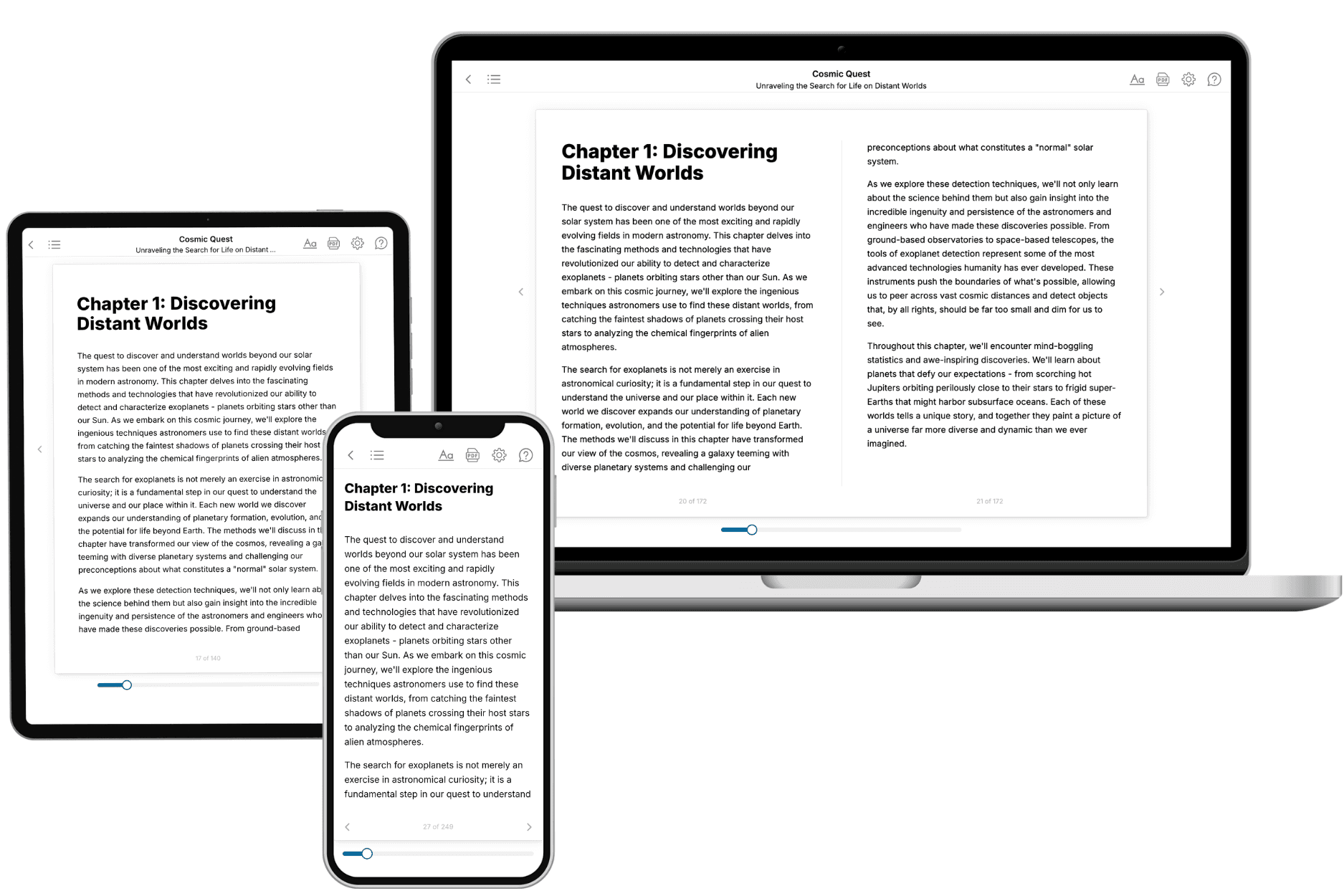
Your book is ready in 10 minutes. Read it online, download as EPUB or PDF, or send to Kindle.

Frequently asked questions
- What is TailoredRead?
TailoredRead creates complete, full-length nonfiction ebooks, written specifically for you. Tell us what you want to learn and why, and TailoredRead writes you a complete ebook on it, with charts, tables, and diagrams throughout. Read it online, on Kindle, or on any e-reader, or download it as a PDF or EPUB. Every book is written fresh the day you order it.
- How is the book tailored to me?
Before anything is written, you answer a few short questions about your goals, your background, and the topics you care about. Your book is then planned around your answers: written at your level, focused on your goals, and covering the topics you chose, instead of the one-size-fits-all book a store sells everyone.
- Will it read like generic AI content?
No. Your book isn't a chat transcript: it's planned chapter by chapter before a single word is written, told in a clear book voice, and explains ideas visually with charts, tables, and diagrams. After writing, every book goes through an editorial pass that polishes chapters so the book reads consistent from start to finish. Judge for yourself: browse thousands of sample books on our Explore Books page.
- How accurate is the content?
Our AI first checks whether your subject needs live research. Niche and fast-moving subjects are researched before writing, and the book plan and chapters are grounded in what it finds. After writing, every book goes through a quality pass that checks its facts and consistency, and researched books list their sources in a Notes section at the back.
- How long is the book?
You choose the length: Comprehensive (250-300 pages), Detailed (150-200 pages), Essential (70-100 pages), or Short (30-50 pages).
- Does the book include visuals?
Yes. Every book includes visual elements such as timelines, checklists, step-by-step guides, decision trees, comparison tables, and matrices, and many include bar charts. A typical book includes dozens of these visual elements.
- Can I read it on Kindle? What formats can I download?
Yes. Every book can be read in our online reader or downloaded as a PDF or EPUB. The EPUB can be opened with Kindle, Apple Books, Kobo, and any e-reader. The Commercial and Author licenses also include an editable Word (DOCX) and Markdown download.
- How much does it cost?
About the price of a regular ebook. The exact price depends on your book's length and complexity, from $2 for the shortest books to $35 for the most comprehensive, and it's shown when you review your book, before you commit to anything. Each book is a one-time purchase, yours to keep, no subscription. Licenses that let you share, teach, or publish your book range from $35.99 to $49.99.
- Can I preview the book before purchasing?
Before you pay, you'll see what your book will cover: the title, a detailed description, the estimated length, and the complete chapter-by-chapter table of contents, so you know what you're getting before you decide. The full text itself is written after you purchase.
- How long does it take to create a book?
About 10 minutes. You can start reading the opening chapters while the rest is still being written.