Operational Risk Mastery
Building Resilient Operations Through Systematic Risk Management
Many operations professionals believe that operational risks are unpredictable events that strike without warning, leaving teams scrambling to respond after damage is already done.
284 pages16 chaptersEnglishSep 30, 2025Risk Management
About this book
This reactive mindset keeps organizations vulnerable to preventable disruptions that could have been identified and mitigated through systematic approaches. This comprehensive guide transforms how you think about and manage operational risks in manufacturing and operations environments. You'll discover proven frameworks for identifying hidden vulnerabilities in your processes, assessing their potential impact, and implementing targeted mitigation strategies that build resilience into your operations from the ground up. Through practical methodologies and real-world applications, you'll learn to create robust monitoring systems, develop effective contingency plans, and foster a culture where risk awareness becomes part of daily operations. The book covers everything from supply chain vulnerabilities and equipment reliability to human factors and technology risks, providing you with a complete toolkit for operational excellence. Whether you're managing a production facility, overseeing complex operations, or leading operational improvement initiatives, this book equips you with the knowledge and tools to anticipate challenges, prevent disruptions, and maintain consistent operational performance even in uncertain environments.
Table of contents
- IntroductionThe Reality of Operational Risk, Shifting from Reactive to Proactive, The Systematic Approach Framework, How to Use This BookRead below
- Chapter 1: Foundations of Operational Risk ManagementDefining Operational Risk in Context, Categories and Types of Operational Risks, Understanding the True Cost of Risk, Core Principles of Risk Prevention
- Chapter 2: Risk Identification Methods and TechniquesSystematic Process Observation, Gathering Input from All Stakeholders, Learning from Historical Data, Scenario-Based Risk Discovery
- Chapter 3: Risk Assessment and Prioritization FrameworksProbability and Impact Analysis, Quantitative Assessment Methods, Qualitative Risk Evaluation, Risk Prioritization Matrices
- Chapter 4: Process-Related Risk ManagementIdentifying Workflow Vulnerabilities, Managing Bottleneck and Capacity Risks, Quality Control Risk Mitigation, Standardization as Risk Reduction
- Chapter 5: Equipment and Technology Risk ManagementEquipment Reliability and Maintenance, Managing Technology Dependencies, System Integration Risks, Backup Systems and Redundancy Planning
- Chapter 6: Human Factors and Organizational RisksSkill Gaps and Competency Risks, Communication Breakdown Prevention, Training and Development Programs, Cultural Factors in Risk Management
- Chapter 7: Supply Chain and External Risk ManagementSupplier Risk Assessment, Supply Chain Dependency Mapping, Alternative Sourcing Strategies, Managing External Disruption Risks
- Chapter 8: Environmental and Facility Risk ManagementFacility Condition Assessment, Environmental Hazard Management, Workspace Design for Risk Reduction, Emergency Preparedness Planning
- Chapter 9: Data and Information Risk ManagementEnsuring Data Integrity, Information Flow Risk Assessment, Documentation and Version Control, Knowledge Retention Strategies
- Chapter 10: Risk Mitigation Strategies and ImplementationPrevention-Focused Strategies, Risk Mitigation Techniques, Contingency Planning Methods, Implementation Roadmap Development
- Chapter 11: Monitoring and Early Warning SystemsKey Risk Indicators Development, Monitoring Tools and Technologies, Alert and Notification Systems, Dashboard and Reporting Design
- Chapter 12: Incident Response and Recovery PlanningIncident Response Protocols, Escalation Procedures, Recovery and Restoration Strategies, Business Continuity Planning
- Chapter 13: Continuous Improvement and LearningRisk Management Performance Metrics, Capturing and Applying Lessons Learned, Evolving Your Risk Management Program, Innovation and Adaptation Strategies
- Chapter 14: Integration and Culture DevelopmentIntegrating Risk Management into Daily Operations, Building a Risk-Aware Culture, Leadership Engagement and Support, Sustaining Risk Management Practices
- Chapter 15: Advanced Risk Management TechniquesPredictive Analytics for Risk Management, Simulation and Modeling Techniques, Cross-Functional Risk Integration, Leveraging Emerging Technologies
- Chapter 16: Practical Implementation GuideGetting Started: First Steps, Resource Planning and Allocation, Timeline and Milestone Development, Measuring Implementation Success
- ConclusionKey Takeaways and Action Items, Your Next Steps Forward
Introduction
Operations professionals face a stark reality every day: the difference between smooth operations and costly disruptions often comes down to risks that were either identified and managed proactively, or overlooked until they became expensive problems. In manufacturing facilities, distribution centers, and complex operational environments worldwide, the same pattern repeats itself. Teams work diligently to meet production targets and maintain quality standards, yet unexpected equipment failures, supply chain disruptions, process breakdowns, and human errors continue to derail even the most well-intentioned operational plans. The traditional approach of responding to problems after they occur has proven insufficient in today's interconnected and fast-paced operational landscape.
The challenge isn't that operational risks are inherently unpredictable or unmanageable. Rather, most organizations lack systematic approaches for identifying, assessing, and mitigating these risks before they manifest as operational disruptions. Many operations teams operate under the assumption that certain failures are simply part of doing business
and focus their energy on becoming better at crisis response rather than prevention. This reactive mindset creates a cycle where teams become skilled at firefighting but never address the underlying conditions that create fires in the first place. The result is higher costs, increased stress, reduced efficiency, and missed opportunities for operational excellence.
This book presents a fundamentally different approach to operational risk management. Instead of waiting for problems to occur and then scrambling to respond, you'll learn to systematically identify potential risks embedded within your operational processes, assess their likelihood and potential impact, and implement targeted strategies that prevent disruptions before they happen. The methodologies presented here have been developed through extensive analysis of operational environments across various industries, combined with proven risk management principles adapted specifically for operations professionals. You'll discover that operational risks, while complex, follow predictable patterns and can be managed through structured approaches that integrate seamlessly with existing operational practices.
The Reality of Operational Risk
Operational risks exist in every aspect of your operations, often hiding in plain sight within processes that appear to function normally. These risks manifest in multiple forms: equipment that operates within acceptable parameters but shows subtle signs of impending failure, supply chain relationships that seem stable but lack adequate backup options, processes that work well under normal conditions but become vulnerable during peak demand periods, and human factors that create single points of failure when key personnel are unavailable. The interconnected nature of modern operations means that a risk in one area can quickly cascade into problems across multiple operational domains.
Consider the case of a mid-sized manufacturing facility that experienced a three-day production shutdown due to what initially appeared to be a simple conveyor belt failure. Investigation revealed that the failure occurred because maintenance schedules were based on manufacturer recommendations rather than actual usage patterns, the backup conveyor system had been cannibalized for parts months earlier, the supplier for replacement parts had recently changed their delivery schedule without notification, and the maintenance team lacked cross-training to handle this specific type of repair. What seemed like a single equipment failure was actually the convergence of multiple operational risks that had been developing over months.
The financial impact of operational risks extends far beyond the immediate costs of repairs or replacements. Production delays create ripple effects through customer relationships, inventory management, and revenue streams. Quality issues resulting from rushed recovery efforts can damage brand reputation and customer trust. Employee morale suffers when teams repeatedly face crisis situations that could have been prevented. Regulatory compliance issues may arise when standard procedures are bypassed during emergency responses. The true cost of operational risks includes these indirect impacts, which often exceed the direct costs by significant margins.
Traditional risk management approaches often fail in operational environments because they focus on high-level strategic risks rather than the day-to-day operational vulnerabilities that actually cause most disruptions. Many organizations have comprehensive enterprise risk management programs that address market risks, regulatory changes, and competitive threats, but lack systematic approaches for managing the operational risks that affect daily performance. This gap exists because operational risks are often viewed as tactical issues rather than strategic concerns, despite their significant impact on organizational performance and profitability.
The complexity of operational risks increases with the sophistication of operational systems. Modern operations involve intricate relationships between people, processes, technology, suppliers, and environmental factors. Changes in one element can create unexpected vulnerabilities in others. For example, implementing new technology to improve efficiency might reduce certain process risks while creating new dependencies on technical support, software updates, and specialized skills. Understanding these interconnections is essential for effective risk management in operational environments.
Data from operational environments reveals patterns that many organizations fail to recognize. Equipment failures often follow predictable patterns based on usage cycles, environmental conditions, and maintenance practices. Supply chain disruptions frequently result from concentration risks and inadequate supplier diversification. Process breakdowns typically occur at interfaces between different operational areas or during shift changes. Human errors cluster around specific tasks, time periods, and environmental conditions. These patterns provide opportunities for proactive risk management, but only when organizations have systems in place to collect, analyze, and act on operational data.
The competitive advantage of effective operational risk management becomes clear when comparing organizations with proactive versus reactive approaches. Companies that systematically manage operational risks experience fewer disruptions, maintain more consistent quality levels, achieve better cost control, and demonstrate higher customer satisfaction. Their operations teams spend more time on improvement activities and less time on crisis response. They build stronger supplier relationships because they're not constantly dealing with emergency situations. Most importantly, they create operational resilience that allows them to maintain performance even when unexpected challenges arise.
Understanding the reality of operational risk requires recognizing that these risks are not random events but predictable outcomes of operational design choices, resource allocation decisions, and management practices. Every operational system contains inherent vulnerabilities based on how it was designed, implemented, and maintained. The goal of operational risk management is not to eliminate all risks, which would be impossible and economically unfeasible, but to identify the most significant risks and implement cost-effective strategies to manage them. This requires a systematic approach that goes beyond intuition and experience to include structured analysis, data-driven decision making, and continuous monitoring.
Shifting from Reactive to Proactive
The transition from reactive to proactive operational risk management represents a fundamental shift in how operations teams think about and approach their daily responsibilities. Reactive management focuses on responding quickly and effectively when problems occur, developing expertise in crisis response, damage control, and rapid recovery. While these skills remain valuable, they address symptoms rather than causes and create a cycle where teams become increasingly skilled at managing crises but never reduce the frequency of crisis situations. Proactive management, by contrast, focuses on identifying and addressing the conditions that create problems before they manifest as operational disruptions.
This mindset shift requires changing how teams allocate their time and attention. In reactive environments, urgent problems consume most available resources, leaving little time for systematic analysis and prevention activities. Teams develop a culture where firefighting is rewarded and prevention work is often viewed as less important because its benefits are not immediately visible. Proactive management requires deliberately allocating time and resources to prevention activities, even when urgent problems are demanding attention. This means establishing processes for regular risk assessment, implementing monitoring systems that provide early warning of developing problems, and creating accountability for prevention activities alongside operational performance metrics.
The proactive approach recognizes that most operational problems provide warning signs before they become critical issues. Equipment performance typically degrades gradually before complete failure occurs. Supply chain problems often develop over weeks or months before they impact operations. Process inefficiencies usually start small and grow over time. Human factors that contribute to errors often involve patterns that can be identified and addressed. The key is developing systems and practices that detect these early warning signs and trigger appropriate responses before problems escalate.
Implementing proactive risk management requires developing new capabilities within operations teams. Team members need skills in risk identification, data analysis, root cause analysis, and systematic problem-solving. They need tools and processes for collecting and analyzing operational data, conducting risk assessments, and implementing prevention strategies. Most importantly, they need support from leadership to prioritize prevention activities and invest in long-term operational resilience rather than focusing exclusively on short-term performance metrics.
The cultural aspects of this transition are often more challenging than the technical aspects. Operations teams that have operated in reactive mode for extended periods may resist changes that seem to add complexity to their daily routines. They may question the value of spending time on problems that haven't occurred yet, especially when current problems are demanding immediate attention. Successful transitions require demonstrating the value of proactive approaches through pilot projects, celebrating prevention successes, and gradually building confidence in new methods.
Measurement systems play a crucial role in supporting the shift to proactive management. Traditional operational metrics focus on output, quality, and efficiency, but rarely measure prevention activities or risk management effectiveness. Proactive organizations develop metrics that track leading indicators of operational health, measure the effectiveness of prevention activities, and recognize teams for avoiding problems rather than just solving them. These might include metrics such as:
- Number of potential risks identified and addressed before they impact operations
- Percentage of equipment operating within optimal performance ranges
- Frequency of process variations that could indicate developing problems
- Supplier performance trends that might predict future supply chain issues
- Training completion rates and competency assessments for critical skills
Technology can significantly support the transition to proactive risk management by providing tools for data collection, analysis, and monitoring that would be impractical to implement manually. Modern sensors can monitor equipment performance in real-time and alert teams to developing problems. Data analytics tools can identify patterns in operational data that indicate emerging risks. Communication systems can ensure that risk information is shared quickly across relevant teams. However, technology alone is not sufficient; it must be combined with appropriate processes, skills, and cultural changes to be effective.
The benefits of proactive operational risk management become apparent relatively quickly once systems are in place and teams begin using them effectively. Organizations typically see reductions in unplanned downtime, fewer quality issues, lower maintenance costs, and improved customer satisfaction. More importantly, they develop operational resilience that allows them to maintain performance even when unexpected challenges arise. Teams report higher job satisfaction because they spend more time on meaningful improvement activities and less time on crisis response. The organization builds a reputation for reliability that strengthens customer relationships and competitive positioning.
Success in this transition requires patience and persistence. Proactive risk management is not a quick fix but a long-term approach to operational excellence. Initial efforts may seem to add complexity without immediately visible benefits. Some prevention activities may address risks that would never have materialized into actual problems. However, the cumulative effect of systematic risk management is a significant improvement in operational performance and resilience. Organizations that commit to this approach and implement it systematically find that it becomes a sustainable competitive advantage that continues to deliver value over time.
The Systematic Approach Framework
The systematic approach to operational risk management presented in this book follows a structured framework that can be adapted to various operational environments while maintaining consistency in methodology and effectiveness. This framework consists of five core phases that work together to create comprehensive risk management capabilities: Risk Identification, Risk Assessment, Risk Mitigation, Monitoring and Response, and Continuous Improvement. Each phase includes specific tools, techniques, and processes that build upon previous phases while contributing to the overall effectiveness of the risk management system.
The Risk Identification phase focuses on systematically discovering potential risks within operational processes, systems, and environments. This goes beyond obvious risks that everyone can see to include subtle vulnerabilities that may not be apparent without structured analysis. The identification process uses multiple techniques including process mapping, stakeholder interviews, historical data analysis, and scenario planning to ensure comprehensive coverage of potential risk sources. The goal is to create a complete inventory of risks that could impact operational performance, organized by category and operational area for effective management.
During the Risk Assessment phase, identified risks are evaluated to determine their likelihood of occurrence and potential impact on operations. This assessment uses both quantitative and qualitative methods to create a clear understanding of which risks pose the greatest threats to operational performance. The assessment process considers not only the direct impacts of individual risks but also their potential interactions and cascading effects. Risk assessment results are used to prioritize mitigation efforts and allocate resources effectively, ensuring that the most significant risks receive appropriate attention.
The Risk Mitigation phase involves developing and implementing strategies to reduce the likelihood or impact of identified risks. Mitigation strategies are tailored to specific risk characteristics and operational constraints, with emphasis on prevention rather than reaction. This phase includes developing contingency plans for risks that cannot be completely eliminated, creating backup systems and processes, implementing monitoring systems, and establishing response protocols. The mitigation approach balances cost-effectiveness with risk reduction to create sustainable solutions that integrate with existing operational practices.
The Monitoring and Response phase establishes ongoing systems for tracking risk indicators, detecting developing problems, and triggering appropriate responses when risks begin to materialize. This includes developing key risk indicators, implementing monitoring technologies, creating alert systems, and establishing response protocols. The monitoring system provides early warning of developing problems and enables proactive responses that prevent minor issues from becoming major disruptions. Response protocols ensure that teams know how to react quickly and effectively when risks do materialize despite prevention efforts.
The Continuous Improvement phase ensures that the risk management system evolves and improves over time based on experience, changing conditions, and new information. This includes regular reviews of risk assessments, evaluation of mitigation strategy effectiveness, analysis of incidents and near-misses, and updates to processes and procedures. The continuous improvement process captures lessons learned from both successful prevention activities and actual incidents, incorporating this knowledge into improved risk management practices.
The framework is designed to be scalable and adaptable to different operational environments and organizational capabilities. Small operations teams can implement simplified versions of each phase using basic tools and techniques, while larger organizations can develop sophisticated systems with advanced analytics and automation. The key is maintaining the systematic approach regardless of the level of sophistication, ensuring that all five phases are addressed even if implementation varies based on available resources and organizational needs.
Integration with existing operational processes is a critical aspect of the framework design. Rather than creating a separate risk management system that operates independently from daily operations, the framework embeds risk management activities into existing processes and workflows. This integration ensures that risk management becomes part of normal operational practice rather than an additional burden on operations teams. For example:
- Risk identification activities are incorporated into process improvement initiatives
- Risk assessment becomes part of project planning and change management processes
- Mitigation strategies are integrated with maintenance schedules and operational procedures
- Monitoring activities use existing data collection systems and reporting structures
- Continuous improvement aligns with existing quality management and operational excellence programs
The framework emphasizes data-driven decision making while recognizing the importance of experience and judgment in operational environments. Quantitative analysis provides objective foundations for risk assessment and mitigation decisions, but qualitative insights from experienced operations professionals remain essential for understanding operational nuances and implementation challenges. The framework provides structure for combining both types of information effectively, ensuring that decisions are based on comprehensive understanding of operational realities.
Implementation of the framework follows a phased approach that allows organizations to build capabilities gradually while demonstrating value at each stage. Initial implementation typically focuses on high-impact, low-complexity risks that can be addressed quickly and provide visible benefits. Success with these initial efforts builds confidence and support for expanding the program to address more complex risks and develop more sophisticated capabilities. This phased approach reduces implementation risk and allows organizations to learn and adapt their approach based on early experience.
This is the end of the free sample. The full book has 16 chapters.
Want this book written for you?
Tell us your goals and background, and get your own version of this book, tailored by AI to you.


Benefits of AI-tailored books
- Read one book, not ten:
- all the Risk Management knowledge you need, gathered into a single book.
- Save days of learning:
- tell us your goals, choose your topics, and the whole book is built around them.
- Learn effortlessly:
- Risk Management book written for your specific background and expertise.
- Understand at a glance:
- includes charts, tables, timelines, checklists, decision trees, and more.
- Stay current:
- written the day you order it, not years ago.
- Trust what you read:
- every book is checked for accuracy, with real research when your subject needs it.
Create your unique book in 3 steps
- 1. Select your focus
Select the focus of your Risk Management book and share your background
- 2. Personalize your book
Specify your goals and choose sub-topics to include
- 3. Get your tailored book
Your book is ready in 10 minutes. Read it online, download as EPUB or PDF, or send to Kindle.


Frequently asked questions
- What is TailoredRead?
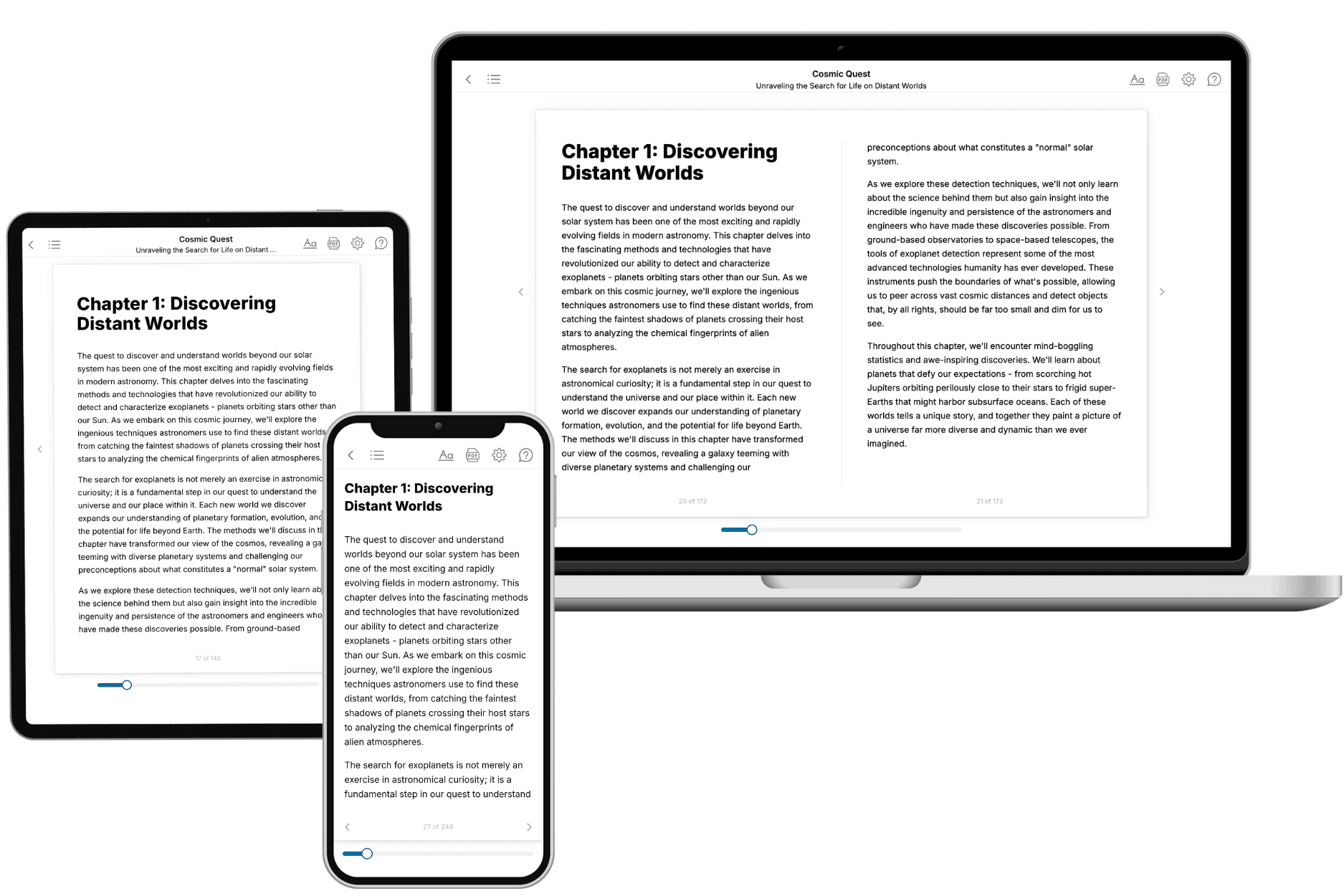
TailoredRead creates complete, full-length nonfiction ebooks, written specifically for you. Tell us what you want to learn and why, and TailoredRead writes you a complete ebook on it, with charts, tables, and diagrams throughout. Read it online, on Kindle, or on any e-reader, or download it as a PDF or EPUB. Every book is written fresh the day you order it.
- How is the book tailored to me?
Before anything is written, you answer a few short questions about your goals, your background, and the topics you care about. Your book is then planned around your answers: written at your level, focused on your goals, and covering the topics you chose, instead of the one-size-fits-all book a store sells everyone.
- Will it read like generic AI content?
No. Your book isn't a chat transcript: it's planned chapter by chapter before a single word is written, told in a clear book voice, and explains ideas visually with charts, tables, and diagrams. After writing, every book goes through an editorial pass that polishes chapters so the book reads consistent from start to finish. Judge for yourself: browse thousands of sample books on our Explore Books page.
- How accurate is the content?
Our AI first checks whether your subject needs live research. Niche and fast-moving subjects are researched before writing, and the book plan and chapters are grounded in what it finds. After writing, every book goes through a quality pass that checks its facts and consistency, and researched books list their sources in a Notes section at the back.
- How long is the book?
You choose the length: Comprehensive (250-300 pages), Detailed (150-200 pages), Essential (70-100 pages), or Short (30-50 pages).
- Does the book include visuals?
Yes. Every book includes charts, tables, and diagrams: timelines, checklists, step-by-step guides, decision trees, comparison tables, matrices, and bar charts. A typical book includes dozens of these visual elements.
- Can I read it on Kindle? What formats can I download?
Yes. Every book can be read in our online reader or downloaded as a PDF or EPUB. The EPUB can be opened with Kindle, Apple Books, Kobo, and any e-reader. The Commercial and Author licenses also include an editable Word (DOCX) and Markdown download.
- How much does it cost?
About the price of a regular ebook. The exact price depends on your book's length and complexity, from $2 for the shortest books to $35 for the most comprehensive, and it's shown when you review your book, before you commit to anything. Each book is a one-time purchase, yours to keep, no subscription. Licenses that let you share, teach, or publish your book range from $35.99 to $49.99.
- Can I preview the book before purchasing?
Before you pay, you'll see what your book will cover: the title, a detailed description, the estimated length, and the complete chapter-by-chapter table of contents, so you know what you're getting before you decide. The full text itself is written after you purchase.
- How long does it take to create a book?
About 10 minutes. You can start reading the opening chapters while the rest is still being written.