Optical Mark Recognition Mastery
From Fundamentals to Advanced OMR Implementation in Modern Systems
Discover how optical mark recognition technology powers everything from standardized testing to ballot processing and survey analysis.
222 pages10 chaptersNov 12, 2025Computer Vision
About this book
This guide takes you through the complete OMR landscape, starting with the fundamental principles of how computers detect and interpret marked positions on documents. You'll explore the image processing pipeline that transforms raw scans into actionable data, understand the algorithms that distinguish marks from noise and artifacts, and learn how to implement robust systems that handle real-world variability. Whether you're building an OMR system from scratch, optimizing an existing solution, or integrating OMR into a larger application, you'll gain practical insights into algorithm selection, performance tuning, and production deployment. By the end, you'll have both the theoretical foundation and practical knowledge needed to architect and implement effective optical mark recognition solutions.
Table of contents
- IntroductionWhat is Optical Mark Recognition?, How OMR Differs from General OCR, Real-World Applications and Use Cases, Your Learning RoadmapRead below
- Chapter 1: Fundamentals of Optical Mark RecognitionCore Concepts and Terminology, Types of Marks and Document Formats, Basic OMR System Architecture
- Chapter 2: Image Acquisition and Input HandlingScanning Devices and Image Capture, Image Formats and Resolution Requirements, Assessing and Validating Image Quality
- Chapter 3: Image Preprocessing TechniquesBinarization: Converting to Black and White, Noise Reduction and Filtering, Image Normalization and Alignment
- Chapter 4: Mark Detection AlgorithmsThreshold-Based Detection Methods, Contour Analysis and Shape Recognition, Machine Learning and Neural Network Approaches
- Chapter 5: Data Extraction and ValidationClassifying Marks and Confidence Scoring, Error Detection and Correction Strategies, Mapping Marks to Structured Data
- Chapter 6: Handling Real-World ChallengesManaging Document Quality and Variability, Addressing Lighting Conditions and Skew, Handling Edge Cases and Ambiguous Marks
- Chapter 7: Performance Optimization and ScalingOptimizing Algorithm Efficiency, Parallel Processing and Batch Operations, Memory and Resource Management
- Chapter 8: Implementation Frameworks and ToolsOpen-Source Libraries and Frameworks, Commercial OMR Solutions and Platforms, Selecting the Right Technology Stack
- Chapter 9: Building Production OMR SystemsDesigning Robust OMR Architectures, Testing, Validation, and Quality Assurance, Deployment and Continuous Monitoring
- Chapter 10: Advanced Topics and Future DirectionsDeep Learning and Advanced Neural Networks, Multi-Modal Processing and Hybrid Approaches, Emerging Trends and Future Developments
- ConclusionKey Takeaways and Best Practices, Your Next Steps in OMR Development
- Glossary
- Further Reading and Resources
Introduction
Every time you fill out a standardized test, complete a survey form, or cast a ballot using a paper form, you're participating in a process that relies on optical mark recognition technology. Behind the scenes, sophisticated algorithms analyze the marks you've made, transforming simple pencil strokes into structured digital data. This technology has been quietly powering critical systems for decades, processing billions of documents annually with remarkable accuracy. Yet despite its widespread use, the inner workings of OMR systems remain largely mysterious to many technical professionals who could benefit from understanding and implementing these solutions.
The field of optical mark recognition sits at the intersection of computer vision, image processing, and practical software engineering. Unlike general-purpose optical character recognition that must interpret the full complexity of written language, OMR focuses on a more constrained but equally challenging problem: detecting whether specific positions on a document have been marked. This specialization allows for highly optimized algorithms and architectures, but it also introduces unique challenges around accuracy, reliability, and real-world variability. Understanding these trade-offs is essential for anyone looking to implement or improve OMR systems.
This book bridges the gap between theoretical concepts and practical implementation. You'll gain insight into the complete OMR pipeline, from the moment a document enters a scanner to the final validated data output. Whether you're building a new system from scratch, optimizing an existing solution, or simply seeking to understand how these technologies work, you'll find actionable guidance grounded in real-world experience. The journey ahead will equip you with both the foundational knowledge and the practical skills needed to tackle OMR challenges with confidence.
What is Optical Mark Recognition?
Optical mark recognition is a specialized technology that detects the presence or absence of marks in predetermined positions on a document. Unlike systems that must interpret arbitrary handwriting or printed text, OMR operates within a structured framework where the location and meaning of potential marks are known in advance. The system's task is to determine whether each designated area contains a mark that meets specific criteria, then translate those detections into meaningful data. This constrained problem space enables OMR systems to achieve accuracy rates exceeding 99% in controlled environments, making them suitable for high-stakes applications where reliability is paramount.
The fundamental principle underlying OMR is pattern recognition through image analysis. When a marked document is scanned, it becomes a digital image composed of pixels with varying brightness values. The OMR system examines specific regions of this image, looking for patterns that indicate the presence of marks. These patterns might include areas of increased darkness, specific shapes or contours, or statistical properties that distinguish marked regions from unmarked ones. The challenge lies in distinguishing intentional marks from artifacts like smudges, shadows, or printing imperfections that can appear visually similar.
A typical OMR workflow consists of several distinct stages, each building upon the previous one:
- Image acquisition: Capturing a digital representation of the physical document through scanning or photography
- Preprocessing: Enhancing the image quality and normalizing variations in lighting, orientation, and scale
- Registration: Identifying the document's position and alignment within the image
- Mark detection: Analyzing predetermined regions to determine whether marks are present
- Validation: Applying business rules and quality checks to ensure data integrity
- Data extraction: Converting detected marks into structured output formats
The accuracy of OMR systems depends heavily on document design and marking instructions. Well-designed OMR forms include timing marks or registration points that help the system locate and align the document precisely. They specify clear marking areas with sufficient size and spacing to minimize ambiguity. They also provide explicit instructions to users about acceptable marking methods, typically requiring filled circles or boxes rather than checkmarks or X marks. These design considerations aren't merely cosmetic—they directly impact the system's ability to reliably distinguish marks from non-marks.
Modern OMR technology has evolved significantly from its origins in the 1930s when IBM developed the first mark-sensing machines for test scoring. Early systems used analog methods, detecting marks through variations in light reflection or electrical conductivity. Contemporary digital OMR relies on sophisticated image processing algorithms that can handle a much wider range of document conditions and mark types. Machine learning approaches have further expanded capabilities, enabling systems to adapt to different marking styles and document variations without extensive manual tuning.
The distinction between mark detection and mark recognition is subtle but important. Detection refers to the binary decision of whether a mark exists in a given location, while recognition involves classifying the type or quality of that mark. Most OMR applications focus primarily on detection, but some advanced systems incorporate recognition capabilities to handle multiple mark types or to assess mark quality for confidence scoring. This additional layer of analysis can improve overall system reliability by flagging ambiguous cases for human review rather than making potentially incorrect automated decisions.
Understanding what OMR can and cannot do is crucial for setting appropriate expectations. OMR excels at processing large volumes of structured forms where the layout is consistent and the marking areas are clearly defined. It struggles with unstructured documents, handwritten text outside designated areas, or situations where document quality is highly variable. Recognizing these limitations helps you design systems that leverage OMR's strengths while incorporating appropriate fallback mechanisms for cases that exceed its capabilities. The most successful OMR implementations combine automated processing with human oversight for edge cases.
How OMR Differs from General OCR
Optical character recognition and optical mark recognition are often confused, but they address fundamentally different problems with distinct technical approaches. OCR attempts to interpret arbitrary text characters from images, requiring systems to recognize thousands of potential character shapes across multiple fonts, sizes, and writing styles. OMR, by contrast, operates within a constrained problem space where the system only needs to determine whether predetermined locations contain marks. This specialization allows OMR to use simpler, faster algorithms while achieving higher accuracy rates for its specific use case.
The algorithmic complexity differs dramatically between these technologies. OCR systems typically employ sophisticated pattern matching or neural network architectures trained on vast datasets of character examples. They must handle segmentation challenges, distinguishing individual characters within continuous text, and resolve ambiguities where similar-looking characters could represent different meanings. OMR systems can often achieve excellent results with relatively straightforward image processing techniques like threshold-based detection or simple statistical analysis of pixel values within defined regions. This simplicity translates to faster processing speeds and lower computational requirements.
Consider the practical differences in a concrete example. An OCR system processing a handwritten form must:
- Locate text regions within the document without prior knowledge of their positions
- Segment continuous handwriting into individual characters or words
- Classify each character from among thousands of possibilities
- Handle variations in writing style, slant, size, and spacing
- Resolve ambiguities where characters might be misread (like "0" versus "O")
The training and setup requirements also differ significantly. Modern OCR systems, particularly those using deep learning approaches, require extensive training datasets containing millions of character examples across diverse conditions. This training process can take days or weeks on powerful hardware. OMR systems can often be configured through simple parameter tuning or template definition, specifying the locations and sizes of marking areas. Some advanced OMR implementations do use machine learning, but even these typically require far less training data and computational resources than comparable OCR systems.
Error patterns and failure modes distinguish these technologies as well. OCR errors typically involve character substitutions—reading a "B" as an "8" or misinterpreting a poorly written "a" as an "o". These errors can be subtle and difficult to detect automatically. OMR errors usually manifest as false positives (detecting marks where none exist) or false negatives (missing actual marks). These binary outcomes are often easier to validate through consistency checks and business rules. For instance, if an OMR form should have exactly one mark per question, detecting zero or multiple marks immediately flags a potential error.
The document design requirements reflect these different capabilities. OCR-friendly documents need clear, legible text with good contrast and minimal background noise, but they don't require rigid structural constraints. OMR documents must adhere to precise layouts with marking areas in exact positions. This rigidity is both a strength and a limitation—it enables reliable automated processing but reduces flexibility in form design. You cannot simply add a new question to an OMR form without updating the system's configuration, whereas OCR can often handle document variations without modification.
Performance characteristics favor OMR for its specific use case. A well-optimized OMR system can process hundreds of pages per minute with accuracy exceeding 99.5% under controlled conditions. OCR systems, while continuously improving, typically achieve lower accuracy rates, particularly for handwritten text, and require more processing time per page. This performance advantage makes OMR the clear choice for high-volume applications where the structured form format is acceptable. However, OCR's flexibility makes it indispensable for applications requiring interpretation of arbitrary text content.
Some modern systems blur the boundaries between OMR and OCR, incorporating both technologies to handle different aspects of document processing. A survey form might use OMR for multiple-choice questions while employing OCR to capture handwritten comments in free-text fields. Understanding the strengths and limitations of each technology helps you architect hybrid solutions that leverage the right tool for each specific task. The key is recognizing that OMR and OCR are complementary technologies, not competing alternatives, each optimized for different aspects of document digitization.
Real-World Applications and Use Cases
Standardized testing represents one of the most visible and demanding applications of OMR technology. Organizations like the College Board process millions of SAT answer sheets annually, requiring systems that combine extreme accuracy with high throughput. These applications cannot tolerate even small error rates—a single misread answer could affect a student's college admissions prospects. The OMR systems used in educational testing typically incorporate multiple validation stages, including statistical analysis to detect anomalous response patterns and manual review of low-confidence detections. The scale of these operations demands highly optimized processing pipelines capable of handling thousands of documents per hour.
Election systems increasingly rely on OMR technology for ballot processing, where accuracy and auditability are paramount. Unlike testing applications where errors might be caught through score validation, election errors can have serious consequences for democratic processes. Modern ballot-scanning systems must handle diverse ballot designs across different jurisdictions, accommodate various marking implements and styles, and maintain detailed audit trails for verification and recounts. These systems often incorporate redundancy, with multiple independent scans of each ballot and comparison algorithms to detect discrepancies. The 2020 U.S. presidential election saw OMR systems process over 100 million mail-in ballots, demonstrating both the technology's maturity and the critical importance of robust implementation.
Healthcare applications leverage OMR for patient intake forms, insurance claims, and medical surveys. A typical hospital might process thousands of forms weekly, capturing patient demographics, medical history, and symptom information. The challenge in healthcare settings involves balancing automation with accuracy—while OMR dramatically reduces data entry time, medical information errors can have serious consequences. Successful healthcare OMR implementations typically include validation rules that flag inconsistent or incomplete responses for human review. For example, if a patient marks both "yes" and "no" for the same question, the system should route that form for manual verification rather than making an arbitrary choice.
Market research and survey organizations use OMR to process customer feedback forms, opinion polls, and satisfaction surveys. These applications often involve high volumes with less stringent accuracy requirements than testing or elections—a small percentage of errors in aggregate survey data may be acceptable. However, survey OMR systems must handle diverse form designs and marking styles, as respondents receive less standardized instruction than test-takers. Advanced survey processing systems incorporate confidence scoring, allowing researchers to weight responses based on mark quality or to exclude ambiguous responses from analysis. This flexibility enables cost-effective processing while maintaining data quality appropriate to the research objectives.
Attendance tracking and time management systems employ OMR for recording employee hours, student attendance, and event participation. Consider a university with 30,000 students attending hundreds of classes daily—manual attendance tracking would be prohibitively time-consuming. OMR-based systems allow instructors to distribute simple forms where students mark their presence, then batch-process these forms to update attendance databases. The key requirements for these applications include rapid turnaround (attendance data should be available within hours) and integration with existing information systems. The accuracy requirements are moderate—occasional errors can be corrected through exception handling—but the system must be reliable enough to avoid frequent manual intervention.
Inventory management and logistics applications use OMR for tracking shipments, recording warehouse operations, and managing asset movements. A distribution center might use OMR forms for workers to record picking operations, quality checks, or equipment inspections. These applications prioritize speed and simplicity—workers need to quickly mark forms without extensive training or complex instructions. The OMR systems must integrate tightly with inventory databases and enterprise resource planning systems, often processing forms in near-real-time to maintain accurate inventory counts. Error handling typically involves exception queues where supervisors review flagged forms rather than halting operations.
Financial services employ OMR for processing deposit slips, loan applications, and customer service forms. Banks and credit unions handle millions of paper forms annually, making automation essential for cost control. Financial OMR applications require high accuracy for numerical data and strong audit capabilities for regulatory compliance. A typical implementation might use OMR for checkbox fields while employing OCR or manual entry for handwritten amounts and account numbers. The system must maintain detailed logs of all processing steps, enabling reconstruction of how each form was interpreted if questions arise later. Integration with core banking systems and fraud detection algorithms adds additional complexity to these implementations.
The diversity of these applications demonstrates OMR's versatility while highlighting the importance of tailoring implementations to specific requirements. A testing application prioritizes accuracy above all else, accepting slower processing speeds and higher costs to minimize errors. A survey application might prioritize throughput and cost-effectiveness, accepting slightly lower accuracy for aggregate data analysis. Understanding your application's specific requirements—accuracy thresholds, processing speed needs, integration requirements, and error tolerance—is essential for designing an effective OMR solution. The technical approaches and architectural decisions that work well for one application may be inappropriate for another, making requirements analysis a critical first step in any OMR project.
Your Learning Roadmap
This book follows a structured progression from foundational concepts through advanced implementation topics, mirroring the typical journey of developing an OMR system. The early chapters establish essential background knowledge about how OMR works, the types of documents and marks involved, and the overall system architecture. You'll gain a solid conceptual foundation before diving into technical details, ensuring you understand not just how to implement specific algorithms but why particular approaches work and when to apply them. This foundation proves invaluable when you encounter real-world challenges that don't match textbook examples.
The middle chapters focus on the core technical pipeline, walking through each stage of OMR processing in detail. You'll explore image acquisition and quality assessment, learning how scanner characteristics and image formats impact downstream processing. The preprocessing chapters cover essential techniques like binarization, noise reduction, and normalization—unglamorous but critical operations that often determine whether your system succeeds or fails. The mark detection chapters present multiple algorithmic approaches, from simple threshold-based methods to sophisticated machine learning techniques, helping you understand the trade-offs between complexity, accuracy, and computational requirements.
As you progress through the book, the content becomes increasingly practical and implementation-focused. The chapters on data extraction and validation show how to transform raw mark detections into structured, validated data ready for downstream systems. You'll learn strategies for handling errors, ambiguous marks, and edge cases that inevitably arise in production environments. The real-world challenges chapter addresses the gap between idealized algorithms and messy reality, covering issues like variable document quality, lighting conditions, and user marking behavior that can derail naive implementations.
The later chapters shift focus to production concerns and advanced topics. You'll explore performance optimization techniques essential for processing large document volumes efficiently, including parallel processing strategies and resource management approaches. The implementation frameworks chapter surveys available tools and libraries, helping you make informed technology choices rather than reinventing solutions to solved problems. The production systems chapter covers architecture, testing, deployment, and monitoring—the engineering practices that separate proof-of-concept prototypes from reliable production systems.
Throughout the book, you'll encounter concrete examples and case studies drawn from real implementations. Rather than presenting only abstract algorithms, each chapter includes practical scenarios showing how concepts apply to actual problems. You'll see code snippets illustrating key techniques, though the focus remains on concepts and approaches rather than specific programming languages. The examples progress in complexity, starting with simplified scenarios that clearly illustrate core principles, then building toward realistic situations that incorporate the messy complications of production systems.
The book assumes you have foundational knowledge of programming and basic algorithms, but it doesn't require prior experience with computer vision or image processing. Key concepts from these fields are introduced as needed, with explanations targeted at intermediate developers rather than specialists. If you've worked with images in any programming context—even simple operations like resizing or format conversion—you have sufficient background to follow the technical content. The mathematical concepts are presented with intuitive explanations alongside formal definitions, making them accessible without sacrificing rigor.
Your learning path through this material should be active rather than passive. As you read about preprocessing techniques, consider how they might apply to documents you've encountered. When exploring mark detection algorithms, think about the trade-offs relevant to your specific use case. The book includes questions and considerations throughout to prompt this kind of engaged thinking. If you're working on an actual OMR project, you might jump directly to chapters addressing your immediate challenges, then circle back to fill in foundational knowledge. The content is structured to support both linear reading and targeted reference use.
By the conclusion, you'll have comprehensive knowledge spanning the entire OMR landscape—from the physics of how scanners capture images to the software architecture of production systems. More importantly, you'll have developed the judgment to make informed decisions about algorithm selection, system design, and implementation trade-offs. You'll understand not just what techniques exist but when to apply each one, how to combine approaches effectively, and how to troubleshoot problems when systems don't behave as expected. This practical wisdom, built through understanding both theory and real-world constraints, is what transforms technical knowledge into effective implementation capability. The journey ahead is substantial, but the destination—mastery of OMR technology and its applications—is well worth the effort.
This is the end of the free sample. The full book has 10 chapters.
Want this book written for you?
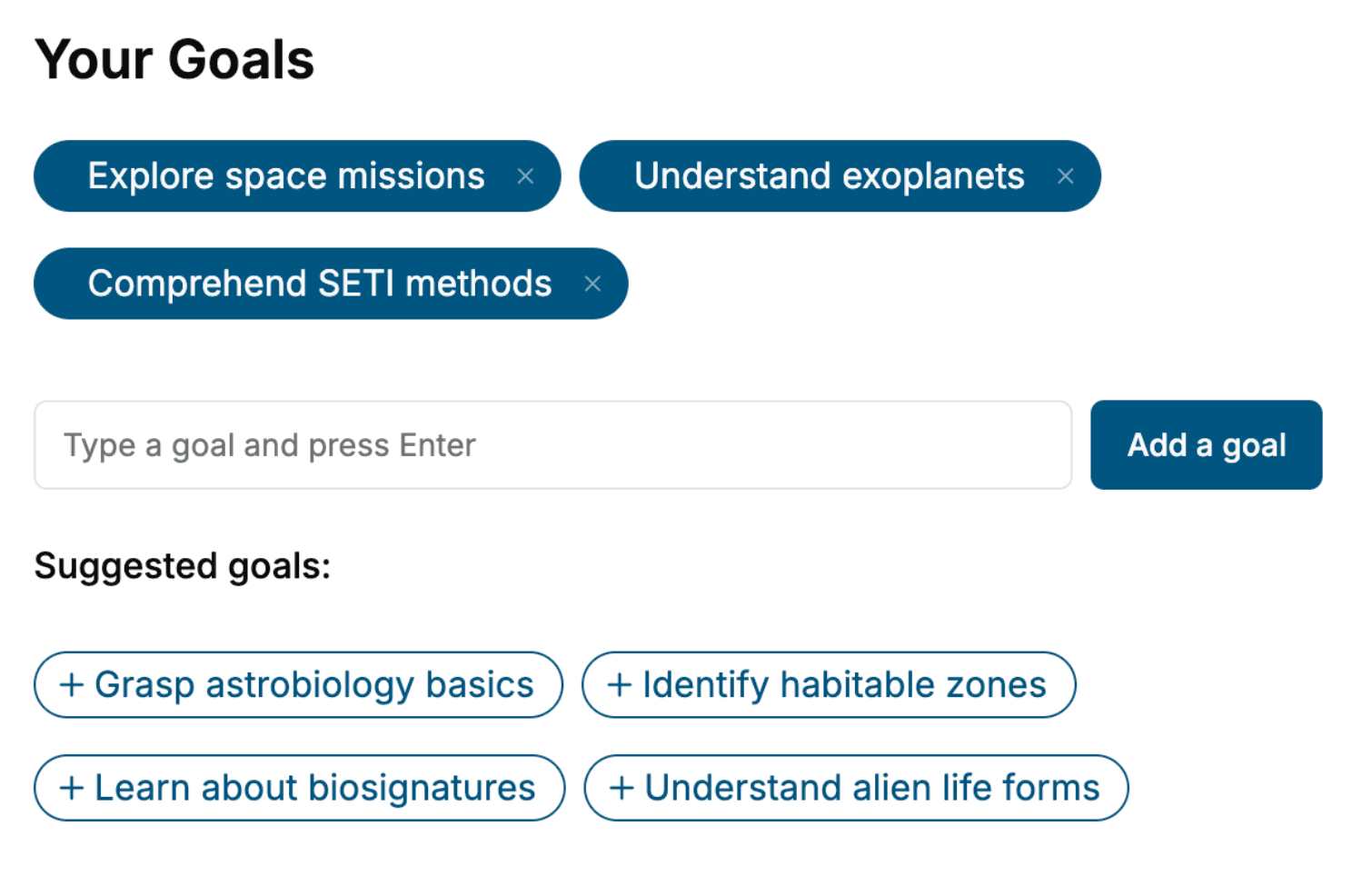
Tell us your goals and background, and get your own version of this book, tailored by AI to you.


Benefits of AI-tailored books
- Read one book, not ten:
- all the Computer Vision knowledge you need, gathered into a single book.
- Save days of learning:
- tell us your goals, choose your topics, and the whole book is built around them.
- Learn effortlessly:
- Computer Vision book written for your specific background and expertise.
- Understand at a glance:
- includes charts, tables, timelines, checklists, decision trees, and more.
- Stay current:
- written the day you order it, not years ago.
- Trust what you read:
- every book is checked for accuracy, with real research when your subject needs it.
Create your unique book in 3 steps
- 1. Select your focus
Select the focus of your Computer Vision book and share your background
- 2. Personalize your book
Specify your goals and choose sub-topics to include
- 3. Get your tailored book
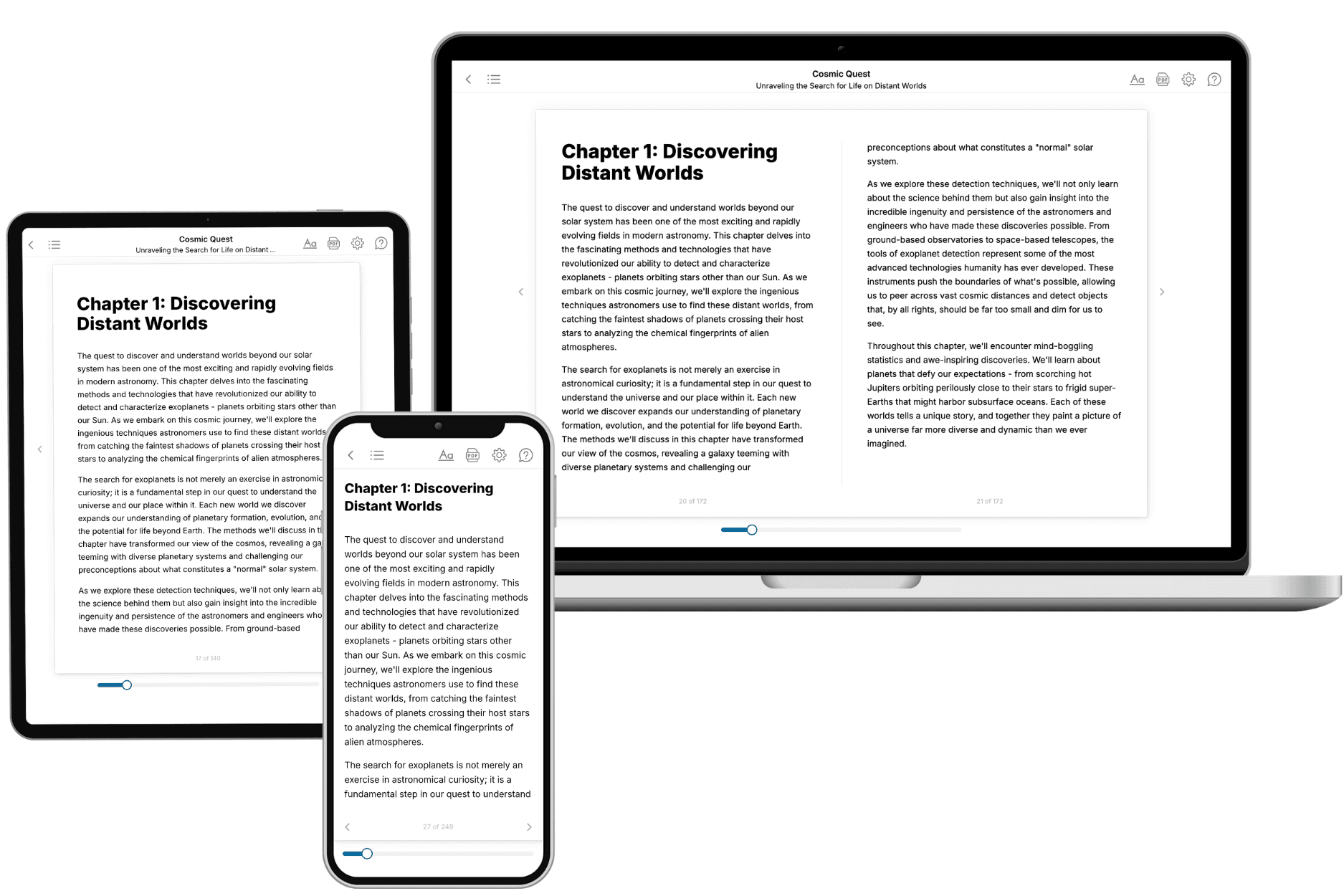
Your book is ready in 10 minutes. Read it online, download as EPUB or PDF, or send to Kindle.

Frequently asked questions
- What is TailoredRead?
TailoredRead creates complete, full-length nonfiction ebooks, written specifically for you. Tell us what you want to learn and why, and TailoredRead writes you a complete ebook on it, with charts, tables, and diagrams throughout. Read it online, on Kindle, or on any e-reader, or download it as a PDF or EPUB. Every book is written fresh the day you order it.
- How is the book tailored to me?
Before anything is written, you answer a few short questions about your goals, your background, and the topics you care about. Your book is then planned around your answers: written at your level, focused on your goals, and covering the topics you chose, instead of the one-size-fits-all book a store sells everyone.
- Will it read like generic AI content?
No. Your book isn't a chat transcript: it's planned chapter by chapter before a single word is written, told in a clear book voice, and explains ideas visually with charts, tables, and diagrams. After writing, every book goes through an editorial pass that polishes chapters so the book reads consistent from start to finish. Judge for yourself: browse thousands of sample books on our Explore Books page.
- How accurate is the content?
Our AI first checks whether your subject needs live research. Niche and fast-moving subjects are researched before writing, and the book plan and chapters are grounded in what it finds. After writing, every book goes through a quality pass that checks its facts and consistency, and researched books list their sources in a Notes section at the back.
- How long is the book?
You choose the length: Comprehensive (250-300 pages), Detailed (150-200 pages), Essential (70-100 pages), or Short (30-50 pages).
- Does the book include visuals?
Yes. Every book includes charts, tables, and diagrams: timelines, checklists, step-by-step guides, decision trees, comparison tables, matrices, and bar charts. A typical book includes dozens of these visual elements.
- Can I read it on Kindle? What formats can I download?
Yes. Every book can be read in our online reader or downloaded as a PDF or EPUB. The EPUB can be opened with Kindle, Apple Books, Kobo, and any e-reader. The Commercial and Author licenses also include an editable Word (DOCX) and Markdown download.
- How much does it cost?
About the price of a regular ebook. The exact price depends on your book's length and complexity, from $2 for the shortest books to $35 for the most comprehensive, and it's shown when you review your book, before you commit to anything. Each book is a one-time purchase, yours to keep, no subscription. Licenses that let you share, teach, or publish your book range from $35.99 to $49.99.
- Can I preview the book before purchasing?
Before you pay, you'll see what your book will cover: the title, a detailed description, the estimated length, and the complete chapter-by-chapter table of contents, so you know what you're getting before you decide. The full text itself is written after you purchase.
- How long does it take to create a book?
About 10 minutes. You can start reading the opening chapters while the rest is still being written.