The Oromo Language
A Comprehensive Guide to Africa's Widely Spoken Cushitic Language
Discover the depth and significance of one of Africa's most important languages.
207 pages10 chaptersMar 27, 2026Learning Ethiopian Languages
About this book
This comprehensive guide takes you beyond basic language facts to explore Oromo's fascinating linguistic structure, rich cultural heritage, and vital role in East African societies. You'll learn how Oromo's phonetic system and grammar reflect unique patterns of human communication, trace its evolution through different writing systems, and understand its place within the broader Cushitic language family. Whether you're a language enthusiast, student of African studies, or someone seeking to connect with Oromo-speaking communities, this book provides the knowledge and context needed to appreciate why Oromo matters. Explore the language's oral traditions, contemporary literature, and ongoing revitalization efforts while gaining practical insights into how language shapes culture and identity. By the end, you'll have a nuanced understanding of Oromo's complexity and its essential role in preserving African linguistic diversity.
Table of contents
- IntroductionWhy Oromo Matters in the African Linguistic Landscape, What You'll Learn in This Book, How to Use This GuideRead below
- Chapter 1: The Oromo People and Their LanguageWho Are the Oromo? Geography and Demographics, Historical Development of Oromo Societies, Language as a Marker of Cultural Identity
- Chapter 2: Oromo Within the Cushitic Language FamilyUnderstanding the Cushitic Language Family, Oromo's Relationship to Other Cushitic Languages, Oromo's Place in the Broader Afro-Asiatic Language Group
- Chapter 3: The Sound System of OromoConsonant Phonemes and Their Articulation, The Vowel System and Length Distinctions, Stress, Tone, and Phonological Patterns
- Chapter 4: Grammar and Syntax FundamentalsWord Order and Sentence Structure, The Noun System: Gender, Number, and Case, The Verb System: Tense, Aspect, and Mood, Agreement Patterns and Grammatical Relationships
- Chapter 5: Writing Systems: From Ge'ez to QubeeThe Ge'ez Script and Historical Literacy, The Qubee Latin-Based Orthography, The Transition Between Writing Systems
- Chapter 6: Vocabulary and Semantic FieldsCore Vocabulary and Everyday Language, Semantic Domains: Nature, Culture, and Society, Loanwords and Language Contact Influences
- Chapter 7: Oral Traditions and Literary HeritageOral Poetry and Traditional Storytelling, Proverbs, Sayings, and Wisdom Literature, Modern Oromo Literature and Written Works
- Chapter 8: Dialects and Linguistic VariationMajor Dialect Groups and Geographic Distribution, Distinctive Features of Regional Dialects, Mutual Intelligibility and Dialect Continua
- Chapter 9: Oromo in the Modern WorldOromo in Education and Media, Digital Presence and Technology, Contemporary Social and Political Discourse
- Chapter 10: Language Preservation and RevitalizationChallenges to Language Preservation, Community and Institutional Revitalization Efforts, Future Prospects and Language Rights
- ConclusionKey Takeaways and Reflections, Your Journey with the Oromo Language
- Further Reading and Resources
Introduction
Somewhere in the highlands of Ethiopia, a grandmother tells her grandchildren a story that has been passed down for generations. She speaks in a language that carries the weight of centuries, a language that has survived conquest, suppression, and political upheaval. That language is Oromo, and it belongs to more than 50 million people across East Africa. It is the fourth most widely spoken language on the African continent, yet it remains one of the least studied and least understood outside of its home region.[1]
Oromo is not a minor regional dialect or a disappearing tongue. It is a living, dynamic language spoken across Ethiopia, Kenya, Somalia, and parts of the broader East African diaspora. It has its own grammar, its own literary tradition, its own writing system, and its own deep cultural logic. For anyone serious about understanding East Africa, its history, its politics, or its people, Oromo is not optional. It is essential. Yet for too long, it has been treated as a footnote in broader discussions about African languages and cultures.
This book exists to change that. Whether you are a student of African linguistics, a researcher exploring Cushitic language families, a heritage speaker reconnecting with your roots, or simply someone fascinated by how language shapes human experience, this guide is designed to give you a thorough, honest, and engaging account of what Oromo is and why it matters. The chapters ahead cover everything from phonetics and grammar to oral traditions, writing systems, and the ongoing fight for language rights. Each section builds on the last, creating a complete picture of a language that deserves far more attention than it typically receives.
One thing worth noting before you begin: this is not a phrasebook or a tourist's quick-start guide. It is a comprehensive exploration of Oromo as a linguistic and cultural system. That said, it is written to be accessible. Technical terms are explained when they appear, and every abstract concept is grounded in concrete examples. The goal is not to overwhelm you with jargon but to give you the tools to think clearly and deeply about Oromo and the communities that speak it.
Why Oromo Matters in the African Linguistic Landscape
Africa is home to roughly 2,000 languages, representing about one-third of all the world's languages.[2] Within that extraordinary diversity, Oromo stands out not just for its size but for its structural complexity and cultural depth. It belongs to the Cushitic branch of the Afro-Asiatic language family, a group that also includes Somali, Afar, and Beja. Understanding Oromo means understanding a whole branch of human linguistic history that stretches back thousands of years across the Horn of Africa.
The sheer number of Oromo speakers makes it a language of regional and global significance. With over 50 million speakers, it surpasses many European languages in terms of total speaker population. For comparison, Danish has around 6 million speakers and Norwegian around 5 million. Yet Oromo receives a fraction of the academic attention, publishing resources, and digital infrastructure that those languages enjoy. This imbalance is not accidental. It reflects historical patterns of political marginalization that have shaped how the world perceives and values African languages.
Oromo's importance goes beyond raw numbers. The language is the primary vehicle for the Gadaa system, a traditional democratic governance structure that the Oromo people developed over centuries. The Gadaa system was inscribed on UNESCO's Representative List of the Intangible Cultural Heritage of Humanity in 2016.[3] Without Oromo, that system cannot be fully understood, practiced, or transmitted to future generations. Language and culture are inseparable here in ways that are both profound and practical.
From a purely linguistic standpoint, Oromo offers fascinating insights into how human languages can organize meaning. Its verb-final sentence structure, its system of grammatical gender, its use of vowel length to distinguish meaning, and its rich system of verbal derivation all make it a compelling subject for anyone interested in how languages work. These features are not quirks or curiosities. They are systematic patterns that reveal how the Oromo-speaking mind has organized experience and communication over millennia.
Oromo also matters because of its role in contemporary East African politics and society. The language has been at the center of major political movements in Ethiopia, including protests over land rights, educational policy, and cultural recognition. In 2019, Abiy Ahmed, an Oromo speaker, became Prime Minister of Ethiopia and went on to win the Nobel Peace Prize. The visibility of Oromo speakers in regional leadership has brought renewed attention to the language and its communities. Understanding Oromo is increasingly important for anyone following East African affairs.
Finally, Oromo matters because of what its preservation represents for global linguistic diversity. Every language that disappears takes with it a unique way of seeing the world, a set of concepts, metaphors, and ways of organizing knowledge that cannot be fully translated into another tongue. Oromo is not at immediate risk of extinction, but it has faced suppression and marginalization that have limited its development in education, media, and technology. Supporting Oromo means supporting the broader principle that all languages deserve respect, resources, and room to thrive.
A note on scale: To put Oromo's speaker population in perspective, consider that it has more native speakers than Polish (about 45 million), Romanian (about 24 million), or Dutch (about 24 million). These European languages have extensive academic literature, major publishing industries, and strong digital presences. Oromo is catching up, but the gap remains significant and worth acknowledging.
The linguistic landscape of Africa is often described as the most diverse on Earth, and Oromo is one of its most important features. Studying it seriously means engaging with that diversity on its own terms, not through the lens of European linguistic traditions or colonial-era assumptions about which languages are worth studying. This book takes that commitment seriously throughout every chapter.
What You'll Learn in This Book
This guide is organized to take you from broad context to specific detail, and then back out to the bigger picture. It begins with the people who speak Oromo, moves through the language's structure and history, and ends with its present-day challenges and future possibilities. Each chapter is designed to stand on its own while also contributing to a cumulative understanding of the whole.
Here is a clear overview of what each part of the book covers:
- Chapter 1: The Oromo People and Their Language introduces the communities that speak Oromo, their geographic spread, and the historical forces that have shaped both the people and their language. This chapter provides the human context that makes everything else meaningful.
- Chapter 2: Oromo Within the Cushitic Language Family places Oromo in its broader linguistic family tree. You will learn how it relates to Somali, Afar, and other Cushitic languages, and what those relationships reveal about ancient patterns of migration and cultural exchange.
- Chapter 3: The Sound System of Oromo covers phonetics and phonology in accessible detail. You will learn about Oromo's consonants, vowels, and the role of vowel length in distinguishing meaning. This chapter is essential for anyone who wants to pronounce Oromo correctly.
- Chapter 4: Grammar and Syntax Fundamentals explores how Oromo sentences are built. Topics include word order, the noun system, the verb system, and how different parts of a sentence agree with each other. Concrete examples are used throughout.
- Chapter 5: Writing Systems: From Ge'ez to Qubee traces the history of how Oromo has been written, from early use of the Ge'ez script to the development of the modern Latin-based Qubee orthography. This chapter also addresses the political dimensions of script choice.
- Chapter 6: Vocabulary and Semantic Fields examines the core vocabulary of Oromo and how it is organized around key domains of life, including nature, family, governance, and spirituality. Loanwords and language contact are also discussed.
- Chapter 7: Oral Traditions and Literary Heritage explores Oromo's rich tradition of oral poetry, storytelling, proverbs, and the growing body of modern written literature. This chapter shows how language carries cultural memory.
- Chapter 8: Dialects and Linguistic Variation maps the major dialect groups of Oromo and explains how they differ from one another. The concept of mutual intelligibility is discussed in practical terms.
- Chapter 9: Oromo in the Modern World looks at how Oromo is used today in education, media, digital platforms, and political discourse. This chapter connects the language's past to its present-day realities.
- Chapter 10: Language Preservation and Revitalization addresses the challenges facing Oromo and the efforts being made to strengthen it. This chapter also discusses language rights as a broader human rights issue.
By the time you finish this book, you will have a working understanding of Oromo's phonetic system and be able to recognize its key sounds. You will understand how its grammar differs from Indo-European languages and why those differences matter. You will know the history of its writing systems and the debates surrounding them. You will be familiar with its oral and literary traditions, its major dialects, and its role in contemporary East African society.
More than that, you will have a framework for thinking about African languages in general. The questions this book asks about Oromo, such as how a language encodes cultural values, how writing systems shape literacy, and how political history affects language development, are questions that apply across the continent and beyond. Oromo is the lens, but the view it offers is much wider.
This book also aims to correct some common misconceptions. Oromo is sometimes described as a single uniform language, when in fact it encompasses a rich spectrum of dialects. It is sometimes treated as a purely oral language with no written tradition, when in fact it has a growing body of written literature and a well-developed orthography. And it is sometimes discussed only in the context of Ethiopian politics, when in fact it is a transnational language with speakers across multiple countries and continents. Each of these misconceptions is addressed directly in the chapters ahead.
Practical examples appear throughout the book. When discussing grammar, real Oromo sentences are used to illustrate the rules. When discussing oral traditions, actual proverbs and poetic forms are quoted and analyzed. When discussing dialects, specific regional differences are named and explained. The goal is always to ground abstract concepts in concrete, observable language use.
You do not need to be a professional linguist to benefit from this book. A basic familiarity with linguistic concepts, such as phoneme, morpheme, and syntax, will be helpful, but all technical terms are explained when they first appear. If you have studied any other African language, even at a basic level, you will find many points of comparison that enrich your understanding of both that language and Oromo.
How to Use This Guide
This book is designed to be read from beginning to end, but it also works as a reference. If you are primarily interested in grammar, you can go directly to Chapter 4. If your focus is on oral traditions and literature, Chapter 7 is your starting point. Each chapter is self-contained enough to be read independently, though the earlier chapters provide context that enriches the later ones. Cross-references are included throughout to help you connect related ideas across chapters.
For those reading the book cover to cover, here is a suggested approach to get the most out of each chapter:
- Read actively. When a new term or concept is introduced, pause and make sure you understand it before moving on. Many concepts in linguistics build on each other, and a shaky foundation makes later chapters harder to follow.
- Engage with the examples. Every time an Oromo word, phrase, or sentence appears, try to say it aloud if you can. Even an approximate pronunciation helps the sounds become more familiar and makes the phonology chapter more meaningful.
- Use the footnotes. The footnotes throughout this book point to primary sources, academic studies, and additional reading. If a topic interests you, the footnotes are your roadmap to going deeper.
- Connect to what you already know. If you speak another language, look for parallels and contrasts with Oromo. If you have studied another Cushitic language like Somali, you will notice structural similarities that are worth reflecting on.
- Return to earlier chapters. After finishing the book, going back to the early chapters often reveals details that were not fully meaningful on first reading. The grammar chapter, for example, makes more sense after you have read about dialects and oral traditions.
A note on the representation of Oromo in this book: Oromo words and phrases are written using the Qubee orthography, the Latin-based writing system that is now the standard for written Oromo. This system was officially adopted in Ethiopia in 1991 and is used in schools, media, and government in the Oromia region. Where relevant, the Ge'ez script representation is also provided for historical context. Pronunciation guides are included in Chapter 3, and it is worth reading that chapter early even if phonology is not your primary interest.
The book uses a consistent set of conventions for presenting linguistic data. Oromo words appear in italics when they are being discussed as linguistic forms. English translations appear in single quotation marks immediately after the Oromo form. For example: bishaan 'water'. Grammatical glosses, which break down the meaning of each part of a word or sentence, are used in Chapter 4 and follow standard linguistic conventions. These are explained in detail when they first appear.
If you are using this book as part of a course or study group, each chapter contains enough material for a substantial discussion session. The chapters on grammar, writing systems, and dialects are particularly well-suited to comparative exercises, where you can look at how different features of Oromo compare to other languages you know. The chapters on oral traditions and language preservation lend themselves to broader discussions about culture, identity, and language rights.
For independent learners, the most important thing is consistency. Spending thirty minutes with this book three or four times a week will serve you better than trying to read it all at once. Language learning and language study both benefit from spaced repetition, from returning to material after a gap and seeing what has stuck and what needs reinforcement. The same principle applies to reading about language.
A practical tip for building familiarity with Oromo: As you read, keep a small notebook where you write down Oromo words and phrases that interest you. Group them by topic or by the chapter where you encountered them. By the end of the book, you will have a personal vocabulary list that reflects your own interests and learning priorities. This kind of active engagement with the material makes a significant difference in how much you retain.
One final thought before you begin: approach Oromo with genuine curiosity and respect. This is a language that has been spoken by millions of people across centuries of history, a language that has carried love songs and legal arguments, prayers and political speeches, children's games and philosophical debates. Every language is a complete world, and Oromo is no exception. The more you bring to your reading, the more you will take away from it. The chapters ahead are an invitation to enter that world with open eyes.
There is a well-known Oromo proverb that captures the spirit of learning well: Beekumsi mana hin guutu, garuu sammuu guuta. It means, roughly, 'Knowledge does not fill a house, but it fills the mind.' That is the spirit in which this book is offered. Not as a definitive final word on Oromo, but as a contribution to an ongoing conversation, one that you are now part of.
Notes
Introduction
This is the end of the free sample. The full book has 10 chapters.
Want this book written for you?
Tell us your goals and background, and get your own version of this book, tailored by AI to you.


Benefits of AI-tailored books
- Read one book, not ten:
- all the Learning Ethiopian Languages knowledge you need, gathered into a single book.
- Save days of learning:
- tell us your goals, choose your topics, and the whole book is built around them.
- Learn effortlessly:
- Learning Ethiopian Languages book written for your specific background and expertise.
- Understand at a glance:
- includes charts, tables, timelines, checklists, decision trees, and more.
- Stay current:
- written the day you order it, not years ago.
- Trust what you read:
- every book is checked for accuracy, with real research when your subject needs it.
Create your unique book in 3 steps
- 1. Select your focus
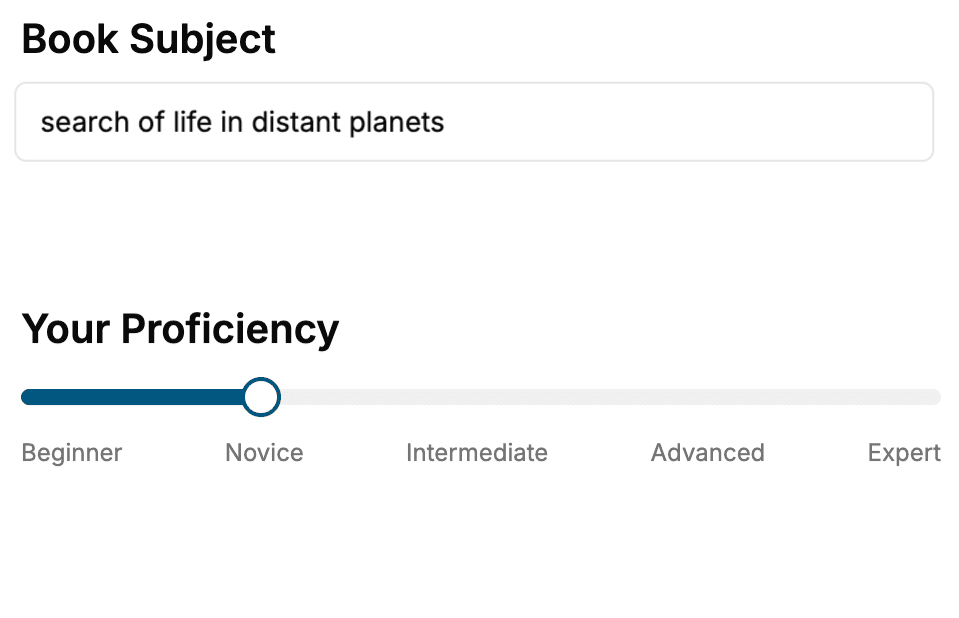
Select the focus of your Learning Ethiopian Languages book and share your background
- 2. Personalize your book
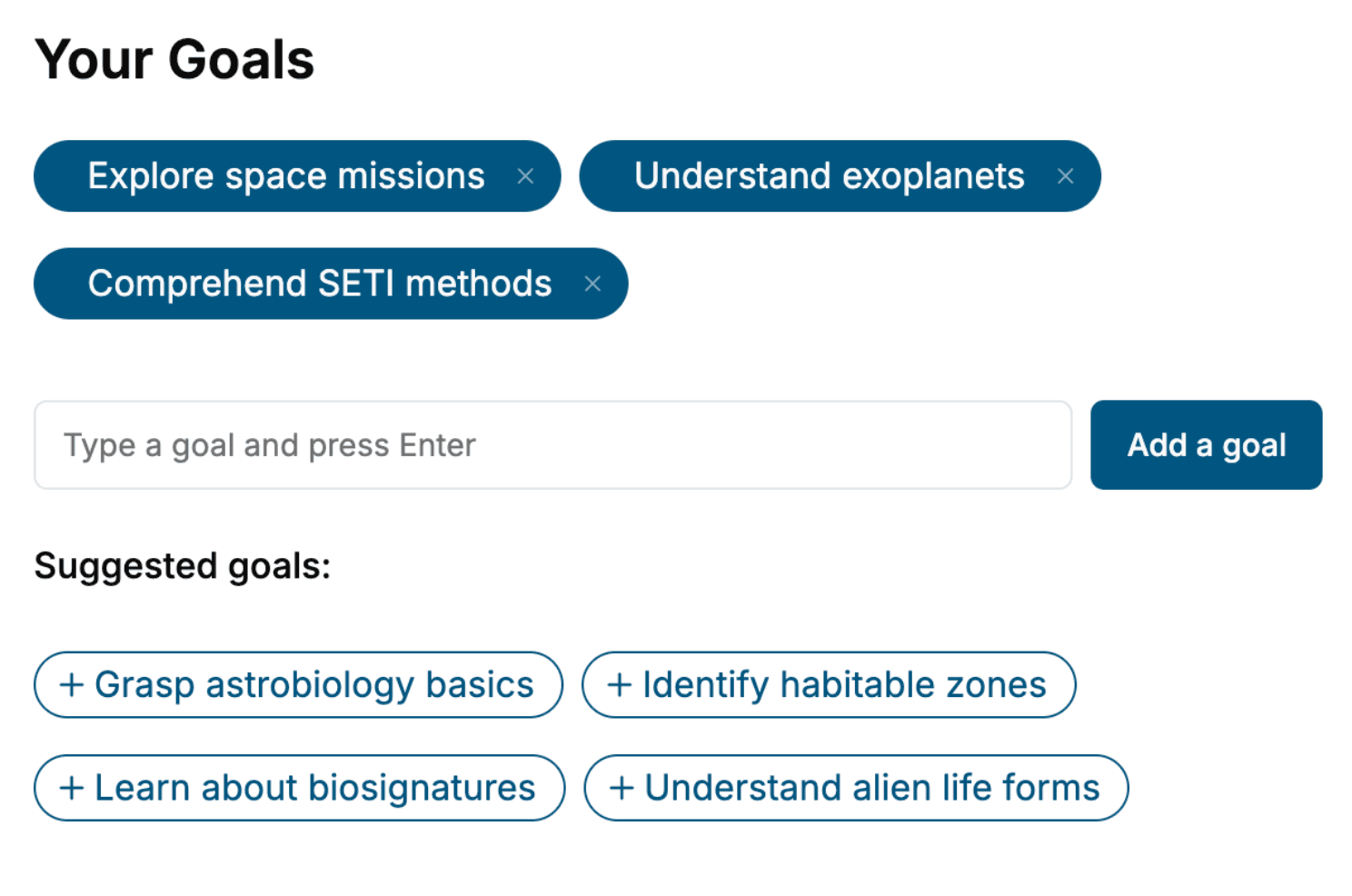
Specify your goals and choose sub-topics to include
- 3. Get your tailored book
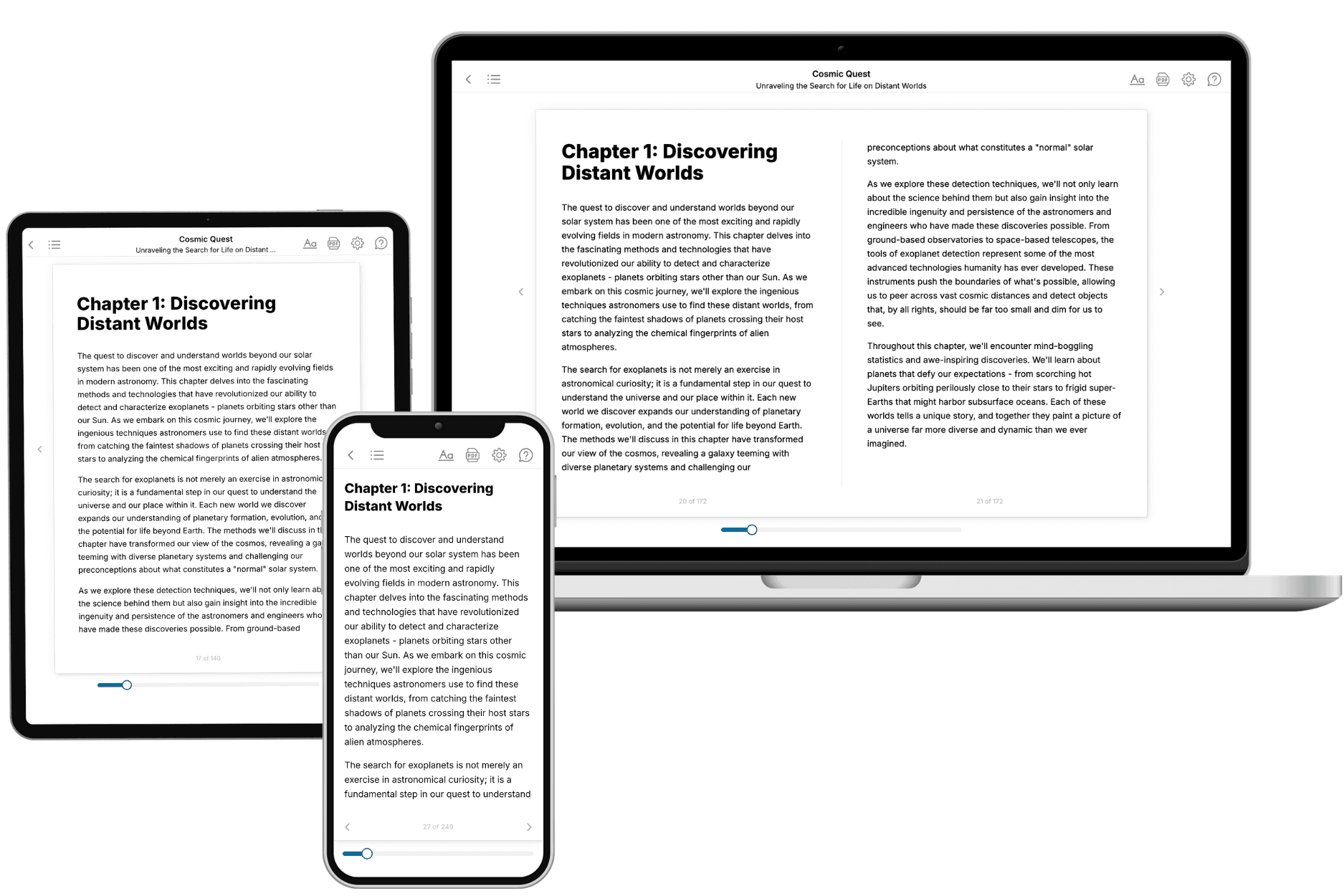
Your book is ready in 10 minutes. Read it online, download as EPUB or PDF, or send to Kindle.
Frequently asked questions
- What is TailoredRead?
TailoredRead creates complete, full-length nonfiction ebooks, written specifically for you. Tell us what you want to learn and why, and TailoredRead writes you a complete ebook on it, with charts, tables, and diagrams throughout. Read it online, on Kindle, or on any e-reader, or download it as a PDF or EPUB. Every book is written fresh the day you order it.
- How is the book tailored to me?
Before anything is written, you answer a few short questions about your goals, your background, and the topics you care about. Your book is then planned around your answers: written at your level, focused on your goals, and covering the topics you chose, instead of the one-size-fits-all book a store sells everyone.
- Will it read like generic AI content?
No. Your book isn't a chat transcript: it's planned chapter by chapter before a single word is written, told in a clear book voice, and explains ideas visually with charts, tables, and diagrams. After writing, every book goes through an editorial pass that polishes chapters so the book reads consistent from start to finish. Judge for yourself: browse thousands of sample books on our Explore Books page.
- How accurate is the content?
Our AI first checks whether your subject needs live research. Niche and fast-moving subjects are researched before writing, and the book plan and chapters are grounded in what it finds. After writing, every book goes through a quality pass that checks its facts and consistency, and researched books list their sources in a Notes section at the back.
- How long is the book?
You choose the length: Comprehensive (250-300 pages), Detailed (150-200 pages), Essential (70-100 pages), or Short (30-50 pages).
- Does the book include visuals?
Yes. Every book includes charts, tables, and diagrams: timelines, checklists, step-by-step guides, decision trees, comparison tables, matrices, and bar charts. A typical book includes dozens of these visual elements.
- Can I read it on Kindle? What formats can I download?
Yes. Every book can be read in our online reader or downloaded as a PDF or EPUB. The EPUB can be opened with Kindle, Apple Books, Kobo, and any e-reader. The Commercial and Author licenses also include an editable Word (DOCX) and Markdown download.
- How much does it cost?
About the price of a regular ebook. The exact price depends on your book's length and complexity, from $2 for the shortest books to $35 for the most comprehensive, and it's shown when you review your book, before you commit to anything. Each book is a one-time purchase, yours to keep, no subscription. Licenses that let you share, teach, or publish your book range from $35.99 to $49.99.
- Can I preview the book before purchasing?
Before you pay, you'll see what your book will cover: the title, a detailed description, the estimated length, and the complete chapter-by-chapter table of contents, so you know what you're getting before you decide. The full text itself is written after you purchase.
- How long does it take to create a book?
About 10 minutes. You can start reading the opening chapters while the rest is still being written.