Parallel Computing with SciPy
Master Distributed Systems and High-Performance Computing for Real-World Applications
Discover how to harness the power of multiple processors and distributed systems to dramatically accelerate your computational workflows.
191 pages9 chaptersJan 13, 2026SciPy
About this book
This practical guide teaches you how to design and implement parallel and distributed computing solutions using SciPy, Python's premier scientific computing library. You'll learn when to parallelize your code, how to avoid common pitfalls like race conditions and deadlocks, and how to measure whether your optimizations actually improve performance. Through hands-on examples and real-world case studies, you'll master shared-memory parallelism with multiprocessing and threading, distributed computing with frameworks like Dask, and advanced techniques for scaling scientific computations. Whether you're processing massive datasets, running simulations, or training machine learning models, this book equips you with the knowledge and practical skills to build faster, more efficient applications that leverage modern hardware effectively.
Table of contents
- IntroductionWhy Parallel Computing Matters Today, The SciPy Ecosystem and Its Role, What You'll Learn in This Book, How to Use This Book EffectivelyRead below
- Chapter 1: Fundamentals of Parallel ComputingSequential vs. Parallel Execution Models, Understanding Modern Hardware: Cores, Threads, and Processors, Amdahl's Law and Speedup Limitations
- Chapter 2: Shared-Memory Parallelism with PythonThreading: Lightweight Concurrency, Multiprocessing: True Parallelism, The Global Interpreter Lock and Its Implications
- Chapter 3: SciPy and NumPy for Parallel ComputingVectorization and Implicit Parallelism, Built-in Parallel Functions in SciPy, Optimizing SciPy Code for Performance
- Chapter 4: Distributed Computing FundamentalsDistributed Computing vs. Parallel Computing, Network Communication and Latency Considerations, Consistency, Availability, and Partition Tolerance
- Chapter 5: Dask: Distributed Computing with SciPyDask Architecture and Task Graphs, Working with Dask Arrays for Large Datasets, Dask DataFrames for Distributed Data Processing
- Chapter 6: Synchronization and CoordinationLocks, Semaphores, and Mutual Exclusion, Detecting and Preventing Race Conditions, Deadlock Prevention and Recovery
- Chapter 7: Performance Profiling and OptimizationProfiling Tools and Techniques, Identifying Bottlenecks in Parallel Code, Optimization Strategies and Trade-offs
- Chapter 8: Real-World Applications and Case StudiesScientific Simulations and Monte Carlo Methods, Large-Scale Data Processing Pipelines, Scaling Machine Learning Workloads
- Chapter 9: Advanced Patterns and Best PracticesLoad Balancing and Work Distribution, Fault Tolerance and Error Handling, Best Practices for Production Systems
- ConclusionKey Takeaways and Next Steps, Future Directions in Parallel Computing
- Appendix: Quick Reference and ResourcesCommon Code Patterns and Snippets, Further Reading and Learning Resources, Glossary of Key Terms
Introduction
The computational demands of modern software development have reached unprecedented levels. Data scientists process terabytes of information daily, researchers run simulations that would have taken decades just years ago, and machine learning engineers train models on datasets that dwarf the storage capacity of entire data centers from the previous generation. Yet despite these escalating requirements, single-processor performance improvements have slowed dramatically since the mid-2000s. The era of simply waiting for faster chips to solve performance problems has ended, and a new paradigm has emerged: parallel and distributed computing.
This shift represents more than just a technical evolution—it fundamentally changes how you must think about solving computational problems. Instead of optimizing a single sequence of operations, you now have the opportunity to divide work across multiple processors, cores, or even separate machines working in concert. The Python ecosystem, particularly through SciPy and its related libraries, has evolved to make this transition accessible to developers who may not have formal training in systems programming or distributed systems architecture. You no longer need to master low-level threading primitives or write complex message-passing code to achieve significant performance gains.
This book bridges the gap between theoretical parallel computing concepts and practical implementation using Python's scientific computing stack. You'll discover how to identify opportunities for parallelization in your existing code, implement solutions using proven patterns and libraries, and measure the actual performance improvements you achieve. More importantly, you'll learn when not to parallelize—because not every problem benefits from parallel execution, and poorly implemented parallelism can actually make your code slower and more complex. The goal is to equip you with both the technical skills and the judgment needed to make informed decisions about performance optimization in real-world applications.
Whether you're processing sensor data from IoT devices, running financial simulations, analyzing genomic sequences, or training neural networks, the principles and techniques in this book will help you leverage modern hardware effectively. The examples and case studies draw from diverse domains, but the underlying patterns remain consistent. By the end of this journey, you'll have a comprehensive toolkit for building high-performance applications that scale from your laptop to cloud-based clusters, all while maintaining code that remains readable, maintainable, and debuggable.
Why Parallel Computing Matters Today
The computing landscape has undergone a fundamental transformation over the past two decades. For years, developers could rely on Moore's Law to deliver consistent performance improvements—each new generation of processors ran at higher clock speeds, executing sequential code faster without requiring any changes to the software. This free performance boost ended around 2005 when physical limitations, particularly heat dissipation and power consumption, made further clock speed increases impractical. Instead, chip manufacturers shifted to adding more cores to each processor, fundamentally changing the performance equation.
Today's typical laptop contains four to eight cores, while server processors routinely feature dozens of cores, and high-performance computing clusters provide access to thousands or even millions of cores working in parallel. However, this abundance of computational resources only benefits applications explicitly designed to use them. A traditional sequential program running on a modern eight-core processor utilizes just one-eighth of the available computing power, leaving the remaining cores idle. This represents an enormous opportunity cost—you're paying for hardware capabilities that your software cannot access. Parallel computing techniques unlock this latent potential, allowing your applications to scale their performance in proportion to available hardware resources.
The data explosion compounds this hardware evolution. Consider these real-world scenarios that demand parallel processing capabilities:
- Scientific research: Climate models process petabytes of atmospheric data, requiring distributed computation across supercomputer clusters to produce timely forecasts
- Financial services: Risk analysis systems evaluate millions of portfolio scenarios simultaneously to calculate value-at-risk metrics before market opening
- Healthcare: Genomic sequencing generates gigabytes of data per patient, requiring parallel processing pipelines to identify genetic variants within clinically relevant timeframes
- E-commerce: Recommendation engines analyze billions of user interactions in real-time to personalize shopping experiences for millions of concurrent users
- Autonomous vehicles: Sensor fusion algorithms process data from dozens of cameras, lidar, and radar systems simultaneously to make split-second navigation decisions
These applications share a common characteristic: the computational workload far exceeds what any single processor can handle within acceptable time constraints. A sequential approach simply isn't viable. For instance, training a modern deep learning model on a single CPU might take months, but distributing the work across multiple GPUs can reduce this to hours or days. This isn't just a convenience—it's the difference between a research idea being feasible or impossible, between a business insight being actionable or obsolete.
Beyond raw performance, parallel computing enables new problem-solving approaches that weren't previously practical. Monte Carlo simulations, which require running thousands of randomized scenarios to estimate probabilities, become tractable when each scenario runs on a separate core. Parameter sweeps for optimization problems can explore the solution space much more thoroughly when evaluations happen in parallel. Interactive data exploration becomes possible when queries that once took minutes now complete in seconds. The shift from sequential to parallel thinking opens up entirely new categories of applications and analyses.
The economic implications are equally compelling. Cloud computing platforms charge based on resource consumption, and inefficient code directly impacts your operational costs. A well-parallelized application might complete its work in one hour using eight cores instead of eight hours using one core—potentially reducing costs by a factor of eight while delivering results seven hours sooner. For organizations processing data continuously, these efficiency gains translate to substantial savings. Conversely, failing to leverage parallel computing means paying for idle resources while waiting for sequential code to complete.
The accessibility of parallel computing tools has improved dramatically. You no longer need specialized hardware or exotic programming languages to benefit from parallelism. Modern Python libraries abstract away much of the complexity, providing high-level interfaces that feel natural to developers already familiar with NumPy and SciPy. Cloud platforms offer on-demand access to massive computing resources without capital investment. Open-source frameworks handle the intricate details of work distribution, fault tolerance, and result aggregation. The barriers to entry have never been lower, making this the ideal time to add parallel computing to your skill set.
However, parallel computing isn't a silver bullet that automatically makes everything faster. It introduces new challenges: coordinating work across multiple processors, managing shared resources, debugging non-deterministic behavior, and reasoning about performance in systems where multiple operations happen simultaneously. Understanding when and how to apply parallel computing techniques—and equally important, when not to—requires developing new mental models and analytical skills. This book provides that foundation, helping you navigate the trade-offs and make informed architectural decisions for your specific use cases.
The SciPy Ecosystem and Its Role
SciPy sits at the heart of Python's scientific computing ecosystem, providing a comprehensive collection of algorithms for optimization, integration, interpolation, linear algebra, statistics, and signal processing. Built on top of NumPy's efficient array operations, SciPy has become the de facto standard for scientific and technical computing in Python. Its importance for parallel computing stems from both its internal optimizations and its role as a foundation for higher-level parallel computing frameworks. Understanding how SciPy fits into the broader ecosystem is essential for leveraging its capabilities effectively.
At the foundation level, NumPy provides the ndarray data structure—a multidimensional array that stores homogeneous data in contiguous memory blocks. This design enables vectorized operations that execute far faster than equivalent Python loops because the actual computation happens in optimized C code. Many NumPy operations automatically leverage BLAS (Basic Linear Algebra Subprograms) and LAPACK (Linear Algebra Package) libraries, which are often compiled with multi-threading support. This means that certain operations, particularly large matrix multiplications and decompositions, already use multiple cores without any explicit parallelization in your Python code[1].
SciPy extends NumPy's capabilities with specialized algorithms that maintain the same performance-oriented design philosophy. When you call a SciPy function like scipy.optimize.minimize() or scipy.integrate.quad(), you're invoking battle-tested implementations that have been optimized over decades. Many of these functions wrap highly efficient Fortran libraries like QUADPACK, ODEPACK, and MINPACK. This heritage means you're building on a foundation of computational methods that have been refined by the scientific computing community for generations, with performance characteristics that would be extremely difficult to replicate from scratch.
The ecosystem extends beyond SciPy itself to include complementary libraries that enable different parallelization strategies:
- Dask: Provides parallel arrays and dataframes that mirror NumPy and Pandas APIs while distributing computation across multiple cores or machines
- Joblib: Offers simple parallelization of Python functions using multiprocessing, with built-in caching and progress tracking
- Ray: Enables distributed computing with a focus on machine learning workloads and reinforcement learning applications
- Numba: Compiles Python functions to optimized machine code with support for parallel execution through decorators
- CuPy: Implements NumPy-compatible arrays that execute on NVIDIA GPUs, enabling massive parallelism for suitable workloads
These libraries share a common design philosophy: maintain familiar APIs while adding parallelization capabilities. If you already know how to use NumPy arrays, transitioning to Dask arrays requires minimal syntax changes. This consistency reduces the learning curve and makes it easier to experiment with different parallelization approaches. You can often start with sequential NumPy code, identify performance bottlenecks through profiling, and then selectively replace bottleneck operations with parallel equivalents without restructuring your entire application.
The integration between these tools creates powerful combinations. For example, you might use Dask to distribute a large dataset across multiple machines, apply SciPy functions to each partition in parallel, and use Numba to accelerate custom computations within each partition. This layered approach lets you choose the right tool for each aspect of your problem. Large-scale data movement and coordination happens through Dask, established scientific algorithms come from SciPy, and domain-specific calculations benefit from Numba's just-in-time compilation.
Understanding the ecosystem's architecture helps you make informed decisions about where to invest your optimization efforts. Not every operation benefits equally from parallelization. Operations that are already vectorized and running in optimized C code may see minimal improvements from explicit parallelization, while pure Python loops processing large datasets often see dramatic speedups. The key is recognizing which layer of the stack is limiting your performance—whether it's Python interpreter overhead, memory bandwidth, computational complexity, or coordination overhead—and applying the appropriate tool to address that specific bottleneck.
The open-source nature of this ecosystem provides additional advantages. You can examine the source code to understand exactly how algorithms are implemented, contribute improvements back to the community, and benefit from continuous enhancements made by thousands of developers worldwide. The documentation includes not just API references but also tutorials, examples, and performance tips accumulated from years of real-world usage. This collective knowledge base accelerates your learning and helps you avoid common pitfalls that others have already encountered and solved.
SciPy's role extends beyond providing algorithms—it establishes conventions and patterns that the entire ecosystem follows. The emphasis on array-oriented programming, the preference for vectorized operations over explicit loops, and the focus on composable functions that can be chained together all influence how you structure parallel code. By learning to think in terms of array operations and transformations rather than element-by-element processing, you naturally write code that's more amenable to parallelization. This mindset shift is perhaps the most valuable aspect of working within the SciPy ecosystem.
What You'll Learn in This Book
This book provides a comprehensive journey from fundamental parallel computing concepts to advanced distributed systems implementation. You'll start by building a solid theoretical foundation, understanding how modern hardware executes parallel operations and what fundamental laws govern the performance improvements you can achieve. This groundwork is essential because effective parallel programming requires thinking differently about problem decomposition and algorithm design. Without understanding the underlying principles, you risk implementing parallelization strategies that add complexity without delivering meaningful performance gains.
The early chapters focus on shared-memory parallelism—techniques for leveraging multiple cores within a single machine. You'll learn the critical distinction between Python's threading and multiprocessing modules, understand why the Global Interpreter Lock (GIL) affects your parallelization choices, and discover how to work around these limitations. Through practical examples, you'll see how to parallelize common computational patterns like embarrassingly parallel problems, map-reduce operations, and pipeline processing. Each concept is accompanied by working code that you can run, modify, and adapt to your own use cases.
As you progress, the book explores how SciPy and NumPy's design naturally supports parallel execution. You'll discover that many operations you're already using have implicit parallelism through optimized libraries, and learn how to structure your code to maximize these benefits. The chapters on vectorization demonstrate how replacing explicit loops with array operations not only makes code more concise but also dramatically faster. You'll see concrete examples comparing sequential and vectorized approaches, with performance measurements showing the real-world impact of these techniques.
The middle sections transition to distributed computing, where work is spread across multiple machines rather than just multiple cores. This introduces new challenges: network communication latency, partial failures, data consistency, and coordination overhead. You'll learn to reason about these trade-offs and make architectural decisions appropriate for your scale and reliability requirements. The focus on Dask provides hands-on experience with a production-ready framework that handles much of the complexity while remaining accessible to developers without distributed systems expertise.
Practical implementation details receive substantial attention throughout the book. You'll learn specific techniques for common scenarios:
- How to parallelize Monte Carlo simulations by distributing independent trials across workers
- Strategies for processing large datasets that don't fit in memory by chunking and streaming
- Methods for parallelizing hyperparameter searches in machine learning pipelines
- Approaches to accelerating numerical optimization by evaluating objective functions in parallel
- Techniques for parallel data preprocessing and feature engineering in data science workflows
- Patterns for implementing parallel versions of common algorithms like sorting, searching, and graph traversal
Debugging and profiling parallel code requires different skills than sequential programming, and dedicated chapters address these challenges. You'll learn how to use profiling tools to identify actual bottlenecks rather than guessing where optimization efforts should focus. The book covers techniques for detecting race conditions, preventing deadlocks, and debugging non-deterministic behavior that only appears under specific timing conditions. These skills are crucial because parallel bugs can be subtle and difficult to reproduce, making prevention and systematic debugging approaches essential.
Performance optimization goes beyond just making code parallel—it requires understanding the entire system's behavior. You'll learn to measure speedup and efficiency, interpret profiling results, and identify when communication overhead or synchronization costs outweigh the benefits of parallelization. The book presents frameworks for analyzing whether a given problem is suitable for parallelization and estimating the maximum speedup you can realistically achieve. This analytical approach helps you set appropriate expectations and make data-driven decisions about where to invest optimization effort.
Real-world case studies demonstrate how these techniques apply to actual problems across different domains. You'll see complete examples of scientific simulations that leverage parallel computing to explore parameter spaces, data processing pipelines that handle streaming data from multiple sources, and machine learning workflows that distribute training across multiple GPUs. Each case study includes not just the final solution but also the reasoning process—how the problem was analyzed, why particular approaches were chosen, and what alternatives were considered and rejected.
The final chapters address production concerns that are often overlooked in introductory materials. You'll learn about fault tolerance strategies for long-running computations, load balancing techniques to ensure work is distributed evenly, and monitoring approaches to detect performance degradation. The book covers best practices for structuring parallel code to remain maintainable as projects grow, including patterns for testing parallel code and strategies for managing complexity. These practical considerations are essential for building systems that not only work in development but remain reliable and performant in production environments.
Throughout the book, you'll develop intuition for recognizing parallelization opportunities in your own code. This pattern recognition skill—knowing when you're looking at an embarrassingly parallel problem, when you need careful synchronization, or when sequential execution is actually the better choice—comes from exposure to many examples and understanding the underlying principles. By the end, you'll have both the theoretical knowledge and practical experience to approach performance optimization systematically, making informed decisions based on measurement and analysis rather than assumptions or cargo-cult programming.
How to Use This Book Effectively
This book is designed for active learning—reading alone won't develop the skills you need to implement parallel computing solutions effectively. Each chapter includes code examples that you should run, modify, and experiment with on your own system. The act of changing parameters, observing how performance characteristics shift, and occasionally breaking things through experimentation builds intuition that passive reading cannot provide. Set up a development environment where you can easily test code snippets, and make a habit of running examples before moving forward. The time invested in hands-on practice pays dividends in deeper understanding and retained knowledge.
The chapters are structured to build progressively, with later material assuming familiarity with earlier concepts. However, if you already have experience with certain topics, you can skip ahead selectively. For example, if you're already comfortable with Python's multiprocessing module, you might skim Chapter 2 and focus more attention on the distributed computing chapters. That said, even familiar topics may contain insights or perspectives you haven't encountered before, so consider at least reviewing sections that seem basic. The book occasionally references earlier examples or concepts, so maintaining some familiarity with all chapters helps you follow these connections.
Performance measurement is emphasized throughout because optimization without measurement is guesswork. Every time you implement a parallel version of some computation, measure both the sequential and parallel execution times. Use the profiling techniques introduced in Chapter 7 to understand where time is actually being spent. You'll often find that your intuitions about performance are wrong—operations you expected to be slow run quickly, while seemingly trivial operations become bottlenecks. Developing the habit of measuring before optimizing and verifying improvements after changes prevents wasted effort on optimizations that don't actually help.
The code examples use consistent conventions and patterns that you should adopt in your own work:
- Functions are kept small and focused on single responsibilities, making them easier to test and parallelize
- Type hints document expected input and output types, improving code clarity and enabling static analysis
- Docstrings explain not just what functions do but also their computational complexity and memory requirements
- Configuration parameters are separated from logic, making it easy to experiment with different settings
- Error handling includes specific exception types rather than bare except clauses, enabling better debugging
- Timing and profiling code is included in examples, demonstrating how to measure performance systematically
When working through examples, resist the temptation to simply copy and paste code. Type it out yourself, even if it feels tedious. This forces you to read each line carefully and think about what it does. As you type, consider why the code is structured the way it is—why certain functions are separated, why particular data structures are chosen, why error handling appears in specific locations. This active engagement with the code builds understanding that passive copying cannot achieve. Once you have a working example, modify it to solve a slightly different problem or handle different data, reinforcing your understanding through application.
The book includes exercises and challenges at the end of most chapters, though they're not explicitly marked as such. When you encounter a statement like "consider how you might parallelize this algorithm" or "think about what would happen if this assumption were violated," treat these as prompts to pause and work through the problem yourself before reading further. Write down your thoughts, sketch out potential solutions, or even implement your ideas in code. Then compare your approach to what the book presents. This active problem-solving develops the analytical skills you need to tackle novel parallelization challenges in your own work.
Different readers will have different goals, and you should adapt your reading strategy accordingly. If you're primarily interested in speeding up data processing pipelines, pay extra attention to the chapters on Dask and distributed computing. If you're working on scientific simulations, focus on the sections covering Monte Carlo methods and numerical optimization. If you're building production systems, emphasize the chapters on debugging, profiling, and best practices. The book provides a comprehensive foundation, but you'll get the most value by connecting the material to your specific use cases and experimenting with techniques relevant to your domain.
Keep a notebook—physical or digital—where you record insights, performance measurements, and lessons learned from your experiments. When you discover that a particular parallelization strategy works well for a specific problem type, document it. When you encounter a subtle bug caused by race conditions, write down how you identified and fixed it. This personal knowledge base becomes increasingly valuable as you accumulate experience, providing a reference for future projects and helping you recognize patterns across different problems. The act of writing also reinforces learning and often reveals gaps in your understanding that you can then address.
Finally, remember that parallel computing is a means to an end, not an end in itself. The goal isn't to parallelize everything possible but to solve computational problems effectively. Sometimes the best solution is to use a better algorithm rather than parallelizing an inefficient one. A sequential algorithm with O(n log n) complexity often outperforms a parallel algorithm with O(n²) complexity, even with many cores available. Keep the bigger picture in mind—focus on delivering working, maintainable solutions that meet your performance requirements, and use parallelization as one tool among many in your optimization toolkit. The most successful practitioners are those who know when to apply parallel computing and when to pursue alternative approaches.
Notes
Introduction
- 1. Van Der Walt and others, "The NumPy array," Computing in Science & Engineering, 2011
This is the end of the free sample. The full book has 9 chapters.
Want this book written for you?
Tell us your goals and background, and get your own version of this book, tailored by AI to you.


Benefits of AI-tailored books
- Read one book, not ten:
- all the SciPy knowledge you need, gathered into a single book.
- Save days of learning:
- tell us your goals, choose your topics, and the whole book is built around them.
- Learn effortlessly:
- SciPy book written for your specific background and expertise.
- Understand at a glance:
- includes charts, tables, timelines, checklists, decision trees, and more.
- Stay current:
- written the day you order it, not years ago.
- Trust what you read:
- every book is checked for accuracy, with real research when your subject needs it.
Create your unique book in 3 steps
- 1. Select your focus
Select the focus of your SciPy book and share your background
- 2. Personalize your book
Specify your goals and choose sub-topics to include
- 3. Get your tailored book
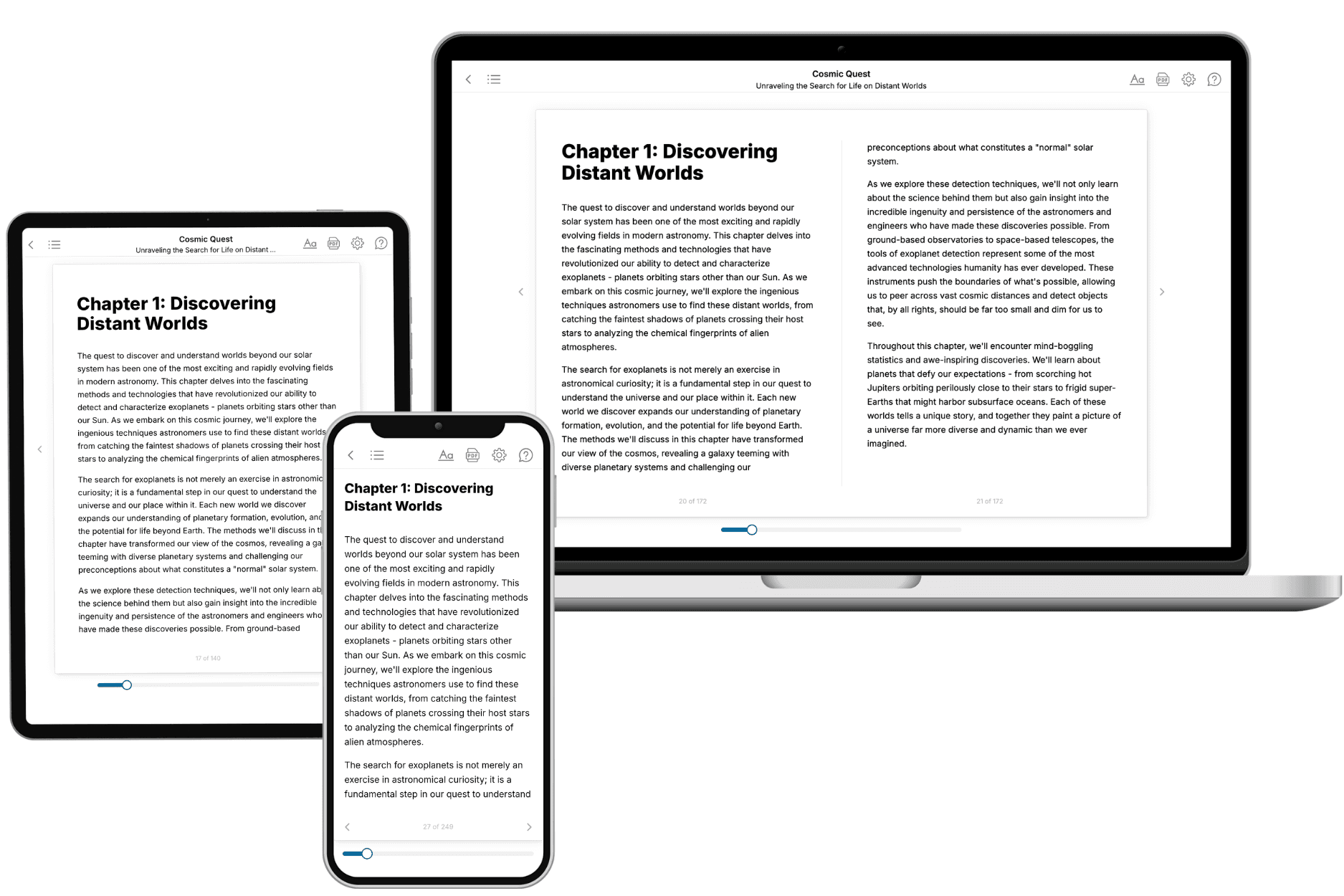
Your book is ready in 10 minutes. Read it online, download as EPUB or PDF, or send to Kindle.

Frequently asked questions
- What is TailoredRead?
TailoredRead creates complete, full-length nonfiction ebooks, written specifically for you. Tell us what you want to learn and why, and TailoredRead writes you a complete ebook on it, with charts, tables, and diagrams throughout. Read it online, on Kindle, or on any e-reader, or download it as a PDF or EPUB. Every book is written fresh the day you order it.
- How is the book tailored to me?
Before anything is written, you answer a few short questions about your goals, your background, and the topics you care about. Your book is then planned around your answers: written at your level, focused on your goals, and covering the topics you chose, instead of the one-size-fits-all book a store sells everyone.
- Will it read like generic AI content?
No. Your book isn't a chat transcript: it's planned chapter by chapter before a single word is written, told in a clear book voice, and explains ideas visually with charts, tables, and diagrams. After writing, every book goes through an editorial pass that polishes chapters so the book reads consistent from start to finish. Judge for yourself: browse thousands of sample books on our Explore Books page.
- How accurate is the content?
Our AI first checks whether your subject needs live research. Niche and fast-moving subjects are researched before writing, and the book plan and chapters are grounded in what it finds. After writing, every book goes through a quality pass that checks its facts and consistency, and researched books list their sources in a Notes section at the back.
- How long is the book?
You choose the length: Comprehensive (250-300 pages), Detailed (150-200 pages), Essential (70-100 pages), or Short (30-50 pages).
- Does the book include visuals?
Yes. Every book includes visual elements such as timelines, checklists, step-by-step guides, decision trees, comparison tables, and matrices, and many include bar charts. A typical book includes dozens of these visual elements.
- Can I read it on Kindle? What formats can I download?
Yes. Every book can be read in our online reader or downloaded as a PDF or EPUB. The EPUB can be opened with Kindle, Apple Books, Kobo, and any e-reader. The Commercial and Author licenses also include an editable Word (DOCX) and Markdown download.
- How much does it cost?
About the price of a regular ebook. The exact price depends on your book's length and complexity, from $2 for the shortest books to $35 for the most comprehensive, and it's shown when you review your book, before you commit to anything. Each book is a one-time purchase, yours to keep, no subscription. Licenses that let you share, teach, or publish your book range from $35.99 to $49.99.
- Can I preview the book before purchasing?
Before you pay, you'll see what your book will cover: the title, a detailed description, the estimated length, and the complete chapter-by-chapter table of contents, so you know what you're getting before you decide. The full text itself is written after you purchase.
- How long does it take to create a book?
About 10 minutes. You can start reading the opening chapters while the rest is still being written.