The Partitive Article Mastery Guide
Master French Grammar's Most Misunderstood Concept
You'll move from confusion to confidence by understanding exactly when and why French uses partitive articles instead of other article types.
222 pages10 chaptersFeb 14, 2026Learn French
About this book
This guide breaks down the partitive article system into clear, manageable concepts that build on each other logically. Rather than memorizing rules, you'll develop an intuitive grasp of how French speakers think about quantity and specificity. Each chapter combines clear explanations with practical examples drawn from real French conversations, menus, news, and literature. You'll discover why your English instincts mislead you and how to retrain your brain to think in French. By the end, you'll recognize partitive articles instantly, use them naturally in speech and writing, and understand the subtle differences that distinguish fluent speakers from intermediate learners. This book transforms a notoriously difficult grammar concept into your competitive advantage in French fluency.
Table of contents
- IntroductionWhy Partitive Articles Matter for Your French, The Struggles You've Probably Faced, How to Use This Book for Maximum LearningRead below
- Chapter 1: The Three Article Systems in FrenchDefinite Articles: Talking About Specific Things, Indefinite Articles: Talking About One or More Items, Partitive Articles: The Missing Piece
- Chapter 2: Understanding Quantity and SpecificityCountable Nouns Versus Uncountable Nouns, Specific Versus Indefinite Quantity, The Quantity Spectrum: From Specific to Vague
- Chapter 3: The Forms of Partitive ArticlesDu, De la, Des: The Three Forms, Gender and Number Agreement Rules, Pronunciation and Contractions with Prepositions
- Chapter 4: When to Use Partitive ArticlesUsing Partitives with Uncountable Nouns, Expressing Abstract Concepts and Qualities, Indicating Partial or Unspecified Quantities
- Chapter 5: Partitive Articles in Negative SentencesHow Negation Transforms Partitive Articles, The Ne...Pas Construction with Partitives, Other Negative Expressions and Partitives
- Chapter 6: Verbs and Expressions That Require PartitivesVerbs of Consumption: Manger, Boire, Prendre, Expressions of Quantity and Measurement, Special Verb Constructions and Idioms
- Chapter 7: Common Mistakes and How to Avoid ThemEnglish Interference: Your Brain's Biggest Obstacle, Confusing Partitives with Definite or Indefinite Articles, Strategies for Self-Correction and Improvement
- Chapter 8: Partitive Articles in Real-World ContextsFood, Dining, and Restaurant Conversations, Shopping, Markets, and Commercial Transactions, Everyday Conversations and Social Interactions
- Chapter 9: Advanced Partitive ConceptsPartitive Articles with Adjectives and Modifiers, Partitive Articles in Questions and Interrogatives, Regional Variations and Stylistic Nuances
- Chapter 10: Practice and ApplicationGuided Exercises with Detailed Explanations, Analyzing Partitives in Authentic French Materials, Speaking and Writing Practice Scenarios
- ConclusionYour Path Forward: From Learner to Fluent Speaker, Continued Mastery and Lifelong Learning
- Glossary of Key Terms
- Further Reading and Resources
Introduction
You've been studying French for months or even years, and you can conjugate verbs, construct sentences, and hold basic conversations. Yet there's one grammatical element that continues to trip you up every single time: those mysterious little words du, de la, and des that seem to appear randomly before nouns. You know they're called partitive articles, and you've read the textbook explanations, but when you're speaking or writing, you freeze. Should you say Je veux du pain
or Je veux le pain
? Why does your French teacher correct J'ai mangé des pommes
to J'ai mangé les pommes
in one sentence but not another? The confusion is real, and you're not alone in experiencing it.
Partitive articles represent one of the most challenging aspects of French grammar for English speakers because English simply doesn't have an equivalent structure. When you say I want bread
in English, you don't need any article at all. But French requires you to make a grammatical choice that reflects how you're thinking about that bread—is it specific bread, some bread, or bread in general? This fundamental difference in how the two languages conceptualize quantity and specificity creates a persistent stumbling block. Your brain wants to translate directly from English, but direct translation leads you astray every time. The result is hesitation, errors, and a nagging sense that you'll never quite master this aspect of French.
This book exists to eliminate that confusion permanently. You're about to embark on a systematic journey through the partitive article system that will transform your understanding from murky to crystal clear. Rather than memorizing disconnected rules, you'll develop an intuitive grasp of the underlying logic that governs when and why French uses partitive articles. You'll discover practical patterns, learn to recognize common contexts, and develop strategies for self-correction. By the time you finish this guide, partitive articles will no longer be a source of anxiety but rather a tool you wield confidently and naturally. Your French will sound more native, your comprehension will improve, and you'll finally understand what's happening in those conversations and texts where partitive articles appear constantly.
Why Partitive Articles Matter for Your French
Partitive articles aren't just another grammar rule to memorize—they're fundamental to how French speakers communicate about the world around them. Every time you discuss food, drinks, abstract concepts, or unspecified quantities, you need partitive articles. Consider how often you talk about eating, drinking, shopping, or experiencing emotions in a typical day. In French, virtually all of these conversations require correct partitive article usage. When you say Je bois du café
(I'm drinking coffee), Elle a de la patience
(She has patience), or Nous achetons des légumes
(We're buying vegetables), you're using partitive articles to express ideas that English handles differently. Without mastering this structure, your French remains fundamentally incomplete.
The frequency of partitive articles in everyday French cannot be overstated. Research on spoken French corpus data shows that partitive articles appear in approximately fifteen to twenty percent of all sentences in casual conversation[1]. This means that in any five-minute conversation, you'll encounter dozens of instances where native speakers use partitives naturally and automatically. When you listen to French radio, watch French films, or read French newspapers, partitive articles are everywhere. They're not an obscure grammatical curiosity reserved for formal writing—they're the everyday language of French speakers discussing ordinary topics. If you can't recognize and use them correctly, you're missing a crucial component of authentic French communication.
Beyond mere frequency, partitive articles carry important semantic information that affects meaning. The difference between Je veux le pain
(I want the bread—specific bread we've been discussing) and Je veux du pain
(I want some bread—any bread, an unspecified amount) is not trivial. These articles signal to your listener whether you're talking about something specific or something general, whether you mean a complete quantity or a partial amount. Using the wrong article doesn't just sound ungrammatical—it can actually confuse your meaning or make you sound unintentionally rude or unclear. Native speakers use these distinctions automatically to communicate precisely, and you need to develop the same intuitive sense.
Mastering partitive articles also dramatically improves your listening comprehension. When you understand the system, you can decode what native speakers mean even when they speak quickly. You'll recognize that J'ai pas d'argent
(I don't have any money) uses de instead of d'argent because of negation rules. You'll catch the difference between Elle mange des fruits
(She's eating some fruits) and Elle mange les fruits
(She's eating the fruits—specific ones). These distinctions flash by in rapid conversation, but once you've internalized the patterns, your brain processes them automatically. Your comprehension becomes faster and more accurate because you're not struggling to parse these fundamental grammatical structures.
From a practical standpoint, correct partitive article usage is one of the markers that distinguishes intermediate learners from advanced speakers. Native French speakers and experienced teachers can immediately identify learners who haven't mastered partitives because the errors are so noticeable and frequent. Conversely, when you use partitive articles correctly and naturally, you signal linguistic competence. Your French sounds more polished, more native-like, and more confident. This isn't about perfectionism—it's about effective communication. The investment you make in understanding partitive articles pays dividends across every aspect of your French proficiency, from casual conversations to professional contexts.
Finally, understanding partitive articles opens the door to understanding broader patterns in French grammar. The same conceptual framework that governs partitives—thinking about specificity, quantity, and countability—applies to other grammatical structures as well. Once you grasp how French conceptualizes these categories differently from English, you'll find other aspects of French grammar becoming clearer too. The partitive article system is a window into the French linguistic worldview, and mastering it gives you insight into how the language works at a fundamental level. This deeper understanding accelerates your overall language acquisition and makes future learning more intuitive.
Consider this concrete example of why partitives matter. Imagine you're at a French bakery. If you say Je voudrais le pain
, you're asking for a specific loaf of bread, probably one you're pointing at or that you've discussed previously. But if you say Je voudrais du pain
, you're asking for some bread—any bread, an unspecified amount. The baker might ask you how much or what type. Now imagine you say Je voudrais pain
with no article at all—you sound like a beginner struggling with basic grammar. These small words carry significant communicative weight, and using them correctly transforms your ability to navigate real-world French situations with confidence and clarity.
The Struggles You've Probably Faced
If you're reading this book, you've almost certainly experienced the frustration of partitive article confusion firsthand. Perhaps you've been in a French restaurant, trying to order, and you froze when deciding whether to say Je voudrais du vin
or Je voudrais le vin
. Maybe you've written an email or essay in French, and your teacher circled every instance where you used the wrong article, leaving you bewildered about what you did wrong. Or perhaps you've been speaking with a French friend who politely corrected your article usage, but you couldn't understand the underlying reason for the correction. These experiences are universal among French learners, and they stem from predictable patterns of confusion that this book will address systematically.
One of the most common struggles involves the fundamental question of when to use any article at all. In English, you can say I like coffee
, She needs patience
, or We're buying vegetables
without any article before the noun. Your English-speaking brain has been trained for decades to omit articles in these contexts. But French requires articles in virtually all of these situations—J'aime le café
, Elle a besoin de patience
, Nous achetons des légumes
. The challenge is that sometimes French uses definite articles (le, la, les), sometimes partitive articles (du, de la, des), and sometimes the preposition de alone. Your textbook might have given you rules, but applying them in real-time conversation feels impossible.
Another persistent struggle involves negative sentences. You might have learned that partitive articles change to de in negative constructions, so J'ai du temps
(I have time) becomes Je n'ai pas de temps
(I don't have time). But then you encounter exceptions like Ce n'est pas du vin, c'est du jus
(That's not wine, it's juice), where the partitive article remains even in a negative sentence. These apparent contradictions make you question whether you understand the rule at all. You start second-guessing yourself constantly, and the mental effort required to choose the correct article slows down your speech and makes you sound hesitant. The cognitive load of processing partitive articles while simultaneously constructing sentences and choosing vocabulary becomes overwhelming.
Many learners also struggle with the distinction between partitive des and indefinite article des. Both look identical, but they function differently. When you say J'ai des amis
(I have friends), you're using the indefinite article—you're talking about countable friends, some number of them. But when you say J'ai des doutes
(I have doubts), you might be using the partitive article, expressing an unspecified quantity of doubt. The ambiguity is confusing, and textbooks often gloss over this distinction or explain it in ways that don't clarify the practical difference. You're left wondering whether there's actually a meaningful distinction or whether French speakers themselves are confused about it.
The challenge intensifies when you encounter expressions of quantity. You learn that after quantity expressions like beaucoup de (a lot of), un peu de (a little of), or trop de (too much of), you use de alone without any article: beaucoup de pain
, not beaucoup du pain
. But then you see la plupart des gens
(most people) with des, and bien du courage
(quite a lot of courage) with du. The exceptions seem to outnumber the rules, and you feel like you're memorizing arbitrary patterns rather than understanding a coherent system. This sense of arbitrariness is demoralizing and makes you wonder whether you'll ever develop native-like intuition.
Perhaps the most frustrating struggle is the gap between recognition and production. You might be able to recognize partitive articles when you see them in written French or hear them in slow, clear speech. You can complete fill-in-the-blank exercises in your textbook with reasonable accuracy. But when you're speaking spontaneously, trying to express your own thoughts in real-time, the correct article simply doesn't come to mind. You default to what feels natural based on English, which is often wrong. Or you hesitate so long trying to remember the rule that the conversation moves on without you. This gap between passive knowledge and active use is one of the most common and persistent challenges in language learning, and it requires specific strategies to overcome.
Finally, many learners struggle with the emotional and psychological aspects of partitive article confusion. After months or years of making the same mistakes repeatedly, you might feel discouraged or even embarrassed. You might avoid certain constructions or topics because you know they require partitive articles and you're not confident using them. This avoidance strategy limits your expressive range and keeps you stuck at an intermediate plateau. You might also experience anxiety when speaking with native speakers, worrying that your article errors make you sound incompetent or uneducated. These emotional barriers are real and valid, and addressing them is part of the learning process. This book acknowledges these struggles and provides not just grammatical explanations but also practical strategies for building confidence and overcoming psychological blocks.
How to Use This Book for Maximum Learning
This book is structured to build your understanding systematically, from foundational concepts to advanced applications. Each chapter addresses a specific aspect of partitive articles, and the chapters are ordered to create a logical progression. You'll start by understanding how partitive articles fit into the broader French article system, then move through the forms and functions of partitives, explore common contexts and challenges, and finally practice applying your knowledge in realistic scenarios. While you can certainly jump to specific chapters that address your immediate questions, you'll gain the most comprehensive understanding by working through the book sequentially. The concepts build on each other, and later chapters assume familiarity with material covered earlier.
As you read each chapter, approach the material actively rather than passively. Don't just read the explanations—engage with them. When you encounter an example sentence, pause and analyze it. Ask yourself why that particular article was used. Try to construct similar sentences using the same pattern. Cover up the English translations and see if you can understand the French examples on your own. This active engagement transforms reading from a passive activity into a learning experience that builds neural pathways and strengthens your intuitive grasp of the material. The more actively you engage with each example and explanation, the more effectively you'll internalize the patterns.
Pay special attention to the examples throughout the book. Each example has been carefully chosen to illustrate a specific point or pattern. The examples progress from simple to complex within each chapter, allowing you to build confidence gradually. When you see an example, don't just glance at it—study it. Notice the context, the surrounding words, and the specific article choice. Many examples include multiple variations showing what's correct and what's incorrect, helping you develop the ability to distinguish between similar constructions. These comparative examples are particularly valuable because they highlight the precise distinctions that matter in French. Create your own examples following the same patterns to reinforce your understanding.
The book includes practical exercises and application scenarios, particularly in later chapters. Approach these exercises seriously, even if you're tempted to skip them. Research on language acquisition consistently shows that active production—actually using the language yourself—is far more effective for long-term retention than passive exposure[2]. When you encounter an exercise, complete it fully before checking the answers or explanations. If you make mistakes, that's valuable information—it shows you exactly where your understanding needs strengthening. Review the relevant sections, then try the exercise again. This iterative process of attempting, checking, reviewing, and re-attempting is how you transform theoretical knowledge into practical skill.
Consider keeping a dedicated notebook or digital document for your partitive article learning journey. As you work through the book, record examples that particularly resonate with you, patterns you find helpful, and mistakes you tend to make. Create your own reference sheets summarizing key rules and exceptions. Write out practice sentences and have them checked by a teacher, tutor, or language exchange partner if possible. This personalized reference material becomes increasingly valuable over time because it reflects your specific learning needs and challenges. The act of writing things down also reinforces learning through the motor memory of handwriting or typing.
Don't rush through the material. Partitive articles are complex, and developing true mastery takes time and repeated exposure. It's better to work through one chapter thoroughly, practicing and internalizing the concepts, than to race through the entire book without retention. Consider spending several days or even a week on each chapter, depending on your available study time and the complexity of the material. Return to earlier chapters periodically to refresh your understanding and notice details you might have missed on first reading. This spaced repetition approach, where you revisit material at increasing intervals, is one of the most effective learning strategies supported by cognitive science research[3].
Supplement your reading with real-world French exposure. As you learn about partitive articles in this book, start noticing them in authentic French materials. Watch French films or TV shows with French subtitles and pause when you hear partitive articles. Read French news articles, blogs, or social media posts and highlight every partitive article you find. Listen to French podcasts and try to catch partitive articles in natural speech. This real-world exposure reinforces what you're learning in the book and helps you see how native speakers actually use these structures in context. Create a collection of authentic examples that illustrate the patterns you're studying. This bridge between textbook learning and real-world usage is crucial for developing practical fluency.
Finally, be patient and compassionate with yourself throughout this learning process. Mastering partitive articles is genuinely challenging, and you will make mistakes. Every French learner makes these mistakes, including those who eventually achieve native-like fluency. Mistakes are not failures—they're essential data points that show you where your understanding needs refinement. When you catch yourself making an error, view it as progress rather than setback. You're now aware enough to recognize the error, which means your knowledge is developing. Celebrate small victories: the first time you use a partitive article correctly without thinking about it, the moment you catch yourself about to make an error and self-correct, the conversation where you notice you're using partitives naturally. These milestones mark your journey from confusion to mastery, and they're worth acknowledging and celebrating.
This book is your comprehensive guide to one of French grammar's most challenging concepts. By the time you complete it, partitive articles will no longer be a source of anxiety but rather a tool you wield with confidence and precision. Your French will sound more natural, your comprehension will deepen, and you'll have eliminated one of the major obstacles that keeps intermediate learners from advancing to fluency. The journey begins now, with a clear understanding of why partitive articles matter and a structured path forward. Turn the page, and let's begin transforming your relationship with this essential aspect of French grammar.
Notes
Introduction
- 1. Paul Rowlett, The Syntax of French, Cambridge University Press, 2007
- 2. Merrill Swain, Communicative competence: Some roles of comprehensible input and comprehensible output in its development, Input in Second Language Acquisition, 1985
- 3. Nicholas J. Cepeda and others, "Distributed practice in verbal recall tasks," Psychological Bulletin, 2006
This is the end of the free sample. The full book has 10 chapters.
Want this book written for you?
Tell us your goals and background, and get your own version of this book, tailored by AI to you.


Benefits of AI-tailored books
- Read one book, not ten:
- all the Learn French knowledge you need, gathered into a single book.
- Save days of learning:
- tell us your goals, choose your topics, and the whole book is built around them.
- Learn effortlessly:
- Learn French book written for your specific background and expertise.
- Understand at a glance:
- includes charts, tables, timelines, checklists, decision trees, and more.
- Stay current:
- written the day you order it, not years ago.
- Trust what you read:
- every book is checked for accuracy, with real research when your subject needs it.
Create your unique book in 3 steps
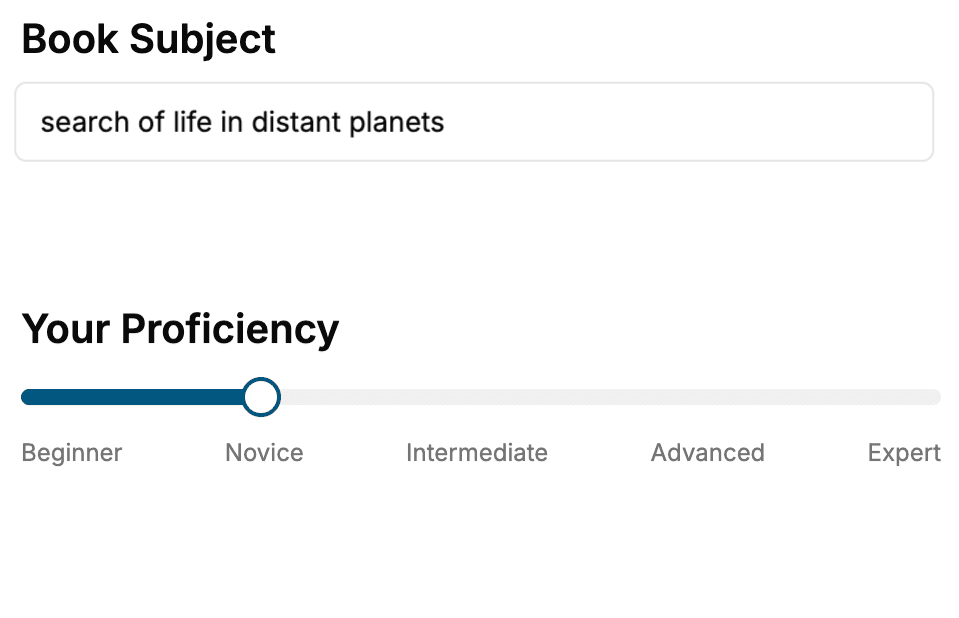
- 1. Select your focus
Select the focus of your Learn French book and share your background
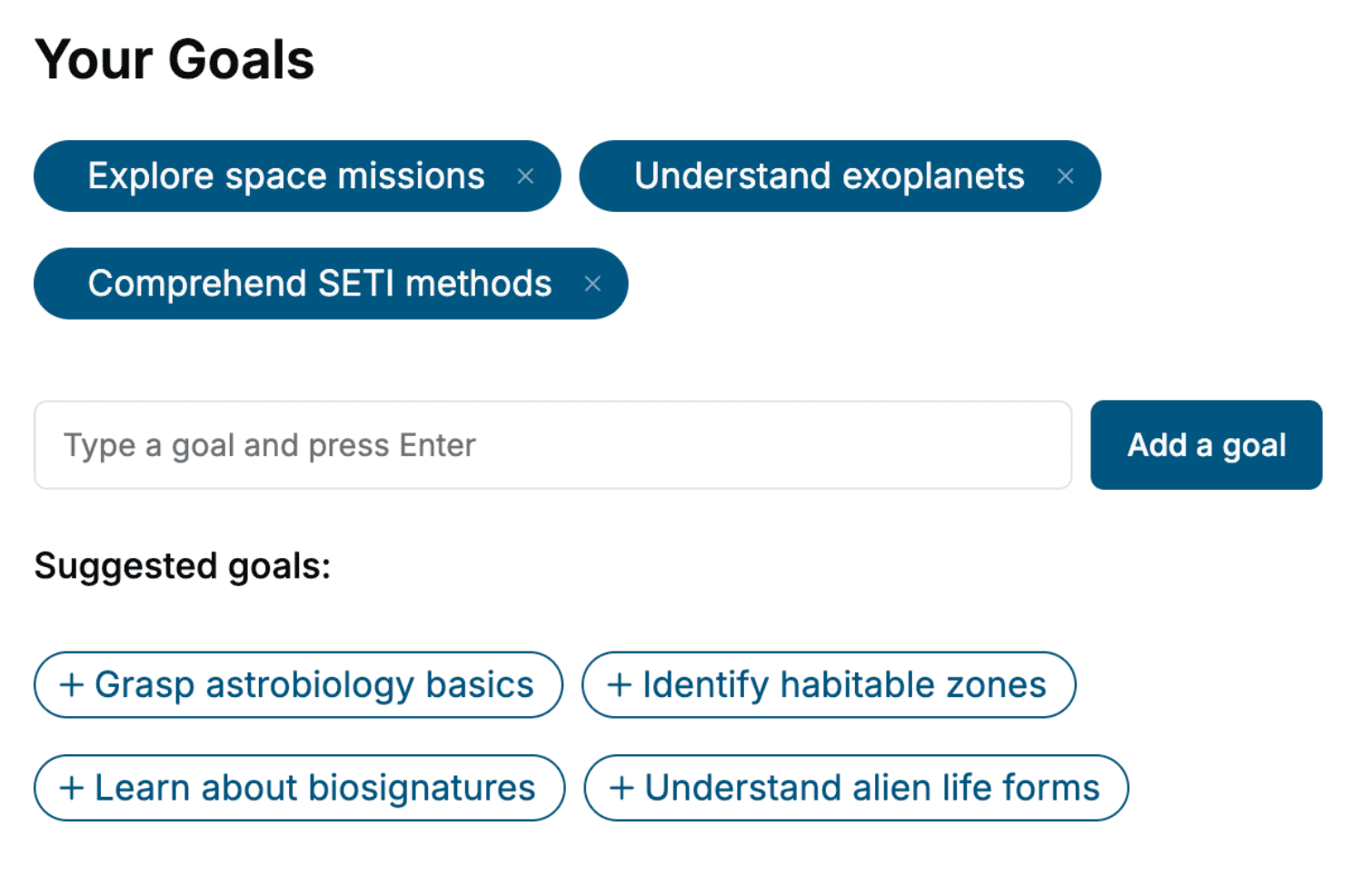
- 2. Personalize your book
Specify your goals and choose sub-topics to include
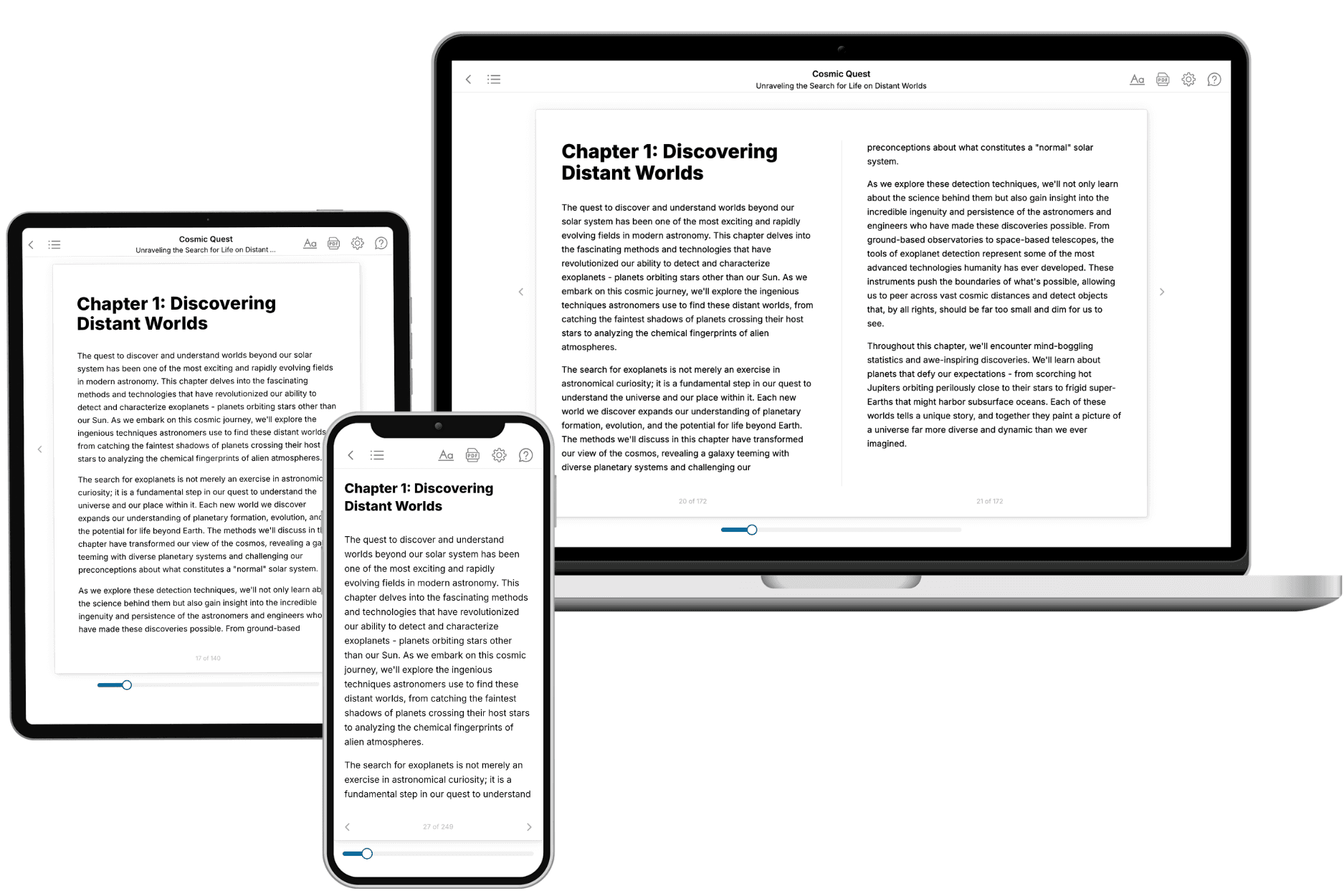
- 3. Get your tailored book
Your book is ready in 10 minutes. Read it online, download as EPUB or PDF, or send to Kindle.
Frequently asked questions
- What is TailoredRead?
TailoredRead creates complete, full-length nonfiction ebooks, written specifically for you. Tell us what you want to learn and why, and TailoredRead writes you a complete ebook on it, with charts, tables, and diagrams throughout. Read it online, on Kindle, or on any e-reader, or download it as a PDF or EPUB. Every book is written fresh the day you order it.
- How is the book tailored to me?
Before anything is written, you answer a few short questions about your goals, your background, and the topics you care about. Your book is then planned around your answers: written at your level, focused on your goals, and covering the topics you chose, instead of the one-size-fits-all book a store sells everyone.
- Will it read like generic AI content?
No. Your book isn't a chat transcript: it's planned chapter by chapter before a single word is written, told in a clear book voice, and explains ideas visually with charts, tables, and diagrams. After writing, every book goes through an editorial pass that polishes chapters so the book reads consistent from start to finish. Judge for yourself: browse thousands of sample books on our Explore Books page.
- How accurate is the content?
Our AI first checks whether your subject needs live research. Niche and fast-moving subjects are researched before writing, and the book plan and chapters are grounded in what it finds. After writing, every book goes through a quality pass that checks its facts and consistency, and researched books list their sources in a Notes section at the back.
- How long is the book?
You choose the length: Comprehensive (250-300 pages), Detailed (150-200 pages), Essential (70-100 pages), or Short (30-50 pages).
- Does the book include visuals?
Yes. Every book includes charts, tables, and diagrams: timelines, checklists, step-by-step guides, decision trees, comparison tables, matrices, and bar charts. A typical book includes dozens of these visual elements.
- Can I read it on Kindle? What formats can I download?
Yes. Every book can be read in our online reader or downloaded as a PDF or EPUB. The EPUB can be opened with Kindle, Apple Books, Kobo, and any e-reader. The Commercial and Author licenses also include an editable Word (DOCX) and Markdown download.
- How much does it cost?
About the price of a regular ebook. The exact price depends on your book's length and complexity, from $2 for the shortest books to $35 for the most comprehensive, and it's shown when you review your book, before you commit to anything. Each book is a one-time purchase, yours to keep, no subscription. Licenses that let you share, teach, or publish your book range from $35.99 to $49.99.
- Can I preview the book before purchasing?
Before you pay, you'll see what your book will cover: the title, a detailed description, the estimated length, and the complete chapter-by-chapter table of contents, so you know what you're getting before you decide. The full text itself is written after you purchase.
- How long does it take to create a book?
About 10 minutes. You can start reading the opening chapters while the rest is still being written.