Phanom Rung: A Complete Guide to Thailand's Mountaintop Masterpiece
Discover the History, Architecture, and Sacred Significance of Southeast Asia's Most Stunning Khmer Temple
Discover what makes Phanom Rung one of Thailand's most extraordinary destinations.
191 pages8 chaptersJul 6, 2026Thailand Travel Guide
About this book
This guide takes you through the fascinating history of this 11th-century Khmer temple perched 835 meters above the Nakhon Ratchasima plateau, revealing how ancient architects engineered a sanctuary that aligns with celestial events and showcases masterful stone carving. You'll explore the temple's architectural elements, understand the spiritual beliefs embedded in its design, and learn the stories behind its remarkable restoration. Beyond history, you'll find practical guidance on planning your visit—from the best times to experience the famous equinox phenomenon to navigating the steep approach and understanding what you're seeing at each level. Whether you're a history enthusiast, architecture lover, or curious traveler, this comprehensive guide prepares you to experience Phanom Rung not as a tourist checking off a list, but as someone who truly understands the significance of what you're witnessing.
Table of contents
- IntroductionWhy Phanom Rung Matters, What You'll Discover in This Guide, How to Use This BookRead below
- Chapter 1: The Khmer Empire and Its Legacy in ThailandUnderstanding the Khmer Civilization, Khmer Expansion into Present-Day Thailand, The Lasting Cultural Legacy
- Chapter 2: Phanom Rung: Origins and Historical TimelineThe Founding Period (10th Century), Expansion and Development (11th-13th Centuries), Decline, Abandonment, and Rediscovery, Modern Restoration and Preservation
- Chapter 3: Architectural Mastery: Design and StructureThe Temple's Overall Layout and Orientation, Key Structural Elements and Materials, Ancient Construction Techniques and Engineering
- Chapter 4: The Equinox Phenomenon and Astronomical AlignmentUnderstanding the Celestial Alignment, The Famous Equinox Event Explained, Spiritual and Religious Significance, Planning Your Visit for the Equinox
- Chapter 5: Stone Carvings and IconographyReligious Symbolism in Stone, Decorative Elements and Motifs, How to Interpret What You're Seeing
- Chapter 6: A Level-by-Level ExplorationThe Approach and Naga Stairway, The Outer Galleries and Courtyards, The Inner Sanctuary and Central Prang
- Chapter 7: Planning Your Visit: Practical EssentialsGetting There: Transportation Options, Best Times to Visit and What to Expect, Physical Preparation and What to Bring, Entrance Fees, Hours, and Facilities
- Chapter 8: Maximizing Your Experience: Tips and InsightsThe Value of Hiring a Knowledgeable Guide, Photography Tips and Best Vantage Points, Cultural Etiquette and Respectful Visiting, Nearby Attractions and Extended Itineraries
- ConclusionThe Lasting Impressions of Phanom Rung, Continuing Your Journey Through Thai History
- Glossary of Terms
- Further Reading and Resources
Introduction
Imagine standing at the top of an ancient volcano, looking down a long stone processional walkway that stretches nearly 200 meters before you. Lotus-bud finials line both sides. A pair of stone bridges cross shallow reflecting pools. And at the far end, a towering sandstone sanctuary rises against the open sky of northeastern Thailand. This is Phanom Rung, and the moment you see it for the first time, something shifts. You realize you are not simply looking at old stones. You are looking at a thousand years of human ambition, devotion, and extraordinary skill.
Phanom Rung Historical Park sits in Buriram Province, roughly 400 kilometers northeast of Bangkok, perched on the rim of an extinct volcano at 835 meters above sea level. The Khmer people built this temple complex between the 10th and 13th centuries, dedicating it primarily to the Hindu god Shiva. At its peak, it served as a major religious and political center along the ancient road connecting the Khmer capital of Angkor to the broader empire. Today, it stands as one of the best-preserved and most architecturally sophisticated Khmer temples anywhere in Southeast Asia, including those found in Cambodia itself.
Despite its remarkable significance, Phanom Rung remains far less visited than Angkor Wat or even some of Thailand's more famous Buddhist temples. That relative quietness is part of its appeal. On most days, you can walk its galleries, study its carvings, and stand inside its central sanctuary without the overwhelming crowds that characterize more famous heritage sites. But that accessibility also means many visitors arrive without the background knowledge to fully understand what they are seeing. A carved lintel becomes just a decorative stone. A precisely oriented doorway becomes just an entrance. This guide exists to change that.
Whether you are planning a first visit, preparing to return with deeper curiosity, or simply exploring Thailand's history from home, this book gives you the context, detail, and practical knowledge to engage with Phanom Rung on a much richer level. The chapters ahead cover everything from the rise and fall of the Khmer Empire to the engineering logic behind the temple's famous astronomical alignments. You will learn how to read the stone carvings, navigate the site level by level, and plan your trip with confidence. By the time you finish, Phanom Rung will not just be a destination on a map. It will be a place you genuinely understand.
Why Phanom Rung Matters
Phanom Rung is not simply one of many ancient temples scattered across Southeast Asia. It represents a specific and remarkable convergence of geography, religion, politics, and artistic achievement that makes it genuinely unique. The Khmer builders did not choose this volcanic summit by accident. The elevation gave the temple a commanding presence visible for miles across the Khorat Plateau. The site also carried deep spiritual meaning, since the Khmer associated mountaintops with Mount Meru, the sacred cosmic mountain at the center of the Hindu universe. Building here was a statement about divine authority and cosmic order.
The temple's architectural quality is exceptional even by Khmer standards. Scholars and archaeologists who have studied both Phanom Rung and the temples of Angkor consistently note that the craftsmanship here rivals anything produced at the Khmer heartland in Cambodia.[1] The stone carvings are intricate and well-preserved. The proportions of the central tower, known as the prang, reflect a sophisticated understanding of visual harmony. The processional walkway creates a ceremonial approach that builds anticipation and frames the sanctuary in a way that feels deliberately theatrical and spiritually charged.
One of the most compelling reasons Phanom Rung matters is the astronomical phenomenon it was designed to produce. Four times a year, the rising or setting sun aligns perfectly through all fifteen doorways of the temple's main axis, creating a tunnel of light that passes from the eastern entrance straight through to the western wall of the inner sanctuary. The most celebrated of these alignments occurs around the time of the March and September equinoxes. This was not accidental. The Khmer architects planned it deliberately, embedding a celestial calendar into the very structure of the building. Very few ancient monuments anywhere in the world demonstrate this level of astronomical precision combined with architectural beauty.
Phanom Rung also matters because of what it tells us about cultural exchange in Southeast Asia. The temple was built by Khmer rulers and dedicated to Hindu deities, yet it stands on soil that is now Thailand. Over the centuries, it was adapted, reused, and eventually absorbed into the Buddhist traditions of the Thai kingdoms that followed. Some of its original Hindu sculptures were modified or replaced. New Buddhist elements were added. The site became a layered record of religious and cultural transformation spanning more than a millennium. Understanding Phanom Rung means understanding how civilizations borrow, adapt, and build upon each other's legacies.
The temple's modern story is equally significant. For much of the 20th century, Phanom Rung sat in a state of partial ruin, its stones scattered, its galleries collapsed, and its most famous carved lintel missing entirely. A decades-long restoration project, completed in 1988, reassembled the complex with painstaking care. The return of the stolen Narai lintel from the Art Institute of Chicago in 1988, after years of diplomatic effort, became a landmark moment in the global conversation about cultural heritage and the repatriation of looted antiquities.[2] Phanom Rung is therefore not just a window into the ancient past. It is also a story about how modern societies choose to protect and reclaim their history.
Finally, Phanom Rung matters because of the experience it offers. There are heritage sites that impress through sheer scale, and there are sites that move you through intimacy and detail. Phanom Rung does both. The approach along the processional walkway gives you a sense of grand ceremony. The carvings on the lintels and pediments reward close, patient attention. The view from the summit, looking out over the flat plateau in every direction, connects you physically to the landscape the ancient Khmer surveyed and chose. Few places in Thailand offer this combination of intellectual depth and visceral impact in a single visit.
What You'll Discover in This Guide
This guide is organized to take you from broad historical context down to the specific details of individual carvings and practical logistics. Each chapter builds on the one before it, so reading from start to finish gives you the most complete picture. That said, every chapter is also designed to stand on its own if you want to jump directly to a specific topic. Here is a brief overview of what each section covers and why it matters for your understanding of Phanom Rung.
Chapter 1 introduces the Khmer Empire and its expansion into what is now Thailand. Before you can understand Phanom Rung, you need to understand the civilization that built it. This chapter covers the political structure of the Khmer state, the religious beliefs that drove temple construction, and the network of roads and outposts that connected distant sites like Phanom Rung to the imperial capital at Angkor. It also examines the lasting cultural legacy the Khmer left on Thai art, architecture, and religious practice.
Chapter 2 traces the specific history of Phanom Rung from its earliest construction in the 10th century through its expansion, decline, abandonment, and eventual restoration. This chapter introduces the key historical figures associated with the site, including the local Khmer lords who commissioned its construction and the rulers who expanded it over successive generations. It also covers the modern restoration project and the story of the famous stolen lintel.
Chapters 3 and 4 go deep into the architecture. Chapter 3 examines the temple's overall layout, its structural elements, and the construction techniques the Khmer used to build on a volcanic summit without modern equipment. Chapter 4 focuses entirely on the astronomical alignments, explaining the geometry behind the equinox phenomenon and what it meant spiritually to the people who designed and used the temple.
Chapter 5 is a guide to reading the stone carvings. Phanom Rung is covered in intricate relief sculpture depicting scenes from Hindu mythology, royal ceremonies, and cosmic battles. This chapter explains the most important iconographic elements you will encounter, including the key figures from the Ramayana and Mahabharata, the symbolic meaning of the naga serpent, and how to identify different Hindu deities from their attributes and postures.
Chapter 6 takes you through the site level by level, from the base of the volcano to the inner sanctuary. Think of it as a guided walk you can follow in real time during your visit. Each section describes what you will see, what to look for, and what it means. This chapter is particularly useful to read again on-site, either the night before your visit or while you are actually walking the grounds.
Chapters 7 and 8 cover everything practical. Chapter 7 addresses transportation, timing, physical preparation, entrance fees, and facilities. Chapter 8 goes further, offering advice on hiring guides, photography, cultural etiquette, and nearby attractions worth combining with your Phanom Rung visit. Together, these two chapters give you everything you need to plan a visit that is comfortable, respectful, and deeply rewarding.
Throughout the guide, you will find specific examples, historical anecdotes, and practical tips drawn from the site itself. The goal is not to overwhelm you with academic detail but to give you exactly the knowledge that makes a difference when you are standing in front of a carved doorway or climbing the final staircase to the central tower. Every piece of information here was chosen because it genuinely enhances the experience of being at Phanom Rung.
How to Use This Book
There is no single right way to use this guide, because different readers come to Phanom Rung with different needs and different levels of prior knowledge. However, a few suggested approaches can help you get the most out of it depending on where you are in your journey with this site.
If you are planning a first visit and have several weeks before your trip, the best approach is to read the book from beginning to end. Start with the historical and architectural chapters to build your foundational understanding. Then read the practical chapters closer to your departure date, when the logistics are more immediately relevant. Re-read Chapter 6, the level-by-level exploration, the night before your visit so the layout is fresh in your mind when you arrive.
If you are already in Thailand and have a few days before visiting Phanom Rung, prioritize Chapters 2, 5, and 6. Chapter 2 gives you the historical narrative that makes the site feel alive rather than abstract. Chapter 5 teaches you to read the carvings, which transforms the experience from passive sightseeing into active discovery. Chapter 6 prepares you to navigate the site with purpose and attention. Then read Chapters 7 and 8 for the practical details you need immediately.
If you are visiting specifically for the equinox, Chapter 4 is essential reading before you go. The equinox event draws large crowds and requires advance planning. Understanding the astronomical mechanics and the spiritual significance of the alignment will make the experience far more meaningful than simply watching light pass through a doorway. Chapter 7 also contains specific advice about timing and logistics for equinox visits.
If you are a returning visitor who has already seen Phanom Rung and wants to go deeper, focus on Chapters 3, 4, and 5. These are the chapters most likely to reveal things you missed or did not fully understand on a first visit. Many people who return to Phanom Rung after reading more about its architecture and iconography describe the experience as feeling like an entirely different site. The carvings that seemed decorative on a first visit suddenly tell coherent stories. The proportions of the buildings reveal deliberate choices rather than arbitrary forms.
A few practical notes on how the book is structured will also help you navigate it efficiently. Key terms are introduced in bold when they first appear and are defined in the Glossary at the back of the book. If you encounter a Sanskrit or Khmer term that is unfamiliar, the Glossary is the quickest place to find a clear explanation. Footnotes throughout the text point to sources for specific claims and also suggest additional reading for topics you may want to explore further.
The most rewarding visits to heritage sites are not the ones where you see the most things. They are the ones where you understand what you are seeing. Phanom Rung rewards preparation more than almost any other site in Thailand, because its meaning is embedded in details that are invisible without context.
The Further Reading section at the end of the book lists academic works, travel resources, and online materials for those who want to go beyond what this guide covers. Phanom Rung has attracted serious scholarly attention, and there is a rich body of research available in English for readers who want to pursue specific topics in greater depth. The suggestions there are organized by theme, so you can easily find resources relevant to whichever aspect of the site interests you most.
One final note before you begin. Phanom Rung is an active heritage site managed by Thailand's Fine Arts Department. Conditions, opening hours, and access policies can change. The practical information in this guide reflects the most current available details at the time of writing, but it is always worth checking with the Fine Arts Department or a reliable local source before your visit to confirm current arrangements. The historical and architectural content, of course, will remain accurate regardless of when you visit. The stones have been there for a thousand years. They will be there when you arrive.
Now, let's begin where all great stories begin: with the civilization that made it all possible. The Khmer Empire was one of the most powerful and culturally sophisticated states in the history of Southeast Asia, and understanding it is the essential first step toward understanding Phanom Rung. Turn the page, and step back into a world of kings, gods, and extraordinary stone.
This is the end of the free sample. The full book has 8 chapters.
Want this book written for you?
Tell us your goals and background, and get your own version of this book, tailored by AI to you.


Benefits of AI-tailored books
- Read one book, not ten:
- all the Thailand Travel Guide knowledge you need, gathered into a single book.
- Save days of learning:
- tell us your goals, choose your topics, and the whole book is built around them.
- Learn effortlessly:
- Thailand Travel Guide book written for your specific background and expertise.
- Understand at a glance:
- includes charts, tables, timelines, checklists, decision trees, and more.
- Stay current:
- written the day you order it, not years ago.
- Trust what you read:
- every book is checked for accuracy, with real research when your subject needs it.
Create your unique book in 3 steps
- 1. Select your focus
Select the focus of your Thailand Travel Guide book and share your background
- 2. Personalize your book
Specify your goals and choose sub-topics to include
- 3. Get your tailored book
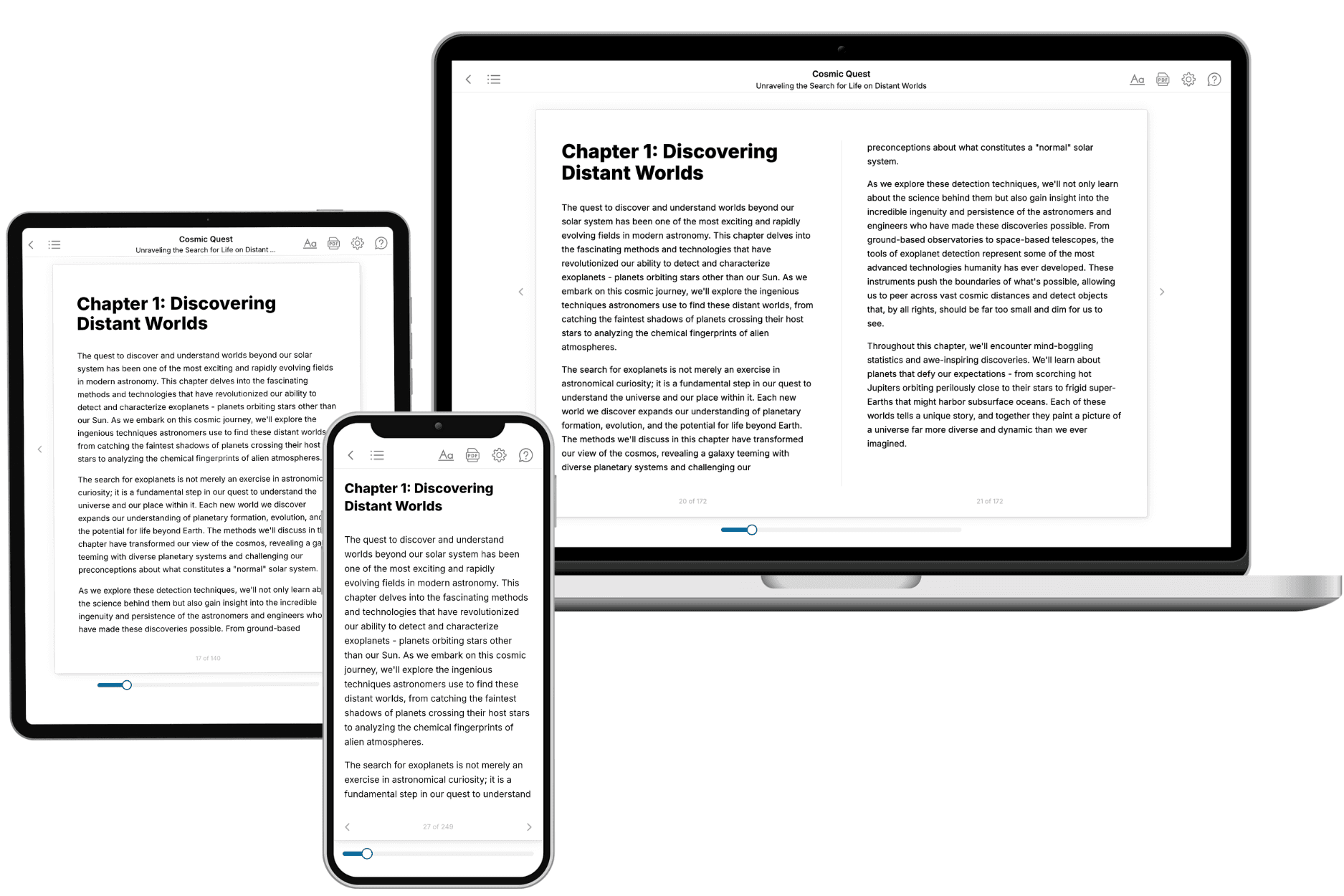
Your book is ready in 10 minutes. Read it online, download as EPUB or PDF, or send to Kindle.
Frequently asked questions
- What is TailoredRead?
TailoredRead creates complete, full-length nonfiction ebooks, written specifically for you. Tell us what you want to learn and why, and TailoredRead writes you a complete ebook on it, with charts, tables, and diagrams throughout. Read it online, on Kindle, or on any e-reader, or download it as a PDF or EPUB. Every book is written fresh the day you order it.
- How is the book tailored to me?
Before anything is written, you answer a few short questions about your goals, your background, and the topics you care about. Your book is then planned around your answers: written at your level, focused on your goals, and covering the topics you chose, instead of the one-size-fits-all book a store sells everyone.
- Will it read like generic AI content?
No. Your book isn't a chat transcript: it's planned chapter by chapter before a single word is written, told in a clear book voice, and explains ideas visually with charts, tables, and diagrams. After writing, every book goes through an editorial pass that polishes chapters so the book reads consistent from start to finish. Judge for yourself: browse thousands of sample books on our Explore Books page.
- How accurate is the content?
Our AI first checks whether your subject needs live research. Niche and fast-moving subjects are researched before writing, and the book plan and chapters are grounded in what it finds. After writing, every book goes through a quality pass that checks its facts and consistency, and researched books list their sources in a Notes section at the back.
- How long is the book?
You choose the length: Comprehensive (250-300 pages), Detailed (150-200 pages), Essential (70-100 pages), or Short (30-50 pages).
- Does the book include visuals?
Yes. Every book includes charts, tables, and diagrams: timelines, checklists, step-by-step guides, decision trees, comparison tables, matrices, and bar charts. A typical book includes dozens of these visual elements.
- Can I read it on Kindle? What formats can I download?
Yes. Every book can be read in our online reader or downloaded as a PDF or EPUB. The EPUB can be opened with Kindle, Apple Books, Kobo, and any e-reader. The Commercial and Author licenses also include an editable Word (DOCX) and Markdown download.
- How much does it cost?
About the price of a regular ebook. The exact price depends on your book's length and complexity, from $2 for the shortest books to $35 for the most comprehensive, and it's shown when you review your book, before you commit to anything. Each book is a one-time purchase, yours to keep, no subscription. Licenses that let you share, teach, or publish your book range from $35.99 to $49.99.
- Can I preview the book before purchasing?
Before you pay, you'll see what your book will cover: the title, a detailed description, the estimated length, and the complete chapter-by-chapter table of contents, so you know what you're getting before you decide. The full text itself is written after you purchase.
- How long does it take to create a book?
About 10 minutes. You can start reading the opening chapters while the rest is still being written.