Photosynthesis Unlocked
A Coloring Guide to Understanding How Plants Convert Light into Life
Have you ever wondered how plants actually turn sunlight into food?
207 pages9 chaptersNov 23, 2025Biology
About this book
Photosynthesis seems like magic, but it's actually one of nature's most elegant chemical processes—and it's happening right now in every leaf around you. This coloring book transforms the complex world of photosynthesis into an engaging, visual learning experience. By coloring detailed diagrams of chloroplasts, light reactions, and the Calvin cycle, you'll develop a deeper, more intuitive understanding of how plants capture light energy and convert it into the glucose that fuels life itself. Each illustration is carefully designed to highlight the key structures and processes, while the act of coloring helps cement these concepts in your memory. Whether you're a student seeking to master this crucial biological process, an educator looking for innovative teaching tools, or simply a curious learner who wants to understand the science behind the green world, this book offers a unique blend of scientific accuracy and creative engagement that makes complex biochemistry accessible and memorable.
Table of contents
- IntroductionWhy Photosynthesis Matters, How Coloring Enhances Learning, How to Use This Book, A Quick Overview of the ProcessRead below
- Chapter 1: The Basics: What Is Photosynthesis?The Definition and Chemical Equation, Energy Conversion: From Light to Chemical, Where Photosynthesis Happens, Why It's Essential for Life
- Chapter 2: Chloroplasts: The Powerhouse of PhotosynthesisChloroplast Structure and Organization, Thylakoids and Stroma: Two Distinct Regions, Chlorophyll and Other Pigments, Coloring Activity: Label and Color a Chloroplast
- Chapter 3: Light and Pigments: Capturing Solar EnergyUnderstanding the Light Spectrum, How Pigments Absorb Light, Photosystems I and II, Coloring Activity: Pigment Absorption Patterns
- Chapter 4: The Light-Dependent Reactions: Energy CapturePhotosystem II and Water Splitting, The Electron Transport Chain, Photosystem I and NADPH Formation, ATP Synthesis and Chemiosmosis, Coloring Activity: The Light-Dependent Reactions
- Chapter 5: The Calvin Cycle: Building GlucoseCarbon Fixation and RuBisCO, The Reduction Phase, Regeneration of RuBP, From 3-PG to Glucose, Coloring Activity: The Calvin Cycle
- Chapter 6: Environmental Factors: Optimizing PhotosynthesisLight Intensity and Saturation, Carbon Dioxide Concentration, Temperature and Enzyme Activity, Water Availability and Stomatal Control
- Chapter 7: Variations in Photosynthesis: C3, C4, and CAMC3 Photosynthesis: The Standard Pathway, C4 Photosynthesis: An Efficient Adaptation, CAM Plants: Desert Survival Strategy, Coloring Activity: Comparing Photosynthetic Pathways
- Chapter 8: Photosynthesis and Respiration: A Balanced CycleHow Cellular Respiration Complements Photosynthesis, Energy Flow Through Ecosystems, The Global Carbon Cycle, Coloring Activity: Photosynthesis and Respiration Together
- Chapter 9: Real-World Applications: From Biofuels to ClimateOptimizing Photosynthesis in Agriculture, Harnessing Photosynthesis for Biofuels, Photosynthesis and Climate Change Mitigation, Artificial Photosynthesis and Future Technologies
- ConclusionKey Takeaways, Continuing Your Exploration
- Glossary of Terms
- Further Reading and Resources
Introduction
Every breath you take, every meal you eat, and nearly every moment of your existence depends on a process happening silently in the green world around you. Photosynthesis is the invisible engine that powers life on Earth, converting sunlight into the chemical energy that flows through every ecosystem. Yet despite its fundamental importance, photosynthesis often remains abstract and difficult to grasp. The molecular machinery, the electron transport chains, the intricate dance of enzymes and substrates—these concepts can feel distant and disconnected from the vibrant, living plants we see every day. This book bridges that gap by combining rigorous scientific content with an engaging, hands-on approach that transforms passive reading into active learning.
The challenge with understanding photosynthesis isn't just the complexity of the biochemistry involved. It's also the difficulty of visualizing processes that occur at the molecular level, hidden within microscopic structures inside plant cells. Traditional textbooks present diagrams and descriptions, but they often fail to create the deep, intuitive understanding that comes from truly engaging with the material. When you color a diagram, you're not just looking at it—you're tracing the pathways, following the flow of electrons, and physically connecting the structures to their functions. This kinesthetic engagement creates neural pathways that strengthen memory and comprehension in ways that passive observation cannot match.
This book is designed for anyone who wants to move beyond superficial knowledge and develop a genuine understanding of how plants convert light into life. Whether you're a student preparing for exams, an educator seeking innovative teaching tools, or simply someone fascinated by the natural world, you'll find that the combination of detailed scientific explanations and interactive coloring activities creates a learning experience that is both effective and enjoyable. The act of coloring transforms study time into a meditative practice, reducing stress while simultaneously deepening your grasp of complex biological processes. By the time you complete this book, you won't just know about photosynthesis—you'll understand it at a level that allows you to visualize the process happening in real time whenever you look at a leaf.
The structure of this book follows the logical flow of photosynthesis itself, beginning with the fundamental concepts and gradually building toward a comprehensive understanding of the entire process. Each chapter introduces new concepts, structures, and reactions, with coloring activities strategically placed to reinforce what you've learned. The illustrations are scientifically accurate and carefully designed to highlight the key features you need to understand. As you progress through the chapters, you'll build a mental model of photosynthesis that integrates structure and function, showing how each component contributes to the remarkable efficiency of this biological solar panel.
Why Photosynthesis Matters
Photosynthesis is not merely one biological process among many—it is the foundation upon which nearly all life on Earth depends. Every year, photosynthetic organisms convert approximately 100 billion tons of carbon dioxide into organic compounds, releasing oxygen as a byproduct[1]. This massive transformation of energy and matter sustains the entire biosphere, from the smallest bacteria to the largest whales. Without photosynthesis, the oxygen in our atmosphere would gradually disappear, and the food chains that support complex life would collapse. Understanding photosynthesis means understanding the fundamental mechanism that makes our planet habitable.
The oxygen you're breathing right now was produced by photosynthesis. Approximately 21% of Earth's atmosphere consists of oxygen, and virtually all of it originated from photosynthetic organisms over billions of years. Before photosynthesis evolved, Earth's atmosphere contained almost no free oxygen. The emergence of oxygenic photosynthesis around 2.4 billion years ago fundamentally transformed our planet, creating the conditions necessary for aerobic respiration and the evolution of complex multicellular life. This event, known as the Great Oxidation Event, represents one of the most significant transitions in Earth's history, and it was driven entirely by the metabolic activities of photosynthetic organisms.
Beyond oxygen production, photosynthesis is the entry point for energy into most ecosystems. Plants, algae, and photosynthetic bacteria are primary producers, converting solar energy into chemical energy stored in glucose and other organic molecules. This energy then flows through food webs as herbivores consume plants, carnivores consume herbivores, and decomposers break down organic matter. The energy that powers your muscles, fuels your thoughts, and maintains your body temperature ultimately came from the sun, captured and converted by photosynthetic organisms. Even fossil fuels—coal, oil, and natural gas—represent ancient sunlight captured by photosynthesis millions of years ago and stored in the remains of prehistoric organisms.
The practical applications of understanding photosynthesis extend far beyond academic interest. Agricultural productivity depends on optimizing photosynthetic efficiency in crop plants. As the global population continues to grow, improving photosynthesis could be key to feeding billions of people while minimizing environmental impact. Researchers are exploring ways to enhance photosynthetic efficiency through genetic engineering, potentially increasing crop yields by 30-50%[2]. Understanding the molecular mechanisms of photosynthesis also informs the development of artificial photosynthesis systems that could produce clean fuels directly from sunlight, water, and carbon dioxide.
Climate change has made photosynthesis more relevant than ever. Plants and other photosynthetic organisms act as carbon sinks, removing carbon dioxide from the atmosphere and storing it in biomass. Forests, grasslands, and ocean phytoplankton play crucial roles in regulating atmospheric carbon dioxide levels. However, rising temperatures, changing precipitation patterns, and increasing carbon dioxide concentrations are altering photosynthetic rates and ecosystem dynamics in complex ways. Understanding these changes requires a solid grasp of how photosynthesis works and how environmental factors affect it. The knowledge you gain from this book will help you understand current environmental challenges and evaluate proposed solutions.
Photosynthesis also represents one of nature's most elegant solutions to a fundamental problem: how to capture and store energy from a diffuse, intermittent source. The molecular machinery of photosynthesis has been refined over billions of years of evolution, resulting in a system that operates with remarkable efficiency under diverse conditions. By studying photosynthesis, you're examining a masterpiece of biological engineering that continues to inspire innovations in renewable energy, nanotechnology, and materials science. The principles you learn here have applications far beyond plant biology, offering insights into energy conversion, electron transport, and molecular organization that are relevant across multiple scientific disciplines.
Finally, understanding photosynthesis deepens your connection to the natural world. When you can visualize the light reactions occurring in thylakoid membranes and the Calvin cycle building glucose molecules in the stroma, you see plants differently. A forest becomes not just a collection of trees but a vast solar energy collection system, continuously converting light into the organic compounds that sustain entire ecosystems. A single leaf becomes a marvel of biological engineering, containing millions of chloroplasts working in concert to capture photons and transform them into chemical energy. This knowledge transforms casual observation into informed appreciation, enriching your experience of the living world around you.
How Coloring Enhances Learning
The combination of coloring and learning might seem unconventional, but it's grounded in solid cognitive science. When you color a diagram, you engage multiple cognitive processes simultaneously: visual processing, motor coordination, spatial reasoning, and conceptual understanding. This multi-modal engagement creates stronger neural connections than passive reading alone. Research in educational psychology has shown that active learning strategies—those that require learners to do something with the information rather than simply receive it—produce significantly better retention and understanding[3]. Coloring transforms you from a passive recipient of information into an active participant in the learning process.
The act of coloring requires sustained attention and focus. As you carefully fill in the structures of a chloroplast or trace the pathway of electrons through the electron transport chain, you're forced to slow down and examine each component carefully. This deliberate, focused attention is exactly what's needed to understand complex systems. Unlike skimming through text or glancing at a diagram, coloring demands that you spend time with each element, considering its shape, its position relative to other structures, and its role in the overall process. This extended engagement allows you to notice details you might otherwise overlook and to build a more complete mental model of the system.
Coloring also provides a framework for organizing information spatially. The human brain is exceptionally good at remembering spatial relationships and visual patterns. When you color different components of photosynthesis in distinct colors, you're creating a visual code that helps you remember and distinguish between structures and processes. For example, you might color all structures involved in the light-dependent reactions in shades of blue and purple, while using greens and yellows for the Calvin cycle. These color associations become memory aids that help you recall information during exams or when trying to explain concepts to others. The spatial organization of the diagrams also helps you understand the physical relationships between components, which is crucial for understanding how they interact.
The meditative quality of coloring offers additional benefits for learning. Stress and anxiety interfere with memory formation and cognitive processing. When you're anxious about understanding difficult material, that anxiety itself becomes an obstacle to learning. Coloring has been shown to reduce stress and promote a state of relaxed focus similar to meditation[4]. This relaxed state is optimal for learning because it allows your brain to process information without the interference of stress hormones. By combining the calming effects of coloring with the cognitive engagement of learning, you create ideal conditions for understanding and retaining complex information.
Coloring activities also provide immediate feedback about your understanding. As you color a diagram, you quickly discover whether you actually understand the structure and organization of what you're coloring. If you're unsure which part is the thylakoid membrane and which is the stroma, that uncertainty becomes immediately apparent when you try to color them. This immediate feedback allows you to identify gaps in your understanding while you're still engaged with the material, prompting you to review the relevant sections before moving on. This self-assessment is more effective than waiting until an exam to discover what you don't understand.
The kinesthetic component of coloring creates additional neural pathways for memory. When you physically trace the path of electrons through photosystem II, along the electron transport chain, and into photosystem I, you're not just seeing that pathway—you're experiencing it through movement. This motor memory complements your visual and conceptual understanding, creating multiple routes for retrieving information. Studies of motor learning have shown that physical engagement with material enhances memory consolidation, making it easier to recall information later. The simple act of moving your hand along a pathway while coloring it creates a physical memory of that pathway that reinforces your conceptual understanding.
Finally, coloring makes learning enjoyable, which is perhaps its most important benefit. When learning feels like a chore, you're less likely to engage deeply with the material or to persist when concepts become challenging. The creative, playful aspect of coloring transforms study time into something you might actually look forward to. This positive emotional association with the material enhances motivation and persistence, making it more likely that you'll complete your study sessions and return to the material regularly. The satisfaction of completing a beautifully colored diagram provides a sense of accomplishment that reinforces your learning efforts and encourages continued engagement with the subject.
How to Use This Book
This book is designed to be worked through sequentially, with each chapter building on concepts introduced in previous chapters. While you might be tempted to jump directly to the coloring activities, you'll get much more value from reading the explanatory text first. Each chapter begins with detailed explanations of the structures and processes you'll be coloring, providing the conceptual foundation you need to make the coloring activities meaningful. Read through these sections carefully, taking time to understand each concept before moving to the coloring activities. If a concept isn't clear on first reading, don't hesitate to reread the section or refer back to earlier chapters that cover prerequisite concepts.
When you reach a coloring activity, gather your materials before you begin. Colored pencils work best for these activities because they allow for precise control and can be layered to create different shades. You'll want at least 12-24 different colors to distinguish between the various structures and molecules. Consider using a consistent color scheme throughout the book—for example, always coloring chlorophyll in green, ATP in red, and NADPH in blue. This consistency will help reinforce the connections between different diagrams and make it easier to remember the roles of different molecules. Keep a separate sheet of paper where you record your color choices for key molecules and structures so you can maintain consistency across chapters.
As you color each diagram, refer back to the text frequently. The coloring activities include labels and brief descriptions, but the full explanations in the main text provide essential context. Don't rush through the coloring—take your time to think about what each structure does and how it relates to other components. If you're coloring the electron transport chain, for example, pause to consider how electrons move from one carrier to the next and why this movement generates the proton gradient that drives ATP synthesis. Use the coloring time as an opportunity to mentally review the concepts and to visualize the dynamic processes occurring within these static diagrams.
Consider creating your own notes and annotations as you work through the book. Write questions in the margins when something isn't clear, and return to those questions after completing the chapter or consulting additional resources. Add your own labels to diagrams if you want to emphasize particular features or connections. Draw arrows to show the flow of energy or materials through the system. These personal additions transform the book from a passive resource into an active learning tool that reflects your own understanding and questions. The more you interact with the material, the deeper your understanding will become.
Use the coloring activities as review tools after you've completed each chapter. Return to diagrams you've already colored and try to explain each component and process without looking at the text. This self-testing is one of the most effective learning strategies available. If you can explain a diagram from memory, you've truly learned the material. If you struggle to remember certain details, that struggle itself is valuable—it shows you exactly what you need to review. Make a note of concepts that are difficult to recall and spend extra time with those sections. Consider coloring the same diagram multiple times, using different color schemes or focusing on different aspects of the process each time.
Don't work through the book in isolation. Discuss what you're learning with others, whether they're fellow students, teachers, or simply interested friends and family. Explaining photosynthesis to someone else is an excellent way to identify gaps in your own understanding and to solidify your knowledge. Show people your colored diagrams and walk them through the processes. Teaching others forces you to organize your knowledge clearly and to find ways to make complex concepts accessible, which deepens your own understanding in the process. You might even consider forming a study group where everyone works through the book together, comparing colored diagrams and discussing challenging concepts.
Finally, be patient with yourself. Photosynthesis is genuinely complex, involving multiple interconnected processes occurring simultaneously at the molecular level. You won't understand everything immediately, and that's perfectly normal. Learning is a process that takes time and repeated exposure. If a concept doesn't make sense on first reading, move on and return to it later. Often, understanding later chapters will clarify earlier concepts that were initially confusing. The goal isn't to memorize every detail but to build a coherent mental model of how photosynthesis works. Focus on understanding the big picture first, then gradually fill in the details as you work through the book multiple times.
A Quick Overview of the Process
Before diving into the detailed mechanisms, it's helpful to have a broad overview of photosynthesis as a whole. At its most basic level, photosynthesis converts light energy into chemical energy stored in glucose molecules. The overall chemical equation is deceptively simple: 6CO₂ + 6H₂O + light energy → C₆H₁₂O₆ + 6O₂. This equation shows that carbon dioxide and water, using light energy, are converted into glucose and oxygen. However, this simple equation conceals an intricate series of reactions involving dozens of enzymes, electron carriers, and molecular complexes working in precise coordination. Understanding photosynthesis means understanding how this remarkable transformation actually occurs at the molecular level.
Photosynthesis occurs in two main stages: the light-dependent reactions and the light-independent reactions (also called the Calvin cycle). These stages occur in different locations within the chloroplast and serve different functions, but they're intimately connected. The light-dependent reactions occur in the thylakoid membranes, where chlorophyll and other pigments capture light energy. This energy is used to split water molecules, releasing oxygen as a byproduct and generating two crucial energy-carrying molecules: ATP (adenosine triphosphate) and NADPH (nicotinamide adenine dinucleotide phosphate). These molecules serve as the energy currency that powers the second stage of photosynthesis.
The light-independent reactions occur in the stroma, the fluid-filled space surrounding the thylakoids. Here, the ATP and NADPH produced by the light reactions power a series of enzyme-catalyzed reactions that incorporate carbon dioxide into organic molecules, eventually producing glucose. This process is called carbon fixation because it takes inorganic carbon (CO₂) and fixes it into organic compounds. The key enzyme in this process is RuBisCO (ribulose-1,5-bisphosphate carboxylase/oxygenase), which is probably the most abundant protein on Earth. The Calvin cycle runs continuously as long as ATP and NADPH are available, building glucose molecules one carbon at a time through a complex series of reactions.
The light-dependent reactions can be thought of as the energy capture phase of photosynthesis. When light strikes chlorophyll molecules in the thylakoid membrane, it excites electrons to higher energy levels. These high-energy electrons are passed through a series of electron carriers in what's called an electron transport chain. As electrons move through this chain, their energy is used to pump protons across the thylakoid membrane, creating a concentration gradient. This gradient drives the synthesis of ATP through a process called chemiosmosis, similar to how a dam uses water pressure to generate electricity. Meanwhile, the electrons eventually reach photosystem I, where they're re-energized by another photon and used to produce NADPH. The entire process is remarkably efficient, converting light energy into chemical energy with minimal waste.
The Calvin cycle represents the synthesis phase of photosynthesis, where the energy captured during the light reactions is used to build glucose. The cycle has three main phases: carbon fixation, reduction, and regeneration. During carbon fixation, CO₂ is attached to a five-carbon sugar called ribulose bisphosphate (RuBP), creating an unstable six-carbon compound that immediately splits into two three-carbon molecules. During the reduction phase, these three-carbon molecules are converted into glyceraldehyde-3-phosphate (G3P) using the ATP and NADPH from the light reactions. Some G3P molecules are used to synthesize glucose, while others are used to regenerate RuBP, allowing the cycle to continue. It takes three turns of the Calvin cycle to produce one G3P molecule that can be used for glucose synthesis, and six turns to produce one glucose molecule.
The two stages of photosynthesis are interdependent. The light reactions produce ATP and NADPH, which the Calvin cycle requires to function. Conversely, the Calvin cycle regenerates ADP and NADP⁺, which the light reactions need to continue producing ATP and NADPH. This interdependence means that both stages must operate in coordination. If light intensity decreases, the light reactions slow down, reducing the supply of ATP and NADPH and consequently slowing the Calvin cycle. If carbon dioxide becomes limiting, the Calvin cycle slows down, causing ATP and NADPH to accumulate and potentially damaging the photosynthetic machinery. Plants have evolved sophisticated regulatory mechanisms to balance these two stages under varying environmental conditions.
Environmental factors significantly influence photosynthetic rates. Light intensity affects the rate of the light reactions—more light generally means more photosynthesis, up to a saturation point where other factors become limiting. Carbon dioxide concentration affects the Calvin cycle, with higher CO₂ levels generally increasing photosynthetic rates until other factors limit the process. Temperature affects enzyme activity throughout photosynthesis, with optimal temperatures varying by species. Water availability influences photosynthesis both directly, as a substrate in the light reactions, and indirectly, through its effects on stomatal opening and gas exchange. Understanding these environmental influences is crucial for understanding how plants respond to their environments and how climate change might affect global photosynthesis rates.
As you work through this book, you'll explore each of these components in detail, building a comprehensive understanding of how photosynthesis works. You'll examine the structure of chloroplasts and see how their organization supports the two stages of photosynthesis. You'll trace the path of electrons through the light reactions, following them from water molecules through photosystems and electron carriers to NADPH. You'll work through the Calvin cycle step by step, seeing how carbon dioxide is incorporated into organic molecules and how glucose is eventually synthesized. By the end, you'll have a deep, visual understanding of this fundamental process that sustains life on Earth. The journey begins with understanding the basic structures where photosynthesis occurs, which is where we'll turn our attention in the next chapter.
Notes
Introduction
- 1. R. E. Blankenship, Molecular Mechanisms of Photosynthesis, Wiley-Blackwell, 2014
- 2. D. R. Ort and others, "Redesigning photosynthesis to sustainably meet global food and bioenergy demand," Proceedings of the National Academy of Sciences, 2015
- 3. S. Freeman and others, "Active learning increases student performance in science, engineering, and mathematics," Proceedings of the National Academy of Sciences, 2014
- 4. N. A. Curry and T. Kasser, "Can coloring mandalas reduce anxiety?," Art Therapy, 2005
This is the end of the free sample. The full book has 9 chapters.
Want this book written for you?
Tell us your goals and background, and get your own version of this book, tailored by AI to you.


Benefits of AI-tailored books
- Read one book, not ten:
- all the Biology knowledge you need, gathered into a single book.
- Save days of learning:
- tell us your goals, choose your topics, and the whole book is built around them.
- Learn effortlessly:
- Biology book written for your specific background and expertise.
- Understand at a glance:
- includes charts, tables, timelines, checklists, decision trees, and more.
- Stay current:
- written the day you order it, not years ago.
- Trust what you read:
- every book is checked for accuracy, with real research when your subject needs it.
Create your unique book in 3 steps
- 1. Select your focus
Select the focus of your Biology book and share your background
- 2. Personalize your book
Specify your goals and choose sub-topics to include
- 3. Get your tailored book
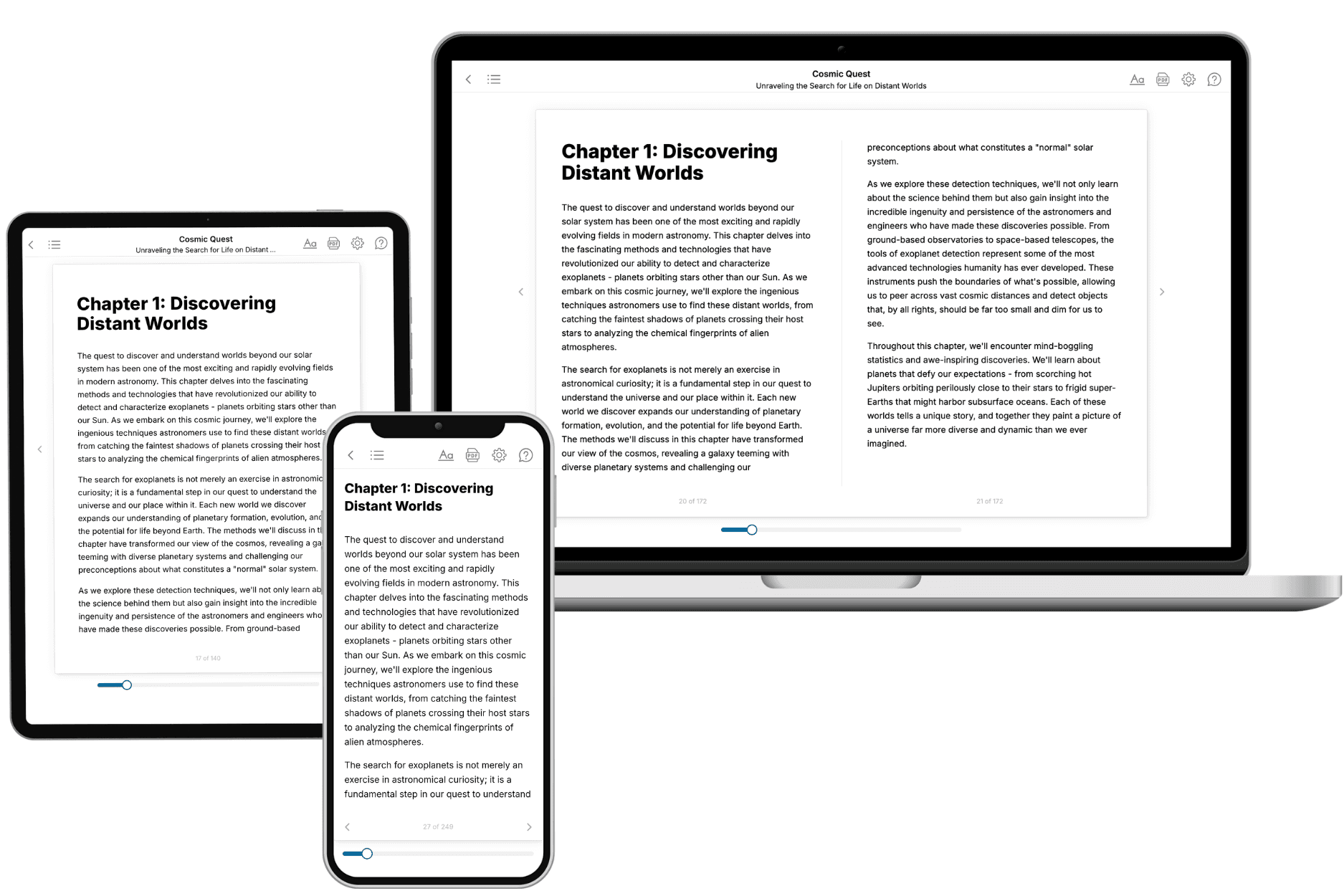
Your book is ready in 10 minutes. Read it online, download as EPUB or PDF, or send to Kindle.

Frequently asked questions
- What is TailoredRead?
TailoredRead creates complete, full-length nonfiction ebooks, written specifically for you. Tell us what you want to learn and why, and TailoredRead writes you a complete ebook on it, with charts, tables, and diagrams throughout. Read it online, on Kindle, or on any e-reader, or download it as a PDF or EPUB. Every book is written fresh the day you order it.
- How is the book tailored to me?
Before anything is written, you answer a few short questions about your goals, your background, and the topics you care about. Your book is then planned around your answers: written at your level, focused on your goals, and covering the topics you chose, instead of the one-size-fits-all book a store sells everyone.
- Will it read like generic AI content?
No. Your book isn't a chat transcript: it's planned chapter by chapter before a single word is written, told in a clear book voice, and explains ideas visually with charts, tables, and diagrams. After writing, every book goes through an editorial pass that polishes chapters so the book reads consistent from start to finish. Judge for yourself: browse thousands of sample books on our Explore Books page.
- How accurate is the content?
Our AI first checks whether your subject needs live research. Niche and fast-moving subjects are researched before writing, and the book plan and chapters are grounded in what it finds. After writing, every book goes through a quality pass that checks its facts and consistency, and researched books list their sources in a Notes section at the back.
- How long is the book?
You choose the length: Comprehensive (250-300 pages), Detailed (150-200 pages), Essential (70-100 pages), or Short (30-50 pages).
- Does the book include visuals?
Yes. Every book includes charts, tables, and diagrams: timelines, checklists, step-by-step guides, decision trees, comparison tables, matrices, and bar charts. A typical book includes dozens of these visual elements.
- Can I read it on Kindle? What formats can I download?
Yes. Every book can be read in our online reader or downloaded as a PDF or EPUB. The EPUB can be opened with Kindle, Apple Books, Kobo, and any e-reader. The Commercial and Author licenses also include an editable Word (DOCX) and Markdown download.
- How much does it cost?
About the price of a regular ebook. The exact price depends on your book's length and complexity, from $2 for the shortest books to $35 for the most comprehensive, and it's shown when you review your book, before you commit to anything. Each book is a one-time purchase, yours to keep, no subscription. Licenses that let you share, teach, or publish your book range from $35.99 to $49.99.
- Can I preview the book before purchasing?
Before you pay, you'll see what your book will cover: the title, a detailed description, the estimated length, and the complete chapter-by-chapter table of contents, so you know what you're getting before you decide. The full text itself is written after you purchase.
- How long does it take to create a book?
About 10 minutes. You can start reading the opening chapters while the rest is still being written.