Pipeline Economics and Operations
A Practical Guide to Understanding Oil Transportation Systems, Infrastructure, and Business Strategy
Many professionals in the oil industry underestimate how pipeline transportation shapes market dynamics, profitability, and competitive advantage.
191 pages8 chaptersDec 21, 2025Oil Industry
About this book
While crude oil extraction and refining capture headlines, the pipeline infrastructure that moves oil across continents operates as the backbone of the entire supply chain—yet remains poorly understood by many decision-makers. This book demystifies pipeline economics and operations, revealing how infrastructure constraints drive prices, how regulatory frameworks impact project viability, and how strategic pipeline investments create lasting competitive advantages. You'll learn the technical fundamentals of pipeline systems, the economic principles governing tariffs and throughput, the regulatory landscape shaping development, and the strategic considerations that separate successful operators from struggling ones. Whether you're evaluating investment opportunities, optimizing operations, or understanding market trends, this guide provides the practical knowledge needed to navigate the complex world of oil pipeline transportation with confidence and insight.
Table of contents
- IntroductionWhy Pipelines Matter in the Oil Industry, What This Book Covers and How to Use It, Key Concepts and TerminologyRead below
- Chapter 1: Pipeline Fundamentals and InfrastructureTypes of Pipelines: Crude, Product, and Gas, Essential Components and System Design, Understanding Capacity, Bottlenecks, and Flow Dynamics
- Chapter 2: Pipeline Economics and Financial ModelsCapital Costs, Operating Expenses, and Profitability, Tariff Structures and Revenue Models, Throughput Optimization and Utilization Rates
- Chapter 3: Operations, Maintenance, and SafetyDaily Operations and Control Systems, Preventive Maintenance and Integrity Management, Safety Standards and Risk Mitigation
- Chapter 4: Regulatory Framework and ComplianceRegulatory Bodies and Jurisdictional Requirements, Environmental Standards and Sustainability, Permitting, Approvals, and Project Development
- Chapter 5: Market Dynamics and Competitive StrategyPipeline's Role in the Oil Supply Chain, Pricing, Competition, and Market Power, Strategic Positioning and Competitive Advantage
- Chapter 6: Investment Analysis and Project EvaluationEvaluating Pipeline Projects and Feasibility, Financial Metrics and Return on Investment, Risk Assessment and Mitigation Strategies
- Chapter 7: Technology and Innovation in Pipeline SystemsAdvanced Monitoring and Diagnostic Technologies, Automation and Operational Efficiency, Emerging Technologies and Digital Transformation
- Chapter 8: Geopolitical and Strategic ConsiderationsGeopolitical Factors and Energy Security, Trade Policies and Cross-Border Pipelines, Energy Transition and Long-Term Demand Outlook
- ConclusionKey Takeaways and Strategic Insights, The Future of Pipeline Transportation
- Glossary of Terms
- Further Reading and Resources
Introduction
Pipeline infrastructure represents one of the most critical yet least understood components of the global oil industry. While crude oil extraction and refining operations frequently dominate industry discussions and media coverage, the vast network of pipelines that transport oil across continents operates quietly in the background—moving billions of barrels annually and fundamentally shaping market dynamics, pricing structures, and competitive positioning. These steel arteries carry approximately 70% of all crude oil and petroleum products transported in North America alone, making them the backbone of energy security and economic stability[1]. Despite their enormous economic significance, pipeline systems remain poorly understood by many professionals working in adjacent sectors of the oil industry, creating knowledge gaps that can lead to suboptimal business decisions and missed strategic opportunities.
The economics of pipeline transportation differ fundamentally from other modes of oil movement such as rail, truck, or marine tanker. Pipelines offer unmatched cost efficiency for long-distance transportation, with per-barrel costs often 50-70% lower than rail alternatives for comparable distances. This cost advantage creates powerful economic incentives that shape investment decisions, supply chain configurations, and regional market structures. However, pipelines also require massive upfront capital investments—often ranging from $1 million to $3 million per mile for large-diameter crude oil pipelines—and face lengthy regulatory approval processes that can extend project timelines by years or even decades. Understanding these economic trade-offs is essential for anyone involved in strategic planning, investment analysis, or operational decision-making within the oil sector.
This book provides a comprehensive examination of pipeline economics and operations, bridging the gap between technical engineering knowledge and business strategy. Whether you're a business manager evaluating transportation options, an engineer seeking to understand commercial considerations, an investor analyzing infrastructure opportunities, or an industry analyst forecasting market trends, this guide offers practical insights grounded in real-world operations and economic principles. The chapters ahead will equip you with the knowledge needed to understand how pipeline constraints influence oil prices, how regulatory frameworks impact project viability, how tariff structures affect profitability, and how strategic infrastructure investments create lasting competitive advantages. By the end of this book, you'll possess a working knowledge of pipeline systems that enables more informed decision-making and deeper insight into the forces shaping oil market dynamics.
Why Pipelines Matter in the Oil Industry
Pipeline infrastructure serves as the circulatory system of the modern oil industry, connecting production regions with refineries, storage facilities, and end markets across vast geographic distances. Without this extensive network, the oil industry as we know it simply could not function at its current scale. The United States alone operates over 200,000 miles of liquid petroleum pipelines, forming an interconnected web that moves approximately 18 billion barrels of crude oil and refined products annually[2]. This infrastructure enables the efficient movement of oil from remote production areas like the Permian Basin in West Texas or the oil sands of Alberta to coastal refineries and export terminals, creating the geographic flexibility that underpins modern energy markets.
The economic impact of pipeline capacity—or lack thereof—extends far beyond simple transportation costs. Pipeline constraints create price differentials between regions that can reach $10-20 per barrel or more during periods of acute bottlenecks. These differentials directly affect producer revenues, refinery input costs, and ultimately consumer prices at the pump. Consider the dramatic example of Western Canadian crude oil prices in late 2018, when insufficient pipeline capacity to move growing oil sands production resulted in the Western Canadian Select (WCS) benchmark trading at a discount of more than $50 per barrel relative to West Texas Intermediate (WTI)[3]. This unprecedented price collapse cost Canadian producers billions in lost revenue and triggered production curtailments, demonstrating how pipeline infrastructure constraints can reshape entire regional economies.
Pipeline systems also create natural monopolies in many regions due to the prohibitive costs of building competing infrastructure along the same routes. Once a pipeline corridor is established and operational, the barriers to entry for competitors become extraordinarily high. This market structure has profound implications for competition, pricing power, and regulatory oversight. Pipeline operators in monopolistic positions can potentially extract significant economic rents through tariff structures, making regulatory frameworks and access policies critically important for maintaining competitive markets. Understanding these dynamics is essential for anyone evaluating investment opportunities, negotiating transportation contracts, or analyzing competitive positioning within the oil supply chain.
The strategic importance of pipelines extends beyond pure economics into the realm of energy security and geopolitical influence. Nations with extensive pipeline infrastructure connecting diverse supply sources enjoy greater energy security and reduced vulnerability to supply disruptions. Conversely, countries dependent on single pipeline routes or limited transportation options face heightened geopolitical risks. The ongoing debates surrounding projects like the Keystone XL pipeline, the Trans Mountain expansion, or various European gas pipelines illustrate how pipeline infrastructure decisions intersect with national security considerations, environmental policy, and international relations. These projects become focal points for competing interests—economic development versus environmental protection, energy independence versus climate commitments, regional cooperation versus national sovereignty.
From an operational perspective, pipelines offer unmatched reliability and safety compared to alternative transportation modes. Modern pipeline systems operate 24 hours per day, 365 days per year, with utilization rates often exceeding 90% and minimal weather-related disruptions. Advanced monitoring systems detect leaks within minutes, and automated shut-off valves can isolate affected sections before significant volumes are released. Statistical data consistently shows that pipelines experience fewer spills per ton-mile than rail or truck transportation, though individual pipeline incidents can be more visible and environmentally significant when they occur[4]. This safety profile, combined with lower greenhouse gas emissions per barrel transported, makes pipelines the preferred option from both operational and environmental standpoints for most long-distance oil transportation applications.
The financial characteristics of pipeline assets make them particularly attractive to certain classes of investors, especially those seeking stable, long-term cash flows. Pipeline companies typically operate under long-term contracts with committed volumes or minimum throughput guarantees, providing revenue predictability that resembles utility-like business models. This stability has made pipeline infrastructure a favored investment for pension funds, infrastructure funds, and income-focused investors. Master Limited Partnerships (MLPs) in the United States have structured themselves specifically to own and operate pipeline assets, offering tax-advantaged distributions to investors. Understanding the financial engineering and investment structures surrounding pipeline assets is crucial for anyone evaluating opportunities in the midstream sector or analyzing the competitive landscape of oil transportation.
Looking forward, pipeline infrastructure faces both opportunities and challenges as the global energy system evolves. Growing oil production in certain regions creates demand for new pipeline capacity, while energy transition pressures and climate policies raise questions about the long-term viability of fossil fuel infrastructure investments. Some pipelines may find extended life through repurposing for hydrogen or carbon dioxide transportation, while others may face stranded asset risks as demand patterns shift. The tension between near-term infrastructure needs and long-term decarbonization goals creates a complex decision-making environment for pipeline operators, investors, and policymakers. Navigating this landscape requires understanding not just current economics and operations, but also the forces reshaping energy markets over the coming decades.
What This Book Covers and How to Use It
This book is structured to build your understanding progressively, starting with fundamental technical concepts before advancing to economic analysis, operational considerations, and strategic decision-making frameworks. Each chapter addresses a distinct aspect of pipeline economics and operations while connecting to the broader themes that run throughout the book. The early chapters establish the technical foundation necessary to understand how pipeline systems function, what determines their capacity and efficiency, and what physical constraints shape their operations. These fundamentals provide the context needed to grasp the economic and strategic concepts explored in later chapters. You don't need an engineering background to benefit from this material—the technical content is presented in accessible language with practical examples that illustrate real-world applications.
The book's middle chapters dive deep into the economic principles governing pipeline operations and the regulatory frameworks that shape the industry. You'll learn how pipeline companies structure tariffs, optimize throughput to maximize profitability, and manage the complex interplay between fixed costs and variable revenues. The regulatory chapters examine how government oversight affects project development timelines, operating costs, and competitive dynamics. These sections include specific examples of regulatory decisions that have significantly impacted pipeline economics, helping you understand how policy changes can create risks or opportunities. Whether you're evaluating a potential investment, negotiating a transportation contract, or forecasting market trends, these chapters provide the analytical tools needed to assess pipeline economics with confidence.
Later chapters shift focus to strategic considerations, competitive positioning, and the broader market forces affecting pipeline infrastructure. You'll explore how pipeline capacity constraints influence regional price differentials, how operators create competitive advantages through strategic network positioning, and how geopolitical factors affect long-term demand outlooks. The investment analysis chapter provides frameworks for evaluating pipeline projects, including financial metrics, risk assessment methodologies, and scenario planning approaches. These strategic chapters are particularly valuable for business managers, investors, and analysts who need to understand how pipeline infrastructure decisions affect competitive dynamics and market outcomes across the oil supply chain.
The book concludes with forward-looking chapters on technology innovation and the evolving landscape of pipeline transportation. You'll learn about emerging monitoring technologies that improve safety and reduce operating costs, automation systems that enhance efficiency, and digital transformation initiatives reshaping pipeline operations. The final chapter addresses the elephant in the room—how energy transition pressures and climate policies are affecting pipeline demand outlooks and creating both risks and opportunities for infrastructure investors. This section helps you think critically about the long-term viability of pipeline investments and the factors that will determine which assets thrive and which face obsolescence in a changing energy landscape.
To get the most value from this book, consider your specific objectives and tailor your reading approach accordingly. If you're new to pipeline transportation, reading sequentially from beginning to end will build your knowledge systematically. The early chapters establish concepts and terminology that later chapters assume you understand. However, if you're already familiar with pipeline basics and want to focus on specific topics, the book is designed to allow selective reading. Each chapter stands alone sufficiently that you can jump directly to sections addressing your immediate questions or interests. For example, if you're primarily interested in investment analysis, you might start with Chapter 6 and refer back to earlier chapters as needed for context on technical or regulatory considerations.
Throughout the book, you'll find practical examples drawn from real pipeline projects and operations. These examples illustrate how theoretical concepts play out in practice and provide concrete reference points for understanding abstract principles. When specific projects or companies are mentioned, they serve as case studies to demonstrate broader patterns rather than as investment recommendations or endorsements. The goal is to help you develop pattern recognition skills that enable you to analyze new situations and apply the frameworks presented here to your specific decision-making contexts. Pay particular attention to the examples that most closely resemble the situations you encounter in your professional role—these will provide the most immediately applicable insights.
The book also includes numerous lists, frameworks, and analytical tools that you can reference and apply directly to your work. These practical resources are designed to serve as ongoing references rather than one-time reading material. Consider marking or bookmarking sections that contain frameworks relevant to your regular responsibilities. For instance, if you frequently evaluate pipeline projects, the investment analysis frameworks in Chapter 6 can serve as checklists to ensure comprehensive evaluation. If you negotiate transportation contracts, the tariff structure explanations in Chapter 2 provide context for understanding pricing proposals and identifying negotiation leverage points. The goal is for this book to become a working reference that continues providing value long after your initial reading.
Finally, recognize that pipeline economics and operations exist within a rapidly evolving context. Regulatory frameworks change, technologies advance, market conditions shift, and strategic priorities evolve. While the fundamental principles presented here remain relatively stable, their application requires staying current with industry developments. The book provides a solid foundation for understanding pipeline transportation, but maintaining expertise requires ongoing engagement with industry publications, regulatory updates, and market analysis. Use this book as your baseline knowledge framework, then build upon it through continued learning and practical experience. The combination of foundational understanding and current awareness will position you to make informed decisions and provide valuable insights regardless of how the industry evolves.
Key Concepts and Terminology
Before diving into the detailed chapters ahead, establishing a common vocabulary for discussing pipeline economics and operations will ensure clarity and precision throughout the book. The pipeline industry uses specialized terminology that can be confusing to those more familiar with other sectors of the oil business. Understanding these key concepts upfront will make the subsequent chapters more accessible and prevent misunderstandings that can arise from ambiguous or unfamiliar terms. This section introduces the most important concepts and definitions you'll encounter repeatedly throughout the book, serving as a reference point you can return to whenever you need clarification on specific terms or concepts.
The term throughput refers to the volume of oil or petroleum products moving through a pipeline over a specific time period, typically measured in barrels per day (bpd) or thousands of barrels per day (mbpd). Throughput is the fundamental measure of pipeline utilization and directly determines revenue for pipeline operators. Maximum throughput capacity depends on numerous factors including pipe diameter, operating pressure, fluid viscosity, elevation changes along the route, and the number and power of pumping stations. Understanding the difference between nameplate capacity (the theoretical maximum throughput under ideal conditions) and operational capacity (the realistic sustained throughput under normal operating conditions) is crucial for accurate analysis. Operational capacity typically runs 5-10% below nameplate capacity due to maintenance requirements, operational flexibility needs, and safety margins.
Pipeline tariffs represent the fees charged for transporting oil through a pipeline system, typically expressed in dollars per barrel. Tariff structures vary significantly depending on regulatory jurisdiction, competitive conditions, and contract terms. The two primary tariff models are cost-of-service tariffs, where rates are set to recover costs plus a regulated return on investment, and market-based tariffs, where rates reflect competitive conditions and negotiated agreements. Many pipelines operate under hybrid models that incorporate elements of both approaches. Understanding tariff structures is essential for evaluating pipeline economics, as tariff rates directly determine revenue potential and profitability. Tariffs may also include various components such as base transportation rates, fuel surcharges, quality adjustments, and ancillary service fees.
The concept of capacity constraints and bottlenecks plays a central role in pipeline economics and market dynamics. A bottleneck occurs when pipeline capacity is insufficient to transport all the oil that producers want to ship, creating competition for limited space. Bottlenecks typically result in apportionment, where available capacity is allocated among shippers according to specific rules or formulas. During apportionment periods, shippers may receive only a percentage of their nominated volumes, forcing them to seek alternative transportation or reduce production. Bottlenecks create price differentials between regions, as oil trapped behind capacity constraints trades at discounts relative to markets with adequate transportation access. Identifying potential bottlenecks before they develop provides valuable insights for investment decisions and strategic planning.
Pipeline infrastructure is typically categorized into three main types based on what they transport:
- Crude oil pipelines transport unrefined petroleum from production areas to refineries or export terminals
- Refined product pipelines move gasoline, diesel, jet fuel, and other finished products from refineries to distribution terminals
- Natural gas liquids (NGL) pipelines transport ethane, propane, butane, and natural gasoline extracted from natural gas streams
The term midstream refers to the segment of the oil industry focused on transportation, storage, and wholesale marketing of crude oil and petroleum products. Pipeline companies are the core of the midstream sector, though it also includes storage facilities, marine terminals, and gathering systems. Midstream operations sit between upstream activities (exploration and production) and downstream operations (refining and retail marketing). The midstream sector has distinct economic characteristics, including relatively stable cash flows, high capital intensity, and regulatory oversight. Many midstream companies are structured as Master Limited Partnerships (MLPs) or similar entities designed to provide tax-advantaged income distributions to investors. Understanding where pipeline operations fit within the broader oil industry value chain helps clarify their strategic role and economic drivers.
Integrity management encompasses the systems, processes, and technologies used to ensure pipeline safety and prevent failures. Modern integrity management programs include regular inspections using inline inspection tools (also called "smart pigs") that travel through pipelines detecting corrosion, cracks, and other defects. Cathodic protection systems prevent external corrosion by applying electrical currents that counteract corrosive electrochemical reactions. Pressure testing verifies pipeline strength and identifies weak points before they fail in service. Integrity management represents a significant ongoing cost for pipeline operators but is essential for maintaining safety, environmental protection, and regulatory compliance. The effectiveness of integrity management programs directly affects operational reliability, insurance costs, and regulatory relationships.
Understanding regulatory frameworks is essential for anyone involved in pipeline economics or operations. In the United States, the Federal Energy Regulatory Commission (FERC) regulates interstate oil pipeline tariffs and ensures non-discriminatory access to pipeline capacity. The Pipeline and Hazardous Materials Safety Administration (PHMSA) establishes and enforces safety standards for pipeline design, construction, and operation. State regulatory bodies oversee intrastate pipelines and environmental permitting. In Canada, the Canada Energy Regulator (CER) performs similar functions for interprovincial and international pipelines. These regulatory bodies significantly influence pipeline economics through tariff approvals, safety requirements, and environmental standards. Changes in regulatory policy can dramatically affect project viability, operating costs, and competitive dynamics, making regulatory awareness a critical component of pipeline analysis.
The concept of economies of scale is particularly important in pipeline economics. Larger diameter pipelines can transport significantly more oil with only modest increases in construction and operating costs compared to smaller lines. For example, a 36-inch diameter pipeline might cost 40% more to build than a 24-inch line but can transport more than twice the volume. This relationship creates strong incentives to build larger pipelines when demand projections justify the additional capacity. However, larger pipelines also require higher upfront capital investments and longer time periods to reach full utilization, creating risk-return trade-offs that must be carefully evaluated. Understanding these scale economics helps explain why pipeline networks tend toward consolidation and why new pipeline projects often face "build it big or don't build it at all" decisions.
Finally, the concept of stranded assets has gained prominence as energy transition discussions intensify. A stranded asset is infrastructure that becomes obsolete or uneconomic before the end of its expected useful life due to changes in market conditions, technology, or policy. For pipelines, stranded asset risk arises from the possibility that declining oil demand, policy restrictions, or competing infrastructure could render a pipeline underutilized or worthless before its capital costs are fully recovered. This risk affects investment decisions, financing costs, and strategic planning for both pipeline operators and their customers. Evaluating stranded asset risk requires analyzing long-term demand outlooks, policy trajectories, and competitive dynamics—topics explored in depth in later chapters. Understanding this concept is increasingly important as the oil industry navigates the tension between near-term infrastructure needs and long-term decarbonization pressures.
This is the end of the free sample. The full book has 8 chapters.
Want this book written for you?
Tell us your goals and background, and get your own version of this book, tailored by AI to you.


Benefits of AI-tailored books
- Read one book, not ten:
- all the Oil Industry knowledge you need, gathered into a single book.
- Save days of learning:
- tell us your goals, choose your topics, and the whole book is built around them.
- Learn effortlessly:
- Oil Industry book written for your specific background and expertise.
- Understand at a glance:
- includes charts, tables, timelines, checklists, decision trees, and more.
- Stay current:
- written the day you order it, not years ago.
- Trust what you read:
- every book is checked for accuracy, with real research when your subject needs it.
Create your unique book in 3 steps
- 1. Select your focus
Select the focus of your Oil Industry book and share your background
- 2. Personalize your book
Specify your goals and choose sub-topics to include
- 3. Get your tailored book
Your book is ready in 10 minutes. Read it online, download as EPUB or PDF, or send to Kindle.


Frequently asked questions
- What is TailoredRead?
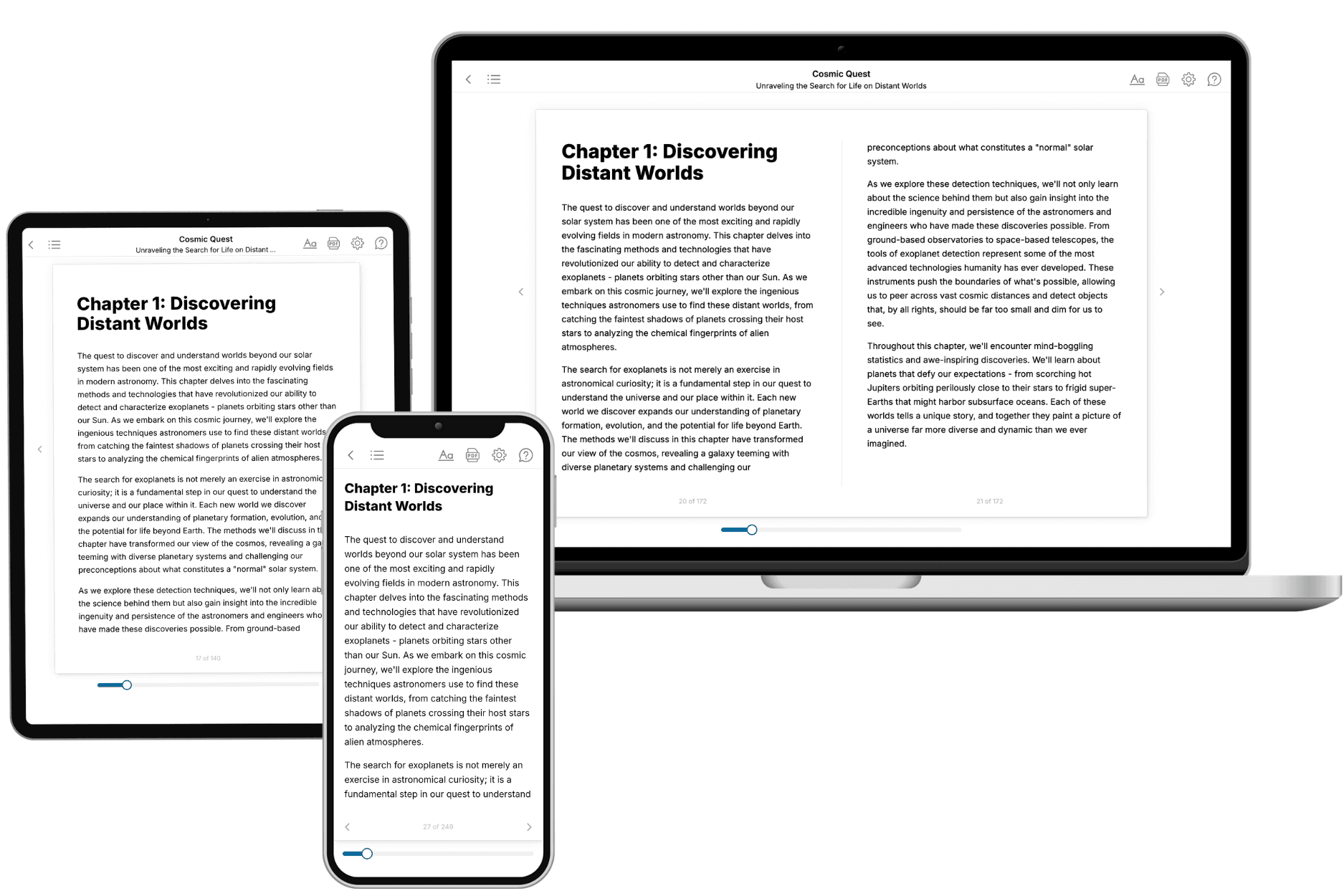
TailoredRead creates complete, full-length nonfiction ebooks, written specifically for you. Tell us what you want to learn and why, and TailoredRead writes you a complete ebook on it, with charts, tables, and diagrams throughout. Read it online, on Kindle, or on any e-reader, or download it as a PDF or EPUB. Every book is written fresh the day you order it.
- How is the book tailored to me?
Before anything is written, you answer a few short questions about your goals, your background, and the topics you care about. Your book is then planned around your answers: written at your level, focused on your goals, and covering the topics you chose, instead of the one-size-fits-all book a store sells everyone.
- Will it read like generic AI content?
No. Your book isn't a chat transcript: it's planned chapter by chapter before a single word is written, told in a clear book voice, and explains ideas visually with charts, tables, and diagrams. After writing, every book goes through an editorial pass that polishes chapters so the book reads consistent from start to finish. Judge for yourself: browse thousands of sample books on our Explore Books page.
- How accurate is the content?
Our AI first checks whether your subject needs live research. Niche and fast-moving subjects are researched before writing, and the book plan and chapters are grounded in what it finds. After writing, every book goes through a quality pass that checks its facts and consistency, and researched books list their sources in a Notes section at the back.
- How long is the book?
You choose the length: Comprehensive (250-300 pages), Detailed (150-200 pages), Essential (70-100 pages), or Short (30-50 pages).
- Does the book include visuals?
Yes. Every book includes charts, tables, and diagrams: timelines, checklists, step-by-step guides, decision trees, comparison tables, matrices, and bar charts. A typical book includes dozens of these visual elements.
- Can I read it on Kindle? What formats can I download?
Yes. Every book can be read in our online reader or downloaded as a PDF or EPUB. The EPUB can be opened with Kindle, Apple Books, Kobo, and any e-reader. The Commercial and Author licenses also include an editable Word (DOCX) and Markdown download.
- How much does it cost?
About the price of a regular ebook. The exact price depends on your book's length and complexity, from $2 for the shortest books to $35 for the most comprehensive, and it's shown when you review your book, before you commit to anything. Each book is a one-time purchase, yours to keep, no subscription. Licenses that let you share, teach, or publish your book range from $35.99 to $49.99.
- Can I preview the book before purchasing?
Before you pay, you'll see what your book will cover: the title, a detailed description, the estimated length, and the complete chapter-by-chapter table of contents, so you know what you're getting before you decide. The full text itself is written after you purchase.
- How long does it take to create a book?
About 10 minutes. You can start reading the opening chapters while the rest is still being written.