Practice the Feeling
How Behavioral Repetition Rewires Your Emotional Life and Breaks the Depression Cycle
You already understand how habits form and how behavior shapes the brain.
67 pages3 chaptersSep 24, 2026Behavioral PsychologyCreated by Mary
About this book
This book takes that knowledge deeper, showing you exactly how emotional and thought patterns become entrenched through repetition—and how you can deliberately practice new ones, even when life is hard. You'll discover why acting as if you feel good isn't fake; it's a neurobiological strategy that gradually rewires your emotional baseline. Through the lens of neuroplasticity, habit loops, and behavioral integration, you'll learn concrete methods for building resilience through micro-habits, reversing learned helplessness, and breaking the depression cycle that traps so many in unhelpful thinking patterns. This isn't about positive thinking alone. It's about understanding the bidirectional relationship between thought, feeling, and action—and using that understanding to rescue yourself from lifelong patterns. You'll explore how affective forecasting errors work against you, why positive rumination matters, and how existential meaning in daily practice creates lasting neurochemical shifts. Grounded in behavioral science and written for someone with your depth of expertise, this book offers both the theoretical framework and the practical tools to help you—and those you care about—build emotional and thought habits that stick.
Table of contents
- Chapter 1: The Bidirectional Loop: How Behavior Shapes Emotion and ThoughtWhy You Get Better at Whatever You Practice—Including How You Feel, Neuroplasticity and the Habit Loop: Your Brain's Capacity for ChangeRead below
- Chapter 2: Building Resilience Through Deliberate PracticeMicro-Habits and Habit Stacking: Making Emotional Regulation Automatic, Integrating Thought, Feeling, and Action: The Practical Framework, Affective Forecasting Errors: Why Action Precedes Motivation
- Chapter 3: Breaking Free: From Learned Helplessness to Existential MeaningReversing Learned Helplessness: Retraining Your Brain's Predictions, Positive Rumination, Existential Meaning, and Neurochemical Shifts, The Depression Cycle: How Emotional Regulation Through Repetition Breaks It
- Conclusion
Chapter 1: The Bidirectional Loop: How Behavior Shapes Emotion and Thought
A retired counselor notices she feels calmer on mornings she makes her bed. It is not the tidiness itself that soothes her. The calm arrives because the act of completing a small behavior has already begun rewriting the emotional signal her brain expects next. Her hands move, the sheets tighten, the corners square off, and before she has consciously registered any feeling, something in her nervous system logs a small win. That log entry changes what comes next: a slightly steadier mood, a little more willingness to face the rest of the morning.
This is not a quirky personal habit. It reflects a mechanism that runs underneath almost everything a person does, thinks, and feels. Behavior, emotion, and thought are not arranged in a straight line where one causes the next in fixed order. They form a loop, each one feeding back into the others continuously. Thinking shapes feeling, feeling shapes behavior, but behavior also shapes feeling, and feeling shapes thinking. Once this loop is visible, a much wider set of interventions becomes available than the ones most people default to, which usually start and end with trying to think differently.
For decades, popular psychology leaned heavily on a one-directional model: fix the thought, and the feeling and behavior will follow. Cognitive approaches built entire treatment systems on this assumption, and they work for many people, some of the time.[1] But the model was always incomplete. Behavior therapists working in parallel traditions kept finding that changing what a person did, independent of what they believed or felt, produced emotional change on its own.[2] The two traditions eventually merged into integrated frameworks precisely because neither one alone captured the full loop.
The practical stakes of this are large. If someone believes emotion only flows downhill from thought, they will wait to feel differently before acting differently, and that wait can stretch for years. If someone understands the loop runs both ways, they gain a second entry point: they can act their way into a feeling state rather than only thinking their way into one. This chapter builds the case for that second entry point from the ground up, starting with why repeated action changes emotional capacity the same way repeated practice changes any skill, and then grounding that claim in what is known about how the brain physically changes in response to repetition.
Why You Get Better at Whatever You Practice—Including How You Feel
Skill acquisition follows a familiar pattern in almost every domain. A person who practices scales gets better at scales. A person who practices public speaking gets less rattled by an audience. The nervous system treats repeated action as a signal worth reinforcing, strengthening the pathways involved and making the response easier to produce the next time. There is little reason to expect emotional and cognitive responses to be exempt from this pattern, and a large body of behavioral research confirms they are not. What gets rehearsed, deliberately or not, becomes the default.
Consider two people recovering from a difficult period. One spends most evenings replaying arguments and disappointments, turning them over in detail. The other spends a comparable amount of time each evening naming one thing that went acceptably that day, however small. Neither is lying to themselves about the state of their life. But each is running a different kind of practice session, and each is training a different response to become more automatic. The first person is becoming more skilled at accessing grievance. The second is becoming more skilled at accessing appraisal that does not spiral. Skill, in both cases, is the right word.
This reframes a common objection to intentionally practicing positive emotional states: the worry that doing so is artificial or dishonest. Practicing a felt state is no more dishonest than a musician practicing a piece before they can play it fluently. Nobody accuses the beginner pianist of faking musicianship because their first attempts are effortful and imperfect. The same standard applies to practicing calm, gratitude, or steadiness before those states arrive easily. Early repetitions are supposed to feel effortful. That effort is not evidence the practice is fraudulent, it is evidence the skill has not yet consolidated.
The mechanism behind this is sometimes called the Bidirectional Loop: behavior, emotion, and thought each influence the other two, in both directions, continuously. A thought about failure can produce a slumped posture. But a slumped posture, held for even a short period, can independently produce thoughts and feelings consistent with defeat, even when nothing in the person's actual circumstances has changed. Researchers studying embodiment effects have repeatedly found that manipulating posture or facial expression shifts self-reported mood and even hormone levels, without any corresponding change in the person's beliefs about their situation.[3] The behavior is not a mere symptom of the internal state. It is one of the levers that produces it.
This has a direct application for anyone trying to shift an emotional pattern that feels stuck. Waiting for motivation or mood to improve before acting differently often gets the causal direction backward. A more reliable path is choosing a small behavior consistent with the desired emotional state and repeating it, on schedule, regardless of how it feels on any given day. The counselor who makes her bed is not waiting to feel orderly before organizing her bedding. She organizes the bedding first, and the felt sense of order follows as a downstream effect of the completed action. Multiply that structure across dozens of small daily behaviors and the cumulative pull on emotional baseline becomes substantial.
It helps to be specific about what counts as practice in this sense, because the term can sound abstract. Practice here means a repeated, identifiable action performed with some regularity, not a single instance of trying hard. Sitting up straight once during a bad afternoon is not practice. Choosing to sit up straight at the start of every meeting for a month is practice, because repetition is what allows a nervous system to treat the pattern as reliable enough to reinforce. The same logic applies to speech patterns, breathing patterns, and the specific content a person rehearses in their own head during idle moments.
One useful test for whether a candidate behavior is worth practicing deliberately is to ask what it would mean if a mentally healthy version of the person already did this reliably. If a resilient version of someone routinely greets colleagues warmly regardless of mood, that behavior is a plausible target for deliberate practice, because performing it repeatedly moves the practicing person closer to that resilient baseline, not just in appearance but in underlying emotional tone. This is sometimes described as acting the part until the part becomes true, a phrase that sounds glib but describes a mechanism with real physiological weight behind it.
Skeptics sometimes argue that practicing a feeling one does not have amounts to suppression, and that suppression carries its own psychological costs.[4] The distinction matters. Suppression involves denying or hiding a felt emotion while it is actively present, which does carry costs including elevated physiological stress. Practicing a target state is different: it does not require denying whatever is currently present, only choosing to add a new behavior alongside it. A person can acknowledge sadness honestly while also performing an action associated with resilience, such as calling a friend or stepping outside for air. The two are not in conflict, because practice is additive, not concealing.
The following timeline traces how this idea moved from scattered clinical observations into an integrated framework, giving a sense of how long behavioral scientists have understood that action shapes feeling rather than merely following it.
From One-Directional to Bidirectional Models
- 1950sEarly behaviorist research shows that reinforced actions change response patterns independent of stated beliefs - Laid groundwork for treating behavior as a driver, not just a symptom, of internal states
- 1960s-70sCognitive therapy popularizes the idea that changing thoughts changes feelings and behavior - Highly effective, but framed as largely one-directional
- 1980s-2000sFacial feedback and embodiment studies show that physical action alone shifts reported emotion - Demonstrated the reverse direction: body to feeling, not just feeling to body
- 2000s-presentIntegrated behavioral-cognitive frameworks formalize the loop as bidirectional - Modern practice draws on both directions rather than favoring one
Practically, this means a deliberate practice program for emotional life needs two ingredients working together: a clearly defined behavior, and a schedule that guarantees repetition rather than relying on spontaneous motivation. A person who intends to practice steadiness only when they happen to remember will accumulate almost no repetitions, because the very state they are trying to build is the state that makes remembering easier. Anchoring the practice to an existing routine, a strategy explored in depth under Habit Stacking in a later chapter, solves this reliability problem directly.
There is also a compounding effect worth naming explicitly. Each successful repetition of a target behavior does two things at once: it produces whatever immediate emotional shift the behavior tends to produce, and it also slightly strengthens the underlying pathway, making the next repetition marginally easier to perform and marginally more effective. This is why people who commit to small emotional practices for a period of months often describe a sense that the practice eventually stopped requiring effort. That shift is not imagination. It reflects the pathway becoming genuinely more efficient, a process explored in mechanistic detail in the next subchapter.
None of this implies that behavior is the only lever worth pulling, or that thought and cognitive reframing are unimportant. The loop runs in every direction, and a full practice program draws on all three points of entry: choosing behaviors, examining thoughts, and naming feelings honestly. But because most self-help advice already emphasizes the thought-first entry point heavily, the behavioral entry point tends to be underused, despite strong evidence for its power. Restoring balance to that emphasis is one of the central aims of the practice framework this book builds toward.
A concrete illustration helps make the abstract claim tangible. Suppose someone has spent several years in a role that left them chronically undervalued, and their default posture during meetings became closed off: arms crossed, eyes down, voice quiet. Cognitive work alone, aimed at correcting the belief I have nothing worth saying
, may help, but it competes against years of physical rehearsal of the opposite posture. Pairing the cognitive work with deliberate physical practice, sitting upright, making eye contact, speaking at a slightly higher volume, gives the nervous system a second stream of evidence pointing the same direction as the new belief. Two converging streams change a pattern faster than one stream working alone.
This dual-stream approach also explains why insight-only interventions sometimes stall. A person can understand intellectually, with complete clarity, that their negative self-view is inaccurate, and still feel stuck. The insight sits in the cognitive layer of the loop, but the behavioral layer has not received any new instructions, so the old behavioral patterns keep feeding old feelings back into the system. Insight without a matching behavioral change is like correcting a musical score without ever picking up the instrument. The correction is real, but nothing in the hands has changed yet.
The counselor's bed-making habit returns here as a useful anchor point for the whole argument. It is a five-minute behavior with no direct relationship to her larger life circumstances. It does not pay her bills, resolve her relationships, or address any deep existential question. And yet it reliably nudges her emotional starting point for the day, because it is a small, completed, repeated action that her nervous system has learned to associate with a controlled, orderly state. Multiply that single lever across a deliberately chosen set of daily behaviors, and the aggregate effect on emotional baseline becomes considerable, even before any other form of intervention is added.
The remainder of this book develops specific applications of this principle, including how to select behaviors worth practicing, how to make the practice small enough to sustain, and how to apply the same logic to reversing more entrenched patterns like learned helplessness. But the foundational point precedes all of that detail: emotional states respond to repetition the same way physical skills do, and behavior is a legitimate, evidence-backed entry point for changing them, not a poor substitute for changing them through thought alone.
Understanding this reframes a common source of guilt for people struggling with mood. Many assume that if they cannot think their way out of a low period, they have failed at some kind of internal effort that should have been sufficient. Recognizing the loop as bidirectional removes that guilt, because it shows that thought was never supposed to carry the whole burden. Behavior was always available as a second lever, and for many people, especially during periods when thinking itself feels sluggish or unreliable, the behavioral lever is easier to pull first.
The next subchapter turns to the physical substrate that makes all of this possible: the brain's capacity to change its own wiring in response to repeated experience, and the specific habit-loop structure that governs how a repeated behavior becomes an automatic one.
Neuroplasticity and the Habit Loop: Your Brain's Capacity for Change
Neuroplasticity refers to the brain's capacity to change its structure and function in response to experience, throughout life rather than only during childhood development.[5] This capacity is the physical reason deliberate practice of any kind, including emotional practice, produces lasting change rather than temporary distraction. Neurons that fire together repeatedly strengthen the connections between them, a principle often summarized as cells that fire together wire together. Every time a specific thought pattern, feeling, and behavior co-occur, the neural pathway linking them gets marginally more efficient, making that same combination easier to produce the next time it is triggered.
This has a double edge that deserves direct attention. The same mechanism that allows someone to build a new pattern of resilience also explains how patterns of helplessness, anxiety, or rumination became entrenched in the first place. A person who has spent years responding to setbacks with self-criticism has, in a very literal physiological sense, practiced self-criticism thousands of times, strengthening that pathway the same way athletic practice strengthens a swing or a serve. This is not a moral failing. It is the predictable output of a brain doing exactly what brains do: reinforcing whatever gets repeated, without judgment about whether the pattern is helpful.
The encouraging half of this same fact is that the mechanism does not discriminate in the other direction either. A brain that spent years reinforcing self-criticism retains full capacity to reinforce a different pattern, given enough consistent repetition of the alternative. This is different from claiming the brain can change instantly or effortlessly. Long-practiced pathways do not disappear the moment a new one appears, and they can remain available, sometimes reasserting themselves under stress, for a long time. But their relative strength, compared to a newly practiced alternative, shifts gradually and measurably with sustained repetition, which is the entire premise behind deliberate emotional practice.
A useful way to picture this is a walking path through a field. Years of use have worn one path into hard-packed dirt, easy to walk without thinking. A new path through the same field starts as barely visible, easy to lose, requiring conscious attention to follow rather than drift back onto the old one. Each time the new path is walked deliberately, it becomes slightly clearer. Eventually, if walked consistently enough, it becomes the easier route, the one the feet find automatically, while the old path slowly grows over from disuse. Neuroplasticity operates on roughly this timeline, weeks to months of consistent repetition rather than single dramatic insights.
This is where the Habit Loop becomes the operational unit worth understanding closely. The habit loop, as described in behavioral research, has three core components: a cue that triggers the behavior, a routine that is the behavior itself, and a reward that reinforces the loop, making the brain more likely to run the same sequence again when the same cue reappears.[6] A fourth element, craving, often develops over time as the brain begins to anticipate the reward before the routine even runs, which is part of why long-standing habits can feel involuntary rather than chosen.
Applying the habit loop to emotional practice requires identifying all three parts explicitly rather than leaving any of them to chance. Consider someone practicing a shift away from chronic irritability toward a calmer default response. The cue might be a specific recurring trigger, such as a phone notification from a difficult family member. The routine is the practiced behavior, perhaps a slow exhale followed by a chosen neutral phrase before responding. The reward needs to be genuinely present and noticeable, such as the felt relief of not having escalated, or a brief mental note of having handled the moment as intended. Without a real, noticed reward, the loop has no reason to strengthen, regardless of how many times the routine is performed.
This point about reward is where many well-intentioned attempts at emotional change quietly fail. A person may perform a new behavior repeatedly, in good faith, but if they never pause to register that it produced something positive, the brain has no signal telling it to reinforce the pathway. The habit loop is not built by the behavior alone. It is built by the behavior plus a registered payoff. This is one reason simply naming, out loud or in a journal, what felt better after a practiced behavior can matter as much as the behavior itself. The naming step closes the loop.
Key takeaway: The Three Parts of the Habit Loop
Cue: the trigger that starts the sequence.
Routine: the practiced behavior itself.
Reward: the noticed payoff that tells the brain to repeat the sequence next time.
A practice that skips the reward step rarely becomes automatic, no matter how often it is repeated.
Neuroplasticity is not unlimited or instant, and setting expectations accurately matters for anyone applying this framework to their own life. Structural changes measurable in research settings, such as increased gray matter density following sustained practice of a skill, typically take weeks of consistent repetition to appear, and longer to stabilize into something resistant to lapse.[7] A person practicing a new emotional pattern for three days and concluding it does not work has not given the mechanism enough time to demonstrate anything, one way or the other. This is a common and understandable source of premature discouragement.
The concept of Deliberate Practice, originally developed in research on expert performance in fields like music and chess, is useful here because it specifies what separates practice that produces change from repetition that does not.[8] Deliberate practice is focused, intentional, and includes feedback about whether it is working, as opposed to mindless repetition performed on autopilot. Applied to emotional patterns, this means a practiced behavior performed while distracted, resentful, or going through the motions produces far weaker reinforcement than the same behavior performed with attention to what it is meant to accomplish and honest tracking of whether it helped.
This distinction explains why two people can perform what looks like the identical practice, such as a daily gratitude note, with very different results. One writes the note automatically, barely reading their own words, treating it as a box to check. The other pauses to actually notice something specific and true, connects briefly with the feeling attached to it, and lets that feeling register before moving on. The second version engages the loop's cue, routine, and reward components fully. The first version runs the routine while skipping the reward almost entirely, which limits how much reinforcement accumulates over time.
One practical implication is worth stating plainly for anyone building an emotional practice: quality of attention during a small number of repetitions can outperform a larger number of repetitions performed carelessly. This does not mean frequency is unimportant, since the habit loop still depends on consistent repetition to consolidate. But it does mean that rushing through a practiced behavior purely to log it as completed undercuts the mechanism the whole approach depends on. A brief, fully attended version of a practice generally beats a longer, distracted version.
Another implication concerns setbacks and lapses, which are inevitable in any long-term behavior change effort. Because neuroplastic change is gradual and because old pathways do not vanish the moment a new one strengthens, a missed day or a return to an old pattern under stress does not erase the progress already made. The old path in the field has grown over somewhat, but a single walk down it does not instantly restore it to its former width. Framing lapses this way, as temporary reactivations of a weakened pathway rather than as proof the new pathway never existed, prevents the common trap of treating one bad day as evidence the whole effort has failed.
The relationship between neuroplasticity and the earlier discussion of the Bidirectional Loop is direct. The loop describes the functional relationship between behavior, emotion, and thought, showing that each one can influence the others. Neuroplasticity describes the physical mechanism that allows repeated activation of that loop, in any particular pattern, to become progressively easier and more automatic. Together they explain both why deliberate emotional practice is possible in principle and how, mechanically, that practice produces lasting rather than momentary change.
Neuroplasticity does not promise that any behavior, repeated enough, will produce any desired feeling regardless of context. It does not promise that any behavior, repeated enough, will produce any desired feeling regardless of context. A person cannot practice smiling through a genuinely dangerous or unjust situation and expect that alone to resolve the underlying problem. Neuroplasticity governs how the brain's internal wiring responds to repeated patterns, not whether external circumstances themselves change. The practical framework built throughout this book applies specifically to shifting habitual internal responses, alongside, not instead of, addressing whatever real external circumstances require separate action.
There is also a meaningful difference between neuroplasticity as a general capacity and the specific direction any individual's plasticity gets pointed in. The brain does not choose a direction on its own. Direction comes from what gets repeated, deliberately or by default. This puts real weight on the earlier point about identifying, with some precision, which behaviors are worth practicing. A person who understands neuroplasticity but never chooses a specific target behavior to repeat consistently gains little practical benefit from the knowledge alone. The mechanism only produces results when paired with a defined habit loop, run consistently, over a period measured in weeks and months rather than days.
Later chapters build directly on this foundation, translating the mechanism described here into specific, small, sustainable practices, a structure covered under Micro-Habit and Habit Stacking, and applying the same underlying logic to more entrenched patterns such as learned helplessness and the depression cycle. What matters at this stage is holding two facts together without letting either one cancel the other: emotional and cognitive patterns feel fixed because they have been practiced heavily, often for years, and yet the same mechanism that fixed them in place remains fully capable of building something different, given the same kind of sustained, attentive repetition pointed in a new direction.
The retired counselor making her bed each morning is, without necessarily framing it in these terms, running a small and deliberate experiment in exactly this mechanism. She is not waiting for her nervous system to feel calm before acting calm. She is acting first, letting the completed behavior send its own signal, and trusting a physical process inside her brain to do the rest of the work across repeated mornings. That trust turns out to be well placed, not because of any special willpower on her part, but because the underlying biology has been reliably demonstrated to work this way for anyone willing to repeat a small, well-chosen action long enough for the pathway to strengthen.
Notes
Chapter 1: The Bidirectional Loop: How Behavior Shapes Emotion and Thought
- 1. Aaron Beck, Cognitive Therapy and the Emotional Disorders, International Universities Press, 1976
- 2. B. F. Skinner, Science and Human Behavior, Macmillan, 1953
- 3. Amy Cuddy and others, "The Benefit of Power Posing Before a High-Stakes Social Evaluation," Harvard Business School Working Paper, 2012
- 4. James Gross and Robert Levenson, "Emotional Suppression," Journal of Personality and Social Psychology, 1993
- 5. Donald Hebb, The Organization of Behavior, Wiley, 1949
- 6. Charles Duhigg, The Power of Habit, Random House, 2012
- 7. Eleanor Maguire and others, "Navigation-Related Structural Change in the Hippocampi of Taxi Drivers," Proceedings of the National Academy of Sciences, 2000
- 8. K. Anders Ericsson and others, "The Role of Deliberate Practice in the Acquisition of Expert Performance," Psychological Review, 1993
This is the end of the free sample. The full book has 3 chapters.
Want this book written for you?
Tell us your goals and background, and get your own version of this book, tailored by AI to you.


Benefits of AI-tailored books
- Read one book, not ten:
- all the Behavioral Psychology knowledge you need, gathered into a single book.
- Save days of learning:
- tell us your goals, choose your topics, and the whole book is built around them.
- Learn effortlessly:
- Behavioral Psychology book written for your specific background and expertise.
- Understand at a glance:
- includes charts, tables, timelines, checklists, decision trees, and more.
- Stay current:
- written the day you order it, not years ago.
- Trust what you read:
- every book is checked for accuracy, with real research when your subject needs it.
Create your unique book in 3 steps
- 1. Select your focus
Select the focus of your Behavioral Psychology book and share your background
- 2. Personalize your book
Specify your goals and choose sub-topics to include
- 3. Get your tailored book
Your book is ready in 10 minutes. Read it online, download as EPUB or PDF, or send to Kindle.

Frequently asked questions
- What is TailoredRead?
TailoredRead creates complete, full-length nonfiction ebooks, written specifically for you. Tell us what you want to learn and why, and TailoredRead writes you a complete ebook on it, with charts, tables, and diagrams throughout. Read it online, on Kindle, or on any e-reader, or download it as a PDF or EPUB. Every book is written fresh the day you order it.
- How is the book tailored to me?
Before anything is written, you answer a few short questions about your goals, your background, and the topics you care about. Your book is then planned around your answers: written at your level, focused on your goals, and covering the topics you chose, instead of the one-size-fits-all book a store sells everyone.
- Will it read like generic AI content?
No. Your book isn't a chat transcript: it's planned chapter by chapter before a single word is written, told in a clear book voice, and explains ideas visually with charts, tables, and diagrams. After writing, every book goes through an editorial pass that polishes chapters so the book reads consistent from start to finish. Judge for yourself: browse thousands of sample books on our Explore Books page.
- How accurate is the content?
Our AI first checks whether your subject needs live research. Niche and fast-moving subjects are researched before writing, and the book plan and chapters are grounded in what it finds. After writing, every book goes through a quality pass that checks its facts and consistency, and researched books list their sources in a Notes section at the back.
- How long is the book?
You choose the length: Comprehensive (250-300 pages), Detailed (150-200 pages), Essential (70-100 pages), or Short (30-50 pages).
- Does the book include visuals?
Yes. Every book includes charts, tables, and diagrams: timelines, checklists, step-by-step guides, decision trees, comparison tables, matrices, and bar charts. A typical book includes dozens of these visual elements.
- Can I read it on Kindle? What formats can I download?
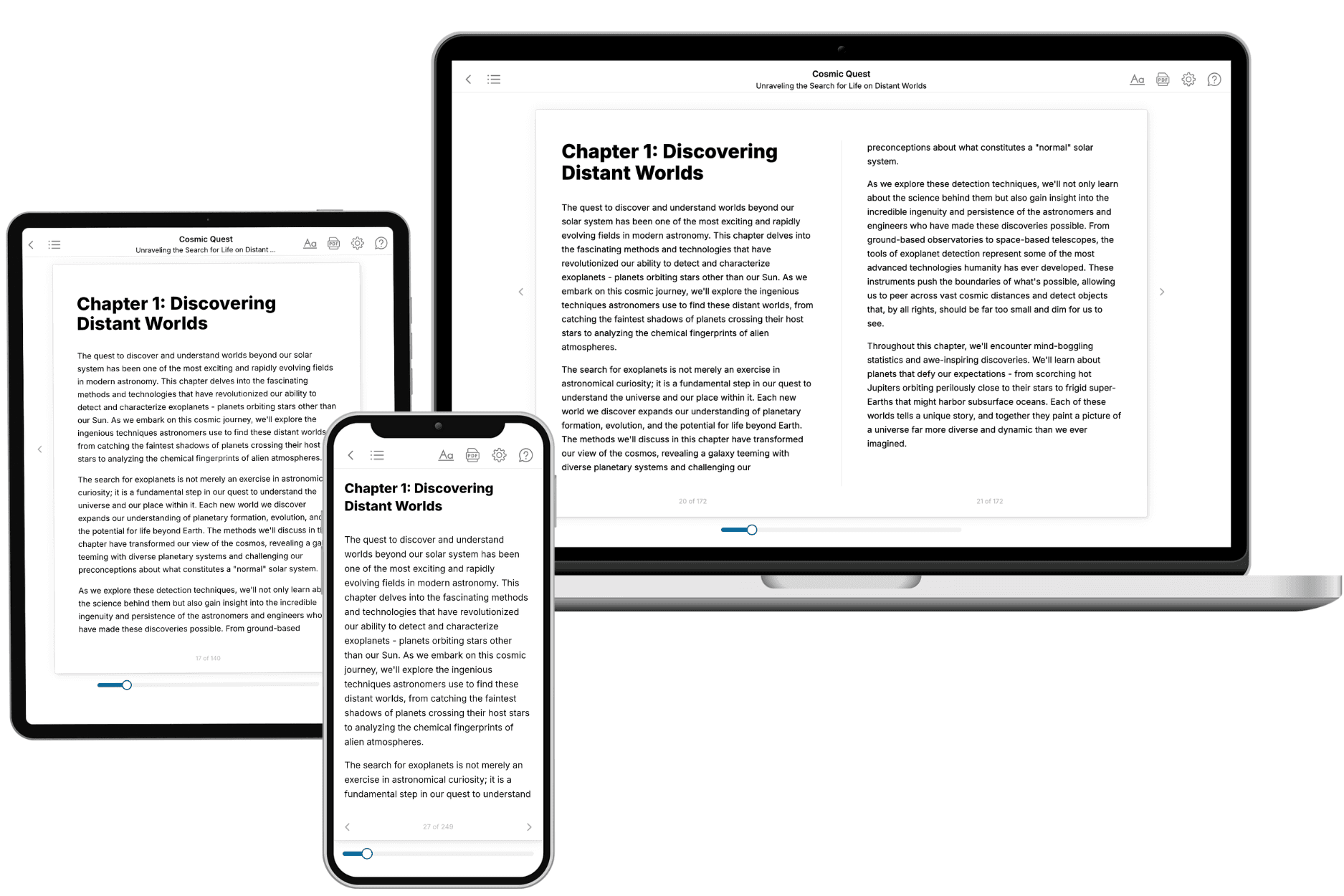
Yes. Every book can be read in our online reader or downloaded as a PDF or EPUB. The EPUB can be opened with Kindle, Apple Books, Kobo, and any e-reader. The Commercial and Author licenses also include an editable Word (DOCX) and Markdown download.
- How much does it cost?
About the price of a regular ebook. The exact price depends on your book's length and complexity, from $2 for the shortest books to $35 for the most comprehensive, and it's shown when you review your book, before you commit to anything. Each book is a one-time purchase, yours to keep, no subscription. Licenses that let you share, teach, or publish your book range from $35.99 to $49.99.
- Can I preview the book before purchasing?
Before you pay, you'll see what your book will cover: the title, a detailed description, the estimated length, and the complete chapter-by-chapter table of contents, so you know what you're getting before you decide. The full text itself is written after you purchase.
- How long does it take to create a book?
About 10 minutes. You can start reading the opening chapters while the rest is still being written.