Private Military Contractors
Understanding the Role, Impact, and Future of PMCs in Global Security
Navigate the complex world of private military contractors and their profound impact on global security.
222 pages10 chaptersApr 24, 2026Military History
About this book
This book cuts through the misconceptions and provides you with a clear, evidence-based understanding of how PMCs operate, why nations employ them, and what their rise means for international stability. You'll explore the historical evolution of military privatization, examine real-world case studies from Iraq to Africa, and understand the legal frameworks—and gaps—that govern these powerful organizations. Whether you're concerned about accountability, curious about defense policy, or seeking to understand modern conflicts, this book equips you with the knowledge to engage thoughtfully with one of the most consequential trends in contemporary security. Discover how PMCs challenge traditional notions of state power, what regulations actually work, and what the future holds for private military forces in an increasingly complex world.
Table of contents
- IntroductionWhy Private Military Contractors Matter Today, What This Book Covers and Why, How to Engage with This MaterialRead below
- Chapter 1: Defining Private Military ContractorsWhat Exactly Is a Private Military Contractor?, Types and Categories of PMCs, PMCs, Mercenaries, and Security Firms: Understanding the Distinctions
- Chapter 2: Historical Evolution of Military PrivatizationPrivate Military Forces Throughout History, The Cold War and Early PMC Development, Post-Cold War Expansion and Professionalization
- Chapter 3: The Business of Private Military ServicesHow PMCs Generate Revenue and Operate, Major PMC Companies and Their Operations, Market Dynamics and Industry Growth
- Chapter 4: Legal Frameworks and Regulatory GapsInternational Law and PMC Regulation, National Regulations and Licensing Requirements, Accountability Challenges and Enforcement Gaps
- Chapter 5: PMCs in Modern ConflictsIraq and Afghanistan: The Modern PMC Expansion, PMC Operations in Africa and Emerging Markets, Contemporary Conflicts and PMC Involvement
- Chapter 6: Operational Roles and ResponsibilitiesCombat Support and Direct Action Roles, Training, Advisory, and Capacity-Building Missions, Security, Logistics, and Support Functions
- Chapter 7: Ethical and Political ImplicationsSovereignty and the State Monopoly on Force, Democratic Accountability and Transparency Issues, Human Rights Concerns and Misconduct
- Chapter 8: Geopolitical Impact and Strategic ImplicationsPMCs as Tools of Power Projection, Impact on Regional Stability and Conflict Dynamics, PMCs in Great Power Competition
- Chapter 9: Regulation and Reform EffortsExisting International Frameworks and Agreements, Proposed Reforms and Best Practices, Challenges in Implementation and Enforcement
- Chapter 10: The Future of Private Military ContractorsTechnology, Automation, and Future PMC Operations, Evolving Security Threats and PMC Adaptation, Predictions and Possible Trajectories
- ConclusionKey Takeaways and Critical Questions, Your Role in the PMC Debate
- Glossary
- Further Reading and Resources
Introduction
On September 16, 2007, a convoy of armored vehicles moved through the streets of Baghdad. The men providing security were not U.S. soldiers. They were employees of Blackwater USA, a private military contractor hired to protect American diplomatic personnel. What happened next became one of the most scrutinized incidents of the Iraq War. Blackwater personnel opened fire in Nisour Square, killing 17 Iraqi civilians. The incident sparked international outrage, triggered congressional investigations, and forced a global conversation about who these private military contractors actually were, who they answered to, and what rules governed their actions.[1] That conversation has never really ended.
Private military contractors, commonly referred to as PMCs, are companies and individuals that provide military and security services for payment. They train soldiers, guard embassies, operate surveillance systems, maintain weapons platforms, and in some cases engage directly in armed conflict. They work for governments, international organizations, corporations, and occasionally non-state actors. Their presence in modern conflicts has grown dramatically over the past three decades, to the point where contractors now routinely outnumber uniformed military personnel in active theaters of operation. During the peak of U.S. operations in Iraq and Afghanistan, the ratio of contractors to troops sometimes exceeded one to one.[2]
Yet despite their scale and influence, PMCs remain poorly understood by most people outside defense and policy circles. Public perception tends to oscillate between two extremes: the romanticized image of elite soldiers-for-hire operating in the shadows, and the cynical view of profit-driven mercenaries with no loyalty beyond their next paycheck. Neither picture is accurate, and neither is particularly useful for understanding what PMCs actually do, why governments rely on them, and what their growing presence means for international security. This book is designed to move past both extremes and give you a grounded, evidence-based understanding of one of the most consequential developments in modern warfare.
The questions raised by the PMC industry are not abstract or academic. They touch on fundamental issues of democratic governance, human rights, international law, and the nature of state power. When a government hires a private company to conduct military operations, who bears responsibility if something goes wrong? When a PMC trains the armed forces of an authoritarian regime, is the hiring government complicit in whatever those forces do next? When private contractors operate in legal gray zones where neither military law nor civilian law clearly applies, how is accountability maintained? These are not hypothetical questions. They are live debates playing out in courtrooms, legislatures, and international forums right now.
This introduction lays the groundwork for everything that follows. It explains why PMCs matter in today's security environment, outlines what this book covers and why those topics were chosen, and offers some guidance on how to engage with material that is often contested, politically charged, and rapidly evolving. The goal is not to tell you what to think about private military contractors. The goal is to give you the knowledge and analytical tools to think about them clearly.
Why Private Military Contractors Matter Today
The private military industry is not a niche phenomenon. By the mid-2010s, the global private security and military services market was estimated to be worth over $200 billion annually, with projections pointing toward continued growth.[3] Companies like G4S, DynCorp, MPRI, and the rebranded remnants of Blackwater (now operating under various names) employ tens of thousands of personnel worldwide. Russia's Wagner Group, a PMC with close ties to the Kremlin, has operated in Syria, Libya, Mali, Sudan, and Ukraine, functioning as an instrument of Russian foreign policy while maintaining a degree of official deniability. The scale and reach of these organizations make them impossible to ignore in any serious analysis of contemporary security.
One reason PMCs matter so much today is the structural shift in how modern states conduct military operations. After the Cold War, many Western governments dramatically reduced the size of their standing armed forces. The U.S. military shrank from roughly 2.1 million active-duty personnel in 1990 to around 1.3 million by the early 2000s.[4] When the demands of the post-9/11 wars in Afghanistan and Iraq exceeded what those reduced forces could handle, contractors filled the gap. This was not a temporary workaround. It became a structural feature of how the United States and its allies conduct operations, and that pattern has persisted long after the peak of those conflicts.
PMCs also matter because they change the political calculus of military intervention. Deploying contractors is often less politically visible than deploying uniformed troops. Contractor casualties rarely receive the same media attention as military deaths. Congressional oversight is less direct. Public debate is more muted. This reduced visibility can make it easier for governments to sustain operations that might otherwise face domestic opposition, which raises serious questions about democratic accountability and the transparency of foreign policy decisions.
Beyond Western contexts, PMCs have become significant actors in conflicts across Africa, the Middle East, and Central Asia. In some cases, they have propped up fragile governments. In others, they have been accused of prolonging conflicts, committing human rights abuses, or serving the interests of foreign powers rather than local populations. The Wagner Group's operations in Mali and the Central African Republic offer a particularly stark example of how PMCs can function as geopolitical tools, extending a state's influence while obscuring its direct involvement.[5]
The legal landscape governing PMCs adds another layer of urgency. International humanitarian law was largely designed with state actors in mind. The rules governing armed conflict, the treatment of prisoners, and the protection of civilians were written for armies, not corporations. PMCs operate in a space where these rules apply imperfectly, where enforcement mechanisms are weak, and where jurisdictional questions are genuinely unresolved. The result is a system where serious misconduct can go unpunished, not because no one cares, but because the legal architecture for holding private military actors accountable simply does not work well enough.
Finally, PMCs matter because the trends driving their growth are not going away. Budget pressures, the complexity of modern threats, the demand for specialized capabilities, and the political appeal of deniable operations all point toward continued reliance on private military services. Understanding this industry is not just a matter of historical interest. It is essential preparation for engaging with the security debates of the next decade and beyond.
The privatization of military force is not a temporary anomaly in the history of warfare. It is a structural feature of the contemporary security environment, and its implications for governance, accountability, and international stability deserve serious, sustained attention.
Consider what it means for a democracy when a significant portion of its military capacity is held by private companies with shareholders, profit motives, and limited public accountability. Or consider what it means for a developing nation when its security depends on foreign contractors whose loyalties and incentives may not align with the country's long-term interests. These are not rhetorical questions. They are practical governance challenges that policymakers, analysts, and informed citizens need to grapple with directly.
What This Book Covers and Why
This book is organized to take you from foundational concepts through to forward-looking analysis. It begins by establishing clear definitions, because the terminology in this field is genuinely contested and often misused. The difference between a PMC, a mercenary, and a private security company matters legally, ethically, and analytically. Getting the definitions right is not pedantry. It is the foundation for everything else.
From definitions, the book moves into history. Understanding where PMCs came from helps explain why they look the way they do today. Private military forces are not a post-Cold War invention. They have existed in various forms for centuries, from the Swiss mercenaries who served European monarchs in the medieval period to the East India Company's private armies in the 18th century. The modern PMC industry, however, has distinctive features shaped by specific historical moments: the end of the Cold War, the drawdown of Western militaries, the wars in the Balkans, and the post-9/11 security environment. That history is covered in depth in Chapters 1 and 2.
Chapters 3 through 6 focus on how the PMC industry actually works. This includes the business models that make these companies profitable, the major players in the industry, the legal frameworks that are supposed to govern their behavior, and the specific operational roles they play in modern conflicts. These chapters draw heavily on documented case studies, including the well-documented experiences of Iraq and Afghanistan, PMC operations across sub-Saharan Africa, and more recent involvements in conflicts in Libya, Syria, and Ukraine. The goal is to ground the analysis in real events and real organizations, not abstract models.
Chapters 7 and 8 shift to the broader implications. The ethical and political questions raised by PMCs are genuinely difficult, and this book does not pretend otherwise. The tension between operational effectiveness and democratic accountability, the challenge of maintaining human rights standards in privatized military operations, and the impact of PMCs on state sovereignty and regional stability are all examined with the complexity they deserve. These chapters are designed to help you develop your own analytical framework, not to hand you a predetermined conclusion.
Chapters 9 and 10 look at regulation and the future. The regulatory landscape is fragmented and often ineffective, but there are meaningful reform efforts underway, and understanding them is important for anyone interested in policy. The future chapter examines how emerging technologies, including autonomous systems, artificial intelligence, and cyber capabilities, are likely to reshape the PMC industry in ways that will create new challenges for oversight and accountability.
It is worth being clear about what this book does not cover. It is not a comprehensive operational history of every PMC that has ever existed. It does not provide tactical or operational details about how private military operations are conducted at the unit level. It does not advocate for any particular policy position, political party, or ideological framework. The aim is analysis, not advocacy. Where evidence points clearly in one direction, that is noted. Where reasonable people disagree, the disagreement is presented honestly.
The book also acknowledges its own limitations. The PMC industry is not transparent. Many contracts are classified. Many incidents go unreported. Some of the most significant PMC operations are known only through fragmentary evidence, investigative journalism, and leaked documents. Where the evidentiary record is thin, that is acknowledged. Where claims are contested, competing perspectives are presented. The goal is intellectual honesty about what is known, what is uncertain, and what remains genuinely unclear.
One deliberate choice in this book's structure is the consistent use of specific, documented examples rather than generic descriptions. Abstract claims about PMC behavior are less useful than concrete cases that illustrate how those behaviors actually manifest. Throughout the book, you will encounter specific incidents, specific companies, and specific policy decisions. These examples are not cherry-picked to support a predetermined argument. They are chosen because they are well-documented, analytically significant, and representative of broader patterns.
How to Engage with This Material
The subject of private military contractors generates strong reactions. People who have worked in the industry often feel that public discourse misrepresents their work and unfairly tars legitimate security professionals with the brush of mercenary misconduct. Critics of the industry argue that the entire enterprise of privatizing military force is fundamentally incompatible with democratic governance and the rule of law. Academics, policymakers, military officers, human rights advocates, and journalists all bring different frameworks and priorities to the subject. Engaging with this material well means being aware of those different perspectives and being willing to hold complexity without collapsing it into simple narratives.
One useful habit when reading about PMCs is to ask consistently: who is making this claim, and what are their incentives? A PMC industry association's report on the economic benefits of military outsourcing deserves scrutiny. So does a human rights organization's report on contractor misconduct. Both may contain accurate information. Both may also reflect the priorities and blind spots of their authors. Triangulating across multiple sources, including government reports, academic research, investigative journalism, and firsthand accounts, gives you a more reliable picture than relying on any single source.
It also helps to distinguish between different types of PMC activity. The industry is not monolithic. A company that trains police forces in post-conflict societies is doing something very different from a company that provides armed escorts in active combat zones, which is in turn different from a company that operates surveillance drones or maintains military aircraft. Lumping all of these activities together under a single moral or analytical judgment produces more heat than light. The chapters ahead are designed to help you make these distinctions clearly and consistently.
Here are some specific analytical questions worth keeping in mind as you read:
- Accountability: Who is legally and politically responsible when a PMC employee commits a serious violation? Is the answer different depending on the type of contract, the location of the incident, or the nationality of the people involved?
- Effectiveness: Do PMCs actually deliver the military and security outcomes that governments pay for? Under what conditions do they perform well, and under what conditions do they fail or cause harm?
- Incentives: How do profit motives shape PMC behavior? Are there structural incentives that push contractors toward certain kinds of conduct, good or bad?
- Alternatives: When governments rely on PMCs, what are the alternatives? Are those alternatives actually feasible given budget constraints, political realities, and operational demands?
- Power dynamics: Who benefits from the current PMC system, and who bears the costs? Are the benefits and costs distributed fairly across different countries, populations, and stakeholders?
These questions do not have simple answers, but asking them consistently will help you engage with the material more critically and productively. They will also help you evaluate the arguments made by different stakeholders in the PMC debate, from industry advocates to regulatory reformers to outright abolitionists.
A note on terminology is also worth making here. This book uses the term private military contractor as a broad umbrella that encompasses a range of organizations and activities. Where finer distinctions matter, they are drawn explicitly. The term mercenary is used in its specific legal and historical sense, not as a general pejorative. The term private security company is used for firms whose activities are primarily defensive and non-combat in nature. These distinctions are explained in detail in Chapter 1, but it is useful to flag them here so that the terminology does not create confusion from the outset.
The chapters in this book are designed to be read in sequence, because each one builds on the concepts and context established in the ones before it. That said, if you have a specific area of interest, such as the legal frameworks governing PMCs or their role in African conflicts, those chapters are written to be accessible even if you come to them without reading everything that precedes them. Key terms are explained when they first appear, and important context is provided within each chapter rather than assumed from earlier sections.
Finally, it is worth saying something about the emotional dimension of this subject. Many of the events discussed in this book involved real people who were killed, injured, or had their lives fundamentally altered. The Nisour Square massacre mentioned at the opening of this introduction was not an abstract policy failure. It was a tragedy that ended 17 lives and traumatized many more. The PMC operations in the Central African Republic that have been linked to serious human rights abuses affected real communities. Keeping that human dimension in view, even while engaging in analytical and policy-oriented discussion, is both intellectually honest and morally important. Analysis that loses sight of the human stakes of military and security decisions is analysis that has lost something essential.
What follows is an attempt to provide the clearest, most honest, and most useful account of private military contractors that the available evidence allows. The subject is complex, the evidence is sometimes incomplete, and the debates are genuinely unresolved. But the importance of understanding this industry, for anyone who cares about how military force is used in the world and who is accountable for it, is beyond question. The pages ahead are an invitation to engage with that importance seriously.
Notes
Introduction
- 1. James Risen, Pay Any Price: Greed, Power, and Endless War, Houghton Mifflin Harcourt, 2014
- 2. Congressional Budget Office, Contractors' Support of U.S. Operations in Iraq, CBO Publication, 2008
- 3. Deborah D. Avant and Lee Sigelman, "Private Security and Democracy," Security Studies, 2010
- 4. U.S. Department of Defense, Active Duty Military Personnel Strengths by Regional Area and by Country, Washington, D.C.: DoD, 2001
- 5. Joseph Siegle and RSA Staff, Russia's Wagner Group in Africa: Influence, Operations, and Atrocities, Africa Center for Strategic Studies, 2022
This is the end of the free sample. The full book has 10 chapters.
Want this book written for you?
Tell us your goals and background, and get your own version of this book, tailored by AI to you.


Benefits of AI-tailored books
- Read one book, not ten:
- all the Military History knowledge you need, gathered into a single book.
- Save days of learning:
- tell us your goals, choose your topics, and the whole book is built around them.
- Learn effortlessly:
- Military History book written for your specific background and expertise.
- Understand at a glance:
- includes charts, tables, timelines, checklists, decision trees, and more.
- Stay current:
- written the day you order it, not years ago.
- Trust what you read:
- every book is checked for accuracy, with real research when your subject needs it.
Create your unique book in 3 steps
- 1. Select your focus
Select the focus of your Military History book and share your background
- 2. Personalize your book
Specify your goals and choose sub-topics to include
- 3. Get your tailored book
Your book is ready in 10 minutes. Read it online, download as EPUB or PDF, or send to Kindle.


Frequently asked questions
- What is TailoredRead?
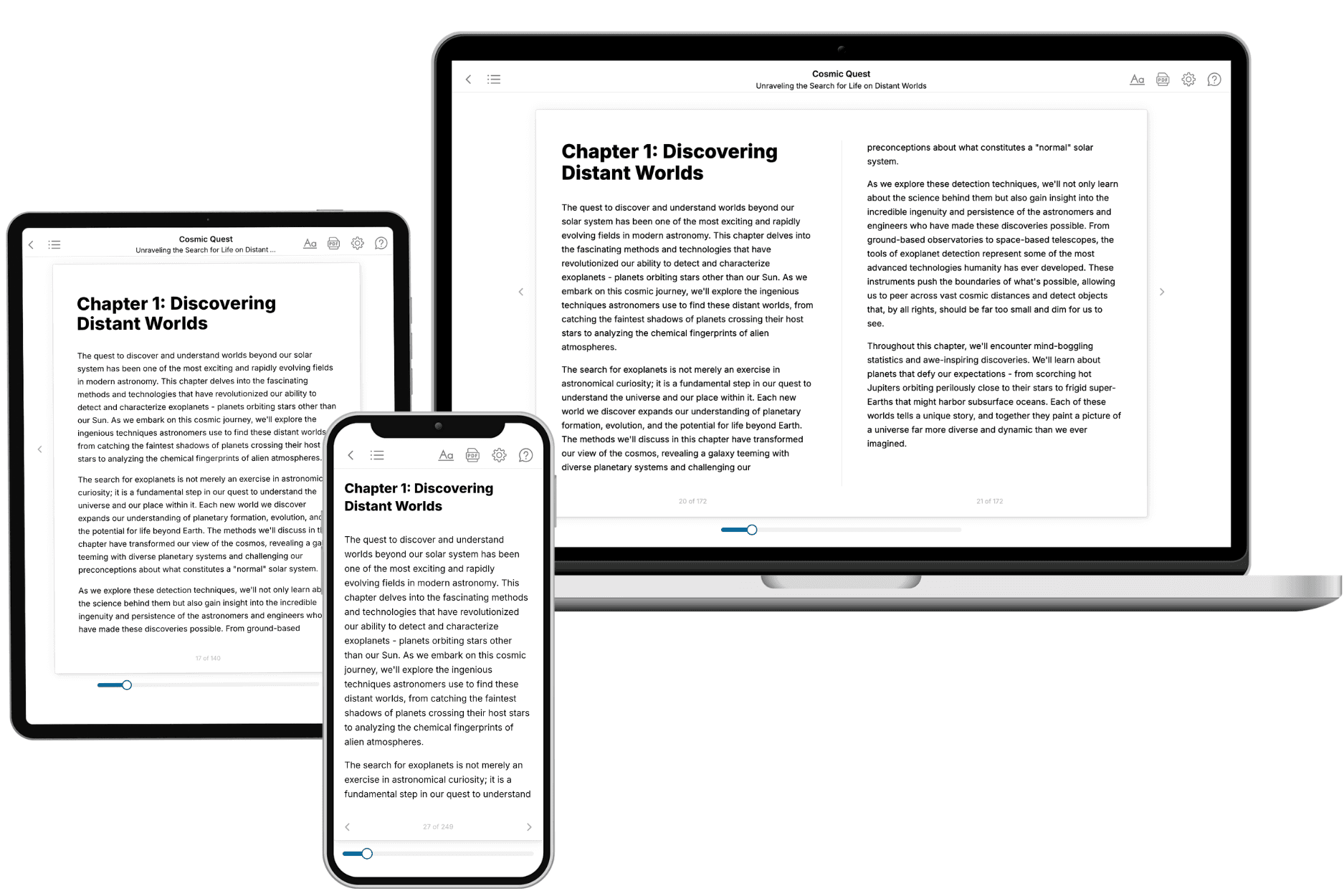
TailoredRead creates complete, full-length nonfiction ebooks, written specifically for you. Tell us what you want to learn and why, and TailoredRead writes you a complete ebook on it, with charts, tables, and diagrams throughout. Read it online, on Kindle, or on any e-reader, or download it as a PDF or EPUB. Every book is written fresh the day you order it.
- How is the book tailored to me?
Before anything is written, you answer a few short questions about your goals, your background, and the topics you care about. Your book is then planned around your answers: written at your level, focused on your goals, and covering the topics you chose, instead of the one-size-fits-all book a store sells everyone.
- Will it read like generic AI content?
No. Your book isn't a chat transcript: it's planned chapter by chapter before a single word is written, told in a clear book voice, and explains ideas visually with charts, tables, and diagrams. After writing, every book goes through an editorial pass that polishes chapters so the book reads consistent from start to finish. Judge for yourself: browse thousands of sample books on our Explore Books page.
- How accurate is the content?
Our AI first checks whether your subject needs live research. Niche and fast-moving subjects are researched before writing, and the book plan and chapters are grounded in what it finds. After writing, every book goes through a quality pass that checks its facts and consistency, and researched books list their sources in a Notes section at the back.
- How long is the book?
You choose the length: Comprehensive (250-300 pages), Detailed (150-200 pages), Essential (70-100 pages), or Short (30-50 pages).
- Does the book include visuals?
Yes. Every book includes charts, tables, and diagrams: timelines, checklists, step-by-step guides, decision trees, comparison tables, matrices, and bar charts. A typical book includes dozens of these visual elements.
- Can I read it on Kindle? What formats can I download?
Yes. Every book can be read in our online reader or downloaded as a PDF or EPUB. The EPUB can be opened with Kindle, Apple Books, Kobo, and any e-reader. The Commercial and Author licenses also include an editable Word (DOCX) and Markdown download.
- How much does it cost?
About the price of a regular ebook. The exact price depends on your book's length and complexity, from $2 for the shortest books to $35 for the most comprehensive, and it's shown when you review your book, before you commit to anything. Each book is a one-time purchase, yours to keep, no subscription. Licenses that let you share, teach, or publish your book range from $35.99 to $49.99.
- Can I preview the book before purchasing?
Before you pay, you'll see what your book will cover: the title, a detailed description, the estimated length, and the complete chapter-by-chapter table of contents, so you know what you're getting before you decide. The full text itself is written after you purchase.
- How long does it take to create a book?
About 10 minutes. You can start reading the opening chapters while the rest is still being written.