Pyrrolidine Alkaloids
Understanding Structure, Synthesis, and Applications in Modern Chemistry
Gain a thorough understanding of pyrrolidine alkaloids and their significance in modern chemistry.
238 pages11 chaptersJun 30, 2026Organic Chemistry
About this book
This book bridges the gap between basic organic chemistry and specialized alkaloid research, providing you with the knowledge to recognize, synthesize, and apply these important compounds. You'll explore the fundamental structures that make pyrrolidine alkaloids unique, discover how chemists create them in the laboratory, and learn about their remarkable biological properties. Whether you're interested in pharmaceutical development, natural product chemistry, or advancing your expertise in organic synthesis, this guide equips you with practical insights and theoretical foundations. Each chapter builds progressively, from foundational concepts to advanced applications, ensuring you can apply this knowledge to real-world research and industrial challenges. Discover why pyrrolidine alkaloids remain at the forefront of drug discovery and chemical innovation.
Table of contents
- IntroductionWhat Are Alkaloids and Why They Matter, An Overview of Pyrrolidine Alkaloids, How to Use This BookRead below
- Chapter 1: Fundamentals of Alkaloid ChemistryHistorical Development of Alkaloid Research, Classification Systems for Alkaloids, The Role of Nitrogen in Alkaloid Structure
- Chapter 2: The Pyrrolidine Ring: Structure and PropertiesAnatomy of the Five-Membered Pyrrolidine Ring, Chemical Properties and Reactivity, Stereochemistry and Conformational Analysis
- Chapter 3: Classification of Pyrrolidine AlkaloidsSimple Pyrrolidine Alkaloids, Tropane Alkaloids and Their Derivatives, Pyrrolizidine Alkaloids and Related Compounds, Other Important Pyrrolidine-Containing Alkaloid Classes
- Chapter 4: Natural Sources and BioprospectingPyrrolidine Alkaloids in Plants, Fungal and Microbial Sources, Marine Organisms as Alkaloid Producers
- Chapter 5: Classical Synthesis MethodsRing Formation Strategies, Reduction and Functional Group Transformations, Classic Syntheses of Important Pyrrolidine Alkaloids
- Chapter 6: Modern Asymmetric SynthesisPrinciples of Asymmetric Synthesis, Catalytic Asymmetric Methods, Chiral Auxiliaries and Protecting Groups
- Chapter 7: Biological Activity and PharmacologyAntimicrobial and Antifungal Properties, Anticancer and Cytotoxic Effects, Neurological and Psychoactive Effects, Other Biological Activities and Mechanisms
- Chapter 8: Spectroscopic CharacterizationNuclear Magnetic Resonance Spectroscopy, Mass Spectrometry and Fragmentation Patterns, Infrared and Ultraviolet Spectroscopy
- Chapter 9: Pharmaceutical Applications and Drug DevelopmentPyrrolidine Alkaloids as Drug Candidates, Clinical Examples and Case Studies, Structure-Activity Relationships and Drug Design
- Chapter 10: Industrial and Commercial ApplicationsAgrochemical Applications, Use as Catalysts and Synthetic Reagents, Specialty Chemicals and Manufacturing
- Chapter 11: Safety, Toxicology, and Regulatory ConsiderationsToxicological Profiles of Common Pyrrolidine Alkaloids, Regulatory Frameworks and Compliance, Safe Handling and Laboratory Practices
- ConclusionKey Takeaways and Future Directions, Emerging Trends in Pyrrolidine Alkaloid Research
- Glossary of Terms
- Further Reading and Resources
Introduction
Chemistry has a long tradition of drawing inspiration from nature. Some of the most powerful medicines, most elegant synthetic strategies, and most surprising biological discoveries have come from studying the molecules that living organisms produce. Among these natural compounds, alkaloids occupy a special place. They are nitrogen-containing organic molecules found across the plant kingdom, in fungi, in marine creatures, and even in certain animals. For centuries, humans have used alkaloid-rich plants as medicines, poisons, and ritual substances without knowing anything about the underlying chemistry. Today, that chemistry is understood in remarkable detail, and it continues to drive innovation in drug discovery, organic synthesis, and materials science.
Within the broad world of alkaloids, one structural family stands out for its versatility and prevalence: the pyrrolidine alkaloids. These compounds are built around a five-membered ring containing one nitrogen atom, a deceptively simple scaffold that gives rise to an enormous range of chemical behavior and biological activity. From the nicotine in tobacco leaves to the proline-derived building blocks found in complex natural products, pyrrolidine-based structures appear again and again across chemistry and biology. Understanding them is not just an academic exercise. It is a practical skill with real consequences for pharmaceutical research, agricultural chemistry, and industrial synthesis.
This book is designed for readers who already have a working foundation in organic chemistry and want to go deeper into one of its most rewarding specialized areas. Whether you are a graduate student encountering alkaloid chemistry for the first time in a research context, a professional chemist looking to expand your expertise, or a researcher in pharmacology or natural products who wants a clearer picture of the structural chemistry involved, this book offers a structured and accessible path forward. Each chapter builds on the last, moving from foundational concepts to advanced synthesis and real-world applications. The goal is not just to describe pyrrolidine alkaloids but to help you think about them clearly and use that thinking productively.
The chapters ahead cover a wide range of topics, from the historical development of alkaloid research and the basic chemistry of the pyrrolidine ring, to modern asymmetric synthesis, spectroscopic characterization, pharmaceutical development, and industrial applications. Along the way, concrete examples and case studies ground the theory in practice. By the end, you will have a comprehensive picture of why pyrrolidine alkaloids matter, how chemists work with them, and where the field is heading. Before diving into the technical content, this introduction sets the stage by answering three foundational questions: What are alkaloids and why do they matter? What specifically makes pyrrolidine alkaloids worth studying? And how is this book organized to help you get the most from it?
What Are Alkaloids and Why They Matter
The word alkaloid literally means "alkali-like," a reference to the basic (high pH) character that most of these compounds display due to their nitrogen content. The term was first used in the early nineteenth century as chemists began isolating and characterizing the active principles of medicinal plants. Morphine was isolated from opium in 1804, quinine from cinchona bark in 1820, and caffeine from coffee in 1819.[1] Each of these discoveries revealed that a single purified compound could account for the dramatic physiological effects of a complex plant extract. That insight transformed both medicine and chemistry.
Defining alkaloids precisely is harder than it might seem. The most widely accepted working definition describes them as naturally occurring, nitrogen-containing organic compounds that are basic in character and have significant pharmacological activity. However, this definition has fuzzy edges. Some alkaloids are not particularly basic. Some nitrogen-containing natural products are excluded by convention. And the line between an alkaloid and a simple amino acid derivative is not always clear. In practice, chemists use the term broadly to cover a large and structurally diverse group of secondary metabolites, meaning compounds that organisms produce not for primary metabolic functions like energy production, but for other purposes such as defense, signaling, or competition.
Why do plants and other organisms make alkaloids? The most widely supported explanation is ecological. Many alkaloids are toxic or deterrent to herbivores, insects, and pathogens. A plant that produces bitter, toxic compounds in its leaves is less likely to be eaten. A fungus that secretes antimicrobial alkaloids has a competitive advantage in a crowded soil environment. This ecological pressure has driven the evolution of enormous chemical diversity over hundreds of millions of years, producing a natural library of bioactive molecules that chemists are still cataloguing and studying today.[2]
From a human perspective, alkaloids matter for several interconnected reasons. First, they have been the source of some of the most important drugs in the history of medicine. Morphine and codeine are still used for pain management. Quinine and its derivatives remain relevant in antimalarial therapy. Vincristine and vinblastine, alkaloids from the periwinkle plant, are frontline chemotherapy agents. Second, alkaloids serve as structural templates for synthetic drug design. Even when the natural compound itself is not used directly, its scaffold often inspires the design of synthetic analogs with improved properties. Third, studying how organisms biosynthesize alkaloids has deepened understanding of enzyme chemistry, metabolic pathways, and the logic of natural product assembly.
The pharmacological relevance of alkaloids is not limited to historical examples. Active research programs around the world continue to screen alkaloids from plants, fungi, and marine organisms for new biological activities. The discovery pipeline from natural product to clinical drug is long and uncertain, but alkaloids have a strong track record. Roughly half of all approved drugs are either natural products or directly derived from them, and alkaloids represent a significant portion of that group.[3] Understanding alkaloid chemistry is therefore not just intellectually satisfying. It is practically important for anyone working in drug discovery or medicinal chemistry.
Beyond pharmaceuticals, alkaloids have found roles in agriculture as natural pesticides and insecticides, in the flavor and fragrance industry, and increasingly as chiral catalysts and reagents in asymmetric synthesis. The pyrrolidine ring, in particular, has proven to be an exceptionally useful scaffold in organocatalysis, where small organic molecules replace metal catalysts to drive enantioselective reactions. This breadth of application is one reason why alkaloid chemistry remains a vibrant and growing field, rather than a mature area with little left to discover.
For the reader approaching this subject for the first time in depth, it helps to think of alkaloids not as a single chemical class but as a vast and varied collection of compounds united by a few common features: nitrogen content, natural origin, and biological activity. The diversity within that collection is what makes alkaloid chemistry so rich. And within that diversity, the pyrrolidine alkaloids offer a particularly well-defined and tractable entry point, because their core structure is simple enough to analyze clearly while still being complex enough to generate interesting chemistry.
An Overview of Pyrrolidine Alkaloids
The pyrrolidine ring is a five-membered saturated ring containing four carbon atoms and one nitrogen atom. Its molecular formula as a standalone compound is C₄H₉N, and it is structurally related to the amino acid proline, which contains a pyrrolidine ring as part of its backbone. This structural connection to amino acid chemistry is significant: many pyrrolidine alkaloids are biosynthesized from amino acid precursors, particularly ornithine and proline, through well-characterized enzymatic pathways. The ring is fully saturated, meaning it lacks the aromatic character of pyridine or pyrrole, and this gives it a distinct set of chemical properties that will be explored in detail in Chapter 2.
What makes the pyrrolidine ring so useful as a chemical scaffold? Several features stand out. The nitrogen atom is a good nucleophile and a moderate base, enabling a wide range of reactions with electrophiles and acids. The ring geometry is relatively rigid compared to open-chain amines, which constrains the spatial arrangement of substituents and makes stereochemical control more predictable. The five-membered ring size is also favorable for stability, avoiding the ring strain associated with three- and four-membered rings while remaining more reactive than the larger, more flexible six-membered piperidine ring. These properties combine to make pyrrolidine an attractive building block for both natural product biosynthesis and laboratory synthesis.
Pyrrolidine alkaloids are not a single homogeneous group. They span several distinct structural classes, each with its own chemistry and biological profile. The major categories include:
- Simple pyrrolidine alkaloids, such as hygrine and cuscohygrine, which contain the pyrrolidine ring with relatively few additional structural features
- Tropane alkaloids, including cocaine and atropine, which incorporate the pyrrolidine ring as part of a bicyclic tropane framework
- Pyrrolizidine alkaloids, such as senecionine and retrorsine, which consist of two fused five-membered rings sharing a nitrogen atom
- Indolizidine alkaloids and other fused-ring systems that incorporate the pyrrolidine unit in more complex polycyclic frameworks
Each of these classes has its own biosynthetic logic, characteristic reactions, and set of biological activities. Chapter 3 covers this classification in detail, but even at this introductory stage it is worth appreciating the structural diversity that a single five-membered ring can generate when combined with different ring fusion patterns, substituents, and stereochemical arrangements.
A few specific examples help illustrate the range of pyrrolidine alkaloids and their significance. Nicotine, perhaps the most familiar pyrrolidine alkaloid, contains a pyrrolidine ring connected to a pyridine ring. It is the primary addictive component of tobacco and acts on nicotinic acetylcholine receptors in the nervous system. Its pharmacology has been studied intensively, and nicotinic receptor agonists and antagonists derived from its structure are active areas of drug development for conditions ranging from Alzheimer's disease to smoking cessation.[4]
Cocaine is a tropane alkaloid from the coca plant (Erythroxylum coca) that has had an outsized influence on both medicine and society. From a purely chemical perspective, it was the first local anesthetic to be used in surgery, and its structure inspired the development of synthetic local anesthetics like procaine and lidocaine that are still in clinical use today. The tropane scaffold in cocaine is a bicyclic system that incorporates the pyrrolidine ring, and understanding its structure-activity relationships was a landmark achievement in early medicinal chemistry.
Proline itself, while technically an amino acid rather than a secondary metabolite alkaloid, deserves mention here because of its central role in organocatalysis. The pyrrolidine ring in proline makes it an effective catalyst for asymmetric aldol reactions and other carbon-carbon bond-forming processes. The Hajos-Parrish-Eder-Sauer-Weechert reaction, developed in the 1970s, used proline to catalyze an intramolecular aldol condensation with high enantioselectivity, foreshadowing the modern field of organocatalysis by decades.[5] This example shows how the pyrrolidine scaffold bridges natural product chemistry and synthetic methodology in productive ways.
The biological activities of pyrrolidine alkaloids are as diverse as their structures. They include antimicrobial effects, anticancer activity, inhibition of specific enzymes, modulation of neurotransmitter systems, and insecticidal properties. Some pyrrolizidine alkaloids are potently hepatotoxic, causing serious liver damage in livestock and humans who consume contaminated plant material. This toxicity is itself a subject of active research, both to understand the mechanisms involved and to develop safer analogs for therapeutic use. The full range of biological activities is covered in Chapter 7, but the key point here is that the pyrrolidine scaffold is not biologically inert. It interacts with biological systems in specific, often potent ways that make it both medically valuable and potentially hazardous.
From a synthetic chemistry perspective, pyrrolidine alkaloids present interesting challenges and opportunities. Their stereochemistry is often critical to their biological activity, meaning that synthesizing the correct enantiomer or diastereomer is essential. Modern asymmetric synthesis has developed powerful tools for constructing pyrrolidine rings with precise stereochemical control, and many of these tools are now standard in pharmaceutical process chemistry. The interplay between natural product synthesis and methodology development is one of the most productive dynamics in organic chemistry, and pyrrolidine alkaloids sit at the center of it.
How to Use This Book
This book is organized to take you from foundational concepts to advanced applications in a logical, progressive sequence. Each chapter builds on what came before, so reading in order is generally the most effective approach, especially if you are new to alkaloid chemistry. That said, the chapters are also written to be reasonably self-contained, so if you have specific background knowledge and want to jump to a particular topic, you can do so with the help of cross-references and the glossary at the back.
Here is a brief map of what each part of the book covers and how the chapters connect:
- Chapters 1 and 2 establish the foundations. Chapter 1 covers the history and classification of alkaloids broadly, giving you the context needed to understand where pyrrolidine alkaloids fit in the larger picture. Chapter 2 focuses specifically on the pyrrolidine ring, examining its structure, chemical properties, and stereochemistry in detail. These two chapters together provide the chemical vocabulary used throughout the rest of the book.
- Chapter 3 surveys the major classes of pyrrolidine alkaloids, from simple pyrrolidines to tropane and pyrrolizidine alkaloids. This chapter is essentially a guided tour of structural diversity, with representative examples from each class.
- Chapter 4 shifts to natural sources, exploring where pyrrolidine alkaloids come from in nature and how bioprospecting efforts identify new compounds from plants, fungi, and marine organisms.
- Chapters 5 and 6 cover synthesis. Chapter 5 addresses classical methods for constructing pyrrolidine rings and synthesizing important alkaloids. Chapter 6 moves into modern asymmetric synthesis, covering catalytic methods, chiral auxiliaries, and the principles of enantioselective chemistry as applied to pyrrolidine alkaloids.
- Chapter 7 examines biological activity and pharmacology, covering the mechanisms by which pyrrolidine alkaloids interact with biological systems and the implications for drug development.
- Chapter 8 provides a practical guide to spectroscopic characterization, focusing on NMR, mass spectrometry, and IR/UV spectroscopy as tools for identifying and analyzing pyrrolidine alkaloids.
- Chapters 9 and 10 address applications. Chapter 9 focuses on pharmaceutical development, including structure-activity relationships and clinical case studies. Chapter 10 covers industrial and commercial applications beyond pharmaceuticals, including agrochemicals, catalysis, and specialty chemicals.
- Chapter 11 addresses safety, toxicology, and regulatory considerations, which are essential for anyone working with these compounds in a laboratory or industrial setting.
Throughout the book, several recurring features are designed to make the content more accessible and actionable. Structural examples are provided for key compounds, with discussion of how specific structural features relate to chemical behavior or biological activity. Reaction schemes are described in enough detail to understand the logic of each transformation, even where full mechanistic detail is beyond the scope of a single chapter. Case studies connect the chemistry to real-world outcomes, whether in drug development, industrial process chemistry, or natural product isolation.
If you are using this book as a companion to a graduate course in natural products chemistry or medicinal chemistry, the chapter sequence maps well onto a typical semester structure. Chapters 1 through 4 cover background and classification material suitable for the first few weeks. Chapters 5 and 6 on synthesis align with the middle portion of a course focused on synthetic methodology. Chapters 7 through 10 on biological activity and applications work well as the applied component in the latter half of a course. Chapter 11 on safety and regulation is relevant throughout but can be assigned as a standalone reading at any point.
If you are a researcher or professional using this book as a reference, the glossary and index at the back will help you locate specific terms and compounds quickly. The further reading section at the end of the book points to primary literature, review articles, and specialized monographs for each major topic. These resources are particularly useful if you need to go deeper into a specific area than a single chapter can cover.
A note on chemical nomenclature: this book uses IUPAC names where precision is important, but also uses common names freely for well-known compounds. When a compound is introduced for the first time, both names are given where they differ. Structural formulas are described verbally and referenced to figures throughout the text. Readers who want to draw out structures as they read will find this a useful habit, as visualizing three-dimensional molecular geometry is essential for understanding stereochemistry and reactivity.
One of the goals of this book is to show that pyrrolidine alkaloid chemistry is not an isolated specialty but a field deeply connected to mainstream organic chemistry, biochemistry, pharmacology, and even ecology. The same principles of nucleophilicity, stereochemical control, and structure-activity relationships that apply in any area of organic chemistry apply here, but in a context that is particularly rich in interesting examples and practical consequences. Approaching the material with that perspective in mind will make it easier to connect new information to what you already know and to see the broader significance of specific details.
Finally, it is worth saying something about the pace and depth of coverage. This book aims to be thorough without being exhaustive. Pyrrolidine alkaloid chemistry is a large field with a literature spanning more than a century, and no single volume can cover all of it. The choices made here prioritize conceptual clarity, practical relevance, and representative examples over comprehensive cataloguing. Where important topics are treated briefly, the further reading section provides pathways to more detailed sources. The aim throughout is to give you a solid, working understanding that you can build on, not a static summary of facts to memorize.
With that orientation in place, it is time to begin. The next chapter opens with the history of alkaloid research, tracing how chemists first isolated and characterized these compounds and how that work laid the foundation for everything that followed. Understanding where the field came from is the best way to appreciate where it is now and where it is going.
Notes
Introduction
- 1. P. M. Dewick, Medicinal Natural Products: A Biosynthetic Approach, 3rd ed. Wiley-Blackwell, 2009
- 2. M. Wink, "Evolutionary advantage and molecular modes of action of multi-component mixtures used in phytomedicine," Current Drug Metabolism, 2008
- 3. D. J. Newman and G. M. Cragg, "Natural products as sources of new drugs over the nearly four decades from 01/1981 to 09/2019," Journal of Natural Products, 2020
- 4. N. L. Benowitz, "Nicotine addiction," New England Journal of Medicine, 2010
- 5. B. List, "Proline-catalyzed aldol reactions," Tetrahedron, 2002
This is the end of the free sample. The full book has 11 chapters.
Want this book written for you?
Tell us your goals and background, and get your own version of this book, tailored by AI to you.


Benefits of AI-tailored books
- Read one book, not ten:
- all the Organic Chemistry knowledge you need, gathered into a single book.
- Save days of learning:
- tell us your goals, choose your topics, and the whole book is built around them.
- Learn effortlessly:
- Organic Chemistry book written for your specific background and expertise.
- Understand at a glance:
- includes charts, tables, timelines, checklists, decision trees, and more.
- Stay current:
- written the day you order it, not years ago.
- Trust what you read:
- every book is checked for accuracy, with real research when your subject needs it.
Create your unique book in 3 steps
- 1. Select your focus
Select the focus of your Organic Chemistry book and share your background
- 2. Personalize your book
Specify your goals and choose sub-topics to include
- 3. Get your tailored book
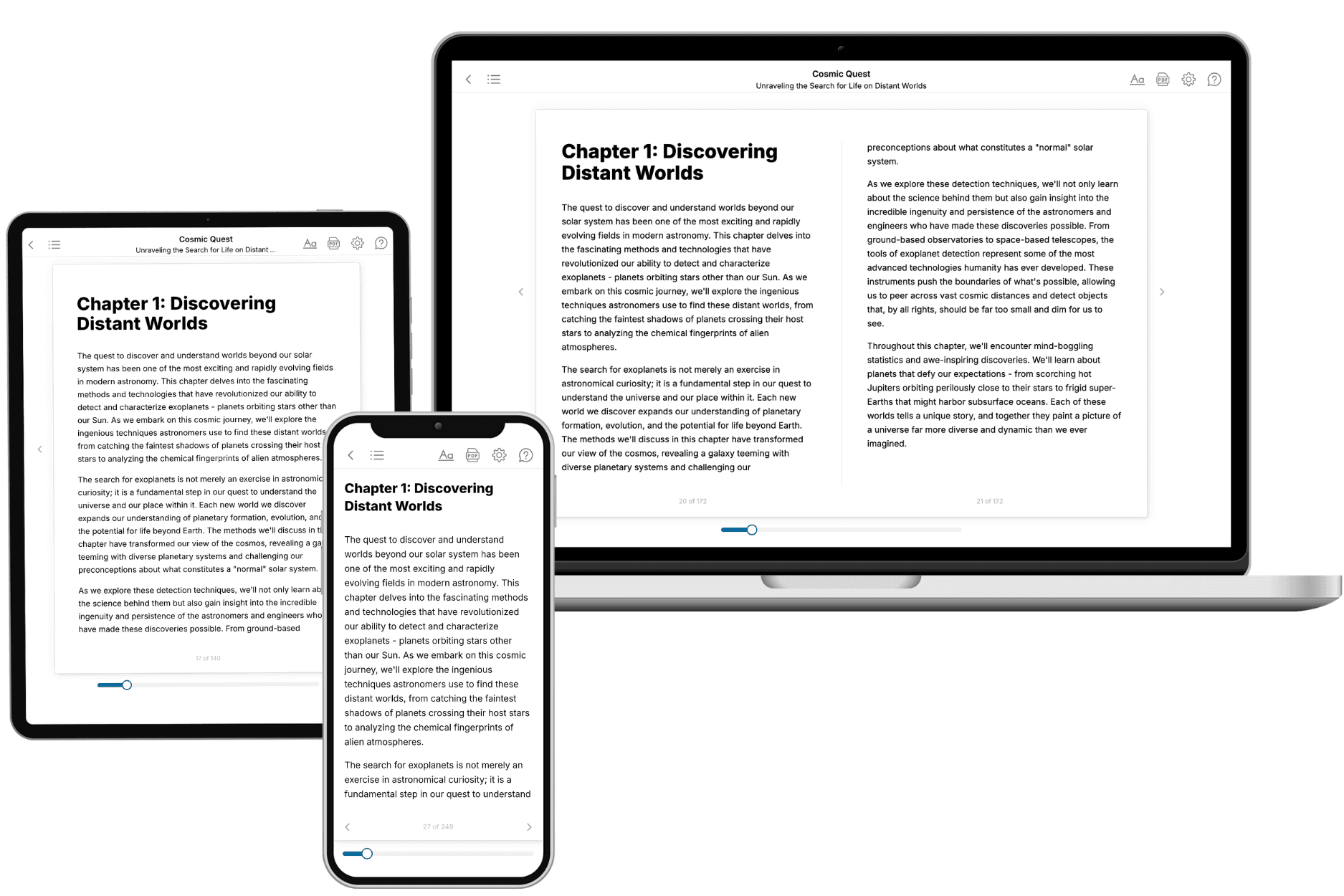
Your book is ready in 10 minutes. Read it online, download as EPUB or PDF, or send to Kindle.

Frequently asked questions
- What is TailoredRead?
TailoredRead creates complete, full-length nonfiction ebooks, written specifically for you. Tell us what you want to learn and why, and TailoredRead writes you a complete ebook on it, with charts, tables, and diagrams throughout. Read it online, on Kindle, or on any e-reader, or download it as a PDF or EPUB. Every book is written fresh the day you order it.
- How is the book tailored to me?
Before anything is written, you answer a few short questions about your goals, your background, and the topics you care about. Your book is then planned around your answers: written at your level, focused on your goals, and covering the topics you chose, instead of the one-size-fits-all book a store sells everyone.
- Will it read like generic AI content?
No. Your book isn't a chat transcript: it's planned chapter by chapter before a single word is written, told in a clear book voice, and explains ideas visually with charts, tables, and diagrams. After writing, every book goes through an editorial pass that polishes chapters so the book reads consistent from start to finish. Judge for yourself: browse thousands of sample books on our Explore Books page.
- How accurate is the content?
Our AI first checks whether your subject needs live research. Niche and fast-moving subjects are researched before writing, and the book plan and chapters are grounded in what it finds. After writing, every book goes through a quality pass that checks its facts and consistency, and researched books list their sources in a Notes section at the back.
- How long is the book?
You choose the length: Comprehensive (250-300 pages), Detailed (150-200 pages), Essential (70-100 pages), or Short (30-50 pages).
- Does the book include visuals?
Yes. Every book includes charts, tables, and diagrams: timelines, checklists, step-by-step guides, decision trees, comparison tables, matrices, and bar charts. A typical book includes dozens of these visual elements.
- Can I read it on Kindle? What formats can I download?
Yes. Every book can be read in our online reader or downloaded as a PDF or EPUB. The EPUB can be opened with Kindle, Apple Books, Kobo, and any e-reader. The Commercial and Author licenses also include an editable Word (DOCX) and Markdown download.
- How much does it cost?
About the price of a regular ebook. The exact price depends on your book's length and complexity, from $2 for the shortest books to $35 for the most comprehensive, and it's shown when you review your book, before you commit to anything. Each book is a one-time purchase, yours to keep, no subscription. Licenses that let you share, teach, or publish your book range from $35.99 to $49.99.
- Can I preview the book before purchasing?
Before you pay, you'll see what your book will cover: the title, a detailed description, the estimated length, and the complete chapter-by-chapter table of contents, so you know what you're getting before you decide. The full text itself is written after you purchase.
- How long does it take to create a book?
About 10 minutes. You can start reading the opening chapters while the rest is still being written.