Python for Full-Stack ML Engineering
Build, Deploy, and Scale Production Machine Learning Systems
Most Python developers can train a machine learning model, but few can deploy one that actually works in production.
222 pages11 chaptersJan 11, 2026Machine LearningCreated by Iraklis
About this book
You've likely hit the wall where your Jupyter notebook doesn't translate to a scalable system—your models are slow, your data pipelines break, and you're unsure how to version, monitor, or update them safely. This book bridges that gap by teaching you the complete ML engineering stack: from optimizing data pipelines with Pandas and SQL, through building robust ML architectures with Scikit-Learn and TensorFlow, to deploying production systems with FastAPI, Docker, and Kubernetes. You'll learn how to structure code for maintainability, automate workflows with Airflow and CI/CD, implement proper testing and monitoring, and leverage cloud platforms like AWS SageMaker. Each chapter combines theory with practical patterns you can apply immediately, covering real-world challenges like hyperparameter tuning, model serialization, API authentication, and real-time inference. By the end, you'll have the skills to architect and deploy ML systems that are reliable, scalable, and production-ready.
Table of contents
- IntroductionWhy Full-Stack ML Engineering Matters, From Notebook to Production: The Gap, What You'll Learn in This Book, How to Use This BookRead below
- Chapter 1: Python Foundations for ML EngineeringNumPy Array Operations and Performance, Pandas Data Cleaning Workflows, Performance Optimization Fundamentals
- Chapter 2: Data Preprocessing and Feature EngineeringSQL Query Optimization for Data Extraction, Feature Engineering Techniques and Pipelines, Data Validation and Quality Assurance
- Chapter 3: Building ML Pipelines with Scikit-LearnScikit-Learn Pipeline Architecture, Model Hyperparameter Tuning Strategies, Cross-Validation Strategies and Best Practices
- Chapter 4: Deep Learning with PyTorch and TensorFlowPyTorch Neural Networks and Training, TensorFlow Model Development and Optimization, TensorFlow Model Serialization and Loading
- Chapter 5: Model Evaluation and TestingImplementing Model Evaluation Frameworks, Unit Testing ML Code and Pipelines, Testing Strategies for Production Models
- Chapter 6: Building ML APIs with FastAPIFastAPI ML Endpoint Design, REST API Authentication and Security, API Performance and Request Handling
- Chapter 7: Containerization and OrchestrationDocker Container Optimization for ML, Kubernetes Orchestration Basics, Deployment Patterns and Scaling
- Chapter 8: Model Management and VersioningMLflow Model Registry and Tracking, Model Versioning Systems and Lineage, Experiment Tracking and Reproducibility
- Chapter 9: Workflow Automation and CI/CDAirflow Workflow Orchestration, CI/CD Pipeline Automation for ML, Automation Best Practices and Monitoring
- Chapter 10: Real-Time Inference and MonitoringReal-Time Inference Systems Architecture, Logging Best Practices for Production, Monitoring, Alerting, and Performance Tracking
- Chapter 11: Cloud Deployment with AWS SageMakerAWS SageMaker Deployment Fundamentals, Cloud Infrastructure and Cost Optimization, Production Operations and Maintenance
- ConclusionRecap: Key Concepts and Patterns, Next Steps in Your ML Engineering Journey
- Appendix: Quick Reference GuideCommon Code Patterns and Snippets, Troubleshooting Common Issues, Additional Resources and Further Reading
Introduction
Machine learning has moved from research labs into production systems that power everything from recommendation engines to fraud detection platforms. Yet a significant gap exists between training a model in a Jupyter notebook and deploying a system that serves millions of requests daily. You might have completed online courses, built impressive models on Kaggle datasets, or even earned certifications in data science. But when it comes time to put those models into production, you face unfamiliar challenges: how do you version your models, handle real-time inference at scale, monitor performance degradation, or integrate with existing backend systems? This book addresses that gap directly by teaching you the complete stack of skills required to build, deploy, and maintain production machine learning systems.
The transition from data scientist to ML engineer requires a fundamental shift in perspective. Data scientists focus primarily on model accuracy, feature engineering, and experimental iteration. ML engineers must consider the entire system lifecycle: data pipeline reliability, API design, infrastructure scalability, deployment automation, monitoring frameworks, and operational maintenance. You need to think about what happens when your data source changes format, when traffic spikes unexpectedly, when a model needs to be rolled back, or when you need to explain why predictions changed between versions. These concerns rarely appear in academic courses or tutorial notebooks, yet they dominate the day-to-day work of production ML systems.
This book takes a pragmatic, hands-on approach to full-stack ML engineering. Rather than providing superficial overviews of dozens of tools, it focuses on the core technologies that form the foundation of modern ML infrastructure: Python's scientific computing stack, Scikit-Learn and TensorFlow for modeling, FastAPI for serving predictions, Docker and Kubernetes for deployment, MLflow for experiment tracking, and AWS SageMaker for cloud infrastructure. Each chapter builds on previous concepts, moving systematically from data preprocessing through model development to production deployment and monitoring. You'll encounter real-world patterns, common pitfalls, and practical solutions that you can apply immediately to your own projects. By the end, you'll have the confidence and skills to architect complete ML systems that are reliable, maintainable, and production-ready.
Why Full-Stack ML Engineering Matters
The demand for ML engineers who can bridge the gap between data science and software engineering has exploded in recent years. Companies have discovered that hiring data scientists alone doesn't result in production ML systems. A model that achieves impressive accuracy on a test set provides zero business value if it can't be deployed reliably, integrated with existing systems, or maintained over time. Organizations need professionals who understand both the statistical foundations of machine learning and the engineering practices required to build scalable, robust systems. This dual expertise commands premium salaries and opens doors to roles that combine intellectual challenge with tangible business impact.
Consider a typical scenario: a data science team builds a recommendation model that improves click-through rates by fifteen percent in offline experiments. The model uses complex feature engineering, ensemble methods, and careful hyperparameter tuning. But when the team attempts to deploy it, they encounter a cascade of problems. The feature engineering code runs too slowly for real-time inference. The model file is too large to load efficiently. There's no clear way to version the model or roll back if something goes wrong. The API they built crashes under load. Monitoring is limited to basic server metrics that don't capture model-specific issues like prediction drift or data quality problems. After months of effort, the model never makes it to production, and the business sees no return on the investment.
This scenario repeats itself across industries because traditional software engineering practices don't translate directly to ML systems. ML systems have unique characteristics that require specialized approaches:
- Data dependencies: Unlike traditional software where behavior is determined by code, ML systems depend critically on training data quality, distribution, and freshness
- Experimental nature: Model development involves extensive experimentation with different architectures, features, and hyperparameters that must be tracked and reproduced
- Performance degradation: Models can silently degrade over time as real-world data distributions shift, requiring continuous monitoring and retraining
- Resource intensity: Training and inference often require significant computational resources that must be managed efficiently
- Versioning complexity: A complete ML system includes code, data, model weights, and configuration—all of which must be versioned together
Full-stack ML engineering addresses these challenges by combining data science expertise with production engineering practices. You learn to design data pipelines that are both statistically sound and operationally reliable. You build models that are not just accurate but also efficient, interpretable, and maintainable. You create APIs that handle authentication, rate limiting, and error handling properly. You implement monitoring systems that track both technical metrics and model-specific performance indicators. You automate deployment workflows so that updates can be rolled out safely and rolled back quickly if needed. This holistic approach ensures that your ML systems deliver sustained business value rather than becoming abandoned experiments.
The business impact of proper ML engineering practices is substantial. Companies with mature ML operations can iterate faster, deploy more models, and maintain higher system reliability. They can A/B test new models safely, monitor performance across different user segments, and respond quickly when issues arise. They avoid the common pattern of having dozens of promising models that never make it to production because the deployment process is too complex or risky. Research from major tech companies shows that organizations with strong ML engineering practices deploy models ten times more frequently and experience fifty percent fewer production incidents compared to those relying on ad-hoc processes[1]. These improvements translate directly to competitive advantage in markets where ML capabilities differentiate winners from losers.
Beyond business impact, full-stack ML engineering offers significant career advantages. The role sits at the intersection of multiple high-demand skill areas: machine learning, software engineering, cloud infrastructure, and DevOps. This combination makes ML engineers valuable across industries and resilient to market shifts. You're not limited to data science roles at tech companies—you can work in finance, healthcare, manufacturing, retail, or any industry that generates data and needs to extract value from it. The skills you develop are transferable and foundational: understanding how to build reliable systems, optimize performance, and manage complexity applies far beyond ML-specific contexts. As ML becomes increasingly central to business operations, professionals who can build and maintain production systems will remain in high demand.
The technical challenges of full-stack ML engineering are intellectually rewarding. You're constantly solving problems that require both analytical thinking and creative engineering. How do you reduce inference latency from two hundred milliseconds to fifty without sacrificing accuracy? How do you design a feature store that serves both batch training and real-time prediction? How do you detect when a model's performance is degrading before it impacts users? These questions don't have simple answers—they require understanding trade-offs, experimenting with different approaches, and developing intuition about system behavior. The work combines the statistical rigor of data science with the craft of software engineering, offering continuous learning opportunities and the satisfaction of building systems that work reliably at scale.
From Notebook to Production: The Gap
Jupyter notebooks are excellent tools for exploration, experimentation, and communication. They allow you to iterate quickly, visualize results immediately, and document your thinking alongside code. Most ML education happens in notebooks because they lower the barrier to entry and make learning interactive. However, notebooks encourage practices that are fundamentally incompatible with production systems. Code in notebooks is typically executed top-to-bottom once, with state accumulated across cells. Functions are often defined inline rather than in modules. Configuration is hardcoded rather than parameterized. Error handling is minimal because you're present to fix issues immediately. These patterns work fine for exploration but create serious problems when you try to operationalize the code.
The first major challenge in moving from notebook to production is reproducibility. A notebook that runs perfectly on your laptop might fail in production due to different Python versions, missing dependencies, or environmental differences. You might have installed packages manually, set environment variables in your shell, or relied on data files in specific locations. When someone else tries to run your code—or when you try to run it six months later—these implicit dependencies cause failures. Production systems require explicit dependency management, containerization, and configuration management. Every aspect of the environment must be specified and version-controlled so that the system behaves identically across development, staging, and production environments.
Consider this common notebook pattern that causes production problems:
import pandas as pd
import numpy as np
from sklearn.ensemble import RandomForestClassifier

# Load data
df = pd.read_csv('/Users/yourname/data/training_data.csv')

# Quick preprocessing
df = df.dropna()
df['feature_1'] = df['feature_1'].apply(lambda x: x * 2 if x > 0 else 0)

# Train model
X = df[['feature_1', 'feature_2', 'feature_3']]
y = df['target']
model = RandomForestClassifier(n_estimators=100, random_state=42)
model.fit(X, y)

# Save model
import pickle
pickle.dump(model, open('model.pkl', 'wb'))The second challenge is code organization and maintainability. Notebooks encourage linear, procedural code where everything happens in sequence. Production systems require modular, testable code organized into functions, classes, and modules. You need clear separation between data loading, preprocessing, model training, evaluation, and inference. Each component should have well-defined inputs and outputs, comprehensive error handling, and unit tests. Configuration should be externalized so that the same code can run with different parameters. Logging should be structured and comprehensive so that you can diagnose issues in production. These practices require restructuring notebook code into proper Python packages with clear architecture and documentation.
The third challenge is performance and scalability. Notebooks typically process small datasets that fit in memory on a single machine. Production systems must handle datasets that are too large for memory, serve predictions with strict latency requirements, and scale to handle variable load. A preprocessing step that takes five minutes in a notebook might need to process millions of records per hour in production. An inference function that takes one second per prediction might need to handle one thousand requests per second. These requirements demand different approaches: batch processing frameworks, distributed computing, caching strategies, model optimization, and careful resource management. Code that works fine for experimentation often needs complete rewrites to meet production performance requirements.
The fourth challenge is monitoring and maintenance. When you run code in a notebook, you see the output immediately and can inspect variables, plot distributions, and debug interactively. Production systems run unattended, often for months or years. You need comprehensive logging to understand what the system is doing, metrics to track performance over time, alerts to notify you when something goes wrong, and dashboards to visualize system health. You need to detect when input data distributions shift, when model performance degrades, when API latency increases, or when error rates spike. You need mechanisms to roll back deployments, drain traffic gradually, and test changes safely. These operational concerns are completely absent from notebook-based development but dominate production ML work.
Real-world example: A financial services company built a fraud detection model in notebooks that achieved excellent results on historical data. When they deployed it, they discovered several critical issues. First, the model took three seconds to make a prediction because it loaded a large feature lookup table on every request. Second, the preprocessing code failed when it encountered data formats that didn't exist in the training set. Third, the model's performance degraded over time as fraud patterns evolved, but they had no monitoring to detect this. Fourth, when they tried to update the model, they couldn't reproduce the original training process because dependencies and data had changed. They spent six months rebuilding the system with proper engineering practices: caching the lookup table, implementing robust data validation, adding comprehensive monitoring, and creating reproducible training pipelines. The rebuilt system served predictions in under fifty milliseconds, handled edge cases gracefully, and could be updated weekly with new training data.
Bridging the notebook-to-production gap requires learning new tools, practices, and ways of thinking. You need to understand how to structure ML projects for maintainability, how to test ML code effectively, how to optimize for production performance, how to deploy models as services, how to monitor system health, and how to automate workflows. These skills aren't typically taught in data science courses, but they're essential for building ML systems that deliver sustained business value. This book provides a systematic path from notebook experimentation to production deployment, teaching you the engineering practices that separate successful ML systems from abandoned experiments.
What You'll Learn in This Book
This book provides a comprehensive, practical guide to building production ML systems with Python. You'll start with foundational skills in data manipulation and preprocessing, progress through model development and evaluation, and culminate in deployment, monitoring, and maintenance of production systems. Each chapter focuses on specific technologies and practices, with concrete examples, code patterns, and real-world scenarios. The content assumes you have intermediate Python programming skills and basic familiarity with machine learning concepts, but it doesn't assume prior experience with production systems or DevOps practices. By the end, you'll have hands-on experience with the complete ML engineering stack and the confidence to architect systems from scratch.
The first section of the book covers data foundations and preprocessing. You'll master NumPy array operations and performance optimization techniques that form the foundation of efficient numerical computing. You'll learn Pandas workflows for data cleaning, transformation, and validation that ensure high-quality inputs to your models. You'll discover SQL optimization strategies for extracting data efficiently from databases, including indexing, query planning, and join optimization. You'll implement feature engineering pipelines that transform raw data into model-ready features while maintaining reproducibility. You'll build data validation frameworks that catch quality issues before they impact model training or inference. These skills ensure that your ML systems have reliable, high-quality data pipelines that can scale to production workloads.
The second section focuses on model development and evaluation. You'll learn to build Scikit-Learn pipelines that encapsulate preprocessing, feature engineering, and model training in reproducible workflows. You'll implement hyperparameter tuning strategies using grid search, random search, and Bayesian optimization to find optimal model configurations. You'll master cross-validation techniques that provide reliable estimates of model performance and prevent overfitting. You'll develop neural networks with PyTorch and TensorFlow, understanding when to use each framework and how to optimize training performance. You'll implement comprehensive model evaluation frameworks that go beyond simple accuracy metrics to assess performance across different data segments, edge cases, and business-relevant scenarios. You'll learn model serialization techniques that preserve not just model weights but also preprocessing logic and metadata.
The third section covers deployment and serving. You'll build ML APIs with FastAPI that expose models as RESTful services with proper authentication, rate limiting, and error handling. You'll implement request validation, response formatting, and API documentation that make your services easy to integrate and maintain. You'll learn Docker containerization techniques that package your models with all dependencies in portable, reproducible containers. You'll understand Kubernetes orchestration fundamentals for deploying containers at scale with automatic scaling, health checks, and rolling updates. You'll implement deployment patterns like blue-green deployments and canary releases that allow you to update models safely with minimal risk. These skills enable you to serve predictions reliably at scale with proper security and operational controls.
The fourth section addresses workflow automation and operations. You'll use MLflow to track experiments, manage model versions, and maintain lineage from training data through deployed models. You'll implement model registries that provide a central source of truth for model artifacts, metadata, and deployment status. You'll build Airflow workflows that orchestrate complex data pipelines, training jobs, and deployment processes on schedules or triggers. You'll create CI/CD pipelines that automatically test, build, and deploy ML systems when code changes, reducing manual effort and deployment risk. You'll implement comprehensive logging frameworks that capture both technical metrics and model-specific information. You'll build monitoring dashboards that track model performance, data quality, API latency, and system health in real-time. You'll set up alerting systems that notify you when metrics exceed thresholds or anomalies are detected.
The final section explores cloud deployment and production operations. You'll learn AWS SageMaker fundamentals for training models at scale and deploying them with managed infrastructure. You'll understand how to optimize cloud costs by choosing appropriate instance types, using spot instances, and implementing auto-scaling policies. You'll implement production operations practices like gradual traffic shifting, A/B testing, and model performance monitoring. You'll learn troubleshooting techniques for diagnosing and resolving production issues quickly. You'll understand how to maintain ML systems over time, including retraining strategies, data drift detection, and model refresh policies. These skills enable you to leverage cloud platforms effectively while maintaining control over costs and performance.
Throughout the book, you'll encounter practical patterns and anti-patterns drawn from real-world ML systems. You'll see examples of what works well and what causes problems in production. You'll learn when to use different tools and techniques, understanding the trade-offs involved in architectural decisions. You'll develop intuition about system behavior, performance characteristics, and operational concerns. The goal isn't just to teach you specific tools—it's to develop your judgment as an ML engineer so you can make informed decisions about system design, technology choices, and operational practices. By working through concrete examples and understanding the reasoning behind different approaches, you'll build the expertise needed to architect ML systems that are reliable, maintainable, and production-ready.
Each chapter includes actionable code examples that you can adapt to your own projects. Rather than toy examples with synthetic data, you'll work with realistic scenarios that reflect actual production challenges. You'll see complete implementations, not just fragments, so you understand how different components fit together. You'll learn debugging techniques, optimization strategies, and troubleshooting approaches that help you resolve issues independently. The book emphasizes practical skills that you can apply immediately, with enough theoretical foundation to understand why certain approaches work and when to use them. By the end, you'll have a portfolio of patterns, techniques, and best practices that form the foundation of professional ML engineering work.
How to Use This Book
This book is designed for systematic learning, with each chapter building on concepts from previous chapters. The recommended approach is to read sequentially, working through code examples and exercises as you go. However, the book is also structured to serve as a reference guide that you can return to when facing specific challenges in your own projects. Each chapter is relatively self-contained, with clear explanations of prerequisites and references to related content in other chapters. If you're already familiar with certain topics, you can skim those sections and focus on areas where you need deeper knowledge. The key is to engage actively with the material rather than passively reading—type out code examples, experiment with variations, and apply concepts to your own datasets and problems.
To get the most value from this book, set up a proper development environment before you begin. You'll need Python 3.8 or later, preferably managed with a tool like pyenv or conda that allows you to create isolated environments. Install Jupyter for interactive exploration, but also set up a proper IDE like VS Code or PyCharm for writing production code. Create a GitHub repository for your practice projects so you can track changes and experiment safely. Install Docker Desktop so you can work with containers locally. Set up a free-tier AWS account if you want to follow along with cloud deployment examples. Having these tools configured upfront will allow you to work through examples smoothly without interruptions for environment setup. The appendix includes detailed setup instructions and troubleshooting tips for common configuration issues.
Each chapter follows a consistent structure designed to facilitate learning:
- Conceptual overview: Each chapter begins with clear explanations of key concepts, why they matter, and how they fit into the broader ML engineering workflow
- Practical examples: Concepts are illustrated with concrete code examples that you can run and modify, showing both correct implementations and common mistakes
- Real-world scenarios: Each chapter includes case studies or scenarios drawn from actual production systems, demonstrating how concepts apply in practice
- Best practices: You'll learn established patterns and anti-patterns, understanding what works well and what causes problems in production
- Troubleshooting guidance: Common issues and their solutions are highlighted, helping you diagnose and resolve problems independently
The code examples in this book are available in a companion GitHub repository that includes complete implementations, sample datasets, and additional exercises. The repository is organized by chapter, with each example in its own directory including a README with setup instructions and explanations. You can clone the repository and work through examples locally, modifying them to experiment with different approaches. The repository also includes solutions to exercises, though you'll learn more by attempting them yourself before looking at solutions. As you progress through the book, you'll build increasingly sophisticated projects that integrate concepts from multiple chapters, culminating in a complete end-to-end ML system that demonstrates all the skills you've learned.
Consider creating a personal project that you work on throughout the book, applying each new concept as you learn it. This could be a prediction system for a domain you're interested in, a recommendation engine, an anomaly detection system, or any other ML application. Start with a simple notebook implementation in the early chapters, then progressively refactor it into a production system as you learn new techniques. By the end of the book, you'll have a complete portfolio project that demonstrates your full-stack ML engineering skills. This hands-on approach reinforces learning much more effectively than passive reading, and it gives you concrete artifacts to discuss in job interviews or show to potential employers.
The book includes numerous footnotes and references to additional resources for readers who want to dive deeper into specific topics. These references point to academic papers, technical documentation, blog posts, and other books that provide more detailed coverage of particular subjects. You don't need to follow every reference to benefit from the book, but they're valuable if you want to understand the theoretical foundations behind practical techniques or explore advanced topics beyond the book's scope. The appendix also includes a curated list of resources for continued learning, including online courses, documentation sites, community forums, and blogs that provide ongoing education in ML engineering practices.
As you work through the book, focus on understanding principles rather than memorizing syntax. The specific tools and libraries will evolve over time, but the underlying concepts—how to structure ML systems, how to optimize performance, how to ensure reliability, how to monitor production systems—remain relatively stable. When you encounter a new tool or technique, ask yourself: What problem does this solve? What are the trade-offs? When would I use this versus alternatives? How does this fit into the broader system architecture? This analytical approach develops the engineering judgment that distinguishes senior practitioners from junior ones. By the end of the book, you'll have not just technical skills but also the conceptual framework needed to continue learning and adapting as the field evolves.
Finally, remember that becoming proficient in full-stack ML engineering takes time and practice. Don't be discouraged if concepts seem challenging at first or if your initial implementations don't work perfectly. Production ML engineering is genuinely difficult—it requires integrating knowledge from multiple domains and developing intuition about complex systems. The key is consistent practice and learning from mistakes. Every error message teaches you something about how systems work. Every performance bottleneck you diagnose improves your optimization skills. Every production incident you resolve makes you better at building reliable systems. Approach the learning process with patience and curiosity, and you'll develop the expertise needed to build ML systems that deliver sustained business value in production environments.
Notes
Introduction
- 1. D. Sculley and others, Hidden Technical Debt in Machine Learning Systems, NIPS, 2015
This is the end of the free sample. The full book has 11 chapters.
Want this book written for you?
Tell us your goals and background, and get your own version of this book, tailored by AI to you.


Benefits of AI-tailored books
- Read one book, not ten:
- all the Machine Learning knowledge you need, gathered into a single book.
- Save days of learning:
- tell us your goals, choose your topics, and the whole book is built around them.
- Learn effortlessly:
- Machine Learning book written for your specific background and expertise.
- Understand at a glance:
- includes charts, tables, timelines, checklists, decision trees, and more.
- Stay current:
- written the day you order it, not years ago.
- Trust what you read:
- every book is checked for accuracy, with real research when your subject needs it.
Create your unique book in 3 steps
- 1. Select your focus
Select the focus of your Machine Learning book and share your background
- 2. Personalize your book
Specify your goals and choose sub-topics to include
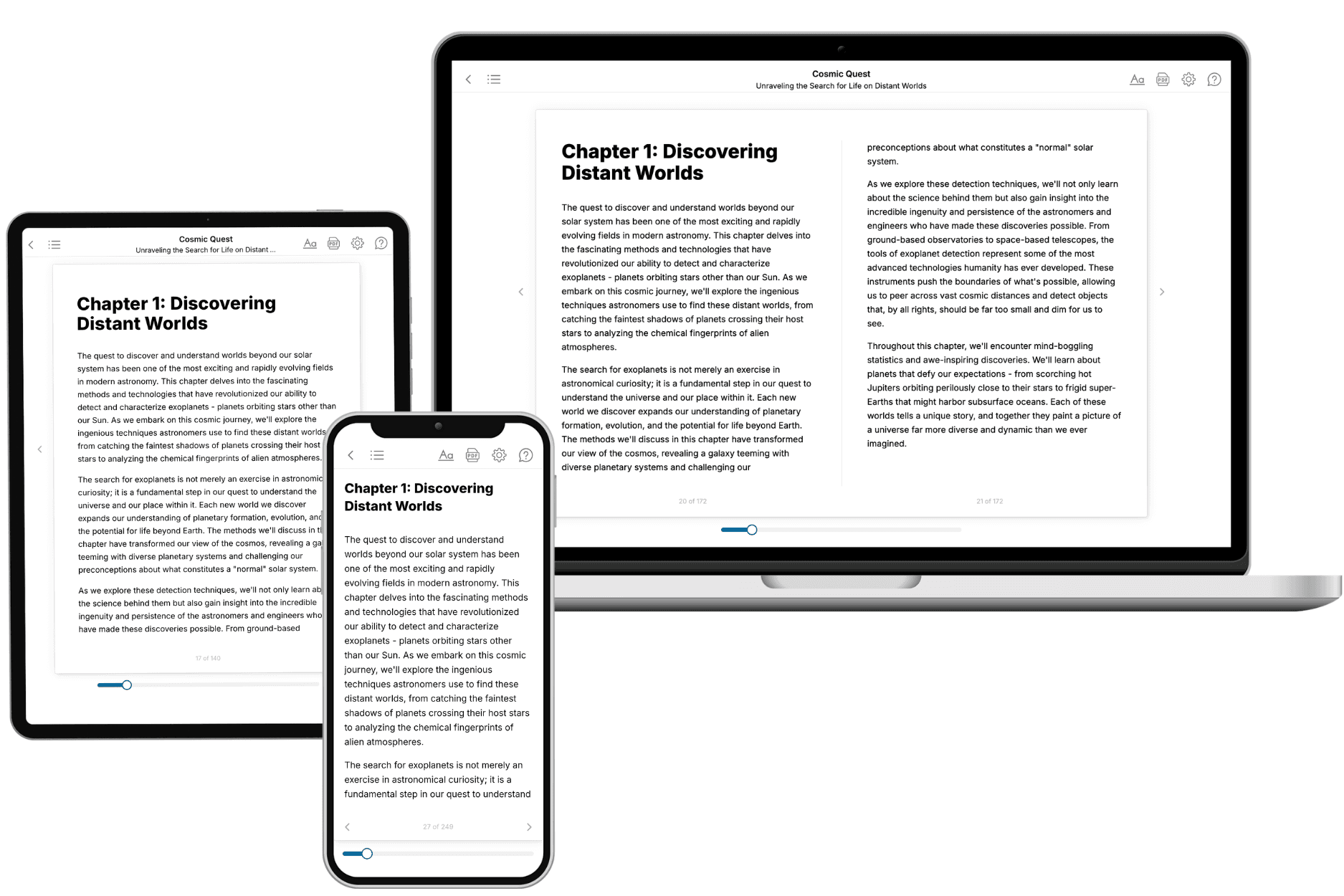
- 3. Get your tailored book
Your book is ready in 10 minutes. Read it online, download as EPUB or PDF, or send to Kindle.
Frequently asked questions
- What is TailoredRead?
TailoredRead creates complete, full-length nonfiction ebooks, written specifically for you. Tell us what you want to learn and why, and TailoredRead writes you a complete ebook on it, with charts, tables, and diagrams throughout. Read it online, on Kindle, or on any e-reader, or download it as a PDF or EPUB. Every book is written fresh the day you order it.
- How is the book tailored to me?
Before anything is written, you answer a few short questions about your goals, your background, and the topics you care about. Your book is then planned around your answers: written at your level, focused on your goals, and covering the topics you chose, instead of the one-size-fits-all book a store sells everyone.
- Will it read like generic AI content?
No. Your book isn't a chat transcript: it's planned chapter by chapter before a single word is written, told in a clear book voice, and explains ideas visually with charts, tables, and diagrams. After writing, every book goes through an editorial pass that polishes chapters so the book reads consistent from start to finish. Judge for yourself: browse thousands of sample books on our Explore Books page.
- How accurate is the content?
Our AI first checks whether your subject needs live research. Niche and fast-moving subjects are researched before writing, and the book plan and chapters are grounded in what it finds. After writing, every book goes through a quality pass that checks its facts and consistency, and researched books list their sources in a Notes section at the back.
- How long is the book?
You choose the length: Comprehensive (250-300 pages), Detailed (150-200 pages), Essential (70-100 pages), or Short (30-50 pages).
- Does the book include visuals?
Yes. Every book includes visual elements such as timelines, checklists, step-by-step guides, decision trees, comparison tables, and matrices, and many include bar charts. A typical book includes dozens of these visual elements.
- Can I read it on Kindle? What formats can I download?
Yes. Every book can be read in our online reader or downloaded as a PDF or EPUB. The EPUB can be opened with Kindle, Apple Books, Kobo, and any e-reader. The Commercial and Author licenses also include an editable Word (DOCX) and Markdown download.
- How much does it cost?
About the price of a regular ebook. The exact price depends on your book's length and complexity, from $2 for the shortest books to $35 for the most comprehensive, and it's shown when you review your book, before you commit to anything. Each book is a one-time purchase, yours to keep, no subscription. Licenses that let you share, teach, or publish your book range from $35.99 to $49.99.
- Can I preview the book before purchasing?
Before you pay, you'll see what your book will cover: the title, a detailed description, the estimated length, and the complete chapter-by-chapter table of contents, so you know what you're getting before you decide. The full text itself is written after you purchase.
- How long does it take to create a book?
About 10 minutes. You can start reading the opening chapters while the rest is still being written.