Python Text Mining Mastery
A Comprehensive Guide to Building Production-Ready Text Analytics and NLP Systems
Master the art of building production-ready text analytics and NLP systems with confidence and precision.
238 pages12 chaptersOct 20, 2025Natural Language ProcessingCreated by WB
About this book
This comprehensive guide bridges the gap between theoretical knowledge and practical implementation, showing you how to architect robust text mining pipelines that scale. You'll discover proven strategies for preprocessing unstructured text data, selecting optimal machine learning algorithms for classification tasks, and implementing sophisticated language models that deliver measurable results. From dimensionality reduction techniques that preserve semantic meaning to advanced named entity recognition systems, you'll gain the expertise needed to tackle real-world text analytics challenges. Learn how to evaluate model performance rigorously, visualize complex textual patterns, and write Python code that adheres to industry best practices. Whether you're building topic modeling systems, implementing n-gram analysis, or creating text summarization tools, you'll find actionable guidance grounded in both research and practical experience. This book equips you with the technical depth and hands-on skills to design NLP applications that solve meaningful problems while maintaining code quality, reproducibility, and performance at scale.
Table of contents
- IntroductionThe Modern Text Analytics Landscape, Adopting a Production-First Mindset, How to Use This BookRead below
- Chapter 1: Python Best Practices for Text AnalyticsStructuring Text Mining Projects, Writing Readable and Maintainable Code, Testing and Debugging NLP Pipelines, Optimizing Python Performance for Large Text Corpora
- Chapter 2: Acquiring and Managing Textual DataIdentifying and Accessing Text Data Sources, Web Scraping and API Integration, Storage Strategies for Text Collections, Assessing and Ensuring Data Quality
- Chapter 3: Building Robust Text Preprocessing PipelinesText Cleaning and Normalization Techniques, Tokenization Strategies for Different Languages, Stopword Removal and Stemming vs. Lemmatization, Designing Task-Specific Preprocessing Functions
- Chapter 4: Feature Engineering and Dimensionality ReductionBag-of-Words and TF-IDF Representations, Word Embeddings and Contextual Representations, Dimensionality Reduction Techniques for Text, Feature Selection and Engineering Best Practices
- Chapter 5: N-gram Analysis and Language ModelingUnderstanding N-gram Statistics and Applications, Building Statistical Language Models, Smoothing Techniques and Perplexity Evaluation
- Chapter 6: Text Classification SystemsSelecting Classification Algorithms for Text, Implementing Advanced Classifiers and Ensembles, Handling Class Imbalance in Text Data, Multi-class and Multi-label Classification
- Chapter 7: Named Entity RecognitionRule-Based and Statistical NER Approaches, Sequence Labeling Models for Entity Extraction, Training Custom Entity Recognizers
- Chapter 8: Topic Modeling and Document ClusteringImplementing Latent Dirichlet Allocation, Alternative Topic Modeling Methods, Evaluating and Interpreting Topic Models, Document Clustering Techniques
- Chapter 9: Text Summarization TechniquesExtractive Summarization Methods, Abstractive Summarization Approaches, Summarization Evaluation Metrics
- Chapter 10: Evaluating Model PerformanceSelecting Appropriate Evaluation Metrics, Cross-Validation Strategies for Text Data, Conducting Systematic Error Analysis, Statistical Significance Testing
- Chapter 11: Visualizing Text Data and ResultsExploratory Visualization Techniques, Visualizing Word and Document Embeddings, Model Interpretation and Explanation Visualizations
- Chapter 12: Building Production NLP ApplicationsDesigning Scalable NLP Pipeline Architectures, Version Control and Reproducibility, Monitoring and Maintaining NLP Systems, Deployment Strategies and Best Practices
- ConclusionEssential Principles for Text Analytics Success, Emerging Trends and Future Directions
- AppendixEssential Python Libraries for Text Mining, Additional Resources and Datasets
Introduction
Text analytics has evolved from an academic curiosity into a mission-critical capability for organizations across every sector. The exponential growth of unstructured textual data—from social media conversations and customer reviews to scientific publications and internal documents—has created both unprecedented opportunities and formidable challenges. While powerful algorithms and frameworks have become increasingly accessible, the gap between implementing a proof-of-concept model and deploying a robust, production-ready system remains substantial. This book addresses that gap directly, providing you with the technical depth and practical guidance needed to build text mining systems that deliver consistent value in real-world environments.
The landscape of natural language processing has transformed dramatically over the past decade. Neural architectures and transformer-based models have achieved remarkable performance on benchmark tasks, capturing headlines and imagination alike. Yet the reality of production text analytics is more nuanced than these advances might suggest. Many practitioners discover that simpler models outperform complex ones when training data is limited, domain-specific, or noisy. Others find that the computational requirements of state-of-the-art models exceed their infrastructure budgets or latency constraints. The most successful text analytics systems balance algorithmic sophistication with practical considerations like maintainability, interpretability, and operational costs.
This book takes a production-first approach to text mining, emphasizing the decisions and trade-offs that separate experimental prototypes from systems that scale reliably. You'll learn not just how to implement algorithms, but when to choose one approach over another based on your specific constraints and objectives. The focus throughout is on building systems that work consistently across diverse inputs, degrade gracefully when encountering unexpected data, and remain maintainable as requirements evolve. Whether you're architecting a sentiment analysis pipeline for customer feedback, building a document classification system for content management, or implementing named entity recognition for information extraction, the principles and practices in this book will guide you toward robust, production-quality solutions.
The Python ecosystem provides an exceptionally rich toolkit for text analytics, but with that richness comes complexity. Dozens of libraries offer overlapping functionality, each with different APIs, performance characteristics, and design philosophies. Beyond selecting the right tools, writing production-quality Python code requires attention to structure, testing, documentation, and performance optimization. This book integrates best practices for Python development throughout, ensuring that your text mining pipelines are not only algorithmically sound but also maintainable, testable, and efficient. You'll see concrete examples of well-structured code, learn strategies for debugging complex NLP pipelines, and discover techniques for optimizing performance when processing large text corpora.
The Modern Text Analytics Landscape
The field of text analytics encompasses a diverse array of techniques, each designed to extract different types of insights from unstructured text. At the foundation lie preprocessing operations—tokenization, normalization, and cleaning—that transform raw text into structured representations suitable for analysis. These seemingly simple operations profoundly impact downstream performance, yet they're often treated as afterthoughts rather than critical design decisions. The optimal preprocessing pipeline depends on your specific task, language characteristics, and data quality. A sentiment analysis system processing social media posts requires different preprocessing than a topic modeling application analyzing scientific abstracts or a named entity recognizer extracting information from clinical notes.
Feature engineering and representation learning form the next layer of the text analytics stack. Traditional approaches like bag-of-words and TF-IDF transform documents into numerical vectors by counting and weighting term occurrences. These methods remain surprisingly effective for many applications, offering interpretability and computational efficiency that more complex approaches cannot match. Word embeddings like Word2Vec and GloVe capture semantic relationships by representing words as dense vectors in continuous space, enabling models to recognize that king
relates to queen
similarly to how man
relates to woman
. Contextual embeddings from transformer models like BERT go further, generating different representations for the same word based on surrounding context, distinguishing between bank
as a financial institution versus a river's edge.
The choice between these representation strategies involves fundamental trade-offs that extend beyond raw performance metrics. Consider a document classification task with ten thousand training examples:
- TF-IDF with logistic regression trains in seconds, produces interpretable feature weights showing which terms drive predictions, and requires minimal computational resources for inference
- Pre-trained word embeddings with a neural classifier captures semantic relationships and handles vocabulary variations better, but requires more training time and computational resources
- Fine-tuned BERT achieves the highest accuracy on benchmark datasets, but demands GPU resources, takes hours to train, and produces opaque predictions that resist interpretation
The optimal choice depends on your specific constraints and requirements. If you need to explain predictions to stakeholders, deploy on resource-constrained devices, or iterate rapidly during development, simpler approaches often prove superior despite lower benchmark scores. Production systems frequently employ hybrid architectures that combine multiple representation strategies, using simple models for initial filtering and reserving expensive neural models for cases where they provide clear value. This pragmatic approach balances performance, cost, and maintainability in ways that pure benchmark optimization cannot capture.
Text classification represents one of the most common text analytics applications, encompassing tasks from spam detection and sentiment analysis to topic categorization and intent recognition. The algorithmic landscape ranges from classical machine learning methods like Naive Bayes and Support Vector Machines to deep learning architectures including convolutional neural networks, recurrent networks, and transformers. Each approach brings distinct advantages and limitations. Naive Bayes trains quickly and works well with limited data but assumes feature independence that rarely holds in practice. Support Vector Machines with appropriate kernels can capture complex decision boundaries but struggle with very large datasets. Neural networks can learn intricate patterns but require substantial training data and careful regularization to avoid overfitting.
Beyond classification, text analytics encompasses information extraction tasks like named entity recognition, which identifies and categorizes mentions of people, organizations, locations, and other entities within text. Modern NER systems combine rule-based patterns with statistical sequence labeling models, leveraging domain knowledge alongside learned patterns. Topic modeling techniques like Latent Dirichlet Allocation discover thematic structure in document collections without supervision, revealing latent topics that organize content. Text summarization condenses documents while preserving key information, using either extractive methods that select important sentences or abstractive approaches that generate novel summaries. Each of these capabilities addresses different analytical needs and requires distinct modeling strategies.
The evaluation of text analytics systems extends far beyond simple accuracy metrics. Precision and recall trade-offs matter differently depending on application context—a spam filter prioritizes precision to avoid false positives that discard legitimate messages, while a medical information extraction system prioritizes recall to avoid missing critical findings. Class imbalance pervades real-world text data, where rare categories of interest appear infrequently among dominant classes. Temporal dynamics affect performance as language evolves, new entities emerge, and data distributions shift. Production systems must account for these complexities through careful metric selection, robust validation strategies, and ongoing monitoring that detects performance degradation before it impacts users.
The infrastructure supporting text analytics has matured significantly, with libraries like NLTK, spaCy, scikit-learn, Gensim, and Hugging Face Transformers providing high-quality implementations of core algorithms. Yet this abundance of tools creates its own challenges. Different libraries make different design choices regarding API design, performance optimization, and feature coverage. Understanding when to use spaCy's efficient pipeline architecture versus NLTK's comprehensive linguistic utilities, or when to leverage scikit-learn's consistent interface versus specialized libraries for specific tasks, requires experience and judgment. This book provides that guidance, helping you navigate the ecosystem effectively and select tools that align with your requirements.
Adopting a Production-First Mindset
Building production-ready text analytics systems requires a fundamentally different mindset than developing research prototypes or proof-of-concept demonstrations. Research code prioritizes experimentation and rapid iteration, often sacrificing structure and robustness for flexibility. Production code must handle edge cases gracefully, fail predictably when encountering unexpected inputs, and maintain consistent performance across diverse operating conditions. This transition from prototype to production represents one of the most challenging aspects of applied text analytics, yet it receives surprisingly little attention in academic curricula and technical literature. The gap between a Jupyter notebook that works on clean sample data and a deployed system processing millions of documents daily is vast.
Code quality forms the foundation of production systems. Well-structured code organized into modular functions and classes enables testing, debugging, and maintenance. Following Python conventions like PEP 8 ensures consistency and readability, making code accessible to team members and your future self. Comprehensive error handling prevents cryptic failures and provides actionable information when problems occur. Consider this contrast between prototype and production approaches to text preprocessing:
Prototype approach: A single function that chains together cleaning operations, assumes inputs are well-formed, and fails silently when encountering unexpected characters or encodings.
Production approach: Modular functions for each preprocessing step, explicit validation of inputs and outputs, graceful handling of encoding issues, logging of anomalies for monitoring, and comprehensive unit tests covering edge cases.
The production approach requires more upfront investment but pays dividends throughout the system lifecycle. When preprocessing fails on a subset of documents, modular design enables rapid identification of the problematic step. When requirements change—perhaps stopword removal proves counterproductive for your specific task—isolated functions can be modified or removed without cascading changes. When new team members join the project, well-structured code with clear interfaces accelerates onboarding. These benefits compound over time, making the difference between systems that evolve smoothly and those that calcify into unmaintainable tangles of technical debt.
Testing strategies for text analytics systems must address unique challenges that distinguish NLP from other software domains. Unit tests verify that individual functions behave correctly on representative inputs, including edge cases like empty strings, special characters, and unusual encodings. Integration tests ensure that pipeline components work together correctly, catching issues that emerge from component interactions. End-to-end tests validate that the complete system produces expected outputs for realistic inputs. Beyond functional correctness, performance tests verify that processing times remain acceptable as data volumes scale. Regression tests detect when code changes inadvertently degrade model performance, catching subtle bugs that functional tests might miss.
Reproducibility represents another critical dimension of production systems. Text analytics pipelines involve numerous sources of randomness—random initialization of model parameters, shuffling of training data, sampling during preprocessing—that can cause results to vary across runs. Production systems must control these sources of variation through explicit random seeds, deterministic algorithms where possible, and comprehensive versioning of code, data, and dependencies. When a model's performance degrades in production, you need the ability to reproduce training conditions exactly to diagnose whether the issue stems from code changes, data drift, or infrastructure differences. Without reproducibility, debugging becomes guesswork and confidence in system behavior erodes.
Version control extends beyond code to encompass models, data, and experimental results. Git manages code effectively, but trained models and datasets require different approaches. Tools like DVC (Data Version Control) track large files and datasets alongside code, enabling you to reproduce any historical version of your system completely. Experiment tracking platforms like MLflow or Weights & Biases record hyperparameters, metrics, and artifacts for each training run, making it possible to compare approaches systematically and identify which changes improved performance. This infrastructure transforms ad-hoc experimentation into a systematic process where insights accumulate rather than being lost in scattered notebooks and forgotten experiments.
Monitoring and observability distinguish systems that degrade gracefully from those that fail catastrophically. Production text analytics systems must instrument key metrics—processing latency, prediction confidence distributions, input data characteristics, error rates—and expose them for monitoring. Alerting rules detect anomalies like sudden increases in processing time, shifts in input data distributions, or degradation in model confidence. Logging captures sufficient context to diagnose issues without overwhelming storage or analysis capacity. When problems occur, comprehensive monitoring enables rapid diagnosis and remediation. Without it, you discover issues only when users complain, by which time damage may be substantial.
The production-first mindset also encompasses operational considerations like deployment strategies, resource management, and scaling approaches. Containerization with Docker ensures consistent environments across development, testing, and production. Orchestration platforms like Kubernetes manage scaling and resource allocation automatically. API design determines how other systems interact with your text analytics capabilities, affecting both usability and performance. Caching strategies reduce redundant computation for frequently processed inputs. Batch processing versus real-time inference involves trade-offs between latency and throughput that depend on application requirements. These operational concerns may seem distant from core text analytics algorithms, but they determine whether your carefully crafted models deliver value in practice.
How to Use This Book
This book is structured to guide you from foundational practices through increasingly sophisticated text analytics capabilities, with each chapter building on previous concepts while remaining accessible as a standalone reference. The organization reflects the typical workflow of text analytics projects, beginning with Python best practices and data acquisition, progressing through preprocessing and feature engineering, exploring specific analytical techniques, and culminating in production deployment considerations. You can read sequentially for comprehensive coverage or jump to specific chapters addressing your immediate needs. Cross-references throughout connect related concepts and help you navigate dependencies between topics.
Chapter 1 establishes Python best practices that underpin all subsequent material. You'll learn how to structure text mining projects for maintainability, write code that adheres to community conventions, implement testing strategies for NLP pipelines, and optimize performance for large text corpora. These practices may seem tangential to text analytics algorithms, but they determine whether your implementations remain manageable as complexity grows. The chapter provides concrete examples of well-structured code, common anti-patterns to avoid, and techniques for debugging issues that arise in text processing pipelines. Even experienced Python developers will find valuable insights specific to text analytics applications.
Chapters 2 and 3 address data acquisition and preprocessing, the foundational stages that consume the majority of time in real-world text analytics projects. Chapter 2 covers identifying data sources, web scraping and API integration, storage strategies for text collections, and data quality assessment. Chapter 3 dives deep into preprocessing pipelines, exploring cleaning and normalization techniques, tokenization strategies for different languages, stopword removal and lemmatization trade-offs, and task-specific preprocessing design. These chapters emphasize that preprocessing is not a one-size-fits-all process but rather a set of decisions that should be optimized for your specific task and data characteristics. You'll see concrete examples of how preprocessing choices impact downstream performance and learn systematic approaches to pipeline design.
Chapters 4 and 5 explore feature engineering and language modeling, the techniques that transform preprocessed text into numerical representations suitable for machine learning. Chapter 4 covers bag-of-words and TF-IDF representations, word embeddings and contextual representations, dimensionality reduction techniques, and feature selection best practices. Chapter 5 focuses on n-gram analysis and statistical language models, including smoothing techniques and perplexity evaluation. These chapters provide both theoretical understanding and practical implementation guidance, helping you select appropriate representation strategies based on your task requirements, data characteristics, and computational constraints. Extensive examples demonstrate the impact of different choices on model performance and interpretability.
Chapters 6 through 9 cover specific text analytics capabilities that address common application needs:
- Chapter 6: Text Classification Systems explores algorithm selection, advanced classifiers and ensembles, handling class imbalance, and multi-class/multi-label classification
- Chapter 7: Named Entity Recognition covers rule-based and statistical approaches, sequence labeling models, and training custom entity recognizers
- Chapter 8: Topic Modeling and Document Clustering examines Latent Dirichlet Allocation, alternative topic modeling methods, evaluation strategies, and clustering techniques
- Chapter 9: Text Summarization Techniques addresses extractive and abstractive summarization methods along with evaluation metrics
Chapters 10 and 11 address evaluation and visualization, critical capabilities for understanding model behavior and communicating results. Chapter 10 covers metric selection, cross-validation strategies for text data, systematic error analysis, and statistical significance testing. Chapter 11 explores exploratory visualization techniques, embedding visualization, and model interpretation visualizations. These chapters emphasize that evaluation extends beyond simple accuracy metrics to encompass precision-recall trade-offs, class imbalance considerations, and real-world deployment constraints. Visualization reveals patterns invisible in raw metrics and enables effective communication with stakeholders who may lack technical backgrounds.
Chapter 12 synthesizes previous material into comprehensive guidance for building production NLP applications. You'll learn how to design scalable pipeline architectures, implement version control and reproducibility, establish monitoring and maintenance practices, and select appropriate deployment strategies. This chapter connects algorithmic choices to operational realities, helping you build systems that deliver consistent value over time. The focus is on practical considerations that distinguish experimental prototypes from production systems—handling data drift, managing model updates, ensuring consistent performance, and maintaining system health.
Throughout the book, code examples follow consistent conventions and demonstrate production-quality practices. Examples are complete enough to run independently while remaining focused on illustrating specific concepts. All code adheres to PEP 8 style guidelines, includes appropriate error handling, and demonstrates modular design principles. When multiple implementation approaches exist, examples show the trade-offs between them and provide guidance for selecting the most appropriate option. Footnotes reference research papers, documentation, and additional resources for readers seeking deeper understanding of specific topics.
The book assumes you have strong Python programming skills and familiarity with fundamental machine learning concepts. You should be comfortable with NumPy arrays, pandas DataFrames, and scikit-learn's API conventions. Prior exposure to natural language processing concepts is helpful but not required—the book provides sufficient background for each topic while focusing on practical implementation rather than theoretical foundations. The target audience is advanced practitioners seeking to build production-quality text analytics systems, not beginners learning programming or machine learning fundamentals. If you're comfortable implementing machine learning algorithms in Python and want to master text analytics specifically, this book will meet your needs.
Each chapter concludes with key takeaways that summarize essential concepts and actionable guidance. These summaries serve as quick references when you return to specific topics later. The appendix provides curated lists of Python libraries for text mining, along with datasets and additional resources for continued learning. Together, these elements create a comprehensive resource that supports both initial learning and ongoing reference as you build increasingly sophisticated text analytics systems. The goal is not just to teach specific techniques but to develop your judgment about when and how to apply them effectively in production environments where constraints and trade-offs matter as much as algorithmic sophistication.
This is the end of the free sample. The full book has 12 chapters.
Want this book written for you?
Tell us your goals and background, and get your own version of this book, tailored by AI to you.


Benefits of AI-tailored books
- Read one book, not ten:
- all the Natural Language Processing knowledge you need, gathered into a single book.
- Save days of learning:
- tell us your goals, choose your topics, and the whole book is built around them.
- Learn effortlessly:
- Natural Language Processing book written for your specific background and expertise.
- Understand at a glance:
- includes charts, tables, timelines, checklists, decision trees, and more.
- Stay current:
- written the day you order it, not years ago.
- Trust what you read:
- every book is checked for accuracy, with real research when your subject needs it.
Create your unique book in 3 steps
- 1. Select your focus
Select the focus of your Natural Language Processing book and share your background
- 2. Personalize your book
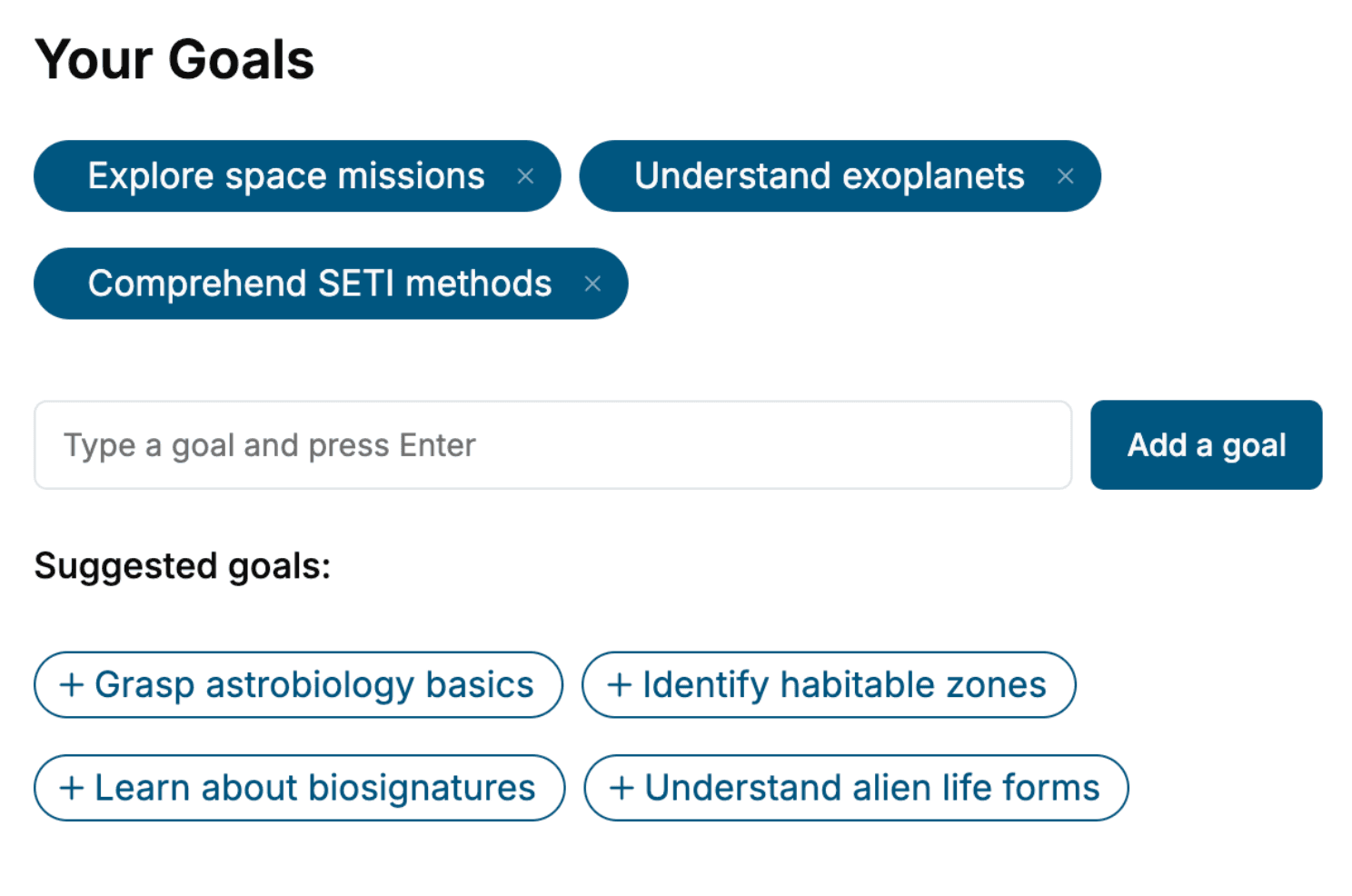
Specify your goals and choose sub-topics to include
- 3. Get your tailored book
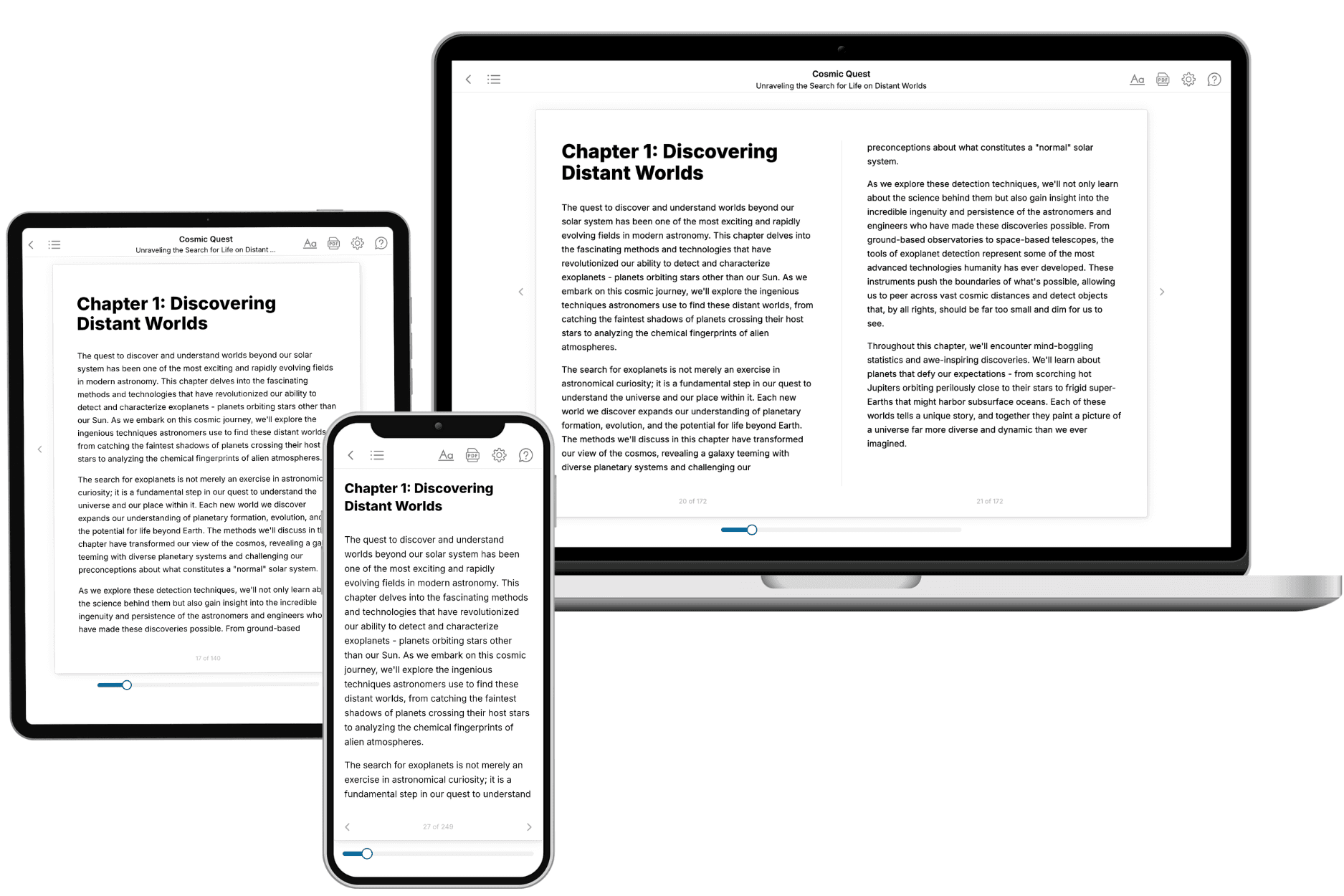
Your book is ready in 10 minutes. Read it online, download as EPUB or PDF, or send to Kindle.

Frequently asked questions
- What is TailoredRead?
TailoredRead creates complete, full-length nonfiction ebooks, written specifically for you. Tell us what you want to learn and why, and TailoredRead writes you a complete ebook on it, with charts, tables, and diagrams throughout. Read it online, on Kindle, or on any e-reader, or download it as a PDF or EPUB. Every book is written fresh the day you order it.
- How is the book tailored to me?
Before anything is written, you answer a few short questions about your goals, your background, and the topics you care about. Your book is then planned around your answers: written at your level, focused on your goals, and covering the topics you chose, instead of the one-size-fits-all book a store sells everyone.
- Will it read like generic AI content?
No. Your book isn't a chat transcript: it's planned chapter by chapter before a single word is written, told in a clear book voice, and explains ideas visually with charts, tables, and diagrams. After writing, every book goes through an editorial pass that polishes chapters so the book reads consistent from start to finish. Judge for yourself: browse thousands of sample books on our Explore Books page.
- How accurate is the content?
Our AI first checks whether your subject needs live research. Niche and fast-moving subjects are researched before writing, and the book plan and chapters are grounded in what it finds. After writing, every book goes through a quality pass that checks its facts and consistency, and researched books list their sources in a Notes section at the back.
- How long is the book?
You choose the length: Comprehensive (250-300 pages), Detailed (150-200 pages), Essential (70-100 pages), or Short (30-50 pages).
- Does the book include visuals?
Yes. Every book includes charts, tables, and diagrams: timelines, checklists, step-by-step guides, decision trees, comparison tables, matrices, and bar charts. A typical book includes dozens of these visual elements.
- Can I read it on Kindle? What formats can I download?
Yes. Every book can be read in our online reader or downloaded as a PDF or EPUB. The EPUB can be opened with Kindle, Apple Books, Kobo, and any e-reader. The Commercial and Author licenses also include an editable Word (DOCX) and Markdown download.
- How much does it cost?
About the price of a regular ebook. The exact price depends on your book's length and complexity, from $2 for the shortest books to $35 for the most comprehensive, and it's shown when you review your book, before you commit to anything. Each book is a one-time purchase, yours to keep, no subscription. Licenses that let you share, teach, or publish your book range from $35.99 to $49.99.
- Can I preview the book before purchasing?
Before you pay, you'll see what your book will cover: the title, a detailed description, the estimated length, and the complete chapter-by-chapter table of contents, so you know what you're getting before you decide. The full text itself is written after you purchase.
- How long does it take to create a book?
About 10 minutes. You can start reading the opening chapters while the rest is still being written.