Quantum Annealing Essentials
Mastering the Next Generation of Optimization Algorithms
Imagine solving optimization problems that would take classical computers years to complete—in minutes.
207 pages9 chaptersJun 2, 2026Optimization Algorithms
About this book
Quantum annealing makes this possible by harnessing quantum mechanics to navigate solution spaces more intelligently than traditional algorithms. This book demystifies quantum annealing for professionals ready to understand this transformative technology. You'll explore the quantum physics foundations that make annealing work, discover which real-world problems benefit most from quantum approaches, and learn practical techniques for implementing solutions on current quantum hardware. Whether you're optimizing supply chains, training machine learning models, or tackling combinatorial challenges, this guide equips you with both theoretical understanding and actionable insights. Move beyond the hype to grasp quantum annealing's genuine capabilities, current limitations, and the hybrid strategies that deliver results today. Perfect for computer scientists, algorithm developers, and technical leaders seeking competitive advantage through quantum-enhanced optimization.
Table of contents
- IntroductionWhy Quantum Annealing Matters Now, What You'll Learn in This Book, How to Use This GuideRead below
- Chapter 1: The Optimization ChallengeThe Limits of Classical Optimization, Understanding the Optimization Landscape, Real-World Optimization Problems
- Chapter 2: Quantum Mechanics FundamentalsEssential Quantum Concepts, Superposition and Entanglement, Quantum Tunneling and Energy Barriers
- Chapter 3: How Quantum Annealing WorksThe Annealing Process Explained, The Adiabatic Theorem and Ground States, Quantum vs. Simulated Annealing
- Chapter 4: Problem Formulation and MappingQuadratic Unconstrained Binary Optimization (QUBO), The Ising Model and Hamiltonian Design, Handling Constraints and Penalties
- Chapter 5: Current Quantum HardwareD-Wave Systems and Quantum Processors, Current Hardware Limitations and Constraints, Emerging Quantum Annealing Platforms
- Chapter 6: Applications Across IndustriesPortfolio Optimization and Risk Management, Logistics and Supply Chain Optimization, Machine Learning and Sampling Applications
- Chapter 7: Hybrid Classical-Quantum ApproachesDesigning Effective Hybrid Algorithms, Preprocessing and Postprocessing Techniques, Integration Patterns with Classical Systems
- Chapter 8: Performance Analysis and BenchmarkingMeasuring Quantum Advantage, Benchmarking Against Classical Algorithms, Setting Realistic Expectations for Performance
- Chapter 9: Implementation and Best PracticesGetting Started with Quantum Annealing, Debugging and Optimizing Your Solutions, Moving to Production: Reliability and Scaling
- ConclusionThe Future of Quantum Annealing, Your Next Steps
- Glossary
- Further Reading and Resources
Introduction
There is a class of problems that quietly defeats every classical computer ever built. Not because the machines are slow or poorly programmed, but because the problems themselves grow in complexity so fast that even the most powerful supercomputers run out of time before they run out of options. Scheduling thousands of flights, optimizing a global supply chain, finding the lowest-energy configuration of a protein molecule: these are not exotic academic puzzles. They are real challenges that cost industries billions of dollars every year, and they share a common trait. The number of possible solutions explodes exponentially as the problem grows larger.
Quantum annealing offers a fundamentally different way to attack these problems. Instead of testing solutions one by one, or even in parallel batches, a quantum annealer exploits the strange behavior of quantum mechanics to explore vast solution spaces simultaneously. It uses phenomena like quantum tunneling and superposition, concepts that sound abstract at first, to navigate around the traps that snare classical optimization algorithms. The result is a machine that can find very good solutions to certain hard problems far faster than any classical approach currently can.
This book is written for professionals who already understand computing at a foundational level and want to move beyond the headlines. Quantum computing gets a lot of press, and much of it is either breathlessly optimistic or dismissively skeptical. Neither extreme is useful if you are trying to decide whether quantum annealing belongs in your technical toolkit. What you need is a clear, honest, and practical account of what quantum annealing actually does, where it genuinely helps, where it falls short, and how to start using it today. That is exactly what this book delivers.
The field is moving quickly. D-Wave Systems has been shipping commercial quantum annealers since 2011, and their latest processors contain thousands of qubits connected in increasingly sophisticated architectures.[1] Researchers at universities and national laboratories are publishing new results every month, and major corporations in finance, logistics, and pharmaceuticals are running pilot programs right now. Understanding quantum annealing is no longer a purely academic exercise. It is becoming a practical skill for algorithm developers and technical leaders who want to stay ahead of the curve.
The chapters ahead build your understanding layer by layer. You will start with the optimization problems that motivate the entire field, move through the quantum physics that makes annealing possible, and arrive at concrete implementation techniques you can apply to real hardware. Along the way, the book is honest about limitations. Quantum annealing is not a magic wand. It excels at specific problem types and struggles with others. Knowing the difference is half the battle, and this guide will make that distinction clear at every step.
Why Quantum Annealing Matters Now
Classical computing has had an extraordinary run. For decades, Moore's Law reliably delivered faster processors every two years, and software engineers could count on hardware improvements to bail out inefficient algorithms. That era is effectively over. Transistors are approaching physical size limits, and clock speeds have plateaued.[2] The industry has responded with parallelism, specialized chips, and better algorithms, but for a specific category of problems, those responses are not enough. Combinatorial optimization problems, the kind where you are searching for the best arrangement among an astronomically large number of possibilities, remain stubbornly hard.
Consider the Traveling Salesman Problem as a concrete illustration. A salesperson needs to visit 20 cities and return home, taking the shortest possible route. The number of possible routes is roughly 60 quadrillion. A classical computer checking one million routes per second would need about two years to check them all. Scale that to 50 cities, and the number of routes exceeds the estimated number of atoms in the observable universe. No amount of classical hardware can brute-force that. Heuristic algorithms help, but they trade optimality for speed, and for many real-world applications, a near-optimal solution is not good enough.
Quantum annealing addresses this challenge by changing the rules of the search. Rather than moving through a solution space step by step, a quantum annealer initializes all possible solutions simultaneously through superposition and then uses quantum tunneling to pass through energy barriers that would trap a classical algorithm in a suboptimal answer. The physical process is analogous to a ball rolling downhill to find the lowest valley in a landscape, except the quantum ball can tunnel through hills rather than being forced to climb over them. This is not a metaphor for marketing purposes. It is a genuine physical mechanism with measurable consequences.
The timing matters for several converging reasons. First, quantum hardware has crossed a threshold of practical usability. Early quantum annealers were fragile research instruments. Today's systems, particularly D-Wave's Advantage platform with over 5,000 qubits, are accessible via cloud APIs and can be programmed using standard software tools.[3] Second, the software ecosystem has matured. Libraries like Ocean SDK make it possible to formulate problems and submit them to quantum hardware without a physics PhD. Third, real-world results are accumulating. Volkswagen used quantum annealing to optimize traffic flow for 10,000 taxis in Beijing. Lockheed Martin explored it for software verification. These are not toy examples.
There is also a competitive dimension worth acknowledging. Organizations that develop quantum literacy now will be better positioned when the technology matures further. The learning curve for quantum annealing is real but manageable, especially for professionals who already understand classical optimization. The concepts build on familiar ideas like energy minimization, graph theory, and probabilistic search. What changes is the physical substrate doing the computation, and understanding that substrate is what this book is designed to help you do.
It is equally important to be clear about what quantum annealing does not do. It is not a general-purpose speedup for all computing tasks. It will not make your web server faster or your database queries more efficient. It is a specialized tool for a specific class of problems, and using it well requires knowing which problems belong to that class. The chapters ahead will give you a precise map of that territory, so you can make informed decisions rather than chasing hype.
The broader quantum computing landscape includes gate-based quantum computers from IBM, Google, and others, which are pursuing a different approach to quantum advantage. Quantum annealing and gate-based quantum computing are complementary, not competing, technologies. Each has its strengths. This book focuses exclusively on quantum annealing because it is the most mature quantum computing technology available today for optimization tasks, and because it has a clear, well-defined application domain that makes it immediately useful for practitioners.
What You'll Learn in This Book
This book is organized to take you from foundational understanding to practical implementation in a logical sequence. Each chapter builds on the previous one, but the structure also allows you to jump to specific topics if you already have background in certain areas. Here is a clear picture of what each part of the journey covers and what you will be able to do after completing it.
Chapter 1: The Optimization Challenge establishes the problem context. Before diving into quantum mechanics, it is worth understanding exactly why classical optimization struggles with certain problem types. You will learn about NP-hard problems, energy landscapes, local minima, and the specific characteristics that make a problem a good candidate for quantum annealing. This chapter grounds everything that follows in practical motivation.
Chapter 2: Quantum Mechanics Fundamentals covers the physics you need without requiring a physics degree. The focus is on three core concepts: superposition, entanglement, and quantum tunneling. These are explained through intuitive analogies and concrete examples rather than heavy mathematics. By the end of this chapter, you will understand why quantum systems behave differently from classical ones and why that difference matters for optimization.
Chapters 3 and 4 form the technical core of the book. Chapter 3 explains how the annealing process works, including the adiabatic theorem that underpins it and how quantum annealing compares to simulated annealing. Chapter 4 covers problem formulation, which is arguably the most critical practical skill in the entire field. You will learn how to express real-world problems as Quadratic Unconstrained Binary Optimization (QUBO) problems and how to map them onto the Ising model that quantum hardware actually solves. This is where theory meets practice.
The middle section of the book, Chapters 5 through 7, covers the applied landscape. Chapter 5 examines current quantum hardware, with a detailed look at D-Wave systems and an honest assessment of their limitations. Chapter 6 surveys real-world applications across finance, logistics, and machine learning, with specific case studies and measurable outcomes. Chapter 7 addresses hybrid classical-quantum approaches, which are currently the most practical path to quantum advantage for most organizations.
The final section, Chapters 8 and 9, focuses on performance and implementation. Chapter 8 gives you the tools to measure whether quantum annealing is actually helping your specific problem, including benchmarking methodologies and a realistic framework for evaluating quantum advantage. Chapter 9 walks through the practical steps of getting started, debugging solutions, and moving toward production use. By the end of this chapter, you will have a concrete roadmap for your first quantum annealing project.
Across all chapters, the book maintains a consistent commitment to specificity. Every concept is illustrated with concrete examples. Every claim about performance is qualified with context about when it applies and when it does not. The goal is not to make quantum annealing sound impressive. The goal is to make it understandable, so you can form your own accurate judgment about where and how to use it.
After completing this book, you will be able to:
- Identify which optimization problems are good candidates for quantum annealing
- Formulate problems in QUBO and Ising model formats
- Understand the capabilities and limitations of current quantum annealing hardware
- Design hybrid classical-quantum workflows for practical applications
- Benchmark quantum annealing results against classical baselines
- Access and use D-Wave's cloud platform and Ocean SDK for real experiments
- Evaluate quantum annealing proposals and vendor claims with informed skepticism
These are not abstract learning objectives. They are skills that translate directly into the ability to evaluate, prototype, and potentially deploy quantum annealing solutions in professional contexts. The field is still young enough that professionals who develop this expertise now are genuinely ahead of the curve.
How to Use This Guide
This book is designed to serve different readers in different ways, depending on your background and goals. Understanding how to navigate it will help you get the most value from your time. The core assumption is that you have a working knowledge of computer science fundamentals: algorithms, data structures, complexity theory, and basic probability. You do not need prior knowledge of quantum physics or advanced mathematics. Where equations appear, they are explained in plain language alongside the formal notation.
If you are coming to this topic completely fresh, the recommended path is to read the chapters in order. The sequence is deliberate. Chapter 1 builds the motivation, Chapter 2 builds the physics intuition, and Chapters 3 and 4 build the technical framework. Skipping ahead before those foundations are in place will make the later material harder to absorb. The investment in the early chapters pays dividends throughout the rest of the book.
If you already have a background in optimization or operations research, you may find Chapter 1 moves quickly through familiar territory. Feel free to skim it and focus on the sections that introduce quantum-specific concepts. Similarly, if you have some exposure to quantum computing from other sources, Chapter 2 may serve more as a review and vocabulary alignment exercise than new learning. The key terms introduced there are used consistently throughout the book, so it is worth at least scanning the chapter even if the concepts are familiar.
For readers with a specific application domain in mind, Chapter 6 can be read independently once you have completed Chapters 3 and 4. The application chapters are written to be self-contained within the context of the book's earlier material. If you are primarily interested in finance applications, for example, you can read the portfolio optimization section of Chapter 6 and then return to the implementation details in Chapter 9 without needing to read the logistics or machine learning sections first.
Throughout the book, you will encounter several recurring features designed to reinforce learning:
- Concrete examples: Every major concept is illustrated with a specific, real-world scenario. These are not simplified toy problems invented for illustration. They are drawn from actual use cases documented in research literature and industry reports.
- Comparison tables: Where quantum annealing is compared to classical alternatives, the comparisons are presented in structured tables that make the trade-offs explicit and easy to reference.
- Practical frameworks: Chapters 4, 7, and 9 include step-by-step frameworks for problem formulation, hybrid design, and implementation. These are designed to be used as working references, not just read once.
- Honest limitations: Every chapter that introduces a capability also addresses its boundaries. This is intentional. Understanding where a tool fails is as important as understanding where it succeeds.
A note on mathematics: this book uses mathematical notation where it genuinely clarifies rather than obscures. The QUBO formulation in Chapter 4 and the Hamiltonian description in Chapter 3 involve equations, because those equations are the actual language of the field and you will encounter them in research papers and documentation. However, every equation is accompanied by a plain-language explanation of what it means and why it matters. The goal is to make you comfortable with the notation, not to test your algebra.
The book also includes footnotes throughout, pointing to primary sources, research papers, and technical documentation. These are not decorative. If a claim is made about performance benchmarks or hardware specifications, the footnote tells you exactly where that data comes from so you can verify it and explore further. The quantum annealing field moves fast, and some specifics will evolve after this book is published. The footnotes give you the tools to track those changes.
For hands-on practice, Chapter 9 provides guidance on accessing D-Wave's Leap cloud platform, which offers free trial access for developers.[4] The Ocean SDK is open source and well-documented, and several of the examples in the book can be run directly on the cloud platform without any local hardware setup. If you want to move from reading to doing, that is the fastest path to hands-on experience.
Finally, a word about expectations. Quantum annealing is genuinely exciting technology, and it is easy to get caught up in the possibilities. This book tries to maintain a steady, analytical tone throughout. The technology has real advantages for specific problems, and it has real limitations that matter for practical deployment. Both are treated with equal seriousness. The goal is to leave you with an accurate mental model, not an inflated one. An accurate model is far more useful when you are making real decisions about where to invest time and resources.
The quantum computing revolution is not a single moment. It is an ongoing process of incremental capability improvements, expanding software ecosystems, and growing practitioner expertise. You are reading this book at a moment when quantum annealing has crossed from research curiosity to practical tool, but before it has become mainstream. That is an excellent time to learn. The concepts are stable enough to be reliable, the hardware is accessible enough to experiment with, and the competitive advantage of early expertise is still real. The chapters ahead are your guide to making the most of that opportunity.
Notes
Introduction
- 1. D-Wave Systems, D-Wave Advantage System Overview, D-Wave Technical Documentation, 2023
- 2. M. M. Waldrop, "The chips are down for Moore's law," Nature, 2016
- 3. D-Wave Systems, "D-Wave Advantage2 Prototype Performance," Technical Report, 2022
- 4. D-Wave Systems, "Leap Quantum Cloud Service," 2023
This is the end of the free sample. The full book has 9 chapters.
Want this book written for you?
Tell us your goals and background, and get your own version of this book, tailored by AI to you.


Benefits of AI-tailored books
- Read one book, not ten:
- all the Optimization Algorithms knowledge you need, gathered into a single book.
- Save days of learning:
- tell us your goals, choose your topics, and the whole book is built around them.
- Learn effortlessly:
- Optimization Algorithms book written for your specific background and expertise.
- Understand at a glance:
- includes charts, tables, timelines, checklists, decision trees, and more.
- Stay current:
- written the day you order it, not years ago.
- Trust what you read:
- every book is checked for accuracy, with real research when your subject needs it.
Create your unique book in 3 steps
- 1. Select your focus
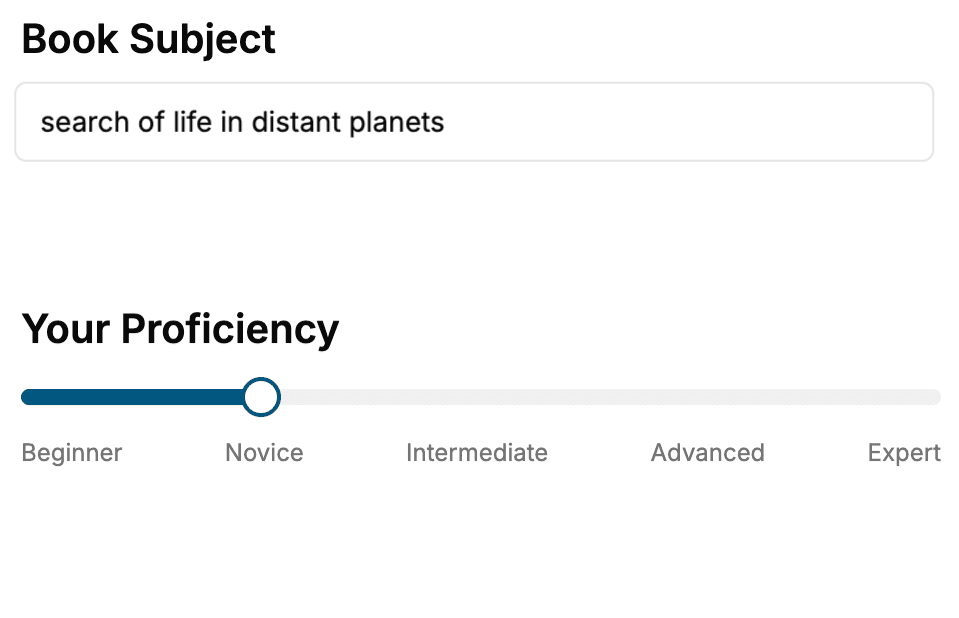
Select the focus of your Optimization Algorithms book and share your background
- 2. Personalize your book
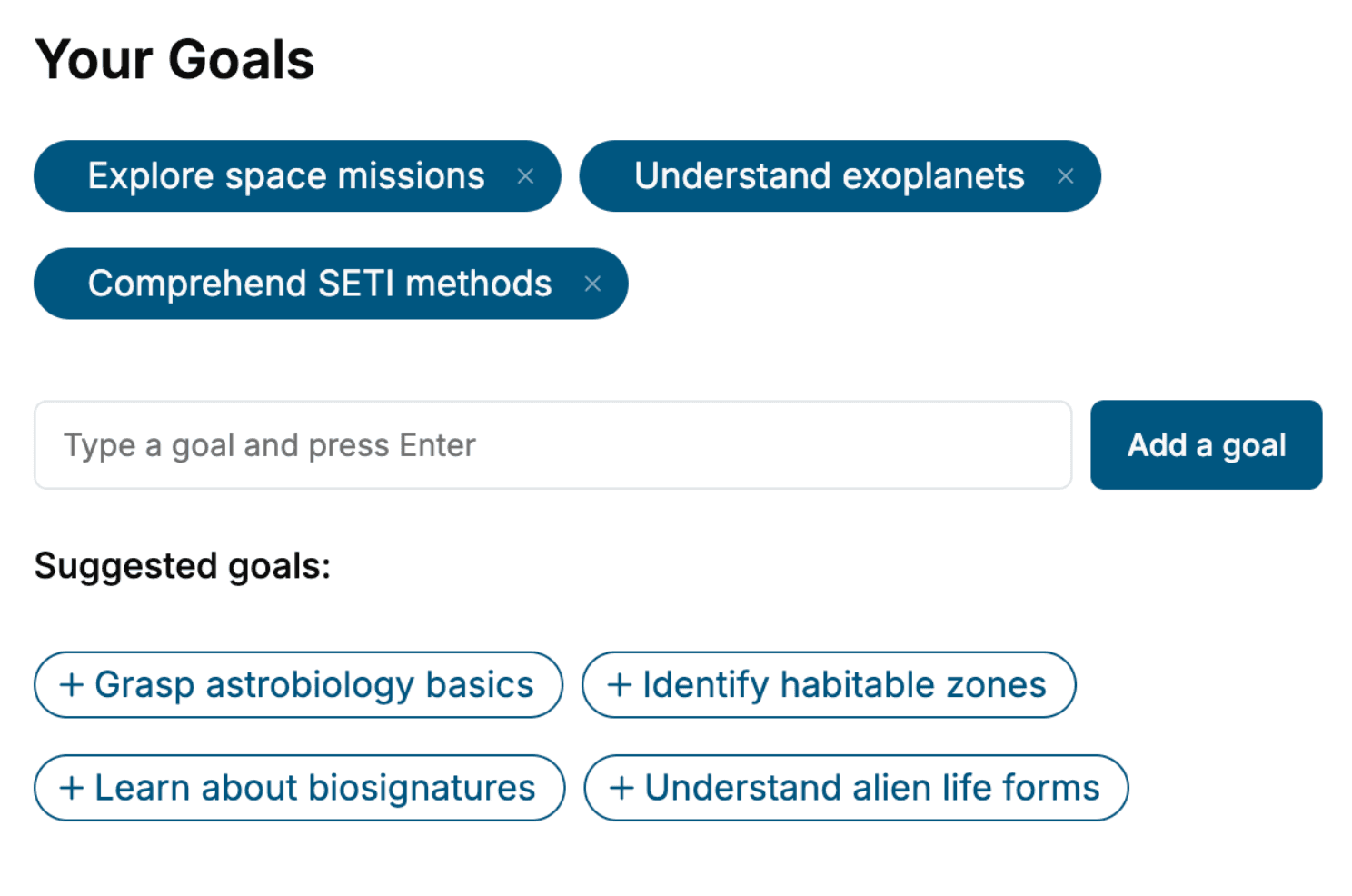
Specify your goals and choose sub-topics to include
- 3. Get your tailored book
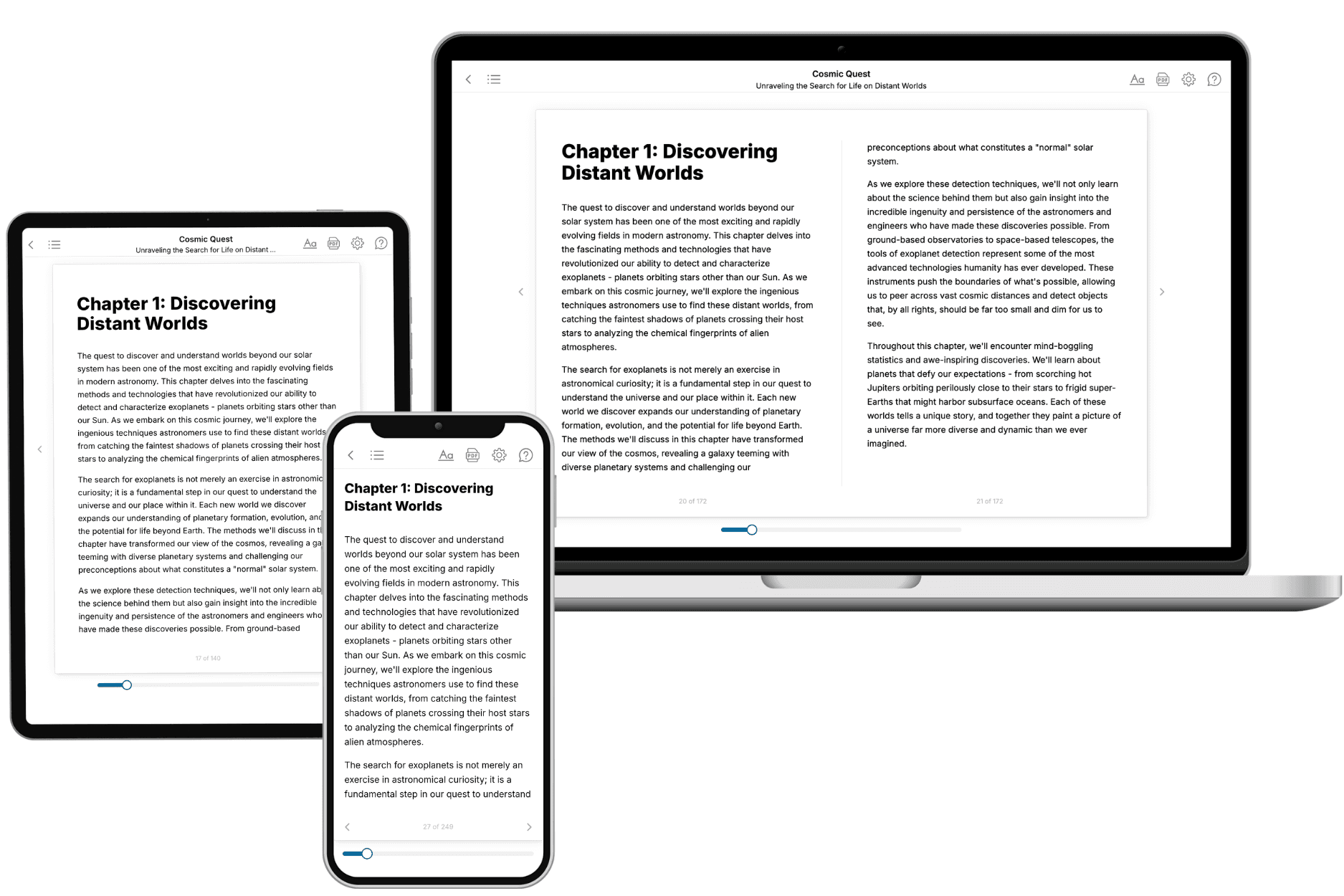
Your book is ready in 10 minutes. Read it online, download as EPUB or PDF, or send to Kindle.
Frequently asked questions
- What is TailoredRead?
TailoredRead creates complete, full-length nonfiction ebooks, written specifically for you. Tell us what you want to learn and why, and TailoredRead writes you a complete ebook on it, with charts, tables, and diagrams throughout. Read it online, on Kindle, or on any e-reader, or download it as a PDF or EPUB. Every book is written fresh the day you order it.
- How is the book tailored to me?
Before anything is written, you answer a few short questions about your goals, your background, and the topics you care about. Your book is then planned around your answers: written at your level, focused on your goals, and covering the topics you chose, instead of the one-size-fits-all book a store sells everyone.
- Will it read like generic AI content?
No. Your book isn't a chat transcript: it's planned chapter by chapter before a single word is written, told in a clear book voice, and explains ideas visually with charts, tables, and diagrams. After writing, every book goes through an editorial pass that polishes chapters so the book reads consistent from start to finish. Judge for yourself: browse thousands of sample books on our Explore Books page.
- How accurate is the content?
Our AI first checks whether your subject needs live research. Niche and fast-moving subjects are researched before writing, and the book plan and chapters are grounded in what it finds. After writing, every book goes through a quality pass that checks its facts and consistency, and researched books list their sources in a Notes section at the back.
- How long is the book?
You choose the length: Comprehensive (250-300 pages), Detailed (150-200 pages), Essential (70-100 pages), or Short (30-50 pages).
- Does the book include visuals?
Yes. Every book includes charts, tables, and diagrams: timelines, checklists, step-by-step guides, decision trees, comparison tables, matrices, and bar charts. A typical book includes dozens of these visual elements.
- Can I read it on Kindle? What formats can I download?
Yes. Every book can be read in our online reader or downloaded as a PDF or EPUB. The EPUB can be opened with Kindle, Apple Books, Kobo, and any e-reader. The Commercial and Author licenses also include an editable Word (DOCX) and Markdown download.
- How much does it cost?
About the price of a regular ebook. The exact price depends on your book's length and complexity, from $2 for the shortest books to $35 for the most comprehensive, and it's shown when you review your book, before you commit to anything. Each book is a one-time purchase, yours to keep, no subscription. Licenses that let you share, teach, or publish your book range from $35.99 to $49.99.
- Can I preview the book before purchasing?
Before you pay, you'll see what your book will cover: the title, a detailed description, the estimated length, and the complete chapter-by-chapter table of contents, so you know what you're getting before you decide. The full text itself is written after you purchase.
- How long does it take to create a book?
About 10 minutes. You can start reading the opening chapters while the rest is still being written.