Quantum Cellular Automata on Your PC
Harnessing Quantum Computing Principles for Personal Computer Applications
Discover how quantum computing principles can be explored and applied on your personal computer.
222 pages10 chaptersJan 4, 2026Quantum Computing
About this book
This book bridges the gap between theoretical quantum mechanics and practical computing, showing you how quantum cellular automata work and why they matter for the future of personal computing. You'll progress from understanding classical cellular automata foundations to grasping quantum superposition and entanglement in computational systems. Learn how to simulate quantum cellular automata on standard PCs, explore real-world applications in optimization and cryptography, and understand the mathematical frameworks that make these systems work. Whether you're preparing for quantum computing's mainstream adoption or seeking to expand your technical knowledge, this guide provides clear explanations, practical examples, and actionable insights. Gain the conceptual tools to evaluate quantum cellular automata's potential impact on your work and computing practices.
Table of contents
- IntroductionWhy Quantum Cellular Automata Matter Now, What You'll Learn in This Book, How to Use This GuideRead below
- Chapter 1: Classical Cellular Automata FundamentalsWhat Are Cellular Automata?, Rules, States, and Evolution, Famous Examples: Conway's Game of Life and Beyond
- Chapter 2: Quantum Mechanics Essentials for ComputingSuperposition: Multiple States at Once, Entanglement and Quantum Correlation, Measurement and Wave Function Collapse
- Chapter 3: Introduction to Quantum Cellular AutomataDefining Quantum Cellular Automata, How QCA Differs from Classical Automata, Key Properties and Characteristics
- Chapter 4: Mathematical Foundations of QCAUnitary Operators and Reversibility, Hilbert Spaces and Quantum State Representation, Evolution Equations and Dynamics
- Chapter 5: Simulating QCA on Personal ComputersSimulation Approaches and Algorithms, Available Software Tools and Frameworks, Building Your First QCA Simulation
- Chapter 6: QCA Applications in OptimizationUnderstanding Optimization Challenges, Quantum Search and Optimization Algorithms, Real-World Optimization Examples
- Chapter 7: Cryptography and Security ApplicationsQuantum Key Distribution Concepts, QCA-Based Encryption Methods, Security Implications and Considerations
- Chapter 8: Simulation and Modeling with QCAModeling Physical Systems, Materials Science and Molecular Simulation, Complex Systems and Emergent Behavior
- Chapter 9: Performance, Limitations, and Practical ConstraintsComputational Complexity and Scalability, Hardware Constraints on Personal Computers, Hybrid Classical-Quantum Approaches
- Chapter 10: The Future of QCA and Quantum ComputingEmerging Research Directions, Evolution of Quantum Hardware and Integration, Preparing Yourself for Quantum Computing's Future
- ConclusionKey Takeaways and Next Steps
- Glossary of Terms
- Further Reading and Resources
Introduction
Quantum computing has long been portrayed as an exclusive domain of research laboratories and tech giants with billion-dollar budgets. The narrative suggests that exploring quantum phenomena requires specialized hardware, advanced physics degrees, and access to rare quantum processors. This perception creates an unnecessary barrier between curious technologists and one of computing's most fascinating frontiers. The reality is far more accessible than you might think. Quantum cellular automata represent a unique intersection where quantum mechanics meets computational theory in ways that can be explored, simulated, and understood using the personal computer sitting on your desk right now.
The convergence of quantum principles with cellular automata creates a powerful framework for understanding how information behaves at the quantum level. Unlike traditional quantum computing approaches that focus on gate-based circuits or quantum annealing, quantum cellular automata provide an intuitive model based on spatial patterns and local interactions. This approach mirrors the classical cellular automata you may already know, like Conway's Game of Life, but extends them with quantum superposition and entanglement. The result is a computational model that captures quantum behavior while remaining conceptually grounded in familiar territory. You don't need a quantum computer to begin this journey, just curiosity and a willingness to expand your understanding of what computation can be.
This book bridges the gap between theoretical quantum mechanics and practical exploration on personal computers. You'll discover how quantum cellular automata work, why they matter for computing's future, and how to simulate them using software tools available today. The journey ahead balances conceptual understanding with actionable knowledge. Each chapter builds progressively, starting from classical foundations and advancing through quantum principles to practical applications. Whether you're a software developer preparing for quantum computing's mainstream adoption, a technology enthusiast seeking deeper knowledge, or a computer professional evaluating emerging technologies, this guide provides the framework you need to understand and engage with quantum cellular automata meaningfully.
The timing for exploring quantum cellular automata has never been better. Major technology companies are investing heavily in quantum computing infrastructure, with IBM, Google, and Microsoft offering cloud-based quantum computing platforms. Academic research in quantum algorithms accelerates monthly, and the first practical quantum applications are emerging in optimization, cryptography, and materials science. Understanding quantum cellular automata positions you at the forefront of this transformation. More importantly, the simulation techniques and conceptual frameworks you'll learn apply directly to understanding how quantum computers work, how quantum algorithms function, and where quantum computing will impact your field. This knowledge becomes increasingly valuable as quantum technologies transition from research curiosities to practical tools.
Why Quantum Cellular Automata Matter Now
The computing industry stands at an inflection point where classical computing approaches face fundamental physical limits. Moore's Law, which predicted the doubling of transistor density every two years, has slowed dramatically as chip manufacturers approach atomic-scale features. Traditional computing architectures struggle with certain problem classes that grow exponentially in complexity, including cryptographic analysis, molecular simulation, optimization across vast solution spaces, and modeling quantum systems themselves. These limitations aren't merely engineering challenges to be solved with better materials or clever design. They represent fundamental constraints imposed by classical physics and information theory. Quantum cellular automata offer a different computational paradigm that sidesteps these limitations by embracing quantum mechanical principles.
Quantum cellular automata matter because they provide an accessible entry point into quantum computing concepts without requiring specialized hardware. While gate-based quantum computers remain expensive and difficult to access, quantum cellular automata can be simulated on conventional computers for small to medium-sized systems. This accessibility democratizes quantum computing education and experimentation. You can write code today that simulates quantum behavior, test quantum algorithms, and develop intuition about how quantum systems evolve. The simulation approach has practical limits, certainly, but it provides invaluable learning opportunities and allows you to explore quantum computing principles immediately rather than waiting for quantum hardware to become widely available.
The theoretical framework of quantum cellular automata connects directly to practical quantum computing applications emerging today. Consider these concrete examples where quantum cellular automata principles apply:
- Optimization problems: Logistics companies use quantum-inspired algorithms to optimize delivery routes across thousands of variables, reducing fuel costs by 15-20% compared to classical approaches
- Drug discovery: Pharmaceutical researchers simulate molecular interactions using quantum principles to identify promising compounds faster than traditional screening methods
- Financial modeling: Investment firms apply quantum algorithms to portfolio optimization, analyzing risk across millions of scenarios simultaneously
- Cryptography: Security professionals prepare for post-quantum cryptography by understanding how quantum systems can break current encryption and create new secure protocols
Understanding quantum cellular automata prepares you for the hybrid computing future that's already emerging. The next decade won't see quantum computers replacing classical systems entirely. Instead, we'll see hybrid architectures where classical computers handle conventional tasks while quantum processors tackle specific problems suited to quantum approaches. This hybrid model requires professionals who understand both paradigms and can identify which problems benefit from quantum methods. Quantum cellular automata provide the conceptual bridge between these worlds. They demonstrate how quantum and classical computation can coexist, how information flows between quantum and classical domains, and where quantum advantages emerge.
The mathematical and conceptual frameworks underlying quantum cellular automata extend beyond computing into fundamental physics and information theory. Researchers use quantum cellular automata to model physical systems, explore the foundations of quantum mechanics, and investigate how complexity emerges from simple quantum rules. These theoretical investigations have practical implications. For example, understanding how quantum information propagates through cellular automata helps design better quantum error correction codes, which are essential for building reliable quantum computers. The relationship between quantum cellular automata and physical reality also informs our understanding of spacetime, quantum field theory, and the nature of computation itself.
The skills you develop working with quantum cellular automata transfer directly to other quantum computing domains. The mathematical tools, including linear algebra, unitary operators, and Hilbert space representations, apply across all quantum computing approaches. The programming concepts, such as managing quantum state vectors and implementing quantum gates, translate to working with quantum programming languages like Qiskit, Cirq, or Q#. The problem-solving strategies, including decomposing problems into quantum-suitable forms and managing quantum measurement, prepare you for practical quantum algorithm development. Learning quantum cellular automata isn't just about understanding one specific model; it's about building a comprehensive quantum computing skill set.
Market demand for quantum computing expertise is growing rapidly while the talent pool remains limited. According to a 2023 survey by the Quantum Economic Development Consortium, 67% of companies exploring quantum computing report difficulty finding qualified personnel[1]. This skills gap creates opportunities for professionals who invest in quantum computing knowledge now. Understanding quantum cellular automata demonstrates both theoretical knowledge and practical capability. It shows you can work with quantum concepts, implement quantum simulations, and think about problems from a quantum perspective. These competencies become increasingly valuable as quantum computing transitions from research to commercial applications over the next five to ten years.
Finally, quantum cellular automata matter because they're intellectually fascinating and conceptually beautiful. They reveal how simple local rules, when combined with quantum superposition and entanglement, generate complex global behavior. They demonstrate how reversibility and unitarity constrain computation in the quantum domain. They show how measurement fundamentally changes quantum systems, collapsing superpositions into definite states. These insights aren't just technically useful; they're deeply satisfying for anyone curious about how computation and physics intersect. The journey of understanding quantum cellular automata rewards you with both practical skills and profound insights into the nature of information and reality.
What You'll Learn in This Book
This book follows a carefully structured progression from familiar classical concepts through quantum principles to practical applications. You'll begin with classical cellular automata, ensuring you have solid foundations before introducing quantum mechanics. Chapter 1 covers classical cellular automata fundamentals, including how rules define evolution, how states propagate through grids, and why cellular automata serve as powerful computational models. You'll explore Conway's Game of Life and other famous examples, understanding what makes cellular automata interesting and useful. This classical foundation proves essential because quantum cellular automata extend these concepts rather than replacing them entirely. The patterns, behaviors, and computational properties you learn in classical systems provide the reference frame for understanding quantum extensions.
The quantum mechanics essentials in Chapter 2 provide the physical and mathematical foundations you need without requiring a physics degree. You'll learn about superposition, the principle that allows quantum systems to exist in multiple states simultaneously until measured. You'll understand entanglement, the phenomenon where quantum systems become correlated in ways that have no classical analog. You'll grasp how measurement affects quantum systems, collapsing superpositions into definite outcomes. These concepts are presented with clear explanations, practical examples, and visual analogies that make abstract quantum principles concrete. The chapter focuses specifically on aspects relevant to computation, avoiding unnecessary physics details while ensuring you understand the quantum phenomena that make quantum cellular automata work.
Chapter 3 introduces quantum cellular automata themselves, defining what they are and how they differ from classical versions. You'll learn the formal definition of quantum cellular automata, understand their key properties including reversibility and unitarity, and see how quantum superposition and entanglement change computational dynamics. The chapter provides concrete examples showing quantum cellular automata in action, demonstrating how quantum rules generate different behaviors than classical rules. You'll understand why quantum cellular automata are computationally interesting and where their advantages over classical systems emerge. This chapter serves as the conceptual core of the book, connecting classical foundations with quantum principles in the specific context of cellular automata.
The mathematical framework in Chapter 4 equips you with the formal tools needed to work with quantum cellular automata rigorously. You'll learn about:
- Unitary operators: The mathematical objects that describe quantum evolution, ensuring reversibility and probability conservation
- Hilbert spaces: The mathematical structures where quantum states live, providing the framework for quantum state representation
- Evolution equations: The mathematical descriptions of how quantum cellular automata change over time
- Tensor products: The mathematical operation that combines quantum systems, essential for multi-cell automata
Chapter 5 transitions from theory to practice, showing you how to simulate quantum cellular automata on your personal computer. You'll learn multiple simulation approaches, from direct state vector simulation to more efficient methods for specific automata types. The chapter surveys available software tools and frameworks, including Python libraries like QuTiP and Qiskit, specialized quantum simulation packages, and general-purpose scientific computing tools adapted for quantum simulation. Most importantly, you'll build your first quantum cellular automata simulation step-by-step, writing code that implements quantum rules, evolves quantum states, and visualizes results. This hands-on experience transforms abstract concepts into concrete computational objects you can manipulate and explore.
Chapters 6 through 8 explore practical applications where quantum cellular automata provide real value. Chapter 6 covers optimization applications, showing how quantum cellular automata can search solution spaces more efficiently than classical approaches for certain problem types. You'll see specific examples including traveling salesman problems, scheduling optimization, and resource allocation. Chapter 7 examines cryptography and security applications, explaining quantum key distribution, quantum random number generation, and post-quantum cryptography considerations. Chapter 8 explores simulation and modeling applications, demonstrating how quantum cellular automata can model physical systems, simulate materials at the molecular level, and capture emergent behavior in complex systems. Each application chapter includes concrete examples, implementation strategies, and realistic assessments of where quantum approaches provide advantages.
Chapter 9 addresses performance, limitations, and practical constraints honestly and thoroughly. You'll learn about computational complexity, understanding which quantum cellular automata problems can be simulated efficiently on classical computers and which cannot. You'll understand hardware constraints on personal computers, including memory limitations, processing speed bottlenecks, and numerical precision issues. The chapter explores hybrid classical-quantum approaches that combine the strengths of both paradigms, providing practical strategies for working within current technological constraints. This realistic assessment helps you set appropriate expectations and make informed decisions about when quantum cellular automata approaches make sense for your applications.
The final chapter looks forward, exploring emerging research directions, the evolution of quantum hardware, and how to prepare yourself for quantum computing's future. You'll learn about current research frontiers in quantum cellular automata, understand the trajectory of quantum hardware development, and discover resources for continued learning. The chapter provides actionable advice for staying current with quantum computing developments, building relevant skills, and positioning yourself to take advantage of opportunities as quantum technologies mature. By the book's end, you'll have both comprehensive understanding of quantum cellular automata and practical knowledge for applying these concepts in your work and continued learning.
How to Use This Guide
This book is designed for progressive learning, with each chapter building on previous material. The recommended approach is to read chapters sequentially, especially for your first pass through the content. The classical cellular automata foundations in Chapter 1 provide essential context for understanding quantum extensions. The quantum mechanics essentials in Chapter 2 introduce concepts that appear throughout subsequent chapters. Skipping ahead to application chapters without this foundation will leave you missing crucial context. That said, the book is structured so you can return to specific chapters as references once you've completed an initial read-through. Each chapter stands relatively independently for review purposes, with cross-references directing you to related material elsewhere in the book.
The mathematical content increases in sophistication as the book progresses, but remains accessible to readers with intermediate technical backgrounds. You should be comfortable with basic algebra, understand what functions and variables are, and have some exposure to programming concepts. Familiarity with linear algebra helps, particularly understanding vectors and matrices, but the book reviews essential concepts as needed. If you encounter mathematical notation or concepts that seem unfamiliar, the glossary provides definitions and the footnotes often reference additional resources. Don't let mathematical formalism intimidate you. The book presents mathematics as a tool for precise thinking, not as an obstacle. Focus on understanding the concepts first, then return to mathematical details as your comfort grows.
The practical simulation examples in Chapter 5 and application chapters assume basic programming knowledge. The code examples use Python because of its readability and extensive scientific computing libraries. If you're not familiar with Python specifically, the code remains readable and the concepts translate to other languages. You don't need to run every code example to benefit from the book, but hands-on experimentation significantly deepens understanding. Consider setting up a Python environment with the recommended libraries and working through at least some examples. The process of writing code, debugging issues, and seeing quantum cellular automata evolve on your screen transforms abstract concepts into tangible understanding. Even if you encounter errors or unexpected results, the troubleshooting process itself teaches valuable lessons about how quantum systems behave.
Each chapter includes multiple learning aids designed to reinforce understanding:
- Concrete examples: Real-world scenarios and specific cases that illustrate abstract concepts
- Visual descriptions: Explanations of how quantum cellular automata look and behave, helping you build mental models
- Comparisons: Contrasts between classical and quantum approaches that highlight key differences
- Step-by-step processes: Detailed procedures for implementing concepts or solving problems
- Common pitfalls: Warnings about frequent misunderstandings or mistakes to avoid
- Practical tips: Actionable advice for applying concepts effectively
The book balances breadth and depth, covering multiple aspects of quantum cellular automata without exhausting any single topic. This approach provides comprehensive overview while keeping the content accessible and the page count reasonable. When topics warrant deeper exploration, footnotes and the further reading section point you toward additional resources. Consider this book as your foundation and launching point rather than the final word on quantum cellular automata. After completing it, you'll have the knowledge needed to read research papers, explore specialized topics, and engage with the quantum computing community meaningfully. The bibliography and resource sections provide curated starting points for deeper dives into areas that particularly interest you.
Different readers will find different chapters most relevant to their interests and goals. If you're primarily interested in practical applications, you might spend extra time on Chapters 6 through 8, which cover optimization, cryptography, and simulation applications. If you're more theoretically inclined, Chapters 3 and 4 on quantum cellular automata principles and mathematical foundations might warrant closer attention. If you're preparing for hands-on quantum computing work, Chapter 5 on simulation and the practical examples throughout the book deserve careful study. Feel free to adjust your focus based on your goals, but ensure you understand the foundational material in early chapters before diving deep into specialized topics.
The book includes exercises and thought experiments throughout, though not in a formal problem-set format. These appear as questions posed in the text, scenarios to consider, or suggestions for exploration. Engage with these actively rather than reading passively past them. Pause to think through the questions, work out the scenarios mentally or on paper, and consider the implications before continuing. This active engagement significantly improves retention and understanding. If you're reading in a digital format, consider keeping a notebook for working through these exercises. The act of writing or sketching reinforces learning and creates a personal reference you can return to later.
Finally, approach this material with patience and realistic expectations. Quantum mechanics is genuinely counterintuitive, violating many assumptions built from everyday experience. Feeling confused or uncertain at times is normal and expected. Understanding develops gradually through repeated exposure, multiple examples, and hands-on experimentation. Don't expect to master every concept on first reading. Instead, aim for progressive understanding, where each pass through the material reveals new layers of meaning. The journey of learning quantum cellular automata is as valuable as the destination. The thinking skills, problem-solving approaches, and conceptual frameworks you develop along the way apply far beyond this specific topic, enhancing your overall technical capabilities and preparing you for computing's quantum future.
Notes
Introduction
- 1. Quantum Economic Development Consortium, Quantum Industry Workforce Survey Report, 2023
This is the end of the free sample. The full book has 10 chapters.
Want this book written for you?
Tell us your goals and background, and get your own version of this book, tailored by AI to you.


Benefits of AI-tailored books
- Read one book, not ten:
- all the Quantum Computing knowledge you need, gathered into a single book.
- Save days of learning:
- tell us your goals, choose your topics, and the whole book is built around them.
- Learn effortlessly:
- Quantum Computing book written for your specific background and expertise.
- Understand at a glance:
- includes charts, tables, timelines, checklists, decision trees, and more.
- Stay current:
- written the day you order it, not years ago.
- Trust what you read:
- every book is checked for accuracy, with real research when your subject needs it.
Create your unique book in 3 steps
- 1. Select your focus
Select the focus of your Quantum Computing book and share your background
- 2. Personalize your book
Specify your goals and choose sub-topics to include
- 3. Get your tailored book
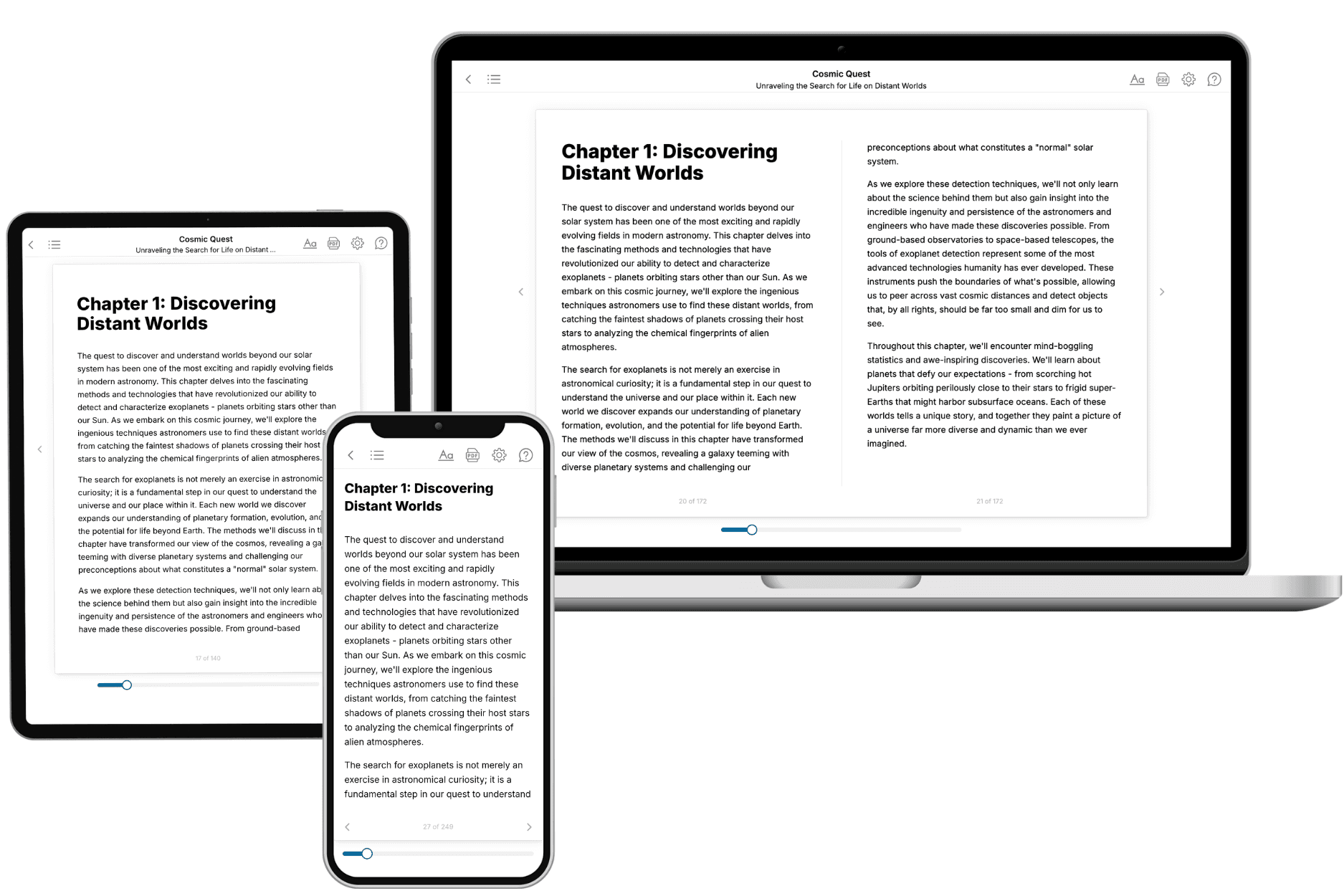
Your book is ready in 10 minutes. Read it online, download as EPUB or PDF, or send to Kindle.
Frequently asked questions
- What is TailoredRead?
TailoredRead creates complete, full-length nonfiction ebooks, written specifically for you. Tell us what you want to learn and why, and TailoredRead writes you a complete ebook on it, with charts, tables, and diagrams throughout. Read it online, on Kindle, or on any e-reader, or download it as a PDF or EPUB. Every book is written fresh the day you order it.
- How is the book tailored to me?
Before anything is written, you answer a few short questions about your goals, your background, and the topics you care about. Your book is then planned around your answers: written at your level, focused on your goals, and covering the topics you chose, instead of the one-size-fits-all book a store sells everyone.
- Will it read like generic AI content?
No. Your book isn't a chat transcript: it's planned chapter by chapter before a single word is written, told in a clear book voice, and explains ideas visually with charts, tables, and diagrams. After writing, every book goes through an editorial pass that polishes chapters so the book reads consistent from start to finish. Judge for yourself: browse thousands of sample books on our Explore Books page.
- How accurate is the content?
Our AI first checks whether your subject needs live research. Niche and fast-moving subjects are researched before writing, and the book plan and chapters are grounded in what it finds. After writing, every book goes through a quality pass that checks its facts and consistency, and researched books list their sources in a Notes section at the back.
- How long is the book?
You choose the length: Comprehensive (250-300 pages), Detailed (150-200 pages), Essential (70-100 pages), or Short (30-50 pages).
- Does the book include visuals?
Yes. Every book includes charts, tables, and diagrams: timelines, checklists, step-by-step guides, decision trees, comparison tables, matrices, and bar charts. A typical book includes dozens of these visual elements.
- Can I read it on Kindle? What formats can I download?
Yes. Every book can be read in our online reader or downloaded as a PDF or EPUB. The EPUB can be opened with Kindle, Apple Books, Kobo, and any e-reader. The Commercial and Author licenses also include an editable Word (DOCX) and Markdown download.
- How much does it cost?
About the price of a regular ebook. The exact price depends on your book's length and complexity, from $2 for the shortest books to $35 for the most comprehensive, and it's shown when you review your book, before you commit to anything. Each book is a one-time purchase, yours to keep, no subscription. Licenses that let you share, teach, or publish your book range from $35.99 to $49.99.
- Can I preview the book before purchasing?
Before you pay, you'll see what your book will cover: the title, a detailed description, the estimated length, and the complete chapter-by-chapter table of contents, so you know what you're getting before you decide. The full text itself is written after you purchase.
- How long does it take to create a book?
About 10 minutes. You can start reading the opening chapters while the rest is still being written.