Quantum Computing Decoded
A CTO's Guide to Harnessing the Power of Qubits
In a world where classical computing is reaching its limits, you face the challenge of navigating the complex and often counterintuitive realm of quantum computing.
269 pages13 chaptersMay 29, 2025Quantum ComputingCreated by Alex
About this book
As a CTO, you're tasked with leading your organization into this new frontier, but the gap between theoretical knowledge and practical application can seem insurmountable. Quantum Computing Decoded: A CTO's Guide to Harnessing the Power of Qubits is your compass in this quantum landscape. This book bridges the divide between your current understanding and the cutting-edge concepts that will drive the next generation of computing. You'll gain a deep understanding of quantum principles, from superposition and entanglement to quantum algorithms and error correction. But this isn't just a theoretical treatise. You'll learn how to apply these concepts to real-world problems, design quantum circuits, and even begin to explore quantum machine learning and optimization. With this knowledge, you'll be equipped to lead quantum initiatives, mentor your teams, and make informed decisions about integrating quantum technologies into your organization's strategy. Whether you're looking to advance quantum research or prepare your company for the quantum revolution, this book provides the insights and practical knowledge you need to stay ahead in the rapidly evolving field of quantum computing.
Table of contents
- IntroductionThe Quantum Computing Revolution, Book Overview and How to Use It, A CTO's Perspective on Quantum Computing, Bridging Classical and Quantum WorldsRead below
- Chapter 1: Quantum Computing BasicsClassical vs. Quantum Computing, Introduction to Qubits, Superposition: The Power of 'And', Entanglement: Spooky Action at a Distance
- Chapter 2: Understanding Quantum StatesThe Bloch Sphere: Visualizing Qubits, Quantum Measurement and Collapse, Quantum State Tomography, Pure and Mixed Quantum States
- Chapter 3: Quantum Gates and CircuitsSingle-Qubit Gates, Multi-Qubit Gates and Entanglement, Universal Gate Sets, Quantum Circuit Design Principles
- Chapter 4: Fundamental Quantum AlgorithmsThe Deutsch-Jozsa Algorithm, Quantum Fourier Transform, Shor's Algorithm: Breaking RSA, Grover's Algorithm: Quantum Search
- Chapter 5: Quantum Error CorrectionSources of Quantum Errors, Quantum Decoherence, Quantum Error Correction Codes, Fault-Tolerant Quantum Computing
- Chapter 6: Quantum Computing HardwareSuperconducting Qubits, Trapped Ion Quantum Computers, Topological Qubits, Photonic Quantum Computing
- Chapter 7: Quantum Software and ProgrammingQuantum Programming Languages, Quantum Development Kits, Quantum Cloud Services, Classical Simulation of Quantum Systems
- Chapter 8: Quantum Computing ApplicationsQuantum Chemistry Simulations, Quantum Optimization Problems, Quantum Machine Learning, Quantum Computing in Finance
- Chapter 9: Quantum CommunicationQuantum Teleportation, Quantum Key Distribution, The Quantum Internet, Quantum Repeaters and Long-Distance Communication
- Chapter 10: Quantum CryptographyPost-Quantum Cryptography, Quantum-Safe Encryption Algorithms, Quantum Random Number Generation, Quantum Blockchain Technology
- Chapter 11: Quantum Sensing and MetrologyQuantum-Enhanced Sensing, Quantum Atomic Clocks, Quantum Imaging and Microscopy, Quantum Radar and LIDAR
- Chapter 12: Quantum Supremacy and BeyondDefining Quantum Supremacy, Quantum Supremacy Experiments, The Post-Quantum Supremacy Era, From Supremacy to Quantum Advantage
- Chapter 13: The Future of Quantum ComputingScalability Challenges and Solutions, Quantum AI and the Future of Intelligence, Societal Impacts of Quantum Technologies, Ethical Considerations in Quantum Computing
- ConclusionReflecting on Your Quantum Journey, Next Steps for Quantum Leaders
- Glossary of Quantum Computing Terms
- Further Reading and Resources
Introduction
Welcome to the fascinating world of quantum computing, a realm where the rules of classical physics give way to the mind-bending principles of quantum mechanics. As you embark on this journey through "Quantum Computing Decoded: A CTO's Guide to Harnessing the Power of Qubits," you're about to explore a technology that promises to revolutionize computation as we know it. This introduction will set the stage for your deep dive into the quantum realm, providing you with a solid foundation upon which to build your understanding of this cutting-edge field.
Quantum computing represents a paradigm shift in how we approach complex computational problems. Unlike classical computers, which operate on bits that can be either 0 or 1, quantum computers harness the principles of quantum mechanics to manipulate qubits—quantum bits that can exist in multiple states simultaneously. This fundamental difference opens up new possibilities for solving problems that are intractable for even the most powerful classical supercomputers.
As a Chief Technology Officer with a background in Electrical Engineering, you're uniquely positioned to appreciate the technical challenges and opportunities that quantum computing presents. Your role in guiding your organization through this quantum revolution is crucial, and this book aims to equip you with the knowledge and insights needed to lead with confidence in this rapidly evolving field.
Throughout this book, you'll encounter concepts that may seem counterintuitive at first. The quantum world operates on principles that often defy our classical intuitions. Phenomena like superposition, entanglement, and quantum interference form the backbone of quantum computing, and understanding these concepts is key to grasping the full potential of this technology. As you progress through the chapters, you'll find that these initially abstract ideas begin to coalesce into a coherent framework for quantum computation.
This introduction will provide you with an overview of the quantum computing landscape, outline how to make the most of this book, offer insights from a CTO's perspective, and help you bridge the gap between classical and quantum computing paradigms. By the end of this chapter, you'll be well-prepared to delve into the more technical aspects of quantum computing that follow.
The Quantum Computing Revolution
The quantum computing revolution is upon us, marking a transformative era in the history of computation. This paradigm shift promises to redefine the boundaries of what's computationally possible, offering solutions to problems that have long been considered intractable. As we stand on the brink of this technological revolution, it's crucial to understand its origins, current state, and the profound implications it holds for the future of technology and society at large.
The roots of quantum computing can be traced back to the early 1980s when physicist Richard Feynman proposed the idea of using quantum mechanical systems to perform computations. Feynman recognized that simulating quantum systems on classical computers was exponentially difficult, suggesting that a computer based on quantum principles could potentially solve such problems more efficiently. This insight laid the foundation for what would become the field of quantum computing.
In the decades since Feynman's proposal, quantum computing has evolved from a theoretical concept to a rapidly advancing technological reality. Major tech companies, startups, and research institutions around the world are now investing heavily in quantum research and development. IBM, Google, Microsoft, and others have made significant strides in building quantum processors with increasing numbers of qubits. In 2019, Google claimed to have achieved quantum supremacy, demonstrating that their quantum processor could perform a specific calculation faster than any classical computer[1]. While this claim has been debated, it nonetheless marked a significant milestone in the field.
The potential applications of quantum computing span a wide range of industries and scientific disciplines. In chemistry and materials science, quantum computers could simulate molecular interactions with unprecedented accuracy, potentially revolutionizing drug discovery and the development of new materials. In finance, quantum algorithms could optimize portfolio management and risk analysis. Cryptography faces both challenges and opportunities, as quantum computers threaten to break current encryption methods while also enabling new, quantum-secure communication protocols.
One of the most promising areas for quantum computing is optimization. Many real-world problems in logistics, supply chain management, and resource allocation are fundamentally optimization problems. Quantum algorithms, such as the Quantum Approximate Optimization Algorithm (QAOA), show potential for solving these problems more efficiently than classical methods. This could lead to significant improvements in areas ranging from traffic flow in smart cities to energy distribution in power grids.
Machine learning is another field poised for disruption by quantum computing. Quantum machine learning algorithms could potentially process vast amounts of data and recognize patterns far more quickly than classical algorithms. This could accelerate advancements in artificial intelligence, leading to more sophisticated natural language processing, computer vision, and predictive analytics.
However, the quantum revolution is not without its challenges. Building practical, large-scale quantum computers requires overcoming significant technical hurdles. Quantum systems are extremely sensitive to environmental disturbances, making it difficult to maintain quantum coherence—the property that gives quantum computers their power. Researchers are working on various approaches to quantum error correction and fault-tolerant quantum computing to address these issues.
Another challenge lies in developing quantum algorithms that can outperform classical algorithms for practical problems. While theoretical quantum algorithms like Shor's algorithm for factoring large numbers show exponential speedup over classical methods, finding quantum algorithms with practical advantages for a wide range of problems remains an active area of research.
As a CTO, understanding the quantum computing revolution is crucial for strategic planning and technology roadmapping. The potential disruptions and opportunities presented by quantum computing will likely impact virtually every industry in the coming decades. Early adopters who can effectively harness quantum technologies may gain significant competitive advantages.
Moreover, the quantum revolution extends beyond computing. Quantum sensing technologies promise unprecedented precision in measurement, with applications in navigation, medical imaging, and scientific instrumentation. Quantum communication networks could provide unbreakable encryption and form the basis of a future quantum internet.
As we progress through this book, you'll gain a deeper understanding of the principles underlying quantum computing and how they translate into practical applications. You'll be equipped to evaluate the potential impact of quantum technologies on your organization and industry, and to make informed decisions about investments in quantum research and development.
The quantum computing revolution represents a fundamental shift in our approach to computation and information processing. It promises to unlock new realms of computational power, enabling us to tackle problems that were previously beyond our reach. As we stand at the threshold of this new era, the potential for innovation and discovery is immense. Your journey into quantum computing begins here, and the knowledge you gain will be instrumental in navigating the quantum landscape and shaping the technological future.
Book Overview and How to Use It
"Quantum Computing Decoded: A CTO's Guide to Harnessing the Power of Qubits" is designed to be your comprehensive resource for understanding and applying quantum computing concepts in your role as a technology leader. This book is structured to provide a logical progression from fundamental principles to advanced applications, allowing you to build your knowledge systematically. Whether you're looking to gain a broad understanding of quantum computing or dive deep into specific aspects, this guide will serve as your roadmap through the quantum landscape.
The book is divided into thirteen chapters, each focusing on a crucial aspect of quantum computing. We begin with the basics, introducing the fundamental concepts that distinguish quantum computing from classical computing. As you progress, you'll explore more advanced topics such as quantum algorithms, error correction, and the various hardware implementations of quantum computers. The later chapters delve into practical applications, the current state of quantum supremacy, and future prospects of the field.
To make the most of this book, it's recommended that you approach it in a way that aligns with your current knowledge level and specific interests. If you're new to quantum computing, starting from the beginning and working your way through sequentially will provide you with a solid foundation. Each chapter builds upon the concepts introduced in previous ones, ensuring a coherent learning experience. However, if you already have some background in quantum computing, you may choose to focus on specific chapters that address areas you want to explore further.
Throughout the book, you'll find various features designed to enhance your learning experience:
- Key Concepts: At the beginning of each chapter, you'll find a list of key concepts that will be covered. This allows you to quickly grasp the main ideas and decide which sections are most relevant to your needs.
- Real-world Examples: To bridge the gap between theory and practice, we've included numerous real-world examples and case studies. These illustrate how quantum computing principles are being applied in various industries and research fields.
- Technical Deep Dives: For those interested in the mathematical and technical details, we provide "Deep Dive" sections. These explore complex topics in greater depth but can be skipped without losing the overall narrative if you prefer a higher-level understanding.
- CTO Insights: Given your role as a CTO, we've included special "CTO Insight" boxes throughout the book. These offer strategic perspectives on how the discussed concepts relate to business and technology leadership.
- Code Examples: Where relevant, we provide code snippets and examples using popular quantum computing frameworks. These practical demonstrations will help you understand how quantum algorithms are implemented in real quantum circuits.
As you read, it's important to engage actively with the material. Try to relate the concepts to your own experiences and consider how they might apply to your organization's challenges and opportunities. Don't hesitate to revisit earlier chapters if you need to refresh your understanding of fundamental concepts as you progress to more advanced topics.
The book also includes interactive elements to reinforce your learning:
- End-of-Chapter Summaries: Each chapter concludes with a concise summary of the key points covered, helping you consolidate your understanding.
- Review Questions: Test your comprehension with review questions at the end of each chapter. These are designed to reinforce important concepts and encourage critical thinking.
- Thought Experiments: Throughout the book, you'll encounter thought experiments that challenge you to apply quantum principles to hypothetical scenarios. These exercises help develop your quantum intuition.
- Further Reading: For those who wish to explore topics in greater depth, we provide suggestions for further reading at the end of each chapter.
Remember that quantum computing is a rapidly evolving field. While this book provides a comprehensive overview of the current state of quantum computing, new developments are occurring constantly. To stay up-to-date, we recommend following the latest research publications, attending quantum computing conferences, and engaging with the quantum computing community.
As you progress through the book, you may find some concepts challenging at first. This is entirely normal—quantum mechanics often defies our classical intuitions. Persistence is key. If you encounter a difficult concept, take your time to understand it fully before moving on. Often, later chapters will provide additional context that helps clarify earlier ideas.
Finally, consider this book as a starting point for your quantum computing journey. The knowledge you gain here will equip you to engage more deeply with quantum computing research, make informed decisions about quantum technologies, and lead your organization in exploring quantum applications. As you read, think about how the concepts could apply to your specific industry and the unique challenges your organization faces.
By the end of this book, you should have a solid grasp of quantum computing principles, an understanding of the current state of the technology, and insights into its potential applications and future developments. You'll be well-prepared to lead discussions on quantum computing within your organization and to make strategic decisions regarding quantum technologies.
Remember, the goal is not just to understand quantum computing theoretically, but to be able to apply this knowledge practically in your role as a CTO. As you read, constantly ask yourself: "How could this concept be applied in my organization?" and "What strategic advantages could quantum computing offer us?" This approach will help you translate the knowledge gained from this book into actionable insights for your business.
A CTO's Perspective on Quantum Computing
As a Chief Technology Officer, your role is pivotal in steering your organization through the complex and rapidly evolving landscape of emerging technologies. Quantum computing, with its potential to revolutionize numerous industries, presents both exciting opportunities and significant challenges. This section aims to provide you with a strategic perspective on quantum computing, helping you to navigate its implications for your organization and industry.
First and foremost, it's crucial to understand that quantum computing is not just another incremental advancement in computing technology. It represents a fundamental shift in how we approach computation and problem-solving. As a CTO, your task is to evaluate how this paradigm shift aligns with your organization's goals and how it might reshape your industry in the coming years.
One of the primary considerations from a CTO's perspective is the potential impact of quantum computing on your organization's competitive advantage. Quantum computers excel at solving certain types of problems that are intractable for classical computers. These include optimization problems, simulation of quantum systems, and certain machine learning tasks. Consider how these capabilities align with your organization's core competencies and challenges. Could quantum optimization algorithms streamline your supply chain or improve your financial modeling? Might quantum simulations accelerate your R&D processes in areas like drug discovery or materials science?
However, it's equally important to maintain a balanced view. While the potential of quantum computing is immense, practical, large-scale quantum computers are still years away from widespread commercial availability. As a CTO, you need to strike a balance between preparing for the quantum future and addressing immediate technological needs. This might involve:
- Developing a quantum readiness strategy that outlines how your organization will adapt to and leverage quantum technologies as they mature.
- Identifying specific use cases within your organization where quantum computing could provide significant advantages.
- Investing in quantum literacy for your technical teams, ensuring they are prepared to work with quantum technologies as they become available.
- Exploring partnerships with quantum computing companies or research institutions to stay at the forefront of developments in the field.
Another critical aspect to consider is the impact of quantum computing on cybersecurity. Quantum computers have the potential to break many of the encryption algorithms currently used to secure digital communications and data storage. As a CTO, you need to start thinking about quantum-safe cryptography now, even if large-scale quantum computers are not yet a reality. This involves:
- Assessing your organization's cryptographic infrastructure and identifying vulnerabilities to quantum attacks.
- Developing a roadmap for transitioning to post-quantum cryptographic algorithms.
- Considering the long-term security of sensitive data that needs to remain confidential for decades.
From a resource allocation perspective, quantum computing presents some unique challenges. The field is advancing rapidly, but the timeline for practical, large-scale quantum computers remains uncertain. As a CTO, you need to make strategic decisions about investment in quantum technologies:
- Should you invest in in-house quantum expertise, or rely on partnerships and external consultants?
- Is it worth investing in quantum hardware, or is cloud-based access to quantum resources sufficient for your needs?
- How do you balance investment in quantum technologies with other emerging technologies like artificial intelligence, blockchain, or edge computing?
It's also important to consider the human capital aspect of quantum computing. The field requires a unique blend of skills, combining expertise in quantum mechanics, computer science, and domain-specific knowledge. As a CTO, you may need to rethink your hiring and training strategies to build a workforce capable of leveraging quantum technologies effectively.
Another key consideration is the regulatory landscape surrounding quantum technologies. As quantum computing advances, it's likely to attract increased attention from regulators, particularly in areas like cryptography and data privacy. Staying informed about emerging regulations and participating in industry discussions on quantum governance will be crucial.
From an innovation perspective, quantum computing opens up new possibilities for solving previously intractable problems. As a CTO, you should encourage your teams to think creatively about how quantum algorithms could be applied to your organization's challenges. This might involve:
- Setting up innovation labs or hackathons focused on quantum computing applications.
- Encouraging cross-functional collaboration to identify potential quantum use cases across different departments.
- Exploring how quantum computing could enable new products or services in your industry.
It's also worth considering the potential disruptive impact of quantum computing on your industry. Could quantum technologies enable new entrants to challenge established players? How might your competitors be leveraging quantum computing? Conducting regular quantum technology assessments and incorporating quantum considerations into your strategic planning processes can help you stay ahead of these potential disruptions.
As you lead your organization into the quantum era, effective communication will be crucial. You'll need to articulate the potential of quantum computing to both technical and non-technical stakeholders, translating complex quantum concepts into business value propositions. This might involve:
- Developing quantum computing primers for different levels of your organization.
- Creating case studies or proof-of-concept projects to demonstrate the potential impact of quantum technologies.
- Regularly updating your board and executive team on quantum developments and their strategic implications.
Finally, as a CTO, you play a crucial role in fostering a culture of continuous learning and adaptation. The field of quantum computing is evolving rapidly, and staying informed about the latest developments is crucial. Encourage your teams to engage with the quantum computing community, attend conferences, and participate in collaborative research projects where appropriate.
In conclusion, quantum computing presents a unique set of challenges and opportunities for CTOs. By maintaining a strategic perspective, balancing short-term needs with long-term preparation, and fostering a culture of quantum readiness, you can position your organization to thrive in the quantum era. As you progress through this book, keep these strategic considerations in mind, and think about how the concepts you're learning can be applied to drive innovation and competitive advantage in your organization.
Bridging Classical and Quantum Worlds
As we embark on our journey into the realm of quantum computing, it's crucial to understand how this new paradigm relates to the classical computing world we're familiar with. Bridging the gap between classical and quantum computing is not just an academic exercise; it's a practical necessity for integrating quantum technologies into existing IT infrastructures and workflows. This section will explore the key differences and similarities between classical and quantum computing, and discuss strategies for leveraging the strengths of both paradigms.
At its core, classical computing is based on the manipulation of bits, which can be in one of two states: 0 or 1. All classical computations, no matter how complex, ultimately boil down to sequences of operations on these binary digits. This model has served us well for decades, enabling the digital revolution that has transformed every aspect of our lives. However, classical computing has its limitations, particularly when it comes to certain types of problems that scale exponentially with the size of the input.
Quantum computing, on the other hand, operates on quantum bits, or qubits. Unlike classical bits, qubits can exist in a superposition of states, effectively being 0 and 1 simultaneously. This property, along with quantum entanglement, allows quantum computers to perform certain calculations exponentially faster than classical computers. However, it's important to note that quantum computers are not simply faster versions of classical computers; they operate on fundamentally different principles and are suited to different types of problems.
One of the key challenges in bridging classical and quantum worlds is understanding which problems are best suited for quantum computation. Not all computational tasks will benefit from quantum processing. In fact, for many everyday computing tasks, classical computers will remain the most practical and efficient solution. As a CTO, part of your role will be to identify areas where quantum computing can provide a significant advantage over classical methods.
Some of the areas where quantum computing shows the most promise include:
- Optimization problems: Many business and scientific challenges involve finding the best solution among a vast number of possibilities. Quantum algorithms like the Quantum Approximate Optimization Algorithm (QAOA) could potentially solve these problems more efficiently than classical methods.
- Simulation of quantum systems: Modeling the behavior of molecules and materials at the quantum level is extremely challenging for classical computers but natural for quantum systems. This could accelerate drug discovery and materials science research.
- Machine learning: Certain quantum algorithms could potentially speed up machine learning tasks, particularly in areas like unsupervised learning and dimensionality reduction.
- Cryptography: While quantum computers pose a threat to current encryption methods, they also enable new, quantum-secure cryptographic protocols.
To effectively bridge classical and quantum computing, it's essential to develop hybrid approaches that leverage the strengths of both paradigms. This might involve using classical computers for pre-processing and post-processing tasks, while offloading specific computations to quantum processors. Many current quantum computing frameworks, such as Qiskit and Cirq, are designed to facilitate this kind of hybrid classical-quantum computation.
Another important aspect of bridging classical and quantum worlds is the development of quantum-inspired algorithms. These are classical algorithms that borrow ideas from quantum computing to improve performance on certain tasks. Even if your organization isn't ready to invest in quantum hardware, exploring quantum-inspired approaches could yield significant benefits in the near term.
From an infrastructure perspective, integrating quantum computing into existing IT systems presents both challenges and opportunities. Cloud-based quantum computing services, offered by companies like IBM, Google, and Amazon, provide a way to experiment with quantum algorithms without investing in quantum hardware. As a CTO, you might consider how these cloud quantum services could be integrated into your existing cloud strategy.
Data management is another crucial consideration when bridging classical and quantum worlds. Quantum computers require quantum data as input and produce quantum states as output. Developing efficient methods for encoding classical data into quantum states and measuring quantum outputs to obtain classical results is an active area of research. As quantum technologies mature, you may need to rethink your data architecture to accommodate these new data flows.
Software development practices will also need to evolve to accommodate quantum computing. Quantum algorithms often require a different approach to problem-solving compared to classical algorithms. Encouraging your development teams to think in terms of quantum superposition and interference, rather than classical logic gates, will be crucial for leveraging the full power of quantum computing.
As you navigate the transition to quantum computing, it's important to maintain a balanced perspective. While quantum computing has the potential to revolutionize certain areas of computation, it's not a panacea. Classical computing will continue to play a crucial role in most computing tasks for the foreseeable future. The goal is not to replace classical computing with quantum computing, but to develop a complementary approach that leverages the strengths of both paradigms.
Education and training will be key to successfully bridging classical and quantum worlds. As a CTO, you might consider:
- Developing quantum literacy programs for your technical teams.
- Encouraging collaboration between classical computer scientists and quantum physicists.
- Partnering with academic institutions or quantum computing companies to access specialized expertise.
Finally, it's worth noting that the field of quantum computing is still rapidly evolving. New quantum algorithms, hardware architectures, and programming paradigms are being developed all the time. Staying informed about these developments and maintaining flexibility in your quantum strategy will be crucial for successfully navigating the quantum transition.
In conclusion, bridging classical and quantum worlds is a multifaceted challenge that touches on hardware, software, algorithms, data management, and organizational culture. As a CTO, your role is to guide your organization through this transition, identifying opportunities to leverage quantum technologies while maintaining the strengths of your classical computing infrastructure. By fostering a culture of quantum awareness and encouraging hybrid classical-quantum approaches, you can position your organization to thrive in the emerging quantum computing landscape.
Notes
Introduction
- 1. Arute, F., Arya, K., Babbush, R. et al. Quantum supremacy using a programmable superconducting processor. Nature 574, 505-510 (2019).
This is the end of the free sample. The full book has 13 chapters.
Want this book written for you?
Tell us your goals and background, and get your own version of this book, tailored by AI to you.


Benefits of AI-tailored books
- Read one book, not ten:
- all the Quantum Computing knowledge you need, gathered into a single book.
- Save days of learning:
- tell us your goals, choose your topics, and the whole book is built around them.
- Learn effortlessly:
- Quantum Computing book written for your specific background and expertise.
- Understand at a glance:
- includes charts, tables, timelines, checklists, decision trees, and more.
- Stay current:
- written the day you order it, not years ago.
- Trust what you read:
- every book is checked for accuracy, with real research when your subject needs it.
Create your unique book in 3 steps
- 1. Select your focus
Select the focus of your Quantum Computing book and share your background
- 2. Personalize your book
Specify your goals and choose sub-topics to include
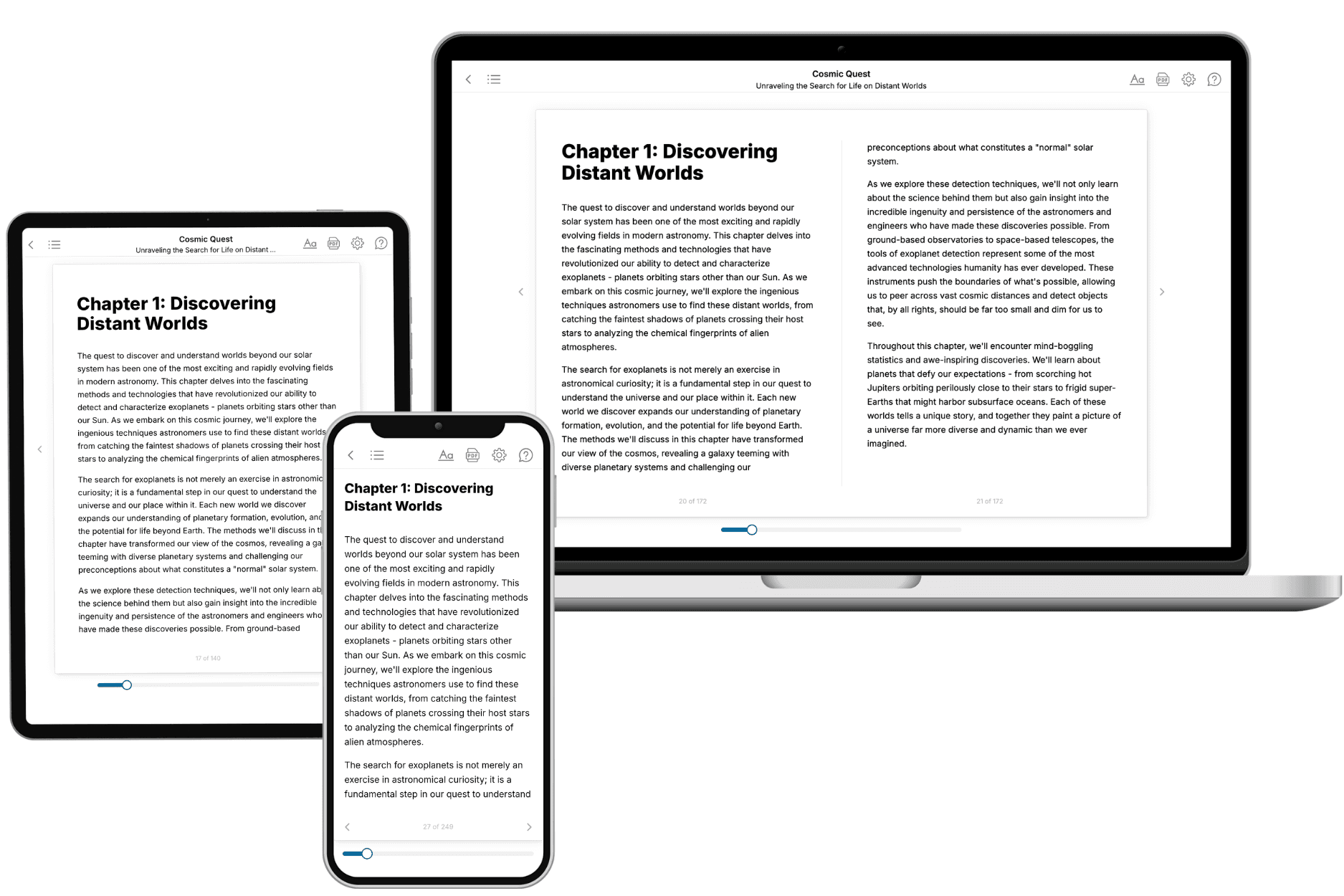
- 3. Get your tailored book
Your book is ready in 10 minutes. Read it online, download as EPUB or PDF, or send to Kindle.
Frequently asked questions
- What is TailoredRead?
TailoredRead creates complete, full-length nonfiction ebooks, written specifically for you. Tell us what you want to learn and why, and TailoredRead writes you a complete ebook on it, with charts, tables, and diagrams throughout. Read it online, on Kindle, or on any e-reader, or download it as a PDF or EPUB. Every book is written fresh the day you order it.
- How is the book tailored to me?
Before anything is written, you answer a few short questions about your goals, your background, and the topics you care about. Your book is then planned around your answers: written at your level, focused on your goals, and covering the topics you chose, instead of the one-size-fits-all book a store sells everyone.
- Will it read like generic AI content?
No. Your book isn't a chat transcript: it's planned chapter by chapter before a single word is written, told in a clear book voice, and explains ideas visually with charts, tables, and diagrams. After writing, every book goes through an editorial pass that polishes chapters so the book reads consistent from start to finish. Judge for yourself: browse thousands of sample books on our Explore Books page.
- How accurate is the content?
Our AI first checks whether your subject needs live research. Niche and fast-moving subjects are researched before writing, and the book plan and chapters are grounded in what it finds. After writing, every book goes through a quality pass that checks its facts and consistency, and researched books list their sources in a Notes section at the back.
- How long is the book?
You choose the length: Comprehensive (250-300 pages), Detailed (150-200 pages), Essential (70-100 pages), or Short (30-50 pages).
- Does the book include visuals?
Yes. Every book includes visual elements such as timelines, checklists, step-by-step guides, decision trees, comparison tables, and matrices, and many include bar charts. A typical book includes dozens of these visual elements.
- Can I read it on Kindle? What formats can I download?
Yes. Every book can be read in our online reader or downloaded as a PDF or EPUB. The EPUB can be opened with Kindle, Apple Books, Kobo, and any e-reader. The Commercial and Author licenses also include an editable Word (DOCX) and Markdown download.
- How much does it cost?
About the price of a regular ebook. The exact price depends on your book's length and complexity, from $2 for the shortest books to $35 for the most comprehensive, and it's shown when you review your book, before you commit to anything. Each book is a one-time purchase, yours to keep, no subscription. Licenses that let you share, teach, or publish your book range from $35.99 to $49.99.
- Can I preview the book before purchasing?
Before you pay, you'll see what your book will cover: the title, a detailed description, the estimated length, and the complete chapter-by-chapter table of contents, so you know what you're getting before you decide. The full text itself is written after you purchase.
- How long does it take to create a book?
About 10 minutes. You can start reading the opening chapters while the rest is still being written.