Quantum Entanglement and Computational Complexity
How Quantum Correlations Challenge the Foundations of One-Way Functions and Algorithmic Security
Imagine understanding the profound connection between the strangest phenomenon in quantum physics and the security of every encrypted message sent across the internet.
238 pages12 chaptersOct 18, 2025Quantum Computing
About this book
Quantum entanglement—Einstein's "spooky action at a distance"—isn't just a curiosity of the subatomic world. It's reshaping the landscape of computational complexity and challenging the very foundations of algorithmic security. This book bridges the gap between quantum mechanics and computer science, exploring how entangled particles create computational advantages that threaten traditional one-way functions. You'll discover why the correlations between entangled systems cannot be replicated by classical algorithms, how quantum computers exploit these correlations to solve problems once thought intractable, and what this means for the future of cryptography and secure communication. Through clear explanations and rigorous analysis, you'll gain insight into Bell's theorem, quantum algorithms, post-quantum cryptography, and the fundamental limits of computation. Whether you're designing algorithms, researching quantum systems, or simply fascinated by the intersection of physics and computer science, this book provides the conceptual tools and technical understanding to navigate the quantum computational revolution.
Table of contents
- IntroductionTwo Revolutions Colliding, Why Entanglement Matters for Computation, What You'll Learn in This BookRead below
- Chapter 1: Quantum FoundationsQuantum States and Superposition, Measurement and Wave Function Collapse, Quantum Information and Qubits
- Chapter 2: The Entanglement PhenomenonCreating and Characterizing Entangled States, The EPR Paradox and Nonlocality, Bell's Theorem and Experimental Violations, Entanglement as a Physical Resource
- Chapter 3: Computational Complexity FundamentalsComplexity Classes and Problem Hardness, The P versus NP Question, Reductions and Hardness Proofs
- Chapter 4: One-Way Functions and Cryptographic PrimitivesDefining One-Way Functions, Applications in Modern Cryptography, Candidate One-Way Functions, Classical Security Assumptions
- Chapter 5: Quantum Computation ModelsQuantum Gates and Circuits, Quantum Parallelism and Interference, The BQP Complexity Class
- Chapter 6: Quantum Algorithms and EntanglementDeutsch-Jozsa and Early Quantum Algorithms, Grover's Search Algorithm, Shor's Factoring Algorithm, The Role of Entanglement in Quantum Speedup
- Chapter 7: Breaking Classical One-Way FunctionsRSA and Factoring-Based Cryptography, Discrete Logarithm Problems, Quantum Attack Strategies
- Chapter 8: Entanglement and Nonlocal CorrelationsThe CHSH Game and Quantum Advantage, Distributed Computing with Entanglement, Communication Complexity and Quantum Protocols, Limits of Classical Simulation
- Chapter 9: Post-Quantum CryptographyQuantum-Resistant One-Way Functions, Lattice-Based Cryptography, Hash-Based and Code-Based Approaches, Security Proofs in the Quantum Setting
- Chapter 10: Quantum Information TheoryVon Neumann Entropy and Quantum Information, Measuring Entanglement, No-Cloning Theorem and Information Bounds
- Chapter 11: Fundamental Limits of Quantum ComputationWhat Quantum Computers Cannot Do, Oracle Separations and Black-Box Limits, Decoherence and Error Constraints
- Chapter 12: Future Directions and Open ProblemsThe Existence of Post-Quantum One-Way Functions, Open Questions in Quantum Complexity Theory, Practical Implications for Algorithm Design
- ConclusionKey Takeaways, Continuing Your Exploration
- Further Reading
Introduction
The world of computation stands at a crossroads. For decades, the security of digital communications, financial transactions, and sensitive data has rested on mathematical problems believed to be computationally intractable. These problems form the backbone of cryptographic systems through structures called one-way functions—mathematical operations easy to perform in one direction but prohibitively difficult to reverse. Meanwhile, in the realm of quantum physics, entanglement has puzzled scientists since Einstein famously dismissed it as spooky action at a distance.
Today, these two seemingly disparate domains are colliding in ways that fundamentally challenge our understanding of what computers can and cannot do.
Quantum entanglement represents one of the most counterintuitive phenomena in physics. When particles become entangled, measuring one particle instantaneously affects the state of another, regardless of the distance separating them. This correlation cannot be explained by any classical mechanism or hidden variable theory, as demonstrated by Bell's theorem and subsequent experimental validations. For computer scientists, this phenomenon is more than a curiosity—it represents a computational resource that enables algorithms to solve certain problems exponentially faster than any known classical approach. The implications extend far beyond theoretical interest, threatening to undermine the cryptographic infrastructure that secures modern digital society.
This book explores the profound intersection between quantum entanglement and computational complexity theory. You'll discover how entangled quantum states create correlations that classical systems cannot replicate, why these correlations enable quantum computers to break traditional one-way functions, and what this means for the future of algorithmic security. The journey requires bridging concepts from quantum mechanics, information theory, and complexity theory, but the reward is a deeper understanding of computation itself. Whether quantum computers will ultimately render classical cryptography obsolete, or whether new post-quantum one-way functions will preserve algorithmic security, depends on questions at the frontier of both physics and computer science.
The stakes are remarkably high. Organizations worldwide are racing to build practical quantum computers while simultaneously developing quantum-resistant cryptographic systems. Understanding the relationship between entanglement and computational hardness is no longer optional for those working in algorithm design, security research, or quantum computing. This introduction sets the stage by examining why two scientific revolutions are converging, what makes entanglement computationally significant, and how this book will guide you through the technical landscape where quantum mechanics meets complexity theory.
Two Revolutions Colliding
The first revolution began in the 1970s when researchers established the theoretical foundations of computational complexity. This framework categorized problems based on the resources—time and space—required to solve them. The discovery that certain problems appear fundamentally harder than others led to the development of complexity classes like P (problems solvable in polynomial time) and NP (problems whose solutions can be verified in polynomial time). From this theoretical foundation emerged the concept of one-way functions, which became the cornerstone of modern cryptography. These functions are easy to compute but computationally infeasible to invert, enabling secure communication even when adversaries can observe encrypted messages.
The second revolution emerged from quantum mechanics, which had already transformed physics in the early twentieth century. By the 1980s, physicists and computer scientists began exploring whether quantum mechanical systems could perform computations. Richard Feynman observed that simulating quantum systems on classical computers appeared to require exponential resources, suggesting that quantum computers might possess inherent advantages. David Deutsch formalized the quantum Turing machine model, establishing that quantum computers could solve certain problems more efficiently than classical machines. These early insights sparked decades of research into quantum algorithms and their computational power.
The collision of these revolutions became unavoidable in 1994 when Peter Shor discovered a quantum algorithm that could factor large integers in polynomial time[1]. This breakthrough shattered the security assumptions underlying RSA encryption and other cryptographic systems based on factoring or discrete logarithm problems. Suddenly, the theoretical advantages of quantum computation posed a direct threat to real-world security infrastructure. The algorithm's power derives fundamentally from quantum entanglement and superposition, which enable quantum computers to explore exponentially many computational paths simultaneously while maintaining correlations that classical parallel computing cannot achieve.
Understanding why these revolutions collide requires recognizing that both concern fundamental limits of information processing. Computational complexity theory asks which problems are inherently hard, while quantum mechanics reveals that nature processes information according to rules fundamentally different from classical physics. When quantum systems become entangled, they exhibit correlations that violate Bell inequalities—mathematical constraints that any classical system must satisfy. These nonlocal correlations represent a form of information processing that transcends classical limitations, enabling quantum algorithms to solve problems by exploiting interference patterns and entangled states in ways that have no classical analog.
The practical implications extend beyond cryptography. Entanglement enables quantum communication protocols like quantum key distribution, which provides information-theoretic security based on physical principles rather than computational assumptions. It also powers quantum algorithms for simulating molecular systems, optimizing complex networks, and solving linear systems of equations. Each application leverages entanglement as a computational resource, demonstrating that the quantum-classical divide represents more than a difference in processing speed—it reflects fundamentally different computational paradigms.
The collision has sparked an urgent global response. Governments and research institutions are investing billions in quantum computing research while simultaneously developing post-quantum cryptographic standards. The National Institute of Standards and Technology (NIST) has initiated a multi-year process to standardize quantum-resistant cryptographic algorithms, recognizing that the transition to post-quantum security must begin before large-scale quantum computers become operational. This race against time underscores the practical urgency of understanding how entanglement challenges computational hardness assumptions.
Yet the collision also reveals deep theoretical questions. Does the existence of quantum algorithms that break classical one-way functions mean that no one-way functions exist in a quantum world? Or do quantum-resistant one-way functions exist based on problems that remain hard even for quantum computers? These questions connect to fundamental issues in complexity theory, including whether P equals NP and whether quantum computers can solve NP-complete problems efficiently. The answers will shape not only cryptographic practice but our understanding of computation's ultimate limits.
The convergence of these revolutions creates both challenges and opportunities. For security professionals, it necessitates a transition to quantum-resistant cryptography. For algorithm designers, it opens new possibilities for solving previously intractable problems. For theorists, it raises profound questions about the relationship between physical law and computational complexity. This book navigates these intersecting domains, providing the conceptual tools and technical understanding needed to engage with the quantum computational revolution.
Why Entanglement Matters for Computation
Entanglement matters for computation because it enables correlations that no classical system can produce. Consider two entangled particles separated by arbitrary distances. When you measure one particle's spin along a particular axis, the measurement outcome appears random. However, when you measure the second particle's spin along the same axis, the outcomes are perfectly correlated—if the first measurement yields "up," the second yields "down," and vice versa. Remarkably, this correlation holds regardless of which axis you choose to measure, yet no information travels between the particles faster than light. This phenomenon, verified in countless experiments, demonstrates that entangled systems possess correlations that cannot be explained by any local hidden variable theory.
These nonlocal correlations translate directly into computational advantages. In distributed computing scenarios, classical systems require communication to coordinate their actions and achieve correlated outputs. Entangled quantum systems, however, can produce correlated outputs without communication, effectively providing a shared randomness resource that classical systems cannot replicate. This advantage manifests in communication complexity problems, where entanglement can reduce the amount of classical communication needed to solve certain tasks. The CHSH game provides a concrete example: two players who share entangled particles can win the game with probability approximately 85%, while classical players cannot exceed 75% regardless of their strategy.
The computational power of entanglement extends beyond communication complexity. Quantum algorithms exploit entanglement to create superpositions of exponentially many computational paths, then use interference to amplify correct answers while canceling incorrect ones. This process requires maintaining quantum coherence across many qubits, with entanglement serving as the mechanism that correlates their states. Without entanglement, quantum computers would essentially behave like classical probabilistic computers, losing their exponential advantages. Research has shown that certain quantum algorithms require entanglement to achieve their speedups, establishing entanglement as a necessary computational resource rather than merely a curious physical phenomenon[2].
Understanding entanglement's computational significance requires distinguishing it from mere superposition. A single qubit can exist in a superposition of states, representing both 0 and 1 simultaneously until measured. However, superposition alone provides limited computational advantage—measuring a superposition yields only one outcome, collapsing the quantum state. Entanglement changes this picture by correlating multiple qubits such that measuring one affects the others. This correlation structure enables quantum algorithms to process information globally rather than locally, creating interference patterns that guide computation toward correct solutions. The distinction matters because it explains why quantum computers require multiple entangled qubits to achieve exponential speedups.
The relationship between entanglement and computational hardness becomes apparent when examining specific algorithms. Shor's factoring algorithm creates an entangled state representing all possible periods of a modular exponential function simultaneously. Through quantum Fourier transform, the algorithm extracts the period by measuring this entangled state, yielding information that enables efficient factorization. Classical computers must check periods sequentially or use sophisticated number-theoretic techniques that still require exponential time for large numbers. The quantum advantage stems directly from the ability to maintain and manipulate entangled superpositions across many qubits, performing a form of parallel processing that classical systems cannot replicate.
Entanglement also matters because it reveals fundamental limits of classical simulation. Simulating an entangled quantum system on a classical computer requires tracking exponentially many amplitudes—a system of n qubits requires 2n complex numbers to describe fully. This exponential scaling means that simulating even modest quantum systems becomes intractable for classical computers. For instance, accurately simulating a 300-qubit quantum computer would require more classical bits than there are atoms in the observable universe. This simulation barrier suggests that quantum computers can explore computational spaces fundamentally inaccessible to classical machines, though it doesn't guarantee that quantum computers can solve all hard problems efficiently.
The practical implications of entanglement's computational role are profound. Cryptographic systems based on factoring or discrete logarithms become vulnerable once quantum computers can maintain sufficient entanglement across enough qubits to run Shor's algorithm. Current estimates suggest that factoring a 2048-bit RSA key would require approximately 20 million noisy qubits or several thousand error-corrected logical qubits[3]. While these numbers exceed current capabilities, steady progress in quantum hardware development suggests that such systems may become feasible within decades, necessitating the transition to post-quantum cryptography.
Yet entanglement's computational significance extends beyond breaking classical cryptography. It enables new cryptographic protocols like quantum key distribution, which uses entanglement to detect eavesdropping attempts through disturbances in quantum states. It powers quantum simulation algorithms that could revolutionize drug discovery and materials science by accurately modeling molecular interactions. It enables quantum machine learning algorithms that might process certain datasets more efficiently than classical approaches. Each application leverages entanglement as a resource that enables computational tasks impossible or impractical for classical systems.
The theoretical importance of entanglement for computation lies in what it reveals about information processing itself. Classical information theory, developed by Claude Shannon, treats information as abstract bits that can be copied, transmitted, and processed according to Boolean logic. Quantum information theory reveals that information can exist in superposition, cannot be cloned (due to the no-cloning theorem), and can be correlated through entanglement in ways that transcend classical possibilities. These differences aren't merely technical details—they reflect fundamentally different ways that physical systems can process information, suggesting that our classical intuitions about computation may be incomplete.
What You'll Learn in This Book
This book provides a comprehensive exploration of how quantum entanglement challenges the foundations of one-way functions and algorithmic security. The journey begins with establishing the necessary foundations in both quantum mechanics and computational complexity theory, then progressively builds toward understanding their intersection. Each chapter introduces concepts systematically, with concrete examples and practical implications that connect abstract theory to real-world applications. The structure allows you to develop intuition alongside technical understanding, building a coherent picture of how quantum correlations reshape computational possibilities.
The first section establishes quantum foundations. Chapter 1 introduces quantum states, superposition, and measurement, providing the mathematical framework for understanding quantum systems. You'll learn how quantum states differ from classical probability distributions, why measurement causes wave function collapse, and how qubits encode quantum information. Chapter 2 explores entanglement in depth, covering its creation, characterization, and the EPR paradox that puzzled Einstein. You'll understand Bell's theorem, which proves that entangled systems exhibit correlations impossible for any local hidden variable theory, and learn how entanglement serves as a quantifiable physical resource with operational significance.
The second section covers computational complexity fundamentals. Chapter 3 introduces complexity classes, the P versus NP question, and reduction techniques for proving hardness. You'll understand why certain problems appear inherently harder than others and how complexity theory provides a framework for classifying computational difficulty. Chapter 4 focuses specifically on one-way functions, defining them rigorously and exploring their applications in cryptography. You'll learn about candidate one-way functions based on factoring, discrete logarithms, and other mathematical problems, along with the classical security assumptions that underpin modern cryptographic systems.
The third section bridges quantum mechanics and computation. Chapter 5 introduces quantum computation models, including quantum gates, circuits, and the BQP complexity class that characterizes problems efficiently solvable by quantum computers. You'll understand how quantum parallelism and interference enable computational advantages. Chapter 6 explores specific quantum algorithms, from early examples like Deutsch-Jozsa to Grover's search algorithm and Shor's factoring algorithm. You'll learn precisely how these algorithms exploit entanglement to achieve speedups and understand the role of quantum correlations in their operation. Chapter 7 examines how quantum algorithms break classical one-way functions, analyzing the vulnerability of RSA, discrete logarithm systems, and other cryptographic primitives.
The fourth section explores entanglement's computational implications in depth. Chapter 8 examines nonlocal correlations through examples like the CHSH game, demonstrating how entanglement provides advantages in distributed computing and communication complexity. You'll understand why classical systems cannot simulate these correlations and what this reveals about computational limits. Chapter 9 addresses post-quantum cryptography, exploring quantum-resistant one-way functions based on lattice problems, hash functions, and error-correcting codes. You'll learn how security proofs work in the quantum setting and understand the ongoing effort to standardize post-quantum cryptographic algorithms.
The fifth section examines theoretical foundations and limits. Chapter 10 introduces quantum information theory, covering von Neumann entropy, entanglement measures, and the no-cloning theorem. You'll understand how quantum information differs from classical information and why certain operations impossible classically become possible with quantum systems. Chapter 11 explores fundamental limits of quantum computation, addressing what quantum computers cannot do, oracle separations that distinguish quantum from classical complexity classes, and how decoherence and errors constrain quantum algorithms. This chapter provides crucial perspective on quantum computing's limitations alongside its capabilities.
The final section looks forward. Chapter 12 examines open problems and future directions, including the fundamental question of whether post-quantum one-way functions exist, unresolved questions in quantum complexity theory, and practical implications for algorithm design. You'll understand the current state of research and the challenges that remain. The conclusion synthesizes key takeaways and provides guidance for continuing your exploration of this rapidly evolving field. Throughout the book, you'll encounter:
- Concrete examples that illustrate abstract concepts with specific scenarios and calculations
- Mathematical frameworks presented accessibly without sacrificing rigor
- Practical implications connecting theory to real-world applications in cryptography and algorithm design
- Historical context showing how ideas developed and why certain questions matter
- Current research directions highlighting open problems and ongoing investigations
The book assumes intermediate knowledge of computer science and mathematics. You should be comfortable with basic algorithms, complexity theory concepts like Big-O notation, and fundamental linear algebra including vectors and matrices. Familiarity with probability theory and basic quantum mechanics is helpful but not required—the book develops necessary quantum concepts from first principles. The presentation balances mathematical rigor with intuitive explanations, using formal definitions where precision matters while providing conceptual understanding through examples and analogies. Code examples and pseudocode appear where they clarify algorithmic concepts, though the focus remains on understanding principles rather than implementation details.
Each chapter builds on previous material, creating a progressive learning path. However, the structure also allows selective reading based on your background and interests. If you're already familiar with quantum mechanics, you might skim the quantum foundations chapters while focusing on computational complexity material. Conversely, if you have strong complexity theory background but limited quantum knowledge, you might emphasize the quantum sections. Cross-references throughout the text help you navigate dependencies and find relevant background material when needed. The goal is providing a comprehensive resource that serves both as a systematic introduction and a reference for specific topics.
The book emphasizes developing intuition alongside technical understanding. Quantum mechanics and complexity theory both contain counterintuitive elements that can seem paradoxical when first encountered. Rather than simply presenting results, the text explores why certain phenomena occur and what they reveal about computation and physical law. You'll learn to think about entanglement not just as a strange quantum phenomenon but as a computational resource with specific capabilities and limitations. Similarly, you'll understand one-way functions not merely as cryptographic tools but as objects that reveal deep connections between computational hardness and physical processes.
Throughout the book, footnotes provide citations to original research papers and additional resources for deeper exploration. These references serve multiple purposes: they acknowledge the researchers whose work established the field, they provide pathways for further study, and they demonstrate how theoretical results connect to experimental validations and practical implementations. The further reading section at the book's end offers curated recommendations for continuing your exploration, organized by topic and difficulty level. Whether you're conducting research, designing algorithms, or simply seeking deeper understanding, these resources provide entry points into the broader literature.
The ultimate goal is empowering you to engage meaningfully with the quantum computational revolution. This means understanding not just what quantum computers can do, but why they can do it, what limits they face, and how their capabilities reshape our understanding of computation. You'll develop the conceptual tools to evaluate claims about quantum computing, assess the security of cryptographic systems in a post-quantum world, and contribute to the ongoing effort to understand computation's fundamental nature. The intersection of quantum entanglement and computational complexity represents one of the most exciting frontiers in science—this book provides your guide to navigating that frontier with clarity and confidence.
Notes
Introduction
- 1. P. W. Shor, "Polynomial-Time Algorithms for Prime Factorization and Discrete Logarithms on a Quantum Computer," SIAM Journal on Computing, 1997
- 2. R. Jozsa and N. Linden, "On the role of entanglement in quantum-computational speed-up," Proceedings of the Royal Society of London A, 2003
- 3. C. Gidney and M. Ekerå, How to factor 2048 bit RSA integers in 8 hours using 20 million noisy qubits, Quantum, 2021
This is the end of the free sample. The full book has 12 chapters.
Want this book written for you?
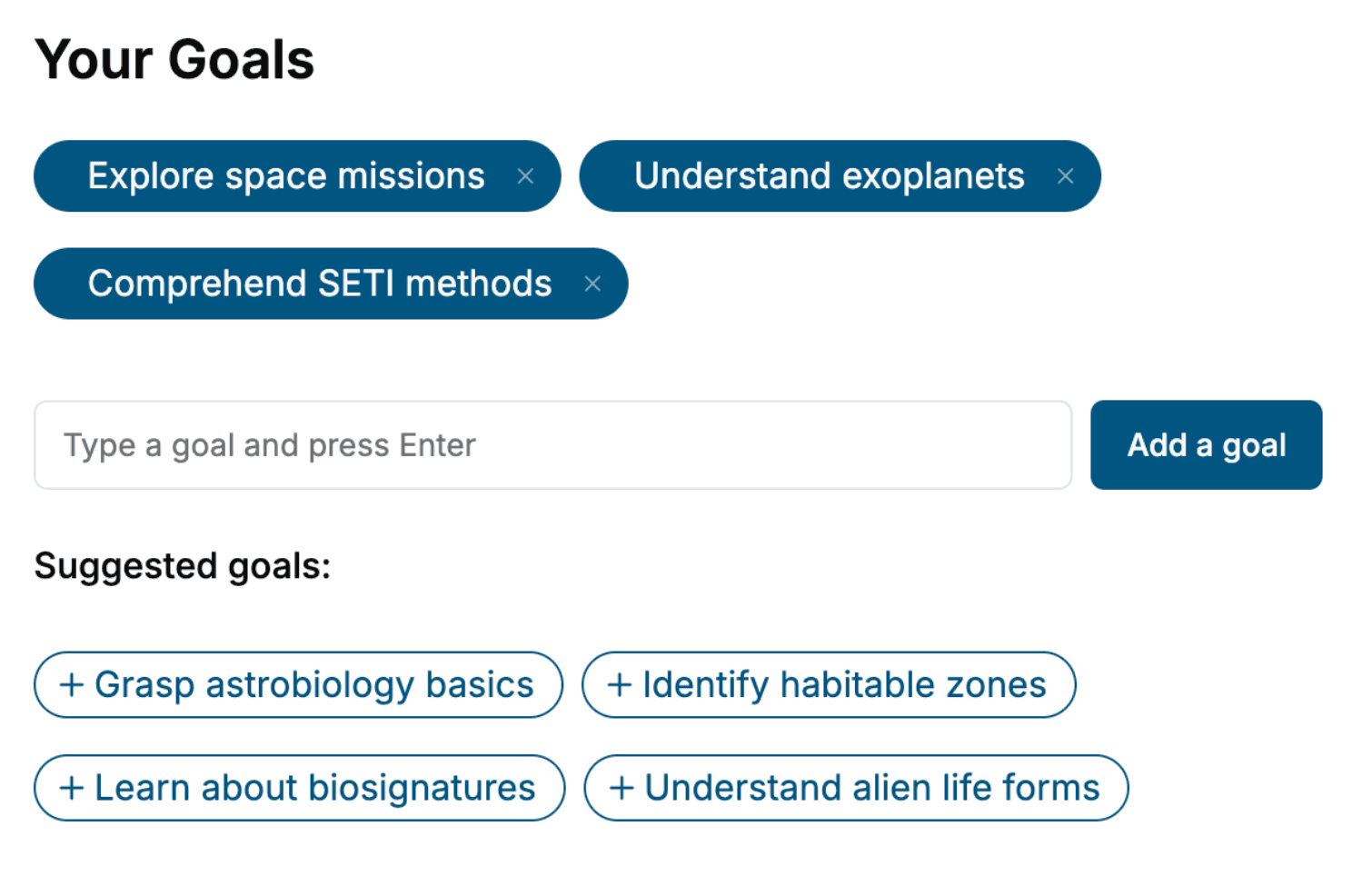
Tell us your goals and background, and get your own version of this book, tailored by AI to you.


Benefits of AI-tailored books
- Read one book, not ten:
- all the Quantum Computing knowledge you need, gathered into a single book.
- Save days of learning:
- tell us your goals, choose your topics, and the whole book is built around them.
- Learn effortlessly:
- Quantum Computing book written for your specific background and expertise.
- Understand at a glance:
- includes charts, tables, timelines, checklists, decision trees, and more.
- Stay current:
- written the day you order it, not years ago.
- Trust what you read:
- every book is checked for accuracy, with real research when your subject needs it.
Create your unique book in 3 steps
- 1. Select your focus
Select the focus of your Quantum Computing book and share your background
- 2. Personalize your book
Specify your goals and choose sub-topics to include
- 3. Get your tailored book
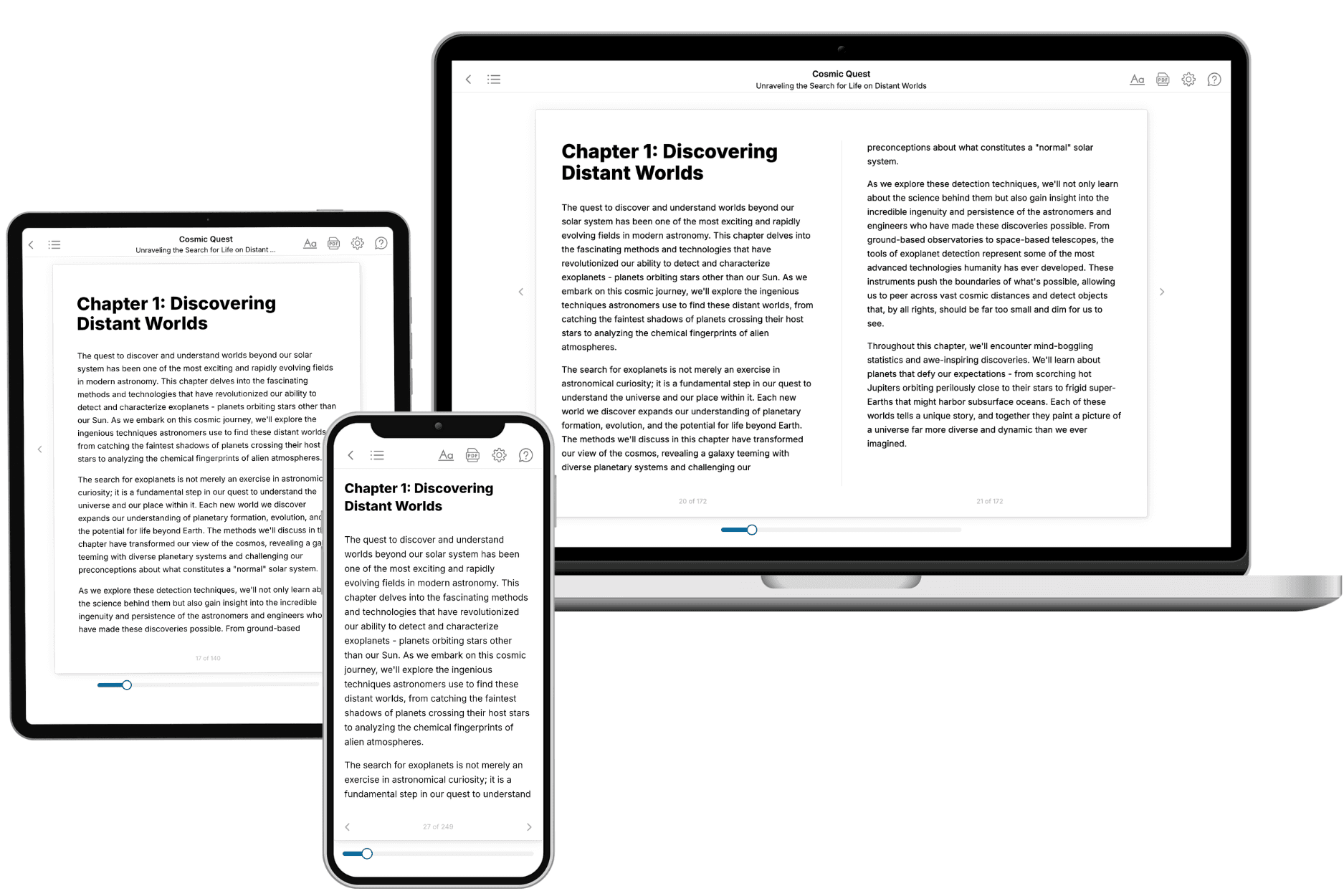
Your book is ready in 10 minutes. Read it online, download as EPUB or PDF, or send to Kindle.

Frequently asked questions
- What is TailoredRead?
TailoredRead creates complete, full-length nonfiction ebooks, written specifically for you. Tell us what you want to learn and why, and TailoredRead writes you a complete ebook on it, with charts, tables, and diagrams throughout. Read it online, on Kindle, or on any e-reader, or download it as a PDF or EPUB. Every book is written fresh the day you order it.
- How is the book tailored to me?
Before anything is written, you answer a few short questions about your goals, your background, and the topics you care about. Your book is then planned around your answers: written at your level, focused on your goals, and covering the topics you chose, instead of the one-size-fits-all book a store sells everyone.
- Will it read like generic AI content?
No. Your book isn't a chat transcript: it's planned chapter by chapter before a single word is written, told in a clear book voice, and explains ideas visually with charts, tables, and diagrams. After writing, every book goes through an editorial pass that polishes chapters so the book reads consistent from start to finish. Judge for yourself: browse thousands of sample books on our Explore Books page.
- How accurate is the content?
Our AI first checks whether your subject needs live research. Niche and fast-moving subjects are researched before writing, and the book plan and chapters are grounded in what it finds. After writing, every book goes through a quality pass that checks its facts and consistency, and researched books list their sources in a Notes section at the back.
- How long is the book?
You choose the length: Comprehensive (250-300 pages), Detailed (150-200 pages), Essential (70-100 pages), or Short (30-50 pages).
- Does the book include visuals?
Yes. Every book includes charts, tables, and diagrams: timelines, checklists, step-by-step guides, decision trees, comparison tables, matrices, and bar charts. A typical book includes dozens of these visual elements.
- Can I read it on Kindle? What formats can I download?
Yes. Every book can be read in our online reader or downloaded as a PDF or EPUB. The EPUB can be opened with Kindle, Apple Books, Kobo, and any e-reader. The Commercial and Author licenses also include an editable Word (DOCX) and Markdown download.
- How much does it cost?
About the price of a regular ebook. The exact price depends on your book's length and complexity, from $2 for the shortest books to $35 for the most comprehensive, and it's shown when you review your book, before you commit to anything. Each book is a one-time purchase, yours to keep, no subscription. Licenses that let you share, teach, or publish your book range from $35.99 to $49.99.
- Can I preview the book before purchasing?
Before you pay, you'll see what your book will cover: the title, a detailed description, the estimated length, and the complete chapter-by-chapter table of contents, so you know what you're getting before you decide. The full text itself is written after you purchase.
- How long does it take to create a book?
About 10 minutes. You can start reading the opening chapters while the rest is still being written.