Quantum Imaging
Unveiling the Invisible World of Quantum Physics
Dive into the fascinating realm of quantum imaging, where the boundaries of perception are pushed to their limits.
284 pages14 chaptersFeb 20, 2025Physics
About this book
This book takes you on an exhilarating exploration of how quantum mechanics revolutionizes our ability to visualize and understand the microscopic world. You'll discover the intricate dance between light and matter at the quantum level, unraveling the mysteries of entanglement and superposition as they apply to imaging techniques. From the foundations of quantum theory to cutting-edge applications in physics research, each chapter builds your knowledge and intuition about this groundbreaking field. As you progress through the book, you'll gain insights into how quantum imaging is reshaping our understanding of fundamental physics and opening new avenues for scientific discovery. Whether you're a physics student, researcher, or curious mind, this book equips you with the tools to appreciate and navigate the quantum realm through the lens of imaging technology.
Table of contents
- IntroductionWhat is Quantum Imaging?, Historical Context and Development, Structure of the Book, Importance in Modern PhysicsRead below
- Chapter 1: Foundations of Quantum MechanicsWave-Particle Duality, Heisenberg's Uncertainty Principle, Superposition of States, Quantum Entanglement
- Chapter 2: Quantum Optics: The Bridge to ImagingPhoton Statistics, Coherent States, Squeezed States of Light, Nonlinear Optics in the Quantum Regime
- Chapter 3: Quantum Measurement TheoryThe Measurement Problem, The Observer Effect, Weak Measurements, Quantum State Tomography
- Chapter 4: Entanglement-Based ImagingThe EPR Paradox and Imaging, Bell States and Their Applications, Quantum Teleportation in Imaging, Entanglement Swapping Techniques
- Chapter 5: Ghost Imaging: Seeing Without LookingPrinciples of Ghost Imaging, Classical vs. Quantum Ghost Imaging, Computational Ghost Imaging, Applications of Ghost Imaging
- Chapter 6: Quantum Illumination and SensingQuantum Radar Principles, Target Detection in Noisy Environments, Quantum LIDAR Systems, Quantum Sensing in Biological Systems
- Chapter 7: Super-Resolution Quantum ImagingBreaking the Diffraction Limit, STED Microscopy, Quantum Lithography, Quantum Optical Coherence Tomography
- Chapter 8: Quantum Image ProcessingQubit Encoding of Images, Quantum Fourier Transform, Quantum Image Compression, Quantum Pattern Recognition
- Chapter 9: Quantum Metrology and ImagingQuantum-Enhanced Measurement, Approaching the Heisenberg Limit, Quantum Clock Synchronization, Quantum Gyroscopes and Rotation Sensing
- Chapter 10: Quantum Imaging in Particle PhysicsQuantum-Enhanced Particle Detectors, Neutrino Imaging Techniques, Antimatter Imaging, Quantum Calorimetry
- Chapter 11: Quantum Imaging in Astronomy and CosmologyQuantum Telescopes, Entangled Photon Imaging of Distant Objects, Quantum Adaptive Optics, Quantum-Enhanced Cosmological Measurements
- Chapter 12: Quantum Imaging TechnologySingle-Photon Detectors, Entangled Photon Sources, Quantum Memories for Imaging, Integrated Quantum Photonics
- Chapter 13: Practical Challenges in Quantum ImagingDealing with Decoherence, Scalability Issues, Quantum Error Correction in Imaging, Interfacing with Classical Systems
- Chapter 14: Future Perspectives in Quantum ImagingQuantum Imaging and the Quantum Internet, AI and Machine Learning in Quantum Imaging, Quantum Imaging and Quantum Computing, Societal Impact and Ethical Considerations
- ConclusionSummary of Key Concepts, Future Research Directions
- Glossary
- Further Reading
Introduction
Welcome to the captivating world of quantum imaging, where the principles of quantum mechanics converge with the art of visualization to unveil the hidden realms of the microscopic universe. This book serves as your guide through the intricate landscape of quantum imaging, a field that has revolutionized our ability to observe and understand phenomena at the most fundamental levels of nature. As you embark on this journey, you'll discover how the counterintuitive principles of quantum mechanics are harnessed to create imaging techniques that surpass classical limitations, offering unprecedented resolution, sensitivity, and insights into the quantum world.
Quantum imaging represents a paradigm shift in how we approach the act of observation itself. It challenges our classical notions of measurement and pushes the boundaries of what we thought was possible in terms of extracting information from physical systems. By leveraging quantum mechanical phenomena such as entanglement, superposition, and the observer effect, quantum imaging techniques have opened up new avenues for exploration in fields ranging from fundamental physics to practical applications in technology and medicine.
Throughout this book, you'll be introduced to the foundational concepts, cutting-edge techniques, and potential future developments in quantum imaging. Whether you're a physics student looking to deepen your understanding, a researcher seeking to apply these techniques to your work, or simply a curious mind fascinated by the quantum world, this book aims to provide you with a comprehensive and accessible exploration of this exciting field.
What is Quantum Imaging?
Quantum imaging is a multidisciplinary field that combines principles from quantum mechanics, optics, and information theory to develop novel imaging techniques that exploit quantum effects. At its core, quantum imaging seeks to harness the unique properties of quantum systems to achieve imaging capabilities that surpass what is possible with classical methods. This field emerged from the realization that quantum mechanical phenomena, often viewed as obstacles in classical physics, could be turned into powerful tools for enhancing our ability to visualize and measure the world around us.
One of the fundamental aspects of quantum imaging is its reliance on the quantum nature of light. In classical optics, light is typically treated as a wave or as a stream of particles (photons), depending on the context. However, quantum imaging fully embraces the wave-particle duality of light, utilizing both aspects simultaneously to achieve remarkable results. For instance, quantum imaging techniques can use entangled photons, where the quantum states of two or more particles are inextricably linked, regardless of the distance between them. This property allows for imaging schemes that seem to defy classical intuition, such as ghost imaging, where an object can be imaged using photons that have never interacted with it directly[1].
Another key aspect of quantum imaging is its ability to overcome classical limits in resolution and sensitivity. The diffraction limit, which has long been considered a fundamental barrier in classical optics, can be surpassed using quantum techniques. Super-resolution methods based on quantum principles have enabled scientists to peer into the nanoscale world with unprecedented clarity. Similarly, quantum imaging can achieve levels of sensitivity that approach the fundamental limits set by quantum mechanics itself, allowing for the detection of incredibly faint signals or minute changes in physical systems.
Quantum imaging also encompasses a wide range of techniques that go beyond traditional optical imaging. It includes methods for sensing and measuring various physical properties using quantum systems. For example, quantum metrology applies quantum imaging principles to achieve ultra-precise measurements of quantities such as time, frequency, and magnetic fields. These techniques have applications in fields as diverse as gravitational wave detection, medical diagnostics, and navigation systems.
One of the most intriguing aspects of quantum imaging is its intimate connection with the foundations of quantum mechanics. Many quantum imaging techniques serve as practical demonstrations of fundamental quantum phenomena, providing new ways to explore and understand the quantum world. For instance, experiments in quantum imaging have provided striking visual evidence for quantum entanglement and have been used to test fundamental principles like Bell's inequalities[2].
As you delve deeper into this book, you'll discover that quantum imaging is not just a collection of techniques, but a new way of thinking about measurement and observation. It challenges us to reconsider our classical intuitions and embrace the counterintuitive nature of the quantum world. By doing so, quantum imaging opens up possibilities that were once thought to be in the realm of science fiction, from seeing through opaque materials to imaging delicate quantum states without disturbing them.
The field of quantum imaging is rapidly evolving, with new discoveries and applications emerging regularly. As you explore the chapters that follow, you'll gain an appreciation for the current state of the art in quantum imaging and glimpse the exciting possibilities that lie on the horizon. From enhancing our understanding of fundamental physics to revolutionizing medical imaging and pushing the boundaries of what we can observe in the cosmos, quantum imaging promises to be a transformative force in science and technology for years to come.
Historical Context and Development
The journey of quantum imaging from a theoretical curiosity to a powerful experimental tool is a testament to the rapid progress in our understanding and manipulation of quantum systems. To appreciate the current state of quantum imaging, it's essential to trace its historical development, which is deeply intertwined with the evolution of quantum mechanics and optics. This historical context not only provides a foundation for understanding the field but also illustrates the often-unexpected ways in which fundamental research can lead to practical applications.
The roots of quantum imaging can be traced back to the early days of quantum mechanics in the early 20th century. The development of quantum theory, spearheaded by pioneers such as Max Planck, Albert Einstein, Niels Bohr, and Werner Heisenberg, laid the groundwork for understanding the behavior of light and matter at the most fundamental levels. Einstein's explanation of the photoelectric effect in 1905, which demonstrated the particle nature of light, was a crucial step towards the concept of photons and ultimately, quantum imaging[3].
The mid-20th century saw significant advancements in quantum optics, which would later form the backbone of quantum imaging techniques. The development of the laser in 1960 by Theodore Maiman provided a powerful tool for exploring quantum optical phenomena. This was followed by groundbreaking work in quantum optics by researchers like Roy Glauber, who developed a quantum theory of optical coherence, earning him the Nobel Prize in Physics in 2005. These developments set the stage for manipulating light at the quantum level, a crucial capability for quantum imaging.
A pivotal moment in the history of quantum imaging came in 1935 when Einstein, Podolsky, and Rosen published their famous paper on what became known as the EPR paradox. This paper, which aimed to challenge the completeness of quantum mechanics, inadvertently laid the foundation for understanding quantum entanglement, a phenomenon that would become central to many quantum imaging techniques. The subsequent work by John Bell in the 1960s, which provided a way to experimentally test the predictions of quantum mechanics regarding entanglement, further paved the way for practical applications of quantum phenomena in imaging and other fields[4].
The 1970s and 1980s saw the first experimental realizations of quantum optical effects that would later be harnessed for imaging. For instance, the demonstration of squeezed light states in 1985 by Slusher et al. showed that it was possible to manipulate the quantum fluctuations of light, a technique that would later be applied to enhance the sensitivity of various measurements, including imaging. The field of quantum cryptography, which emerged during this period, also contributed significantly to the development of single-photon sources and detectors, technologies that are crucial for many quantum imaging applications.
The 1990s marked the beginning of what can be considered modern quantum imaging. A landmark experiment in 1995 by Shih and Alley demonstrated the phenomenon of "ghost imaging" using entangled photon pairs. This experiment showed that it was possible to obtain an image of an object using photons that had never interacted with the object directly, a counterintuitive result that highlighted the power of quantum correlations in imaging. This period also saw the development of other quantum imaging techniques, such as quantum lithography, which promised to overcome classical resolution limits in fabricating semiconductor devices.
The turn of the millennium brought rapid advancements in both the theoretical understanding and practical implementation of quantum imaging techniques. Researchers began to explore a wide range of applications, from biological imaging to remote sensing. The development of more sophisticated sources of entangled photons, improvements in single-photon detectors, and advances in quantum information theory all contributed to the expansion of the field. Notable achievements during this period include the demonstration of sub-shot-noise imaging, quantum illumination for target detection in noisy environments, and the application of weak measurement techniques to imaging.
In recent years, quantum imaging has begun to move from purely fundamental research into practical applications. The development of quantum sensors based on nitrogen-vacancy centers in diamond, for instance, has opened up new possibilities for high-resolution magnetic field imaging with applications in biology and materials science. Quantum-enhanced microscopy techniques are pushing the boundaries of what can be observed in living systems, while quantum radar and lidar systems are being explored for their potential in security and remote sensing applications.
The historical development of quantum imaging is a story of how abstract theoretical concepts can evolve into powerful practical tools. It demonstrates the often-unpredictable nature of scientific progress, where ideas developed to probe the foundations of physics can lead to applications that push the boundaries of what we can observe and measure. As you delve deeper into the specific techniques and applications of quantum imaging in the following chapters, this historical context will provide a valuable perspective on how these methods emerged and continue to evolve.
Looking forward, the field of quantum imaging continues to be an area of active research and rapid development. The integration of quantum imaging with other emerging technologies, such as artificial intelligence and quantum computing, promises to open up new frontiers in imaging and sensing. As our ability to control and manipulate quantum systems continues to improve, we can expect to see even more remarkable applications of quantum imaging in the future, potentially revolutionizing fields from medical diagnostics to space exploration.
Structure of the Book
This book is designed to provide you with a comprehensive and structured exploration of quantum imaging, from its fundamental principles to its cutting-edge applications and future prospects. The organization of the chapters follows a logical progression, building your understanding from the ground up and gradually introducing more complex concepts and techniques. This structure allows you to develop a solid foundation in the basics of quantum mechanics and optics before delving into the intricacies of quantum imaging methods and their diverse applications.
The book begins with an exploration of the foundational concepts that underpin quantum imaging. Chapter 1, "Foundations of Quantum Mechanics," introduces you to the key principles of quantum theory that are essential for understanding quantum imaging. This chapter covers topics such as wave-particle duality, Heisenberg's uncertainty principle, superposition of states, and quantum entanglement. These concepts form the bedrock upon which all quantum imaging techniques are built, and a thorough understanding of them is crucial for grasping the more advanced topics that follow.
Chapter 2, "Quantum Optics: The Bridge to Imaging," serves as a transition from basic quantum mechanics to the specific field of quantum optics. Here, you'll explore how the quantum nature of light is harnessed in imaging applications. Topics include photon statistics, coherent and squeezed states of light, and nonlinear optics in the quantum regime. This chapter provides the necessary background for understanding how quantum effects can be used to enhance imaging capabilities beyond classical limits.
With the foundational concepts established, the book then delves into the core principles and techniques of quantum imaging. Chapter 3, "Quantum Measurement Theory," addresses the crucial role of measurement in quantum systems and its implications for imaging. You'll explore the measurement problem, the observer effect, weak measurements, and quantum state tomography. This chapter sets the stage for understanding the unique challenges and opportunities presented by quantum imaging techniques.
The subsequent chapters focus on specific quantum imaging methods and their applications. Chapter 4, "Entanglement-Based Imaging," explores how the phenomenon of quantum entanglement is leveraged in various imaging techniques. Chapter 5, "Ghost Imaging: Seeing Without Looking," delves into one of the most counterintuitive and fascinating applications of quantum imaging. Chapter 6, "Quantum Illumination and Sensing," discusses how quantum effects can be used to enhance target detection and sensing in challenging environments.
As you progress through the book, you'll encounter increasingly advanced topics and applications. Chapter 7, "Super-Resolution Quantum Imaging," explores techniques for breaking the diffraction limit and achieving unprecedented spatial resolution. Chapter 8, "Quantum Image Processing," introduces you to the emerging field of applying quantum computing principles to image analysis and manipulation. Chapter 9, "Quantum Metrology and Imaging," discusses how quantum imaging techniques are pushing the boundaries of measurement precision in various scientific instruments.
The book then expands its scope to explore applications of quantum imaging in specific scientific domains. Chapter 10, "Quantum Imaging in Particle Physics," and Chapter 11, "Quantum Imaging in Astronomy and Cosmology," demonstrate how quantum imaging techniques are being applied to some of the most fundamental questions in physics, from the study of subatomic particles to the exploration of the cosmos.
The final chapters of the book address practical considerations and future directions in quantum imaging. Chapter 12, "Quantum Imaging Technology," provides an overview of the key technological components that enable quantum imaging, including single-photon detectors and entangled photon sources. Chapter 13, "Practical Challenges in Quantum Imaging," discusses the obstacles that must be overcome to bring quantum imaging techniques from the laboratory to real-world applications. Finally, Chapter 14, "Future Perspectives in Quantum Imaging," offers a glimpse into the potential future developments and applications of quantum imaging, including its integration with quantum computing and artificial intelligence.
Throughout the book, you'll find that each chapter builds upon the knowledge gained in previous sections, creating a coherent narrative that deepens your understanding of quantum imaging. The book is designed to be accessible to readers with a basic background in physics, while still offering depth and insight for more advanced students and researchers. Numerous examples, illustrations, and references to current research are provided to help clarify complex concepts and demonstrate the real-world relevance of quantum imaging techniques.
By the end of the book, you will have gained a comprehensive understanding of the principles, techniques, and applications of quantum imaging. You'll be equipped with the knowledge to appreciate the current state of the field and to engage with ongoing research and developments in quantum imaging. Whether your interest is in fundamental physics, technological applications, or the philosophical implications of quantum measurement, this book aims to provide you with a solid foundation and inspire further exploration of this fascinating field.
Importance in Modern Physics
Quantum imaging stands at the forefront of modern physics, representing a convergence of quantum mechanics, optics, and information theory that is pushing the boundaries of our observational and measurement capabilities. Its importance in contemporary physics cannot be overstated, as it not only provides new tools for scientific inquiry but also challenges and refines our understanding of fundamental quantum principles. The significance of quantum imaging extends across multiple domains of physics and has far-reaching implications for both theoretical understanding and practical applications.
At the most fundamental level, quantum imaging serves as a testbed for exploring the foundations of quantum mechanics. Many quantum imaging experiments provide direct demonstrations of quantum phenomena that were once confined to thought experiments or abstract theoretical discussions. For instance, ghost imaging experiments offer vivid illustrations of quantum entanglement and non-local correlations, concepts that are central to our understanding of quantum mechanics but often seem counterintuitive. These experiments not only confirm theoretical predictions but also push the boundaries of what we thought was possible in terms of extracting information from quantum systems.
In the realm of measurement and metrology, quantum imaging techniques are approaching the fundamental limits of precision set by quantum mechanics itself. The field of quantum metrology, which applies quantum imaging principles to ultra-precise measurements, is revolutionizing our ability to measure physical quantities such as time, frequency, and magnetic fields. For example, quantum sensors based on nitrogen-vacancy centers in diamond are enabling magnetic field measurements with unprecedented spatial resolution and sensitivity. These advancements have profound implications for fields ranging from fundamental physics to practical applications in navigation and medical diagnostics[5].
Quantum imaging is also playing a crucial role in advancing our understanding of light-matter interactions at the quantum level. Techniques such as quantum ghost imaging and interaction-free measurements are revealing new aspects of how photons interact with matter, challenging classical notions of measurement and observation. These insights are not only important for fundamental physics but also have practical implications for developing new types of sensors and imaging devices.
In the field of quantum information science, quantum imaging techniques are providing new ways to generate, manipulate, and detect quantum states of light. This is particularly important for quantum communication and quantum cryptography, where the ability to precisely control and measure individual photons is crucial. Quantum imaging methods are being used to develop more efficient sources of entangled photons, improve single-photon detectors, and create quantum memories, all of which are essential components for future quantum information technologies.
The importance of quantum imaging extends to other areas of physics as well. In particle physics, quantum-enhanced detection techniques are being explored to improve the sensitivity of particle detectors, potentially enabling the observation of rare events or subtle effects that are currently beyond our reach. In cosmology and astronomy, quantum imaging concepts are being applied to develop more sensitive telescopes and detectors, potentially allowing us to peer deeper into the universe and detect faint signals from the early cosmos.
Beyond its direct applications in physics, quantum imaging is driving technological innovation in various fields. In biology and medicine, quantum imaging techniques are enabling new forms of microscopy that can observe living systems with unprecedented detail and minimal disturbance. In materials science, quantum sensing methods are providing new ways to study the properties of materials at the atomic and molecular level. These advancements have the potential to accelerate discoveries in fields ranging from drug development to the design of new quantum materials.
The interdisciplinary nature of quantum imaging is another aspect that underscores its importance in modern physics. It brings together researchers from diverse fields including quantum optics, atomic physics, solid-state physics, and information theory. This cross-pollination of ideas is driving innovation and opening up new avenues of research. For example, the integration of quantum imaging with machine learning and artificial intelligence is an emerging area that promises to enhance our ability to extract meaningful information from quantum measurements.
Furthermore, quantum imaging is playing a crucial role in the broader field of quantum technologies. As we move towards the development of practical quantum computers and quantum communication networks, the ability to precisely control and measure quantum states of light becomes increasingly important. Quantum imaging techniques are providing essential tools for characterizing and validating quantum devices, a critical step in the development of large-scale quantum technologies.
In conclusion, the importance of quantum imaging in modern physics lies in its ability to push the boundaries of measurement and observation, its role in testing and refining fundamental quantum principles, and its potential to enable new technologies across a wide range of fields. As you delve deeper into the specific techniques and applications covered in this book, you'll gain a greater appreciation for how quantum imaging is shaping our understanding of the physical world and opening up new possibilities for scientific discovery and technological innovation. The field of quantum imaging stands as a testament to the power of quantum mechanics not just as a theoretical framework, but as a practical tool for exploring and manipulating the world around us.
Notes
Introduction
- 1. T. B. Pittman and others, "Optical imaging by means of two-photon quantum entanglement," Physical Review AR3429, 1995
- 2. R. S. Aspden and others, "Video recording true single-photon double-slit interference," American Journal of Physics, 2016
- 3. A. Einstein, "Über einen die Erzeugung und Verwandlung des Lichtes betreffenden heuristischen Gesichtspunkt," Annalen der Physik, 1905
- 4. J. S. Bell, "On the Einstein Podolsky Rosen paradox," Physics Physique Fizika, 1964
- 5. C. L. Degen and others, "Quantum sensing," Reviews of Modern Physics, 2017
This is the end of the free sample. The full book has 14 chapters.
Want this book written for you?
Tell us your goals and background, and get your own version of this book, tailored by AI to you.


Benefits of AI-tailored books
- Read one book, not ten:
- all the Physics knowledge you need, gathered into a single book.
- Save days of learning:
- tell us your goals, choose your topics, and the whole book is built around them.
- Learn effortlessly:
- Physics book written for your specific background and expertise.
- Understand at a glance:
- includes charts, tables, timelines, checklists, decision trees, and more.
- Stay current:
- written the day you order it, not years ago.
- Trust what you read:
- every book is checked for accuracy, with real research when your subject needs it.
Create your unique book in 3 steps
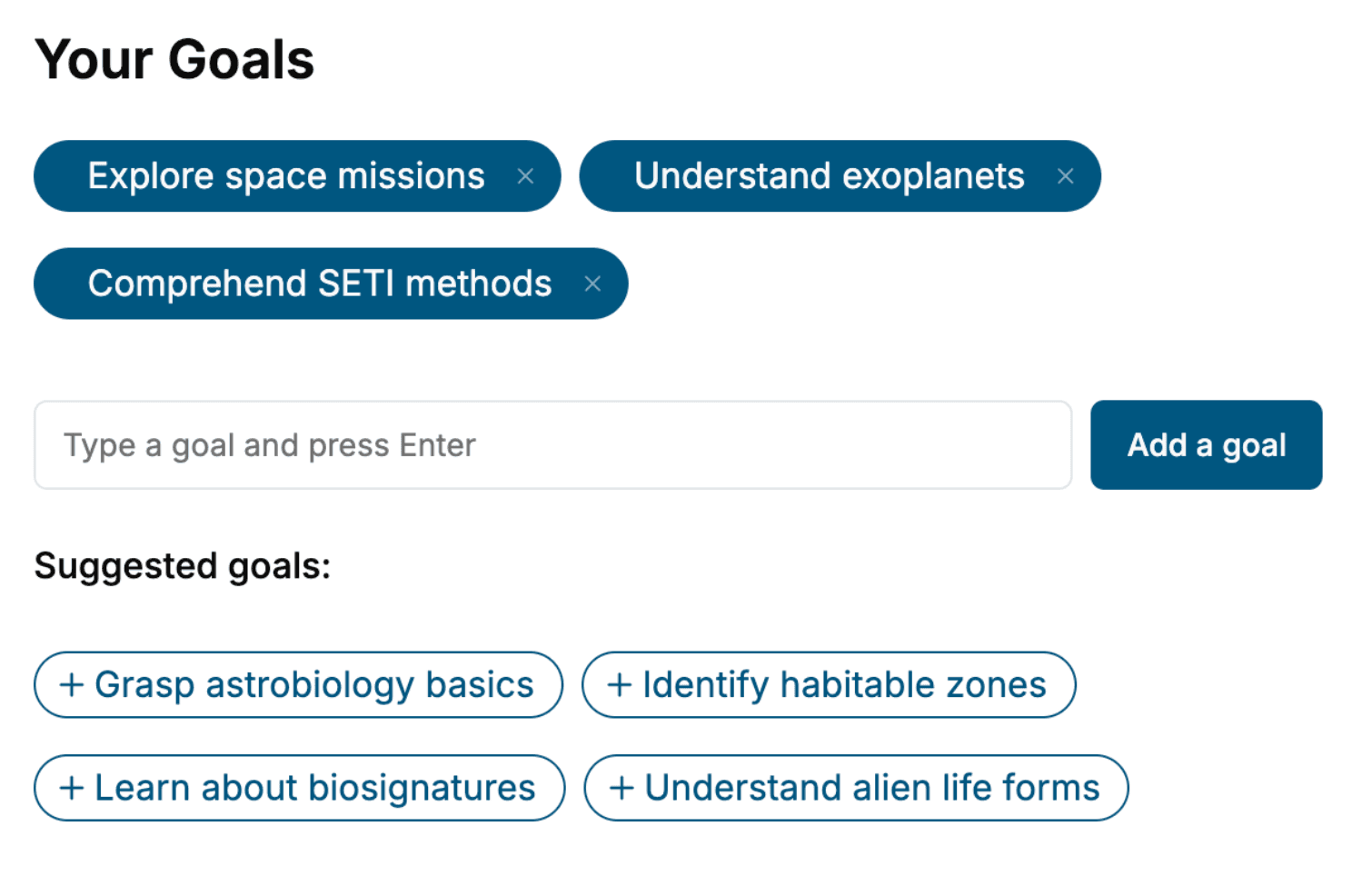
- 1. Select your focus
Select the focus of your Physics book and share your background
- 2. Personalize your book
Specify your goals and choose sub-topics to include
- 3. Get your tailored book
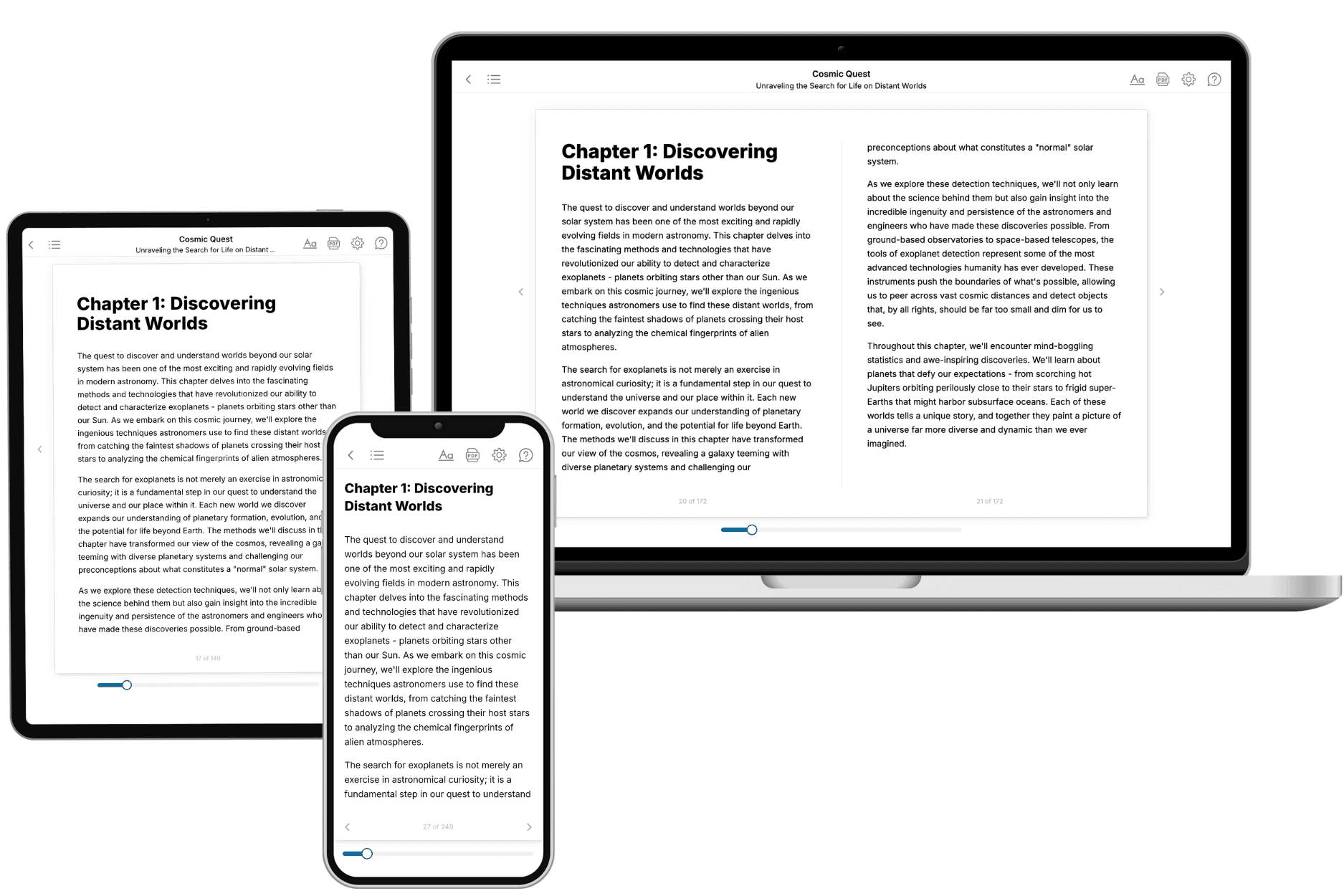
Your book is ready in 10 minutes. Read it online, download as EPUB or PDF, or send to Kindle.

Frequently asked questions
- What is TailoredRead?
TailoredRead creates complete, full-length nonfiction ebooks, written specifically for you. Tell us what you want to learn and why, and TailoredRead writes you a complete ebook on it, with charts, tables, and diagrams throughout. Read it online, on Kindle, or on any e-reader, or download it as a PDF or EPUB. Every book is written fresh the day you order it.
- How is the book tailored to me?
Before anything is written, you answer a few short questions about your goals, your background, and the topics you care about. Your book is then planned around your answers: written at your level, focused on your goals, and covering the topics you chose, instead of the one-size-fits-all book a store sells everyone.
- Will it read like generic AI content?
No. Your book isn't a chat transcript: it's planned chapter by chapter before a single word is written, told in a clear book voice, and explains ideas visually with charts, tables, and diagrams. After writing, every book goes through an editorial pass that polishes chapters so the book reads consistent from start to finish. Judge for yourself: browse thousands of sample books on our Explore Books page.
- How accurate is the content?
Our AI first checks whether your subject needs live research. Niche and fast-moving subjects are researched before writing, and the book plan and chapters are grounded in what it finds. After writing, every book goes through a quality pass that checks its facts and consistency, and researched books list their sources in a Notes section at the back.
- How long is the book?
You choose the length: Comprehensive (250-300 pages), Detailed (150-200 pages), Essential (70-100 pages), or Short (30-50 pages).
- Does the book include visuals?
Yes. Every book includes charts, tables, and diagrams: timelines, checklists, step-by-step guides, decision trees, comparison tables, matrices, and bar charts. A typical book includes dozens of these visual elements.
- Can I read it on Kindle? What formats can I download?
Yes. Every book can be read in our online reader or downloaded as a PDF or EPUB. The EPUB can be opened with Kindle, Apple Books, Kobo, and any e-reader. The Commercial and Author licenses also include an editable Word (DOCX) and Markdown download.
- How much does it cost?
About the price of a regular ebook. The exact price depends on your book's length and complexity, from $2 for the shortest books to $35 for the most comprehensive, and it's shown when you review your book, before you commit to anything. Each book is a one-time purchase, yours to keep, no subscription. Licenses that let you share, teach, or publish your book range from $35.99 to $49.99.
- Can I preview the book before purchasing?
Before you pay, you'll see what your book will cover: the title, a detailed description, the estimated length, and the complete chapter-by-chapter table of contents, so you know what you're getting before you decide. The full text itself is written after you purchase.
- How long does it take to create a book?
About 10 minutes. You can start reading the opening chapters while the rest is still being written.