Quantum Leap
Mastering Semiconductor Physics from Molecules to Devices
Elevate your understanding of the microscopic world that powers our modern technology.
269 pages13 chaptersFeb 7, 2025Physics
About this book
"Quantum Leap: Mastering Semiconductor Physics from Molecules to Devices" is your gateway to unraveling the fascinating realm of semiconductor physics. This comprehensive guide takes you on an exhilarating journey from the fundamental principles of molecular physics to the intricate workings of semiconductor devices. You'll gain a deep understanding of how these tiny structures form the backbone of our digital age, powering everything from smartphones to solar cells. Through clear explanations, practical examples, and thought-provoking insights, you'll develop a robust grasp of concepts such as band theory, carrier transport, and quantum confinement. Whether you're a curious student, an aspiring engineer, or simply passionate about understanding the world around you, this book will equip you with the knowledge to appreciate and discuss semiconductor physics with confidence. Prepare to see the world of electronics in a whole new light as you uncover the quantum mechanics behind the technology that shapes our daily lives.
Table of contents
- IntroductionThe Importance of Semiconductors in Modern Technology, Overview of the Book's Journey, Prerequisites and How to Use This Book, Historical Context of Semiconductor PhysicsRead below
- Chapter 1: Foundations of Quantum MechanicsWave-Particle Duality, The Schrödinger Equation, Quantum States and Wavefunctions, The Heisenberg Uncertainty Principle
- Chapter 2: Atomic Structure and Molecular BondingThe Bohr Model and Beyond, Electron Orbitals and Energy Levels, Covalent Bonding in Semiconductors, Crystal Structures in Semiconductors
- Chapter 3: Energy Bands in SolidsIntroduction to Band Theory, Metals, Insulators, and Semiconductors, Direct and Indirect Bandgaps, Effective Mass Concept
- Chapter 4: Carrier Statistics and EquilibriumFermi-Dirac Distribution, Density of States, Carrier Concentration Calculations, Equilibrium Conditions in Semiconductors
- Chapter 5: Carrier Transport PhenomenaDrift Current and Mobility, Diffusion Current, The Einstein Relation, High-Field Effects and Velocity Saturation
- Chapter 6: Doping of SemiconductorsDonor and Acceptor Impurities, N-type and P-type Semiconductors, Compensation and Doping Profiles, Degenerate Semiconductors
- Chapter 7: Excess Carriers in SemiconductorsCarrier Generation and Recombination, Quasi-Fermi Levels, Carrier Lifetime and Diffusion Length, Surface Effects and Recombination
- Chapter 8: Semiconductor JunctionsThe P-N Junction, Built-in Potential and Depletion Region, Junction Capacitance, Heterojunctions and Band Alignment
- Chapter 9: Bipolar DevicesDiode I-V Characteristics, Bipolar Junction Transistors (BJTs), BJT Operation and Characteristics, Thyristors and Other Bipolar Devices
- Chapter 10: Field-Effect DevicesMOSFET Structure and Operation, MOSFET I-V Characteristics, JFETs and MESFETs, High Electron Mobility Transistors (HEMTs)
- Chapter 11: Quantum Confinement EffectsLow-Dimensional Semiconductor Structures, Quantum Wells and Subbands, Quantum Wires and Quantum Dots, Tunneling Phenomena in Nanostructures
- Chapter 12: Optical Properties of SemiconductorsAbsorption and Emission Processes, Photoconductivity and Photodetectors, Luminescence and LEDs, Semiconductor Lasers
- Chapter 13: Advanced Semiconductor Materials and StructuresIII-V and II-VI Compound Semiconductors, Wide Bandgap Semiconductors, 2D Materials and van der Waals Heterostructures, Topological Insulators and Exotic Phases, Emerging Materials for Future Devices
- ConclusionRecap of Key Concepts, Future Trends in Semiconductor Physics, Interdisciplinary Applications of Semiconductor Physics
- Glossary
- Further Reading
Introduction
Welcome to the fascinating world of semiconductor physics, a realm where the principles of quantum mechanics meet the practical applications that power our modern technological landscape. This introduction serves as your gateway to understanding the fundamental concepts that underlie the devices we use every day, from the smartphones in our pockets to the advanced computing systems that drive scientific research and innovation. As you embark on this journey through "Quantum Leap: Mastering Semiconductor Physics from Molecules to Devices," you'll discover how the microscopic behavior of electrons and atoms translates into the macroscopic properties that enable the functionality of countless electronic devices.
The field of semiconductor physics stands at the intersection of several branches of science and engineering. It draws upon the foundational principles of quantum mechanics, solid-state physics, and materials science to explain and predict the behavior of a special class of materials that have revolutionized technology. These materials, neither full conductors nor insulators, possess unique properties that can be manipulated to control the flow of electrical current with unprecedented precision. This control forms the basis of modern electronics, making semiconductors the backbone of the information age.
Throughout this book, you'll delve into the quantum mechanical principles that govern the behavior of electrons in solids, explore the intricacies of band theory, and uncover the mechanisms of carrier transport. You'll learn how the careful introduction of impurities through doping can dramatically alter a semiconductor's properties, and how the creation of junctions between different types of semiconductors leads to the formation of devices with remarkable capabilities. From the fundamental physics of individual atoms to the complex operations of integrated circuits, this book will guide you through the multi-scale nature of semiconductor physics, revealing how microscopic phenomena give rise to the technologies that shape our world.
As you progress through the chapters, you'll not only gain a deep understanding of established semiconductor physics but also glimpse the cutting edge of the field. You'll explore quantum confinement effects in nanoscale structures, examine the optical properties that enable LEDs and lasers, and consider the potential of emerging materials and exotic quantum states. This comprehensive journey will equip you with the knowledge and insight needed to appreciate the current state of semiconductor technology and to envision its future possibilities.
Whether you're a student of physics or engineering, a professional in the tech industry, or simply a curious mind eager to understand the invisible workings behind our digital world, this book is designed to elevate your understanding and inspire your imagination. Prepare to take a quantum leap into the world of semiconductor physics, where the strange and counterintuitive rules of the quantum realm manifest in the devices that define our technological era.
The Importance of Semiconductors in Modern Technology
Semiconductors are the unsung heroes of modern technology, playing a pivotal role in shaping the world as we know it today. These remarkable materials have become the foundation upon which our digital civilization is built, enabling advancements that were once confined to the realm of science fiction. The importance of semiconductors cannot be overstated; they are the key components in a vast array of devices and systems that have transformed every aspect of human life, from communication and entertainment to healthcare and scientific research.
At the heart of the semiconductor revolution lies the transistor, a fundamental building block of modern electronics. Invented in 1947 by John Bardeen, Walter Brattain, and William Shockley at Bell Labs, the transistor marked a turning point in technological history[1]. This tiny device, capable of amplifying and switching electronic signals, replaced bulky and unreliable vacuum tubes, paving the way for smaller, faster, and more efficient electronic devices. The impact of this invention was so profound that it earned its creators the Nobel Prize in Physics in 1956. Since then, the continuous miniaturization and improvement of transistors have driven the exponential growth in computing power, famously described by Moore's Law, which has held true for decades[2].
The ubiquity of semiconductors in modern technology is staggering. They are the essential components in integrated circuits, which form the brains of computers, smartphones, and tablets. These devices have revolutionized the way we communicate, work, and access information, connecting billions of people across the globe through the internet. Semiconductors also power the sensors in our cameras, the displays on our screens, and the memory chips that store our digital data. In the automotive industry, semiconductors enable advanced driver assistance systems, improve fuel efficiency, and are crucial for the development of electric and autonomous vehicles.
Beyond consumer electronics, semiconductors play a critical role in scientific and medical advancements. They are integral to the sophisticated imaging technologies used in medical diagnostics, such as CT scanners and MRI machines. In space exploration, semiconductor-based systems guide spacecraft and satellites, enabling us to study distant planets and peer into the depths of the universe. The field of renewable energy also heavily relies on semiconductors, with photovoltaic cells harnessing the power of the sun to generate clean electricity.
The semiconductor industry has become a cornerstone of the global economy, with the market valued at hundreds of billions of dollars annually. Countries and companies vie for dominance in semiconductor manufacturing, recognizing it as a key strategic asset. The industry's importance is underscored by its role in geopolitics, with nations investing heavily in research and development to maintain technological superiority. The recent global chip shortage has further highlighted the critical nature of semiconductors, affecting industries from automotive to consumer electronics and emphasizing the need for robust and diversified supply chains[3].
As we look to the future, the importance of semiconductors is only set to grow. Emerging technologies such as artificial intelligence, 5G networks, the Internet of Things (IoT), and quantum computing all rely heavily on advanced semiconductor devices. These technologies promise to usher in new eras of connectivity, automation, and computational power, potentially transforming society in ways we are only beginning to imagine. The development of new semiconductor materials and structures, such as wide-bandgap semiconductors and two-dimensional materials like graphene, opens up possibilities for even more efficient and capable devices.
The environmental impact of semiconductor technology is also becoming increasingly important. While the production of semiconductors can be resource-intensive, their use in energy-efficient devices and renewable energy systems contributes significantly to efforts to combat climate change. As the world moves towards more sustainable practices, semiconductors will play a crucial role in optimizing energy use across various sectors, from smart grids to energy-efficient lighting and appliances.
In conclusion, semiconductors are the invisible enablers of our modern world, underpinning technologies that have become indispensable in our daily lives. Their importance extends far beyond consumer gadgets, influencing fields as diverse as medicine, space exploration, and environmental sustainability. As you delve deeper into the physics of semiconductors throughout this book, keep in mind the profound impact these materials have on our society. Understanding semiconductor physics is not just an academic exercise; it is a key to comprehending the technological fabric of our world and envisioning the innovations that will shape our future. The journey you are about to embark on will not only reveal the fascinating quantum world that governs semiconductor behavior but also equip you with the knowledge to appreciate and potentially contribute to the ongoing technological revolution powered by these remarkable materials.
Overview of the Book's Journey
As you embark on this intellectual journey through "Quantum Leap: Mastering Semiconductor Physics from Molecules to Devices," you are about to traverse a carefully crafted path that will take you from the fundamental principles of quantum mechanics to the cutting-edge applications of semiconductor technology. This book is designed to provide you with a comprehensive understanding of semiconductor physics, bridging the gap between basic concepts and advanced topics in a manner that is both accessible and rigorous. The journey ahead is structured to build your knowledge systematically, ensuring that each chapter lays a solid foundation for the concepts that follow.
Your expedition begins with an exploration of the quantum mechanical foundations that underpin all of semiconductor physics. Chapter 1, "Foundations of Quantum Mechanics," introduces you to the strange and fascinating world of quantum phenomena. Here, you'll grapple with concepts such as wave-particle duality, the Schrödinger equation, and the Heisenberg uncertainty principle. These fundamental ideas will serve as the bedrock for your understanding of how electrons behave in semiconductor materials. As you progress through this chapter, you'll begin to see how the counterintuitive nature of quantum mechanics gives rise to the unique properties of semiconductors that make them so valuable in modern technology.
With a firm grasp of quantum mechanics, you'll then delve into the structure of atoms and molecules in Chapter 2, "Atomic Structure and Molecular Bonding." This chapter bridges the gap between individual particles and the formation of solid materials. You'll explore the Bohr model of the atom, electron orbitals, and the nature of chemical bonds, with a particular focus on the covalent bonding that is characteristic of semiconductor materials. The crystal structures that result from these bonds play a crucial role in determining the electronic properties of semiconductors, setting the stage for the more complex phenomena you'll encounter later in the book.
Chapter 3, "Energy Bands in Solids," marks a significant leap in your understanding, introducing the concept of band theory. This chapter is pivotal, as it explains why some materials conduct electricity while others do not, and how semiconductors occupy a unique middle ground. You'll learn about the formation of energy bands, the distinction between metals, insulators, and semiconductors, and the crucial concepts of bandgaps and effective mass. These ideas are fundamental to explaining the behavior of electrons in semiconductor devices and will be referenced throughout the remainder of the book.
As you progress to Chapter 4, "Carrier Statistics and Equilibrium," you'll dive into the statistical mechanics that govern the behavior of large numbers of electrons and holes in semiconductors. The Fermi-Dirac distribution, density of states, and carrier concentration calculations will become part of your toolkit for understanding how semiconductors behave under various conditions. This chapter lays the groundwork for comprehending the equilibrium conditions in semiconductors, which is essential for predicting device behavior.
Chapter 5, "Carrier Transport Phenomena," builds upon the statistical foundation to explain how charge carriers move within semiconductor materials. You'll explore the concepts of drift and diffusion currents, mobility, and the effects of high electric fields on carrier transport. These principles are crucial for understanding the operation of semiconductor devices and will be applied extensively in later chapters when discussing specific device types.
The manipulation of semiconductor properties through the introduction of impurities is the focus of Chapter 6, "Doping of Semiconductors." This chapter explains how the careful addition of donor or acceptor atoms can dramatically alter the electrical characteristics of a semiconductor, creating n-type and p-type materials. You'll learn about compensation, doping profiles, and the concept of degenerate semiconductors, all of which are essential for designing and optimizing semiconductor devices.
Chapter 7, "Excess Carriers in Semiconductors," delves into non-equilibrium conditions, exploring how excess carriers are generated, recombine, and affect semiconductor behavior. Concepts such as carrier lifetime, diffusion length, and surface effects are introduced, providing insight into the dynamic processes that occur in semiconductor devices during operation.
With a solid understanding of carrier behavior, Chapter 8, "Semiconductor Junctions," introduces you to one of the most important structures in semiconductor devices: the p-n junction. This chapter covers the physics of junction formation, built-in potentials, depletion regions, and capacitance effects. The principles learned here form the basis for understanding diodes, solar cells, and more complex semiconductor devices.
Chapters 9 and 10 focus on specific classes of semiconductor devices. "Bipolar Devices" covers the operation of diodes and bipolar junction transistors (BJTs), while "Field-Effect Devices" introduces you to MOSFETs, JFETs, and other field-effect transistors. These chapters apply the theoretical knowledge you've gained to explain the functioning of real-world devices that form the building blocks of modern electronics.
As the book progresses to more advanced topics, Chapter 11, "Quantum Confinement Effects," explores the fascinating world of low-dimensional semiconductor structures. You'll learn about quantum wells, wires, and dots, and how confinement of carriers in these structures leads to unique electronic and optical properties. This chapter bridges classical semiconductor physics with the quantum effects that become prominent at the nanoscale.
Chapter 12, "Optical Properties of Semiconductors," delves into the interaction between light and semiconductor materials. You'll explore absorption and emission processes, photoconductivity, and the principles behind optoelectronic devices such as LEDs and semiconductor lasers. This chapter highlights the dual nature of semiconductors as both electronic and optical materials.
The journey concludes with Chapter 13, "Advanced Semiconductor Materials and Structures," which provides a glimpse into the cutting edge of semiconductor research and development. From compound semiconductors to 2D materials and topological insulators, this chapter explores the frontiers of the field and the potential for new materials to enable future technological breakthroughs.
Throughout this book, you'll find that each chapter builds upon the knowledge gained in previous sections, creating a coherent narrative that takes you from basic principles to advanced concepts. Practical examples, case studies, and references to real-world applications are interwoven throughout the text, helping you connect theoretical knowledge with tangible technological implementations. By the end of this journey, you will have gained a comprehensive understanding of semiconductor physics, equipped with the tools to analyze existing devices and conceptualize future innovations in the field.
As you progress through the chapters, remember that this book is not just a collection of facts and equations, but a guide to developing a deep, intuitive understanding of semiconductor physics. Take the time to reflect on the concepts presented, work through the examples, and consider how the principles you're learning apply to the technology around you. Your journey through "Quantum Leap" is designed to be both challenging and rewarding, preparing you to engage with the ever-evolving world of semiconductor technology with confidence and insight.
Prerequisites and How to Use This Book
Before you dive into the depths of semiconductor physics, it's important to understand the prerequisites that will help you make the most of this book. While "Quantum Leap: Mastering Semiconductor Physics from Molecules to Devices" is designed to be accessible to a wide range of readers, having a solid foundation in certain areas will significantly enhance your learning experience. This section will outline the recommended background knowledge and provide guidance on how to effectively use this book to maximize your understanding of semiconductor physics.
First and foremost, a strong grasp of basic physics principles is essential. You should be comfortable with classical mechanics, including concepts such as force, energy, and momentum. A familiarity with electromagnetism is also crucial, as many semiconductor phenomena are rooted in the behavior of charged particles in electric and magnetic fields. If you need to refresh your knowledge in these areas, consider reviewing an introductory physics textbook or online resources before proceeding with this book.
Mathematics plays a fundamental role in describing semiconductor physics, so a solid mathematical background is necessary. At a minimum, you should be proficient in algebra, trigonometry, and calculus. Differential equations, linear algebra, and complex numbers also feature prominently in many derivations and explanations throughout the book. If you find your math skills need sharpening, don't hesitate to pause and review these topics as you encounter them. Many excellent online resources and textbooks are available to help you strengthen your mathematical foundation.
A basic understanding of quantum mechanics will be incredibly beneficial as you begin this journey. While Chapter 1 provides an overview of quantum mechanical concepts, having prior exposure to ideas such as wave functions, the Schrödinger equation, and quantization of energy levels will allow you to progress more quickly through the early chapters. If you're new to quantum mechanics, you might consider reading an introductory text on the subject before delving into this book.
Some familiarity with chemistry, particularly atomic structure and chemical bonding, will also prove valuable. The book covers these topics in the context of semiconductors, but prior knowledge will help you grasp the material more readily. A basic understanding of crystallography and solid-state physics concepts can also be advantageous, though these topics are introduced and explained within the text.
To make the most of this book, approach it with an active learning mindset. Reading the material is just the first step; true understanding comes from engaging with the concepts and applying them to solve problems. Here are some strategies to enhance your learning experience:
- Read each chapter thoroughly, taking notes and highlighting key concepts. Don't rush through the material; take the time to reflect on each new idea and how it relates to what you've learned previously.
- Work through all example problems presented in the text. Try to solve them on your own before looking at the provided solutions. This practice will help reinforce your understanding and develop your problem-solving skills.
- Utilize the end-of-chapter problems and exercises. These are designed to test your comprehension and apply the concepts in various contexts. If you struggle with a problem, revisit the relevant sections of the chapter before seeking out the solution.
- Create concept maps or diagrams to visualize the relationships between different topics. Semiconductor physics involves many interconnected ideas, and visual aids can help you see the bigger picture.
- Discuss concepts with peers or join study groups. Explaining ideas to others and engaging in discussions can deepen your understanding and expose you to different perspectives.
- Seek out additional resources when needed. While this book aims to be comprehensive, you may find it helpful to consult other textbooks, scientific papers, or online lectures for alternative explanations or more in-depth coverage of specific topics.
- Apply the concepts to real-world scenarios. Try to relate what you're learning to the technology around you. Understanding how semiconductor physics principles manifest in everyday devices can make the material more engaging and memorable.
As you progress through the book, you'll notice that each chapter builds upon the previous ones. It's crucial to ensure you have a solid understanding of earlier concepts before moving on. If you find yourself struggling with a particular section, don't hesitate to revisit earlier chapters or seek additional resources to fill any knowledge gaps.
The book is structured to accommodate different learning styles and needs. If you're a student using this as a textbook for a course, follow your instructor's guidance on which sections to focus on and in what order. If you're a professional or independent learner, you may choose to concentrate on specific chapters that are most relevant to your work or interests. However, it's recommended to at least skim all chapters to gain a comprehensive overview of the field.
Remember that learning semiconductor physics is a journey, not a destination. The field is constantly evolving, with new discoveries and applications emerging regularly. Use this book as a foundation to build your knowledge, but stay curious and open to learning beyond its pages. Engage with current research, attend seminars or webinars, and keep abreast of developments in the semiconductor industry to continue growing your expertise.
Finally, don't be discouraged if you find some concepts challenging at first. Semiconductor physics can be complex, and it's normal to struggle with new ideas. Persistence and practice are key. As you work through the material, you'll find that seemingly difficult concepts become clearer, and you'll develop an intuition for semiconductor behavior that will serve you well in your studies or career.
By following these guidelines and approaching the material with dedication and curiosity, you'll be well-equipped to navigate the fascinating world of semiconductor physics. This book is your companion on this journey, providing the knowledge and tools you need to understand the principles that underpin modern technology. Embrace the challenge, enjoy the process of discovery, and prepare to take your quantum leap into the realm of semiconductor physics.
Historical Context of Semiconductor Physics
The history of semiconductor physics is a fascinating journey that spans over two centuries, marked by groundbreaking discoveries, technological revolutions, and paradigm shifts in our understanding of matter and electricity. This historical context is crucial for appreciating the depth and breadth of semiconductor physics, as it illustrates how scientific curiosity, theoretical breakthroughs, and practical applications have intertwined to shape the field. By understanding this rich history, you'll gain a deeper appreciation for the concepts you'll encounter throughout this book and the remarkable progress that has led to the semiconductor-driven world we live in today.
The story of semiconductors begins in the early 19th century, long before the term "semiconductor" was coined or their unique properties were fully understood. In 1833, Michael Faraday observed that the electrical resistance of silver sulfide decreased with increasing temperature, contrary to the behavior of metals[1]. This observation, though not immediately recognized as significant, was one of the first indications of semiconductor behavior. Around the same time, in 1839, Alexandre Edmond Becquerel discovered the photovoltaic effect while experimenting with an electrolytic cell, laying the groundwork for future solar cell technology.
The term "semiconductor" itself was first used in 1782 by Alessandro Volta, but it wasn't until the mid-19th century that systematic studies of these materials began. In 1874, Karl Ferdinand Braun discovered the rectifying property of certain metal-semiconductor junctions, a phenomenon that would later be crucial for the development of diodes. The late 19th and early 20th centuries saw increased interest in the peculiar properties of materials like selenium and copper oxide, which were found to have variable conductivity and photosensitivity.
The theoretical foundation for understanding semiconductors began to take shape in the early 20th century with the development of quantum mechanics. In 1926, Erwin Schrödinger formulated his famous wave equation, providing a mathematical framework for describing the behavior of electrons in atoms and solids. This was followed by the band theory of solids, developed by Felix Bloch, Alan Wilson, and others in the late 1920s and early 1930s. These theoretical advances were crucial in explaining why some materials conduct electricity while others do not, and how semiconductors occupy a unique middle ground.
The 1940s marked a turning point in semiconductor physics and technology. In 1947, John Bardeen, Walter Brattain, and William Shockley at Bell Labs invented the point-contact transistor, followed shortly by the more practical bipolar junction transistor in 1948. This invention, which earned them the Nobel Prize in Physics in 1956, is often considered the birth of modern electronics. The transistor's ability to amplify and switch electronic signals revolutionized technology, paving the way for smaller, more efficient electronic devices that would eventually replace vacuum tubes.
The 1950s and 1960s saw rapid advancements in semiconductor technology and understanding. The development of the silicon-based transistor by Gordon Teal at Texas Instruments in 1954 established silicon as the dominant semiconductor material, a position it still holds today. In 1958, Jack Kilby of Texas Instruments demonstrated the first integrated circuit, integrating multiple components onto a single chip of semiconductor material. This innovation laid the foundation for the microelectronics revolution and the exponential growth in computing power described by Moore's Law, proposed by Gordon Moore in 1965.
As the theoretical understanding of semiconductors deepened, new types of devices and materials were developed. The metal-oxide-semiconductor field-effect transistor (MOSFET), invented by Mohamed Atalla and Dawon Kahng at Bell Labs in 1959, became the fundamental building block of modern digital electronics. The discovery of the laser in 1960 led to the development of semiconductor lasers, with the first continuous-wave room-temperature semiconductor laser demonstrated by Zhores Alferov and team in 1970, earning him a share of the Nobel Prize in Physics in 2000.
The latter half of the 20th century saw the emergence of new semiconductor materials and structures. Compound semiconductors like gallium arsenide enabled high-speed and optoelectronic devices. The development of molecular beam epitaxy and other advanced growth techniques in the 1970s allowed for the creation of precisely controlled semiconductor heterostructures, leading to the discovery of the quantum Hall effect by Klaus von Klitzing in 1980 (Nobel Prize in Physics 1985) and the fractional quantum Hall effect by Daniel Tsui, Horst Störmer, and Robert Laughlin in 1982 (Nobel Prize in Physics 1998).
The ability to manipulate materials at the atomic scale opened up new frontiers in semiconductor physics. The invention of the scanning tunneling microscope by Gerd Binnig and Heinrich Rohrer in 1981 (Nobel Prize in Physics 1986) allowed scientists to visualize and manipulate individual atoms, pushing the boundaries of miniaturization. This led to the exploration of low-dimensional semiconductor structures such as quantum wells, wires, and dots in the 1980s and 1990s, revealing new quantum phenomena and enabling novel device concepts.
As we entered the 21st century, semiconductor physics continued to evolve rapidly. The development of wide-bandgap semiconductors like silicon carbide and gallium nitride has enabled more efficient power electronics and blue LEDs, the latter earning Isamu Akasaki, Hiroshi Amano, and Shuji Nakamura the Nobel Prize in Physics in 2014. The discovery of graphene by Andre Geim and Konstantin Novoselov in 2004 (Nobel Prize in Physics 2010) sparked intense interest in two-dimensional materials, opening up new possibilities for ultra-thin and flexible electronics.
Today, semiconductor physics stands at the forefront of many cutting-edge technologies. The field continues to push the boundaries of miniaturization, with transistors now approaching atomic scales. Emerging areas such as spintronics, which seeks to harness electron spin for information processing, and topological insulators, materials with unique surface electronic states, are opening up new avenues for research and potential applications. The quest for quantum computing has also put semiconductor physics at the center of efforts to create scalable qubit architectures.
As you delve into the chapters of this book, keep in mind this rich historical context. The concepts you'll encounter are the result of over two centuries of scientific inquiry, technological innovation, and countless contributions from researchers and engineers around the world. Understanding this history not only provides perspective on the current state of the field but also inspires consideration of where semiconductor physics might lead us in the future. The journey from Faraday's early observations to today's nanoscale devices is a testament to human ingenuity and the power of scientific progress. As you embark on your own exploration of semiconductor physics, you become part of this ongoing story, poised to contribute to the next chapter in this remarkable field.
Notes
Introduction
- 1. M. Riordan and others, "The invention of the transistor," Reviews of Modern PhysicsS336-S345, 1999
- 2. G. E. Moore, "Cramming more components onto integrated circuits," Electronics, 1965
- 3. C. P. Bown, "How the United States marched the semiconductor industry into its trade war with China," East Asian Economic Review, 2020
- 1. G. Busch, "Early history of the physics and chemistry of semiconductors-from doubts to fact in a hundred years," European Journal of Physics, 1989
This is the end of the free sample. The full book has 13 chapters.
Want this book written for you?
Tell us your goals and background, and get your own version of this book, tailored by AI to you.


Benefits of AI-tailored books
- Read one book, not ten:
- all the Physics knowledge you need, gathered into a single book.
- Save days of learning:
- tell us your goals, choose your topics, and the whole book is built around them.
- Learn effortlessly:
- Physics book written for your specific background and expertise.
- Understand at a glance:
- includes charts, tables, timelines, checklists, decision trees, and more.
- Stay current:
- written the day you order it, not years ago.
- Trust what you read:
- every book is checked for accuracy, with real research when your subject needs it.
Create your unique book in 3 steps
- 1. Select your focus
Select the focus of your Physics book and share your background
- 2. Personalize your book
Specify your goals and choose sub-topics to include
- 3. Get your tailored book
Your book is ready in 10 minutes. Read it online, download as EPUB or PDF, or send to Kindle.


Frequently asked questions
- What is TailoredRead?
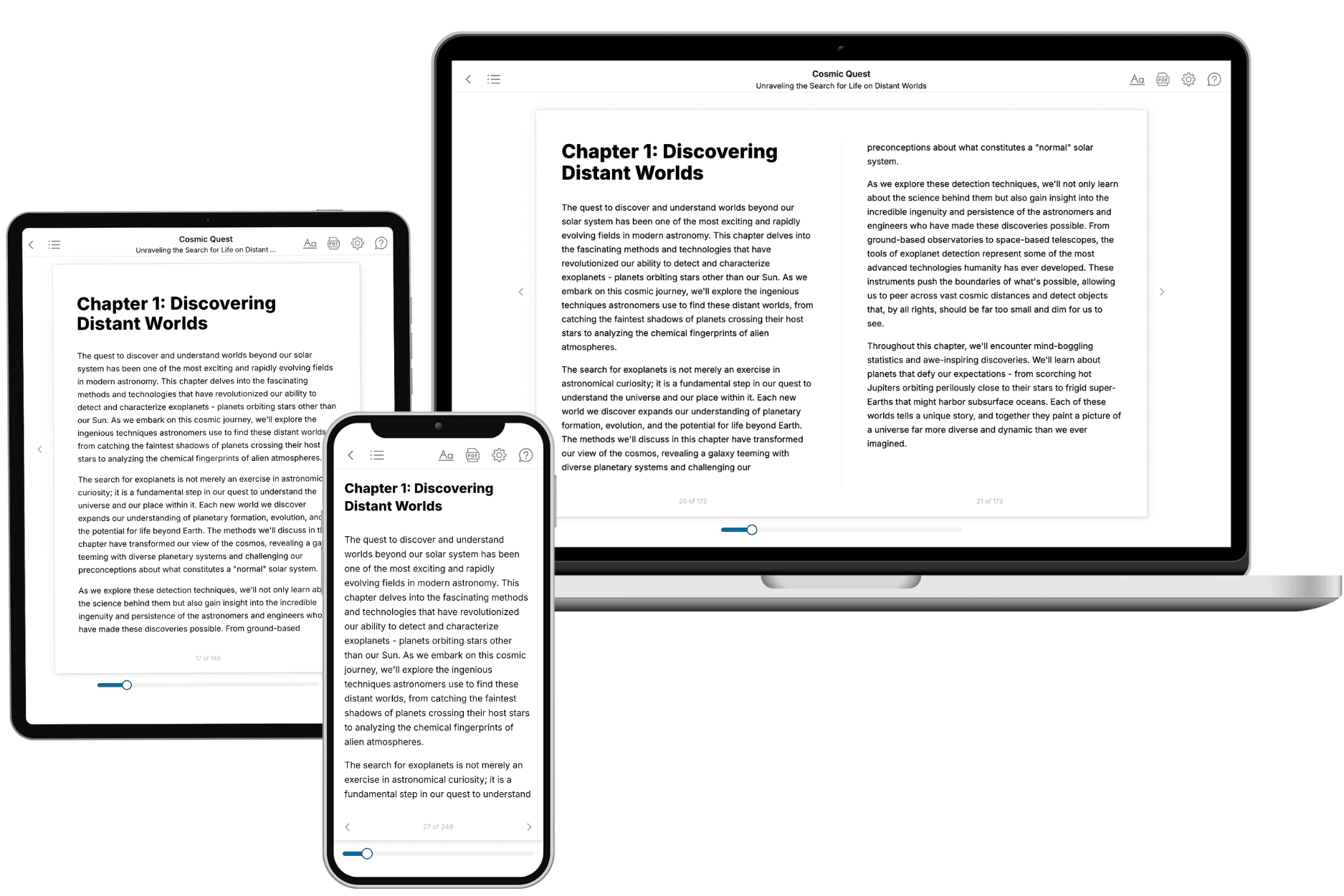
TailoredRead creates complete, full-length nonfiction ebooks, written specifically for you. Tell us what you want to learn and why, and TailoredRead writes you a complete ebook on it, with charts, tables, and diagrams throughout. Read it online, on Kindle, or on any e-reader, or download it as a PDF or EPUB. Every book is written fresh the day you order it.
- How is the book tailored to me?
Before anything is written, you answer a few short questions about your goals, your background, and the topics you care about. Your book is then planned around your answers: written at your level, focused on your goals, and covering the topics you chose, instead of the one-size-fits-all book a store sells everyone.
- Will it read like generic AI content?
No. Your book isn't a chat transcript: it's planned chapter by chapter before a single word is written, told in a clear book voice, and explains ideas visually with charts, tables, and diagrams. After writing, every book goes through an editorial pass that polishes chapters so the book reads consistent from start to finish. Judge for yourself: browse thousands of sample books on our Explore Books page.
- How accurate is the content?
Our AI first checks whether your subject needs live research. Niche and fast-moving subjects are researched before writing, and the book plan and chapters are grounded in what it finds. After writing, every book goes through a quality pass that checks its facts and consistency, and researched books list their sources in a Notes section at the back.
- How long is the book?
You choose the length: Comprehensive (250-300 pages), Detailed (150-200 pages), Essential (70-100 pages), or Short (30-50 pages).
- Does the book include visuals?
Yes. Every book includes visual elements such as timelines, checklists, step-by-step guides, decision trees, comparison tables, and matrices, and many include bar charts. A typical book includes dozens of these visual elements.
- Can I read it on Kindle? What formats can I download?
Yes. Every book can be read in our online reader or downloaded as a PDF or EPUB. The EPUB can be opened with Kindle, Apple Books, Kobo, and any e-reader. The Commercial and Author licenses also include an editable Word (DOCX) and Markdown download.
- How much does it cost?
About the price of a regular ebook. The exact price depends on your book's length and complexity, from $2 for the shortest books to $35 for the most comprehensive, and it's shown when you review your book, before you commit to anything. Each book is a one-time purchase, yours to keep, no subscription. Licenses that let you share, teach, or publish your book range from $35.99 to $49.99.
- Can I preview the book before purchasing?
Before you pay, you'll see what your book will cover: the title, a detailed description, the estimated length, and the complete chapter-by-chapter table of contents, so you know what you're getting before you decide. The full text itself is written after you purchase.
- How long does it take to create a book?
About 10 minutes. You can start reading the opening chapters while the rest is still being written.