Quantum Teleportation Demystified
Master the Linear Algebra Behind Quantum Information Transfer
Quantum teleportation seems like science fiction, but it's grounded in elegant mathematics.
238 pages11 chaptersNov 20, 2025Quantum Computing
About this book
The challenge most people face is that quantum mechanics is typically taught through physics intuition, leaving the mathematical structure mysterious and inaccessible. This book takes a different approach: it builds quantum teleportation from the ground up using linear algebra as your primary lens. You'll start with vector spaces and basis states, progress through eigenvalues and unitary transformations, and finally see how these mathematical concepts combine to enable quantum information transfer. By the end, you'll understand not just how quantum teleportation works, but why it must work the way it does. This is mathematics-first learning that makes quantum mechanics concrete and comprehensible, perfect for anyone ready to move beyond hand-waving explanations into genuine understanding.
Table of contents
- IntroductionWhy Quantum Teleportation Matters, The Mathematics-First Approach, What You'll Learn in This Book, How to Use This BookRead below
- Chapter 1: Foundations of Vector SpacesVectors and Scalars: Building Blocks, Vector Space Axioms and Properties, Basis and Dimension: Spanning Quantum States, Inner Products and Orthogonality
- Chapter 2: Quantum States as VectorsQubits as Vectors in Complex Space, Superposition as Linear Combination, Measurement and Projection Operators, Normalization and Probability Amplitudes
- Chapter 3: Matrices and Linear TransformationsMatrix Fundamentals and Operations, Linear Transformations and Quantum Gates, Eigenvalues and Eigenvectors, Matrix Decomposition and Diagonalization
- Chapter 4: Unitary Transformations and Quantum OperationsUnitary Matrices: Preserving Quantum Information, Hermitian Operators and Observables, Quantum Gates as Unitary Matrices, Composing Gates: Matrix Multiplication
- Chapter 5: Tensor Products and Multi-Qubit SystemsTensor Product Definition and Properties, Multi-Qubit States and Composite Systems, Separable States Versus Entangled States, Operations on Tensor Product Spaces
- Chapter 6: Entanglement Through Linear AlgebraBell States: Constructing Entangled Pairs, Measuring Entanglement Mathematically, Schmidt Decomposition and Entanglement Structure, Properties of Entangled States
- Chapter 7: Bell Measurements and ProjectionsThe Bell Basis: A Complete Orthonormal Set, Projection Operators for Bell Measurements, Measurement Outcomes and Classical Information, Bell Measurement as a Linear Transformation
- Chapter 8: The No-Cloning TheoremProving No-Cloning from Linear Algebra, Implications for Quantum Information, Why Teleportation Is Necessary
- Chapter 9: Quantum Teleportation ProtocolThe Complete Teleportation Protocol, Step-by-Step Mathematical Analysis, Recovery Operations and Unitary Corrections, Verifying the Protocol Works
- Chapter 10: Generalizations and ExtensionsTeleporting Multiple Qubits, Continuous Variable Teleportation, Variants and Optimizations
- Chapter 11: Applications and Future DirectionsApplications in Quantum Computing, Quantum Networks and Communication, Experimental Implementations, Future Possibilities and Open Questions
- ConclusionKey Takeaways, Next Steps in Your Quantum Journey
- Glossary of Terms
- Further Reading and Resources
Introduction
Quantum teleportation sounds like something from a science fiction novel. The idea that information can be transferred from one location to another without physically traveling through the space between them challenges our everyday intuitions about how the world works. Yet quantum teleportation is real, experimentally verified, and increasingly important for emerging quantum technologies. The catch is that most explanations either resort to vague analogies that leave you wondering what's actually happening, or they dive into dense physics formalism that assumes years of specialized training. This book takes a different path entirely.
The secret to understanding quantum teleportation lies not in quantum physics intuition, but in the mathematical structure that underlies it. Quantum mechanics is fundamentally a theory built on linear algebra. Every quantum state is a vector, every measurement is a projection, and every quantum operation is a linear transformation. When you understand the linear algebra, the physics becomes not just comprehensible but inevitable. The mathematics doesn't just describe quantum teleportation—it explains why quantum teleportation must work exactly the way it does, and why certain things that seem like they should be possible are actually forbidden by the mathematical structure itself.
This book is designed for anyone who has encountered basic linear algebra and wants to understand quantum information theory from the ground up. You don't need a physics background. You don't need to have studied quantum mechanics before. What you need is comfort with vectors, matrices, and basic mathematical reasoning. If you've taken a linear algebra course at the undergraduate level, or if you've worked with vectors and matrices in programming or data science, you have the foundation needed to master this material. The goal is to build your understanding systematically, starting with the mathematical tools and gradually assembling them into the complete picture of quantum teleportation.
Why Quantum Teleportation Matters
Quantum teleportation represents one of the most striking demonstrations of how quantum mechanics differs from classical physics. In classical information theory, copying information is trivial—you can duplicate a file, send copies to multiple recipients, and retain the original. Quantum information doesn't work this way. The no-cloning theorem, which emerges directly from the linear algebra of quantum mechanics, proves that you cannot create an identical copy of an unknown quantum state. This fundamental limitation means that transferring quantum information requires a completely different approach than classical communication.
The quantum teleportation protocol, first proposed by Charles Bennett and colleagues in 1993, solves this problem in an elegant way[1]. It allows you to transfer the complete quantum state of a particle from one location to another without the state ever traveling through the intervening space. The process requires three key ingredients: an entangled pair of particles shared between sender and receiver, a measurement performed by the sender, and classical communication of the measurement results. The quantum state is destroyed at the sender's location and recreated at the receiver's location, preserving the no-cloning theorem while enabling perfect state transfer.
Beyond its theoretical elegance, quantum teleportation has become a cornerstone technology for quantum information processing. Quantum computers need to move quantum information between different parts of the processor without destroying delicate superposition states. Quantum networks aim to connect distant quantum computers, enabling distributed quantum computing and ultra-secure quantum communication. Quantum teleportation provides the mechanism for these transfers. Understanding how it works isn't just intellectually satisfying—it's becoming practically important as quantum technologies transition from laboratory demonstrations to real-world applications.
The implications extend to fundamental questions about the nature of information and reality. Quantum teleportation demonstrates that quantum information has properties fundamentally different from classical information. It shows that entanglement—a purely quantum correlation with no classical analog—can be used as a resource to accomplish tasks impossible in classical physics. It reveals that quantum states are not properties of particles themselves but rather mathematical objects that can be transferred between physical systems. These insights reshape how we think about information, measurement, and the relationship between mathematics and physical reality.
Perhaps most importantly, quantum teleportation provides a concrete example where mathematical understanding leads directly to technological capability. The protocol wasn't discovered by experimental trial and error. It was derived mathematically, predicted theoretically, and only then verified experimentally. This progression from mathematical structure to physical implementation exemplifies how deep understanding of the underlying mathematics enables innovation. By mastering the linear algebra of quantum teleportation, you're not just learning about one specific protocol—you're developing the mathematical toolkit needed to understand and potentially contribute to the broader field of quantum information science.
The practical applications continue to expand. Researchers have demonstrated quantum teleportation over distances exceeding 1,400 kilometers using satellite links[2]. Quantum teleportation has been used to transfer quantum information between different types of physical systems, such as from photons to atoms. It forms the basis for quantum repeaters, which will be essential for long-distance quantum communication networks. Each of these applications relies on the same mathematical principles you'll learn in this book. Understanding the linear algebra means understanding not just what these systems do, but how they work and what their fundamental limitations are.
The Mathematics-First Approach
Traditional quantum mechanics courses typically start with physical concepts—wave-particle duality, the uncertainty principle, atomic spectra—and introduce the mathematics as a tool to describe these phenomena. This approach works well if your goal is to solve physics problems, but it can leave the mathematical structure feeling arbitrary and mysterious. Why do we represent quantum states as vectors? Why must quantum operations be unitary transformations? Why does entanglement require tensor products? The physics-first approach often answers these questions with "because that's what matches experiment," which is true but unsatisfying if you want deeper understanding.
This book inverts that traditional approach. We start with the mathematics and show how quantum mechanics emerges naturally from the mathematical structure. You'll see that representing quantum states as vectors isn't an arbitrary choice—it's the natural way to represent systems that can exist in superpositions of multiple possibilities. Unitary transformations aren't just convenient—they're the only transformations that preserve the probabilistic interpretation of quantum mechanics. Tensor products aren't complicated notation—they're the standard mathematical tool for combining independent systems. By building from mathematics to physics, the structure becomes clear and comprehensible.
The mathematics-first approach offers several concrete advantages. First, it makes the subject more accessible to people with mathematical backgrounds but limited physics training. If you're comfortable with linear algebra from computer science, engineering, or data science, you can understand quantum mechanics without first mastering classical mechanics, electromagnetism, and thermodynamics. Second, it reveals connections between quantum mechanics and other fields that use similar mathematics. The same tensor product structures appear in machine learning, the same eigenvalue problems appear in signal processing, and the same linear transformations appear in computer graphics. Recognizing these connections deepens understanding across all these domains.
Third, the mathematics-first approach makes it easier to distinguish what's fundamental from what's conventional. Some aspects of quantum mechanics are mathematical necessities—they follow inevitably from the basic structure. Other aspects are choices of representation or convention—useful but not unique. Understanding which is which helps you develop genuine insight rather than just memorizing formulas. For example, the fact that measurement probabilities are given by squared amplitudes is a mathematical necessity that follows from the inner product structure. The choice to represent spin-up as |0⟩ and spin-down as |1⟩ is a convention that could be reversed without changing the physics.
This approach also prepares you for advanced topics more effectively. Modern quantum information theory is highly mathematical, using tools from functional analysis, group theory, and information theory. By building a strong foundation in the linear algebra of quantum mechanics, you'll be prepared to engage with these advanced topics when you're ready. You'll understand not just how to manipulate the mathematical objects, but what they represent and why they have the properties they do. This deeper understanding is essential for research, for developing new quantum algorithms, or for designing quantum hardware.
The mathematics-first approach does require some adjustment if you're used to physics-first presentations. You'll need to be comfortable working with abstract mathematical objects before seeing their physical interpretation. You'll need to trust that the mathematical development is leading somewhere physically meaningful. But the payoff is substantial: a clear, coherent understanding of quantum mechanics built on solid mathematical foundations rather than physical intuitions that may or may not generalize correctly. By the time you finish this book, you'll see quantum teleportation not as a mysterious quantum phenomenon, but as an elegant application of linear algebra to information transfer.
Throughout the book, we'll maintain a balance between mathematical rigor and practical understanding. Proofs will be complete enough to be convincing but won't dwell on technical details that don't contribute to understanding. Examples will be concrete and computational, showing you how to actually work with the mathematical objects rather than just defining them abstractly. The goal is mathematical understanding that enables practical application, not mathematical formalism for its own sake. You should finish each chapter able to perform calculations, work through examples, and apply the concepts to new situations.
What You'll Learn in This Book
This book builds your understanding systematically, starting with fundamental linear algebra and progressing to the complete quantum teleportation protocol. The first chapters establish the mathematical foundation. You'll review vector spaces, but with a focus on the specific properties that matter for quantum mechanics—complex vector spaces, inner products, and orthonormal bases. You'll see how quantum states are represented as vectors in these spaces, with superposition corresponding to linear combination and measurement corresponding to projection onto basis vectors. These aren't new mathematical ideas, but you'll see them applied in a specific way that makes quantum mechanics possible.
The middle chapters develop the tools for quantum operations and multi-particle systems. You'll learn about unitary transformations and why they're the only allowed quantum operations. You'll see how quantum gates—the building blocks of quantum circuits—are simply unitary matrices acting on quantum state vectors. You'll master tensor products, which allow you to represent systems of multiple qubits and understand how quantum states of composite systems differ from classical combinations. Most importantly, you'll understand entanglement as a specific mathematical property of tensor product states, one that has no classical analog but emerges naturally from the linear algebra.
The later chapters bring everything together to explain quantum teleportation. You'll learn about Bell states—maximally entangled two-qubit states that form the foundation of the teleportation protocol. You'll understand Bell measurements as projections onto the Bell basis, and you'll see how these measurements extract classical information that can be communicated to the receiver. You'll work through the complete mathematical analysis of the teleportation protocol, seeing exactly how the quantum state is transferred and why the protocol requires both quantum entanglement and classical communication. You'll also understand the no-cloning theorem and why it makes teleportation necessary rather than just interesting.
By the end of the book, you'll have a complete mathematical understanding of quantum teleportation. Specifically, you'll be able to:
- Represent arbitrary quantum states as vectors in complex Hilbert spaces
- Calculate measurement probabilities using inner products and projection operators
- Apply quantum gates by multiplying state vectors by unitary matrices
- Construct multi-qubit states using tensor products
- Identify whether a given state is entangled or separable
- Perform Bell measurements and interpret the results
- Work through the quantum teleportation protocol step by step
- Explain why quantum teleportation requires classical communication
Beyond these specific skills, you'll develop a mathematical intuition for quantum mechanics. You'll understand why certain operations are possible and others are forbidden. You'll recognize when two different-looking mathematical expressions represent the same physical state. You'll be able to read research papers in quantum information theory and follow the mathematical arguments. You'll have the foundation needed to explore more advanced topics like quantum error correction, quantum cryptography, or quantum algorithms. Most importantly, you'll understand that quantum mechanics, despite its reputation for being weird and counterintuitive, is actually a beautifully structured mathematical theory.
The book also addresses common misconceptions and confusions. You'll learn why quantum teleportation doesn't enable faster-than-light communication, even though the quantum state seems to transfer instantaneously. You'll understand why entanglement doesn't allow you to send information without classical communication. You'll see why the measurement results in quantum teleportation appear random, yet the protocol still works perfectly. These clarifications come naturally from the mathematical analysis—once you see the linear algebra, the apparent paradoxes resolve themselves. The mathematics doesn't just describe quantum mechanics; it explains why quantum mechanics must work the way it does.
Throughout the book, you'll encounter worked examples that demonstrate how to apply the concepts. These aren't just abstract illustrations—they're computational examples that show you how to actually perform the calculations. You'll see how to multiply matrices to compose quantum gates, how to compute tensor products of multi-qubit states, how to calculate measurement probabilities for entangled states, and how to verify that the teleportation protocol preserves the quantum state. These computational skills are essential for working with quantum systems, whether you're simulating quantum circuits, designing quantum algorithms, or analyzing experimental results.
How to Use This Book
This book is designed to be read sequentially. Each chapter builds on concepts from previous chapters, and the mathematical development is cumulative. If you try to jump directly to the quantum teleportation protocol without understanding tensor products and entanglement, you'll find the mathematics opaque and confusing. If you skip the chapters on unitary transformations, you won't understand why quantum gates have the properties they do. The book is structured to build your understanding systematically, so the most effective approach is to work through it in order, making sure you understand each chapter before moving to the next.
That said, different readers will have different backgrounds and may need to adjust their pace accordingly. If you're very comfortable with linear algebra, you might move quickly through the early chapters on vector spaces and matrices, focusing mainly on how these familiar concepts apply specifically to quantum mechanics. If your linear algebra is rusty, you might want to spend extra time on these foundational chapters, perhaps supplementing with additional linear algebra resources. The key is to ensure you're comfortable with the mathematical tools before trying to apply them to quantum systems. Don't rush through the mathematics to get to the "interesting" quantum parts—the mathematics is the interesting part.
Each chapter includes worked examples that demonstrate the concepts in action. Don't just read these examples passively. Work through them yourself with pencil and paper, verifying each step of the calculation. Try to anticipate what the next step will be before reading it. If you get a different result, figure out where your calculation differs from the book's. This active engagement is essential for developing genuine understanding. Reading about matrix multiplication is not the same as actually multiplying matrices. Reading about tensor products is not the same as computing them. The only way to become comfortable with these operations is to practice them repeatedly.
Consider working through the book with a computational tool alongside pencil and paper. Python with NumPy, MATLAB, or Mathematica can help you verify calculations and explore variations on the examples. For instance, you might implement quantum gates as matrices and verify that they're unitary by checking that their product with their conjugate transpose gives the identity matrix. You might construct Bell states as tensor products and verify that they're entangled by attempting to factor them into separate single-qubit states. These computational explorations reinforce the mathematical concepts and help you develop intuition for how quantum systems behave.
The book includes footnotes with references to original research papers and additional resources. These are provided for readers who want to explore topics in more depth or see how the concepts are used in current research. You don't need to read these references to understand the main text, but they're valuable if you want to go deeper. Many of the foundational papers in quantum information theory are remarkably readable once you understand the mathematical framework, and seeing how researchers use these concepts in practice can deepen your understanding significantly.
As you progress through the book, periodically review earlier chapters. Mathematical understanding deepens with repeated exposure. Concepts that seemed abstract when you first encountered them often become clear when you see them applied in more complex contexts. For example, the significance of unitary transformations preserving inner products might not be fully apparent when you first learn about them, but becomes crucial when you understand how measurement probabilities are calculated. Similarly, the importance of tensor products might not be obvious until you see how they enable entanglement. Reviewing earlier material with the perspective gained from later chapters solidifies your understanding.
Finally, remember that understanding quantum mechanics through linear algebra is a skill that develops with practice. Don't be discouraged if some concepts take time to click. The mathematics is not inherently difficult—it's mostly linear algebra you've seen before—but applying it to quantum systems requires developing new intuitions. Give yourself time to work through examples, make mistakes, and gradually build understanding. The goal is not to memorize formulas but to develop a mathematical framework for thinking about quantum information. With patience and practice, the pieces will come together, and you'll find yourself able to think clearly about quantum systems that once seemed impossibly mysterious.
This book represents a journey from familiar linear algebra to the frontiers of quantum information science. The path is challenging but rewarding. By the end, you'll have not just learned about quantum teleportation, but mastered the mathematical language in which quantum mechanics is written. You'll be able to read research papers, understand quantum algorithms, and think precisely about quantum systems. Most importantly, you'll have seen how powerful mathematical understanding can be—how the right mathematical framework can make the seemingly impossible not just possible, but inevitable. Let's begin that journey.
This is the end of the free sample. The full book has 11 chapters.
Want this book written for you?
Tell us your goals and background, and get your own version of this book, tailored by AI to you.


Benefits of AI-tailored books
- Read one book, not ten:
- all the Quantum Computing knowledge you need, gathered into a single book.
- Save days of learning:
- tell us your goals, choose your topics, and the whole book is built around them.
- Learn effortlessly:
- Quantum Computing book written for your specific background and expertise.
- Understand at a glance:
- includes charts, tables, timelines, checklists, decision trees, and more.
- Stay current:
- written the day you order it, not years ago.
- Trust what you read:
- every book is checked for accuracy, with real research when your subject needs it.
Create your unique book in 3 steps
- 1. Select your focus
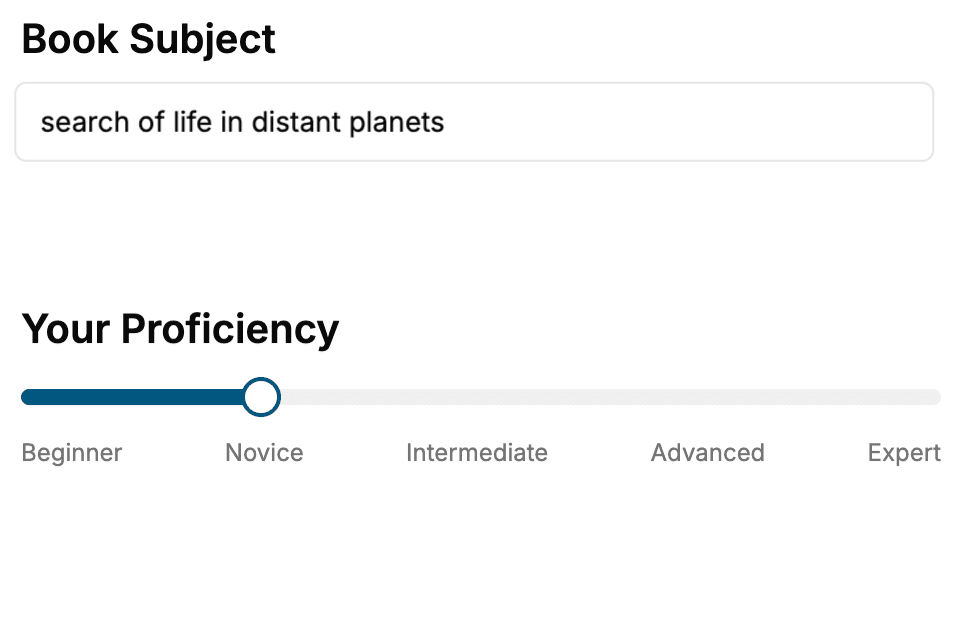
Select the focus of your Quantum Computing book and share your background
- 2. Personalize your book
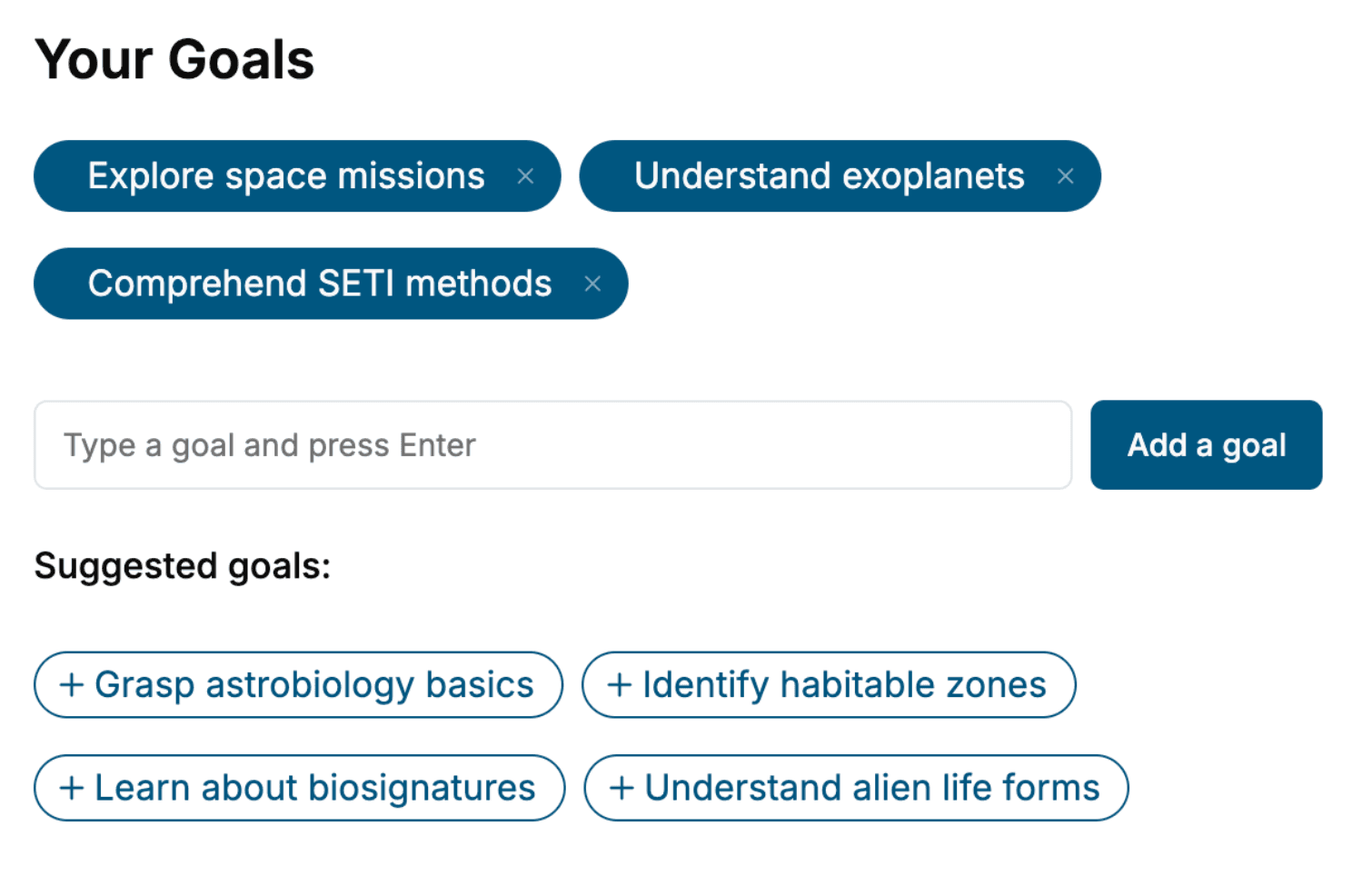
Specify your goals and choose sub-topics to include
- 3. Get your tailored book
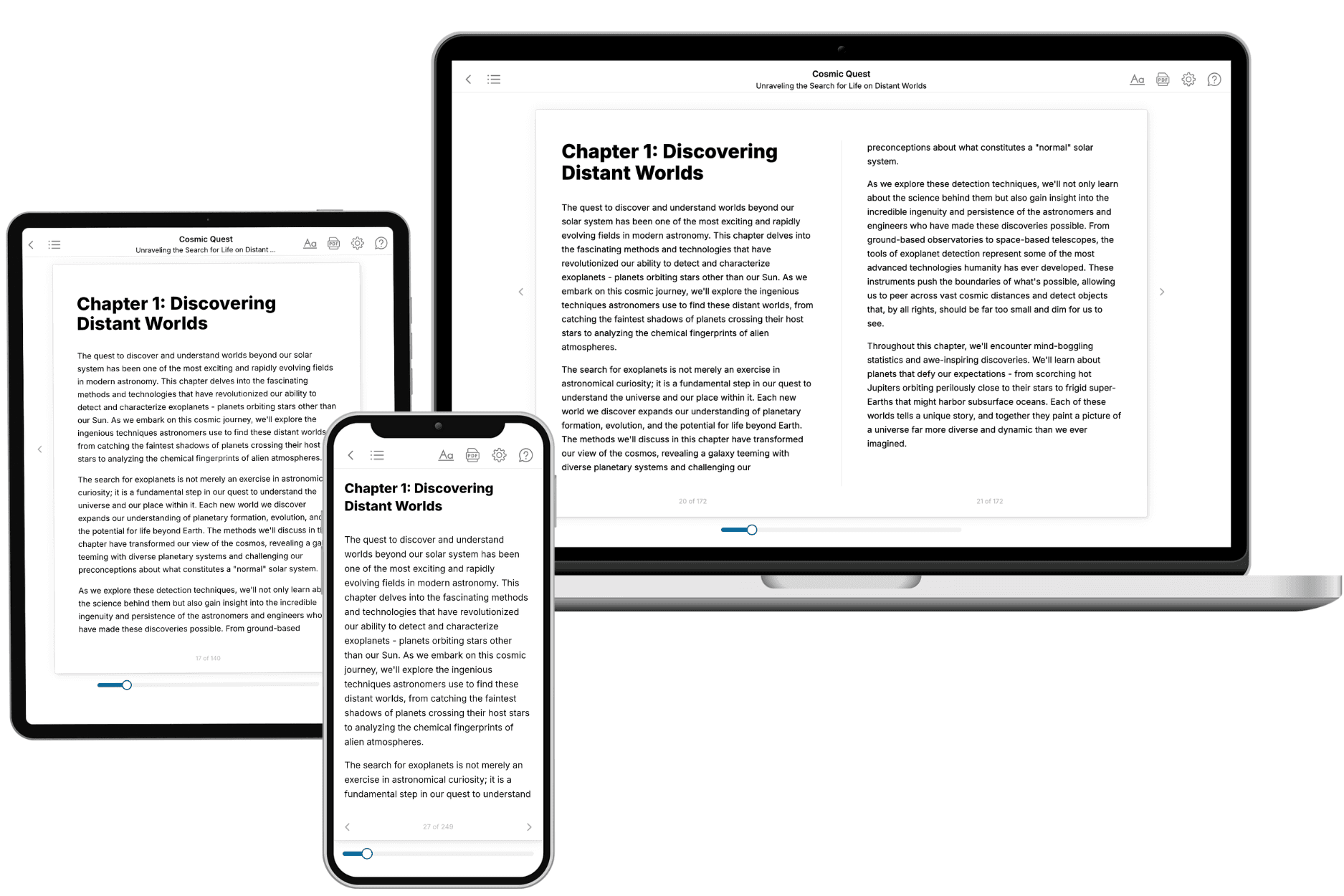
Your book is ready in 10 minutes. Read it online, download as EPUB or PDF, or send to Kindle.
Frequently asked questions
- What is TailoredRead?
TailoredRead creates complete, full-length nonfiction ebooks, written specifically for you. Tell us what you want to learn and why, and TailoredRead writes you a complete ebook on it, with charts, tables, and diagrams throughout. Read it online, on Kindle, or on any e-reader, or download it as a PDF or EPUB. Every book is written fresh the day you order it.
- How is the book tailored to me?
Before anything is written, you answer a few short questions about your goals, your background, and the topics you care about. Your book is then planned around your answers: written at your level, focused on your goals, and covering the topics you chose, instead of the one-size-fits-all book a store sells everyone.
- Will it read like generic AI content?
No. Your book isn't a chat transcript: it's planned chapter by chapter before a single word is written, told in a clear book voice, and explains ideas visually with charts, tables, and diagrams. After writing, every book goes through an editorial pass that polishes chapters so the book reads consistent from start to finish. Judge for yourself: browse thousands of sample books on our Explore Books page.
- How accurate is the content?
Our AI first checks whether your subject needs live research. Niche and fast-moving subjects are researched before writing, and the book plan and chapters are grounded in what it finds. After writing, every book goes through a quality pass that checks its facts and consistency, and researched books list their sources in a Notes section at the back.
- How long is the book?
You choose the length: Comprehensive (250-300 pages), Detailed (150-200 pages), Essential (70-100 pages), or Short (30-50 pages).
- Does the book include visuals?
Yes. Every book includes charts, tables, and diagrams: timelines, checklists, step-by-step guides, decision trees, comparison tables, matrices, and bar charts. A typical book includes dozens of these visual elements.
- Can I read it on Kindle? What formats can I download?
Yes. Every book can be read in our online reader or downloaded as a PDF or EPUB. The EPUB can be opened with Kindle, Apple Books, Kobo, and any e-reader. The Commercial and Author licenses also include an editable Word (DOCX) and Markdown download.
- How much does it cost?
About the price of a regular ebook. The exact price depends on your book's length and complexity, from $2 for the shortest books to $35 for the most comprehensive, and it's shown when you review your book, before you commit to anything. Each book is a one-time purchase, yours to keep, no subscription. Licenses that let you share, teach, or publish your book range from $35.99 to $49.99.
- Can I preview the book before purchasing?
Before you pay, you'll see what your book will cover: the title, a detailed description, the estimated length, and the complete chapter-by-chapter table of contents, so you know what you're getting before you decide. The full text itself is written after you purchase.
- How long does it take to create a book?
About 10 minutes. You can start reading the opening chapters while the rest is still being written.