Race to the Stars
How the Space Race Defined America's Cold War Identity
You'll gain a deeper appreciation for one of the most defining periods in American history as you explore how the Space Race fundamentally reshaped the United States during the Cold War.
284 pages16 chaptersOct 2, 2025United States History
About this book
This comprehensive examination reveals how competition with the Soviet Union drove unprecedented innovation, transformed American education and culture, and established the nation as a global technological leader. You'll discover the intricate connections between space exploration and Cold War strategy, understanding how rockets and satellites became weapons of prestige in an ideological battle that extended far beyond Earth's atmosphere. Through detailed analysis of key missions, technological breakthroughs, and political decisions, you'll see how the Space Race influenced everything from American classrooms to corporate boardrooms. The book illuminates the human stories behind the headlines, from the German scientists who helped build America's rocket program to the engineers and astronauts who turned science fiction into reality. You'll understand how this cosmic competition accelerated innovations that continue to shape modern life, from computer technology to advanced materials. By examining primary sources, declassified documents, and firsthand accounts, you'll develop a nuanced understanding of how the Space Race became both a symbol of American ingenuity and a catalyst for social and technological transformation that defined a generation.
Table of contents
- IntroductionThe Cold War Context, Space as the New Battlefield, America's Response to the Challenge, Framework for UnderstandingRead below
- Chapter 1: Origins of the CompetitionPost-War Tensions and Technological Rivalry, The German Rocket Legacy, Early Soviet Space Advances, American Complacency and Wake-Up Calls
- Chapter 2: The Sputnik ShockOctober 4, 1957: The Surprise That Changed Everything, American Public and Political Reaction, Media Coverage and National Soul-Searching, Immediate Political and Social Consequences
- Chapter 3: Creating NASA and the American ResponseOrganizational Challenges and Solutions, The Formation of NASA, Early Space Programs and Missions, Budget Battles and Political Support
- Chapter 4: Early Milestones and SetbacksAmerica's First Satellites, Preparing for Human Spaceflight, The Mercury Program Launch, Yuri Gagarin and American Determination
- Chapter 5: Kennedy's Moon CommitmentThe Political Calculation Behind the Moon Goal, The May 25, 1961 Speech to Congress, Building Public and Congressional Support, Initial Apollo Program Planning
- Chapter 6: The Technological RevolutionRocket Technology Development, Computer Miniaturization and Electronics, Advanced Materials and Manufacturing, Communication and Navigation Systems
- Chapter 7: The Gemini ProgramBridging Mercury and Apollo, Spacewalk Achievements and Challenges, Mastering Orbital Rendezvous, Long-Duration Flight Experience
- Chapter 8: Apollo Program DevelopmentSaturn Rocket Design and Testing, Command and Service Module Engineering, Lunar Module Innovation, Mission Planning and Procedures
- Chapter 9: The Apollo 1 Tragedy and RecoveryThe Fire and Its Investigation, Complete Safety System Overhaul, Program Delays and Redesign, Renewed National Commitment
- Chapter 10: Apollo Testing PhaseUnmanned Test Flights, Apollo 7: Return to Flight, Apollo 8: Journey to the Moon, Apollo 9 and 10: Final Preparations
- Chapter 11: The Moon Landing AchievementApollo 11 Launch and Journey, The Lunar Descent and Landing, First Steps on the Moon, Global Reaction and Impact
- Chapter 12: Cultural and Social TransformationScience and Mathematics Education Reform, Space in Popular Culture and Media, Inspiring a Generation of Scientists, Changing American Worldview
- Chapter 13: Industrial and Economic ImpactGrowth of the Aerospace Industry, Technology Transfer to Civilian Applications, Regional Economic Development, Creating an Innovation Ecosystem
- Chapter 14: Continuing Apollo MissionsApollo 12-14: Expanding Lunar Exploration, Apollo 15-17: Scientific Achievements, Apollo 13: Crisis and Recovery, Program Conclusion and Lessons Learned
- Chapter 15: Cold War Dynamics and DiplomacySpace Achievements as Propaganda, International Cooperation Opportunities, Apollo-Soyuz Test Project, Space Cooperation and Détente
- Chapter 16: Legacy and Long-term ImpactTechnological Heritage in Modern Life, Institutional and Organizational Changes, Scientific Knowledge and Methods, Impact on American National Identity
- ConclusionAssessing the Space Race's Success, Enduring Lessons for America
Introduction
On October 4, 1957, a small metallic sphere weighing just 183 pounds changed the course of American history forever. As Sputnik 1 orbited Earth every 96 minutes, its radio signals reached across continents and into American homes, carrying a message that shook the nation to its core: the Soviet Union had beaten America into space. This moment marked the beginning of what would become known as the Space Race, a competition that would fundamentally reshape American identity, priorities, and capabilities over the following decades. The beeping satellite represented more than a technological achievement; it symbolized a direct challenge to American technological supremacy and global leadership during the height of the Cold War.
The Space Race was never simply about rockets, satellites, or even reaching the Moon. It was a manifestation of the broader ideological struggle between two superpowers, each seeking to prove the superiority of their political and economic systems. For Americans, space exploration became a matter of national survival, forcing the country to confront uncomfortable truths about its educational system, scientific capabilities, and organizational structures. The competition with the Soviet Union would drive unprecedented changes in how America approached innovation, funded research, and coordinated massive technological projects. These transformations extended far beyond the aerospace industry, touching every aspect of American society from elementary classrooms to corporate boardrooms.
Understanding the Space Race requires recognizing its dual nature as both a scientific endeavor and a geopolitical weapon. Every satellite launch, every astronaut mission, and every technological breakthrough carried profound implications for America's standing in the world. The race to the stars became a race for hearts and minds globally, as developing nations watched to see which superpower could deliver on its promises of technological progress and human advancement. This cosmic competition would ultimately demonstrate America's capacity for sustained national focus and resource mobilization when faced with an existential challenge to its global leadership position.
The Cold War Context
The Space Race emerged from the unique circumstances of the Cold War, a period of intense ideological competition between the United States and Soviet Union that began immediately after World War II. By the mid-1950s, both superpowers possessed nuclear weapons capable of unprecedented destruction, creating a delicate balance of terror that made direct military confrontation unthinkable. This reality forced both nations to seek alternative venues for demonstrating their superiority, leading to proxy conflicts, propaganda campaigns, and technological competitions. Space exploration offered the perfect arena for this rivalry, combining cutting-edge science with powerful symbolic value while avoiding the immediate risk of nuclear escalation.
The ideological dimensions of the Cold War gave special significance to technological achievements in space. The Soviet Union promoted its communist system as the inevitable future of human civilization, pointing to rapid industrialization and scientific progress as evidence of socialism's superiority over capitalism. American leaders, meanwhile, championed democratic values and free-market economics as the foundation for human progress and innovation. When the Soviets achieved early victories in space, they weren't just demonstrating technical competence; they were providing apparent proof that their system could outperform American democracy in the most advanced fields of human endeavor.
The global audience for this competition extended far beyond the two superpowers themselves. Dozens of newly independent nations in Africa, Asia, and Latin America were choosing between competing models of development and governance. These countries watched the Space Race closely, viewing technological achievements as indicators of which superpower could better deliver on promises of modernization and progress. For American policymakers, losing the space competition meant potentially losing influence over these crucial swing nations in the broader Cold War struggle. The stakes were nothing less than the future alignment of the developing world.
Military considerations also shaped the Space Race's importance within Cold War strategy. The same rocket technology that could launch satellites into orbit could also deliver nuclear warheads across continents. Both superpowers understood that advances in space technology directly translated into enhanced military capabilities, particularly in the realm of intercontinental ballistic missiles. This dual-use nature of space technology meant that every Soviet space achievement represented not just a propaganda victory but also a potential military threat that demanded an American response.
The psychological warfare aspects of the Space Race cannot be understated in understanding its Cold War context. Each successful mission generated headlines worldwide, influencing public opinion and government policies across the globe. The Soviets skillfully leveraged their early space achievements to promote their ideology and attract allies, while American failures became sources of international embarrassment and domestic criticism. This psychological dimension transformed space exploration from a scientific pursuit into a critical front in the broader battle for global influence and ideological supremacy.
Economic competition also drove the Space Race within the Cold War framework. Both superpowers sought to demonstrate that their economic systems could generate the resources and innovation necessary for the most ambitious technological projects in human history. The massive investments required for space exploration served as tests of each nation's ability to mobilize resources, coordinate complex projects, and sustain long-term commitments to technological advancement. Success in space became a proxy measure for overall economic and organizational capability in the eyes of the world.
The timing of the Space Race coincided with a period of rapid decolonization and emerging nationalism worldwide. Many newly independent countries were seeking models for rapid modernization and technological development. The superpower that could demonstrate superior capabilities in space exploration would likely attract more followers and allies among these developing nations. This reality gave the Space Race implications that extended far beyond the immediate competition between America and the Soviet Union, affecting the global balance of power for decades to come.
Intelligence gathering represented another crucial Cold War dimension of space competition. Reconnaissance satellites offered unprecedented capabilities for monitoring military activities, troop movements, and weapons development across vast distances. The nation that achieved superiority in space-based intelligence gathering would possess significant advantages in the broader Cold War struggle. This intelligence aspect of space technology added urgency to the competition and justified massive government investments in space programs as matters of national security rather than mere scientific curiosity.
Space as the New Battlefield
Space represented the ultimate high ground in Cold War competition, offering strategic advantages that neither superpower could afford to concede to their rival. Unlike terrestrial battlefields constrained by geography and national boundaries, space provided unlimited room for expansion and development. The nation that controlled space-based assets could potentially dominate global communications, weather monitoring, navigation systems, and military reconnaissance. This reality transformed space from a realm of scientific curiosity into a critical domain for national security and global influence, making the Space Race a matter of survival rather than prestige.
The military applications of space technology became apparent almost immediately after Sputnik's launch. Intercontinental ballistic missiles and space launch vehicles shared virtually identical technology, meaning that advances in one area directly benefited the other. The Soviet Union's ability to place Sputnik in orbit demonstrated their capability to deliver nuclear warheads to any target on Earth, fundamentally altering the strategic balance of the Cold War. American military planners recognized that falling behind in space technology could leave the United States vulnerable to Soviet nuclear blackmail and strategic intimidation.
Reconnaissance satellites emerged as game-changing weapons in the intelligence war between the superpowers. These orbital platforms could photograph military installations, monitor troop movements, and track weapons development with unprecedented detail and frequency. The Corona program, America's first successful spy satellite system, provided crucial intelligence about Soviet military capabilities that helped prevent miscalculations and reduce the risk of nuclear war[1]. The ability to verify arms control agreements through satellite monitoring would later become essential for diplomatic progress between the superpowers.
Communication satellites revolutionized global information flow and created new opportunities for both cooperation and competition. These orbital platforms could relay television broadcasts, telephone calls, and data transmissions across vast distances instantaneously. The superpower that controlled the most advanced communication satellite networks would possess significant advantages in:
- Coordinating military operations across global theaters
- Influencing international public opinion through media broadcasts
- Maintaining secure communications with allies and intelligence assets
- Providing commercial services that generated revenue and political influence
Weather monitoring from space offered both civilian benefits and military advantages that neither superpower could ignore. Accurate weather forecasting was essential for agricultural planning, disaster preparedness, and economic development in developing nations seeking superpower assistance. Military operations also depended heavily on weather intelligence, from planning air strikes to coordinating naval movements. The nation that could provide the most accurate and comprehensive weather data would gain significant influence with allies and neutral countries worldwide.
Navigation satellites represented another crucial battlefield in space competition. These systems could guide ships, aircraft, and eventually ground vehicles with unprecedented precision, offering enormous advantages for both military and civilian applications. The Global Positioning System (GPS) that Americans take for granted today originated from military requirements during the Cold War era. Early navigation satellites gave their operators significant advantages in:
- Guiding ballistic missiles to their targets with improved accuracy
- Coordinating complex military operations across multiple theaters
- Supporting naval operations in remote ocean areas
- Enabling precise mapping and surveying for development projects
The propaganda value of space achievements created another dimension of competition that extended far beyond technical capabilities. Each successful satellite launch, space mission, or technological breakthrough generated worldwide media coverage that influenced public opinion and government policies globally. The Soviets understood this dynamic from the beginning, timing their space achievements for maximum propaganda impact and carefully controlling information about their program to maintain an aura of technological superiority. American space failures, by contrast, occurred in full view of global media, creating additional pressure for success.
Scientific research conducted in space offered long-term advantages that both superpowers recognized as crucial for future technological development. Experiments in zero gravity, observations of Earth's atmosphere and magnetic field, and studies of cosmic radiation provided knowledge that could lead to breakthrough technologies in materials science, electronics, and energy production. The nation that conducted the most advanced space-based research would likely maintain technological leadership in multiple fields for decades to come.
The economic implications of space technology created additional competitive pressures between the superpowers. Advanced space capabilities could generate significant revenue through commercial satellite services, technology licensing, and equipment sales to other nations. More importantly, the technological spillovers from space programs could enhance competitiveness in civilian industries ranging from electronics to materials manufacturing. The superpower that achieved space technology leadership would likely dominate high-technology markets for the foreseeable future, providing both economic benefits and political influence worldwide.
America's Response to the Challenge
The American response to Soviet space achievements revealed both the strengths and weaknesses of democratic decision-making under pressure. Unlike the Soviet system, which could make rapid decisions in secret and implement them without public debate, the United States had to build consensus among multiple government agencies, congressional committees, and public constituencies. This process initially slowed the American response but ultimately created more sustainable and innovative approaches to space exploration. The democratic nature of American society also meant that space program failures occurred in full public view, creating additional pressure for success while fostering transparency and accountability.
President Dwight Eisenhower's initial reaction to Sputnik reflected the complex political calculations facing American leaders during the early Space Race. Eisenhower understood the military implications of Soviet space capabilities but worried about the costs and risks of an all-out space competition. His administration's measured response frustrated many Americans who demanded immediate and dramatic action to counter Soviet achievements. This tension between careful planning and public demands for rapid response would characterize American space policy throughout the early years of the competition.
The creation of NASA in 1958 represented a fundamental shift in how America organized and funded large-scale technological projects. Unlike previous government research efforts that were scattered across military services and civilian agencies, NASA consolidated space exploration under unified leadership with clear objectives and substantial resources. This organizational innovation became a model for future American responses to technological challenges, demonstrating the effectiveness of focused, well-funded civilian agencies in achieving ambitious national goals. The NASA approach would later influence the organization of other major government initiatives from environmental protection to biomedical research.
Educational reform became a crucial component of America's response to the space challenge, as policymakers recognized that long-term technological leadership required fundamental improvements in science and mathematics education. The National Defense Education Act of 1958 provided federal funding for educational programs that had previously been considered state and local responsibilities. This legislation marked a turning point in American education policy, establishing the principle that national security interests justified federal intervention in classroom instruction. The emphasis on science and mathematics education would produce a generation of Americans better prepared for careers in technology and engineering.
Industrial mobilization for the Space Race required unprecedented cooperation between government agencies, private corporations, and academic institutions. The Apollo program alone involved over 400,000 people working for NASA and its contractors, representing one of the largest peacetime mobilizations in American history[2]. This massive undertaking demonstrated America's capacity for coordinating complex projects across multiple organizations and geographic regions. The management techniques and quality control procedures developed for the space program would later be adopted by other industries, contributing to American competitiveness in global markets.
Congressional support for the space program reflected both partisan politics and genuine national security concerns. Democrats criticized the Eisenhower administration for allowing the Soviet Union to achieve space superiority, while Republicans worried about the costs and government expansion associated with massive space spending. However, both parties recognized that American credibility and security were at stake in the space competition. The bipartisan support that eventually emerged for NASA and the Apollo program demonstrated American democracy's ability to unite behind national priorities when faced with external challenges.
Public opinion played a crucial role in shaping America's space response, as polling data showed strong support for increased space spending after Sputnik. Americans were genuinely shocked by Soviet space achievements and demanded that their government take decisive action to restore American technological leadership. This public pressure gave political leaders the mandate they needed to justify massive investments in space exploration. The democratic nature of American society meant that sustained public support was essential for long-term space program success, creating incentives for transparency and public engagement that distinguished the American approach from Soviet secrecy.
Military leaders initially resisted the creation of a civilian space agency, preferring to maintain control over space technology development within the Defense Department. However, the decision to establish NASA as a civilian organization ultimately proved advantageous for American space efforts. The civilian nature of NASA allowed for greater international cooperation, more open sharing of scientific results, and better public relations than would have been possible with a military-dominated program. This approach helped America build alliances and partnerships that enhanced its space capabilities while countering Soviet propaganda about American militarism.
The American response to the space challenge also involved significant changes in government procurement and contracting procedures. Traditional military contracting emphasized lowest-cost bidders and detailed specifications, approaches that proved inadequate for cutting-edge space technology development. NASA pioneered new contracting methods that emphasized innovation, reliability, and performance over cost minimization. These procurement innovations would later be adopted by other government agencies and contributed to American leadership in high-technology industries throughout the Cold War period and beyond.
Framework for Understanding
This book examines the Space Race through multiple interconnected lenses that reveal its profound impact on American society, politics, and identity during the Cold War era. Rather than focusing solely on technical achievements or political decisions, the analysis integrates technological, social, economic, and cultural dimensions to provide a comprehensive understanding of how space exploration transformed America. The framework recognizes that the Space Race was simultaneously a scientific endeavor, a geopolitical competition, an economic stimulus, and a cultural phenomenon that reshaped American values and aspirations for generations.
The chronological structure of the book follows the major phases of the Space Race while highlighting the interconnections between different aspects of the competition. Beginning with the post-World War II origins of space technology and continuing through the Apollo program's conclusion, each chapter examines specific events and developments within their broader historical context. This approach allows readers to understand both the immediate causes and long-term consequences of key decisions and achievements. The narrative demonstrates how early setbacks and successes shaped later developments, creating a path-dependent process that influenced American space policy for decades.
Technological analysis throughout the book emphasizes the practical challenges and innovative solutions that characterized American space development. Rather than treating technology as an abstract force, the discussion focuses on specific engineering problems, design decisions, and manufacturing processes that determined mission success or failure. This approach reveals how technological constraints shaped political decisions and how political priorities influenced technical choices. The analysis also examines the spillover effects of space technology development on other industries and civilian applications, demonstrating the broader economic impact of space investment.
Political and institutional analysis examines how the Space Race influenced American government organization, decision-making processes, and policy priorities. The creation of NASA represented just one example of institutional innovation driven by space competition. The book explores how space program requirements led to new forms of government-industry cooperation, changes in federal research funding, and modifications to educational policy. These institutional changes had lasting effects that extended far beyond the space program itself, influencing how America approached other technological challenges and national priorities.
Social and cultural analysis reveals how the Space Race affected American identity, values, and aspirations during a crucial period of national development. The competition with the Soviet Union forced Americans to confront questions about their educational system, technological capabilities, and national priorities. Space exploration became a source of national pride and international prestige, but it also highlighted social inequalities and resource allocation debates. The book examines how different groups within American society responded to the space challenge and how their participation shaped program development and outcomes.
Economic analysis throughout the book quantifies the costs and benefits of space exploration while examining its impact on American industrial development and competitiveness. The Space Race required unprecedented peacetime government investment in research and development, creating new industries and transforming existing ones. The analysis examines both direct economic effects, such as employment and industrial growth in aerospace regions, and indirect effects, such as technological spillovers and enhanced competitiveness in global markets. This economic perspective helps explain why political support for space exploration persisted despite its enormous costs.
International relations analysis places the Space Race within the broader context of Cold War competition and alliance management. American space achievements influenced relationships with allies, neutral nations, and even adversaries throughout the competition. The book examines how space diplomacy complemented and sometimes conflicted with other aspects of American foreign policy. The analysis also explores how international cooperation in space exploration evolved from initial competition to eventual collaboration, providing lessons for contemporary international relations.
The methodological approach combines primary source analysis with secondary scholarship to provide authoritative and nuanced interpretations of key events and developments. Declassified government documents, congressional hearings, contemporary media coverage, and participant memoirs provide insights into decision-making processes and contemporary perspectives. This primary source material is supplemented by scholarly analysis that places events within broader historical patterns and theoretical frameworks. The combination of contemporary sources and historical perspective allows for balanced assessment of both achievements and failures during the Space Race era.
The book's analytical framework recognizes that the Space Race's significance extends far beyond its immediate Cold War context. The institutional innovations, technological developments, and cultural changes that emerged from space competition continued to influence American society long after the Apollo program ended. Understanding these lasting effects requires examining not just what happened during the Space Race, but how those events shaped subsequent American responses to technological challenges, international competition, and national goal-setting. This long-term perspective reveals the Space Race's enduring relevance for contemporary American policy and identity.
This is the end of the free sample. The full book has 16 chapters.
Want this book written for you?
Tell us your goals and background, and get your own version of this book, tailored by AI to you.


Benefits of AI-tailored books
- Read one book, not ten:
- all the United States History knowledge you need, gathered into a single book.
- Save days of learning:
- tell us your goals, choose your topics, and the whole book is built around them.
- Learn effortlessly:
- United States History book written for your specific background and expertise.
- Understand at a glance:
- includes charts, tables, timelines, checklists, decision trees, and more.
- Stay current:
- written the day you order it, not years ago.
- Trust what you read:
- every book is checked for accuracy, with real research when your subject needs it.
Create your unique book in 3 steps
- 1. Select your focus
Select the focus of your United States History book and share your background
- 2. Personalize your book
Specify your goals and choose sub-topics to include
- 3. Get your tailored book
Your book is ready in 10 minutes. Read it online, download as EPUB or PDF, or send to Kindle.


Frequently asked questions
- What is TailoredRead?
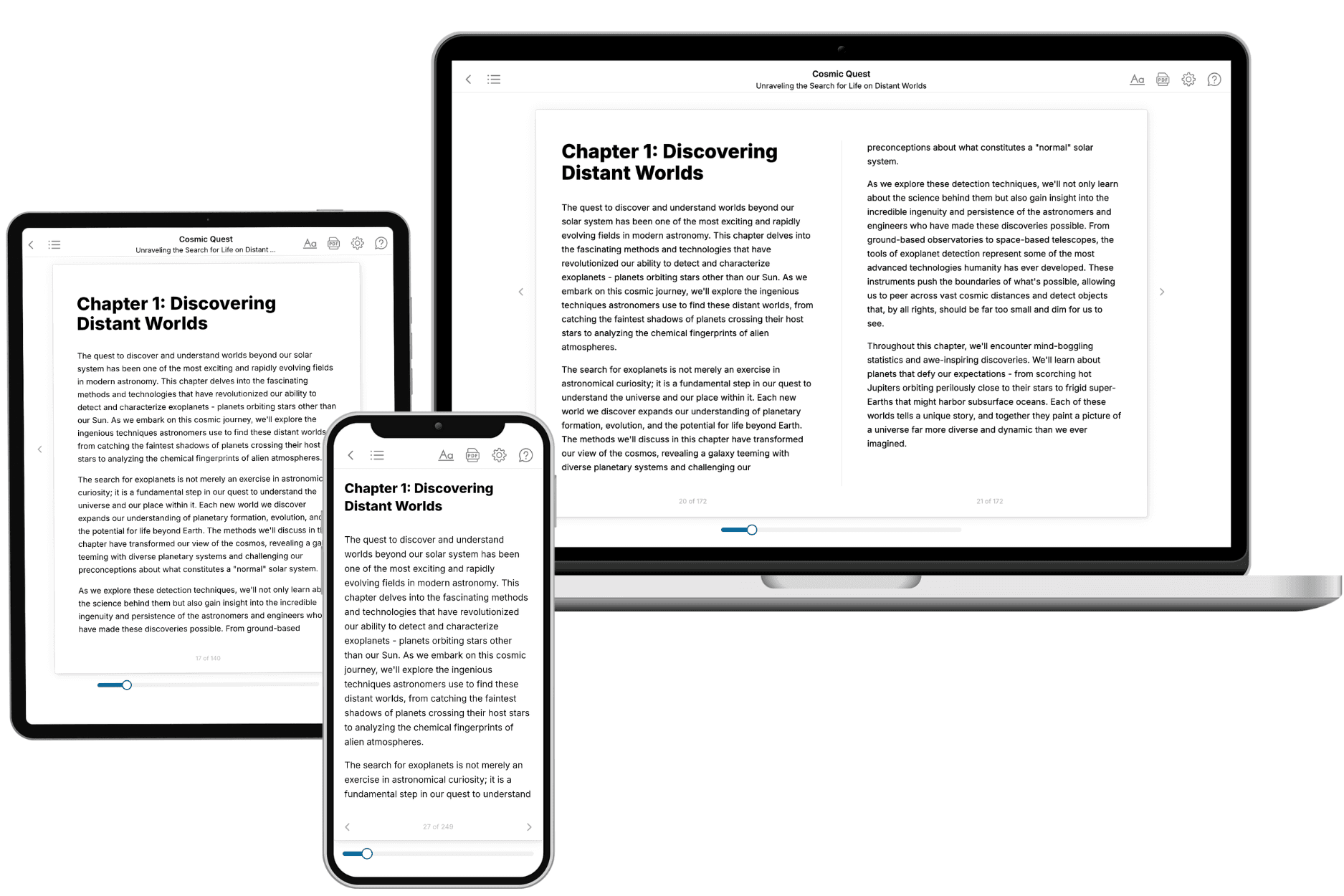
TailoredRead creates complete, full-length nonfiction ebooks, written specifically for you. Tell us what you want to learn and why, and TailoredRead writes you a complete ebook on it, with charts, tables, and diagrams throughout. Read it online, on Kindle, or on any e-reader, or download it as a PDF or EPUB. Every book is written fresh the day you order it.
- How is the book tailored to me?
Before anything is written, you answer a few short questions about your goals, your background, and the topics you care about. Your book is then planned around your answers: written at your level, focused on your goals, and covering the topics you chose, instead of the one-size-fits-all book a store sells everyone.
- Will it read like generic AI content?
No. Your book isn't a chat transcript: it's planned chapter by chapter before a single word is written, told in a clear book voice, and explains ideas visually with charts, tables, and diagrams. After writing, every book goes through an editorial pass that polishes chapters so the book reads consistent from start to finish. Judge for yourself: browse thousands of sample books on our Explore Books page.
- How accurate is the content?
Our AI first checks whether your subject needs live research. Niche and fast-moving subjects are researched before writing, and the book plan and chapters are grounded in what it finds. After writing, every book goes through a quality pass that checks its facts and consistency, and researched books list their sources in a Notes section at the back.
- How long is the book?
You choose the length: Comprehensive (250-300 pages), Detailed (150-200 pages), Essential (70-100 pages), or Short (30-50 pages).
- Does the book include visuals?
Yes. Every book includes charts, tables, and diagrams: timelines, checklists, step-by-step guides, decision trees, comparison tables, matrices, and bar charts. A typical book includes dozens of these visual elements.
- Can I read it on Kindle? What formats can I download?
Yes. Every book can be read in our online reader or downloaded as a PDF or EPUB. The EPUB can be opened with Kindle, Apple Books, Kobo, and any e-reader. The Commercial and Author licenses also include an editable Word (DOCX) and Markdown download.
- How much does it cost?
About the price of a regular ebook. The exact price depends on your book's length and complexity, from $2 for the shortest books to $35 for the most comprehensive, and it's shown when you review your book, before you commit to anything. Each book is a one-time purchase, yours to keep, no subscription. Licenses that let you share, teach, or publish your book range from $35.99 to $49.99.
- Can I preview the book before purchasing?
Before you pay, you'll see what your book will cover: the title, a detailed description, the estimated length, and the complete chapter-by-chapter table of contents, so you know what you're getting before you decide. The full text itself is written after you purchase.
- How long does it take to create a book?
About 10 minutes. You can start reading the opening chapters while the rest is still being written.