Raymarching Optimization Mastery
Advanced Techniques for High-Performance Computer Graphics Development
You'll navigate the complex landscape of raymarching optimization, starting with a deep understanding of why performance matters and where computational bottlenecks actually occur in your rendering pipeline.
191 pages9 chaptersMar 15, 2026Computer Graphics Development
About this book
Through systematic analysis and practical techniques, you'll learn to identify inefficiencies in your distance field calculations, implement spatial acceleration structures that dramatically reduce ray iterations, and apply adaptive algorithms that maintain visual quality while slashing frame times. You'll discover how to leverage GPU architecture effectively, optimize memory access patterns, and integrate temporal techniques that reuse information across frames. By the end, you'll have mastered both standalone optimization strategies and hybrid approaches that combine raymarching with traditional rendering methods. Whether you're developing real-time graphics applications, game engines, or visual effects systems, these techniques will enable you to achieve professional-grade performance and handle increasingly complex scenes without sacrificing quality or responsiveness.
Table of contents
- IntroductionWhy Raymarching Optimization Matters, The Performance Reality: From Theory to Practice, Your Optimization RoadmapRead below
- Chapter 1: Raymarching Fundamentals and Performance BaselinesCore Raymarching Concepts, Understanding Performance Metrics and Bottlenecks, Establishing Your Performance Baseline
- Chapter 2: Distance Field Optimization StrategiesDesigning Efficient Distance Functions, Analytical Simplification and Approximation, Combining and Composing Distance Fields, Precomputation and Caching Strategies
- Chapter 3: Spatial Acceleration StructuresBounding Volume Hierarchies for Raymarching, Octree Structures and Traversal, Grid-Based Acceleration and Voxel Techniques
- Chapter 4: Adaptive Step Sizing and Ray Marching AlgorithmsAdaptive Step Size Calculation, Convergence Strategies and Early Termination, Maintaining Visual Quality During Optimization
- Chapter 5: GPU Architecture and Memory OptimizationUnderstanding GPU Memory Hierarchy, Maximizing Memory Bandwidth Efficiency, Cache-Aware Algorithm Design, Minimizing Warp Divergence and Branch Overhead
- Chapter 6: Temporal Coherence and Frame ReuseFrame Reprojection and Temporal Reuse, History Buffers and Temporal Filtering, Motion Vector Generation and Application
- Chapter 7: Hybrid Rendering ApproachesIntegrating Raymarching with Rasterization, Screen-Space Raymarching and Deferred Rendering, Selective Raymarching for Complex Geometry
- Chapter 8: Profiling, Benchmarking, and Performance AnalysisEssential Profiling Tools and Techniques, Identifying True Performance Bottlenecks, Rigorous Benchmarking Methodology
- Chapter 9: Real-World Optimization Case StudiesOptimizing Complex Procedural Scenes, Real-Time Interactive Applications, Production Pipeline Integration
- ConclusionCore Optimization Principles to Remember, Building a Culture of Performance Excellence
- Appendix: Quick Reference and ResourcesAlgorithm Reference Guide, Further Reading and Research
Introduction
Raymarching is one of the most elegant techniques in computer graphics. With a surprisingly compact set of mathematical tools, you can render complex organic shapes, infinite procedural worlds, volumetric fog, and physically plausible lighting effects that would be extraordinarily difficult to achieve with traditional polygon-based rendering. Shadertoy is full of stunning examples built from just a few hundred lines of shader code. The technique has a certain magic to it, and that magic is part of why so many graphics developers fall in love with it early in their careers.
But magic has a cost. Every pixel on screen may require dozens or even hundreds of distance function evaluations before a ray finds a surface or exits the scene. Multiply that by a 1920x1080 framebuffer and you are looking at hundreds of millions of function calls per frame. On a modern GPU running at 60 frames per second, that budget evaporates fast. What works beautifully in a Shadertoy demo running at a leisurely 20 frames per second becomes completely impractical the moment you need it inside a real-time game engine or an interactive application with strict latency requirements.
This book exists because the gap between "raymarching that works" and "raymarching that performs" is wide, and crossing it requires a systematic understanding of where time actually goes. Intuition is a poor guide here. Developers routinely optimize the wrong things, spending hours tuning distance functions while the real bottleneck sits in memory access patterns or warp divergence. The techniques in this book are designed to give you a clear, structured path from a working raymarcher to a fast one, grounded in how GPUs actually behave and how rendering pipelines actually operate.
Whether you are building a game, a real-time visualization tool, a visual effects pipeline, or just pushing the boundaries of what interactive graphics can do, the principles here apply. The chapters ahead cover everything from foundational performance measurement to advanced temporal reuse strategies, spatial acceleration structures, and hybrid rendering approaches that combine raymarching with traditional rasterization. Each technique is presented with concrete implementation guidance, not just theory. By the time you reach the final chapter, you will have a complete toolkit for diagnosing performance problems and solving them methodically.
Why Raymarching Optimization Matters
The stakes for performance in real-time graphics are unusually high compared to most software domains. A slow database query might add a few hundred milliseconds to a web request. A slow raymarcher can drop your frame rate from 60 fps to 8 fps in a single scene transition, making an application feel completely broken. Users perceive frame rates below roughly 30 fps as noticeably choppy, and competitive games or VR applications require 60 to 90 fps or higher to feel acceptable.[1] The margin for error is thin.
Raymarching is computationally expensive by nature, but the degree of that expense varies enormously depending on how it is implemented. Consider a simple scene with a few geometric primitives rendered using a naive raymarcher with a fixed step size. That same scene, rendered with adaptive step sizing and a bounding volume hierarchy to skip empty space, can run three to ten times faster with no visible quality difference. The optimization is not cosmetic. It is the difference between a technique that is usable in production and one that is confined to offline demos.
The performance gap also widens as scenes grow more complex. A raymarcher that handles five primitives adequately may completely collapse when you add procedural terrain, volumetric clouds, and dynamic lighting. Without proper optimization strategies, complexity scales badly. With the right techniques, you can add significant scene complexity while keeping frame times under control. This scalability is what separates professional-grade implementations from hobbyist ones.
There is also a hardware dimension to consider. GPU architectures have evolved rapidly, and modern GPUs are extraordinarily powerful when their strengths are exploited correctly. They are also surprisingly easy to bottleneck. Memory bandwidth limitations, cache misses, and thread divergence can each independently destroy performance even when raw compute capacity is plentiful. Understanding these constraints is not optional for serious graphics work. It is foundational.
Beyond raw performance numbers, optimization matters for accessibility. A well-optimized raymarcher can run on mid-range consumer hardware, opening your application to a much wider audience. A poorly optimized one may require a high-end GPU just to reach playable frame rates, which is a significant commercial and creative limitation. Optimization is not just a technical concern. It is a product decision with real consequences for who can use what you build.
Finally, optimization forces clarity. When you profile a raymarcher and discover that 70% of frame time is spent in a single distance function, you learn something concrete about your scene design. When you restructure your spatial data to improve cache coherence and see a 40% speedup, you understand your hardware more deeply. The process of optimization is also a process of understanding, and that understanding compounds over time into genuine expertise.
The Performance Reality: From Theory to Practice
There is a persistent gap between how raymarching is taught and how it actually behaves in production. Most introductory resources focus on correctness: how to write a distance function for a sphere, how to compute surface normals, how to implement basic lighting. These are essential foundations. But they leave out the performance story almost entirely, and that omission creates a false impression that a working raymarcher is a production-ready one.
The reality is that naive raymarching implementations share several common performance failure modes. Understanding these failure modes is the first step toward fixing them. The most common ones are:
- Excessive ray iterations: Fixed step sizes that are too small cause rays to take far more steps than necessary to reach a surface.
- Expensive distance functions: Distance functions that use trigonometric operations, square roots, or deeply nested conditionals inside the inner march loop are evaluated millions of times per frame.
- No spatial culling: Every ray evaluates the full scene distance function regardless of whether any geometry is nearby, wasting enormous amounts of compute on empty space.
- Poor memory access patterns: Texture lookups and buffer reads that thrash the GPU cache cause memory stalls that dwarf the cost of the actual computation.
- Warp divergence: Rays that terminate at different iteration counts within the same GPU warp force the hardware to serialize execution, eliminating the parallelism that makes GPUs fast.
Each of these failure modes has a corresponding solution, and those solutions are the core subject of this book. But it is worth pausing on the scale of the problem. A typical 1080p frame contains roughly 2 million pixels. If each pixel requires an average of 64 ray march steps, and each step evaluates a distance function that takes 20 GPU clock cycles, you are looking at approximately 2.56 billion clock cycles per frame just for the march loop. At 1.5 GHz shader clock speed, that is about 1.7 seconds per frame, or less than 1 fps. This is not a hypothetical. It is a realistic description of what an unoptimized raymarcher looks like on complex scenes.
Contrast that with an optimized implementation. Adaptive step sizing can reduce average iteration counts from 64 to 20 or fewer. Spatial acceleration structures can skip 60 to 80 percent of distance function evaluations entirely. Simplified distance functions can cut per-evaluation cost by half. Combine these improvements and the same scene that ran at under 1 fps can reach 30 fps or higher. That is not an exaggeration. These are the kinds of gains that systematic optimization produces.
A real-world example: a procedural cave scene with fractal noise terrain, volumetric fog, and ambient occlusion ran at approximately 4 fps on a mid-range GPU using a naive implementation. After applying adaptive step sizing, bounding volume culling, and a simplified noise approximation for distant geometry, the same scene ran at 28 fps with no perceptible visual difference at normal viewing distances. The optimization work took roughly two days of focused effort.
The practical lesson here is that optimization is not about squeezing out the last few percent of performance through micro-optimizations. It is about identifying the dominant cost and attacking it directly. In raymarching, the dominant costs are almost always iteration count and distance function complexity. Everything else is secondary until those are under control.
It is also worth being honest about what optimization cannot do. Some scenes are genuinely too complex for real-time raymarching at high resolutions, regardless of how well the code is written. Knowing when to use a hybrid approach, combining raymarching with rasterization for different parts of the scene, is as important as knowing how to optimize a pure raymarcher. This book covers both, because production graphics work requires pragmatism alongside technical depth.
One more practical reality deserves mention: profiling is non-negotiable. Developers who optimize without profiling first routinely spend time on the wrong problems. GPU profiling tools like NVIDIA Nsight, AMD Radeon GPU Profiler, and RenderDoc provide precise, actionable data about where time is actually going. Chapter 8 covers these tools in depth. For now, the key principle is simple: measure first, optimize second, measure again to confirm the improvement.
The performance reality of raymarching is demanding but not discouraging. The techniques exist to make it fast. The hardware is capable of running it well. What is required is a systematic approach, a willingness to measure carefully, and the knowledge to apply the right optimization at the right level of the pipeline. That is exactly what this book provides.
Your Optimization Roadmap
This book is structured as a progressive journey from foundations to advanced techniques. Each chapter builds on the previous ones, but the chapters are also designed to be useful as standalone references once you have read through the book once. Here is a clear picture of what each chapter covers and how the pieces fit together.
Chapter 1: Raymarching Fundamentals and Performance Baselines establishes the shared vocabulary and conceptual foundation for everything that follows. Even if you are already comfortable with raymarching basics, this chapter is worth reading because it frames those basics in performance terms. You will learn how to measure frame time, GPU utilization, and iteration counts, and how to establish a reproducible performance baseline before making any changes. Without a baseline, you cannot know whether your optimizations are actually working.
Chapter 2: Distance Field Optimization Strategies dives into the heart of raymarching performance. Distance functions are evaluated more times per frame than any other piece of code in your renderer, so even small improvements here have outsized impact. You will learn how to design efficient distance functions from the ground up, how to apply analytical simplifications that reduce instruction counts without changing visual output, and how to use precomputation and caching to avoid redundant work. Specific techniques include:
- Replacing expensive operations like
sqrtandatan2with cheaper approximations where precision is not critical - Using level-of-detail strategies to simplify distance functions for distant geometry
- Precomputing signed distance fields into 3D textures for static scene elements
- Combining multiple primitives efficiently using smooth minimum functions
Chapter 3: Spatial Acceleration Structures addresses the problem of empty space traversal. A significant fraction of ray march steps in most scenes are wasted on regions that contain no geometry. Bounding volume hierarchies, octrees, and grid-based acceleration structures all solve this problem in different ways, with different tradeoffs for construction cost, traversal overhead, and memory usage. You will learn when to use each structure and how to implement them in a GPU-friendly way that avoids the cache and divergence problems that naive implementations introduce.
Chapter 4: Adaptive Step Sizing and Ray Marching Algorithms covers the algorithms that control how rays move through the scene. The standard sphere tracing algorithm is already adaptive in a basic sense, but there is significant room for improvement. Enhanced step size heuristics, overrelaxation techniques, and early termination strategies can dramatically reduce iteration counts. You will also learn how to handle the tricky cases where aggressive step sizing causes visual artifacts, and how to tune the tradeoff between speed and quality for different scene types.
Chapter 5: GPU Architecture and Memory Optimization shifts focus from algorithm design to hardware behavior. Understanding how GPU memory hierarchies work, how cache lines are loaded and evicted, and how warp divergence affects throughput is essential for writing shaders that actually run fast on real hardware. This chapter explains these concepts clearly and connects them to concrete coding practices. You will learn how to structure your data layouts, texture formats, and access patterns to maximize cache hit rates and minimize memory stalls.
Chapter 6: Temporal Coherence and Frame Reuse introduces a powerful class of techniques that exploit the fact that consecutive frames in an animation or interactive application are usually very similar. By reprojecting information from previous frames and filtering it intelligently, you can effectively render at a fraction of the full resolution and reconstruct high-quality output. Techniques like temporal anti-aliasing, checkerboard rendering, and history buffer accumulation are covered in detail, along with the motion vector generation that makes them work correctly during camera and object movement.
Chapter 7: Hybrid Rendering Approaches addresses the practical reality that pure raymarching is not always the right tool for every part of a scene. Combining raymarching with traditional rasterization allows you to use each technique where it excels. Rasterization handles opaque polygon geometry efficiently. Raymarching handles volumetrics, procedural shapes, and effects that are difficult or impossible to rasterize. You will learn how to integrate these approaches cleanly, handle depth buffer interactions correctly, and design rendering pipelines that get the best of both worlds.
Chapter 8: Profiling, Benchmarking, and Performance Analysis gives you the tools and methodology to measure performance rigorously. This chapter covers GPU profiling tools across major platforms, explains how to interpret profiler output correctly, and provides a structured methodology for identifying true bottlenecks rather than symptoms. You will also learn how to design benchmarks that produce reliable, reproducible results and how to communicate performance data clearly to teammates or stakeholders.
Chapter 9: Real-World Optimization Case Studies brings everything together through detailed walkthroughs of three realistic optimization scenarios: a complex procedural scene with terrain and atmosphere, a real-time interactive application with dynamic objects, and a production pipeline integration challenge. Each case study follows the full optimization process from initial profiling through technique selection, implementation, and validation. These examples show how the individual techniques from earlier chapters combine in practice and how to make decisions when multiple approaches are viable.
To get the most out of this book, a few practical suggestions are worth keeping in mind as you read:
- Implement as you go. The techniques here are most valuable when you apply them to your own code. Each chapter includes enough detail to implement the core ideas immediately.
- Profile before and after every change. This habit will save you from the common trap of optimizing things that do not matter while missing the things that do.
- Treat the case studies as templates. The decision-making process in Chapter 9 is as valuable as the specific techniques. Learn the process, not just the outcomes.
- Revisit earlier chapters as your understanding deepens. Some concepts in Chapter 2 will make more sense after you have read Chapter 5, and vice versa.
The appendix at the end of the book provides a quick-reference guide to the key algorithms and formulas covered throughout, along with a curated list of research papers, tools, and resources for going deeper on any topic. When you need to look something up quickly during implementation, the appendix is designed to give you what you need without requiring you to re-read entire chapters.
One final note on scope: this book focuses on real-time raymarching optimization, meaning techniques that are practical within a per-frame time budget of roughly 16 to 33 milliseconds. Offline rendering has different constraints and different optimal strategies. Some techniques here, particularly temporal reuse and hybrid rendering, are specifically designed around the real-time constraint. If you are working in an offline context, the distance field and spatial acceleration chapters will still be highly relevant, but you may find that some of the more aggressive quality-versus-speed tradeoffs are less applicable to your work.
Raymarching is a technique worth mastering deeply. It enables visual effects and scene types that are genuinely difficult to achieve any other way, and when it is implemented well, it can be fast enough for demanding real-time applications. The path from a working raymarcher to a fast one is clear, systematic, and learnable. The chapters ahead lay out that path in full. Let's get started.
Notes
Introduction
- 1. M. Claypool and K. Claypool, "Latency and player actions in online games," Communications of the ACM, 2007
This is the end of the free sample. The full book has 9 chapters.
Want this book written for you?
Tell us your goals and background, and get your own version of this book, tailored by AI to you.


Benefits of AI-tailored books
- Read one book, not ten:
- all the Computer Graphics Development knowledge you need, gathered into a single book.
- Save days of learning:
- tell us your goals, choose your topics, and the whole book is built around them.
- Learn effortlessly:
- Computer Graphics Development book written for your specific background and expertise.
- Understand at a glance:
- includes charts, tables, timelines, checklists, decision trees, and more.
- Stay current:
- written the day you order it, not years ago.
- Trust what you read:
- every book is checked for accuracy, with real research when your subject needs it.
Create your unique book in 3 steps
- 1. Select your focus
Select the focus of your Computer Graphics Development book and share your background
- 2. Personalize your book
Specify your goals and choose sub-topics to include
- 3. Get your tailored book
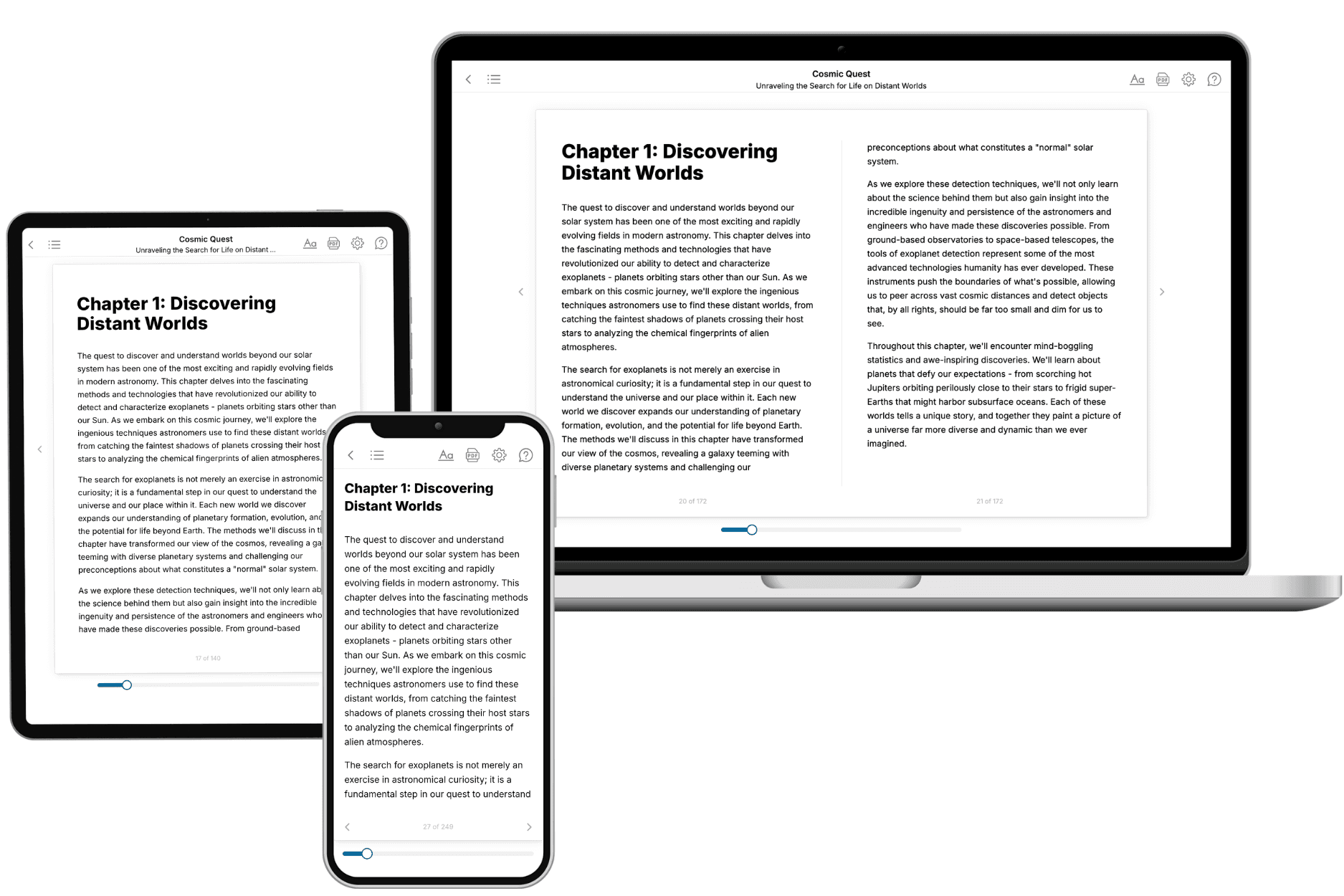
Your book is ready in 10 minutes. Read it online, download as EPUB or PDF, or send to Kindle.

Frequently asked questions
- What is TailoredRead?
TailoredRead creates complete, full-length nonfiction ebooks, written specifically for you. Tell us what you want to learn and why, and TailoredRead writes you a complete ebook on it, with charts, tables, and diagrams throughout. Read it online, on Kindle, or on any e-reader, or download it as a PDF or EPUB. Every book is written fresh the day you order it.
- How is the book tailored to me?
Before anything is written, you answer a few short questions about your goals, your background, and the topics you care about. Your book is then planned around your answers: written at your level, focused on your goals, and covering the topics you chose, instead of the one-size-fits-all book a store sells everyone.
- Will it read like generic AI content?
No. Your book isn't a chat transcript: it's planned chapter by chapter before a single word is written, told in a clear book voice, and explains ideas visually with charts, tables, and diagrams. After writing, every book goes through an editorial pass that polishes chapters so the book reads consistent from start to finish. Judge for yourself: browse thousands of sample books on our Explore Books page.
- How accurate is the content?
Our AI first checks whether your subject needs live research. Niche and fast-moving subjects are researched before writing, and the book plan and chapters are grounded in what it finds. After writing, every book goes through a quality pass that checks its facts and consistency, and researched books list their sources in a Notes section at the back.
- How long is the book?
You choose the length: Comprehensive (250-300 pages), Detailed (150-200 pages), Essential (70-100 pages), or Short (30-50 pages).
- Does the book include visuals?
Yes. Every book includes visual elements such as timelines, checklists, step-by-step guides, decision trees, comparison tables, and matrices, and many include bar charts. A typical book includes dozens of these visual elements.
- Can I read it on Kindle? What formats can I download?
Yes. Every book can be read in our online reader or downloaded as a PDF or EPUB. The EPUB can be opened with Kindle, Apple Books, Kobo, and any e-reader. The Commercial and Author licenses also include an editable Word (DOCX) and Markdown download.
- How much does it cost?
About the price of a regular ebook. The exact price depends on your book's length and complexity, from $2 for the shortest books to $35 for the most comprehensive, and it's shown when you review your book, before you commit to anything. Each book is a one-time purchase, yours to keep, no subscription. Licenses that let you share, teach, or publish your book range from $35.99 to $49.99.
- Can I preview the book before purchasing?
Before you pay, you'll see what your book will cover: the title, a detailed description, the estimated length, and the complete chapter-by-chapter table of contents, so you know what you're getting before you decide. The full text itself is written after you purchase.
- How long does it take to create a book?
About 10 minutes. You can start reading the opening chapters while the rest is still being written.