The Reality Principle
Understanding Political Realism and How Power Actually Works in the Modern World
You're about to discover why nations act the way they do, why leaders make seemingly ruthless decisions, and why idealism often fails in the political arena.
207 pages10 chaptersJan 29, 2026Political Science
About this book
This book cuts through the noise of political rhetoric to reveal the underlying logic of power that shapes our world. Rather than accepting surface-level explanations for international conflicts, trade wars, and diplomatic maneuvering, you'll learn to see the structural forces and rational calculations that drive political behavior. By understanding political realism—the theory that politics is fundamentally about power, interests, and survival—you'll gain the analytical tools to interpret headlines, predict policy decisions, and understand why nations prioritize security and advantage over universal principles. Whether you're interested in international relations, domestic politics, or simply making sense of current events, this exploration of realist theory provides the intellectual foundation for understanding how power actually operates in practice.
Table of contents
- IntroductionWhy Political Realism Matters Today, Beyond Idealism: A Pragmatic Lens, What You'll Learn in This BookRead below
- Chapter 1: Foundations of Political RealismCore Assumptions of Realist Theory, Historical Origins and Evolution, Realism Versus Other Theoretical Frameworks
- Chapter 2: Power and National InterestDefining and Measuring Power, The Concept of National Interest, How States Pursue and Maintain Power
- Chapter 3: The Anarchic International SystemThe Absence of Central Authority, The Security Dilemma and Its Consequences, How Structure Shapes State Behavior
- Chapter 4: Balance of Power and International StabilityUnderstanding the Balance of Power, Mechanisms for Maintaining Equilibrium, Preventing Hegemonic Dominance
- Chapter 5: Classical Realism and Structural RealismClassical Realism: Human Nature and Leadership, Structural Realism: Systems and Incentives, Comparing the Two Traditions
- Chapter 6: Conflict and Cooperation in Realist TheoryWhy Conflict Is Inevitable in Anarchy, The Limits of International Cooperation, Strategic Alliances and Temporary Partnerships
- Chapter 7: Realism and Foreign Policy Decision-MakingRational Choice and Strategic Calculation, How Realism Shapes Foreign Policy, Real-World Examples of Realist Logic
- Chapter 8: Contemporary Realism and Modern ChallengesNon-State Actors and Transnational Issues, Economic Interdependence and Trade, Adapting Realism for the 21st Century
- Chapter 9: Critiques and Limitations of RealismMajor Criticisms of Realist Theory, What Realism May Overlook, Defending Realism Against Alternatives
- Chapter 10: Applying Realism to Current EventsAnalyzing International Conflicts Through a Realist Lens, Understanding Diplomatic Negotiations and Agreements, Using Realism to Predict State Behavior
- ConclusionKey Takeaways and Insights, The Future of Political Realism
- Further Reading and Resources
Introduction
Every day, headlines announce new international tensions, diplomatic standoffs, trade disputes, and military posturing. Nations form alliances one moment and abandon them the next. Leaders who speak eloquently about peace and cooperation simultaneously build up military capabilities and pursue strategic advantages. To the casual observer, international politics can seem chaotic, contradictory, or even hypocritical. But beneath this apparent disorder lies a consistent logic—a set of principles that explains why states behave the way they do, regardless of their political systems, cultural values, or stated ideologies. This logic is the foundation of political realism, and understanding it will fundamentally change how you interpret the political world around you.
Political realism offers a framework for understanding politics that strips away the rhetoric and focuses on the underlying dynamics of power, interest, and survival. It doesn't ask how the world should work according to moral principles or idealistic visions. Instead, it examines how politics actually works in practice, acknowledging the constraints that shape state behavior and the incentives that drive decision-making. This approach might seem cynical at first, but it's actually deeply pragmatic. By understanding the realist perspective, you gain the ability to see past political theater and recognize the strategic calculations that determine outcomes. You'll understand why nations prioritize security over cooperation, why international agreements often fail, and why power remains the ultimate currency in global affairs.
This book is designed for those who want to move beyond surface-level explanations and develop a sophisticated understanding of political dynamics. You don't need a background in political science or international relations to benefit from this exploration. What you need is intellectual curiosity and a willingness to question conventional wisdom about how politics operates. Throughout these chapters, you'll encounter concepts that challenge idealistic assumptions about international cooperation, human nature, and the possibility of lasting peace. You'll learn to analyze political events through a lens that prioritizes strategic interests over stated intentions, structural constraints over individual choices, and power dynamics over moral considerations. This analytical framework won't just help you understand international relations—it will sharpen your ability to interpret domestic politics, organizational behavior, and any situation where power and interests collide.
The journey ahead will take you from the philosophical foundations of realist thought through its practical applications in contemporary politics. You'll explore why the international system is fundamentally anarchic, how this anarchy shapes state behavior, and why the pursuit of power is rational rather than pathological. You'll examine different schools of realist thought, from classical realism's focus on human nature to structural realism's emphasis on systemic constraints. You'll learn how to apply realist analysis to current events, understanding the logic behind foreign policy decisions that might otherwise seem puzzling or contradictory. By the end, you'll possess a powerful analytical tool that reveals the hidden architecture of political behavior.
Why Political Realism Matters Today
The contemporary world presents challenges that demand clear-eyed analysis rather than wishful thinking. From great power competition between the United States and China to regional conflicts in the Middle East and Eastern Europe, international politics continues to be shaped by the dynamics that realist thinkers identified centuries ago. Despite decades of globalization, international institutions, and calls for cooperative solutions to shared problems, states still prioritize their own security and interests above collective goods. Understanding why this pattern persists—and why it's likely to continue—requires grasping the realist perspective. Without this framework, you're left interpreting political events through ideological preferences or moral judgments that obscure rather than illuminate the underlying logic of state behavior.
Consider recent geopolitical developments that confound idealistic expectations. Why did Russia invade Ukraine despite international condemnation and economic sanctions? Why does China continue to expand its military capabilities and assert territorial claims even as it benefits from economic integration with the West? Why do European nations increase defense spending when they've enjoyed decades of peace? Realist theory provides coherent answers to these questions by focusing on the structural incentives that shape state behavior. In an anarchic international system—one without a central authority to enforce rules or guarantee security—states must rely on their own capabilities to survive. This fundamental condition creates a security dilemma where actions taken to enhance one's own security inevitably threaten others, leading to arms races, alliance formation, and periodic conflicts regardless of leaders' intentions or stated values.
The relevance of realism extends beyond explaining major power conflicts. It illuminates the gap between international rhetoric and actual behavior across numerous issue areas. Climate change negotiations reveal how states prioritize economic competitiveness over collective environmental action. Trade agreements demonstrate that nations pursue relative gains and strategic advantages rather than simply maximizing absolute economic benefits. Humanitarian interventions show how moral justifications often mask strategic interests and power projection. Even international institutions like the United Nations operate according to realist logic, with permanent Security Council members wielding veto power that reflects their dominant position in the global hierarchy. By understanding these patterns, you develop the ability to distinguish between what political actors say and what they actually do—a critical skill in an era of sophisticated public relations and strategic communication.
Realism also matters because it provides intellectual honesty about the limits of political change. Idealistic frameworks often promise that better institutions, more dialogue, or evolved consciousness can fundamentally transform international politics. Realism offers a more sobering assessment: while tactics and technologies change, the basic dynamics of power politics remain constant because they're rooted in the structure of the international system itself. This doesn't mean that progress is impossible or that cooperation never occurs. Rather, it means that cooperation happens when it serves state interests, and it remains fragile when those interests diverge. Understanding these constraints helps you set realistic expectations for what political action can achieve and avoid the disillusionment that comes from expecting outcomes that structural conditions make unlikely.
For professionals working in foreign policy, international business, or global affairs, realist analysis is an essential tool. Diplomats use realist frameworks to anticipate how other states will respond to policy initiatives. Business leaders apply realist insights to understand political risks in different markets and how government actions might affect their operations. Journalists and analysts employ realist concepts to explain complex international developments to their audiences. Even if you disagree with realist conclusions or prefer alternative theoretical frameworks, understanding realism is necessary because it remains the dominant lens through which many policymakers and strategists view the world. Engaging effectively in debates about foreign policy, security issues, or international cooperation requires fluency in realist concepts and arguments.
Perhaps most importantly, realism matters because it forces you to confront uncomfortable truths about politics and human organization. It challenges the notion that good intentions and moral principles are sufficient to create desired outcomes. It reveals how structural constraints can compel even well-meaning leaders to make ruthless decisions. It demonstrates that the absence of conflict often reflects a balance of power rather than genuine harmony of interests. These insights can be unsettling, but they're also liberating. By understanding the actual constraints and incentives that shape political behavior, you can develop more effective strategies for pursuing your goals, whether those involve advocating for policy changes, building international coalitions, or simply making sense of a complex and often troubling world. Realism doesn't tell you what values to hold or what outcomes to prefer—it simply provides a clearer picture of the terrain on which political struggles unfold.
The current international environment makes realist analysis particularly urgent. The post-Cold War period of American hegemony and liberal optimism has given way to renewed great power competition, rising nationalism, and challenges to the international order. Assumptions that economic interdependence would prevent conflict or that international institutions could constrain powerful states have proven overly optimistic. Meanwhile, new technologies like cyber weapons and artificial intelligence are creating novel security dilemmas while leaving the fundamental logic of power politics intact. In this context, realism offers analytical clarity precisely because it doesn't rely on assumptions about inevitable progress or the triumph of particular values. Instead, it provides tools for understanding how states will likely behave given their structural position and strategic imperatives, regardless of whether those behaviors align with our preferences or moral intuitions.
Beyond Idealism: A Pragmatic Lens
The contrast between realism and idealism represents one of the fundamental divides in political thought. Idealist approaches—whether liberal internationalism, cosmopolitanism, or various forms of utopianism—begin with visions of how politics should operate according to moral principles, universal values, or rational cooperation. These frameworks emphasize the possibility of transcending power politics through better institutions, shared norms, or enlightened leadership. They focus on how international law, democratic governance, economic interdependence, or cultural exchange can create lasting peace and cooperation. While these perspectives offer inspiring visions and important normative guidance, they often struggle to explain why states repeatedly fail to live up to these ideals or why cooperation proves so difficult to sustain when interests diverge.
Realism takes a fundamentally different starting point. Rather than beginning with how politics should work, it examines how politics actually does work under existing conditions. This approach doesn't deny the importance of moral values or the desirability of cooperation. Instead, it recognizes that moral considerations and cooperative impulses operate within constraints imposed by the structure of the international system and the imperatives of state survival. A realist analysis might acknowledge that leaders genuinely want peace while explaining why structural conditions make conflict likely anyway. It might recognize the value of international institutions while noting their limited ability to constrain powerful states when vital interests are at stake. This pragmatic focus on actual behavior rather than stated intentions or normative preferences provides analytical leverage that idealist frameworks often lack.
The distinction between realism and idealism becomes clear when analyzing specific policy debates. Consider the question of humanitarian intervention. An idealist framework emphasizes the moral obligation to prevent atrocities and protect human rights, arguing that sovereignty should not shield governments that commit mass violence against their populations. This perspective led to interventions in places like Libya in 2011, justified on humanitarian grounds. A realist analysis, however, asks different questions:
- What strategic interests motivate intervening states beyond stated humanitarian concerns?
- How will intervention affect the regional balance of power?
- What capabilities and commitments are required to achieve stated objectives?
- How will other major powers respond to the intervention?
- What precedents does intervention establish for future cases?
The realist critique of idealism centers on the problem of unintended consequences that arise when policy is based on aspirational thinking rather than clear-eyed assessment of constraints and incentives. The expansion of NATO eastward after the Cold War illustrates this dynamic. From an idealist perspective, extending security guarantees and democratic institutions to former Soviet bloc countries represented progress toward a Europe "whole and free." From a realist perspective, this expansion predictably threatened Russian security interests and contributed to the deterioration of relations that eventually manifested in conflicts over Georgia, Ukraine, and other former Soviet states. Realists argue that idealist frameworks failed to anticipate these consequences because they underestimated the enduring importance of geopolitical competition and the security dilemma in an anarchic system.
Moving beyond idealism doesn't mean abandoning ethical considerations or accepting that "might makes right." Rather, it means recognizing that moral principles operate within a political context shaped by power dynamics and strategic imperatives. Effective political action requires understanding these dynamics rather than wishing them away. A realist approach to promoting human rights, for example, would focus on how to leverage power and interests to create incentives for better behavior, rather than assuming that moral arguments alone will compel change. It would recognize that human rights advocacy is most effective when it aligns with the strategic interests of powerful states, and most likely to fail when it conflicts with those interests—not because morality doesn't matter, but because power determines whose moral vision prevails in practice.
The pragmatic lens that realism provides is particularly valuable for avoiding the cycle of idealistic overreach followed by cynical withdrawal that characterizes much foreign policy debate. Idealist frameworks often generate ambitious initiatives—spreading democracy, building international institutions, promoting universal values—that founder when they encounter resistance rooted in divergent interests and power dynamics. The resulting failures then fuel cynicism and isolationism, as publics conclude that international engagement is futile. Realism offers a middle path: engagement based on clear-eyed assessment of interests and capabilities rather than transformative ambitions. This approach sets more modest and achievable goals, reducing the gap between aspirations and outcomes that generates disillusionment with international affairs.
Understanding the realist perspective also helps you recognize when idealistic rhetoric serves as a cover for strategic interests. Political leaders frequently frame policies in moral or idealistic terms because such justifications are more publicly palatable than frank discussions of power and interest. The United States promoted democracy and human rights during the Cold War while supporting authoritarian regimes that aligned with American strategic interests. China speaks of peaceful development and mutual benefit while systematically expanding its military capabilities and territorial claims. Russia invokes the protection of ethnic Russians and opposition to Western hegemony while pursuing traditional great power objectives. A realist lens helps you see through this rhetoric to the underlying strategic logic, providing a more accurate basis for predicting behavior and formulating responses. This doesn't mean that moral rhetoric is meaningless—it shapes domestic politics and international legitimacy—but it means that strategic interests typically determine behavior when the two conflict.
What You'll Learn in This Book
This book provides a comprehensive exploration of political realism as both a theoretical framework and a practical analytical tool. You'll begin by examining the foundational assumptions that underpin realist thought—the centrality of the state, the anarchic structure of the international system, the primacy of power and security, and the rational pursuit of national interests. These core concepts form the basis for all realist analysis, and understanding them thoroughly is essential for applying realist insights to specific situations. You'll learn not just what realists believe, but why they hold these positions and what evidence supports their claims. This foundation will enable you to distinguish realism from other theoretical approaches and understand the specific analytical advantages that realist frameworks provide.
The exploration of power and national interest forms a central component of your learning journey. You'll discover that power is multidimensional, encompassing military capabilities, economic resources, diplomatic influence, and soft power assets like cultural appeal and ideological legitimacy. You'll learn how to assess the relative power of different states and understand how power dynamics shape their behavior and relationships. The concept of national interest—often invoked but rarely defined precisely—will be examined in depth. You'll explore how states define their interests, how these interests evolve over time, and how structural position in the international system constrains the range of interests that states can reasonably pursue. This analysis will help you move beyond simplistic notions of national interest as whatever leaders claim it to be, toward a more sophisticated understanding of how geography, capabilities, and systemic position shape what states can and must pursue to ensure their survival and security.
A substantial portion of the book examines the anarchic structure of the international system and its consequences for state behavior. You'll learn why the absence of a central authority fundamentally shapes international politics, creating a self-help system where states cannot rely on others for their security. The security dilemma—the tragic dynamic where actions taken to enhance one's own security inevitably threaten others—will be explored in detail, with concrete examples showing how this mechanism operates in practice. You'll understand why even defensive military buildups can trigger arms races, why alliances form and dissolve based on threat perceptions, and why cooperation remains difficult to sustain even when it would benefit all parties. These insights reveal why international politics often produces outcomes that no one intended or desired, as rational responses to structural constraints generate collective problems that individual action cannot solve.
The book distinguishes between different schools of realist thought, particularly classical realism and structural realism. Classical realism, rooted in thinkers like Thucydides, Machiavelli, and Hans Morgenthau, emphasizes human nature and the role of individual leaders in shaping political outcomes. You'll explore how this tradition views the lust for power as inherent in human psychology and how it analyzes the qualities required for effective political leadership. Structural realism, developed by Kenneth Waltz and others, shifts focus from human nature to the constraints imposed by the international system itself. You'll learn how this approach explains state behavior as a response to systemic incentives rather than individual characteristics, and why it predicts similar behavior from states regardless of their internal political systems or leaders' personalities. Understanding both traditions will give you a richer analytical toolkit and help you recognize when each approach offers particular insights.
Practical application of realist theory to contemporary issues forms a key component of your learning. You'll examine how realist logic explains current geopolitical competitions, from U.S.-China rivalry to regional conflicts in the Middle East and Eastern Europe. Case studies will demonstrate how realist analysis illuminates foreign policy decisions, alliance patterns, and the outcomes of international negotiations. You'll learn to apply realist frameworks to analyze new developments, asking the right questions about state interests, power dynamics, and structural constraints. This practical focus ensures that you don't just understand realist theory in the abstract, but can actually use it to make sense of complex political situations and anticipate how states are likely to behave under different conditions.
The book also addresses the limitations and critiques of realist theory. You'll encounter arguments from liberal, constructivist, and other theoretical perspectives that challenge realist assumptions and highlight phenomena that realism struggles to explain. These include the democratic peace theory, the role of international institutions in facilitating cooperation, the importance of ideas and norms in shaping state behavior, and the growing influence of non-state actors in international politics. Rather than dismissing these critiques, you'll learn to evaluate them seriously and understand where realism's explanatory power is strongest and where alternative frameworks might offer valuable insights. This balanced approach will help you develop a sophisticated understanding that recognizes both the strengths and limitations of realist analysis.
Throughout the book, you'll develop specific analytical skills that extend beyond understanding realist theory itself. These include:
- Distinguishing between stated intentions and actual interests in political rhetoric
- Assessing the relative power of different actors and how power dynamics shape their relationships
- Identifying structural constraints that limit the range of feasible policy options
- Recognizing security dilemmas and understanding how they generate conflict even among states that prefer peace
- Analyzing how the balance of power affects international stability and the likelihood of conflict
- Evaluating when cooperation is likely to succeed and when it will founder on divergent interests
- Predicting how states will respond to changes in their strategic environment
- Understanding why international institutions have limited ability to constrain powerful states
By the conclusion of this book, you'll possess a comprehensive understanding of political realism as both a theoretical framework and a practical analytical tool. You'll be able to explain why realists view international politics the way they do, what evidence supports their claims, and where their arguments face legitimate challenges. More importantly, you'll be able to apply realist insights to make sense of political developments, understand the logic behind foreign policy decisions, and anticipate how states are likely to behave in different situations. This knowledge won't just make you better informed about international affairs—it will fundamentally change how you interpret political behavior at all levels, from great power competition to everyday organizational politics. You'll see the world more clearly, with fewer illusions about how power operates and what drives political outcomes. This clarity is the ultimate value that realist analysis provides: not cynicism, but clear-eyed understanding of the forces that shape our political world.
This is the end of the free sample. The full book has 10 chapters.
Want this book written for you?
Tell us your goals and background, and get your own version of this book, tailored by AI to you.


Benefits of AI-tailored books
- Read one book, not ten:
- all the Political Science knowledge you need, gathered into a single book.
- Save days of learning:
- tell us your goals, choose your topics, and the whole book is built around them.
- Learn effortlessly:
- Political Science book written for your specific background and expertise.
- Understand at a glance:
- includes charts, tables, timelines, checklists, decision trees, and more.
- Stay current:
- written the day you order it, not years ago.
- Trust what you read:
- every book is checked for accuracy, with real research when your subject needs it.
Create your unique book in 3 steps
- 1. Select your focus
Select the focus of your Political Science book and share your background
- 2. Personalize your book
Specify your goals and choose sub-topics to include
- 3. Get your tailored book
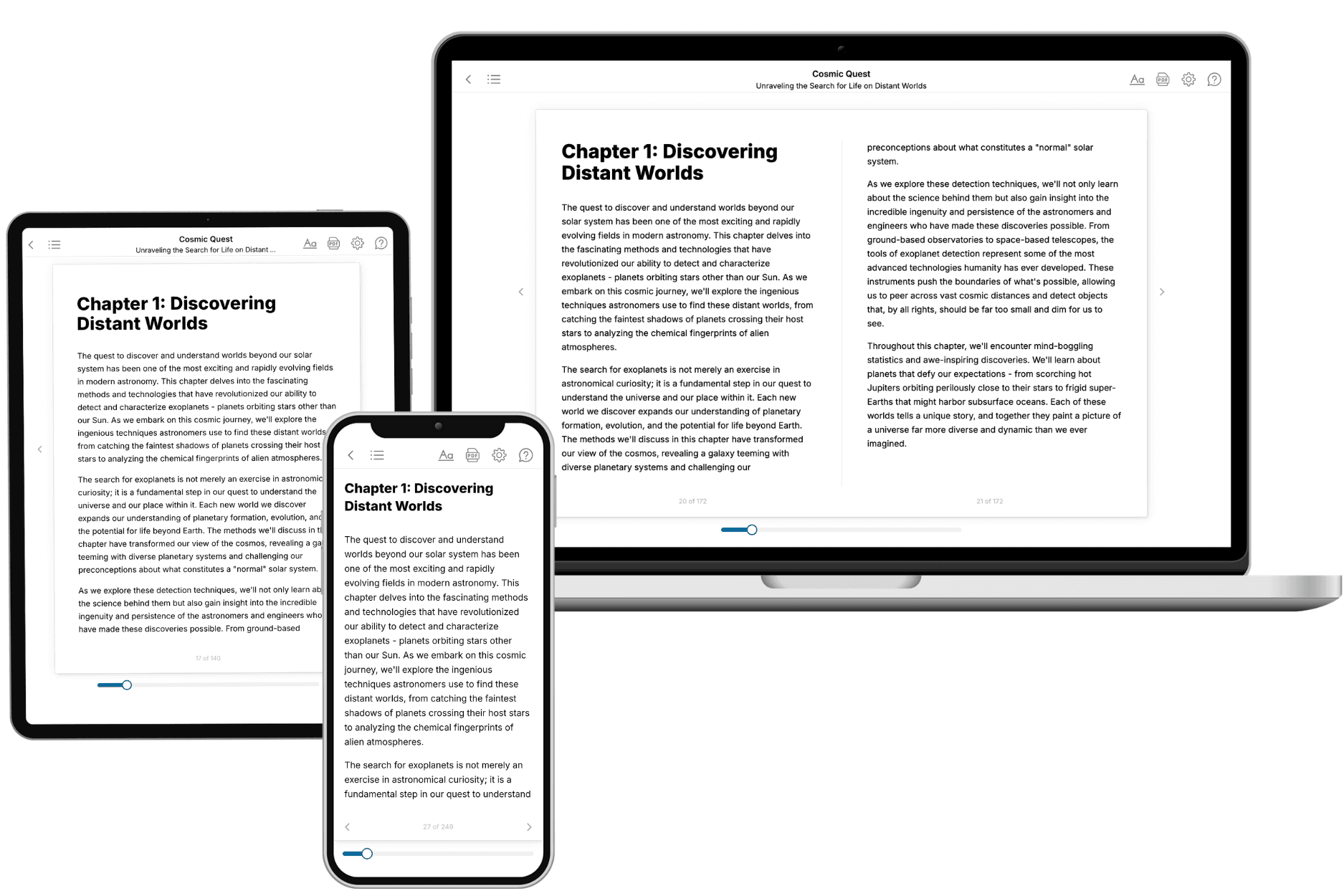
Your book is ready in 10 minutes. Read it online, download as EPUB or PDF, or send to Kindle.

Frequently asked questions
- What is TailoredRead?
TailoredRead creates complete, full-length nonfiction ebooks, written specifically for you. Tell us what you want to learn and why, and TailoredRead writes you a complete ebook on it, with charts, tables, and diagrams throughout. Read it online, on Kindle, or on any e-reader, or download it as a PDF or EPUB. Every book is written fresh the day you order it.
- How is the book tailored to me?
Before anything is written, you answer a few short questions about your goals, your background, and the topics you care about. Your book is then planned around your answers: written at your level, focused on your goals, and covering the topics you chose, instead of the one-size-fits-all book a store sells everyone.
- Will it read like generic AI content?
No. Your book isn't a chat transcript: it's planned chapter by chapter before a single word is written, told in a clear book voice, and explains ideas visually with charts, tables, and diagrams. After writing, every book goes through an editorial pass that polishes chapters so the book reads consistent from start to finish. Judge for yourself: browse thousands of sample books on our Explore Books page.
- How accurate is the content?
Our AI first checks whether your subject needs live research. Niche and fast-moving subjects are researched before writing, and the book plan and chapters are grounded in what it finds. After writing, every book goes through a quality pass that checks its facts and consistency, and researched books list their sources in a Notes section at the back.
- How long is the book?
You choose the length: Comprehensive (250-300 pages), Detailed (150-200 pages), Essential (70-100 pages), or Short (30-50 pages).
- Does the book include visuals?
Yes. Every book includes charts, tables, and diagrams: timelines, checklists, step-by-step guides, decision trees, comparison tables, matrices, and bar charts. A typical book includes dozens of these visual elements.
- Can I read it on Kindle? What formats can I download?
Yes. Every book can be read in our online reader or downloaded as a PDF or EPUB. The EPUB can be opened with Kindle, Apple Books, Kobo, and any e-reader. The Commercial and Author licenses also include an editable Word (DOCX) and Markdown download.
- How much does it cost?
About the price of a regular ebook. The exact price depends on your book's length and complexity, from $2 for the shortest books to $35 for the most comprehensive, and it's shown when you review your book, before you commit to anything. Each book is a one-time purchase, yours to keep, no subscription. Licenses that let you share, teach, or publish your book range from $35.99 to $49.99.
- Can I preview the book before purchasing?
Before you pay, you'll see what your book will cover: the title, a detailed description, the estimated length, and the complete chapter-by-chapter table of contents, so you know what you're getting before you decide. The full text itself is written after you purchase.
- How long does it take to create a book?
About 10 minutes. You can start reading the opening chapters while the rest is still being written.