Reinforcement Learning Algorithms
Master Self-Learning Systems and Build Intelligent Agents from Scratch
You'll gain the ability to design and implement reinforcement learning systems that learn autonomously from their environment.
207 pages9 chaptersAug 2, 2026Reinforcement Learning
About this book
This book bridges the gap between theoretical concepts and practical implementation, providing you with a clear understanding of how machines can achieve intelligent behavior through self-directed learning. Starting with foundational concepts like the Markov Decision Process, you'll progress through value-based and policy-based methods, exploring algorithms like Q-learning, policy gradients, and actor-critic systems. Each concept is explained with intuitive examples and practical code considerations, making complex ideas accessible without oversimplifying. You'll understand the critical trade-offs in algorithm design, learn how to structure reward systems effectively, and discover how to apply these techniques to real-world problems. Whether you're building game-playing agents, robotic controllers, or optimization systems, this book equips you with both the theoretical foundation and practical insights needed to implement reinforcement learning successfully.
Table of contents
- IntroductionWhy Reinforcement Learning Matters, How to Use This Book, Prerequisites and Background Knowledge, What You'll Learn and How It's OrganizedRead below
- Chapter 1: Foundations of Reinforcement LearningLearning from Experience: The Core Principle, Agents and Environments: The Interaction Loop, Rewards and Signals: Guiding Learning, Reinforcement Learning vs. Supervised Learning
- Chapter 2: The Markov Decision Process FrameworkUnderstanding the Markov Decision Process, States, Actions, and Transitions, The Markov Property and Memorylessness, Value Functions and Expected Returns
- Chapter 3: Value-Based Methods: Q-LearningValue Iteration and Bellman Equations, Q-Learning: Learning Action Values, Temporal Difference Learning, Implementing Q-Learning in Practice
- Chapter 4: Deep Q-Networks and Function ApproximationFunction Approximation with Neural Networks, Deep Q-Network Architecture, Experience Replay and Stability, Improvements: Double DQN and Dueling Networks
- Chapter 5: Policy-Based Methods and Policy GradientsRepresenting and Optimizing Policies, The Policy Gradient Theorem, REINFORCE: Basic Policy Gradient, Advantage Functions and Baseline Reduction
- Chapter 6: Actor-Critic MethodsCombining Value and Policy Methods, Actor-Critic Architecture and Components, Advantage Actor-Critic (A2C), Asynchronous Methods and A3C
- Chapter 7: Exploration and ExploitationThe Exploration-Exploitation Dilemma, Epsilon-Greedy and Simple Strategies, Upper Confidence Bound and Thompson Sampling, Curiosity-Driven Exploration
- Chapter 8: Advanced Topics and ExtensionsMulti-Agent Reinforcement Learning, Inverse Reinforcement Learning, Meta-Learning and Learning to Learn, Offline and Batch Reinforcement Learning
- Chapter 9: Practical Implementation and Real-World ApplicationsDesigning Effective Reward Functions, State Representation and Feature Engineering, Hyperparameter Tuning and Debugging, Case Studies: Games, Robotics, and Optimization
- ConclusionKey Takeaways and Your Next Steps, The Future of Reinforcement Learning
- Glossary
- Further Reading and Resources
Introduction
A robot arm fails thousands of times before it learns to pick up a cup. A game-playing program loses millions of matches before it beats the world champion. A traffic control system tries countless signal patterns before it finds one that cuts commute times in half. None of these systems were programmed with explicit rules. They learned by doing, adjusting their behavior based on feedback from the world around them. That feedback loop, simple in concept but rich in consequence, is the engine behind Reinforcement Learning.
Reinforcement Learning sits in a distinct corner of machine learning. Unlike supervised learning, which trains on labeled examples, or unsupervised learning, which finds structure in raw data, Reinforcement Learning trains an Agent to make decisions by interacting with an Environment and receiving a Reward Signal. The agent does not need a teacher to label correct answers. It discovers what works through experience, gradually building a strategy that maximizes cumulative reward over time. This self-directed quality is what makes the field both fascinating and technically demanding.
The algorithms covered in this book span a wide range of approaches, from foundational tabular methods to deep neural network architectures that handle complex, high-dimensional problems. Each approach reflects a different answer to the same core question: how should an agent decide what to do next, given what it knows right now? Understanding the range of answers to that question, and knowing when to apply each one, is the practical skill this book is designed to build.
This introduction sets the stage for everything that follows. It explains why Reinforcement Learning has become one of the most active and consequential areas in modern machine learning, describes how to get the most out of this book, outlines the background knowledge that will help you move through the material confidently, and maps out the structure of the chapters ahead.
Why Reinforcement Learning Matters
Reinforcement Learning has moved from academic curiosity to real-world impact faster than almost any other subfield of machine learning. The clearest public demonstration came in 2016, when DeepMind's AlphaGo defeated the world champion Go player Lee Sedol.[1] Go has more possible board positions than atoms in the observable universe, making it impossible to solve by brute-force search. AlphaGo succeeded by combining deep neural networks with Reinforcement Learning, learning strategies that no human programmer had explicitly encoded. That result signaled to the broader technology world that Reinforcement Learning could tackle problems of genuine complexity.
The applications have expanded well beyond games. In robotics, Reinforcement Learning enables physical systems to learn motor skills through trial and error, adapting to real-world variability that rigid programmed controllers cannot handle. In data center management, Google applied Reinforcement Learning to cooling systems and reported significant reductions in energy consumption.[2] In healthcare, researchers have explored Reinforcement Learning for personalized treatment planning, where the goal is to sequence interventions to maximize long-term patient outcomes rather than optimizing a single decision in isolation.
What makes Reinforcement Learning particularly valuable is its ability to handle sequential decision-making under uncertainty. Most real problems are not single-shot choices. They unfold over time, where each decision affects future options. A chess move changes the board. A drug dosage affects a patient's future response. A financial trade shifts market conditions. Reinforcement Learning is built specifically for this structure, making it the natural framework for problems where actions have long-term consequences.
The field also connects deeply to how biological systems learn. Neuroscience research has found that dopamine signaling in the brain resembles the Temporal Difference Learning mechanism used in many Reinforcement Learning algorithms.[3] This parallel is not just intellectually interesting. It suggests that Reinforcement Learning captures something fundamental about how adaptive behavior emerges from experience, whether in silicon or in neurons.
From a practical standpoint, Reinforcement Learning fills a gap that other machine learning approaches leave open. Supervised learning requires labeled data, which is expensive and sometimes impossible to collect for sequential decision problems. Reinforcement Learning generates its own training signal through interaction. This makes it applicable in domains where labeled datasets simply do not exist, such as novel game environments, physical manipulation tasks, or real-time optimization problems with no historical ground truth.
The growing availability of simulation environments has also accelerated the field's practical reach. Platforms like OpenAI Gym (now Gymnasium) and MuJoCo provide standardized environments where agents can train at scale before being deployed in the real world. This Sim-to-Real Transfer pipeline has become a standard approach in robotics research, allowing algorithms to accumulate millions of training interactions in simulation that would be impractical or unsafe to run on physical hardware.
Understanding Reinforcement Learning is no longer optional for machine learning practitioners who want to work on the most challenging and impactful problems. The algorithms in this book are the building blocks behind some of the most impressive demonstrations of machine intelligence to date, and they are increasingly finding their way into production systems across industries.
How to Use This Book
This book is designed to be read sequentially, at least on a first pass. Each chapter builds on concepts introduced in earlier ones. The Markov Decision Process framework introduced early on is the foundation for every algorithm that follows. The value functions defined in that context reappear in Q-Learning, Deep Q-Networks, and Actor-Critic methods. Skipping ahead without that grounding tends to create gaps that make later material harder to follow.
That said, the book is also structured so that experienced readers can use it as a reference. If you already have a working understanding of tabular Reinforcement Learning and want to go directly to deep learning extensions, the chapter on Deep Q-Networks and Function Approximation is self-contained enough to serve as a standalone reference. Similarly, the chapter on practical implementation is written to be consulted independently when you are debugging a real project.
Each chapter follows a consistent pattern that is worth understanding before you start:
- Conceptual foundation: The core idea is introduced with an intuitive explanation before any formal notation appears.
- Formal definition: Key terms and equations are defined precisely, using the canonical terminology that the field uses.
- Worked example: A concrete scenario illustrates how the concept operates in practice.
- Implementation considerations: Practical notes on how the concept translates into code, including common pitfalls.
The code considerations in this book are language-agnostic in their logic but assume Python as the implementation environment, since Python is the dominant language for Reinforcement Learning research and practice. Pseudocode and algorithmic descriptions are written to be directly translatable into Python using standard libraries. No complete runnable programs are provided, but the algorithmic descriptions are detailed enough to guide implementation.
Pay close attention to the canonical terminology used throughout. Terms like Policy, State-Value Function, Action-Value Function, and Bellman Equation have precise meanings that differ from their casual usage. Using these terms correctly matters when reading research papers, working with existing codebases, or communicating with other practitioners. The glossary at the end of the book provides quick reference definitions for all key terms.
A useful practice is to pause at the end of each chapter and try to explain the main algorithm in plain language, without looking at the text. If you can describe what the agent is doing, what information it uses, and how it updates its behavior, you have understood the chapter at the level needed to move forward. If any part of that explanation feels vague, that is a signal to re-read the relevant section before continuing.
The chapters on advanced topics and practical implementation are best approached after completing the core algorithm chapters. Advanced topics like Multi-Agent Reinforcement Learning, Inverse Reinforcement Learning, and Meta-Learning are extensions of the core framework, and their significance is much clearer once the foundations are solid. The practical implementation chapter is most useful when you are actively working on a project and need guidance on reward design, state representation, and debugging strategies.
Prerequisites and Background Knowledge
This book assumes you are an intermediate learner with some existing exposure to machine learning and programming. You do not need to be an expert in either area, but certain foundational concepts are used throughout without being re-explained from scratch. Knowing what these are in advance helps you identify any gaps to fill before diving in.
Mathematics: The most important mathematical background is linear algebra and probability theory. You should be comfortable with vectors and matrices, including operations like dot products and matrix multiplication. Probability concepts that appear frequently include probability distributions, expected values, and conditional probability. Calculus appears in the policy gradient chapters, where gradient ascent is used to optimize a parameterized policy. You do not need advanced calculus, but understanding what a gradient represents and how it points in the direction of steepest increase is essential for those sections.
Machine learning fundamentals: Familiarity with supervised learning concepts will help significantly. Specifically, understanding how neural networks are trained using gradient descent, what a loss function is, and how backpropagation works will make the deep learning chapters much more accessible. You do not need to have implemented a neural network from scratch, but you should understand the training loop at a conceptual level.
Programming: Python proficiency at an intermediate level is assumed. You should be comfortable writing functions, working with classes, and using libraries like NumPy for numerical computation. Familiarity with a deep learning framework such as PyTorch or TensorFlow is helpful for the later chapters but not strictly required to follow the algorithmic descriptions.
If any of these areas feel shaky, here is a practical checklist to assess your readiness:
- Can you compute the expected value of a discrete random variable by hand?
- Can you explain what a gradient is and why gradient descent minimizes a function?
- Can you describe what a neural network does at a high level, including forward and backward passes?
- Can you write a Python function that takes a list of numbers and returns the one with the highest value?
If all four of those feel straightforward, you have the background needed to work through this book comfortably. If one or two feel uncertain, a brief review of the relevant topic before starting will pay dividends. A solid grasp of probability theory in particular will make the formal definitions in the Markov Decision Process chapter much easier to absorb.
One area that is not a prerequisite is prior exposure to Reinforcement Learning itself. The book starts from the ground up, introducing the core concepts of the Agent, Environment, Reward Signal, and Interaction Loop before building toward more complex algorithms. If you have seen some Reinforcement Learning content before, the early chapters will serve as a structured review that fills in any informal gaps in your understanding.
Domain knowledge in robotics, game theory, or control systems is interesting context but not required. The examples used throughout the book are chosen for clarity rather than domain specificity. A grid-world navigation problem, for instance, illustrates the same algorithmic principles as a robotic manipulation task, with far less domain overhead. The goal is to understand the algorithms deeply enough to apply them to whatever domain you care about.
What You'll Learn and How It's Organized
The book moves through Reinforcement Learning in a deliberate arc, starting with the conceptual and mathematical foundations, progressing through the major families of algorithms, and finishing with advanced extensions and practical implementation guidance. Each stage builds on the previous one, so the progression is not arbitrary. It reflects the logical dependencies between ideas.
The first chapter establishes the core paradigm: what it means for an agent to learn from experience, how the Interaction Loop between agent and environment works, and how Reinforcement Learning differs from other machine learning approaches. This chapter is conceptual rather than mathematical, and its purpose is to build the right mental model before formal notation is introduced.
The second chapter introduces the Markov Decision Process, the mathematical framework that formalizes every Reinforcement Learning problem. This is where key concepts like State, Action, Transition Function, Discount Factor, Policy, and the Bellman Equation are defined precisely. The Markov Decision Process is the skeleton that every algorithm in the book is built upon, so this chapter deserves careful attention.
Chapters three and four cover value-based methods. Chapter three introduces Q-Learning and Temporal Difference Learning, showing how an agent can learn the value of actions through direct experience without a model of the environment. Chapter four extends this to high-dimensional problems using Deep Q-Networks, Experience Replay, and Target Networks, along with improvements like Double DQN and the Dueling Network Architecture.
Chapters five and six cover policy-based methods and their combination with value methods. Chapter five introduces the Policy Gradient Theorem and the REINFORCE Algorithm, explaining how to directly optimize a parameterized policy using gradient ascent. Chapter six combines value and policy approaches in the Actor-Critic Architecture, covering Advantage Actor-Critic and Asynchronous Advantage Actor-Critic methods.
Chapter seven addresses the Exploration-Exploitation Dilemma, one of the most fundamental challenges in Reinforcement Learning. The strategies covered range from simple approaches like the Epsilon-Greedy Strategy to more sophisticated methods like Upper Confidence Bound, Thompson Sampling, and Curiosity-Driven Exploration. The Multi-Armed Bandit problem serves as the primary vehicle for illustrating these ideas.
Chapter eight surveys advanced extensions of the core framework:
- Multi-Agent Reinforcement Learning: settings where multiple agents interact simultaneously, creating cooperative or competitive dynamics.
- Inverse Reinforcement Learning: inferring a reward function from observed behavior, rather than learning from an explicit reward signal.
- Meta-Learning: training agents that can adapt quickly to new tasks with minimal experience.
- Offline Reinforcement Learning: learning from a fixed dataset of past interactions without further environment access.
Chapter nine brings everything together in a practical context. Reward Shaping, state representation, Hyperparameter Tuning, and debugging strategies are covered with concrete guidance. Case studies in game playing, robotics, and optimization illustrate how the algorithms from earlier chapters are applied to real problems, including the challenges that arise when theory meets practice.
The conclusion reflects on the trajectory of the field and points toward open problems and emerging directions. The glossary and further reading sections provide reference material for ongoing study. Together, these resources are designed to support not just a single read-through but continued engagement with the field as it evolves.
By the time you reach the end of this book, the landscape of Reinforcement Learning should feel navigable rather than overwhelming. The algorithms will have names, structures, and clear relationships to one another. The trade-offs between approaches will be concrete rather than abstract. And the gap between reading about an algorithm and implementing one will be much narrower than it was at the start. The field moves fast, but the foundations covered here are stable enough to serve as a reliable base for whatever comes next.
Notes
Introduction
- 1. David Silver and others, "Mastering the Game of Go with Deep Neural Networks and Tree Search," Nature, 2016
- 2. Richard Evans and Jim Gao, "DeepMind AI Reduces Google Data Centre Cooling Bill by 40%," DeepMind Blog, 2016
- 3. Wolfram Schultz and others, "A Neural Substrate of Prediction and Reward," Science, 1997
This is the end of the free sample. The full book has 9 chapters.
Want this book written for you?
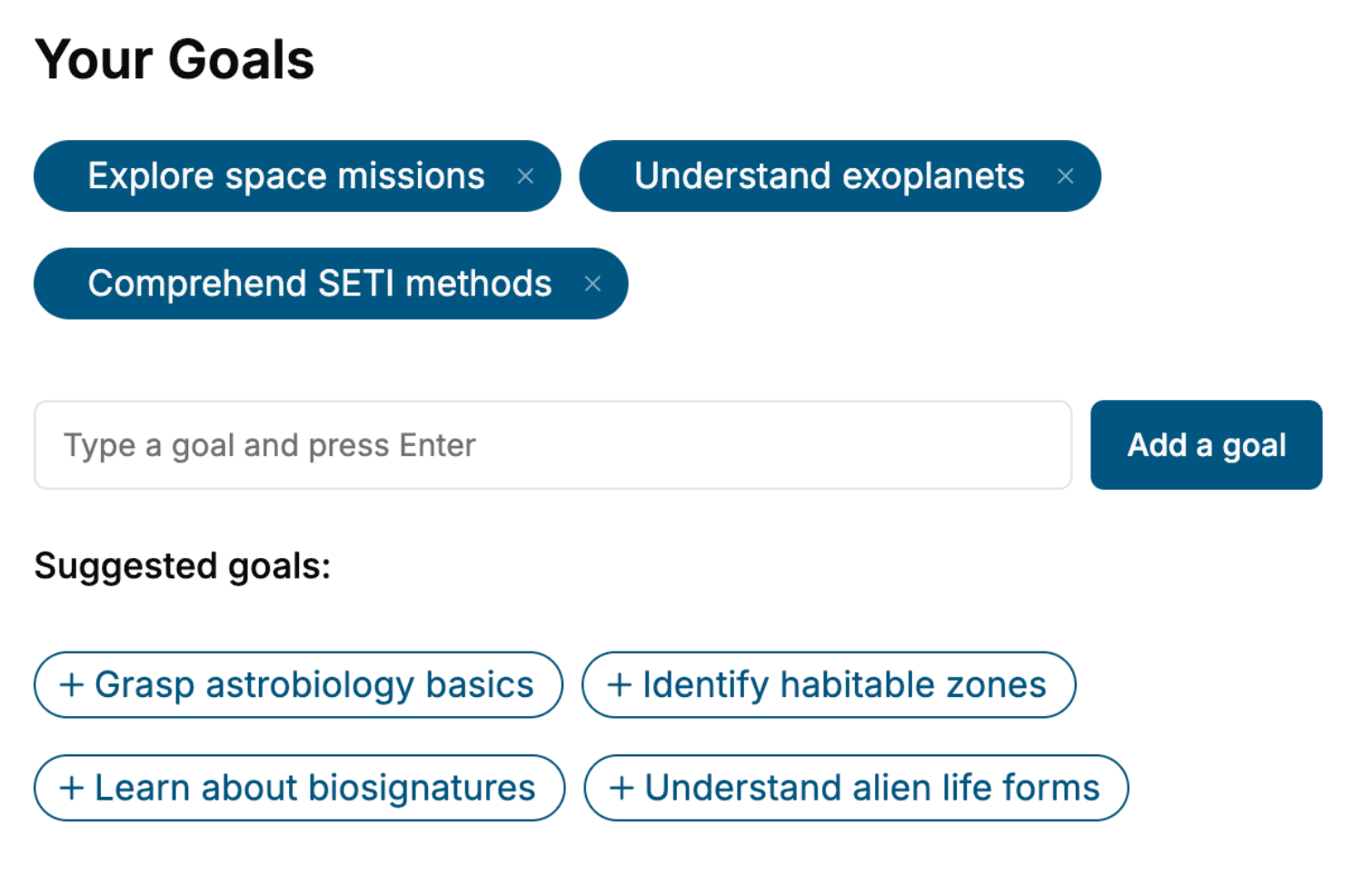
Tell us your goals and background, and get your own version of this book, tailored by AI to you.


Benefits of AI-tailored books
- Read one book, not ten:
- all the Reinforcement Learning knowledge you need, gathered into a single book.
- Save days of learning:
- tell us your goals, choose your topics, and the whole book is built around them.
- Learn effortlessly:
- Reinforcement Learning book written for your specific background and expertise.
- Understand at a glance:
- includes charts, tables, timelines, checklists, decision trees, and more.
- Stay current:
- written the day you order it, not years ago.
- Trust what you read:
- every book is checked for accuracy, with real research when your subject needs it.
Create your unique book in 3 steps
- 1. Select your focus
Select the focus of your Reinforcement Learning book and share your background
- 2. Personalize your book
Specify your goals and choose sub-topics to include
- 3. Get your tailored book
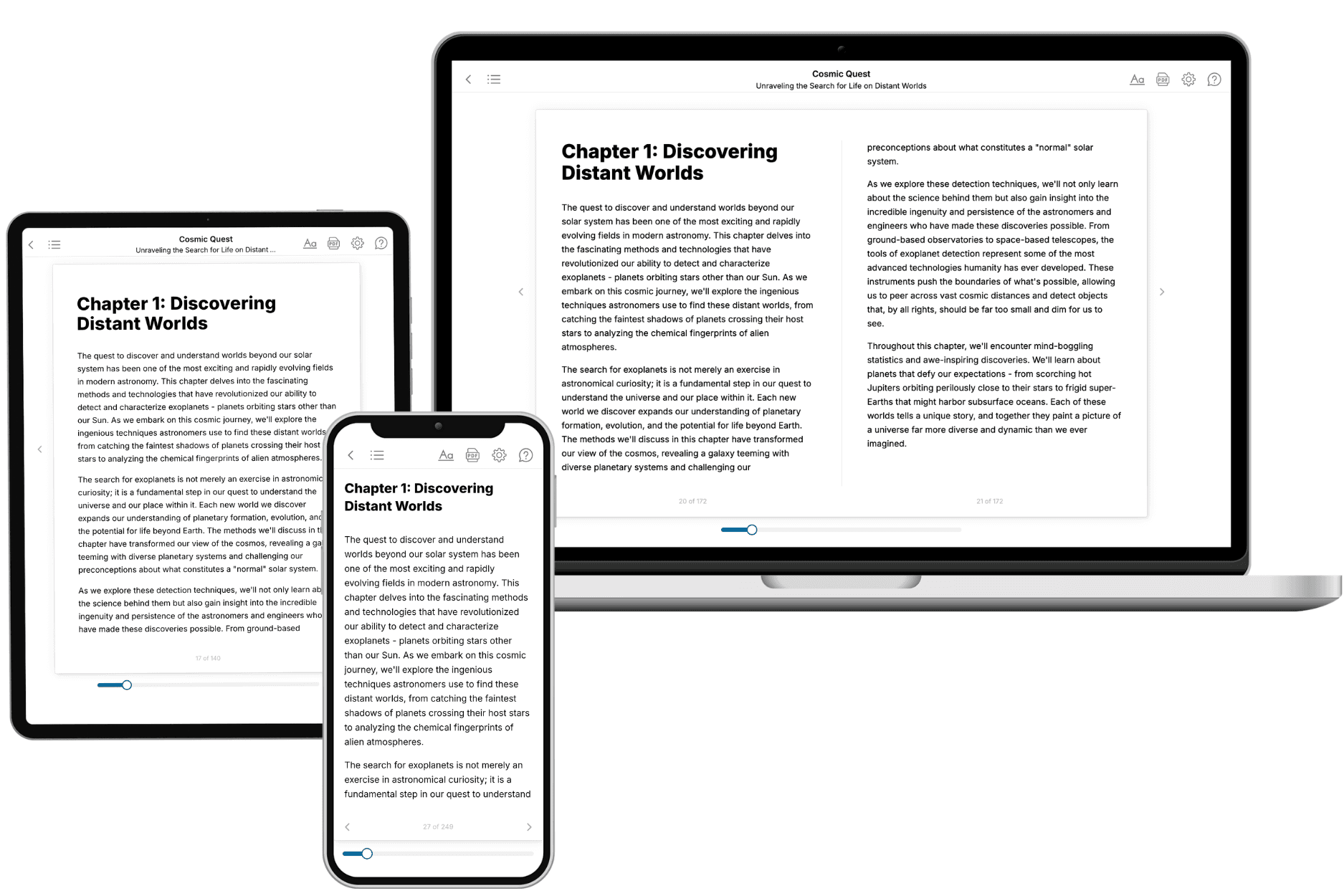
Your book is ready in 10 minutes. Read it online, download as EPUB or PDF, or send to Kindle.

Frequently asked questions
- What is TailoredRead?
TailoredRead creates complete, full-length nonfiction ebooks, written specifically for you. Tell us what you want to learn and why, and TailoredRead writes you a complete ebook on it, with charts, tables, and diagrams throughout. Read it online, on Kindle, or on any e-reader, or download it as a PDF or EPUB. Every book is written fresh the day you order it.
- How is the book tailored to me?
Before anything is written, you answer a few short questions about your goals, your background, and the topics you care about. Your book is then planned around your answers: written at your level, focused on your goals, and covering the topics you chose, instead of the one-size-fits-all book a store sells everyone.
- Will it read like generic AI content?
No. Your book isn't a chat transcript: it's planned chapter by chapter before a single word is written, told in a clear book voice, and explains ideas visually with charts, tables, and diagrams. After writing, every book goes through an editorial pass that polishes chapters so the book reads consistent from start to finish. Judge for yourself: browse thousands of sample books on our Explore Books page.
- How accurate is the content?
Our AI first checks whether your subject needs live research. Niche and fast-moving subjects are researched before writing, and the book plan and chapters are grounded in what it finds. After writing, every book goes through a quality pass that checks its facts and consistency, and researched books list their sources in a Notes section at the back.
- How long is the book?
You choose the length: Comprehensive (250-300 pages), Detailed (150-200 pages), Essential (70-100 pages), or Short (30-50 pages).
- Does the book include visuals?
Yes. Every book includes visual elements such as timelines, checklists, step-by-step guides, decision trees, comparison tables, and matrices, and many include bar charts. A typical book includes dozens of these visual elements.
- Can I read it on Kindle? What formats can I download?
Yes. Every book can be read in our online reader or downloaded as a PDF or EPUB. The EPUB can be opened with Kindle, Apple Books, Kobo, and any e-reader. The Commercial and Author licenses also include an editable Word (DOCX) and Markdown download.
- How much does it cost?
About the price of a regular ebook. The exact price depends on your book's length and complexity, from $2 for the shortest books to $35 for the most comprehensive, and it's shown when you review your book, before you commit to anything. Each book is a one-time purchase, yours to keep, no subscription. Licenses that let you share, teach, or publish your book range from $35.99 to $49.99.
- Can I preview the book before purchasing?
Before you pay, you'll see what your book will cover: the title, a detailed description, the estimated length, and the complete chapter-by-chapter table of contents, so you know what you're getting before you decide. The full text itself is written after you purchase.
- How long does it take to create a book?
About 10 minutes. You can start reading the opening chapters while the rest is still being written.