Representation Learning Essentials
Master How AI Systems Learn to See, Understand, and Create with Midjourney and Beyond
Most people interact with AI tools like Midjourney without understanding the fundamental mechanism that makes them work: representation learning.
222 pages10 chaptersJul 14, 2026Representation Learning
About this book
You might wonder why your prompts sometimes produce stunning results and other times fall flat, or how an AI system can understand abstract concepts and translate them into visual art. The gap between using these tools and truly understanding them limits your ability to work with them effectively. This book bridges that gap by explaining how AI systems learn to represent information in ways that enable understanding, reasoning, and creation. You'll discover how neural networks build hierarchical representations, why embeddings matter, how Midjourney interprets your prompts, and how different AI architectures solve different problems. Whether you're a creative professional, developer, researcher, or curious learner, you'll gain practical insights into how representation learning powers modern AI and how to work more effectively with these transformative technologies.
Table of contents
- IntroductionWhy Representation Learning Matters in the Age of AI, What You'll Learn in This Book, How to Use This BookRead below
- Chapter 1: The Fundamentals of Representation LearningWhat Is a Representation?, From Raw Data to Meaningful Patterns, Why Machines Need Representations
- Chapter 2: How Neural Networks Learn RepresentationsNeurons, Layers, and Information Flow, Hierarchical Feature Learning, Backpropagation: How Networks Learn, Activation Functions and Non-linearity
- Chapter 3: Embeddings: The Language of AIWhat Are Embeddings?, Vector Spaces and Semantic Meaning, Embeddings in Real-World Applications
- Chapter 4: Convolutional Neural Networks and Visual RepresentationsHow CNNs Learn to See, Filters, Feature Maps, and Visual Patterns, From Pixels to High-Level Concepts, CNN Applications in Modern AI
- Chapter 5: Transformers and Attention-Based RepresentationsThe Transformer Revolution, Attention Mechanisms: Focusing on What Matters, Multimodal Representations: Bridging Text and Vision
- Chapter 6: Midjourney and Generative AI: Representations in ActionHow Midjourney Understands Your Prompts, The Text-to-Image Generation Pipeline, Diffusion Models and Learned Representations, Why Prompt Engineering Works: The Representation Perspective
- Chapter 7: Transfer Learning and Representation ReuseStanding on Giants: Pre-trained Representations, Fine-tuning: Adapting Representations for New Tasks, Domain Adaptation and Representation Transfer
- Chapter 8: Unsupervised and Self-Supervised LearningLearning Without Labels, Autoencoders: Learning Through Reconstruction, Contrastive Learning and Self-Supervision, Clustering and Pattern Discovery
- Chapter 9: Evaluating and Debugging RepresentationsMeasuring Representation Quality, Visualizing High-Dimensional Representations, Common Problems and How to Spot Them
- Chapter 10: Practical Applications and Future DirectionsRepresentation Learning in Industry Applications, Emerging Trends and New Architectures, Ethical Considerations in Learned Representations
- ConclusionKey Takeaways, Your Next Steps
- Glossary
- Further Reading and Resources
Introduction
Picture this: you type a few words into Midjourney, something like a misty mountain village at dawn, painted in the style of a Japanese woodblock print,
and within seconds, a stunning image appears that captures exactly the mood you imagined. It feels almost magical. But there is nothing magical about it. Behind that result is a sophisticated, learnable process called representation learning, and once you understand how it works, you will never look at AI tools the same way again. You will start to see the machinery beneath the surface, and that knowledge will make you dramatically better at working with these systems.
Most people who use AI tools like Midjourney, DALL-E, or Stable Diffusion interact with them through trial and error. They tweak prompts, add keywords, and hope for better results. Sometimes it works. Often it does not. The frustration comes from a gap between using a tool and understanding it. That gap is not about technical expertise or programming skills. It is about understanding one core idea: how AI systems learn to represent information. Once that idea clicks, the behavior of these systems stops feeling random and starts making sense.
Representation learning is the process by which AI systems transform raw data, whether pixels, words, or sounds, into structured, meaningful patterns that machines can reason about. It is the foundation beneath virtually every modern AI breakthrough, from image recognition to language translation to generative art. When a neural network learns to recognize a cat, it is not memorizing cat images. It is building a rich internal representation of what "cat-ness" means across shapes, textures, colors, and contexts. That same principle, applied at massive scale, is what allows Midjourney to understand your prompt and generate something coherent and beautiful.
This book is designed to close that gap between using AI and understanding it. It is written for people who already have some familiarity with AI and machine learning concepts but want to go deeper into the mechanisms that make modern systems work. You do not need to be a researcher or an engineer. You need curiosity, a willingness to think carefully about how systems learn, and a desire to work more effectively with the AI tools that are reshaping creative and technical work alike. Whether you are a designer, developer, researcher, or simply someone fascinated by how these systems work, this book will give you a clearer, more grounded picture of what is actually happening inside the models you use every day.
Why Representation Learning Matters in the Age of AI
The history of AI is, in many ways, a history of representation. Early AI systems were built on hand-crafted rules. Programmers would explicitly define what features mattered, what patterns to look for, and how to combine them. This approach worked reasonably well for narrow, well-defined problems. But it broke down quickly when the real world got involved. The real world is messy, ambiguous, and full of variation that no programmer can fully anticipate. Representation learning changed the game by letting machines figure out the relevant features themselves, directly from data.[1]
Consider what it takes to recognize a handwritten digit. A human child learns this effortlessly, but writing a rule-based program to do it reliably is surprisingly hard. The digit "7" can be written with a horizontal crossbar or without one, slanted left or right, thick or thin, large or small. Any rigid rule will fail on some valid example. A representation learning system, by contrast, learns from thousands of examples and builds an internal model of what makes a "7" a "7," capturing the essential structure while ignoring irrelevant variation. This is a simple example, but the same principle scales to faces, objects, scenes, and even abstract concepts like "melancholy" or "futuristic."
The stakes of understanding representation learning have never been higher. AI systems are now making decisions in healthcare, finance, hiring, and creative industries. The quality of those decisions depends directly on the quality of the representations those systems have learned. A medical imaging AI that has learned poor representations of tumor tissue will miss diagnoses. A hiring algorithm that has learned biased representations of "qualified candidate" will perpetuate discrimination. Understanding how representations are built, what makes them good or bad, and where they can go wrong is not just academically interesting. It is practically essential for anyone working with or affected by these systems.
For creative professionals, representation learning is the engine behind every generative AI tool. When you use Midjourney, you are interacting with a system that has learned rich representations of visual style, composition, lighting, subject matter, and the relationships between words and images. Understanding this helps you write better prompts, interpret unexpected outputs, and push the tools further. It also helps you understand their limits. An AI system can only generate what its learned representations can express. Knowing what those representations capture, and what they miss, gives you a significant practical advantage.
The pace of progress in this field is extraordinary. In just the past decade, representation learning has moved from an academic research topic to the core technology powering products used by hundreds of millions of people. Models like CLIP, which learns joint representations of images and text, directly enable tools like Midjourney to connect your words to visual concepts.[2] Diffusion models, which generate images by learning to reverse a noise process, rely on learned representations to guide that generation toward coherent, meaningful outputs. These are not distant research concepts. They are the technologies running on your screen right now.
Understanding representation learning also builds a kind of transferable literacy. The specific tools and models available today will change. New architectures will emerge. But the core ideas, how machines learn to encode meaning, how hierarchical features build up from simple to complex, how embeddings capture relationships, will remain relevant across whatever comes next. Investing in this understanding now pays dividends across the entire arc of AI development, not just for the tools that exist today.
A concrete example: In 2012, a deep learning model called AlexNet dramatically outperformed all previous approaches on the ImageNet visual recognition challenge, not because it used better rules, but because it learned better representations of visual features directly from data. That moment marked a turning point that led, through a chain of research advances, directly to the generative AI tools available today.[3]
The good news is that you do not need a PhD to understand these ideas. Representation learning, at its core, is about a surprisingly intuitive process: learning to describe things in ways that make them easier to work with. Humans do this naturally. We describe a face not as a grid of pixel values but as a collection of features: the shape of the nose, the spacing of the eyes, the curve of the jaw. AI systems learn to do something analogous, and the story of how they do it is both fascinating and accessible.
What You'll Learn in This Book
This book takes you on a structured journey through the core ideas of representation learning, from the foundational concepts to the practical systems you interact with every day. Each chapter builds on the previous one, so by the time you reach the chapters on Midjourney and generative AI, you will have the conceptual vocabulary to understand what is actually happening inside those systems. Here is a map of what lies ahead.
Chapter 1 lays the groundwork by asking a deceptively simple question: what is a representation? You will explore how both humans and machines describe the world, why the choice of representation matters enormously, and how raw data gets transformed into something meaningful. This chapter establishes the core vocabulary and intuitions that everything else builds on.
Chapter 2 dives into neural networks, the primary machinery of modern representation learning. You will learn how neurons and layers work together to process information, how hierarchical feature learning allows networks to build complex understanding from simple components, and how the training process (through backpropagation) actually shapes the representations a network learns. This chapter demystifies the "black box" of neural networks without requiring any math beyond basic intuition.
Chapter 3 focuses on embeddings, one of the most powerful and widely used concepts in modern AI. You will learn what embeddings are, how they encode meaning in numerical vectors, and why the geometry of embedding spaces captures semantic relationships. This chapter includes concrete examples from word embeddings and image embeddings, showing how the famous king minus man plus woman equals queen
relationship emerges naturally from learned representations.[4]
Chapters 4 and 5 cover the two dominant architectural families in modern AI. Chapter 4 explores convolutional neural networks (CNNs) and how they learn visual representations, from detecting edges in early layers to recognizing complex objects in later ones. Chapter 5 covers transformers and attention mechanisms, the architecture behind GPT, BERT, and the text-understanding components of tools like Midjourney. You will also learn how multimodal models bridge text and vision, which is the key to understanding how text-to-image generation works.
Chapter 6 is where everything comes together in a practical context. You will get a detailed look at how Midjourney actually works: how it interprets your prompts, how diffusion models generate images from learned representations, and why prompt engineering is not just guesswork but a principled interaction with a learned representation space. This chapter gives you actionable insights for working more effectively with generative AI tools.
The remaining chapters cover advanced topics that deepen your understanding and expand your practical toolkit. These include:
- Transfer learning (Chapter 7): how pre-trained representations can be reused and adapted for new tasks, dramatically reducing the cost of building new AI systems
- Unsupervised and self-supervised learning (Chapter 8): how AI systems learn representations without labeled data, which is how most modern large-scale models are trained
- Evaluating and debugging representations (Chapter 9): how to measure representation quality, visualize high-dimensional spaces, and identify when something has gone wrong
- Practical applications and future directions (Chapter 10): how representation learning is being applied across industries, what emerging architectures look like, and the ethical considerations that come with learned representations
Throughout the book, the focus is on building genuine understanding rather than surface-level familiarity. Every major concept is illustrated with concrete examples, real-world applications, and practical implications. The goal is not just to know what representation learning is, but to understand it well enough to reason about it, apply it, and recognize it in action whenever you encounter AI systems in the wild.
By the end of this book, you will be able to look at a generative AI tool and understand, at a meaningful level, what is happening when it processes your input and produces its output. You will understand why some prompts work better than others, why AI systems sometimes fail in surprising ways, and how the field is likely to evolve. That understanding is genuinely useful, whether you are building AI systems, working alongside them, or simply trying to make sense of a world increasingly shaped by them.
How to Use This Book
This book is designed to be read from beginning to end, with each chapter building on the concepts introduced in previous ones. If you are new to representation learning, following the chapters in order will give you the most coherent experience. The early chapters establish foundational ideas that later chapters assume you understand. Jumping ahead to the Midjourney chapter, for example, will make more sense after you have read the chapters on embeddings and transformers.
That said, if you already have a solid background in neural networks and embeddings, you can move more quickly through Chapters 1 through 3 and spend more time on the later chapters. Each chapter opens with a clear statement of what it covers, so you can quickly assess whether the material is new to you or a review. The glossary at the back of the book is a useful reference if you encounter a term you want to quickly clarify without rereading an entire chapter.
Throughout the book, you will find several recurring features designed to make the content more practical and memorable:
- Concrete examples: Every major concept is illustrated with a specific, real-world example. These are not hypothetical scenarios but actual systems, models, and applications you can look up and explore further.
- Practical implications: Each chapter connects the technical concepts to practical consequences, especially for working with tools like Midjourney. Look for these connections to ground the theory in something tangible.
- Key terms in bold: When an important technical term is introduced for the first time, it appears in bold. These terms are also collected in the glossary for easy reference.
- Footnotes and citations: Where claims are backed by specific research, footnotes point you to the original sources. These are worth exploring if you want to go deeper on any particular topic.
One important note about the level of mathematics in this book: the goal is conceptual understanding, not mathematical derivation. You will encounter some formulas and technical notation in places where they genuinely clarify rather than obscure. But the emphasis throughout is on building intuition. If you find a mathematical section challenging, focus on the surrounding explanation and examples. The core ideas can be understood without working through every equation, and the practical insights remain fully accessible even if some of the technical details feel abstract at first.
If you are using this book alongside hands-on experimentation with AI tools, that combination will accelerate your learning significantly. As you read about how Midjourney interprets prompts through learned representations, try experimenting with prompts that test those ideas. As you learn about embeddings and semantic similarity, notice how AI tools respond to synonyms, related concepts, and stylistic variations. The theory and the practice reinforce each other in ways that reading alone cannot fully replicate.
A suggested approach for active learners: After finishing each chapter, spend 15 to 20 minutes experimenting with a relevant AI tool. For the embeddings chapter, try exploring a word embedding visualization tool online. For the Midjourney chapter, test the prompt engineering principles discussed in the text. This kind of active engagement turns reading into genuine understanding.
The Further Reading section at the end of the book points you toward papers, courses, and resources for going deeper on any topic that captures your interest. Representation learning is a rich and rapidly evolving field, and this book is designed to be a starting point as much as a complete reference. The goal is to give you a strong enough foundation that you can continue learning independently, follow new developments in the field, and evaluate new tools and architectures with genuine understanding rather than just surface familiarity.
Finally, approach this material with patience and curiosity. Some of the ideas here, particularly around how high-dimensional spaces encode meaning and how diffusion models generate images, can feel counterintuitive at first. That is normal. These are genuinely subtle concepts that took researchers years to develop and refine. Give yourself permission to sit with an idea, revisit it, and let it settle before moving on. The understanding that comes from working through something carefully is far more durable than the kind that comes from skimming. Take your time, and the payoff will be substantial.
Notes
Introduction
- 1. Y. LeCun and others, "Deep learning," Nature, 2015
- 2. A. Radford and others, Learning Transferable Visual Models From Natural Language Supervision, OpenAI, 2021
- 3. A. Krizhevsky and others, ImageNet Classification with Deep Convolutional Neural Networks, Advances in Neural Information Processing Systems, 2012
- 4. T. Mikolov and others, "Linguistic Regularities in Continuous Space Word Representations," Proceedings of NAACL-HLT 2013, 2013
This is the end of the free sample. The full book has 10 chapters.
Want this book written for you?
Tell us your goals and background, and get your own version of this book, tailored by AI to you.


Benefits of AI-tailored books
- Read one book, not ten:
- all the Representation Learning knowledge you need, gathered into a single book.
- Save days of learning:
- tell us your goals, choose your topics, and the whole book is built around them.
- Learn effortlessly:
- Representation Learning book written for your specific background and expertise.
- Understand at a glance:
- includes charts, tables, timelines, checklists, decision trees, and more.
- Stay current:
- written the day you order it, not years ago.
- Trust what you read:
- every book is checked for accuracy, with real research when your subject needs it.
Create your unique book in 3 steps
- 1. Select your focus
Select the focus of your Representation Learning book and share your background
- 2. Personalize your book
Specify your goals and choose sub-topics to include
- 3. Get your tailored book
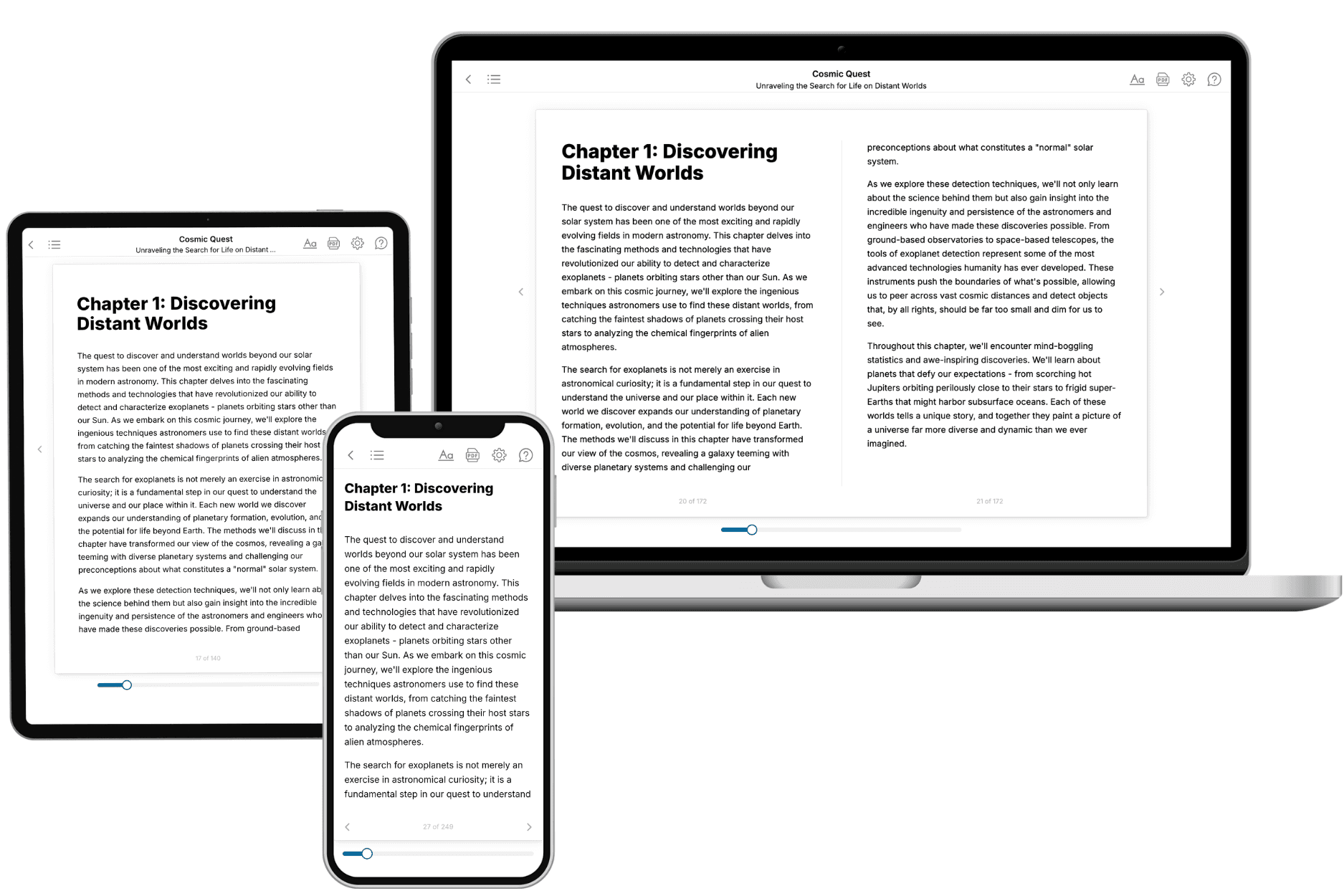
Your book is ready in 10 minutes. Read it online, download as EPUB or PDF, or send to Kindle.
Frequently asked questions
- What is TailoredRead?
TailoredRead creates complete, full-length nonfiction ebooks, written specifically for you. Tell us what you want to learn and why, and TailoredRead writes you a complete ebook on it, with charts, tables, and diagrams throughout. Read it online, on Kindle, or on any e-reader, or download it as a PDF or EPUB. Every book is written fresh the day you order it.
- How is the book tailored to me?
Before anything is written, you answer a few short questions about your goals, your background, and the topics you care about. Your book is then planned around your answers: written at your level, focused on your goals, and covering the topics you chose, instead of the one-size-fits-all book a store sells everyone.
- Will it read like generic AI content?
No. Your book isn't a chat transcript: it's planned chapter by chapter before a single word is written, told in a clear book voice, and explains ideas visually with charts, tables, and diagrams. After writing, every book goes through an editorial pass that polishes chapters so the book reads consistent from start to finish. Judge for yourself: browse thousands of sample books on our Explore Books page.
- How accurate is the content?
Our AI first checks whether your subject needs live research. Niche and fast-moving subjects are researched before writing, and the book plan and chapters are grounded in what it finds. After writing, every book goes through a quality pass that checks its facts and consistency, and researched books list their sources in a Notes section at the back.
- How long is the book?
You choose the length: Comprehensive (250-300 pages), Detailed (150-200 pages), Essential (70-100 pages), or Short (30-50 pages).
- Does the book include visuals?
Yes. Every book includes visual elements such as timelines, checklists, step-by-step guides, decision trees, comparison tables, and matrices, and many include bar charts. A typical book includes dozens of these visual elements.
- Can I read it on Kindle? What formats can I download?
Yes. Every book can be read in our online reader or downloaded as a PDF or EPUB. The EPUB can be opened with Kindle, Apple Books, Kobo, and any e-reader. The Commercial and Author licenses also include an editable Word (DOCX) and Markdown download.
- How much does it cost?
About the price of a regular ebook. The exact price depends on your book's length and complexity, from $2 for the shortest books to $35 for the most comprehensive, and it's shown when you review your book, before you commit to anything. Each book is a one-time purchase, yours to keep, no subscription. Licenses that let you share, teach, or publish your book range from $35.99 to $49.99.
- Can I preview the book before purchasing?
Before you pay, you'll see what your book will cover: the title, a detailed description, the estimated length, and the complete chapter-by-chapter table of contents, so you know what you're getting before you decide. The full text itself is written after you purchase.
- How long does it take to create a book?
About 10 minutes. You can start reading the opening chapters while the rest is still being written.