The Research Paper Playbook
Master the Art of Formatting and Elevate Your Academic Writing
Struggling to format your research paper correctly?
207 pages9 chaptersDec 18, 2025Academic Writing
About this book
You're not alone. Many writers spend hours wrestling with citation styles, margin settings, and heading hierarchies—only to submit work that looks unprofessional or violates academic standards. This confusion wastes your time and distracts from what matters: your research and ideas. This practical guide cuts through the complexity by breaking research paper formatting into manageable, actionable steps. You'll learn the core principles behind APA, MLA, and Chicago styles, understand why formatting matters beyond aesthetics, and discover how to apply these standards consistently. Whether you're tackling your first research paper or refining your academic writing skills, you'll find clear explanations, real-world examples, and troubleshooting tips that address the formatting challenges you actually face. Stop guessing about formatting rules and start writing with confidence.
Table of contents
- IntroductionWhy Formatting Matters More Than You Think, What You'll Learn in This Book, How to Use This GuideRead below
- Chapter 1: The Foundation: Understanding Style GuidesThe Three Major Style Guides: APA, MLA, and Chicago, Choosing the Right Style for Your Discipline, The Philosophy Behind Each Style
- Chapter 2: Page Setup and Document BasicsMargins, Line Spacing, and Font Selection, Headers, Footers, and Page Numbers, Creating Your Title Page
- Chapter 3: Mastering Citations: The Core of Research PapersIn-Text Citations: Crediting Sources Within Your Paper, Works Cited, References, and Bibliography Pages, Common Citation Mistakes and How to Avoid Them
- Chapter 4: APA Style: Format and CitationsAPA Basics: Structure and Requirements, APA Citation Format for Different Source Types, Headings, Sections, and Organization in APA
- Chapter 5: MLA Style: Format and CitationsMLA Basics: Structure and Requirements, MLA Citation Format for Different Source Types, Creating Your Works Cited Page
- Chapter 6: Chicago Style: Format and CitationsChicago Basics: Notes and Bibliography vs. Author-Date, Chicago Citation Format for Different Source Types, Footnotes, Endnotes, and Bibliography
- Chapter 7: Formatting Tables, Figures, and Visual ElementsTables and Figures: Placement and Captions, Formatting Visual Elements Across Different Styles, Integrating Visuals Into Your Narrative
- Chapter 8: Digital Tools and AutomationCitation Management Tools: Zotero, Mendeley, and Others, Using Word Processors to Automate Formatting, Understanding Tool Limitations and When to Format Manually
- Chapter 9: Troubleshooting and Quality ControlIdentifying and Fixing Common Formatting Errors, Your Formatting Proofreading Checklist, The Final Review Process Before Submission
- ConclusionMoving Forward with Confidence
- Appendix: Quick Reference GuidesAPA Quick Reference, MLA Quick Reference, Chicago Quick Reference, Downloadable Formatting Templates
- Frequently Asked QuestionsGeneral Formatting Questions, Citation and Source Questions, Questions About Tools and Software
Introduction
You've spent weeks researching your topic, crafting arguments, and refining your thesis. Your ideas are solid, your evidence is compelling, and your analysis demonstrates real insight. Then you sit down to format your paper according to academic standards, and suddenly everything grinds to a halt. Should the title be centered or left-aligned? Do you need a running head? Where exactly do those page numbers go? What's the difference between a Works Cited page and a References page? These questions multiply faster than you can answer them, and what should have been a quick formatting task turns into hours of frustration, second-guessing, and frantic internet searches that yield conflicting advice.
This scenario plays out in dorm rooms, libraries, and home offices every single day. Formatting confusion isn't a sign of inadequate writing skills or lack of intelligence—it's a natural response to complex, detailed systems that seem designed to trip you up. Academic style guides contain hundreds of specific rules about margins, indentation, capitalization, punctuation, and citation formats. These rules change depending on which style guide your discipline requires, and they're updated periodically, making information you found last semester potentially outdated. The stakes feel high because you know that formatting errors can cost you points, create a poor impression, or even raise questions about the credibility of your research.
The good news is that research paper formatting is entirely learnable. Unlike developing a strong thesis or conducting original research—skills that require creativity, critical thinking, and extensive practice—formatting is fundamentally a technical skill. Once you understand the underlying principles and learn where to find reliable information, you can format any research paper with confidence. This book exists to give you that foundation. You'll learn not just the specific rules for APA, MLA, and Chicago styles, but also the reasoning behind those rules, the patterns that connect them, and the practical strategies that make formatting faster and less stressful. By the end of this guide, formatting will shift from an obstacle that blocks your progress to a routine part of your writing process.
This introduction sets the stage for everything that follows. You'll discover why formatting deserves your attention, what specific skills and knowledge this book will teach you, and how to navigate the chapters efficiently based on your immediate needs. Whether you're formatting your first research paper or your fiftieth, whether you have weeks to prepare or need answers tonight, this guide meets you where you are and provides the practical information you need to succeed.
Why Formatting Matters More Than You Think
Many students view formatting as academic busywork—arbitrary rules that professors enforce simply because that's how it's always been done.
This perspective is understandable but misses the genuine purposes that formatting serves in academic and professional communication. Proper formatting isn't about following rules for their own sake; it's about making your work accessible, credible, and professional. When you format correctly, you're demonstrating respect for your readers, facilitating their understanding of your work, and positioning yourself as a serious participant in scholarly conversation. These benefits extend far beyond a single assignment or course.
First and most practically, formatting creates consistency and readability across academic work. Imagine reading a research paper where every paragraph used a different font, where some citations appeared in parentheses and others in footnotes with no apparent pattern, where headings were indistinguishable from body text, and where the bibliography listed sources in random order. You'd spend mental energy decoding the presentation instead of engaging with the ideas. Standardized formatting removes these distractions. When every paper in your discipline follows the same basic structure, readers can focus on content rather than presentation. They know where to find your thesis, how to locate your sources, and how to navigate your argument efficiently.
Second, formatting serves an ethical function in academic integrity. Citation formats exist primarily to give credit where credit is due and to allow readers to verify your sources. When you cite a source properly, you're acknowledging the intellectual debt you owe to previous researchers and making it possible for others to trace your evidence back to its origin. This transparency is fundamental to how knowledge advances in academic fields. Poor citation practices—even when unintentional—can constitute plagiarism, a serious academic offense with consequences ranging from failed assignments to expulsion. Understanding formatting means understanding how to participate ethically in scholarly discourse.
Third, proper formatting establishes your credibility and professionalism. Whether fair or not, readers make judgments about your work based on its presentation. A paper with consistent formatting, correct citations, and professional appearance signals that you've invested time and care in your work. It suggests attention to detail, respect for academic conventions, and seriousness of purpose. Conversely, formatting errors—even minor ones—can undermine even the strongest arguments. A professor reading your paper might unconsciously question your research quality if your citations are inconsistent, just as a hiring manager might doubt your professionalism if your resume contains typos. First impressions matter, and formatting creates that first impression.
Fourth, mastering formatting develops transferable skills that extend beyond academic writing. The ability to follow detailed specifications, maintain consistency across a long document, and adapt to different style requirements translates directly to professional contexts. Technical writers must follow corporate style guides. Grant writers must meet specific formatting requirements for funding applications. Business professionals must format reports according to industry standards. Legal professionals work with citation systems even more complex than academic ones. The formatting skills you develop now will serve you throughout your career, regardless of your field.
Fifth, understanding formatting gives you control over your writing process. When you're uncertain about formatting rules, you waste time searching for answers, second-guessing your choices, and feeling anxious about whether you've done things correctly. This uncertainty creates unnecessary stress and distracts you from the intellectual work of research and writing. When you understand formatting principles, you can make decisions quickly and confidently. You can set up your document correctly from the start rather than reformatting everything at the end. You can focus your mental energy on developing arguments rather than worrying about margin widths.
Finally, formatting matters because your ideas deserve professional presentation. You've worked hard on your research. You've spent hours reading sources, developing insights, and crafting arguments. Your ideas have value, and they deserve to be presented in a way that gives them the best chance of being understood and appreciated. Poor formatting doesn't just cost you points—it obscures your thinking and prevents your work from having the impact it should. Proper formatting is an act of respect toward your own intellectual labor and toward the readers who will engage with your work.
Consider this real-world example: Two students submit research papers on the same topic with similar thesis statements and comparable evidence. The first paper has inconsistent spacing, a title page that doesn't match the required format, citations that mix different styles, and a bibliography with entries in no particular order. The second paper has clean, consistent formatting throughout, with every element matching the style guide requirements. Even if the first paper's arguments are slightly stronger, the second paper will likely receive a better grade and certainly make a better impression. The formatting doesn't change the quality of the research, but it dramatically affects how that research is received and evaluated.
What You'll Learn in This Book
This book provides comprehensive, practical instruction on research paper formatting, organized to take you from foundational concepts to specific implementation across the three major academic style guides. You'll gain both breadth—understanding how different styles approach formatting—and depth—mastering the specific rules you need for your discipline. The content balances explanation with application, giving you the conceptual understanding to make informed decisions and the practical guidance to implement those decisions correctly. Here's what each major section of the book will teach you.
You'll begin by understanding the landscape of academic style guides and why different disciplines use different formatting systems. Chapter 1 introduces you to APA (American Psychological Association), MLA (Modern Language Association), and Chicago styles—the three dominant formatting systems in academic writing. You'll learn which disciplines typically use each style, what philosophical approaches underlie their different rules, and how to determine which style you should use for any given assignment. This foundation helps you understand that formatting rules aren't arbitrary—they reflect different priorities and practices across academic fields. Social sciences emphasize recent research and author credentials, so APA highlights publication dates. Humanities value the text itself over publication details, so MLA emphasizes author names and page numbers. Understanding these differences makes the specific rules more memorable and logical.
Next, you'll master document basics that apply across all styles. Chapter 2 covers page setup fundamentals: margins, line spacing, font selection, headers, footers, and page numbers. These elements form the foundation of your paper's appearance and must be set up correctly before you begin writing. You'll learn the standard specifications for each style, how to configure these settings in common word processors, and why these specifications exist. You'll also learn how to create title pages that meet style requirements—a surprisingly complex task that varies significantly across styles. This chapter gives you the technical skills to set up your document correctly from the beginning, saving you from reformatting headaches later.
The book then addresses citations—the core challenge of research paper formatting. Chapter 3 provides a comprehensive overview of citation principles before you dive into style-specific rules. You'll learn the difference between in-text citations and bibliography entries, understand what information citations must include and why, and discover the most common citation mistakes and how to avoid them. This chapter teaches you to think about citations systematically rather than treating each source as a unique puzzle. You'll understand the logic behind citation formats, making it easier to construct correct citations even for unusual sources not covered in examples.
With these foundations in place, the book provides detailed, style-specific instruction for APA (Chapter 4), MLA (Chapter 5), and Chicago (Chapter 6). Each of these chapters follows a parallel structure, making it easy to compare styles or focus on the one you need. You'll learn:
- The overall structure and requirements for papers in that style
- How to format in-text citations for different source types (books, journal articles, websites, etc.)
- How to create bibliography entries (References, Works Cited, or Bibliography pages)
- How to format headings and organize sections
- Style-specific quirks and frequently confused rules
Beyond text and citations, you'll learn to format visual elements professionally. Chapter 7 covers tables, figures, charts, graphs, and images—elements that enhance many research papers but require careful formatting. You'll learn how to create clear, readable tables; how to caption and number figures; where to place visual elements in your paper; and how to cite sources for images and data. Different style guides have different requirements for visual elements, and this chapter shows you how to format them correctly for your chosen style. You'll also learn how to integrate visual elements into your narrative effectively, ensuring they support rather than interrupt your argument.
Recognizing that digital tools can streamline the formatting process, Chapter 8 introduces you to citation managers and word processor features that automate formatting tasks. You'll learn about tools like Zotero, Mendeley, and EndNote that can generate citations automatically; how to use built-in word processor features for headers, page numbers, and table of contents; and when to rely on automation versus when to format manually. Importantly, you'll understand the limitations of these tools—they're helpful but not infallible—and learn how to catch and correct the errors they sometimes make. This chapter helps you work smarter, not harder, while maintaining control over your document's quality.
Finally, you'll develop quality control skills to catch and fix formatting errors. Chapter 9 provides systematic approaches to proofreading your formatting, identifying common errors, and conducting a final review before submission. You'll get a comprehensive formatting checklist that covers every element of your paper, from margins to citations to visual elements. This chapter teaches you to proofread for formatting separately from proofreading for content—a crucial distinction that prevents errors from slipping through. You'll learn what to check, in what order, and how to verify that every element meets style requirements.
Throughout the book, you'll find practical tools and resources designed for quick reference. The appendix provides condensed quick-reference guides for APA, MLA, and Chicago styles—perfect for when you need to check a specific rule quickly. The FAQ section addresses the most common formatting questions students ask, organized by category for easy navigation. These resources ensure that the book remains useful long after you've read it cover to cover, serving as a reference you can return to for every research paper you write.
How to Use This Guide
This book is designed to serve multiple purposes and accommodate different learning styles and time constraints. You can read it cover to cover to build comprehensive formatting knowledge, or you can jump directly to specific chapters when you need immediate answers. Understanding how the book is organized and how different sections relate to each other will help you use it most effectively. This section provides a roadmap for navigating the content based on your specific situation and needs.
If you're new to research paper formatting or haven't written a formal research paper before, start by reading the introduction and Chapter 1 to understand the landscape of style guides and why formatting matters. Then read Chapter 2 to learn document basics, and Chapter 3 to understand citation principles. This foundation will make the style-specific chapters much easier to understand. After building this foundation, focus on the chapter covering the style you need—Chapter 4 for APA, Chapter 5 for MLA, or Chapter 6 for Chicago. Work through that chapter carefully, paying attention to examples and trying to format practice citations yourself. Finally, read Chapter 9 to learn how to proofread your formatting before submission. This sequential approach builds your knowledge systematically and ensures you understand not just the rules but the reasoning behind them.
If you're working on a specific paper with a deadline, you can take a more targeted approach. First, identify which style guide you need to use—your assignment instructions should specify this, or you can check Chapter 1 if you're uncertain. Then jump directly to the relevant style chapter (4, 5, or 6) and focus on the sections covering your immediate needs. If you're struggling with citations, read the citation sections carefully and study the examples. If you're unsure about page setup, start with Chapter 2. Keep Chapter 9's proofreading checklist handy as you work, and use it to review your paper before submission. The appendix quick-reference guides are particularly valuable when you're working under time pressure—they provide condensed versions of the most essential rules.
If you're comfortable with one style but need to learn another, the parallel structure of Chapters 4, 5, and 6 makes comparison easy. Read the chapter covering your new style, but pay special attention to how it differs from the style you already know. For example, if you're familiar with MLA but need to learn APA, focus on how APA emphasizes publication dates, uses different punctuation in citations, and requires an abstract. Understanding the differences helps you avoid mixing styles—a common error when writers know multiple systems. The quick-reference guides in the appendix are particularly useful for comparing styles side by side.
If you're an instructor or tutor helping others with formatting, this book provides a structured curriculum you can follow. The chapter organization allows you to teach formatting systematically, starting with concepts and moving to application. The examples throughout the book can serve as teaching tools or practice exercises. The FAQ section addresses the questions students most commonly ask, helping you anticipate confusion and address it proactively. You might assign specific chapters as reading before workshops or tutoring sessions, then use class time to work through examples and answer questions.
As you use this book, keep these practical strategies in mind:
- Use the examples actively: Don't just read the example citations—try creating your own citations for sources you're actually using, then compare them to the examples to check your work
- Bookmark key pages: Mark the pages you reference most frequently, whether that's the citation format for journal articles or the specifications for margins and spacing
- Keep the quick-reference guides accessible: Print them out or bookmark them digitally so you can check rules quickly while writing
- Practice before you need it: If you have time before your paper is due, practice formatting a few citations or setting up a title page to build confidence
- Verify with official sources: While this book provides comprehensive guidance, style guides are occasionally updated; for high-stakes papers, verify current rules with the official style manual or your institution's writing center
The book uses consistent formatting conventions to help you navigate content efficiently. Key terms appear in bold when first introduced or when particularly important. Examples of correct formatting appear in code formatting or in blockquotes to distinguish them from explanatory text. Longer examples, such as complete bibliography entries or formatted title pages, appear in dedicated example blocks. Footnotes provide additional context, sources for claims, or references to official style manuals without interrupting the main text flow. Lists break down complex information into digestible steps or components. These formatting choices make the book easier to scan and help you find information quickly.
Remember that formatting is a skill that improves with practice. Your first attempt at formatting a research paper will take longer and feel more challenging than your tenth attempt. This is normal and expected. Each paper you format builds your familiarity with the rules and strengthens your ability to apply them quickly. Don't expect perfection immediately, and don't let formatting anxiety prevent you from starting. Use this book as a reference, check your work carefully, and recognize that every writer—even experienced academics—occasionally needs to look up formatting rules. The goal isn't to memorize every specification but to understand the principles and know where to find reliable information when you need it.
Finally, adapt the guidance to your specific context. While this book covers standard formatting rules for APA, MLA, and Chicago styles, your instructor or institution may have specific preferences or requirements that modify these standards. Always check your assignment instructions for any special requirements, and when in doubt, ask your instructor for clarification. Some instructors prefer specific variations (such as whether to include a title page in MLA format), and following their preferences takes precedence over general style guide rules. Think of this book as providing the standard baseline, which you can then adjust based on specific assignment requirements.
With this roadmap in mind, you're ready to dive into the content. Whether you're reading cover to cover or jumping to a specific chapter, you'll find clear explanations, practical examples, and actionable guidance that demystifies research paper formatting. The confusion and frustration you may have felt about formatting will give way to confidence and competence. You'll develop skills that serve you throughout your academic career and beyond, and you'll free up mental energy to focus on what really matters: your research, your arguments, and your ideas. Let's begin.
This is the end of the free sample. The full book has 9 chapters.
Want this book written for you?
Tell us your goals and background, and get your own version of this book, tailored by AI to you.


Benefits of AI-tailored books
- Read one book, not ten:
- all the Academic Writing knowledge you need, gathered into a single book.
- Save days of learning:
- tell us your goals, choose your topics, and the whole book is built around them.
- Learn effortlessly:
- Academic Writing book written for your specific background and expertise.
- Understand at a glance:
- includes charts, tables, timelines, checklists, decision trees, and more.
- Stay current:
- written the day you order it, not years ago.
- Trust what you read:
- every book is checked for accuracy, with real research when your subject needs it.
Create your unique book in 3 steps
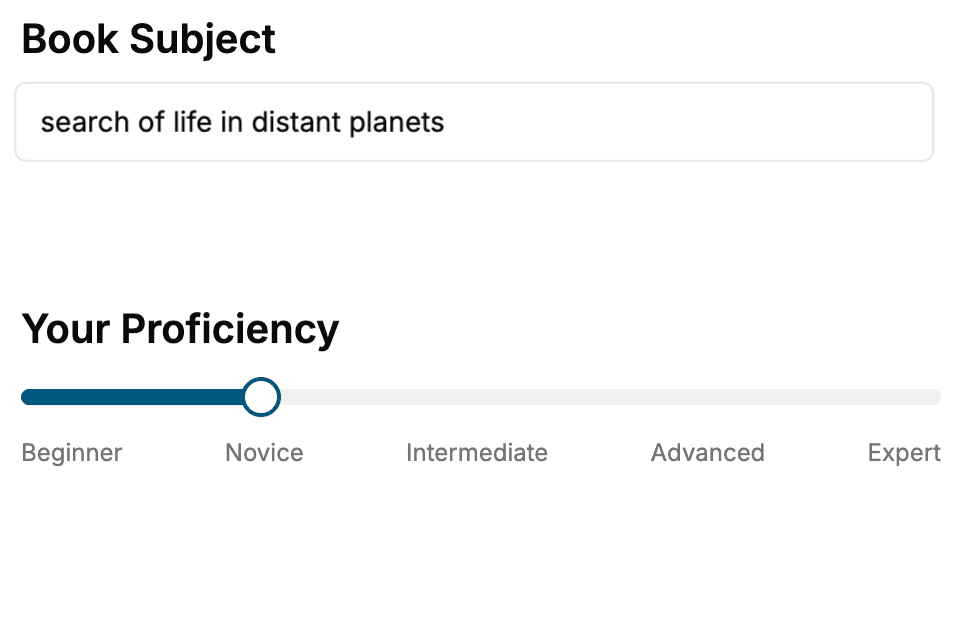
- 1. Select your focus
Select the focus of your Academic Writing book and share your background
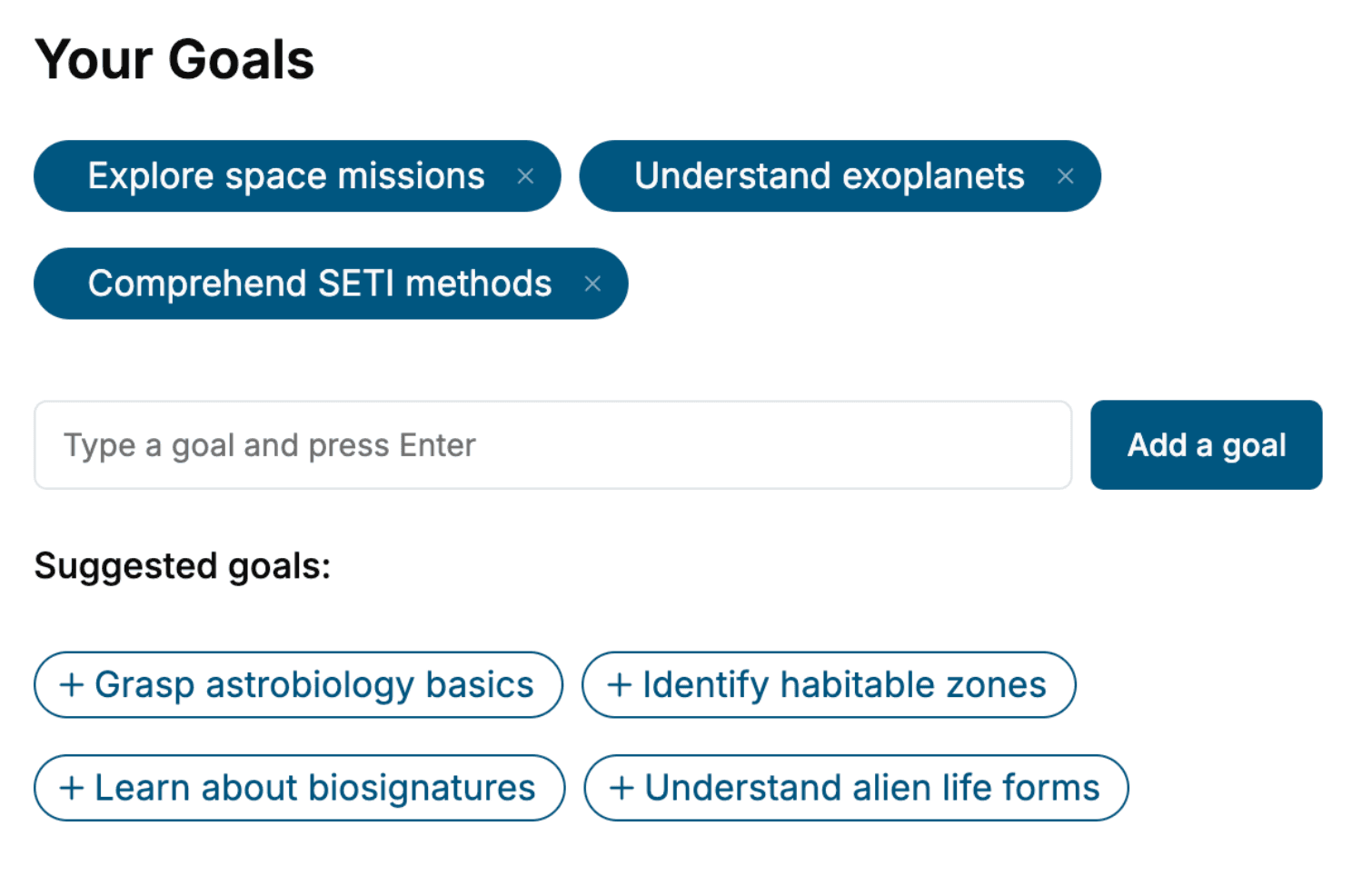
- 2. Personalize your book
Specify your goals and choose sub-topics to include
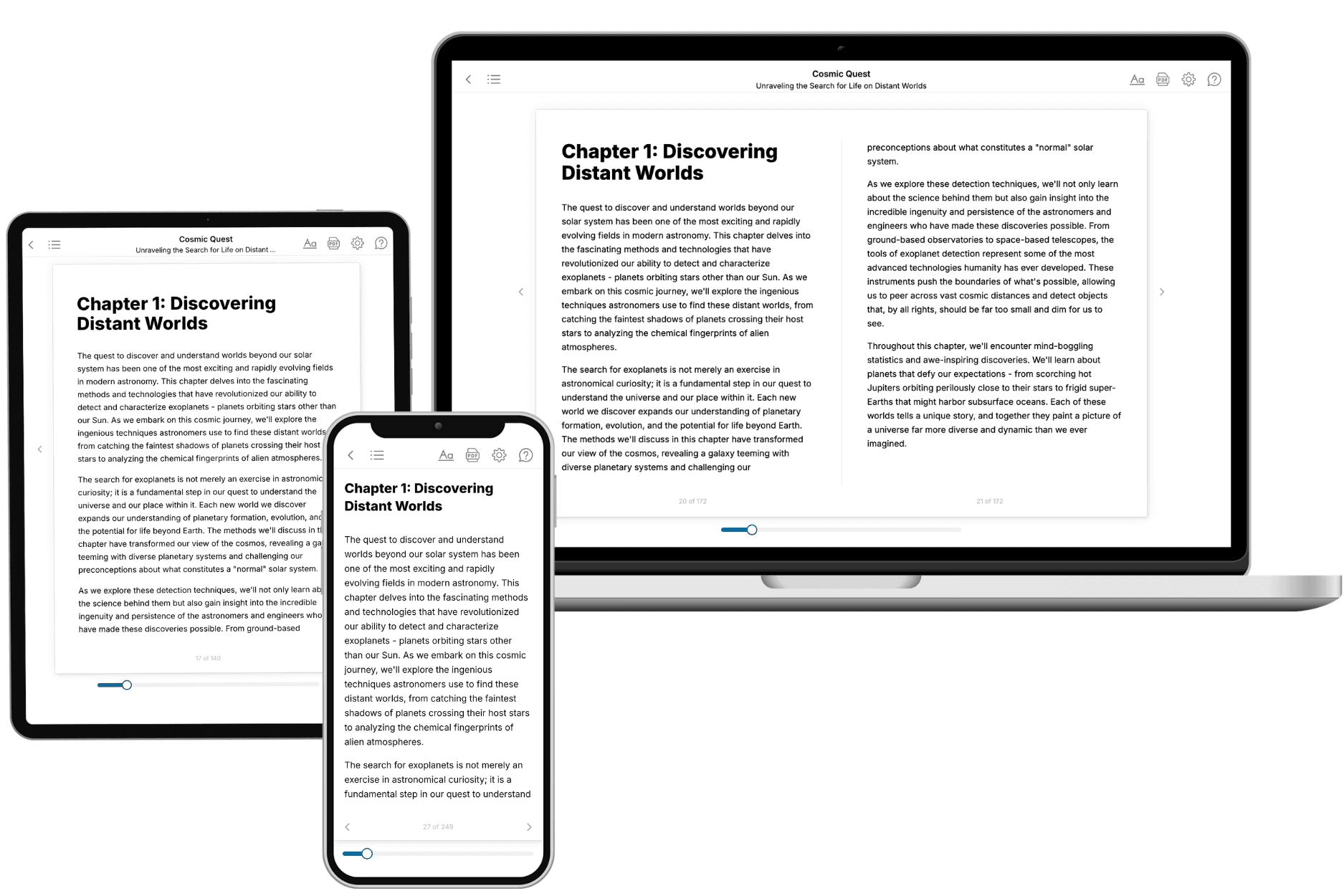
- 3. Get your tailored book
Your book is ready in 10 minutes. Read it online, download as EPUB or PDF, or send to Kindle.
Frequently asked questions
- What is TailoredRead?
TailoredRead creates complete, full-length nonfiction ebooks, written specifically for you. Tell us what you want to learn and why, and TailoredRead writes you a complete ebook on it, with charts, tables, and diagrams throughout. Read it online, on Kindle, or on any e-reader, or download it as a PDF or EPUB. Every book is written fresh the day you order it.
- How is the book tailored to me?
Before anything is written, you answer a few short questions about your goals, your background, and the topics you care about. Your book is then planned around your answers: written at your level, focused on your goals, and covering the topics you chose, instead of the one-size-fits-all book a store sells everyone.
- Will it read like generic AI content?
No. Your book isn't a chat transcript: it's planned chapter by chapter before a single word is written, told in a clear book voice, and explains ideas visually with charts, tables, and diagrams. After writing, every book goes through an editorial pass that polishes chapters so the book reads consistent from start to finish. Judge for yourself: browse thousands of sample books on our Explore Books page.
- How accurate is the content?
Our AI first checks whether your subject needs live research. Niche and fast-moving subjects are researched before writing, and the book plan and chapters are grounded in what it finds. After writing, every book goes through a quality pass that checks its facts and consistency, and researched books list their sources in a Notes section at the back.
- How long is the book?
You choose the length: Comprehensive (250-300 pages), Detailed (150-200 pages), Essential (70-100 pages), or Short (30-50 pages).
- Does the book include visuals?
Yes. Every book includes charts, tables, and diagrams: timelines, checklists, step-by-step guides, decision trees, comparison tables, matrices, and bar charts. A typical book includes dozens of these visual elements.
- Can I read it on Kindle? What formats can I download?
Yes. Every book can be read in our online reader or downloaded as a PDF or EPUB. The EPUB can be opened with Kindle, Apple Books, Kobo, and any e-reader. The Commercial and Author licenses also include an editable Word (DOCX) and Markdown download.
- How much does it cost?
About the price of a regular ebook. The exact price depends on your book's length and complexity, from $2 for the shortest books to $35 for the most comprehensive, and it's shown when you review your book, before you commit to anything. Each book is a one-time purchase, yours to keep, no subscription. Licenses that let you share, teach, or publish your book range from $35.99 to $49.99.
- Can I preview the book before purchasing?
Before you pay, you'll see what your book will cover: the title, a detailed description, the estimated length, and the complete chapter-by-chapter table of contents, so you know what you're getting before you decide. The full text itself is written after you purchase.
- How long does it take to create a book?
About 10 minutes. You can start reading the opening chapters while the rest is still being written.