Rheology Essentials
Understanding Fluid Behavior and Material Flow in Everyday Applications
Most people think rheology is an obscure academic subject with no practical relevance to their work.
191 pages8 chaptersDec 13, 2025Materials Science
About this book
In reality, understanding how materials flow and deform under stress is fundamental to countless industries—from manufacturing pharmaceuticals to designing better concrete, from creating cosmetics to optimizing food production. This book cuts through the complexity and shows you exactly why rheology matters and how to apply it. You'll discover the difference between Newtonian and non-Newtonian fluids, learn how to measure and predict material behavior, and understand the viscoelastic properties that make certain materials uniquely valuable. Whether you're an engineer selecting materials, a manufacturer optimizing processes, or a professional seeking deeper knowledge of mechanics, this guide provides the practical insights and real-world examples you need to make better decisions. Clear explanations, practical applications, and actionable knowledge transform rheology from theoretical concept into a powerful tool for improving performance and innovation.
Table of contents
- IntroductionWhy Rheology Matters in the Modern World, What You'll Learn and How to Use This Book, Common Misconceptions About Material FlowRead below
- Chapter 1: Fundamentals of RheologyDefining Rheology: The Science of Flow and Deformation, Understanding Stress and Strain, Viscosity: The Resistance to Flow, Historical Development of Rheological Science
- Chapter 2: Newtonian Fluids and Linear BehaviorWhat Makes a Fluid Newtonian, Constant Viscosity Across Shear Rates, Real-World Examples of Newtonian Fluids, Mathematical Relationships and Equations
- Chapter 3: Non-Newtonian Fluids and Complex BehaviorIntroduction to Non-Newtonian Behavior, Shear-Thinning (Pseudoplastic) Fluids, Shear-Thickening (Dilatant) Fluids, Plastic and Bingham Fluids
- Chapter 4: Viscoelasticity and Material MemoryElastic and Viscous Behavior Combined, Storage Modulus and Loss Modulus, Relaxation Time and Material Memory, Applications in Polymers and Biological Systems
- Chapter 5: Temperature and Pressure EffectsHow Temperature Affects Viscosity, Pressure Effects on Material Properties, Time-Dependent Behavior and Thixotropy, Predictive Models for Property Changes
- Chapter 6: Rheological Measurement and TestingTypes of Viscometers and Rheometers, Standard Measurement Techniques and Protocols, Interpreting Rheological Data, Quality Control and Consistency Testing
- Chapter 7: Industrial Applications and Case StudiesFood and Beverage Processing, Pharmaceutical and Cosmetic Manufacturing, Polymer Processing and Plastics, Construction Materials and Concrete
- Chapter 8: Advanced Rheological ConceptsNon-Linear Viscoelasticity, Suspension Rheology and Particle Effects, Flow Instabilities and Turbulence
- ConclusionKey Takeaways and Practical Insights, The Future of Rheology and Emerging Applications
- Glossary of Rheological Terms
- Further Reading and Resources
Introduction
Every day, you encounter materials that flow, deform, and respond to forces in ways that seem almost magical. Ketchup refuses to pour from the bottle until you shake it vigorously, then suddenly flows freely. Paint spreads smoothly under your brush but doesn't drip down the wall. Silly putty bounces like a ball when thrown but slowly spreads into a puddle when left on a table. These behaviors aren't random quirks—they're governed by the principles of rheology, the science of how materials flow and deform under applied stress. Understanding these principles transforms seemingly mysterious material behaviors into predictable, controllable phenomena that you can harness for practical applications.
Rheology sits at the intersection of physics, chemistry, and engineering, providing the framework for understanding everything from blood flow in your arteries to the consistency of concrete in a construction project. Despite its fundamental importance, rheology remains surprisingly misunderstood outside specialized academic circles. Many professionals working with materials daily—engineers designing products, manufacturers optimizing processes, quality control specialists ensuring consistency—lack the rheological knowledge that could dramatically improve their outcomes. This knowledge gap leads to costly trial-and-error approaches, unexpected product failures, and missed opportunities for innovation. The good news is that rheological principles, once properly explained, are accessible and immediately applicable to real-world challenges.
This book bridges the gap between theoretical rheology and practical application. You won't find dense mathematical derivations or abstract concepts disconnected from reality. Instead, you'll discover clear explanations of how materials behave, why they behave that way, and how to predict and control their behavior in your specific applications. Whether you're formulating a new cosmetic product, selecting materials for a manufacturing process, troubleshooting quality issues, or simply seeking to understand the mechanics of material flow, this guide provides the knowledge you need. The principles you'll learn apply across industries—from pharmaceuticals to food processing, from polymer manufacturing to construction—making rheology one of the most versatile and valuable areas of applied science you can master.
The approach here is deliberately practical and example-driven. Each concept is illustrated with real-world scenarios that demonstrate why it matters and how to apply it. You'll see specific numbers, measurable outcomes, and actionable steps rather than vague generalities. The goal is not to make you a rheology researcher but to give you the working knowledge that improves your decision-making, enhances your problem-solving capabilities, and enables you to communicate effectively with specialists when needed. By the end of this book, you'll view materials differently—seeing not just what they are, but how they'll behave under the specific conditions of your application.
Why Rheology Matters in the Modern World
The modern economy depends on materials that behave in precisely controlled ways. Consider the pharmaceutical industry, where drug delivery systems must release active ingredients at specific rates under varying conditions inside the human body. A tablet coating that dissolves too quickly renders the medication ineffective; one that dissolves too slowly may cause the drug to pass through the digestive system without being absorbed. These behaviors are fundamentally rheological problems. The viscosity of the coating solution during application, the viscoelastic properties of the dried film, and the dissolution rate in gastric fluids all determine whether a medication works as intended. Pharmaceutical companies invest millions in rheological testing and formulation optimization because the stakes—patient health and regulatory approval—are extraordinarily high.
Manufacturing efficiency and product quality across industries hinge on rheological understanding. In polymer processing, the flow behavior of molten plastic determines whether injection molding produces parts with uniform properties or creates weak spots and defects. A polymer that's too viscous requires excessive pressure and energy to process, increasing costs and potentially damaging equipment. One that's not viscous enough may not fill mold cavities completely, creating incomplete parts. Processing temperatures, shear rates during flow, and cooling rates all interact with the material's rheological properties to determine the final product quality. Engineers who understand these relationships can optimize processing conditions, reduce waste, and improve consistency—advantages that translate directly to competitive advantage and profitability.
The food industry provides particularly vivid examples of rheology's practical importance. Texture is a critical quality attribute for food products, and texture is fundamentally a rheological property. The creaminess of yogurt, the spreadability of butter, the pourability of salad dressing, and the mouthfeel of chocolate all depend on carefully controlled rheological characteristics. Consider chocolate manufacturing: cocoa butter exhibits complex temperature-dependent behavior, and the tempering process—heating and cooling chocolate through specific temperature ranges—controls the crystal structure that determines whether the final product has the desired snap, gloss, and melt-in-your-mouth quality. Without rheological knowledge, chocolate makers would be unable to consistently produce high-quality products. The same principles apply to countless other foods, from mayonnaise to ice cream to bread dough.
Construction and infrastructure development rely heavily on rheological principles, though this connection often goes unrecognized. Concrete is a complex non-Newtonian fluid whose flow properties determine workability during placement and strength after curing. Fresh concrete must be fluid enough to flow into forms and around reinforcing steel, yet viscous enough to maintain its shape and not segregate. The rheology of concrete depends on water content, cement composition, aggregate properties, and chemical admixtures. Modern high-performance concrete formulations use rheology modifiers—chemicals that alter flow behavior—to achieve properties impossible with traditional mixes. Self-consolidating concrete, which flows into complex forms without vibration, represents a rheological innovation that reduces labor costs and enables architectural designs previously impractical. Understanding concrete rheology allows engineers to specify appropriate mixes for specific applications and troubleshoot problems like excessive bleeding or inadequate consolidation.
Environmental and energy applications increasingly depend on rheological expertise. Oil and gas extraction involves pumping fluids through porous rock formations, and the efficiency of this process depends critically on fluid rheology. Hydraulic fracturing fluids must be viscous enough to carry proppant particles into fractures but must break down to low viscosity afterward to allow oil and gas to flow. Drilling muds must suspend rock cuttings and transport them to the surface while maintaining appropriate pressure in the wellbore. In renewable energy, the rheology of battery electrode slurries affects coating uniformity and ultimately battery performance. Wind turbine blade manufacturing requires epoxy resins with carefully controlled flow properties to ensure complete impregnation of fiber reinforcements. As energy technologies advance, rheological challenges become more complex and more critical to success.
Biological and medical applications represent a rapidly growing frontier for rheological science. Blood is a complex non-Newtonian fluid whose flow properties affect cardiovascular health. Abnormal blood rheology contributes to conditions like thrombosis and poor circulation. Synovial fluid in joints exhibits remarkable viscoelastic properties that provide both lubrication and shock absorption—properties that researchers are trying to replicate in artificial joint replacements. Mucus rheology affects respiratory health, with conditions like cystic fibrosis involving abnormally viscous mucus that impairs lung function. Understanding these biological rheological systems opens possibilities for new diagnostic tools and therapeutic interventions. Medical device designers must consider the rheology of materials that contact body fluids, ensuring compatibility and appropriate performance under physiological conditions.
The digital revolution has created new rheological challenges in electronics manufacturing. Solder pastes used in circuit board assembly must have precise rheological properties: they must be printable through fine stencils, maintain their shape before reflow, and then flow to create reliable electrical connections when heated. Conductive inks for printed electronics must flow smoothly during deposition but quickly develop structure to prevent spreading. Thermal interface materials that conduct heat away from processors must be easily applied yet maintain contact under thermal cycling. As electronic devices become smaller and more complex, the rheological requirements for manufacturing materials become more demanding. Companies that master these rheological challenges gain significant advantages in yield, reliability, and manufacturing speed.
Personal care and cosmetics represent a consumer-facing industry where rheology directly affects product success. Consumers judge products largely by texture and application properties—all rheological characteristics. A lotion that feels greasy or doesn't spread easily will fail regardless of its chemical efficacy. Shampoo must pour easily from the bottle, spread through hair, and rinse cleanly—each step involving different rheological requirements. Lipstick must be soft enough to apply smoothly but firm enough to maintain its shape in the tube and on lips. Formulators in this industry are essentially applied rheologists, adjusting compositions to achieve target flow and deformation behaviors. The difference between a successful product and a market failure often comes down to getting the rheology right, making this knowledge directly valuable to product development teams.
What You'll Learn and How to Use This Book
This book is structured to build your rheological knowledge systematically, starting with fundamental concepts and progressing to practical applications. You'll begin by understanding what rheology actually is—the study of how materials respond to applied forces over time. This foundation includes the critical concepts of stress (force per unit area applied to a material) and strain (the resulting deformation), along with the relationship between them. You'll learn why some materials respond instantly to stress while others respond slowly, and why some materials return to their original shape when stress is removed while others flow permanently. These fundamental concepts provide the vocabulary and conceptual framework for everything that follows.
The distinction between Newtonian and non-Newtonian fluids forms a central organizing principle throughout the book. Newtonian fluids—like water, mineral oil, and simple solvents—have constant viscosity regardless of how fast you stir them or how much force you apply. Non-Newtonian fluids—like ketchup, paint, and blood—change their viscosity depending on the applied stress or shear rate. You'll learn to recognize which category a material falls into and what that means for practical applications. This distinction isn't academic; it determines which equations you can use to predict behavior, which processing equipment is appropriate, and which quality control tests are meaningful. Understanding this difference prevents costly mistakes and enables informed material selection.
Viscoelasticity—the combination of viscous flow and elastic deformation—receives detailed attention because it describes so many practically important materials. Polymers, biological tissues, food products, and many industrial materials exhibit viscoelastic behavior. You'll learn how to characterize this behavior using concepts like storage modulus (elastic response) and loss modulus (viscous response), and what these measurements tell you about material performance. More importantly, you'll see how viscoelastic properties determine real-world performance: why some materials bounce back after deformation while others sag, why some materials creep slowly under constant load, and why processing history affects final properties. These insights enable you to predict long-term material behavior from short-term tests and to design products that maintain their properties over their intended lifetime.
Temperature and pressure effects on rheological properties receive practical treatment with emphasis on prediction and control. You'll learn that viscosity typically decreases dramatically with increasing temperature—a relationship quantified by models like the Arrhenius equation. This temperature dependence affects everything from processing conditions to storage stability to end-use performance. Pressure effects, while often smaller, become critical in applications like injection molding and hydraulic systems. Time-dependent effects like thixotropy (viscosity decreasing with time under constant shear) and rheopexy (viscosity increasing with time) explain behaviors that seem mysterious without rheological knowledge. You'll gain practical tools for predicting how materials will behave under your specific conditions rather than relying solely on standard test data that may not match your application.
Measurement and testing methods are covered with emphasis on selecting appropriate techniques and interpreting results correctly. You'll learn about different types of viscometers and rheometers, understanding what each measures and when to use it. More importantly, you'll learn how to design meaningful tests that answer your specific questions:
- Rotational rheometry for measuring viscosity as a function of shear rate, essential for understanding non-Newtonian behavior
- Oscillatory testing for characterizing viscoelastic properties without destroying sample structure
- Capillary rheometry for high-shear-rate measurements relevant to processing conditions
- Extensional rheometry for materials that experience stretching rather than shearing
Industrial applications and case studies throughout the book demonstrate how rheological principles solve real problems. Rather than abstract examples, you'll see specific scenarios: formulating a pharmaceutical suspension that remains uniform during storage but pours easily when needed, optimizing concrete mix designs for specific placement conditions, troubleshooting coating defects caused by inappropriate rheology, and selecting polymer grades for injection molding based on flow properties. These case studies illustrate the decision-making process, showing not just what to do but why, and how to adapt principles to your specific situation. The goal is to develop your intuition so you can apply rheological thinking to novel problems you encounter.
The book is designed for flexible use depending on your needs and background. If you're new to rheology, reading sequentially from beginning to end provides a logical progression from fundamentals to applications. If you have some background and need information on specific topics, each chapter stands relatively independently with cross-references to related concepts. If you're facing a specific practical problem, the application-focused chapters and case studies may be your starting point, with references back to fundamental concepts as needed. Throughout, the emphasis remains on understanding rather than memorization—grasping why materials behave as they do rather than simply cataloging behaviors. This understanding enables you to extrapolate beyond specific examples to solve the unique challenges you face.
Mathematical content is included where it provides genuine insight or practical utility, but always with clear explanation of what equations mean physically and how to use them. You won't need advanced mathematics to benefit from this book, but you will encounter some equations because they're the most precise way to express relationships between variables. When an equation appears, you'll see:
- What each symbol represents in physical terms
- What the equation tells you about material behavior
- How to use it for practical calculations or predictions
- Its limitations and when it doesn't apply
Common Misconceptions About Material Flow
One of the most pervasive misconceptions is that viscosity is a fixed material property like density or melting point. In reality, viscosity is a function that depends on multiple variables including temperature, shear rate, pressure, and time. Saying "the viscosity of this material is 1000 centipoise" is incomplete and potentially misleading unless you specify the conditions under which that viscosity was measured. For Newtonian fluids, viscosity is independent of shear rate (though still temperature-dependent), so a single value at a specified temperature is meaningful. For non-Newtonian fluids, which include most industrially important materials, viscosity changes with shear rate, sometimes by orders of magnitude. A paint might have a viscosity of 50,000 centipoise at rest but only 500 centipoise when brushed—a hundred-fold difference. Recognizing that viscosity is condition-dependent rather than fixed is essential for meaningful material characterization and process design.
Another common misconception is that "thicker" always means "more viscous" in a simple, universal sense. While this intuition works for Newtonian fluids at constant temperature, it breaks down for non-Newtonian materials. Consider two materials: one is highly viscous at low shear rates but thins dramatically when stirred (shear-thinning), while another has lower viscosity at rest but doesn't thin much with shearing. Which is "thicker"? The answer depends entirely on the conditions of your application. If you're pouring the material slowly, the first is thicker. If you're pumping it rapidly through a pipe, the second might be thicker. This context-dependence means you must characterize materials under conditions relevant to your application rather than relying on single-point viscosity measurements that may not represent actual use conditions.
Many people assume that materials are either liquids or solids, with clear and permanent distinction between the two. Rheology reveals this as a false dichotomy. Viscoelastic materials exhibit both liquid-like and solid-like behavior depending on the timescale of observation and the type of deformation applied. Silly putty demonstrates this dramatically: it bounces elastically when thrown (short timescale, rapid deformation) but flows like a viscous liquid when left on a table (long timescale, slow deformation). The same material behaves as both solid and liquid depending on conditions. This dual nature isn't unusual—it's characteristic of polymers, biological materials, suspensions, and many other practically important substances. Understanding that materials can exhibit both behaviors, and that the balance between them depends on conditions, is crucial for predicting performance and avoiding failures.
A related misconception is that elastic materials always return instantly to their original shape when stress is removed. True elastic materials (like steel springs in their normal operating range) do respond essentially instantaneously, but viscoelastic materials exhibit delayed elastic recovery. When you deform a viscoelastic material and then remove the stress, it recovers gradually over time rather than instantly. The timescale of this recovery—characterized by the relaxation time—varies enormously between materials, from milliseconds to hours or even days. This delayed recovery affects everything from how quickly a polymer part springs back after demolding to how long it takes for bread dough to relax after kneading. Ignoring relaxation time leads to problems like trying to process materials before they've fully recovered from previous deformation, resulting in residual stresses and dimensional instability.
Many practitioners believe that rheological testing is only relevant for quality control—checking that materials meet specifications—rather than for fundamental understanding and problem-solving. This narrow view misses rheology's greatest value. While quality control is certainly important, rheological measurements provide diagnostic information that reveals why materials behave as they do and how to modify them to achieve desired properties. When a coating develops defects, rheological testing can identify whether the problem is excessive viscosity preventing proper flow, insufficient viscosity causing sagging, or time-dependent behavior causing uneven drying. When a polymer part warps after molding, rheological analysis can reveal whether the issue is inadequate relaxation time, inappropriate processing temperature, or excessive residual stress. Rheology transforms troubleshooting from guesswork into systematic diagnosis, and enables formulation optimization based on understanding rather than trial and error.
Another misconception is that rheological behavior is purely a material property independent of processing history. In reality, many materials are thixotropic—their structure and therefore their rheology change depending on their shear history. A thixotropic material that's been vigorously mixed has lower viscosity than the same material at rest, and it takes time for the structure to rebuild and viscosity to recover after mixing stops. This time-dependent behavior is intentional in many products: paint should have low viscosity during brushing (when it's being sheared) but should quickly develop higher viscosity afterward to prevent sagging. Ignoring thixotropy leads to confusion when the same material seems to have different viscosities at different times, or when processing conditions that worked initially stop working after the material has been stored or recirculated. Understanding that structure and rheology can change with processing history is essential for consistent results.
Some people assume that rheological properties can be adequately characterized by simple tests like measuring how long it takes material to flow through a cup with a hole in the bottom (flow cup tests). While such simple tests have their place for routine quality control, they provide very limited information and can be misleading. A flow cup test gives you one number—an efflux time—that conflates multiple rheological properties and provides no information about how viscosity varies with shear rate, whether the material is viscoelastic, or how it responds to different conditions. Two materials with identical flow cup times might behave completely differently in your application if one is Newtonian and the other is shear-thinning, or if one is purely viscous and the other is viscoelastic. Proper rheological characterization requires measurements that separate different aspects of behavior and provide information about how properties vary with conditions. Simple tests are useful for checking consistency but insufficient for understanding behavior or solving problems.
Finally, there's a misconception that rheology is so complex and mathematical that it's only accessible to specialists with advanced degrees. While rheology can certainly be studied at highly theoretical levels, the practical application of rheological principles doesn't require advanced mathematics or specialized training. The core concepts—how materials respond to forces, how viscosity changes with conditions, how elastic and viscous behaviors combine—are intuitive once properly explained. You don't need to derive constitutive equations from first principles to apply rheological thinking to practical problems. What you need is understanding of key concepts, familiarity with how different materials behave, and knowledge of which measurements provide useful information for your applications. This book provides exactly that practical knowledge, making rheology accessible and immediately useful regardless of your mathematical background. The goal is to demystify rheology and show that it's a practical tool for solving real problems, not an obscure academic specialty disconnected from everyday work.
This is the end of the free sample. The full book has 8 chapters.
Want this book written for you?
Tell us your goals and background, and get your own version of this book, tailored by AI to you.


Benefits of AI-tailored books
- Read one book, not ten:
- all the Materials Science knowledge you need, gathered into a single book.
- Save days of learning:
- tell us your goals, choose your topics, and the whole book is built around them.
- Learn effortlessly:
- Materials Science book written for your specific background and expertise.
- Understand at a glance:
- includes charts, tables, timelines, checklists, decision trees, and more.
- Stay current:
- written the day you order it, not years ago.
- Trust what you read:
- every book is checked for accuracy, with real research when your subject needs it.
Create your unique book in 3 steps
- 1. Select your focus
Select the focus of your Materials Science book and share your background
- 2. Personalize your book
Specify your goals and choose sub-topics to include
- 3. Get your tailored book
Your book is ready in 10 minutes. Read it online, download as EPUB or PDF, or send to Kindle.


Frequently asked questions
- What is TailoredRead?
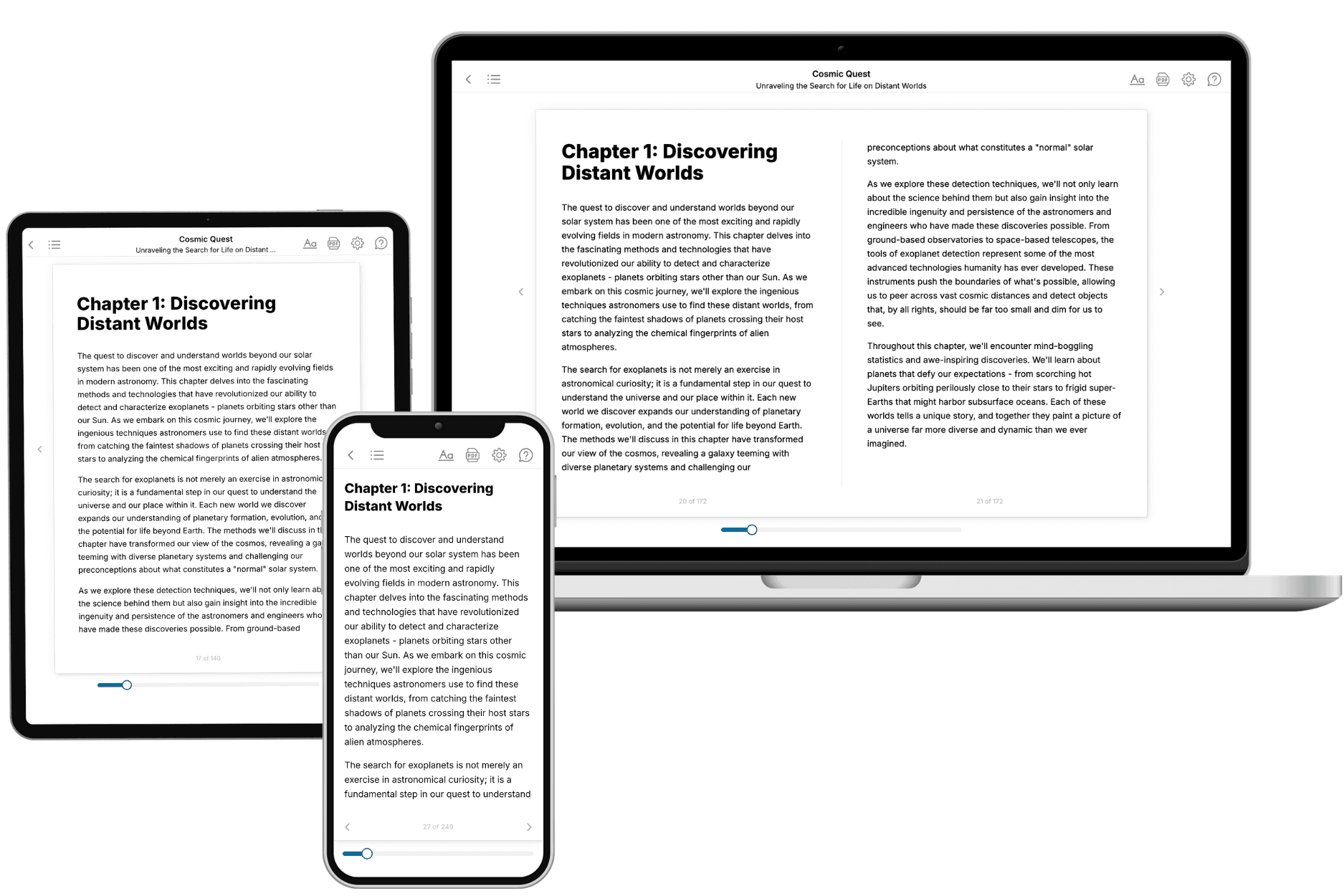
TailoredRead creates complete, full-length nonfiction ebooks, written specifically for you. Tell us what you want to learn and why, and TailoredRead writes you a complete ebook on it, with charts, tables, and diagrams throughout. Read it online, on Kindle, or on any e-reader, or download it as a PDF or EPUB. Every book is written fresh the day you order it.
- How is the book tailored to me?
Before anything is written, you answer a few short questions about your goals, your background, and the topics you care about. Your book is then planned around your answers: written at your level, focused on your goals, and covering the topics you chose, instead of the one-size-fits-all book a store sells everyone.
- Will it read like generic AI content?
No. Your book isn't a chat transcript: it's planned chapter by chapter before a single word is written, told in a clear book voice, and explains ideas visually with charts, tables, and diagrams. After writing, every book goes through an editorial pass that polishes chapters so the book reads consistent from start to finish. Judge for yourself: browse thousands of sample books on our Explore Books page.
- How accurate is the content?
Our AI first checks whether your subject needs live research. Niche and fast-moving subjects are researched before writing, and the book plan and chapters are grounded in what it finds. After writing, every book goes through a quality pass that checks its facts and consistency, and researched books list their sources in a Notes section at the back.
- How long is the book?
You choose the length: Comprehensive (250-300 pages), Detailed (150-200 pages), Essential (70-100 pages), or Short (30-50 pages).
- Does the book include visuals?
Yes. Every book includes charts, tables, and diagrams: timelines, checklists, step-by-step guides, decision trees, comparison tables, matrices, and bar charts. A typical book includes dozens of these visual elements.
- Can I read it on Kindle? What formats can I download?
Yes. Every book can be read in our online reader or downloaded as a PDF or EPUB. The EPUB can be opened with Kindle, Apple Books, Kobo, and any e-reader. The Commercial and Author licenses also include an editable Word (DOCX) and Markdown download.
- How much does it cost?
About the price of a regular ebook. The exact price depends on your book's length and complexity, from $2 for the shortest books to $35 for the most comprehensive, and it's shown when you review your book, before you commit to anything. Each book is a one-time purchase, yours to keep, no subscription. Licenses that let you share, teach, or publish your book range from $35.99 to $49.99.
- Can I preview the book before purchasing?
Before you pay, you'll see what your book will cover: the title, a detailed description, the estimated length, and the complete chapter-by-chapter table of contents, so you know what you're getting before you decide. The full text itself is written after you purchase.
- How long does it take to create a book?
About 10 minutes. You can start reading the opening chapters while the rest is still being written.