The Right Dose for You
A science-minded path to supplements that fit your body
Picture a morning when your daily routine feels settled, your choices feel deliberate, and the bottles on your counter reflect a plan you actually understand.
222 pages10 chaptersOct 23, 2026SupplementsCreated by Petra
About this book
This book is written to help you get there. Instead of chasing whatever supplement is trending this season, you will find a calm, science-based way to think about what your body may need, what the evidence really shows, and how to tell whether a change is helping. Inside, you will explore how personalized supplementation is built step by step: starting with your diet, life stage, and health context, then considering biological profiling and what its results can and cannot tell you. You will learn why dosage optimization matters more than dosage maximization, how to read research with a critical eye, and how to separate persuasive marketing from meaningful data. The book also shows how to set up simple outcome monitoring so your decisions are reviewed rather than repeated out of habit. Throughout, the emphasis stays on general education and practical reasoning. Where interactions, medical conditions, or medications come into play, you will see why a qualified clinician should be part of the conversation. Clear, accessible, and grounded in evidence, this book is built for anyone who wants smarter supplement decisions and the confidence that comes from understanding the reasoning behind them.
Table of contents
- IntroductionWhy Generic Supplement Advice Falls Short, How to Use This Book Well, Scope, Limits, and Professional GuidanceRead below
- Chapter 1: What Personalized Supplementation Really MeansStarting With Your Everyday Diet, How Life Stage Shapes Nutrient Needs, Nutrients Versus Branded Products
- Chapter 2: Understanding Nutrients and Their RolesEssential Vitamins and Minerals Explained, Why Chemical Form Affects Absorption, The Food-First Principle and Its Limits
- Chapter 3: Biological Profiling Without the HypeCommon Biomarkers and What They Measure, Limits of Single Tests and Snapshots, Working With Clinicians on Interpretation
- Chapter 4: Thinking Through Dosage OptimizationThe Dose-Response Relationship Explained, Tolerable Upper Intake Levels Overview, Timing, Food Pairing, and Dosage Form
- Chapter 5: Interactions, Conditions, and Safety ConsiderationsSupplement and Medication Interaction Basics, Pregnancy, Children, and Older Adults, Recognizing Warning Signs Worth Reporting
- Chapter 6: Reading Supplement Research With a Critical EyeStudy Designs From Observational to Trials, How Systematic Reviews Strengthen Evidence, Spotting Weak Claims and Misleading Headlines
- Chapter 7: Decoding Labels, Marketing, and Quality ClaimsReading Supplement Facts Panels Carefully, Third-Party Testing and Quality Seals, Testimonials, Trends, and Persuasive Language
- Chapter 8: Monitoring Outcomes Over TimeDefining Measurable Goals Before Starting, Simple Tracking Methods for Everyday Life, Scheduling Reviews and Deciding to Stop
- Chapter 9: Building a Simple, Reviewable Supplement PlanCore Components of a Sound Plan, Changing One Variable at a Time, Documenting Decisions for Future Review
- Chapter 10: Working With Qualified ProfessionalsPreparing for a Conversation With Your Clinician, Questions Worth Asking Your Provider, Turning Advice Into Shared Decisions
- ConclusionCarrying the Framework Forward
- Further Reading and Resources
- Glossary
Introduction
A bottle of magnesium glycinate sits next to a bottle of magnesium oxide on a pharmacy shelf, priced almost the same, labeled almost the same, and bought by people who have no way of knowing which one their body will actually use. One of them might barely be absorbed before it moves through the digestive tract. The other might do exactly what the shopper hoped for. Nobody tells them this at checkout. This is the ordinary, unglamorous problem that this book was built to address: not whether supplements work in general, but whether a specific nutrient, in a specific form, at a specific dose, makes sense for a specific person.
Most supplement advice is written for an average person who does not exist. A recommendation to take a standard dose of vitamin D, or a multivitamin "just in case," treats a twenty-five-year-old marathon runner the same as a seventy-year-old with limited sun exposure and a restricted diet. Both might walk away from that advice with a bottle that does little for them, or in rare cases, one that interacts badly with something else they are taking. The problem is not that generic advice is dishonest. It is that it answers a question nobody asked: what might help someone, somewhere, in theory. It does not answer the question that actually matters, which is what might help you.
This book treats supplementation as a decision-making process rather than a shopping list. That process has recognizable steps: understanding your own diet and life stage, learning what a nutrient actually does in the body, considering whether biological testing adds useful information, reasoning through dosage rather than guessing at it, checking for interactions, reading research with some skepticism, decoding labels and marketing claims, tracking whether anything changed, and building a plan that can be reviewed and adjusted. Each of those steps gets its own chapter later in the book. The introduction exists to set expectations before that work starts, so the reasoning in later chapters lands on solid ground rather than on assumptions nobody named out loud.
None of this is a substitute for a conversation with a qualified clinician, and that point will return often enough to feel repetitive, because it is the single most important boundary around everything else in the book. What follows is a framework for thinking clearly, asking better questions, and recognizing when evidence is strong or weak. It is not a diagnostic tool, a treatment plan, or a replacement for individualized medical advice. Keeping that boundary visible from the start makes the rest of the book more useful, not less, because it frees the discussion to focus on reasoning rather than on prescribing.
Why Generic Supplement Advice Falls Short
Generic advice tends to start in the wrong place. It starts with a nutrient or a product, something like "take omega-3s" or "everyone should supplement vitamin D," and works backward toward a justification. Personalized supplementation works in the opposite direction. It starts with a person: what they eat on a typical week, how old they are, whether they are pregnant, recovering from illness, training heavily, or aging in ways that change how their body absorbs and uses nutrients. The nutrient question only comes after those personal facts are on the table. This reversal is small to describe but large in consequence, because it changes almost every downstream decision about dose, form, and timing.
Consider two people who both decide to look into iron supplementation. One is a woman in her thirties with heavy menstrual cycles and a diet low in red meat, who feels tired most afternoons. The other is a man in his sixties with a normal diet and no symptoms, who read an article claiming iron improves energy and decided to try it. The first person has a plausible, context-specific reason to investigate further, ideally with bloodwork. The second person is applying a general claim to a situation where it may not fit at all, and iron supplementation taken without a true need can cause its own problems over time. The exact same supplement, approached two different ways, describes exactly why diet, life stage, and personal context has to come first.
Life stage alone changes nutrient needs enough that a single dosage recommendation printed on a label cannot possibly suit everyone who picks up the bottle. A pregnant person, an active teenager, a postmenopausal adult, and a person in their eighties with reduced kidney function are not variations on the same baseline. They are different biological situations with different requirements, different risks, and sometimes opposite considerations for the exact same nutrient. A fixed number on a label is a starting reference, not a verdict, and later chapters on life-stage needs and dosage reasoning will unpack how to think through that gap rather than defer to the printed number by default.
Diet is the other half of the starting point, and it gets skipped constantly in casual supplement talk. Someone who eats fatty fish twice a week, gets regular sun exposure, and cooks with a wide variety of vegetables has a meaningfully different baseline than someone who eats mostly processed food indoors. Supplementation decisions made without accounting for that baseline tend to either duplicate what the diet already supplies, which wastes money and occasionally pushes intake past a reasonable ceiling, or miss a real gap that diet alone does not close. The diet as baseline idea, covered in depth in the chapter on personalized supplementation basics, is the first real filter any nutrient decision should pass through.
Generic advice also tends to flatten the difference between a nutrient and the branded product that claims to deliver it. A label promising "advanced absorption" or "clinical strength" is making a marketing claim, not a biological one, and the gap between those two things is often where money gets wasted. Two products can list the same nutrient and the same milligram amount on the front of the box while differing meaningfully in chemical form, in how the body absorbs that form, and in whether independent testing backs up what is printed. Treating "vitamin" as one simple idea instead of a family of chemical forms with different behaviors in the body is exactly the kind of shortcut that generic advice encourages and personalized reasoning corrects.
There is also a timing problem with generic advice: it rarely gets updated as a person's circumstances change. A recommendation that fit someone's needs five years ago, before a pregnancy, a new medication, a move to a different climate, or a change in diet, may no longer fit today. Personalized supplementation is not a one-time decision frozen in place. It is closer to a habit of periodic review, revisited whenever life stage or health context shifts meaningfully. The chapters on outcome monitoring and review scheduling later in the book return to this idea directly, framing supplementation as something to be checked on rather than something to be set once and forgotten.
None of this means generic guidelines are worthless. Population-level recommendations exist because they are useful starting references, built from research on large groups of people, and they remain a reasonable first anchor when nothing else is known about an individual. The argument here is narrower: a population average is a starting point, not a finish line, and the gap between the average and the individual is precisely the space where personalized reasoning does its work. Learning to notice that gap, and to ask what it means for a particular diet, life stage, and health context, is the mental habit this book is trying to build before any specific nutrient gets discussed.
How to Use This Book Well
The chapters ahead build on each other in a deliberate order, and reading them roughly in sequence will make the later material land better than skipping straight to a favorite topic. Early chapters establish how to think about personal context and nutrient basics. Middle chapters cover biological profiling, dosage reasoning, interactions, and research literacy. Later chapters turn all of that into something concrete: reading labels, monitoring outcomes, building a plan, and working with a clinician. Each piece depends a little on the one before it, so a chapter on dosage reasoning will make more sense once the idea of a dose-response relationship has been introduced a few pages earlier.
That said, this is also a reference text, not only a narrative one. Someone who already has a specific question in mind, such as how to read a Supplement Facts panel or how to interpret a biomarker test result, can jump directly to that chapter without losing much. The glossary at the end of the book exists for exactly this kind of nonlinear use, collecting the recurring technical terms (like bioavailability, tolerable upper intake level, or systematic review) in one place so a reader does not have to hunt back through earlier chapters to find where a term was first defined.
Each chapter is built to combine explanation with something to act on. Expect concrete examples drawn from plausible, everyday situations rather than abstract descriptions. Expect checklists, step-by-step procedures, and comparison tables where those formats genuinely help organize a decision, rather than theory presented as a wall of unbroken paragraphs. The goal throughout is to leave with something usable: a clearer question to bring to a clinician, a sharper eye for a misleading headline, or a simple method for tracking whether a change in routine actually did anything.
A good way to get the most out of the material is to apply each chapter to a real situation while reading it, rather than treating the content as abstract until finished with the whole book. When the chapter on diet as baseline arrives, it helps to actually sketch out a few days of typical eating rather than only reading about the concept in the abstract. When the chapter on dosage reasoning arrives, it helps to pull out an actual supplement bottle from a medicine cabinet and look at its label while reading, comparing what is printed there against the ideas being explained. This kind of active reading turns a framework into a habit much faster than passive reading does.
The decision tree below offers a preview of the kind of reasoning this book is built around: instead of a flat yes-or-no answer about whether to take a given supplement, the question gets broken into smaller, answerable pieces. This exact sequence will be explored in far more depth across several chapters, but seeing the shape of it early on should make clear why the chapters are organized the way they are.
A First Look at Personalized Supplement Reasoning
- Considering a supplement
- Check diet and life stage for a plausible gap
- No plausible gap Revisit food-first options instead
- Plausible gap found Look for solid evidence on dose and form
- Weak or mixed evidence Treat as low priority, discuss with clinician
- Reasonably strong evidence Check medication and condition interactions
- No flagged interaction Set a measurable goal and start a monitored trial
- Interaction or condition flagged Pause and consult a clinician before starting
- Check diet and life stage for a plausible gap
Notice what the decision tree does not include: a verdict that any particular supplement is good or bad in the abstract. Every branch depends on personal facts, like diet, existing conditions, and current medications, that only the reader and their clinician fully know. That is intentional. A book can teach the structure of the reasoning. It cannot, and should not, supply the personal inputs that make the reasoning specific to one person's situation.
Worked examples throughout the book will often follow a consistent small cast of situations, such as a person managing a restrictive diet, an older adult concerned about bone health, or someone training for an athletic goal. These are illustrative scenarios built to demonstrate the reasoning process clearly, not case studies drawn from real individuals. Treat them the way a textbook treats a word problem: useful for seeing how the method works, not a prediction about what will happen to any particular reader who tries something similar.
Terms introduced in one chapter get reused deliberately in later ones, rather than being replaced with synonyms, so that the vocabulary stays consistent across the whole book. A term like reference range, once defined in the chapter on biomarkers, will be used the same way in the chapter on dosage reasoning and again in the chapter on outcome monitoring. This consistency is meant to reduce confusion, not to pad the text with repeated definitions. Where a refresher genuinely helps, a short callout or a glossary cross-reference does the job without rehashing an entire earlier chapter in full.
Scope, Limits, and Professional Guidance
This book is written for general education, not for clinical use. It explains how vitamins and minerals function, what dose-response relationships look like, how researchers evaluate supplement claims, and how biomarker tests work in general terms. It does not diagnose conditions, does not prescribe dosages for an individual, and does not interpret anyone's personal lab results. Those boundaries are not legal fine print tacked on at the end. They reflect a genuine limit on what a general-audience book can responsibly do, since a printed page cannot account for someone's full medical history, current medications, or the nuance a trained clinician brings to a real case.
A fair comparison is a book about personal finance that explains how compound interest works, how to compare loan terms, and how to read a prospectus. That kind of book makes someone a sharper, more informed participant in conversations with a financial advisor. It does not replace the advisor, and nobody would expect it to file their taxes or manage their retirement account directly. This book aims for the same relationship with supplementation: building the reasoning skills and vocabulary that make a conversation with a clinician more productive, not substituting for that conversation.
Some topics in this book, particularly interactions between supplements and medications, and special considerations for pregnancy, childhood, and older age, carry more risk if handled casually than almost anything else covered here. Those chapters will repeatedly point back toward professional guidance rather than offering confident, general-purpose rules, because the stakes of getting those particular calls wrong are higher than the stakes of, say, misjudging whether a protein powder is worth the price. Readers managing a chronic condition, taking prescription medications, or supporting a pregnancy should weigh everything in this book against direct conversation with their own care team, not instead of it.
It also helps to know what this book deliberately leaves out. It does not rank specific brands or recommend particular products, partly because product formulations and third-party testing results change faster than any printed book can track, and partly because brand recommendations are exactly the kind of generic shortcut the whole book argues against. It does not provide meal plans, workout programs, or weight-loss protocols, which belong to other kinds of books entirely. And it does not attempt to resolve every open scientific debate about a given nutrient, since the research on many common supplements is still evolving and a responsible treatment of that evidence means describing uncertainty honestly rather than manufacturing false confidence.
The chapter on reading supplement research with a critical eye exists in part to make that honesty systematic. Readers will come away from this book able to distinguish a single small study from a systematic review summarizing many studies, and able to notice when a headline claims far more than the underlying research actually supports. That skill matters because supplement science moves quickly, headlines move faster, and a reasoning framework that only works for the specific nutrients discussed in this edition would go stale almost immediately. The goal is a framework durable enough to apply to whatever new supplement trend appears next.
Qualified professionals referenced throughout the book include physicians, registered dietitians, pharmacists, and other licensed clinicians trained to evaluate an individual's full health picture. Different professionals bring different strengths. A pharmacist is often the fastest and most accessible resource for checking a medication interaction. A registered dietitian can help translate a dietary gap into realistic food-based changes before reaching for a supplement at all. A physician can order and interpret biomarker testing in the context of a broader medical history. The chapter on clinician collaboration later in the book goes into more detail on how to prepare for these conversations and get more out of them.
Government and public health resources also appear at points throughout this book as background on how vitamins, minerals, and dietary supplements are regulated and studied in the United States, since understanding that landscape helps explain why supplement labels look the way they do and why the evidence base for different products varies so widely. These references are offered as context for understanding the broader system, not as personalized guidance about any individual's supplement use. Readers looking for official, regularly updated fact sheets on specific nutrients can find links and pointers in the further reading section at the end of this book.
With those boundaries in place, the rest of this book can focus on what it does well: teaching a clear, repeatable way to reason about personalized supplementation, one piece at a time, starting with the single most overlooked question in the entire topic, which is simply what a person's diet and life stage already provide before any bottle gets opened at all.
This is the end of the free sample. The full book has 10 chapters.
Want this book written for you?
Tell us your goals and background, and get your own version of this book, tailored by AI to you.


Benefits of AI-tailored books
- Read one book, not ten:
- all the Supplements knowledge you need, gathered into a single book.
- Save days of learning:
- tell us your goals, choose your topics, and the whole book is built around them.
- Learn effortlessly:
- Supplements book written for your specific background and expertise.
- Understand at a glance:
- includes charts, tables, timelines, checklists, decision trees, and more.
- Stay current:
- written the day you order it, not years ago.
- Trust what you read:
- every book is checked for accuracy, with real research when your subject needs it.
Create your unique book in 3 steps
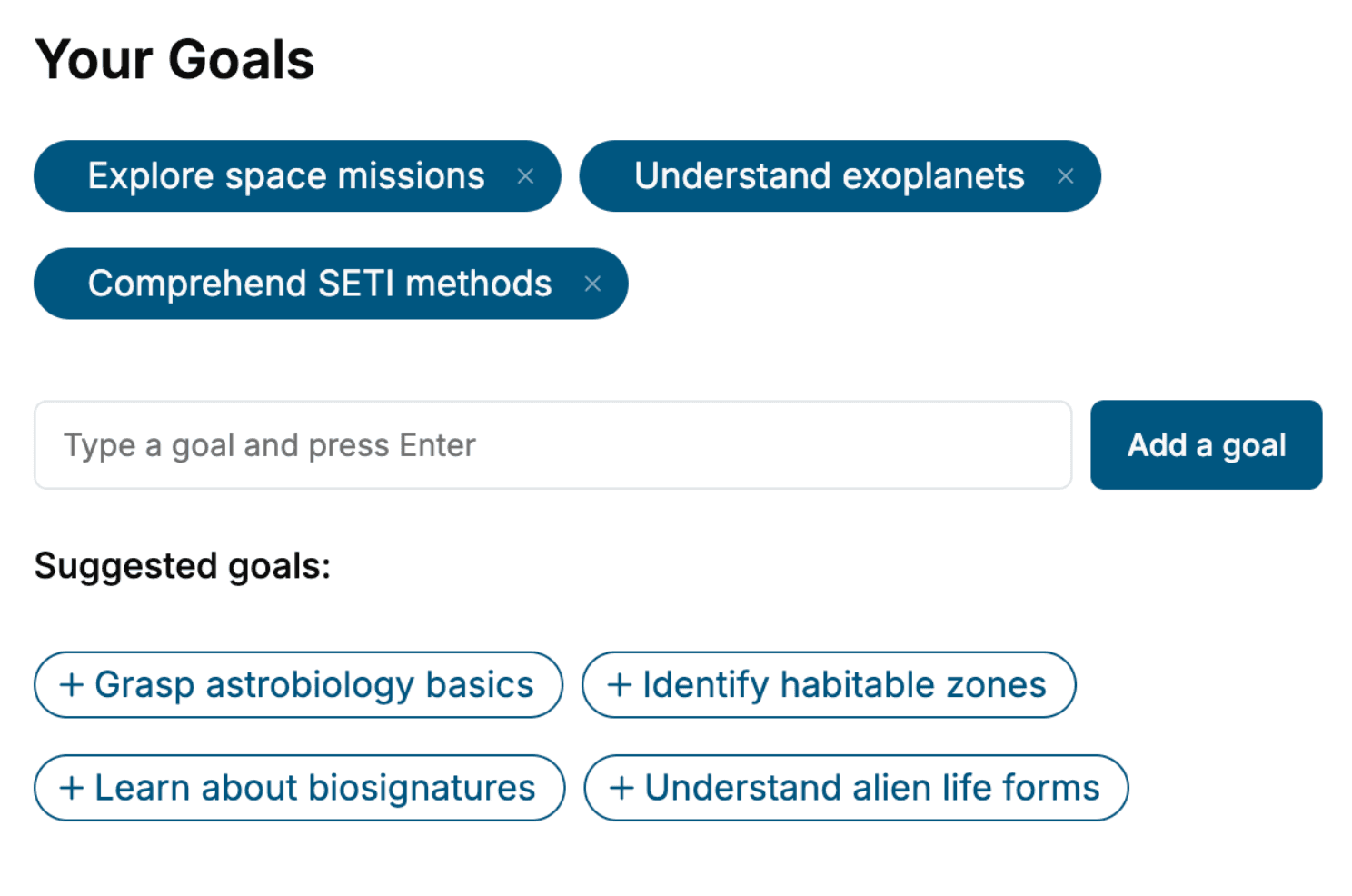
- 1. Select your focus
Select the focus of your Supplements book and share your background
- 2. Personalize your book
Specify your goals and choose sub-topics to include
- 3. Get your tailored book
Your book is ready in 10 minutes. Read it online, download as EPUB or PDF, or send to Kindle.

Frequently asked questions
- What is TailoredRead?
TailoredRead creates complete, full-length nonfiction ebooks, written specifically for you. Tell us what you want to learn and why, and TailoredRead writes you a complete ebook on it, with charts, tables, and diagrams throughout. Read it online, on Kindle, or on any e-reader, or download it as a PDF or EPUB. Every book is written fresh the day you order it.
- How is the book tailored to me?
Before anything is written, you answer a few short questions about your goals, your background, and the topics you care about. Your book is then planned around your answers: written at your level, focused on your goals, and covering the topics you chose, instead of the one-size-fits-all book a store sells everyone.
- Will it read like generic AI content?
No. Your book isn't a chat transcript: it's planned chapter by chapter before a single word is written, told in a clear book voice, and explains ideas visually with charts, tables, and diagrams. After writing, every book goes through an editorial pass that polishes chapters so the book reads consistent from start to finish. Judge for yourself: browse thousands of sample books on our Explore Books page.
- How accurate is the content?
Our AI first checks whether your subject needs live research. Niche and fast-moving subjects are researched before writing, and the book plan and chapters are grounded in what it finds. After writing, every book goes through a quality pass that checks its facts and consistency, and researched books list their sources in a Notes section at the back.
- How long is the book?
You choose the length: Comprehensive (250-300 pages), Detailed (150-200 pages), Essential (70-100 pages), or Short (30-50 pages).
- Does the book include visuals?
Yes. Every book includes charts, tables, and diagrams: timelines, checklists, step-by-step guides, decision trees, comparison tables, matrices, and bar charts. A typical book includes dozens of these visual elements.
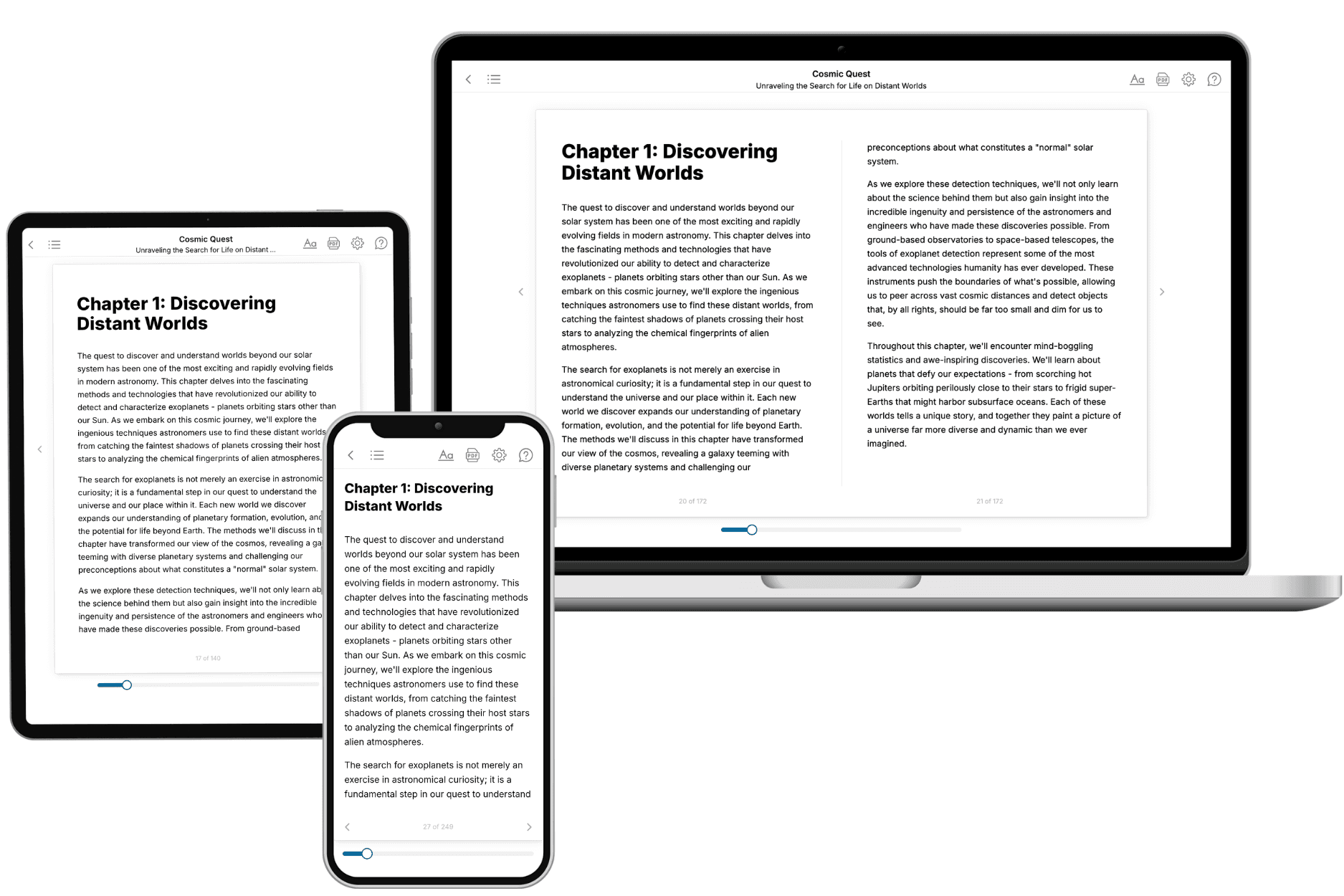
- Can I read it on Kindle? What formats can I download?
Yes. Every book can be read in our online reader or downloaded as a PDF or EPUB. The EPUB can be opened with Kindle, Apple Books, Kobo, and any e-reader. The Commercial and Author licenses also include an editable Word (DOCX) and Markdown download.
- How much does it cost?
About the price of a regular ebook. The exact price depends on your book's length and complexity, from $2 for the shortest books to $35 for the most comprehensive, and it's shown when you review your book, before you commit to anything. Each book is a one-time purchase, yours to keep, no subscription. Licenses that let you share, teach, or publish your book range from $35.99 to $49.99.
- Can I preview the book before purchasing?
Before you pay, you'll see what your book will cover: the title, a detailed description, the estimated length, and the complete chapter-by-chapter table of contents, so you know what you're getting before you decide. The full text itself is written after you purchase.
- How long does it take to create a book?
About 10 minutes. You can start reading the opening chapters while the rest is still being written.