The Rivers of the Sea
How Ocean Currents Shape Our Planet's Climate, Ecosystems, and Future
What if the invisible rivers flowing through our oceans hold the key to understanding the planet's past, present, and future?
207 pages11 chaptersOct 21, 2025Oceanography
About this book
Ocean currents are far more than simple water movements—they are the dynamic forces that regulate global climate, sustain marine life, and connect distant ecosystems in ways that scientists are only beginning to fully comprehend. This book takes you beneath the surface to explore how these massive flows of water shape everything from the smallest plankton blooms to the migration patterns of apex predators. You'll discover why certain coastlines teem with life while others remain barren, how ancient circulation patterns influenced human history, and what current disruptions mean for the ecosystems we depend upon. Through clear explanations grounded in contemporary research, you'll gain insight into the mechanisms driving surface and deep ocean circulation, the ecological consequences of current patterns, and the profound changes now underway. Whether you're deepening your existing knowledge or exploring new dimensions of ocean science, this comprehensive guide will change how you perceive the living ocean and your connection to it.
Table of contents
- IntroductionThe Invisible Rivers That Shape Our World, Why Ocean Currents Matter More Than Ever, What You'll Discover in This BookRead below
- Chapter 1: The Fundamentals of Ocean CirculationDefining Ocean Currents and Their Characteristics, The Primary Forces That Drive Water Movement, Surface Currents Versus Deep Ocean Circulation, How Scientists Measure and Map Ocean Currents
- Chapter 2: Wind-Driven Surface CurrentsThe Interaction Between Wind and Water, Major Ocean Gyres and Their Patterns, The Coriolis Effect and Current Deflection, Western and Eastern Boundary Currents
- Chapter 3: Thermohaline Circulation and the Global Conveyor BeltUnderstanding Density-Driven Ocean Flow, The Global Conveyor Belt System, Deep Water Formation in Polar Regions, Circulation Timescales and Residence Times
- Chapter 4: Upwelling and Downwelling ZonesThe Mechanisms Behind Upwelling, Coastal Upwelling Systems Around the World, Equatorial and Open Ocean Upwelling, Downwelling Processes and Their Ecological Role
- Chapter 5: Ocean Currents and Climate RegulationHow Currents Redistribute Planetary Heat, Current Influence on Regional Climate Patterns, Ocean-Atmosphere Coupling and Feedback Loops, Ocean Currents in Earth's Climate History
- Chapter 6: Currents and Marine Ecosystem DynamicsNutrient Distribution and Primary Productivity, Plankton Communities and Current Patterns, Food Web Connections Across Current Systems, Why Certain Regions Become Biodiversity Hotspots
- Chapter 7: How Marine Species Interact with CurrentsLarval Dispersal and Recruitment Patterns, Migration Routes and Current Highways, Behavioral Adaptations to Current Environments, Population Connectivity Across Ocean Basins
- Chapter 8: El Niño, La Niña, and Climate OscillationsUnderstanding the El Niño-Southern Oscillation, How ENSO Events Alter Current Patterns, Ecological Impacts of Climate Oscillations, Other Ocean-Atmosphere Oscillations
- Chapter 9: Human Impacts on Ocean Current SystemsClimate Change Effects on Circulation Patterns, How Currents Transport Pollution and Debris, Coastal Development and Local Current Disruption
- Chapter 10: Changing Currents in a Warming OceanObserved Changes in Current Strength and Position, The Atlantic Meridional Overturning Circulation Slowdown, Ecological Consequences of Shifting Currents, Future Projections and Uncertainties
- Chapter 11: Monitoring and Predicting Ocean CurrentsModern Technologies for Current Observation, Ocean Circulation Models and Simulations, Integrating Data for Better Predictions
- ConclusionThe Ocean as an Interconnected System, Our Role in Ocean Stewardship, Looking Forward with Knowledge and Purpose
Introduction
Beneath the surface of every ocean lies a hidden network of flowing water that rivals the complexity of any terrestrial river system. These ocean currents move silently and continuously, carrying vast quantities of heat, nutrients, and life across thousands of miles. Unlike the rivers you can see from a bridge or shoreline, these underwater highways remain largely invisible to casual observation, yet their influence touches every corner of the planet. They determine which coastlines receive abundant rainfall and which remain arid. They dictate where marine life thrives in spectacular abundance and where it struggles to survive. They connect tropical waters to polar seas, surface layers to abyssal depths, and past climate conditions to future possibilities.
The study of ocean currents represents one of the most dynamic and consequential fields in contemporary science. As researchers deploy increasingly sophisticated instruments across the global ocean, they continue to uncover surprising connections between current patterns and phenomena ranging from local weather events to mass extinctions in Earth's geological past. The data emerging from thousands of autonomous floats, satellite sensors, and deep-sea moorings reveals an ocean in constant motion, responding to forces both ancient and emerging. This circulation system operates on timescales from hours to millennia, creating patterns that have shaped human history and will profoundly influence humanity's future. Understanding these patterns is no longer merely an academic pursuit—it has become essential knowledge for anyone seeking to comprehend how our planet functions.
This book builds upon foundational oceanographic concepts to explore the mechanisms, patterns, and consequences of ocean circulation in depth. You already possess basic knowledge of how oceans work, which allows us to move beyond simple definitions and examine the nuanced interactions between physical processes and biological systems. Throughout these chapters, you'll encounter specific examples drawn from research conducted in diverse ocean regions, from the nutrient-rich upwelling zones off Peru to the deep water formation sites in the North Atlantic. The goal is not simply to describe what happens in the ocean, but to help you understand why these processes occur, how they interconnect, and what their disruption might mean for marine ecosystems and the climate system that sustains all terrestrial life.
The Invisible Rivers That Shape Our World
When you stand at the ocean's edge, the water appears to stretch endlessly toward the horizon in relative uniformity. The surface may show waves driven by local winds, but the deeper structure remains hidden from view. Yet beneath that deceptively simple surface exists a three-dimensional architecture of flowing water as organized and purposeful as any river system on land. The Gulf Stream, for instance, transports approximately 30 million cubic meters of water per second past Florida—a volume roughly 300 times greater than the Amazon River's discharge[1]. This massive flow carries warm tropical water northward along the eastern coast of North America, releasing heat to the atmosphere that moderates the climate of the entire North Atlantic region. Without this current, winter temperatures in Western Europe would plummet by an estimated 5-10 degrees Celsius, fundamentally altering agriculture, ecosystems, and human settlement patterns.
These invisible rivers operate according to principles that differ significantly from their terrestrial counterparts. Land-based rivers flow downhill under gravity's influence, following topographic channels carved into rock and soil. Ocean currents, by contrast, respond to a complex interplay of forces that include wind stress at the surface, density differences created by temperature and salinity variations, the rotation of the Earth, and the shape of ocean basins. A single current system might be driven primarily by wind in its surface layers while deeper portions respond to density gradients established thousands of miles away. The Antarctic Circumpolar Current, which flows unobstructed around Antarctica, demonstrates this complexity by extending from the surface to depths exceeding 4,000 meters and transporting more water than all the world's rivers combined. This current connects the Atlantic, Pacific, and Indian Oceans, creating a mixing zone that influences global ocean chemistry and climate.
The metaphor of rivers proves useful but incomplete when describing ocean currents. Unlike rivers confined to channels, ocean currents can split, merge, meander, and generate eddies that spin off and travel independently for months or years. The Kuroshio Current off Japan exhibits meandering behavior that creates warm-core and cold-core eddies, each potentially 100-300 kilometers in diameter. These eddies transport water properties, nutrients, and marine organisms far from their origin points, creating patches of distinct environmental conditions within the broader ocean. Some eddies maintain their structure for over a year, functioning as mobile ecosystems that support unique biological communities. This dynamic behavior means that ocean circulation cannot be understood as a static pattern but must be viewed as a constantly evolving system responding to multiple forcing mechanisms operating across different timescales.
The vertical dimension adds another layer of complexity absent from most terrestrial rivers. Ocean currents exist at all depths, from wind-driven surface flows in the upper 100 meters to density-driven circulation in the abyssal plains 4,000 meters below. These layers interact through processes that transfer momentum, heat, and dissolved substances between depth zones. In some regions, surface and deep currents flow in opposite directions, creating a vertical structure that profoundly influences nutrient availability and biological productivity. The California Current system exemplifies this complexity, with southward-flowing surface water overlying a northward-flowing undercurrent that brings nutrient-rich water from equatorial regions. When winds drive surface water offshore, this deep water rises to replace it, creating upwelling zones that support some of the ocean's most productive fisheries.
Understanding ocean currents as three-dimensional, time-varying phenomena requires moving beyond simple two-dimensional maps that show surface flow patterns. Modern oceanography employs sophisticated observational networks and computational models to track water movement throughout the ocean's depth. The Argo program, which maintains approximately 4,000 autonomous profiling floats distributed across the global ocean, provides continuous measurements of temperature, salinity, and current velocity from the surface to 2,000 meters depth[2]. These data reveal circulation patterns that were unknown just two decades ago, including previously unmapped deep currents and unexpected connections between ocean basins. Each new discovery reinforces the reality that ocean circulation represents one of Earth's most complex and consequential physical systems.
The scale of ocean circulation challenges human intuition. Water that sinks in the North Atlantic as part of the thermohaline circulation may not return to the surface for 1,000 years, having traveled through the deep Atlantic, around Antarctica, and into the Pacific and Indian Oceans. During this journey, the water accumulates dissolved nutrients from decomposing organic matter that sinks from surface waters. When this nutrient-rich water eventually upwells in distant regions, it fuels biological productivity that supports entire marine food webs. This connection between deep circulation and surface ecosystems operates on timescales far longer than human lifespans, yet its disruption through climate change could manifest in observable ecological changes within decades. The invisible rivers of the ocean thus link past, present, and future in ways that demand both historical perspective and forward-looking analysis.
These currents also serve as the ocean's memory, storing information about past climate conditions in their temperature, salinity, and chemical composition. Water masses formed decades or centuries ago retain characteristics that allow oceanographers to trace their origins and pathways. The Mediterranean Outflow Water, for example, maintains its distinctive high salinity signature as it flows westward through the Strait of Gibraltar and spreads into the North Atlantic at intermediate depths. This water mass influences regional ocean properties and can be detected thousands of kilometers from its source. By studying such water masses, scientists reconstruct past circulation patterns and assess how current systems have changed over time. This historical perspective proves essential for distinguishing natural variability from human-induced changes in ocean circulation.
The biological consequences of these invisible rivers extend from microscopic plankton to the largest marine mammals. Currents transport larvae of countless species, connecting distant populations and maintaining genetic diversity across vast ocean regions. They create predictable pathways that migratory species follow, concentrating food resources along current boundaries and upwelling zones. The convergence of different water masses often generates frontal zones where distinct ecosystems meet, creating regions of enhanced biological activity that attract predators ranging from seabirds to sharks. Understanding these biological dimensions of ocean currents requires integrating physical oceanography with ecology, genetics, and animal behavior—a synthesis that reveals the ocean as a unified system rather than a collection of isolated processes.
Why Ocean Currents Matter More Than Ever
The relevance of ocean current research has intensified dramatically as evidence accumulates that human activities are altering circulation patterns in measurable ways. Climate change driven by greenhouse gas emissions affects ocean currents through multiple mechanisms. Warming surface waters reduce density differences that drive thermohaline circulation. Melting ice sheets add freshwater to polar regions, further decreasing surface water density and potentially disrupting deep water formation. Changes in wind patterns alter the strength and position of surface currents. These modifications are not theoretical future possibilities—they are occurring now, with consequences that scientists are working urgently to understand and predict. The Atlantic Meridional Overturning Circulation, which includes the Gulf Stream system, has shown signs of weakening over recent decades, though debate continues about the magnitude and causes of this change[3].
The ecological implications of changing currents extend far beyond academic interest. Commercial fisheries depend on current-driven upwelling systems that bring nutrients to surface waters where they fuel the food webs supporting fish populations. The Humboldt Current system off South America generates upwelling that supports the world's largest single-species fishery for Peruvian anchoveta. This fishery produces millions of tons of fish annually, providing protein for human consumption and raw material for fishmeal used in aquaculture and agriculture worldwide. When El Niño events disrupt normal current patterns and suppress upwelling, anchovy populations crash, with cascading economic and ecological consequences. Understanding how climate change might alter the frequency or intensity of such events carries enormous practical importance for food security and economic stability in regions dependent on marine resources.
Coastal communities face direct consequences from changing ocean currents. Currents influence coastal erosion rates, storm surge impacts, and the distribution of marine heat waves that can devastate coastal ecosystems. The position of major currents affects regional sea level, creating variations of 1-2 meters across ocean basins. As currents shift in response to climate change, some coastal regions may experience accelerated sea level rise beyond the global average, while others might see temporary decreases. These regional variations complicate adaptation planning and require detailed understanding of current dynamics. The 2011 Tōhoku earthquake and tsunami in Japan demonstrated how currents transport debris across entire ocean basins—wreckage from Japan reached North American shores within months, carried by the North Pacific Current system. This event highlighted how ocean circulation connects distant regions in ways that matter for disaster response, marine pollution, and invasive species transport.
The transport of pollutants by ocean currents has emerged as a critical environmental concern. Plastic debris accumulates in convergence zones within major ocean gyres, creating vast patches of concentrated pollution. The Great Pacific Garbage Patch, located in the North Pacific Subtropical Gyre, contains an estimated 80,000 tons of plastic debris spanning an area larger than Texas[4]. Understanding current patterns proves essential for predicting where pollution will accumulate, planning cleanup efforts, and tracing debris back to its sources. Similarly, oil spills spread according to surface current patterns, making accurate current forecasts crucial for response planning. The 2010 Deepwater Horizon spill in the Gulf of Mexico demonstrated how currents can transport pollutants into sensitive coastal ecosystems, with impacts persisting years after the initial event.
Ocean currents also play a central role in the global carbon cycle, which directly affects atmospheric carbon dioxide concentrations and climate change trajectories. Cold, dense water sinking in polar regions carries dissolved carbon dioxide into the deep ocean, effectively removing it from the atmosphere for centuries. This biological and physical carbon pump represents one of Earth's major carbon storage mechanisms. Changes in ocean circulation could alter the efficiency of this pump, creating feedback loops that either accelerate or moderate climate change. Some climate models suggest that weakening thermohaline circulation could reduce the ocean's capacity to absorb atmospheric carbon dioxide, leaving more greenhouse gas in the atmosphere and accelerating warming. Other models indicate more complex regional responses. Resolving these uncertainties requires better understanding of how circulation, biology, and chemistry interact in the ocean system.
The connection between ocean currents and extreme weather events adds urgency to circulation research. Hurricanes and typhoons draw energy from warm surface waters, and their tracks often follow or interact with major current systems. The Gulf Stream's warm water provides fuel for hurricanes moving up the Atlantic coast of North America, potentially intensifying storms that might otherwise weaken. Marine heat waves—prolonged periods of unusually warm ocean temperatures—have become more frequent and intense in recent decades, with devastating impacts on coral reefs, kelp forests, and fisheries. These heat waves often result from unusual current patterns that transport warm water into regions typically cooled by cold currents, or from weakened currents that reduce the mixing of warm surface water with cooler deep water. Understanding these dynamics helps improve predictions of both gradual climate changes and extreme events.
National security and geopolitical considerations increasingly involve ocean current knowledge. Submarine operations depend on understanding density layers and current patterns that affect acoustic propagation and vessel detection. Search and rescue operations require accurate current forecasts to locate missing vessels or people. International disputes over fishing rights often hinge on understanding how currents transport fish larvae and connect populations across political boundaries. As Arctic sea ice retreats due to warming, new shipping routes are opening, but navigating these routes safely requires detailed knowledge of current patterns in previously ice-covered regions. The strategic importance of oceanographic knowledge has grown as nations recognize that ocean processes affect economic interests, environmental security, and military capabilities.
Perhaps most fundamentally, ocean currents matter because they reveal the ocean as an integrated global system rather than a collection of separate seas. Water, heat, nutrients, organisms, and pollutants all move through interconnected pathways that link every ocean region. An event in one location—such as deep water formation in the North Atlantic or upwelling intensification off Africa—can influence conditions thousands of miles away through current-mediated connections. This interconnectedness means that local actions can have distant consequences, and that understanding any part of the ocean requires considering its connections to the whole. As human impacts on the ocean intensify through climate change, pollution, and resource extraction, the need to understand these connections becomes more pressing. Ocean currents provide the physical framework for understanding how the ocean functions as a system and how that system is changing.
What You'll Discover in This Book
This book is structured to build your understanding progressively, starting with fundamental physical principles and advancing toward complex interactions between currents, ecosystems, and climate. The early chapters establish the mechanisms that drive ocean circulation, distinguishing between wind-driven surface currents and density-driven deep circulation. You'll learn how the Coriolis effect deflects moving water, why ocean gyres rotate clockwise in the Northern Hemisphere and counterclockwise in the Southern Hemisphere, and how the interplay between wind stress and Earth's rotation creates the major current systems visible on any ocean circulation map. These chapters provide the physical foundation necessary for understanding more complex phenomena introduced later.
The middle chapters explore specific current systems and their ecological consequences in detail. You'll examine upwelling zones where deep, nutrient-rich water rises to the surface, supporting extraordinary biological productivity. The mechanisms behind coastal upwelling, equatorial upwelling, and open ocean upwelling differ in important ways, each creating distinct ecological conditions. You'll discover why the waters off Peru, California, and West Africa rank among the world's most productive fishing grounds, while vast regions of the subtropical gyres remain biological deserts despite receiving abundant sunlight. These chapters connect physical oceanography to marine ecology, showing how current patterns determine the distribution of life in the ocean. Specific examples illustrate how plankton communities, fish populations, and marine mammals respond to current-driven environmental conditions.
Several chapters focus on the relationship between ocean currents and climate, examining both how currents influence atmospheric conditions and how climate change is altering circulation patterns. You'll learn how the thermohaline circulation—often called the global conveyor belt—redistributes heat around the planet and regulates climate on timescales from years to millennia. The book explores El Niño and La Niña events in depth, explaining how these periodic disruptions of normal Pacific Ocean circulation affect weather patterns worldwide. You'll understand why El Niño brings drought to Australia and Indonesia while causing floods in Peru, and why these events matter for agriculture, water resources, and natural disaster planning across multiple continents. The discussion extends to other climate oscillations, including the North Atlantic Oscillation and the Pacific Decadal Oscillation, showing how ocean-atmosphere interactions create variability in Earth's climate system.
The later chapters address contemporary changes in ocean circulation and their implications for marine ecosystems and human societies. You'll examine evidence that major current systems are shifting in strength or position, and explore what these changes might mean for regional climates, fisheries, and coastal communities. The book presents current scientific understanding of how the Atlantic Meridional Overturning Circulation is responding to climate change, why this matters for Europe's climate, and what uncertainties remain in projections of future changes. You'll learn about observed shifts in the Gulf Stream, the Kuroshio Current, and the Antarctic Circumpolar Current, along with the ecological consequences already becoming apparent in some regions. These chapters balance scientific rigor with accessibility, presenting complex research findings in clear language while acknowledging areas where scientific understanding remains incomplete.
Throughout the book, you'll encounter specific examples that illustrate general principles:
- The Agulhas Current system off South Africa, where massive eddies pinch off and carry warm, salty Indian Ocean water into the Atlantic, influencing global thermohaline circulation
- The Somali Current in the Indian Ocean, which reverses direction seasonally in response to monsoon wind patterns, creating one of the ocean's most dramatic examples of current variability
- The East Australian Current, which has extended southward in recent decades, bringing tropical species into temperate waters and disrupting established ecosystems
- The Labrador Current, which transports cold Arctic water and icebergs southward along the coast of eastern Canada, creating hazardous conditions for shipping and influencing regional climate
The book also addresses how scientists study ocean currents, from historical methods involving drift bottles and ship-based measurements to contemporary technologies including satellite altimetry, autonomous underwater vehicles, and sophisticated computer models. You'll gain insight into how oceanographers combine observations from multiple sources to create comprehensive pictures of ocean circulation, and how they use models to predict future changes. This methodological perspective helps you evaluate the strength of evidence behind different scientific claims and understand why some aspects of ocean circulation remain uncertain despite decades of research. The discussion includes practical examples of how current forecasts are used for applications ranging from search and rescue operations to predicting the spread of oil spills.
Each chapter builds on previous material while remaining accessible to readers who may choose to focus on specific topics of interest. Key concepts are reinforced through multiple examples and contexts, helping you develop an integrated understanding of how ocean currents function and why they matter. The book avoids unnecessary jargon but introduces technical terms where they provide precision or connect to broader scientific literature. When specialized terminology appears, it is clearly defined and used consistently throughout subsequent chapters. This approach allows you to engage with primary scientific literature on ocean currents if you choose to explore topics further beyond this book.
The final chapters synthesize material from earlier sections to address the question of how ocean circulation might change in coming decades and what those changes could mean for marine ecosystems and human societies. You'll explore scenarios ranging from relatively modest shifts in current patterns to more dramatic reorganizations of ocean circulation that could trigger abrupt climate changes. The book presents these possibilities within the context of current scientific understanding, distinguishing between well-established findings and more speculative projections. You'll learn what actions might help preserve ocean circulation patterns and what adaptations may become necessary as changes unfold. The goal is not to provide definitive predictions—which remain impossible given the complexity of the ocean-climate system—but to equip you with the knowledge needed to understand ongoing research and make informed judgments about ocean-related environmental issues.
By the end of this book, you will possess a comprehensive understanding of ocean circulation that integrates physical mechanisms, ecological consequences, and climate connections. You'll be able to interpret ocean current maps, understand why specific current systems behave as they do, and recognize how changes in circulation might affect marine ecosystems and regional climates. More importantly, you'll understand the ocean as a dynamic, interconnected system where physical processes and biological communities interact across multiple scales of space and time. This systems perspective proves essential for grasping the full significance of ocean currents and their role in maintaining the planetary conditions that support life. The knowledge you gain here will change how you perceive the ocean—not as a static backdrop to terrestrial life, but as an active, vital component of Earth's life support system.
Notes
Introduction
- 1. P. L. Richardson, "On the history of meridional overturning circulation schematic diagrams," Progress in Oceanography, 2008
- 2. S. C. Riser and others, "Fifteen years of ocean observations with the global Argo array," Nature Climate Change, 2016
- 3. L. Caesar and others, "Observed fingerprint of a weakening Atlantic Ocean overturning circulation," Nature, 2018
- 4. L. Lebreton and others, "Evidence that the Great Pacific Garbage Patch is rapidly accumulating plastic," Scientific Reports, 2018
This is the end of the free sample. The full book has 11 chapters.
Want this book written for you?
Tell us your goals and background, and get your own version of this book, tailored by AI to you.


Benefits of AI-tailored books
- Read one book, not ten:
- all the Oceanography knowledge you need, gathered into a single book.
- Save days of learning:
- tell us your goals, choose your topics, and the whole book is built around them.
- Learn effortlessly:
- Oceanography book written for your specific background and expertise.
- Understand at a glance:
- includes charts, tables, timelines, checklists, decision trees, and more.
- Stay current:
- written the day you order it, not years ago.
- Trust what you read:
- every book is checked for accuracy, with real research when your subject needs it.
Create your unique book in 3 steps
- 1. Select your focus
Select the focus of your Oceanography book and share your background
- 2. Personalize your book
Specify your goals and choose sub-topics to include
- 3. Get your tailored book
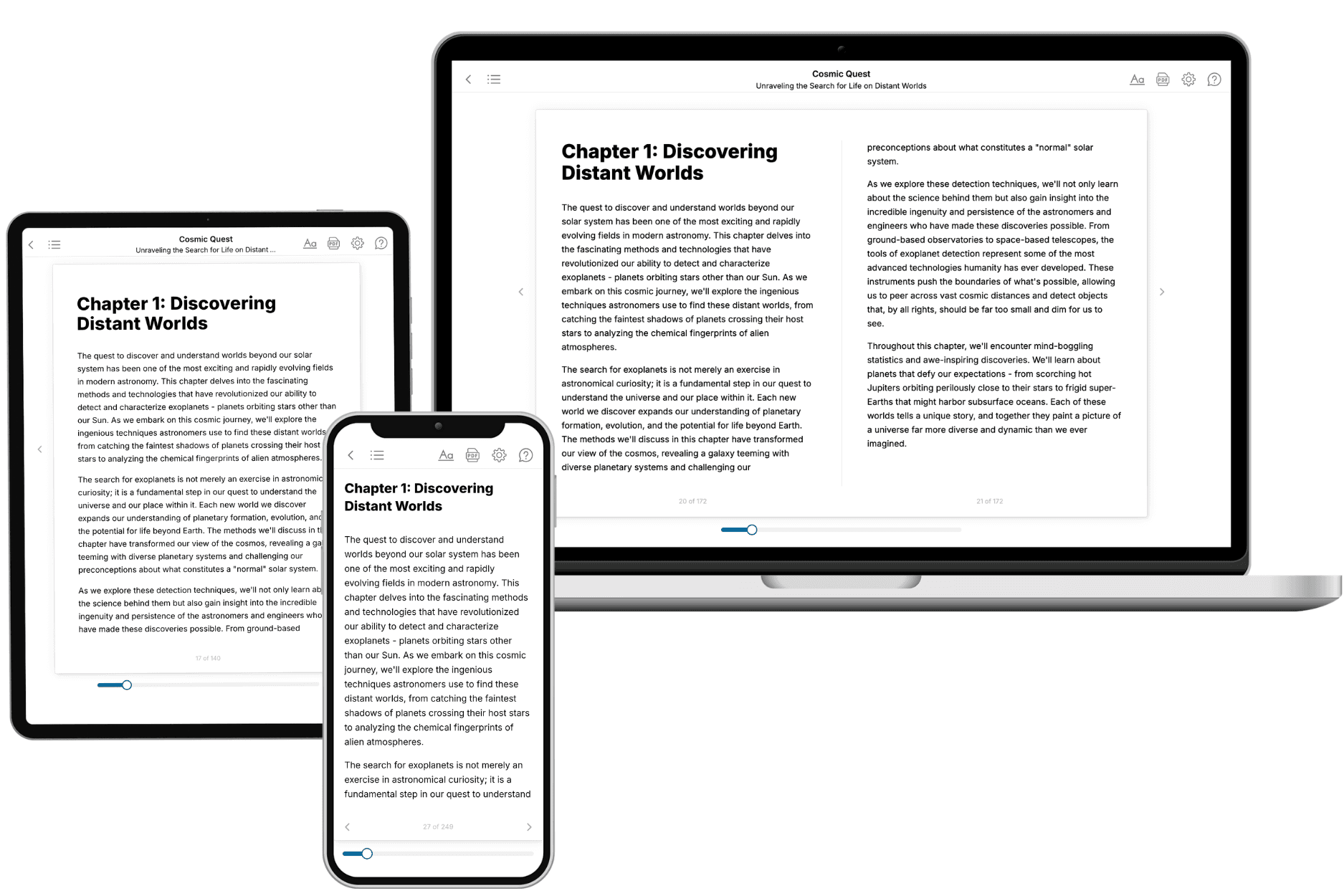
Your book is ready in 10 minutes. Read it online, download as EPUB or PDF, or send to Kindle.
Frequently asked questions
- What is TailoredRead?
TailoredRead creates complete, full-length nonfiction ebooks, written specifically for you. Tell us what you want to learn and why, and TailoredRead writes you a complete ebook on it, with charts, tables, and diagrams throughout. Read it online, on Kindle, or on any e-reader, or download it as a PDF or EPUB. Every book is written fresh the day you order it.
- How is the book tailored to me?
Before anything is written, you answer a few short questions about your goals, your background, and the topics you care about. Your book is then planned around your answers: written at your level, focused on your goals, and covering the topics you chose, instead of the one-size-fits-all book a store sells everyone.
- Will it read like generic AI content?
No. Your book isn't a chat transcript: it's planned chapter by chapter before a single word is written, told in a clear book voice, and explains ideas visually with charts, tables, and diagrams. After writing, every book goes through an editorial pass that polishes chapters so the book reads consistent from start to finish. Judge for yourself: browse thousands of sample books on our Explore Books page.
- How accurate is the content?
Our AI first checks whether your subject needs live research. Niche and fast-moving subjects are researched before writing, and the book plan and chapters are grounded in what it finds. After writing, every book goes through a quality pass that checks its facts and consistency, and researched books list their sources in a Notes section at the back.
- How long is the book?
You choose the length: Comprehensive (250-300 pages), Detailed (150-200 pages), Essential (70-100 pages), or Short (30-50 pages).
- Does the book include visuals?
Yes. Every book includes visual elements such as timelines, checklists, step-by-step guides, decision trees, comparison tables, and matrices, and many include bar charts. A typical book includes dozens of these visual elements.
- Can I read it on Kindle? What formats can I download?
Yes. Every book can be read in our online reader or downloaded as a PDF or EPUB. The EPUB can be opened with Kindle, Apple Books, Kobo, and any e-reader. The Commercial and Author licenses also include an editable Word (DOCX) and Markdown download.
- How much does it cost?
About the price of a regular ebook. The exact price depends on your book's length and complexity, from $2 for the shortest books to $35 for the most comprehensive, and it's shown when you review your book, before you commit to anything. Each book is a one-time purchase, yours to keep, no subscription. Licenses that let you share, teach, or publish your book range from $35.99 to $49.99.
- Can I preview the book before purchasing?
Before you pay, you'll see what your book will cover: the title, a detailed description, the estimated length, and the complete chapter-by-chapter table of contents, so you know what you're getting before you decide. The full text itself is written after you purchase.
- How long does it take to create a book?
About 10 minutes. You can start reading the opening chapters while the rest is still being written.