Russell's Paradox
How a Simple Question Shattered Mathematics and Reshaped Philosophy
Most people assume mathematics is a perfectly consistent system built on solid logical ground.
222 pages10 chaptersNov 13, 2025Logic
About this book
But in 1901, Bertrand Russell discovered something that shattered this assumption: a simple question that mathematics couldn't answer without contradicting itself. This book explores how Russell's Paradox—the question of whether a set can contain itself—exposed fundamental flaws in how mathematicians understood their own discipline. You'll discover why this paradox matters far beyond academic circles, affecting everything from computer programming to artificial intelligence. Through clear explanations and concrete examples, you'll learn what the paradox reveals about self-reference, contradiction, and the nature of logical systems. More importantly, you'll understand how mathematicians resolved this crisis and what their solutions tell us about the limits of human reasoning and the importance of rigorous thinking in any complex system.
Table of contents
- IntroductionWhy Paradoxes Matter, The Crisis in Mathematics, What You'll Learn in This BookRead below
- Chapter 1: The Foundation: Understanding Sets and LogicWhat Is a Set?, Basic Logical Principles, Naive Set Theory and Its Appeal
- Chapter 2: The Question That Changed EverythingThe Barber Paradox: A Familiar Introduction, Russell Formulates the Paradox, Why It Breaks Mathematics
- Chapter 3: Self-Reference: The Hidden CulpritThe Power of Self-Reference, Other Self-Referential Paradoxes, Why Self-Reference Is Dangerous
- Chapter 4: The Mathematical Crisis of the Early 1900sThe State of Mathematics Before Russell, How the Paradox Spread Through the Mathematical Community, The Urgency of Solutions
- Chapter 5: Solution One: Type TheoryRussell Proposes Type Theory, How Type Theory Prevents the Paradox, Strengths and Limitations of Type Theory
- Chapter 6: Solution Two: Axiomatic Set TheoryBuilding Set Theory from Scratch, The Zermelo-Fraenkel Axioms, How Axioms Prevent the Paradox
- Chapter 7: Beyond Mathematics: Philosophical ImplicationsLanguage, Logic, and Reality, The Limits of Formal Systems, What Paradoxes Teach Us About Truth
- Chapter 8: Russell's Paradox in Computer Science and AIParadoxes in Programming and Algorithms, Artificial Intelligence and Self-Reference, Designing Robust Systems That Avoid Paradox
- Chapter 9: Other Paradoxes and Their ConnectionsThe Liar Paradox and Its Variants, Cantor's Paradox and the Problem of Infinity, Family Resemblances Among Paradoxes
- Chapter 10: Thinking Clearly: Lessons for Everyday LogicRecognizing Paradoxical Thinking in Daily Life, Avoiding Logical Traps and Contradictions, Building Better Arguments and Systems
- ConclusionThe Legacy of Russell's Paradox, Ongoing Questions in Logic and Philosophy
- Glossary
- Further Reading
Introduction
Imagine discovering that the foundation of your house has a crack running through it—not a small crack, but one that threatens the entire structure. This is precisely what happened to mathematics in 1901 when Bertrand Russell posed a deceptively simple question that exposed a fundamental flaw in how mathematicians understood their discipline. Russell's Paradox, as it came to be known, wasn't just an academic curiosity or a clever puzzle for philosophers to debate. It revealed that the logical foundation upon which all of mathematics rested contained a contradiction, and contradictions in mathematics are catastrophic. If a mathematical system allows even one contradiction, it becomes possible to prove anything—true or false—rendering the entire system meaningless.
The paradox itself can be stated in remarkably simple terms. Consider the set of all sets that do not contain themselves as members. Does this set contain itself? If it does contain itself, then by definition it shouldn't, because it's supposed to contain only sets that don't contain themselves. But if it doesn't contain itself, then it meets the criteria for membership and should contain itself. Either answer leads to a contradiction. This circular trap, this logical impossibility embedded in what seemed like a perfectly reasonable question, sent shockwaves through the mathematical community. Mathematicians had assumed that any clearly defined property could determine a set, but Russell proved this assumption—called naive set theory—was fundamentally broken.
What makes Russell's Paradox particularly significant is not just that it identified a problem, but that it forced an entire discipline to rebuild its foundations from the ground up. The crisis it triggered led to decades of intensive work on the logical foundations of mathematics, resulting in new formal systems, new ways of thinking about sets and logic, and ultimately a deeper understanding of what mathematics actually is. Beyond mathematics, the paradox has influenced computer science, artificial intelligence, linguistics, and philosophy. It teaches us crucial lessons about self-reference, the limits of formal systems, and the importance of questioning our assumptions—lessons that remain relevant today as we build increasingly complex logical systems, from computer programs to artificial intelligence.
This book will guide you through Russell's Paradox and its far-reaching implications. You don't need advanced mathematical training to understand the core ideas, though some familiarity with basic logic and set theory will help. What you do need is curiosity about how logical systems work and why they sometimes fail. You'll discover that paradoxes aren't just puzzles to solve—they're windows into the nature of logic itself, revealing both the power and the limitations of human reasoning. By understanding how mathematicians responded to Russell's challenge, you'll gain insights that apply far beyond mathematics, helping you think more clearly about any complex system that relies on logical consistency.
Why Paradoxes Matter
Paradoxes occupy a unique position in human thought. They're not simply errors or mistakes that can be corrected with better information. A true paradox is a situation where seemingly valid reasoning leads to a contradiction or an impossible conclusion. Paradoxes force us to confront the limits of our logical systems and question assumptions we thought were unshakeable. Throughout history, paradoxes have served as catalysts for intellectual progress, pushing thinkers to develop more sophisticated frameworks for understanding reality. When Zeno of Elea proposed his paradoxes of motion in ancient Greece, he wasn't just creating puzzles—he was challenging fundamental assumptions about space, time, and infinity that eventually led to the development of calculus centuries later.
Russell's Paradox belongs to a special category of paradoxes that arise from self-reference. Self-reference occurs when something refers to or includes itself, creating a circular relationship that can lead to logical instability. Consider the classic Liar Paradox: This statement is false.
If the statement is true, then it must be false as it claims. But if it's false, then it's actually true. This creates an endless loop with no stable resolution. Self-referential paradoxes reveal something profound about the relationship between language, logic, and meaning. They show us that not all grammatically correct statements are logically coherent, and that the structure of our reasoning systems matters as much as the content of our arguments.
The practical importance of understanding paradoxes extends far beyond academic philosophy. In computer science, programmers must design systems that avoid infinite loops and circular dependencies—problems that are fundamentally related to self-reference. When a program calls itself recursively without proper termination conditions, it can crash or hang indefinitely. Database designers must ensure that referential integrity rules don't create circular constraints that make the database unusable. Legal systems face similar challenges when laws reference other laws, creating potential for circular definitions or contradictory requirements. Understanding how paradoxes arise helps us design better systems in any domain that relies on formal rules and logical consistency.
Paradoxes also serve an important pedagogical function. They humble us by demonstrating that intuition alone is insufficient for rigorous thinking. Many paradoxes seem absurd or impossible at first glance, yet they follow logically from premises that appear reasonable. This gap between intuition and logical consequence teaches us to be more careful in our reasoning and more skeptical of assumptions that seem self-evident. The history of mathematics is filled with examples of intuitive ideas that turned out to be wrong when examined rigorously. For instance, mathematicians once believed that all infinities were the same size, until Georg Cantor proved that some infinities are larger than others—a result that seemed paradoxical but was mathematically sound.
Russell's Paradox specifically matters because it struck at the heart of mathematics itself. Mathematics is supposed to be the most certain form of knowledge, built on logical deduction from clear axioms. If mathematics contains contradictions, then nothing is safe from logical inconsistency. The paradox revealed that mathematicians had been working with an informal, intuitive notion of sets that seemed perfectly clear but was actually incoherent. This discovery forced a fundamental rethinking of mathematical foundations and led to the development of formal axiomatic systems that make explicit all the rules and assumptions underlying mathematical reasoning. This formalization process has become a model for rigorous thinking in many other fields.
Understanding paradoxes changes how you think about truth and certainty. Before encountering paradoxes, many people assume that every well-formed question has a definite answer, and that logical reasoning can always reach that answer. Paradoxes demonstrate that some questions are malformed in ways that aren't immediately obvious, and that the structure of our logical systems determines what questions can be meaningfully asked. This insight is crucial for anyone working with complex systems, whether in mathematics, computer science, law, or organizational design. It teaches us to examine not just the content of our reasoning but the framework within which that reasoning takes place.
The study of paradoxes also reveals the deep connection between logic and language. Many paradoxes arise because natural language allows us to construct statements that seem meaningful but are actually logically incoherent. Russell's Paradox can be expressed in plain English, but that doesn't mean it describes a coherent mathematical object. This distinction between linguistic possibility and logical possibility is crucial for clear thinking. It shows us that we need formal languages and precise definitions to reason reliably about complex subjects. The development of mathematical logic and formal semantics in response to paradoxes like Russell's has given us powerful tools for analyzing arguments and detecting hidden contradictions in reasoning that appears sound on the surface.
The Crisis in Mathematics
To appreciate the impact of Russell's Paradox, you need to understand the state of mathematics at the turn of the twentieth century. Mathematics was experiencing a golden age of discovery and expansion. New fields were emerging, old problems were being solved, and mathematicians were increasingly confident that their discipline rested on solid logical foundations. Set theory, developed by Georg Cantor in the late 1800s, had become a unifying framework that seemed capable of providing a foundation for all of mathematics. The basic idea was beautifully simple: everything in mathematics could be understood in terms of sets and their relationships. Numbers, functions, geometric objects—all could be defined as sets with particular properties.
Cantor's work on set theory had already produced revolutionary results, particularly regarding infinity. He proved that infinite sets come in different sizes—that the set of real numbers is larger than the set of natural numbers, even though both are infinite. This was counterintuitive and controversial, but it was mathematically rigorous and opened up entirely new areas of investigation. Mathematicians were using set theory to clarify and formalize concepts that had previously been understood only intuitively. The hope was that by reducing all of mathematics to set theory, they could eliminate ambiguity and establish mathematics on an unshakeable logical foundation. This project, known as the foundations of mathematics, attracted some of the greatest minds of the era.
The version of set theory that mathematicians were using at this time is now called naive set theory. The term naive
isn't meant to be insulting—it simply means that the theory was based on intuitive principles rather than formal axioms. The central principle of naive set theory was the unrestricted comprehension axiom, which stated that any property or condition could define a set. If you could describe a property clearly, then there existed a set containing exactly those objects that had that property. Want the set of all even numbers? It exists. The set of all red objects? It exists. The set of all sets? It exists. This principle seemed perfectly reasonable and matched how mathematicians naturally thought about collections of objects.
Russell discovered his paradox in 1901 while examining the work of Gottlob Frege, a German mathematician and philosopher who was attempting to derive all of mathematics from pure logic. Frege had just published the first volume of his magnum opus, Grundgesetze der Arithmetik (Basic Laws of Arithmetic), which aimed to show that arithmetic could be reduced to logic and set theory. Russell found that Frege's system, which was based on naive set theory, allowed the construction of the paradoxical set of all sets that don't contain themselves. Russell communicated this discovery to Frege in a letter in 1902, just as Frege was preparing the second volume of his work for publication. Frege's response was gracious but devastated: Your discovery of the contradiction caused me the greatest surprise and, I would almost say, consternation, since it has shaken the basis on which I intended to build arithmetic.
[1]
The crisis wasn't limited to Frege's work. Russell's Paradox threatened the entire edifice of mathematics because set theory had become so central to mathematical practice. If set theory contained a contradiction, then any mathematical proof that relied on set theory was potentially unsound. And since mathematicians were increasingly expressing all mathematical concepts in terms of sets, this meant that virtually all of mathematics was at risk. The situation was particularly troubling because the paradox arose from such simple, intuitive principles. It wasn't the result of some obscure technical assumption that could be easily modified. The unrestricted comprehension axiom seemed like a basic, obvious truth about collections. If even this was wrong, what else might be wrong?
Different mathematicians responded to the crisis in different ways. Some, like Henri Poincaré, argued that the problem arose from allowing sets to be too abstract and self-referential, and advocated for a more constructive approach that only admitted sets that could be explicitly constructed. Others, like David Hilbert, believed that the solution lay in developing a complete formal system for mathematics with explicit axioms and rules of inference, so that every step of every proof could be mechanically verified. Russell himself developed type theory, a system that prevented self-reference by organizing sets into a hierarchy of types. Ernst Zermelo and Abraham Fraenkel developed axiomatic set theory, which replaced the unrestricted comprehension axiom with more carefully formulated axioms that avoided paradox.
The foundational crisis triggered by Russell's Paradox lasted for decades and fundamentally changed how mathematicians understood their discipline. It led to the development of mathematical logic as a distinct field of study, with its own methods and questions. It forced mathematicians to be much more explicit about their assumptions and much more careful about their definitions. The crisis also revealed deep philosophical questions about the nature of mathematical objects and mathematical truth. Do mathematical objects exist independently of human thought, or are they human constructions? Can mathematics be reduced to logic, or does it require its own special axioms? These questions, which arose directly from the attempt to resolve Russell's Paradox, continue to be debated today.
What makes this crisis particularly instructive is that it shows how even the most rigorous intellectual disciplines can rest on unexamined assumptions. Mathematicians had been using set theory successfully for years, proving theorems and making discoveries, without realizing that their foundational principles were inconsistent. The paradox didn't emerge from sloppy thinking or careless reasoning—it emerged from pushing the logical principles of set theory to their natural conclusions. This teaches us that consistency and rigor require constant vigilance, and that we must always be willing to question even our most basic assumptions when confronted with contradictions. The mathematical community's response to Russell's Paradox—rebuilding their foundations rather than ignoring the problem—serves as a model for how to handle fundamental challenges to any system of thought.
What You'll Learn in This Book
This book is structured to take you on a journey from the basic concepts underlying Russell's Paradox to its profound implications for mathematics, philosophy, and practical fields like computer science. You'll start by building a solid understanding of sets and logic—the raw materials from which the paradox is constructed. Even if you've encountered these concepts before, the early chapters will ensure you have the precise understanding needed to fully grasp why the paradox is genuinely paradoxical and not just a clever trick. You'll learn what sets are, how they relate to each other, and why mathematicians found them such a powerful tool for organizing mathematical knowledge.
Once the foundations are in place, you'll encounter the paradox itself in multiple forms. You'll see how it can be expressed as a question about sets, but also how it appears in more intuitive forms like the Barber Paradox. Understanding these different formulations will help you recognize the common structure underlying all self-referential paradoxes. You'll learn to identify the moment where self-reference creates logical instability, and you'll understand why this instability is so problematic for any formal system. The book will show you step-by-step how the paradox generates a contradiction, making it impossible to answer the question Does the set of all sets that don't contain themselves contain itself?
with either yes or no.
A major focus of the book is understanding the various solutions that mathematicians developed in response to Russell's Paradox. You'll explore Russell's own solution, type theory, which prevents paradox by organizing sets into a hierarchy where sets at one level can only contain sets from lower levels. You'll see how this eliminates self-reference but also introduces complications and restrictions. You'll then examine axiomatic set theory, particularly the Zermelo-Fraenkel axioms, which provide a different approach by carefully specifying which sets exist and which operations on sets are permitted. Each solution involves trade-offs, and understanding these trade-offs will give you insight into the nature of formal systems and the choices involved in designing them.
The book goes beyond mathematics to explore the philosophical implications of Russell's Paradox. You'll discover what the paradox reveals about the relationship between language and logic, and why not everything that can be said in natural language corresponds to a coherent logical concept. You'll learn about the limits of formal systems and why some questions might be inherently unanswerable within a given logical framework. These philosophical insights have practical applications: they help us understand why certain problems in computer science are undecidable, why some legal or organizational rules can create impossible situations, and why careful attention to the structure of our reasoning systems is essential for avoiding contradictions.
For readers interested in practical applications, dedicated chapters explore how Russell's Paradox and related concepts appear in computer science and artificial intelligence. You'll see concrete examples of how self-reference can create problems in programming, from infinite loops to circular dependencies in software architecture. You'll learn about strategies for designing systems that avoid these pitfalls, drawing on the lessons mathematicians learned from resolving Russell's Paradox. The book will show you how type systems in programming languages are directly descended from Russell's type theory, and how understanding the mathematical foundations helps you write more robust code and design better systems.
The book also places Russell's Paradox in context by examining related paradoxes and their connections. You'll encounter the Liar Paradox, Cantor's Paradox, and other logical puzzles that share family resemblances with Russell's discovery. By seeing how these paradoxes relate to each other, you'll develop a deeper understanding of the common patterns that generate paradoxical situations. This comparative approach will help you recognize potential paradoxes in new contexts and understand why certain logical structures are inherently problematic. You'll learn to distinguish between genuine paradoxes that reveal fundamental problems and apparent paradoxes that result from ambiguous language or confused thinking.
Throughout the book, the emphasis is on clear explanation and practical understanding rather than technical formalism. While some formal notation is necessary to express certain ideas precisely, the book prioritizes conceptual clarity over mathematical rigor. You'll find concrete examples, analogies, and step-by-step explanations that make abstract concepts tangible. The goal is not to turn you into a mathematical logician, but to give you a solid understanding of Russell's Paradox and its significance—an understanding that will enhance your ability to think clearly about logic, systems, and reasoning in any context.
By the end of this book, you'll understand not just what Russell's Paradox is, but why it matters. You'll see how a simple question about sets led to a fundamental rethinking of mathematics and influenced fields far beyond mathematics. You'll have tools for recognizing self-referential structures and understanding when they might cause problems. Most importantly, you'll appreciate the value of rigorous thinking and the importance of examining the foundations of any system of thought. Russell's Paradox teaches us that even our most basic assumptions deserve scrutiny, and that intellectual progress often comes from confronting contradictions rather than ignoring them. These lessons remain as relevant today as they were when Russell first discovered his paradox over a century ago.
Notes
Introduction
- 1. Frege and Gottlob. Letter to Bertrand Russell, In van Heijenoort, Jean (1967), From Frege to Gödel: A Source Book in Mathematical Logic, 1879-1931. Harvard University Press, 1902
This is the end of the free sample. The full book has 10 chapters.
Want this book written for you?
Tell us your goals and background, and get your own version of this book, tailored by AI to you.


Benefits of AI-tailored books
- Read one book, not ten:
- all the Logic knowledge you need, gathered into a single book.
- Save days of learning:
- tell us your goals, choose your topics, and the whole book is built around them.
- Learn effortlessly:
- Logic book written for your specific background and expertise.
- Understand at a glance:
- includes charts, tables, timelines, checklists, decision trees, and more.
- Stay current:
- written the day you order it, not years ago.
- Trust what you read:
- every book is checked for accuracy, with real research when your subject needs it.
Create your unique book in 3 steps
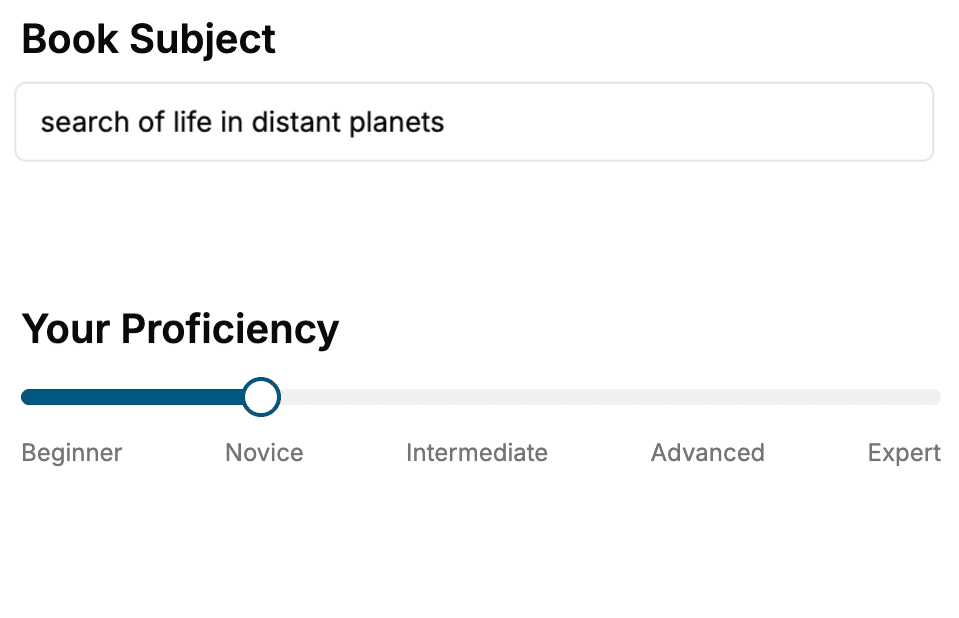
- 1. Select your focus
Select the focus of your Logic book and share your background
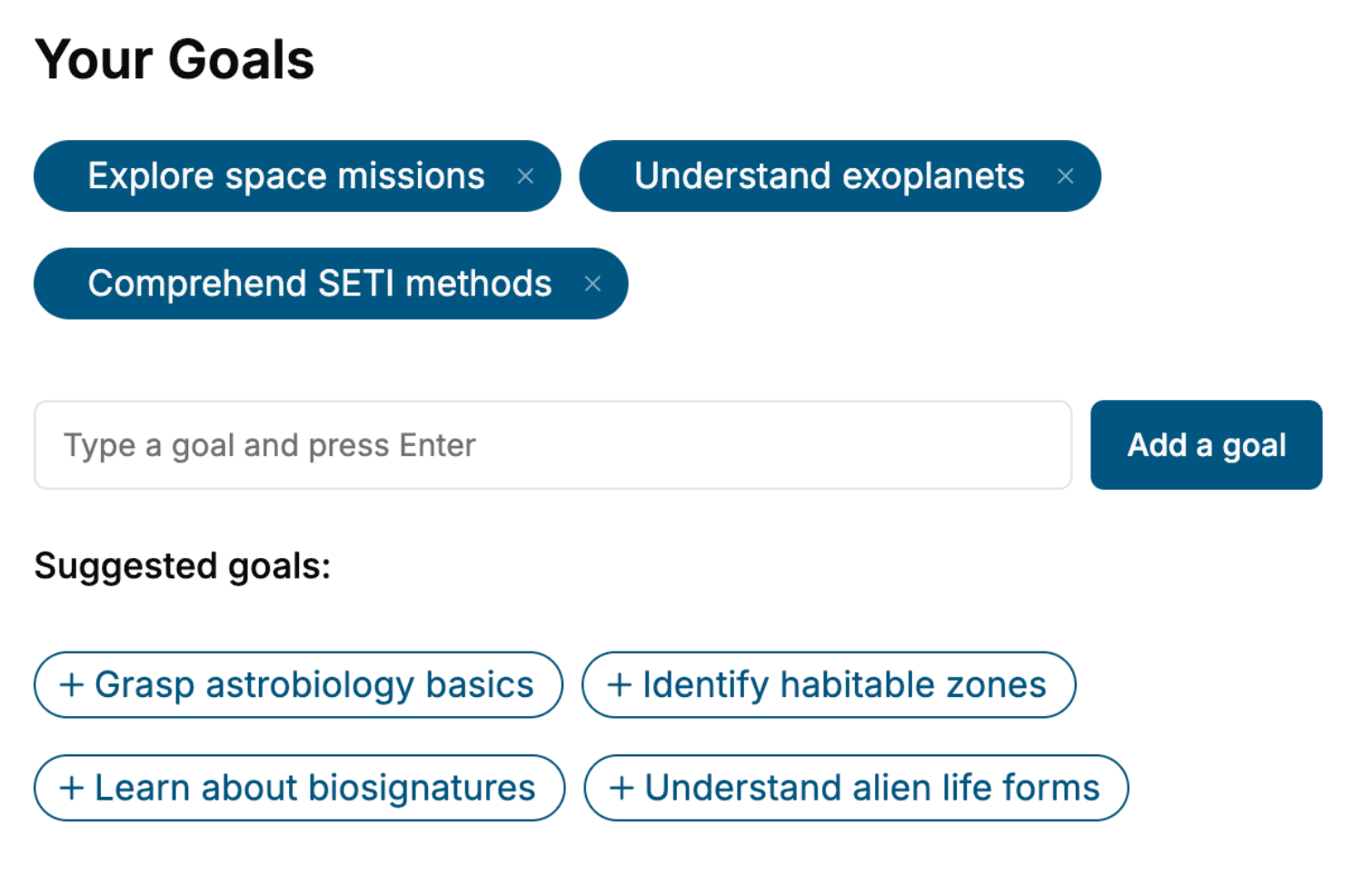
- 2. Personalize your book
Specify your goals and choose sub-topics to include
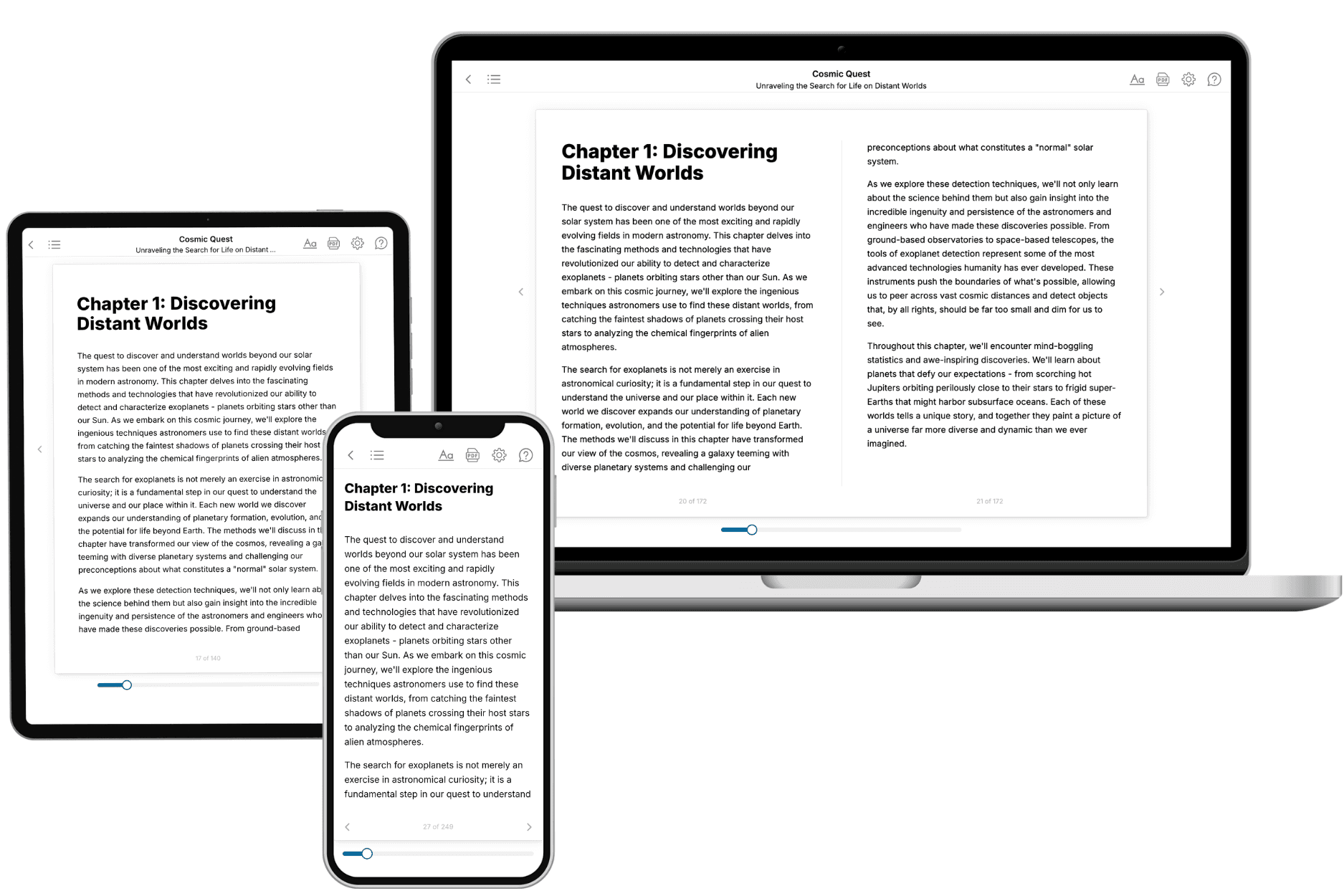
- 3. Get your tailored book
Your book is ready in 10 minutes. Read it online, download as EPUB or PDF, or send to Kindle.
Frequently asked questions
- What is TailoredRead?
TailoredRead creates complete, full-length nonfiction ebooks, written specifically for you. Tell us what you want to learn and why, and TailoredRead writes you a complete ebook on it, with charts, tables, and diagrams throughout. Read it online, on Kindle, or on any e-reader, or download it as a PDF or EPUB. Every book is written fresh the day you order it.
- How is the book tailored to me?
Before anything is written, you answer a few short questions about your goals, your background, and the topics you care about. Your book is then planned around your answers: written at your level, focused on your goals, and covering the topics you chose, instead of the one-size-fits-all book a store sells everyone.
- Will it read like generic AI content?
No. Your book isn't a chat transcript: it's planned chapter by chapter before a single word is written, told in a clear book voice, and explains ideas visually with charts, tables, and diagrams. After writing, every book goes through an editorial pass that polishes chapters so the book reads consistent from start to finish. Judge for yourself: browse thousands of sample books on our Explore Books page.
- How accurate is the content?
Our AI first checks whether your subject needs live research. Niche and fast-moving subjects are researched before writing, and the book plan and chapters are grounded in what it finds. After writing, every book goes through a quality pass that checks its facts and consistency, and researched books list their sources in a Notes section at the back.
- How long is the book?
You choose the length: Comprehensive (250-300 pages), Detailed (150-200 pages), Essential (70-100 pages), or Short (30-50 pages).
- Does the book include visuals?
Yes. Every book includes visual elements such as timelines, checklists, step-by-step guides, decision trees, comparison tables, and matrices, and many include bar charts. A typical book includes dozens of these visual elements.
- Can I read it on Kindle? What formats can I download?
Yes. Every book can be read in our online reader or downloaded as a PDF or EPUB. The EPUB can be opened with Kindle, Apple Books, Kobo, and any e-reader. The Commercial and Author licenses also include an editable Word (DOCX) and Markdown download.
- How much does it cost?
About the price of a regular ebook. The exact price depends on your book's length and complexity, from $2 for the shortest books to $35 for the most comprehensive, and it's shown when you review your book, before you commit to anything. Each book is a one-time purchase, yours to keep, no subscription. Licenses that let you share, teach, or publish your book range from $35.99 to $49.99.
- Can I preview the book before purchasing?
Before you pay, you'll see what your book will cover: the title, a detailed description, the estimated length, and the complete chapter-by-chapter table of contents, so you know what you're getting before you decide. The full text itself is written after you purchase.
- How long does it take to create a book?
About 10 minutes. You can start reading the opening chapters while the rest is still being written.