The Sacred and the Political
Understanding How Religion Shapes Power, Governance, and Society
Many assume religion and politics should remain completely separate—a view so common it feels like common sense.
207 pages10 chaptersJul 6, 2026Philosophy of Religion
About this book
Yet this assumption itself is a philosophical position, not an objective fact. Throughout history and across cultures, religious belief has profoundly shaped political systems, legitimized power, motivated social movements, and defined the boundaries of community. From medieval theocracies to modern democracies wrestling with religious minorities, the relationship between the sacred and the political remains one of the most consequential forces in human society. This book examines how different philosophical traditions understand this relationship, explores historical patterns of religious-political interaction, and analyzes contemporary challenges in pluralistic democracies. Whether you're seeking to understand current political conflicts, explore philosophical foundations of governance, or simply make sense of why religion remains politically significant, this exploration provides essential context for informed citizenship and critical thinking.
Table of contents
- IntroductionWhy This Question Matters Today, Common Misconceptions About Religion and Politics, How to Read This BookRead below
- Chapter 1: Foundations: What We Mean by Religion and PoliticsDefining Religion: Beyond Simple Categories, Defining Politics: Power, Authority, and Governance, Why These Definitions Matter for Our Discussion
- Chapter 2: Historical Patterns: Religion and Political AuthorityAncient Religious States and Divine Kingship, Medieval Theocracy: Church and Crown in Tension, The Reformation and Its Political Consequences, The Enlightenment Shift: Reason and Secularization
- Chapter 3: Philosophical Frameworks: How Thinkers Understand the RelationshipThe Natural Law Tradition: Universal Principles, Social Contract Theory: Consent and Legitimacy, Liberal Secularism: Neutrality and Pluralism, Religious Political Thought: Theocratic and Prophetic Models
- Chapter 4: The Separation of Church and State: History and MeaningOrigins of the Separation Concept, The American Model: First Amendment and Establishment Clause, Global Variations: How Different Nations Approach It, The Limits of Separation: Practical Challenges
- Chapter 5: Religious Motivation in Politics: Progressive and OppressiveReligious Motivation in Social Movements, How Religion Provides Moral Authority and Motivation, Religious Justification for Oppression and Violence, Evaluating Religious Political Action: Context and Consequences
- Chapter 6: Secularism as Philosophy: Not Neutral GroundWhat Secularism Actually Is, Secularism as a Worldview, Not Neutrality, Varieties of Secularism: Hard and Soft, Critiques of Secularism from Religious Perspectives
- Chapter 7: Religious Pluralism and Democratic GovernanceThe Pluralism Challenge: Multiple Truths in One Polity, Religious Minorities and Majority Rule, Public Reason: Can Religious Arguments Justify Law?, Practical Approaches to Religious Pluralism
- Chapter 8: Contemporary Conflicts: Religion in Modern PoliticsReligious Nationalism and Identity Politics, Culture Wars: Abortion, Marriage, and Moral Authority, Religious Extremism and Political Violence, Religion in International Relations and Diplomacy
- Chapter 9: Legitimacy and Authority: Where Does Political Power Come From?Historical Sources of Political Legitimacy, Religious Legitimacy: Divine Right and Sacred Authority, Secular Sources of Legitimacy: Consent and Reason, Hybrid Models: Combining Religious and Secular Authority
- Chapter 10: Practical Wisdom: Navigating Religion and PoliticsCritical Thinking About Religious Political Claims, Dialogue Across Religious and Political Difference, Balancing Personal Conviction with Public Reason
- Conclusion: The Enduring RelationshipKey Takeaways, Questions for the Future
- Further Reading and Resources
Introduction
There is a story many people in modern Western societies tell themselves about religion and politics. It goes something like this: religion is a private matter, politics is a public one, and the two should stay in their respective lanes. This story feels intuitive, even obvious. It seems to promise peace, fairness, and rational governance. But when you look closely at how societies actually function, at how laws get made, how leaders gain authority, how communities define justice, the story starts to fall apart. Religion and politics have never truly been separate, and in most of the world today, they still are not.
This book is about that entanglement. It examines the relationship between religious belief and political power across history, philosophy, and contemporary life. It does not argue that religion should dominate politics, nor that politics should suppress religion. Instead, it takes a more demanding position: that you cannot understand one without understanding the other. The way a society organizes power, distributes rights, and defines the common good is almost always shaped, at least in part, by its deepest beliefs about the nature of reality, human dignity, and moral obligation. Those beliefs are often religious in character, even when they are not labeled as such.
The goal here is not to tell you what to believe about religion or politics. It is to give you better tools for thinking about both. That means examining assumptions that often go unquestioned, including the assumption that secular governance is neutral, that religious arguments are inherently irrational in public life, or that the separation of church and state is a universal principle rather than a specific historical development. These are contested philosophical positions, not settled facts. Understanding why they are contested, and what is at stake in those contests, is essential for anyone who wants to think seriously about governance, justice, and society.
What follows is a journey through some of the most consequential questions in political philosophy and social history. You will encounter ancient empires that fused divine and political authority, medieval thinkers who wrestled with competing claims of pope and king, Enlightenment philosophers who tried to build governance on reason alone, and contemporary democracies struggling to accommodate deep religious diversity. Each of these moments reveals something important about the enduring tension between the sacred and the political, and about why that tension refuses to resolve itself neatly.
Why This Question Matters Today
It would be easy to treat the relationship between religion and politics as a historical curiosity, something that mattered in the age of crusades and inquisitions but has since been resolved by modern liberal democracy. That view is difficult to sustain when you look at the actual landscape of contemporary politics. Across the globe, religious identity and political power remain deeply intertwined in ways that shape everything from foreign policy to domestic legislation to the daily lives of ordinary citizens.
Consider a few concrete examples. In the United States, debates over abortion, same-sex marriage, and religious exemptions from anti-discrimination laws are explicitly framed in religious terms by many of their participants. In India, the rise of Hindu nationalism has reshaped the country's constitutional identity and its treatment of religious minorities. In Iran, a theocratic government exercises direct clerical authority over the state. In Israel, questions about the Jewish character of the state intersect constantly with democratic governance. In Poland and Hungary, Catholic and Christian identity have become central to nationalist political projects. These are not fringe phenomena. They represent the political reality of billions of people.[1]
Even in societies that consider themselves thoroughly secular, religion shapes politics in ways that are easy to miss. The moral intuitions that drive progressive social movements, including commitments to human dignity, equality, and care for the vulnerable, have deep roots in religious traditions, even when their contemporary advocates are not religious. The concept of universal human rights, which underpins much of modern international law, draws heavily on natural law traditions developed by medieval Christian theologians. Secularism itself, as this book will argue, is a philosophical position with its own assumptions and values, not a neutral absence of belief.
There is also a practical urgency to this question. Misunderstanding the role of religion in politics leads to serious analytical errors. Policymakers who assume that religious motivations are simply irrational or that they will fade as societies modernize have repeatedly been caught off guard by the persistence and political force of religious identity. Scholars who treat religion as a purely private matter miss the ways it organizes communities, generates solidarity, and provides the moral vocabulary through which people articulate their political demands. Citizens who cannot engage seriously with religious arguments are poorly equipped to participate in democratic deliberation in a world where those arguments remain central to political life.
Understanding this relationship also matters for personal intellectual integrity. Many people hold political views that are shaped by religious commitments without fully recognizing that connection. Others hold secular views that function in ways structurally similar to religious ones, providing ultimate values, community identity, and a framework for moral judgment. Examining the relationship between religion and politics honestly requires examining your own assumptions, which is always uncomfortable and always worthwhile.
Finally, this question matters because it touches on some of the deepest issues in political philosophy: Where does political authority come from? What makes a law just? How should a society handle deep moral disagreement? What do citizens owe each other across lines of fundamental difference? These are not abstract puzzles. They are the questions that determine how societies treat their most vulnerable members, how they respond to injustice, and whether they can hold together across genuine diversity. Religion has always been one of the primary arenas in which human beings have worked out their answers to these questions, and it continues to be so today.
The question is not whether religion will influence politics. In most of the world, it already does. The question is how to think clearly about that influence, evaluate it honestly, and engage with it wisely.
Common Misconceptions About Religion and Politics
Before diving into the substance of this book, it is worth clearing away some of the most common misconceptions that tend to distort thinking about religion and politics. These are not fringe errors. They are widely held assumptions that show up in mainstream political commentary, academic writing, and everyday conversation. Identifying them early will help you read the rest of this book more clearly and critically.
Misconception 1: Religion and politics are naturally separate domains. This is perhaps the most pervasive assumption in modern Western political thought. It treats the separation of religious and political authority as the natural or default state of human affairs, with historical entanglements representing a kind of deviation or failure. In reality, the separation of church and state is a specific historical development, rooted in particular European experiences of religious warfare and Enlightenment philosophy. For most of human history, and in most cultures today, religious and political authority have been understood as deeply connected, often as two aspects of a single integrated social order.
Misconception 2: Secularism is neutral. Many people assume that a secular approach to governance simply removes religion from the equation, leaving a neutral space where all citizens can participate equally regardless of their beliefs. But secularism is itself a philosophical position. It makes specific claims about the proper role of religion in public life, about the relationship between reason and faith, and about what kinds of arguments are legitimate in democratic deliberation. These claims are contested by many religious traditions and by some secular philosophers as well. Treating secularism as neutral rather than as one position among several makes it harder to think clearly about the actual choices societies face.
Misconception 3: Religious arguments are inherently irrational. A common assumption in secular political discourse is that religious arguments, because they appeal to faith or revelation rather than publicly accessible reason, are somehow less legitimate or less rational than secular ones. This view has been challenged by philosophers across the political spectrum. Many religious arguments are internally coherent, draw on sophisticated philosophical traditions, and engage seriously with empirical evidence. The question of whether religious arguments should be used to justify public policy is a genuine philosophical debate, not a settled matter. Dismissing religious reasoning as inherently irrational forecloses that debate before it begins.
Misconception 4: Religion is primarily a source of conflict. The history of religious violence is real and should not be minimized. But religion has also been a primary driver of some of history's most important progressive social movements. The abolition of slavery in the United States was driven largely by religious conviction. The civil rights movement drew its moral vocabulary, its organizational infrastructure, and much of its leadership from Black Protestant Christianity. Liberation theology in Latin America mobilized religious communities against authoritarian regimes. Reducing religion's political role to a source of conflict and oppression misses half the picture.[2]
Misconception 5: Modernization will make religion politically irrelevant. For much of the twentieth century, social scientists predicted that as societies became more educated, urbanized, and economically developed, religion would fade from public life. This prediction, known as the secularization thesis, has not held up well. Religious identity and practice remain politically significant across much of the world, including in highly developed societies. The United States, one of the world's most technologically advanced nations, also has one of the highest rates of religious belief and practice among wealthy democracies. The relationship between modernization and secularization is far more complex than early theorists assumed.[3]
Misconception 6: All religious political engagement is theocratic. There is a tendency in some secular discourse to treat any religiously motivated political action as a step toward theocracy. This conflates very different things. A citizen who opposes a particular policy because of their religious convictions is doing something fundamentally different from a government that imposes religious law on all citizens regardless of their beliefs. Religious people participate in democratic politics for the same reasons everyone else does: because they have values, interests, and views about justice. The question of how religious arguments should function in democratic deliberation is important and complex, but it is not answered by treating all religious political engagement as inherently dangerous.
Clearing away these misconceptions does not mean accepting any particular view about how religion and politics should relate. It means approaching the question with the intellectual honesty it deserves. The relationship between the sacred and the political is genuinely complex, genuinely contested, and genuinely important. It deserves better than the shortcuts these misconceptions provide.
How to Read This Book
This book is organized to build understanding progressively, but it is also designed so that individual chapters can be read on their own if you have a specific interest. The early chapters lay conceptual foundations, defining key terms and tracing historical patterns. The middle chapters examine philosophical frameworks and specific institutional arrangements. The later chapters turn to contemporary challenges and practical questions. A brief overview of each section will help you navigate the whole.
Chapters 1 and 2 establish the groundwork. Chapter 1 examines what we actually mean by "religion" and "politics," two terms that are used constantly but defined rarely. Getting clear on these definitions matters more than it might seem, because how you define religion determines what counts as religious political influence, and how you define politics determines what counts as political religious action. Chapter 2 surveys historical patterns of religious-political interaction, from ancient divine kingship through medieval theocracy to the Reformation and the Enlightenment. This historical grounding is essential for understanding why the questions this book addresses are structured the way they are.
Chapters 3 through 6 examine philosophical frameworks. Chapter 3 surveys major traditions in political philosophy and how they understand the relationship between religious and political authority, including natural law theory, social contract theory, liberal secularism, and religious political thought. Chapter 4 focuses specifically on the concept of church-state separation, tracing its origins, examining the American model in detail, and surveying how different nations approach the question. Chapter 5 examines religious motivation in politics, looking at both progressive social movements and cases where religion has been used to justify oppression. Chapter 6 makes the case that secularism is itself a philosophical position with specific assumptions, not a neutral default.
Chapters 7 through 9 address contemporary challenges. Chapter 7 examines religious pluralism and the challenges it poses for democratic governance, including the question of whether religious arguments can legitimately justify public law. Chapter 8 surveys contemporary conflicts where religion and politics intersect, including religious nationalism, culture war debates, religious extremism, and religion in international relations. Chapter 9 returns to the foundational question of political legitimacy, examining how different societies have grounded political authority in religious or secular terms, and what hybrid models look like in practice.
Chapter 10 and the Conclusion turn to practical wisdom. Chapter 10 offers frameworks for critical thinking about religious political claims, for engaging in dialogue across religious and political difference, and for balancing personal conviction with the demands of public reason. The conclusion draws together the book's key themes and poses questions that will shape the future of the religion-politics relationship.
A few notes on approach and tone. This book aims to be analytically rigorous without being academically inaccessible. It draws on political philosophy, history, sociology, and theology, but it tries to present ideas in language that does not require specialized training to follow. Where technical terms are necessary, they are explained. Where scholarly debates are relevant, they are summarized fairly. The goal is to give you genuine intellectual tools, not a simplified version of complex ideas.
This book also tries to be genuinely fair to multiple perspectives. That does not mean treating all positions as equally well-supported or refusing to make any evaluative judgments. It means taking seriously the strongest versions of different arguments, including ones you might find initially uncongenial. The relationship between religion and politics is a domain where people hold deep convictions, and those convictions deserve respectful engagement even when they are being critically examined. You will find that some chapters challenge assumptions common in secular liberal discourse, while others challenge assumptions common in religious conservative discourse. That is intentional.
You do not need to agree with every argument in this book to benefit from it. In fact, productive disagreement is one of the best outcomes a book like this can generate. What matters is that your disagreement is informed, that it engages with the actual arguments rather than caricatures of them, and that it reflects genuine thinking rather than reflexive reaction. The questions this book addresses are too important for anything less.
One practical suggestion: as you read, keep a running list of questions that occur to you. The relationship between religion and politics raises questions that do not have clean answers, and sitting with those questions, rather than rushing to resolve them, is often where the most valuable thinking happens. The Further Reading section at the end of the book provides resources for pursuing specific topics in greater depth. Use them. The conversation this book is part of has been going on for centuries, and there is much more to explore than any single volume can contain.
The aim is not to tell you what to conclude about religion and politics. It is to make sure that whatever you conclude, you have thought it through carefully, honestly, and with full awareness of what is actually at stake.
With that in mind, the first task is to get clear on what we are actually talking about. What do we mean when we say "religion"? What do we mean when we say "politics"? These seem like simple questions, but the answers turn out to be surprisingly complex and consequential. That is where the book begins.
This is the end of the free sample. The full book has 10 chapters.
Want this book written for you?
Tell us your goals and background, and get your own version of this book, tailored by AI to you.


Benefits of AI-tailored books
- Read one book, not ten:
- all the Philosophy of Religion knowledge you need, gathered into a single book.
- Save days of learning:
- tell us your goals, choose your topics, and the whole book is built around them.
- Learn effortlessly:
- Philosophy of Religion book written for your specific background and expertise.
- Understand at a glance:
- includes charts, tables, timelines, checklists, decision trees, and more.
- Stay current:
- written the day you order it, not years ago.
- Trust what you read:
- every book is checked for accuracy, with real research when your subject needs it.
Create your unique book in 3 steps
- 1. Select your focus
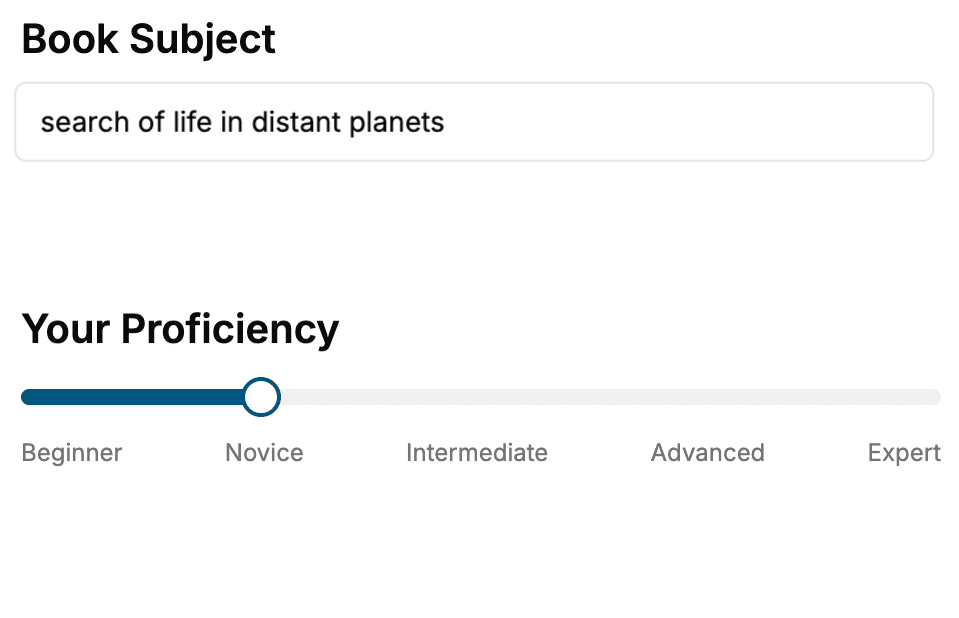
Select the focus of your Philosophy of Religion book and share your background
- 2. Personalize your book
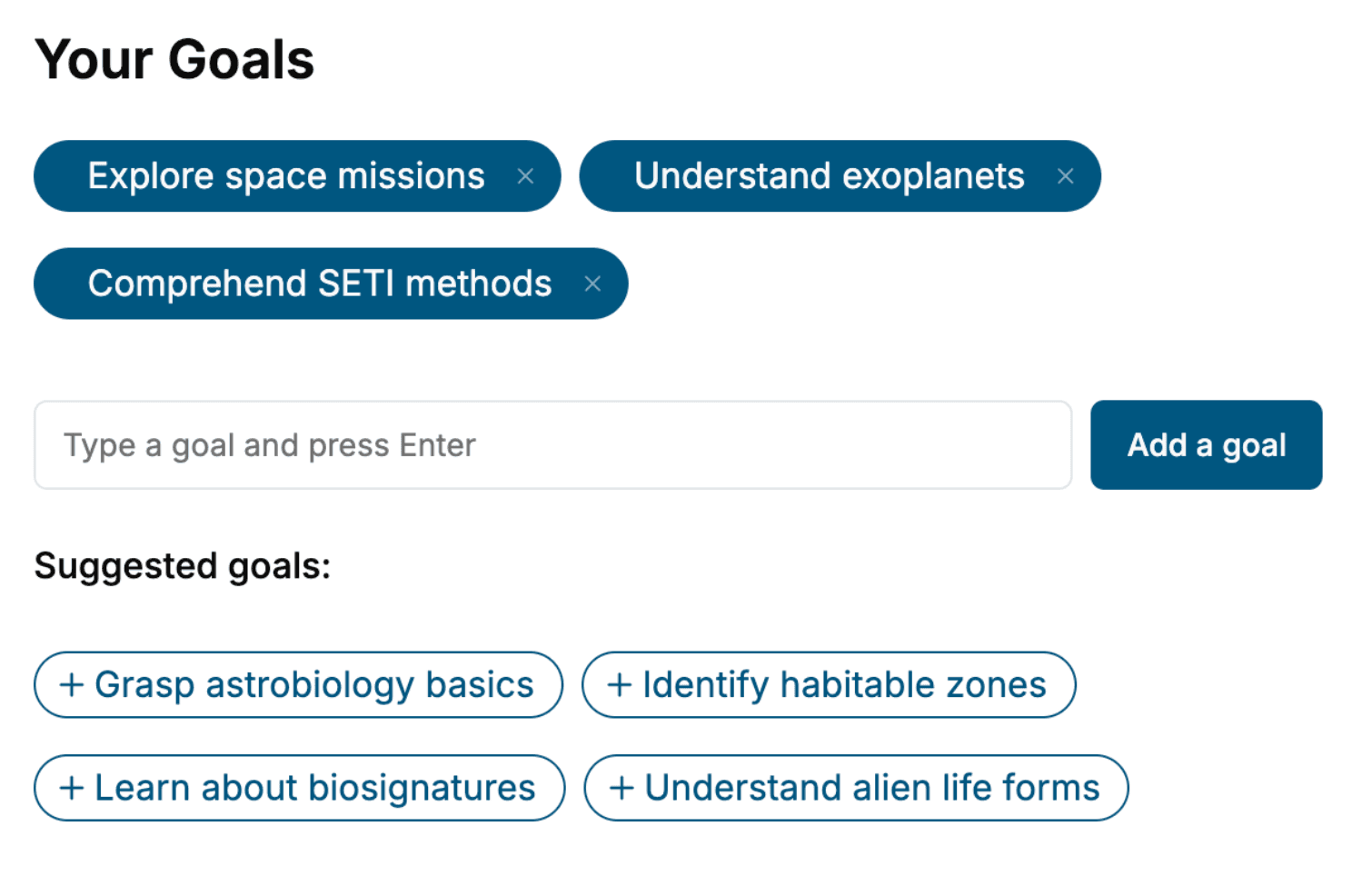
Specify your goals and choose sub-topics to include
- 3. Get your tailored book
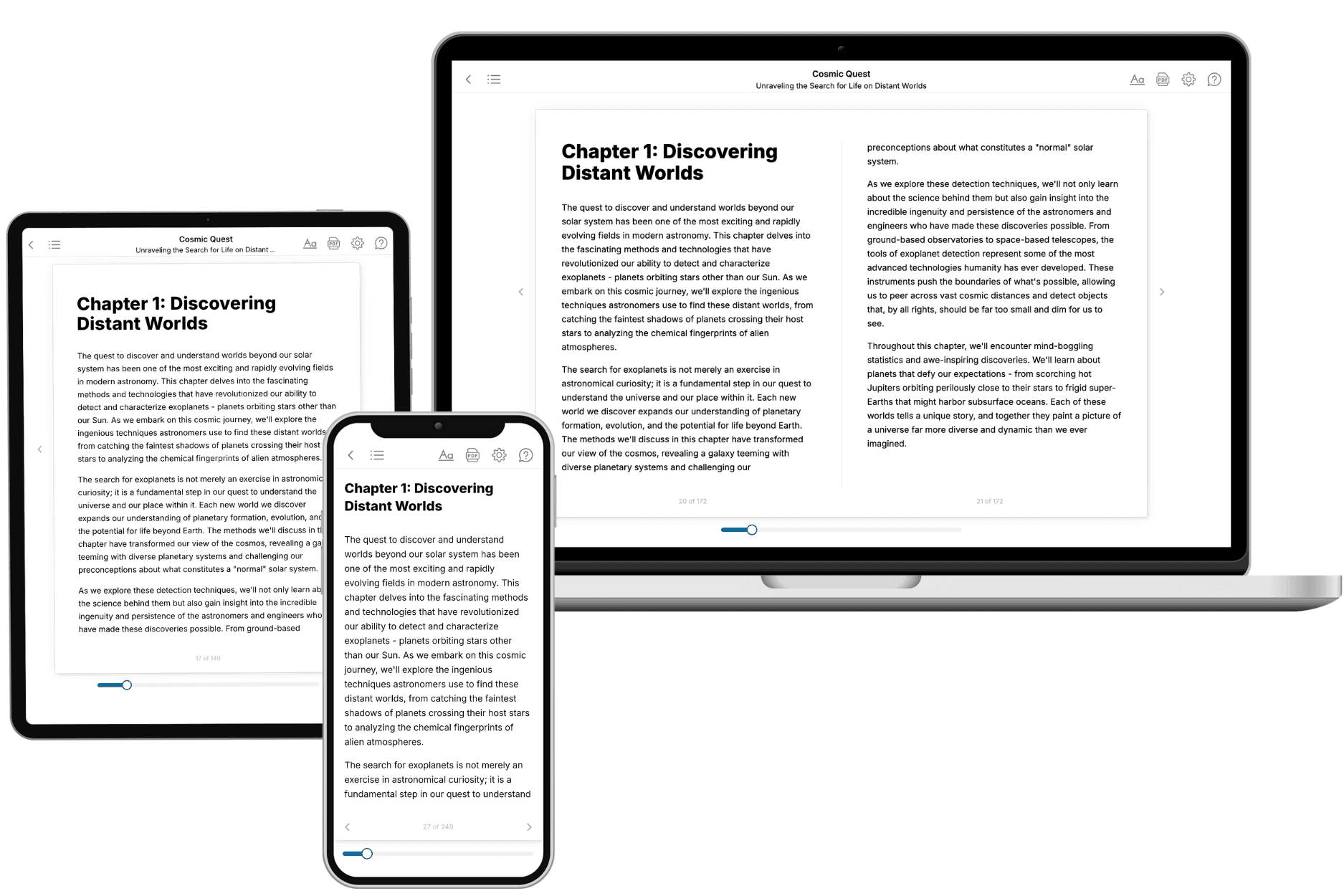
Your book is ready in 10 minutes. Read it online, download as EPUB or PDF, or send to Kindle.
Frequently asked questions
- What is TailoredRead?
TailoredRead creates complete, full-length nonfiction ebooks, written specifically for you. Tell us what you want to learn and why, and TailoredRead writes you a complete ebook on it, with charts, tables, and diagrams throughout. Read it online, on Kindle, or on any e-reader, or download it as a PDF or EPUB. Every book is written fresh the day you order it.
- How is the book tailored to me?
Before anything is written, you answer a few short questions about your goals, your background, and the topics you care about. Your book is then planned around your answers: written at your level, focused on your goals, and covering the topics you chose, instead of the one-size-fits-all book a store sells everyone.
- Will it read like generic AI content?
No. Your book isn't a chat transcript: it's planned chapter by chapter before a single word is written, told in a clear book voice, and explains ideas visually with charts, tables, and diagrams. After writing, every book goes through an editorial pass that polishes chapters so the book reads consistent from start to finish. Judge for yourself: browse thousands of sample books on our Explore Books page.
- How accurate is the content?
Our AI first checks whether your subject needs live research. Niche and fast-moving subjects are researched before writing, and the book plan and chapters are grounded in what it finds. After writing, every book goes through a quality pass that checks its facts and consistency, and researched books list their sources in a Notes section at the back.
- How long is the book?
You choose the length: Comprehensive (250-300 pages), Detailed (150-200 pages), Essential (70-100 pages), or Short (30-50 pages).
- Does the book include visuals?
Yes. Every book includes charts, tables, and diagrams: timelines, checklists, step-by-step guides, decision trees, comparison tables, matrices, and bar charts. A typical book includes dozens of these visual elements.
- Can I read it on Kindle? What formats can I download?
Yes. Every book can be read in our online reader or downloaded as a PDF or EPUB. The EPUB can be opened with Kindle, Apple Books, Kobo, and any e-reader. The Commercial and Author licenses also include an editable Word (DOCX) and Markdown download.
- How much does it cost?
About the price of a regular ebook. The exact price depends on your book's length and complexity, from $2 for the shortest books to $35 for the most comprehensive, and it's shown when you review your book, before you commit to anything. Each book is a one-time purchase, yours to keep, no subscription. Licenses that let you share, teach, or publish your book range from $35.99 to $49.99.
- Can I preview the book before purchasing?
Before you pay, you'll see what your book will cover: the title, a detailed description, the estimated length, and the complete chapter-by-chapter table of contents, so you know what you're getting before you decide. The full text itself is written after you purchase.
- How long does it take to create a book?
About 10 minutes. You can start reading the opening chapters while the rest is still being written.