Sacred Roots
Understanding African Religious Traditions Through History
Deepen your appreciation for one of humanity's oldest and most diverse spiritual landscapes.
284 pages16 chaptersSep 24, 2025African History
About this book
This comprehensive exploration takes you through the rich tapestry of African religious traditions, revealing how these ancient belief systems have shaped cultures, communities, and worldviews across the continent for thousands of years. You'll discover the profound wisdom embedded in oral traditions, the central role of ancestral veneration, and the sophisticated cosmologies that view all existence as interconnected. From the Yoruba pantheon of West Africa to the spiritual practices of the Maasai, from ancient Egyptian mysteries to contemporary syncretic movements, you'll gain insight into belief systems that emphasize community, balance, and harmony with the natural world. This book illuminates how African religious traditions have not only survived but thrived despite centuries of external pressures, adapting while maintaining their essential character. You'll explore sacred rituals, understand the significance of divination practices, and learn about the role of spiritual leaders in maintaining cultural continuity. Whether you're seeking to understand the historical foundations of African spirituality or exploring how these traditions continue to influence contemporary religious movements worldwide, this book provides the knowledge and context you need to appreciate the enduring power and relevance of Africa's sacred heritage.
Table of contents
- IntroductionDefining African Religious Traditions, Historical Context and Timeline, Approaching the Study of African Spirituality, Understanding Continental DiversityRead below
- Chapter 1: Foundations of African SpiritualityPrehistoric Origins and Archaeological Evidence, Core Principles and Worldviews, Cosmological Concepts and Creation Stories, Spiritual Geography and Sacred Landscapes
- Chapter 2: Oral Traditions and Sacred KnowledgeMethods of Knowledge Transmission, Storytelling and Mythological Narratives, Proverbs and Wisdom Literature, Preservation Challenges and Modern Documentation
- Chapter 3: Ancestral Veneration and the Living DeadConcepts of Ancestorhood, Communication with Ancestors, Roles of Ancestors in Daily Life, Memorial Traditions and Commemorative Practices
- Chapter 4: Deities, Spirits, and Divine HierarchiesSupreme Beings and Creator Deities, Nature Spirits and Elemental Forces, Pantheon Structures and Divine Relationships, Spirit Mediums and Divine Communication
- Chapter 5: West African Religious TraditionsYoruba Religion and the Orisha Tradition, Akan Spirituality and Ancestral Wisdom, Dogon Cosmology and Astronomical Knowledge, Vodun Traditions and Spirit Possession
- Chapter 6: East African Religious TraditionsMaasai Spirituality and Pastoral Traditions, Ethiopian Highland Traditions, Kikuyu Beliefs and Mount Kenya Worship, Swahili Coast Spiritual Practices
- Chapter 7: Central African Religious TraditionsBantu Spirituality and Migration Patterns, Kongo Cosmology and the Four Moments of the Sun, Forest Traditions and Pygmy Spirituality, Traditional Healing and Medicinal Practices
- Chapter 8: Southern African Religious TraditionsZulu Spirituality and Ancestral Calling, Shona Traditions and Spirit Mediums, San Beliefs and Rock Art Spirituality, Ubuntu Philosophy and Community Ethics
- Chapter 9: North African Religious TraditionsAncient Egyptian Religious Systems, Berber Traditions and Mountain Spirituality, Nubian Beliefs and Nile Valley Traditions, Early Christian Influences and Syncretism
- Chapter 10: Ritual Practices and Ceremonial LifeLife Cycle Rituals and Rites of Passage, Seasonal Ceremonies and Agricultural Festivals, Healing Rituals and Therapeutic Practices, Community Celebrations and Social Bonding
- Chapter 11: Divination and Prophetic TraditionsTraditional Divination Systems, Oracle Traditions and Sacred Consultation, Dream Interpretation and Vision Quests, Prophetic Movements and Religious Innovation
- Chapter 12: Sacred Spaces and Religious ArchitectureNatural Sanctuaries and Sacred Groves, Shrine Construction and Sacred Architecture, Pilgrimage Sites and Spiritual Journeys, Ceremonial Grounds and Ritual Spaces
- Chapter 13: Religious Leadership and Spiritual AuthorityPriestly Roles and Sacred Responsibilities, Initiation Processes and Training Methods, Gender Roles in Spiritual Leadership, Succession Traditions and Authority Transfer
- Chapter 14: Colonial Impact and Religious TransformationMissionary Encounters and Cultural Clash, Resistance and Adaptation Strategies, Syncretic Movements and Religious Fusion, Underground Preservation and Hidden Practices
- Chapter 15: Diaspora Traditions and Global InfluenceTransatlantic Survival and Transformation, Caribbean Adaptations and New World Synthesis, Brazilian Traditions and Candomblé Development, North American Influence and Cultural Retention
- Chapter 16: Contemporary Revival and Modern PracticeCultural Renaissance and Identity Reclamation, Urban Adaptations and Modern Contexts, Youth Engagement and Generational Transmission, Global Networks and International Communities
- ConclusionThe Enduring Legacy of African Spirituality, Future Directions and Continuing Evolution
Introduction
Africa stands as the birthplace of humanity and the cradle of some of the world's oldest spiritual traditions. Across this vast continent, thousands of distinct religious systems have flourished for millennia, each carrying profound wisdom about the nature of existence, community, and the sacred. These traditions represent far more than historical curiosities—they constitute living, breathing belief systems that continue to shape the lives of millions while offering invaluable insights into alternative ways of understanding spirituality and human connection. The depth and sophistication of African religious thought challenges many Western assumptions about primitive versus advanced spiritual systems, revealing complex cosmologies that integrate science, philosophy, ethics, and mystical experience into coherent worldviews.
The study of African religious traditions requires us to move beyond superficial generalizations and embrace the remarkable diversity that characterizes the continent's spiritual landscape. From the elaborate pantheons of West African Yoruba religion to the astronomical sophistication of Dogon cosmology, from the ancestral reverence of Southern African traditions to the ancient mysteries of Egyptian temple complexes, each system offers unique perspectives on fundamental questions of human existence. These traditions share certain common threads—the centrality of community, the interconnectedness of all life, the importance of maintaining balance between spiritual and material worlds—while expressing these themes through distinctly local cultural forms. Understanding this balance between unity and diversity becomes essential for anyone seeking to appreciate the true richness of African spirituality.
Perhaps most significantly, African religious traditions demonstrate an extraordinary resilience that has enabled them to survive and adapt through centuries of external pressure, including the devastating impacts of the slave trade, colonial domination, and modern globalization. Rather than simply disappearing or becoming fossilized relics, these traditions have shown remarkable capacity for creative adaptation, maintaining their essential character while finding new expressions in contemporary contexts. This adaptability speaks to the fundamental vitality and relevance of African spiritual wisdom, suggesting that these ancient traditions have much to offer our modern world as we grapple with questions of community, environmental stewardship, and meaningful existence in an increasingly fragmented global society.
Defining African Religious Traditions
When we speak of African religious traditions, we refer to the indigenous spiritual systems that developed organically within African communities over thousands of years, distinct from the later arrivals of Christianity and Islam on the continent. These traditions encompass a vast array of beliefs, practices, and institutions that emerged from the lived experiences of African peoples in their specific geographical and cultural contexts. Unlike world religions with centralized doctrines and universal claims, African religious traditions tend to be ethnically specific, meaning they developed within particular cultural groups and reflect the unique histories, environments, and social structures of those communities. However, this ethnic specificity should not be mistaken for insularity, as extensive trade networks, migration patterns, and cultural exchange have created significant cross-pollination of ideas and practices across the continent.
The defining characteristics of African religious traditions include several key elements that distinguish them from other religious systems. Oral transmission serves as the primary vehicle for preserving and passing down religious knowledge, creating dynamic traditions that can adapt to changing circumstances while maintaining core principles. Ancestral veneration forms the cornerstone of most African spiritual systems, establishing a continuous connection between past, present, and future generations. Communal orientation emphasizes collective well-being over individual salvation, viewing spiritual health as inseparable from community harmony. Holistic worldviews integrate spiritual and material realms, rejecting the sharp distinctions between sacred and secular that characterize many other religious traditions. These characteristics work together to create spiritual systems that are deeply embedded in daily life and social relationships.
The geographical scope of African religious traditions extends across the entire continent, from the Mediterranean shores of North Africa to the Cape of Good Hope, encompassing diverse ecological zones including deserts, rainforests, savannas, mountains, and coastal regions. Each environment has shaped distinct spiritual practices and beliefs, creating what scholars estimate to be over 3,000 distinct ethnic groups with their own religious variations[1]. This diversity means that any attempt to generalize about African religion must be balanced with recognition of local specificity. However, certain patterns and themes do emerge across different regions, suggesting deep underlying commonalities in how African peoples have approached fundamental spiritual questions.
The temporal scope of these traditions stretches back to the earliest human societies, with archaeological evidence suggesting sophisticated spiritual practices dating back tens of thousands of years. Rock art sites across the continent, from the Sahara to Southern Africa, provide glimpses into ancient spiritual beliefs and practices that show remarkable continuity with contemporary traditions. This temporal depth gives African religious traditions a unique perspective on human spiritual development, representing unbroken chains of wisdom transmission that predate most other organized religious systems. The antiquity of these traditions also means they have weathered numerous historical challenges and transformations, developing sophisticated mechanisms for adaptation and survival that continue to serve them in the modern era.
Understanding African religious traditions also requires recognizing their dynamic nature. These are not static museum pieces but living traditions that continue to evolve and respond to contemporary challenges. Modern practitioners adapt ancient wisdom to address current concerns such as urbanization, globalization, environmental degradation, and social change. This adaptability has enabled African religious traditions to maintain relevance and vitality even as the contexts in which they operate have transformed dramatically. The result is a rich tapestry of spiritual practices that honor ancestral wisdom while remaining responsive to contemporary needs and circumstances.
The study of African religious traditions has been complicated by historical factors including colonial scholarship that often misrepresented or dismissed these systems as primitive superstition. Early European observers, operating from their own cultural and religious assumptions, frequently failed to recognize the sophistication and coherence of African spiritual systems. This legacy of misrepresentation has required contemporary scholars to undertake careful work of reexamination and reinterpretation, drawing on indigenous knowledge keepers and employing more culturally sensitive methodologies. The result has been a growing appreciation for the depth and complexity of African religious thought, revealing philosophical and theological insights that rival any religious tradition in their sophistication and practical wisdom.
Contemporary definitions of African religious traditions must also account for the complex relationships these systems have developed with Christianity and Islam over centuries of interaction. Rather than simple replacement or syncretism, the reality is often more nuanced, with indigenous traditions maintaining distinct identities while engaging in creative dialogue with other religious systems. Many African Christians and Muslims continue to honor ancestral traditions and participate in indigenous ceremonies, creating complex religious identities that defy simple categorization. This religious plurality reflects the pragmatic and inclusive orientation of many African spiritual systems, which tend to focus more on practical effectiveness and community harmony than on doctrinal purity or exclusive truth claims.
The global significance of African religious traditions extends far beyond the continent itself, as the forced migration of enslaved Africans carried these spiritual systems to the Americas, where they took root and flourished in new forms. Traditions such as Vodou in Haiti, Santería in Cuba, Candomblé in Brazil, and various forms of conjure and rootwork in North America all trace their origins to African spiritual practices. These diaspora traditions have, in turn, influenced global spiritual movements and contributed to contemporary interest in African-derived practices. Understanding African religious traditions therefore requires a global perspective that recognizes their worldwide impact and continuing evolution in diverse cultural contexts.
Historical Context and Timeline
The historical development of African religious traditions unfolds across an immense temporal canvas that spans from the earliest human societies to the present day. Archaeological evidence from sites such as Blombos Cave in South Africa reveals sophisticated symbolic behavior dating back over 70,000 years, including the creation of geometric patterns and the use of ochre pigments that likely held spiritual significance[2]. These early expressions of symbolic thought represent the deep roots of African spiritual consciousness, suggesting that the continent's religious traditions emerged alongside the development of human cognitive capacity itself. The continuity between these ancient practices and contemporary African religious expressions provides a unique window into the evolution of human spiritual awareness over tens of millennia.
The Neolithic period (approximately 10,000-4,000 BCE) marked a crucial phase in the development of African religious traditions as communities transitioned from hunting and gathering to agricultural and pastoral lifestyles. This transformation brought new spiritual concerns related to fertility, seasonal cycles, and the relationship between human communities and the natural world. Rock art from this period across the Sahara, which was then a fertile grassland, depicts elaborate ceremonial scenes involving masked figures, ritual dances, and what appear to be spiritual transformations. The Tassili n'Ajjer paintings in Algeria, dating from around 6,000 BCE, show sophisticated religious iconography including figures that seem to represent spiritual beings or transformed humans, suggesting well-developed concepts of spiritual transcendence and ritual practice.
The emergence of complex societies along the Nile Valley around 3,500 BCE created one of history's most sophisticated religious systems in ancient Egypt. Egyptian religion, with its elaborate pantheon, complex afterlife beliefs, and monumental temple architecture, represents a pinnacle of African religious achievement that influenced spiritual traditions throughout the ancient world. The Egyptian concept of Ma'at—cosmic order and justice—became a foundational principle that resonated throughout African spiritual thought. Simultaneously, the Kingdom of Kush in present-day Sudan developed its own distinctive religious traditions that blended Egyptian influences with indigenous Nubian practices, creating syncretic systems that would influence religious development throughout the Nile Valley and beyond.
The period from 1000 BCE to 1000 CE witnessed the great Bantu migrations that spread agricultural communities and their associated religious traditions across much of sub-Saharan Africa. These migrations were not merely demographic movements but represented massive transfers of spiritual knowledge, ritual practices, and cosmological concepts. As Bantu-speaking peoples moved into new territories, they encountered and interacted with existing populations, creating complex processes of religious exchange and synthesis. The result was the establishment of shared spiritual frameworks across vast regions of Africa, including common concepts of ancestral veneration, divination practices, and community-based ritual systems. This period laid the foundation for many of the religious traditions that continue to flourish across central, eastern, and southern Africa today.
The medieval period (1000-1500 CE) brought significant new influences to African religious landscapes through the expansion of trans-Saharan trade networks and the arrival of Islam in many regions. However, rather than simply displacing indigenous traditions, Islam often engaged in complex processes of accommodation and synthesis. In West Africa, the great empires of Ghana, Mali, and Songhai developed sophisticated approaches to religious plurality that allowed Islamic and indigenous traditions to coexist and interact. The famous pilgrimage of Mansa Musa to Mecca in 1324-1325 demonstrated the integration of Islamic practice with traditional concepts of divine kingship and spiritual authority. Similarly, the Swahili coast of East Africa developed unique forms of Islamic practice that incorporated significant elements from indigenous spiritual traditions.
The arrival of European traders and missionaries from the 15th century onward initiated a new phase of religious encounter and transformation. The Atlantic slave trade (approximately 1500-1850) had devastating impacts on African societies but also led to the remarkable preservation and adaptation of African religious traditions in the Americas. Enslaved Africans carried their spiritual practices across the Atlantic, where they developed new forms of expression under conditions of extreme oppression. The colonial period (roughly 1880-1960) brought intensive Christian missionary activity and systematic attempts to suppress indigenous religious practices. However, African communities developed sophisticated strategies of resistance and adaptation, often maintaining traditional practices while selectively adopting elements of Christianity that resonated with indigenous values.
The 20th century marked a period of both crisis and renewal for African religious traditions. The independence movements of the 1950s and 1960s often included explicit efforts to reclaim and revitalize indigenous spiritual practices as part of broader cultural nationalism. Leaders such as Jomo Kenyatta in Kenya and Leopold Senghor in Senegal advocated for the recognition and preservation of traditional African values, including religious practices. The post-independence period has seen growing scholarly attention to African religious traditions, with African intellectuals such as John Mbiti, Bolaji Idowu, and Mercy Amba Oduyoye developing sophisticated theological and philosophical frameworks for understanding indigenous spiritual systems. This academic renaissance has contributed to broader cultural movements aimed at preserving and revitalizing traditional practices.
The contemporary period (1990-present) has witnessed remarkable developments in the global recognition and practice of African religious traditions. The end of apartheid in South Africa, the growth of Afrocentric movements worldwide, and increasing interest in indigenous spirituality have all contributed to a renaissance of African religious practices. Modern technology has enabled new forms of preservation and transmission, with digital archives documenting traditional practices and global networks connecting practitioners across continents. At the same time, urbanization and globalization continue to present challenges to traditional ways of life, requiring ongoing adaptation and innovation. The result is a dynamic contemporary landscape in which ancient wisdom traditions engage creatively with modern realities, producing new forms of spiritual expression that honor ancestral knowledge while addressing contemporary needs.
Understanding this historical timeline reveals several crucial patterns in the development of African religious traditions. First, these traditions have demonstrated remarkable continuity over millennia, maintaining core principles and practices despite massive social and political changes. Second, they have shown extraordinary adaptability, successfully incorporating new influences while preserving essential characteristics. Third, they have proven to be globally influential, spreading far beyond Africa through both voluntary and forced migration and continuing to shape spiritual movements worldwide. Finally, they represent living traditions that continue to evolve and respond to contemporary challenges, suggesting that their historical development is far from complete and that they will continue to play significant roles in global spiritual landscapes for generations to come.
Approaching the Study of African Spirituality
The study of African religious traditions requires a fundamentally different methodological approach than the examination of text-based world religions. Since these traditions have been primarily transmitted through oral means rather than written scriptures, researchers must develop skills in ethnographic observation, oral history collection, and participatory research methods. This approach demands deep cultural sensitivity and long-term engagement with communities, as spiritual knowledge is often considered sacred and is shared only with appropriate individuals under proper circumstances. The methodology must also account for the fact that religious practice in African traditions is typically integrated into daily life rather than compartmentalized into separate religious spheres, requiring holistic approaches that examine spirituality within broader social, economic, and political contexts.
One of the most critical methodological considerations involves addressing the colonial legacy in African religious studies. Early European scholars and missionaries often approached African traditions with profound cultural biases, describing them as primitive, superstitious, or demonic. These misrepresentations became embedded in academic literature and popular consciousness, creating distorted images that persist today. Contemporary scholarship must actively work to decolonize the study of African religions by centering African voices and perspectives, using indigenous categories and concepts rather than imposing external frameworks, and recognizing the sophistication and coherence of African spiritual systems. This decolonizing approach requires ongoing collaboration with African scholars, religious practitioners, and community leaders who can provide insider perspectives and correct historical misrepresentations.
The participatory research methodology has become increasingly important in African religious studies, recognizing that meaningful understanding often requires some level of participation in religious practices and community life. This approach goes beyond simple observation to involve researchers in the lived experience of religious communities, though always with appropriate respect for boundaries and sacred protocols. Participatory research can provide insights into the experiential dimensions of African spirituality that cannot be captured through external observation alone. However, this methodology also raises important ethical questions about the researcher's role, the potential for exploitation of religious communities, and the responsibility to represent traditions accurately and respectfully.
The study of African religious traditions must also employ interdisciplinary approaches that draw on multiple fields of knowledge. Anthropology provides tools for understanding cultural contexts and social functions of religious practices. History offers perspectives on the development and transformation of traditions over time. Archaeology contributes evidence about ancient spiritual practices and their continuity with contemporary traditions. Linguistics helps decode the symbolic meanings embedded in religious languages and oral traditions. Psychology and neuroscience can illuminate the experiential dimensions of spiritual practices such as possession, trance, and healing. Environmental studies reveal the ecological wisdom embedded in many African spiritual systems. This interdisciplinary approach reflects the holistic nature of African religious traditions themselves, which integrate multiple dimensions of human experience.
The comparative methodology offers valuable insights when applied carefully to African religious traditions. Comparing different African traditions can reveal common patterns and shared principles while highlighting unique local variations. However, comparative approaches must avoid the trap of creating artificial hierarchies or reducing complex traditions to simple categories. The goal should be to understand both the unity and diversity within African spirituality, recognizing how shared themes are expressed through distinctly local cultural forms. Comparison with non-African religious traditions can also be illuminating, but only when conducted with full respect for the integrity and sophistication of African systems rather than using them as foils for supposedly more advanced traditions.
Modern technology has opened new possibilities for studying and preserving African religious traditions. Digital documentation allows for the creation of multimedia archives that can capture not only the verbal content of oral traditions but also their musical, visual, and performative dimensions. Video recordings of ceremonies and rituals provide rich data for analysis while creating permanent records for future generations. Audio recordings preserve the exact intonations and rhythms of sacred songs and chants. Digital mapping can document sacred sites and pilgrimage routes. However, the use of technology in religious research raises important ethical questions about consent, sacred knowledge, and cultural appropriation. Many African communities have legitimate concerns about the documentation and dissemination of sacred knowledge, requiring researchers to develop protocols that respect community wishes and maintain appropriate boundaries.
The insider-outsider dynamic presents ongoing challenges in African religious studies. Insider perspectives from practitioners and community members provide authentic insights into the meaning and significance of religious practices. However, insiders may take certain aspects of their traditions for granted or may be reluctant to share sacred knowledge with outsiders. Outsider perspectives can offer analytical distance and comparative insights but may miss subtle meanings and nuances that are apparent only to community members. The most productive approaches often involve collaboration between insider and outsider researchers, creating teams that combine authentic cultural knowledge with analytical skills and comparative perspectives.
Contemporary African religious studies must also grapple with questions of representation and voice. Who has the authority to speak about African religious traditions? How can scholarship avoid perpetuating colonial patterns of extraction and misrepresentation? How can research benefit the communities being studied rather than simply advancing academic careers? These questions have led to increased emphasis on collaborative research models, community-based participatory research, and the training of African scholars who can study their own traditions from positions of cultural authenticity. The goal is to create scholarship that serves African communities while contributing to global understanding of human spiritual diversity.
Finally, the study of African religious traditions must account for their contemporary dynamism and global reach. These are not museum pieces or historical artifacts but living traditions that continue to evolve and adapt. Research methodologies must be flexible enough to capture ongoing changes while identifying enduring principles and patterns. The global diaspora of African religious traditions requires research approaches that can trace connections and transformations across continents and cultures. The result should be scholarship that honors the depth and complexity of African spiritual wisdom while recognizing its continuing relevance and vitality in our contemporary world.
Understanding Continental Diversity
Africa's religious diversity reflects the continent's extraordinary geographical, cultural, and linguistic complexity. Spanning over 30 million square kilometers and encompassing every major climate zone from Mediterranean to tropical rainforest, Africa provides the environmental foundation for an incredible array of spiritual traditions. Each ecological niche has shaped distinct religious practices adapted to local conditions, from the desert spirituality of the Sahara to the forest traditions of the Congo Basin, from the highland practices of Ethiopia to the coastal ceremonies of the Swahili. This environmental diversity has created religious systems that are deeply attuned to local landscapes, seasonal cycles, and natural resources, resulting in spiritual practices that vary dramatically from region to region while maintaining underlying connections to the African continent's shared heritage.
The linguistic diversity of Africa provides another crucial dimension for understanding religious variation across the continent. Africa is home to over 2,000 languages belonging to four major language families: Afroasiatic, Niger-Congo, Nilo-Saharan, and Khoisan[3]. Each language carries unique conceptual frameworks for understanding spiritual realities, with specific vocabularies for describing divine beings, spiritual forces, ritual practices, and cosmological concepts. The Yoruba concept of àṣẹ (divine force or energy), the Akan notion of sunsum (spiritual essence), and the Shona understanding of ukama (kinship extending to spiritual relationships) represent just a few examples of how linguistic diversity creates distinct approaches to spiritual understanding. These linguistic differences are not merely semantic but reflect fundamentally different ways of conceptualizing and experiencing spiritual reality.
Cultural diversity across Africa manifests in dramatically different social organizations that shape religious expression. Pastoral societies such as the Maasai of East Africa have developed spiritual practices centered on cattle, mobility, and the relationship between humans and livestock. Their religious calendar follows the rhythms of seasonal migration, and their ceremonies often involve the blessing of herds and the maintenance of harmony between human and animal communities. In contrast, agricultural societies such as the Dogon of Mali have created elaborate religious systems focused on farming cycles, fertility, and the relationship between human communities and the land. Their religious practices include complex ceremonies for planting and harvest, rituals for ensuring adequate rainfall, and sophisticated astronomical observations that guide agricultural timing.
The diversity of political systems across Africa has also shaped religious traditions in profound ways. Centralized kingdoms such as those found among the Yoruba, Buganda, and Zulu developed elaborate religious hierarchies that paralleled political structures, with divine kings serving as intermediaries between human and spiritual realms. These systems often include complex pantheons of deities, elaborate court ceremonies, and sophisticated theological concepts about divine kingship and political authority. In contrast, decentralized societies such as the Igbo of Nigeria developed more egalitarian religious systems based on age grades, title societies, and community consensus. Their spiritual practices emphasize collective decision-making, shared ritual responsibilities, and democratic participation in religious life.
Regional variations in African religious traditions can be understood through several major geographical and cultural zones. West Africa is characterized by complex pantheons of deities, elaborate divination systems, and sophisticated concepts of spiritual force and energy. The region's history of powerful kingdoms and extensive trade networks has created religious traditions that are both highly developed and widely influential. East Africa shows the influence of pastoral traditions, highland environments, and Indian Ocean trade connections, resulting in spiritual practices that emphasize mobility, ancestral guidance, and adaptation to diverse ecological conditions. Central Africa reflects the influence of forest environments and Bantu cultural patterns, with religious traditions that emphasize healing, community harmony, and the spiritual significance of natural resources.
Southern Africa demonstrates the complex interactions between indigenous Khoisan traditions and later Bantu influences, creating unique syntheses that combine ancient hunting and gathering spirituality with agricultural and pastoral practices. The region's history of mineral wealth and colonial exploitation has also shaped contemporary religious expressions that address themes of resistance, survival, and cultural preservation. North Africa represents a unique zone where ancient African traditions encountered early Christianity and later Islam, creating complex patterns of religious interaction and synthesis that continue to influence spiritual life throughout the region.
Despite this remarkable diversity, certain common themes emerge across African religious traditions that suggest underlying unity within the continent's spiritual heritage. The centrality of ancestral veneration appears in virtually all African religious systems, though expressed through different ritual forms and conceptual frameworks. The emphasis on community harmony and collective well-being transcends regional boundaries, manifesting in various forms of communal ceremony and social ritual. The integration of spiritual and material realms appears consistently across different traditions, though the specific mechanisms for maintaining this integration vary considerably. The importance of oral tradition as a vehicle for preserving and transmitting spiritual knowledge represents another continental commonality, though the specific forms of oral expression differ dramatically from region to region.
Understanding continental diversity also requires recognizing the dynamic interactions between different African religious traditions over time. Trade routes, migration patterns, intermarriage, and political alliances have created extensive networks of religious exchange that have enriched traditions throughout the continent. The spread of iron-working technology, for example, was accompanied by the transmission of spiritual practices related to metallurgy and craftsmanship. The development of long-distance trade networks facilitated the exchange of religious ideas, ritual objects, and spiritual practices across vast distances. These interactions have created a complex web of religious relationships that connects apparently distinct traditions through shared symbols, practices, and concepts.
Contemporary globalization has added new dimensions to African religious diversity, as traditional practices adapt to urban environments, diaspora communities, and global networks of communication and exchange. Modern African cities have become laboratories for religious innovation, where practitioners from different traditions interact and create new forms of spiritual expression. The global African diaspora has created new contexts for traditional practices, leading to creative adaptations that maintain essential principles while responding to new cultural environments. Digital technology has enabled new forms of religious connection and transmission that transcend geographical boundaries while preserving local distinctiveness. The result is an increasingly complex landscape of African religious diversity that honors traditional wisdom while embracing contemporary possibilities for spiritual expression and community building.
This is the end of the free sample. The full book has 16 chapters.
Want this book written for you?
Tell us your goals and background, and get your own version of this book, tailored by AI to you.


Benefits of AI-tailored books
- Read one book, not ten:
- all the African History knowledge you need, gathered into a single book.
- Save days of learning:
- tell us your goals, choose your topics, and the whole book is built around them.
- Learn effortlessly:
- African History book written for your specific background and expertise.
- Understand at a glance:
- includes charts, tables, timelines, checklists, decision trees, and more.
- Stay current:
- written the day you order it, not years ago.
- Trust what you read:
- every book is checked for accuracy, with real research when your subject needs it.
Create your unique book in 3 steps
- 1. Select your focus
Select the focus of your African History book and share your background
- 2. Personalize your book
Specify your goals and choose sub-topics to include
- 3. Get your tailored book
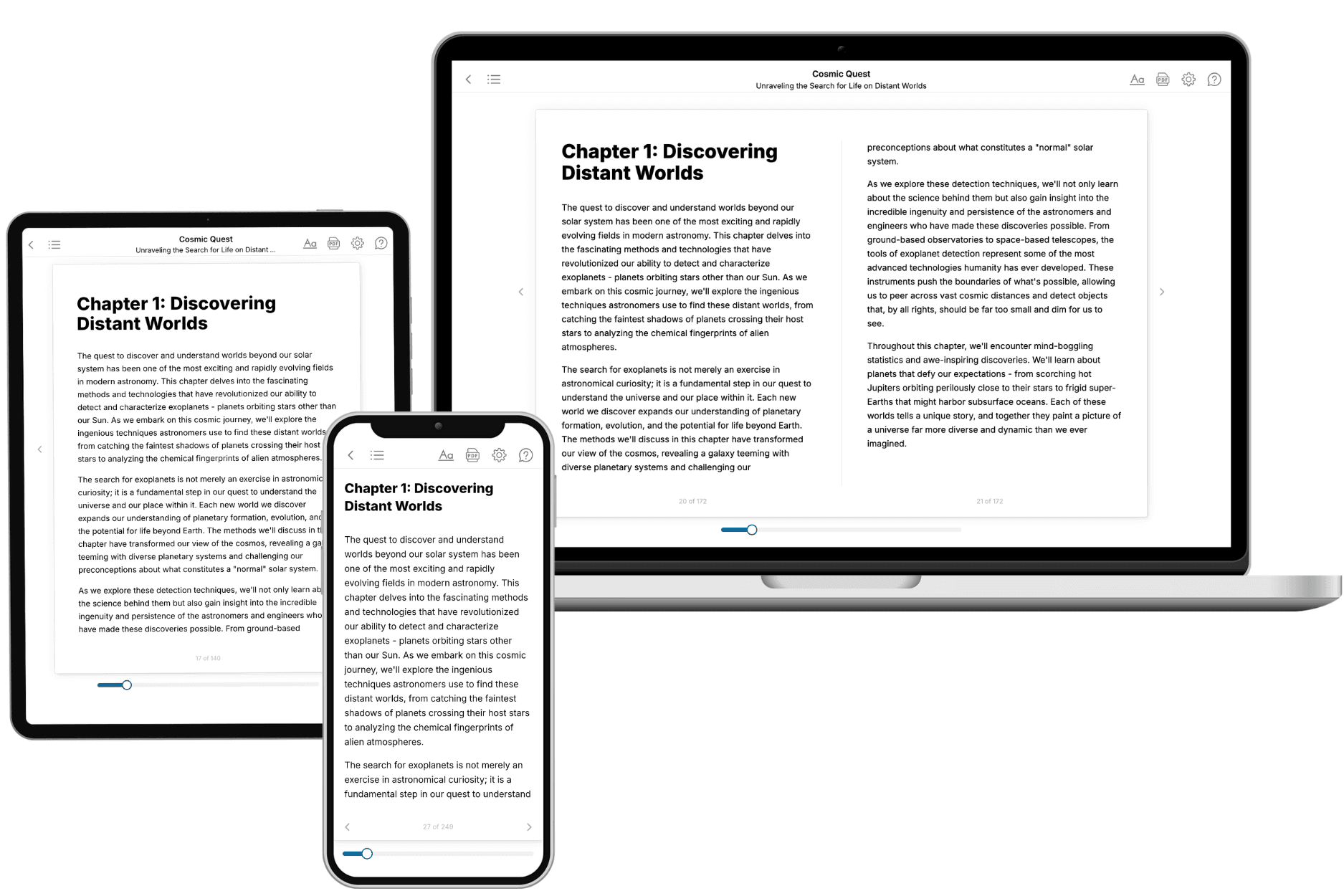
Your book is ready in 10 minutes. Read it online, download as EPUB or PDF, or send to Kindle.

Frequently asked questions
- What is TailoredRead?
TailoredRead creates complete, full-length nonfiction ebooks, written specifically for you. Tell us what you want to learn and why, and TailoredRead writes you a complete ebook on it, with charts, tables, and diagrams throughout. Read it online, on Kindle, or on any e-reader, or download it as a PDF or EPUB. Every book is written fresh the day you order it.
- How is the book tailored to me?
Before anything is written, you answer a few short questions about your goals, your background, and the topics you care about. Your book is then planned around your answers: written at your level, focused on your goals, and covering the topics you chose, instead of the one-size-fits-all book a store sells everyone.
- Will it read like generic AI content?
No. Your book isn't a chat transcript: it's planned chapter by chapter before a single word is written, told in a clear book voice, and explains ideas visually with charts, tables, and diagrams. After writing, every book goes through an editorial pass that polishes chapters so the book reads consistent from start to finish. Judge for yourself: browse thousands of sample books on our Explore Books page.
- How accurate is the content?
Our AI first checks whether your subject needs live research. Niche and fast-moving subjects are researched before writing, and the book plan and chapters are grounded in what it finds. After writing, every book goes through a quality pass that checks its facts and consistency, and researched books list their sources in a Notes section at the back.
- How long is the book?
You choose the length: Comprehensive (250-300 pages), Detailed (150-200 pages), Essential (70-100 pages), or Short (30-50 pages).
- Does the book include visuals?
Yes. Every book includes charts, tables, and diagrams: timelines, checklists, step-by-step guides, decision trees, comparison tables, matrices, and bar charts. A typical book includes dozens of these visual elements.
- Can I read it on Kindle? What formats can I download?
Yes. Every book can be read in our online reader or downloaded as a PDF or EPUB. The EPUB can be opened with Kindle, Apple Books, Kobo, and any e-reader. The Commercial and Author licenses also include an editable Word (DOCX) and Markdown download.
- How much does it cost?
About the price of a regular ebook. The exact price depends on your book's length and complexity, from $2 for the shortest books to $35 for the most comprehensive, and it's shown when you review your book, before you commit to anything. Each book is a one-time purchase, yours to keep, no subscription. Licenses that let you share, teach, or publish your book range from $35.99 to $49.99.
- Can I preview the book before purchasing?
Before you pay, you'll see what your book will cover: the title, a detailed description, the estimated length, and the complete chapter-by-chapter table of contents, so you know what you're getting before you decide. The full text itself is written after you purchase.
- How long does it take to create a book?
About 10 minutes. You can start reading the opening chapters while the rest is still being written.