Selling Smart on Facebook Marketplace
A practical path from first listing to steady home-based income
Picture a steady stream of small sales arriving each week, turning the clutter in your home and the bargains you find around town into income you control.
222 pages11 chaptersNov 26, 2026
About this book
This book is written for people who want to begin reselling on Facebook Marketplace without a large budget or prior experience. It walks you through the platform from your first account setup to a complete 30-day selling plan. You will learn how to choose products with real local demand, find affordable merchandise at thrift stores, yard sales, and estate sales, and calculate the margin that separates a hobby from a business. Practical chapters cover taking photographs with a smartphone, writing titles and descriptions that buyers trust, negotiating low offers without losing a sale, and arranging pickups in safe public locations. You will also learn to spot payment fraud and common scams, protect your personal information, track income and expenses, and understand the recordkeeping that tax authorities expect. Ready-to-use templates, checklists, and sample messages help you put each idea into action right away, so you can build a dependable resale routine one listing at a time.
Table of contents
- IntroductionWhy Marketplace Suits New Resellers, What Earnings Realistically Look Like, How to Use This BookRead below
- Chapter 1: Understanding Facebook MarketplaceSetting Up Your Account and Access, Rules, Restrictions, and Commerce Policies, Core Features Every Seller Should Know
- Chapter 2: Starting With What You Already OwnSorting Household Items for Quick Sales, Your First Test Listing
- Chapter 3: Finding Products Worth ResellingResearching Local Demand and Competition, Spotting Products With Real Profit Potential, Sourcing at Thrift Stores, Yard Sales, and Estate Sales
- Chapter 4: Costs, Margins, and Smart PricingCalculating Costs and Profit Margins, Setting Competitive and Profitable Prices
- Chapter 5: Creating Listings That SellTaking Attractive Photos With a Smartphone, Writing Titles and Descriptions Buyers Trust, Publishing, Categories, and Visibility
- Chapter 6: Communicating and Negotiating With BuyersResponding Clearly to Potential Buyers, Handling Low Offers With Confidence, When Buyers Cancel or Fail to Appear
- Chapter 7: Safe Payments and Avoiding ScamsAccepting Payments Without Losing Money, Recognizing Payment Fraud and Common Scams, Keeping Your Personal Information Private
- Chapter 8: Meetups, Shipping, and Handling ProblemsChoosing Safe Meeting Locations, Pickup, Shipping, and Delivery Compared, Resolving Complaints and Disputes Calmly
- Chapter 9: Tracking Profits and Growing Your BusinessTracking Income, Expenses, and Profit, Tax Reporting and Recordkeeping Basics, Managing Inventory Across Multiple Listings
- Chapter 10: Building a Sustainable Home-Based Resale BusinessBuilding a Strong Seller Reputation, Expanding Beyond Marketplace Carefully, Avoiding Common Beginner Mistakes
- Chapter 11: Your 30-Day Facebook Marketplace Action PlanSetting Up and Making First Sales, Scaling Listings and Refining Your System
- ConclusionNext Steps After Your First Month
- Further Reading and Resources
Introduction
A spare bedroom closet holds a pressure washer that got used twice, a set of kitchen scales from a diet that didn't stick, and three unopened board games from a birthday that came and went. None of it is garbage. All of it has a buyer somewhere within a twenty-minute drive. That gap between "unused item in a closet" and "cash in a seller's pocket" is the entire subject of this book, and Facebook Marketplace is the bridge that connects the two sides without requiring a storefront, a business license, or a single dollar of startup capital.
Reselling has existed for as long as people have had more stuff than they need and neighbors who need more stuff. What has changed is the friction involved in connecting those two groups. A garage sale reaches the people who happen to drive past on a Saturday morning. A classified ad in a newspaper reaches whoever still reads classified ads. Facebook Marketplace reaches, almost instantly, a local population large enough to contain real demand for almost anything a seller lists, from a toddler's outgrown bike to a half-used bag of concrete mix. That reach is the platform's core advantage, and it is why Marketplace has become a practical entry point for people with no prior selling experience.
This book treats reselling as a skill, not a stroke of luck. Skills can be broken into steps, practiced, and improved. A seller who takes blurry photos and writes a one-word title will struggle even with a genuinely good product, while a seller who understands pricing, photography, and buyer communication can do well with ordinary items that nobody would call special. The chapters ahead isolate each of these skills, from setting up an account to tracking profit to scaling into a repeatable system, so that the reader builds competence in order rather than guessing at all of it simultaneously.
The introduction sets expectations before the first real lesson begins. It explains why Marketplace specifically, rather than other resale platforms, suits someone just starting out. It gives an honest picture of what earnings can look like, since vague promises of easy money tend to produce disappointment and distrust. And it lays out how to move through the rest of the book, because a reference guide used out of order is far less useful than one followed with intention.
Why Marketplace Suits New Resellers
Most people already have a Facebook account, which means the barrier to starting is close to zero. There is no new app to download with an unfamiliar interface, no separate password to create, and no waiting period before a listing can go live. For someone testing whether reselling is worth their time, this matters more than it might seem. A platform that takes an afternoon just to set up discourages the kind of small, low-stakes experimentation that teaches a new seller the most in the early days, such as listing an old lamp just to see what happens.
Local reach is the second advantage, and it works differently than shipping-based resale platforms. Instead of competing against sellers across the country, a Marketplace listing surfaces mainly to people nearby, which narrows the competition to a manageable size and makes local pickup the default rather than the exception. This matters for the kind of items a beginner is most likely to start with: furniture, appliances, and anything large that would be expensive or inconvenient to ship. A buyer who can drive fifteen minutes to pick up a dresser is a buyer who never has to think about a shipping box or a carrier. Other chapters cover how fulfillment options compare in more detail, including when shipping does make sense.
Trust moves faster on a platform tied to real identities than on fully anonymous classified sites. A buyer browsing Marketplace can usually see a seller's profile, mutual friends, and some history on the platform, which lowers the suspicion that often slows down transactions on completely anonymous listing boards. This does not eliminate scams, and later chapters spend real time on recognizing fraud patterns, but it does mean that an honest new seller starts with a baseline of credibility that an anonymous posting would not carry. Buyers tend to respond faster and show up more reliably when they can see a human account behind the listing.
Low cost of entry extends beyond account setup into the listing process itself. There is no fee to create a listing, and no inventory commitment required before a single sale happens. This stands in contrast to approaches that ask a new seller to buy stock upfront, rent table space at a market, or commit to a subscription before testing whether a product sells at all. A Marketplace seller can list one item, watch what happens, and adjust before ever spending money on new inventory. That loop of list, observe, and adjust is where real selling skill develops, and it works especially well because each cycle costs nothing but time.
The platform also rewards consistency more than cleverness. A seller who lists steadily, responds to messages promptly, and treats every transaction professionally will outperform a seller chasing one clever gimmick or a single high-value item. This is good news for a beginner, because consistency is learnable and schedulable, while cleverness is not. Showing up, every week, with another listing or another reply to a buyer's question, builds a track record that compounds. Later chapters on reputation and on the thirty-day plan both return to this idea, because it underlies almost everything that separates sellers who stick with reselling from those who try it once and stop.
None of this means Marketplace is the only platform worth using, or that it will remain the best fit forever. Expanding into other platforms, once a seller has a working system, gets its own treatment later in the book. But for someone starting from zero, with no inventory, no following, and no selling history, Marketplace removes more obstacles than any alternative, which is exactly why it anchors the approach this book takes from the first chapter onward.
Consider a simple comparison. A newcomer trying to sell a used stand mixer has several choices: a garage sale, a classified ad, a shipping-based resale app, or Marketplace. The garage sale reaches a tiny, weather-dependent audience. The classified ad reaches almost nobody in most areas today. The shipping-based app requires packaging, a shipping label, and a buyer willing to wait days for delivery of a heavy kitchen appliance. Marketplace lets a local buyer message within hours, agree on a price, and pick the mixer up the same evening. The convenience advantage is not abstract. It shows up in how quickly an item actually sells.
It is also worth understanding what Marketplace is not built for. It does not function as a storefront with a catalog, a cart, or automated checkout the way a dedicated e-commerce site does. Each listing is closer to a single, standalone classified ad than a product page in a store. That structure shapes almost every decision covered later in the book, from how categories and visibility work to how a seller manages dozens of individual listings at once rather than one unified shop. Understanding this distinction early prevents the common mistake of treating Marketplace like a shipping-based storefront and expecting the same behavior from buyers.
Meta, the company that operates Facebook Marketplace, has also been investing in tools meant to lower the effort required to list and sell. Recent additions include features intended to help draft listings from photos and suggest prices based on similar local listings. These tools can speed up the mechanical parts of listing, but they do not replace the judgment this book builds, such as recognizing which items are actually worth sourcing or spotting when a suggested price undervalues an item's real local demand. Treat any automated suggestion as a starting draft to review, not a finished decision.
New sellers sometimes assume that because Marketplace is free and easy to access, it must be saturated with competition to the point of being unprofitable. In practice, the opposite is often true in many categories. A large share of listings are poorly photographed, vaguely titled, or priced without any real research, which means a seller who does even a modest job on presentation and pricing stands out quickly. Later chapters on photography, titles, and pricing are designed to close that gap deliberately, turning basic competence into a competitive edge against a field of listings that mostly did not try very hard.
The comparison table below lays out how Marketplace stacks up against two other common starting points for a brand new reseller, specifically on the dimensions that matter most before a first sale happens: cost to start, audience reach, and typical fulfillment method.
| Starting point | Cost to start | Typical fulfillment |
|---|---|---|
| Facebook Marketplace | Free to list, no inventory required upfront | Local pickup, with some delivery options |
| Weekend garage sale | Free, but limited to items on hand | In-person only, small local audience |
| Shipping-based resale app | Often free to list, packaging adds cost per sale | Shipping required, slower for buyer |
Taken together, these advantages explain why this entire book is built around Marketplace rather than treating it as one option among several given equal weight. A reader following the chapters in order will set up an account, learn the rules that govern selling, and start listing items they already own, all without spending money before the first sale confirms that the process actually works for them.
None of this guarantees results. Demand varies by region, by season, and by category, and two sellers doing everything described in this book can still see different outcomes. What Marketplace offers is a low-risk environment to test reselling as a real activity, learn from real buyer behavior, and build toward the more structured approach the later chapters describe, including the detailed thirty-day plan that closes out the book.
What Earnings Realistically Look Like
Nobody can promise a specific income from reselling on Marketplace, and any claim that does should raise suspicion rather than excitement. Earnings depend on how much time a seller invests, what items they can source cheaply, how much local demand exists for those items, and how disciplined they are about pricing and follow-up. Two sellers in the same city, doing roughly the same work, can still end up with different results depending on factors as simple as what their neighbors happen to be looking for that month. This book avoids income promises entirely and instead focuses on the inputs a seller actually controls.
The most important input is margin, not sale price. A seller who sells an item for a high price but paid nearly as much to acquire it has done very little actual work worth repeating. A seller who sells a much cheaper item for a modest price, after acquiring it for close to nothing, has built something closer to a real profit. This distinction runs through the entire book and gets its own detailed treatment in the chapter on calculating costs and profit margins, but it needs to be understood from the very first listing, because sale price alone is a misleading way to judge success.
Early sales, in the first week or two, tend to be slower and smaller than a new seller expects. This has less to do with the platform and more to do with the learning curve: photographs improve with practice, descriptions get clearer once a seller understands what buyers actually ask about, and response times improve as a seller gets used to checking messages. Treating the first several listings as practice, rather than as the measure of whether reselling will work, keeps early slow results from feeling like failure. The chapter on starting with items already owned is built specifically around this idea, using low-stakes household items as the practice ground before any money gets spent on inventory.
Consistency tends to matter more than any single big sale. A seller who lists one expensive item and waits weeks for the right buyer will likely see less overall income than one who lists several modest items every week and keeps the cycle of sourcing, listing, and selling constantly moving. This is partly a numbers effect, since more listings create more chances for a match with a buyer, and partly a skill effect, since frequent listing builds the habits that make each individual listing better. The thirty-day plan near the end of the book is structured around this principle, treating the number and frequency of listings as something to manage deliberately rather than leaving it to chance.
Seasonality affects almost every category of goods sold locally. Patio furniture sells at different speeds in spring than in winter, and the same is true for holiday decorations, winter coats, or children's outdoor toys. A new seller who expects flat, predictable demand across the year will be surprised when a category that sold briskly for a month suddenly slows down. This is not a sign that something has gone wrong. It reflects ordinary shifts in what local buyers are shopping for, and a seller who tracks results over time, a habit covered in the chapter on tracking income and expenses, will start to notice these patterns and plan sourcing around them.
Costs eat into gross sales in ways that are easy to underestimate at first. Acquisition cost is the obvious one, whether that is a few dollars paid at a thrift store or nothing at all for an item pulled from a closet, but time, gas spent picking up inventory, and occasional packaging materials all reduce the real return. A seller who only tracks the total dollar amount received from sales, without subtracting these costs, will consistently overestimate how much they are actually earning. The chapter on calculating margins works through this with concrete numbers, and the chapter on tracking income, expenses, and profit builds the habit of recording these costs as they happen rather than trying to reconstruct them later.
Gross proceeds reported through a payment platform are not the same thing as taxable profit, and this distinction trips up many new sellers. A Form 1099-K, when one is issued, reports the total amount processed through a payment system, not the profit left after subtracting what was originally paid for the item. A seller who bought a dresser for a small amount at a yard sale and resold it for a larger amount owes tax consideration on the difference, not on the full sale price. The chapter on tax reporting and recordkeeping basics explains how to track this distinction from the start, so that recordkeeping never has to be reconstructed from memory months later.
It helps to think about a realistic early month rather than a single sale. A new seller who lists ten household items worth selling, prices them honestly, and follows up promptly with interested buyers might sell six or seven of them within a few weeks, at prices that reflect genuine demand rather than wishful thinking. The income from that round is modest, but it comes with no financial risk, since nothing was purchased to generate it. That modest, risk-free result is often the actual starting point for sellers who go on to build something larger, and it looks very different from the inflated expectations that surround online selling in general.
Building toward sourced inventory, rather than relying only on items already owned, changes the risk picture. Once money is spent acquiring items to resell, a seller takes on the possibility of a slow sale, a miscalculated price, or an item that simply does not move. The chapters on finding profitable products and on sourcing at thrift stores, yard sales, and estate sales are built to reduce this risk by teaching how to judge demand and spot real margin before money changes hands, rather than buying first and hoping a buyer appears later.
Reputation builds slowly and compounds over time in a way that raw sales numbers in any single week do not capture. A seller with a track record of accurate descriptions, reliable meetups, and fair pricing will find that buyers respond faster and negotiate less aggressively than they did at the start. This shift is gradual and easy to miss while it is happening, but it is one of the most valuable outcomes of sticking with reselling past the first few uncertain weeks. The chapter on building a strong seller reputation returns to this in detail, including specific habits that accelerate the process.
It is reasonable to expect good weeks and quiet weeks, rather than a smooth upward line. A quiet week does not mean the business has stopped working, any more than a single excellent week means the approach has been perfected. Sellers who react too strongly to short-term swings, either by overspending after a good week or giving up after a quiet one, tend to make worse decisions than those who judge their progress over a month or a season. The tracking habits covered later in the book exist partly to make this longer view possible, by turning scattered sales into numbers that can actually be compared over time.
None of this is meant to dampen enthusiasm about reselling as a real source of income. It is meant to replace vague optimism with a grounded sense of what drives results: margin, consistency, honest pricing, and patient reputation building. A seller who understands these mechanics from the outset is far less likely to quit after a disappointing first week, and far more likely to build something that still works a year later.
Key takeaway: What actually drives results
Sale price alone says nothing about success. Profit margin, listing consistency, honest pricing, and patient reputation building are the factors a seller can actually control, and they matter far more than any single transaction.
Keep this distinction between gross sales and real profit in mind while reading every chapter that follows, since it reframes almost every later topic, from pricing to tax recordkeeping, around the same underlying question: not how much money changed hands, but how much of it was actually earned.
How to Use This Book
This book is organized to follow the order a new seller would actually move through, starting with platform setup and ending with a detailed thirty-day plan that ties every earlier lesson together into daily and weekly actions. Reading in order matters more here than in many nonfiction books, because later chapters assume the habits and vocabulary built in earlier ones. The chapter on pricing, for instance, assumes familiarity with acquisition cost and profit margin from the chapter on costs and margins, and the chapter on inventory systems assumes the tracking habits introduced earlier in the book on income and expenses.
Each chapter is built to be used, not just read once. Checklists, step-by-step procedures, and sample messages appear throughout specifically so they can be returned to while actually listing an item, messaging a buyer, or calculating a price, rather than only serving as background reading. A seller preparing their first listing might reasonably have the chapter on smartphone photography open on one screen and the Marketplace app open on another, following the steps directly rather than trying to remember them from a single read-through days earlier.
The early chapters, covering account setup, platform rules, and starting with items already owned, are designed to get a first listing published with no money spent and minimal risk. This is intentional. Reselling is easier to understand by doing a small version of it than by reading about it at length before trying anything. A seller who lists an old phone case or an unused kitchen gadget in the first week will learn more from that single transaction, including how buyers message, how pricing negotiations actually unfold, and how a safe meetup actually feels, than from reading several chapters in isolation.
Once the basics are working, the middle chapters shift toward building a repeatable system: researching local demand, sourcing at thrift stores and estate sales, calculating margins with discipline, and creating listings that consistently attract serious buyers rather than tire-kickers. These chapters assume the reader has already completed a few sales using owned items and is ready to start treating reselling as something closer to a small business, even if a very small and part-time one.
The later chapters address the problems that appear once volume increases: buyers who cancel or never show up, payment fraud and scam patterns, disputes over item condition, and the practical challenge of tracking inventory and profit across dozens of active listings rather than just a handful. These problems rarely show up in the first week of selling, but they become real once a seller is managing several listings at once, which is exactly why they appear later in the book rather than earlier, after the foundational habits are already in place.
The final chapters before the conclusion cover growing a reselling habit into something more durable: building a seller reputation that speeds up future sales, considering whether and how to expand onto other platforms, and avoiding the mistakes that most commonly cause new sellers to quit within the first few months. These chapters assume a working system is already in place and focus on strengthening and extending it rather than introducing new mechanics from scratch.
The thirty-day plan near the end deserves special attention, because it is designed to be used literally rather than read as a summary. It breaks the first month into specific actions across four weeks, starting with account setup and a handful of test listings and ending with a refined system running at a steady pace. A reader who has already absorbed the earlier chapters can follow this plan almost like a checklist, checking off each day's actions as they go, with the surrounding chapters serving as reference material whenever a specific question comes up.
Several recurring tools appear across chapters and are worth recognizing early. Checklists summarize the concrete actions behind a chapter's main idea, useful for quick review before starting a task like meeting a buyer or publishing a listing. Steps walk through processes that have a clear sequence, such as setting up account access or calculating a margin. Callouts flag key takeaways, cautions, or short examples that deserve to stand apart from the surrounding paragraph. Recognizing these formats in advance makes it easier to skim back to a specific piece of guidance later, without rereading an entire chapter to find one detail.
The checklist below gathers the mindset points worth keeping in view while working through the rest of the book, since they apply across nearly every later chapter rather than belonging to just one.
Mindset to carry into every chapter
- Judge success by profit margin, not by the sale price shown in a listing
- Start with items already owned before spending money on new inventory
- Expect slower, smaller results in the first few weeks as skills develop
- Treat scam awareness as part of every transaction, not a separate topic
- Record costs and income as they happen rather than reconstructing them later
- Favor steady, frequent listing over waiting for one perfect item to sell
It is fine to skip ahead to a specific chapter when a specific problem comes up, such as jumping straight to the chapter on recognizing payment fraud after receiving a suspicious message from a buyer. The book is built to support that kind of targeted lookup once the foundational chapters have been read at least once. But for a reader starting from zero, working through the chapters in the order presented will build each skill on top of the last, exactly the way a new seller actually encounters these challenges in practice: setup first, small test sales next, sourcing and pricing after that, and the harder problems of fraud, disputes, and scaling only once a basic rhythm is already working.
Every worksheet, sample message, and pricing formula included later in the book is meant to be copied, adapted, and reused rather than treated as a fixed script. A sample response to a lowball offer, covered in the chapter on handling low offers with confidence, works as a starting template to adjust in a seller's own voice, not as a word-for-word message to send unchanged in every negotiation. The same is true for the margin calculations in the pricing chapters and the tracking templates in the chapter on income, expenses, and profit. Treat all of them as a starting point built from common situations, to be shaped around whatever specific items, buyers, and local market a seller actually encounters.
The next chapter picks up where this one leaves off, starting with the concrete mechanics of setting up account access on Facebook Marketplace and understanding the Meta Commerce Policies that govern what can and cannot be listed. That is the first real step toward the first listing, and everything else in this book builds from it.
This is the end of the free sample. The full book has 11 chapters.
Want this book written for you?
Tell us your goals and background, and get your own version of this book, tailored by AI to you.


Benefits of AI-tailored books
- Read one book, not ten:
- all the knowledge you need, gathered into a single book.
- Save days of learning:
- tell us your goals, choose your topics, and the whole book is built around them.
- Learn effortlessly:
- a book written for your specific background and expertise.
- Understand at a glance:
- includes charts, tables, timelines, checklists, decision trees, and more.
- Stay current:
- written the day you order it, not years ago.
- Trust what you read:
- every book is checked for accuracy, with real research when your subject needs it.

Create your unique book in 3 steps
- 1. Pick a subject
Select what you want to learn and share your background
- 2. Personalize your book
Specify your goals and choose sub-topics to include
- 3. Get your tailored book
Your book is ready in 10 minutes. Read it online, download as EPUB or PDF, or send to Kindle.

Frequently asked questions
- What is TailoredRead?
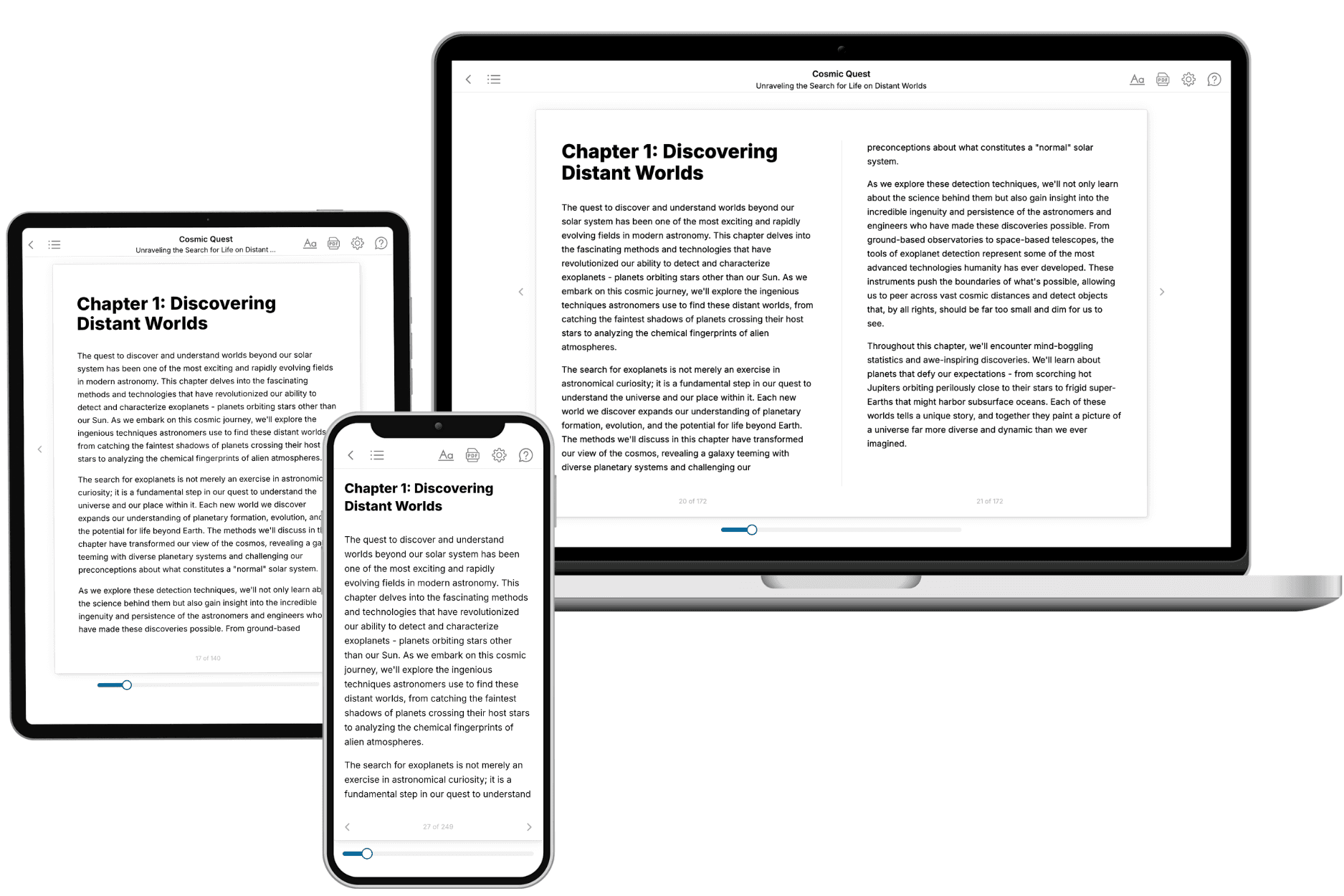
TailoredRead creates complete, full-length nonfiction ebooks, written specifically for you. Tell us what you want to learn and why, and TailoredRead writes you a complete ebook on it, with charts, tables, and diagrams throughout. Read it online, on Kindle, or on any e-reader, or download it as a PDF or EPUB. Every book is written fresh the day you order it.
- How is the book tailored to me?
Before anything is written, you answer a few short questions about your goals, your background, and the topics you care about. Your book is then planned around your answers: written at your level, focused on your goals, and covering the topics you chose, instead of the one-size-fits-all book a store sells everyone.
- Will it read like generic AI content?
No. Your book isn't a chat transcript: it's planned chapter by chapter before a single word is written, told in a clear book voice, and explains ideas visually with charts, tables, and diagrams. After writing, every book goes through an editorial pass that polishes chapters so the book reads consistent from start to finish. Judge for yourself: browse thousands of sample books on our Explore Books page.
- How accurate is the content?
Our AI first checks whether your subject needs live research. Niche and fast-moving subjects are researched before writing, and the book plan and chapters are grounded in what it finds. After writing, every book goes through a quality pass that checks its facts and consistency, and researched books list their sources in a Notes section at the back.
- How long is the book?
You choose the length: Comprehensive (250-300 pages), Detailed (150-200 pages), Essential (70-100 pages), or Short (30-50 pages).
- Does the book include visuals?
Yes. Every book includes visual elements such as timelines, checklists, step-by-step guides, decision trees, comparison tables, and matrices, and many include bar charts. A typical book includes dozens of these visual elements.
- Can I read it on Kindle? What formats can I download?
Yes. Every book can be read in our online reader or downloaded as a PDF or EPUB. The EPUB can be opened with Kindle, Apple Books, Kobo, and any e-reader. The Commercial and Author licenses also include an editable Word (DOCX) and Markdown download.
- How much does it cost?
About the price of a regular ebook. The exact price depends on your book's length and complexity, from $5 for the shortest books to $35 for the most comprehensive, and it's shown when you review your book, before you commit to anything. Each book is a one-time purchase, yours to keep, no subscription. Licenses that let you share, teach, or publish your book range from $35.99 to $49.99.
- Can I preview the book before purchasing?
Before you pay, you'll see what your book will cover: the title, a detailed description, the estimated length, and the complete chapter-by-chapter table of contents, so you know what you're getting before you decide. The full text itself is written after you purchase.
- How long does it take to create a book?
10 minutes. You can start reading the opening chapters while the rest is still being written.