Semantic Image Segmentation for AI Agents
Master the Art of Pixel-Level Understanding in Machine Learning Systems
You're about to discover how semantic image segmentation transforms raw pixels into actionable intelligence for AI agents.
207 pages9 chaptersApr 1, 2026Artificial Intelligence
About this book
This comprehensive guide takes you from foundational concepts through advanced implementation strategies, showing you exactly how machines learn to understand visual scenes at the pixel level. You'll explore the evolution of segmentation architectures, master the mathematics behind loss functions, and learn proven techniques for training models that actually work in production environments. Whether you're building autonomous systems, medical imaging applications, or intelligent robots, you'll gain practical insights into data preparation, model optimization, and real-world deployment challenges. By the end, you'll understand not just how semantic segmentation works, but why it matters for creating AI agents that truly perceive and interact with the world intelligently.
Table of contents
- IntroductionWhy Semantic Segmentation Matters for AI Agents, What You'll Learn in This Book, How to Use This GuideRead below
- Chapter 1: Fundamentals of Semantic SegmentationSegmentation vs. Classification vs. Detection, Understanding Pixel-Level Prediction, Real-World Applications in AI Systems
- Chapter 2: Core Segmentation ArchitecturesFully Convolutional Networks (FCNs), U-Net and Encoder-Decoder Models, DeepLab and Atrous Convolution, Vision Transformers and Modern Approaches
- Chapter 3: Loss Functions and Training ObjectivesCross-Entropy and Weighted Variants, Dice Loss and Focal Loss, Choosing the Right Loss Function for Your Task
- Chapter 4: Data Preparation and AnnotationAnnotation Strategies and Tools, Data Augmentation Techniques, Handling Class Imbalance and Edge Cases
- Chapter 5: Training and Optimization StrategiesTransfer Learning and Pre-trained Models, Hyperparameter Tuning and Learning Schedules, Regularization and Avoiding Overfitting
- Chapter 6: Evaluation Metrics and ValidationIntersection over Union and Dice Coefficient, Boundary-Based Metrics and Panoptic Quality, Cross-Validation and Test Set Design
- Chapter 7: Deployment and Model OptimizationQuantization and Pruning Techniques, Knowledge Distillation and Compression, Inference Acceleration and Edge Deployment
- Chapter 8: Semantic Segmentation in AI AgentsAutonomous Vehicles and Navigation, Medical Imaging and Diagnosis, Robotics and Environmental Perception
- Chapter 9: Advanced Techniques and Future DirectionsMulti-Task Learning and Joint Optimization, Domain Adaptation and Generalization, Emerging Trends and Research Frontiers
- ConclusionKey Takeaways and Next Steps
- Glossary of Terms
- Further Reading and Resources
Introduction
There is a moment in every computer vision project when the gap between what a model sees and what it actually understands becomes painfully obvious. A classifier can tell you there is a car in an image. An object detector can draw a box around it. But neither one can tell you exactly where the car ends and the road begins, which pixels belong to a pedestrian stepping off the curb, or how much of the scene is occupied by a building versus open sky. That gap is precisely where semantic segmentation lives, and closing it is what separates a system that recognizes objects from one that truly perceives a scene.
Semantic segmentation assigns a class label to every single pixel in an image. Not just the interesting pixels, not just the ones inside a bounding box, but every pixel, from corner to corner. The result is a dense map of understanding that gives an AI agent a complete, structured picture of its visual environment. This kind of pixel-level awareness is not a luxury feature. For autonomous vehicles, surgical robots, and environmental monitoring systems, it is a hard requirement. Without it, the agent is essentially navigating with blurry, incomplete information about the world around it.
This book was written for practitioners who already have a working knowledge of machine learning and want to go deeper into one of its most demanding and rewarding subfields. You will not find vague overviews or surface-level summaries here. Instead, you will find concrete architectures, real training strategies, honest discussions of what goes wrong in practice, and clear guidance on how to build systems that hold up outside the lab. The goal is to give you both the conceptual foundation and the practical toolkit to implement semantic segmentation in real AI agent applications, from the first annotation pass all the way through production deployment.
The field has moved fast. In just over a decade, segmentation has gone from a slow, patch-based process requiring hand-crafted features to end-to-end deep learning pipelines that run in real time on embedded hardware. Architectures like Fully Convolutional Networks, U-Net, DeepLab, and Vision Transformers have each pushed the boundary of what is possible, and understanding why each one was designed the way it was will help you make better decisions when you are building your own systems. This book traces that evolution not as a history lesson, but as a practical guide to choosing the right tool for the right job.
Whether you are working on autonomous navigation, medical image analysis, robotic perception, or any other domain where visual understanding matters, the principles in this book apply. The specific datasets change, the class distributions shift, the hardware constraints vary, but the core challenges remain the same: how do you teach a model to understand a scene at the pixel level, and how do you make that model fast, accurate, and reliable enough to trust in a real system? Those are the questions this book is built to answer.
Why Semantic Segmentation Matters for AI Agents
An AI agent that interacts with the physical world needs more than the ability to detect objects. It needs to understand spatial relationships, navigate around obstacles, distinguish between surfaces it can move on and surfaces it cannot, and make decisions based on a complete picture of its environment. Semantic segmentation provides exactly that kind of structured, spatially precise understanding. It is the difference between an agent that knows a person is nearby and one that knows exactly where that person is standing, down to the pixel.
Consider a self-driving car approaching an intersection. A simple classifier might confirm that pedestrians, traffic lights, and road markings are present in the scene. But the vehicle's planning system needs to know which pixels are drivable road, which are sidewalk, where the lane boundaries are, and precisely where each pedestrian's feet are relative to the curb. Without pixel-level labels, the planning system is working with incomplete spatial data, and incomplete spatial data leads to poor decisions in safety-critical situations.[1]
Medical imaging is another domain where the stakes are equally high. When a segmentation model is used to delineate a tumor in an MRI scan, the boundary it draws directly influences treatment planning. A model that is off by a few pixels in a bounding box might still be clinically useful. A segmentation model that misclassifies tissue at the boundary of a tumor is providing information that could affect radiation dosing or surgical margins. Pixel-level precision is not a technical nicety in this context. It is a clinical requirement.
Robotics presents a third compelling case. A robot arm performing pick-and-place operations in a warehouse needs to know not just that a box is present, but exactly which pixels correspond to the graspable surface of that box versus the conveyor belt beneath it. A robot navigating a hospital corridor needs to distinguish between floor, walls, doors, and moving people in real time. Semantic segmentation gives the robot's perception system the dense spatial map it needs to plan actions with confidence.
Beyond these specific domains, semantic segmentation matters because it forces a model to be accountable for every part of an image. Classification and detection models can hide their uncertainty in the regions they ignore. A segmentation model has nowhere to hide. Every pixel gets a label, and every label can be evaluated. This completeness makes segmentation both harder to train and more informative to evaluate, which is part of why it has become such a productive area of research and development.
The practical impact of advances in segmentation is already visible in deployed systems. Tesla's Autopilot, Google's medical imaging tools, and Boston Dynamics' robot navigation systems all rely on forms of dense scene understanding that trace back to segmentation research. As AI agents become more capable and more autonomous, the demand for accurate, efficient segmentation will only grow. Understanding this technology deeply is not just academically interesting. It is professionally valuable in a field that is moving quickly.
Semantic segmentation is not just a computer vision task. It is the perceptual foundation that allows AI agents to reason about space, navigate environments, and make decisions grounded in a complete understanding of what they see.
One more reason segmentation matters is its role as a forcing function for better data. Building a segmentation dataset requires annotators to think carefully about every pixel in every image, which surfaces ambiguities and edge cases that coarser annotation tasks miss. The discipline of pixel-level labeling produces richer, more carefully considered datasets, and those datasets tend to produce better models across the board, not just for segmentation tasks.
What You'll Learn in This Book
This book is organized to take you from foundational concepts through advanced deployment strategies in a logical, progressive sequence. Each chapter builds on the previous one, so by the time you reach the later material on optimization and real-world applications, you will have the conceptual grounding to understand why those techniques work and when to apply them. Here is a clear picture of what each part of the journey covers.
Chapter 1: Fundamentals of Semantic Segmentation establishes the vocabulary and conceptual framework you will use throughout the book. You will learn exactly how segmentation differs from classification and object detection, what pixel-level prediction actually means in practice, and where segmentation fits into the broader landscape of AI agent systems. This chapter is the foundation everything else rests on.
Chapter 2: Core Segmentation Architectures walks through the major model families that define the field. You will explore Fully Convolutional Networks and understand why replacing fully connected layers with convolutional ones was such a significant breakthrough. You will study U-Net's encoder-decoder structure and see why it became the dominant architecture in medical imaging. You will examine DeepLab's use of atrous convolution to capture multi-scale context, and you will look at how Vision Transformers are reshaping the field with attention-based scene understanding.
Chapter 3: Loss Functions and Training Objectives covers the mathematics that drives model learning. You will understand cross-entropy loss and its weighted variants, learn when Dice loss outperforms cross-entropy, and see how focal loss addresses the class imbalance problem that plagues real-world datasets. Choosing the wrong loss function is one of the most common reasons segmentation models underperform, and this chapter gives you the tools to make the right choice.
Chapter 4: Data Preparation and Annotation addresses what is often the most time-consuming and underestimated part of any segmentation project. You will learn practical annotation strategies, explore tools like Labelme, CVAT, and Scale AI, and understand how to design augmentation pipelines that improve generalization without introducing artifacts. You will also learn specific techniques for handling class imbalance, which is a persistent challenge in datasets where background pixels vastly outnumber foreground pixels.
The remaining chapters cover the full pipeline from training through deployment:
- Chapter 5 covers transfer learning, hyperparameter tuning, and regularization strategies that make training more efficient and reliable.
- Chapter 6 explains evaluation metrics including Intersection over Union (IoU), Dice coefficient, boundary metrics, and panoptic quality, so you can measure model performance in ways that actually reflect real-world usefulness.
- Chapter 7 addresses deployment challenges including quantization, pruning, knowledge distillation, and edge inference, giving you the tools to take a research-quality model and make it production-ready.
- Chapter 8 applies everything to three major application domains: autonomous vehicles, medical imaging, and robotics, with domain-specific insights for each.
- Chapter 9 looks at advanced techniques including multi-task learning, domain adaptation, and emerging research directions that are shaping the next generation of segmentation systems.
Throughout the book, you will encounter concrete examples, code-level concepts, and practical frameworks that connect theory to implementation. The goal is not just to explain how segmentation works in the abstract, but to give you the knowledge and confidence to build systems that work in practice. By the end, you will be able to select architectures, design training pipelines, evaluate results rigorously, and deploy models that meet real-world performance requirements.
You will also develop an intuition for the tradeoffs that define this field. Accuracy versus speed, model size versus performance, annotation cost versus data quality. These tradeoffs appear in every real project, and understanding them deeply is what separates practitioners who can adapt to new problems from those who can only follow existing tutorials. This book is designed to build that deeper understanding.
One specific skill this book will help you develop is the ability to diagnose failure modes. When a segmentation model performs poorly, the cause is rarely obvious. It might be a data problem, a loss function mismatch, an architecture limitation, or a training instability. Each chapter includes discussion of what can go wrong and how to identify and fix it, so you build not just knowledge but troubleshooting capability.
How to Use This Guide
This book is designed to be read sequentially, but it is also structured so you can navigate to specific topics when you need them. If you are new to segmentation, reading from Chapter 1 through Chapter 9 in order will give you the most coherent learning experience. Each chapter assumes familiarity with the concepts introduced in previous chapters, so skipping ahead can occasionally leave gaps. That said, if you already have hands-on experience with segmentation and are looking for specific guidance, the chapter structure makes it easy to jump directly to what you need.
The book assumes you have a working knowledge of machine learning fundamentals. You should be comfortable with concepts like gradient descent, backpropagation, convolutional neural networks, and basic Python-based deep learning workflows using frameworks like PyTorch or TensorFlow. You do not need to be an expert in computer vision, but you should not be encountering neural networks for the first time here. If you find that some foundational concepts feel unfamiliar as you read, the Glossary at the back of the book provides clear definitions for all key terms.
Here is a practical guide to getting the most out of each chapter:
- Read the chapter introduction carefully. Each chapter opens with a framing section that explains why the topic matters and how it connects to the broader system. This context will help you understand not just the mechanics but the motivation behind each technique.
- Work through the examples actively. When a code concept or architectural diagram appears, pause and think through what it is doing before moving on. Passive reading of technical material rarely produces deep understanding.
- Use the subchapter structure for reference. Each subchapter is self-contained enough to serve as a reference when you are working on a specific problem. The table of contents is detailed enough to help you find what you need quickly.
- Pay attention to the "what can go wrong" discussions. These sections are often more valuable than the main explanations because they reflect the messy reality of working with real data and real systems.
If you are using this book as part of a structured learning program or team study, a natural breakpoint exists after Chapter 3. Chapters 1 through 3 cover the conceptual and mathematical foundations, while Chapters 4 through 9 focus on practical implementation and deployment. Splitting the book at this point gives you two roughly equal phases: understanding the theory, then applying it. Many teams find it useful to work through the first phase together before splitting into parallel workstreams for the implementation chapters.
For practitioners working on a specific application domain, Chapter 8 is worth reading early, even before you have finished the preceding chapters. Understanding the specific requirements and constraints of your target domain, whether that is autonomous driving, medical imaging, or robotics, will help you read the earlier chapters with a clearer sense of which details matter most for your use case. You can always return to the earlier material with fresh eyes after seeing how it applies in practice.
The Further Reading and Resources section at the end of the book points to key papers, datasets, and open-source tools that extend what is covered here. Semantic segmentation is a fast-moving field, and no single book can cover every development. The resources section is curated to point you toward the most important primary sources and community hubs where you can stay current as the field evolves. Treat it as a starting point for ongoing learning, not a comprehensive bibliography.
One practical recommendation: keep a project in mind as you read. The concepts in this book are much easier to internalize when you are applying them to a real problem, even a small one. If you do not have a project at work that involves segmentation, consider picking a public dataset, such as Cityscapes for urban scene understanding, PASCAL VOC for general object segmentation, or the Medical Segmentation Decathlon for biomedical applications, and use it as a sandbox for experimenting with the techniques you encounter.[2] Hands-on experimentation is the fastest path from reading about a technique to actually understanding it.
Finally, approach this material with patience for complexity. Semantic segmentation is genuinely hard. The models are large, the datasets are expensive to annotate, the evaluation metrics are nuanced, and the deployment constraints are demanding. There are no shortcuts that work reliably across all problems. What this book offers instead is a principled framework for thinking through the decisions you will face, grounded in both the research literature and practical experience. That framework will serve you far longer than any single trick or technique.
The field of semantic segmentation is at an exciting inflection point. Transformer-based architectures are challenging the dominance of convolutional networks. Foundation models trained on massive datasets are enabling few-shot segmentation in domains that previously required thousands of labeled examples. Real-time segmentation on edge devices is becoming practical for the first time. The tools and techniques covered in this book reflect the current state of the art, but they also give you the conceptual vocabulary to understand and adopt whatever comes next. That is the real goal: not just to teach you today's best practices, but to build the understanding that lets you keep up as the field continues to evolve.
This is the end of the free sample. The full book has 9 chapters.
Want this book written for you?
Tell us your goals and background, and get your own version of this book, tailored by AI to you.


Benefits of AI-tailored books
- Read one book, not ten:
- all the Artificial Intelligence knowledge you need, gathered into a single book.
- Save days of learning:
- tell us your goals, choose your topics, and the whole book is built around them.
- Learn effortlessly:
- Artificial Intelligence book written for your specific background and expertise.
- Understand at a glance:
- includes charts, tables, timelines, checklists, decision trees, and more.
- Stay current:
- written the day you order it, not years ago.
- Trust what you read:
- every book is checked for accuracy, with real research when your subject needs it.
Create your unique book in 3 steps
- 1. Select your focus
Select the focus of your Artificial Intelligence book and share your background
- 2. Personalize your book
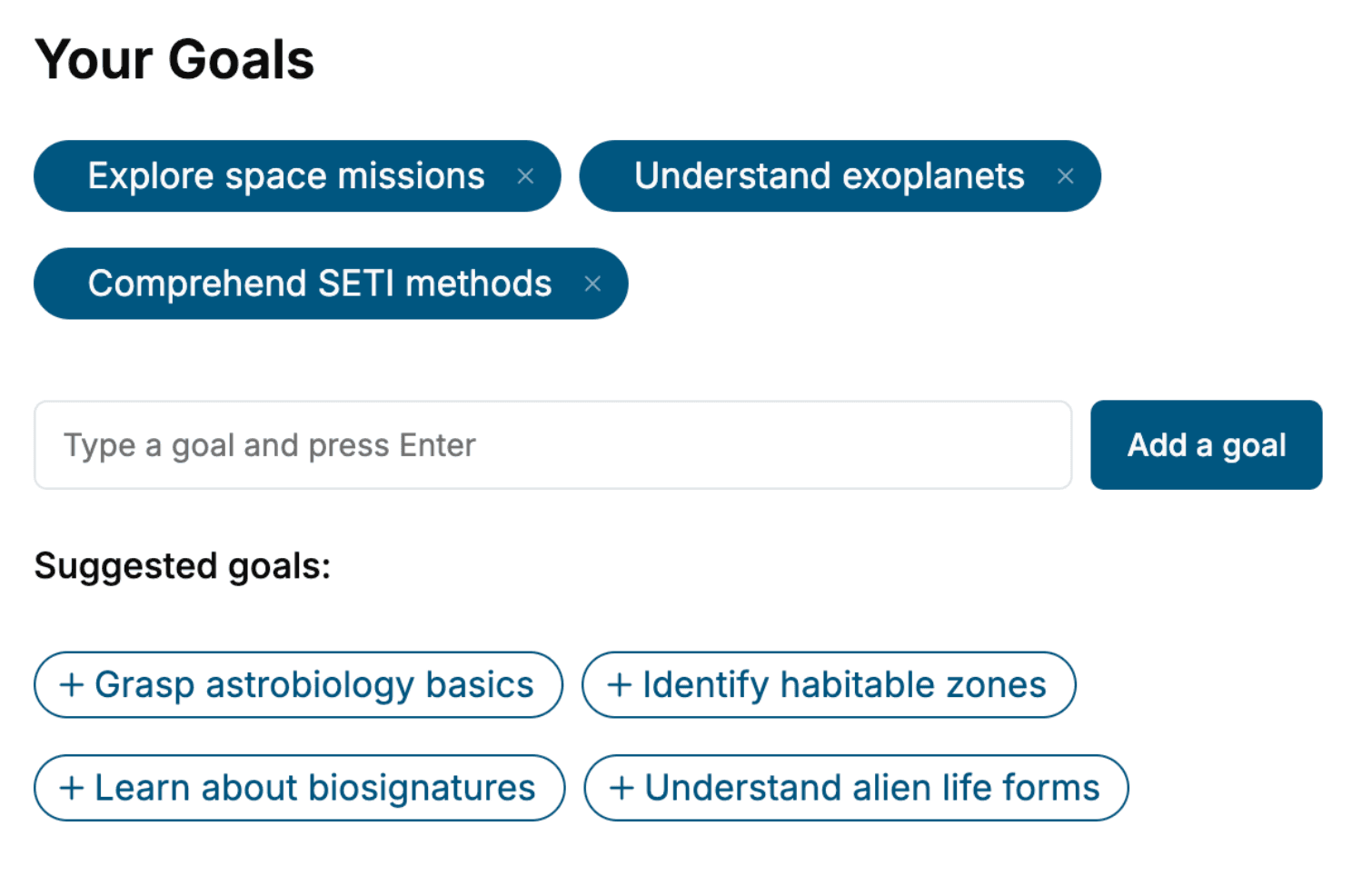
Specify your goals and choose sub-topics to include
- 3. Get your tailored book
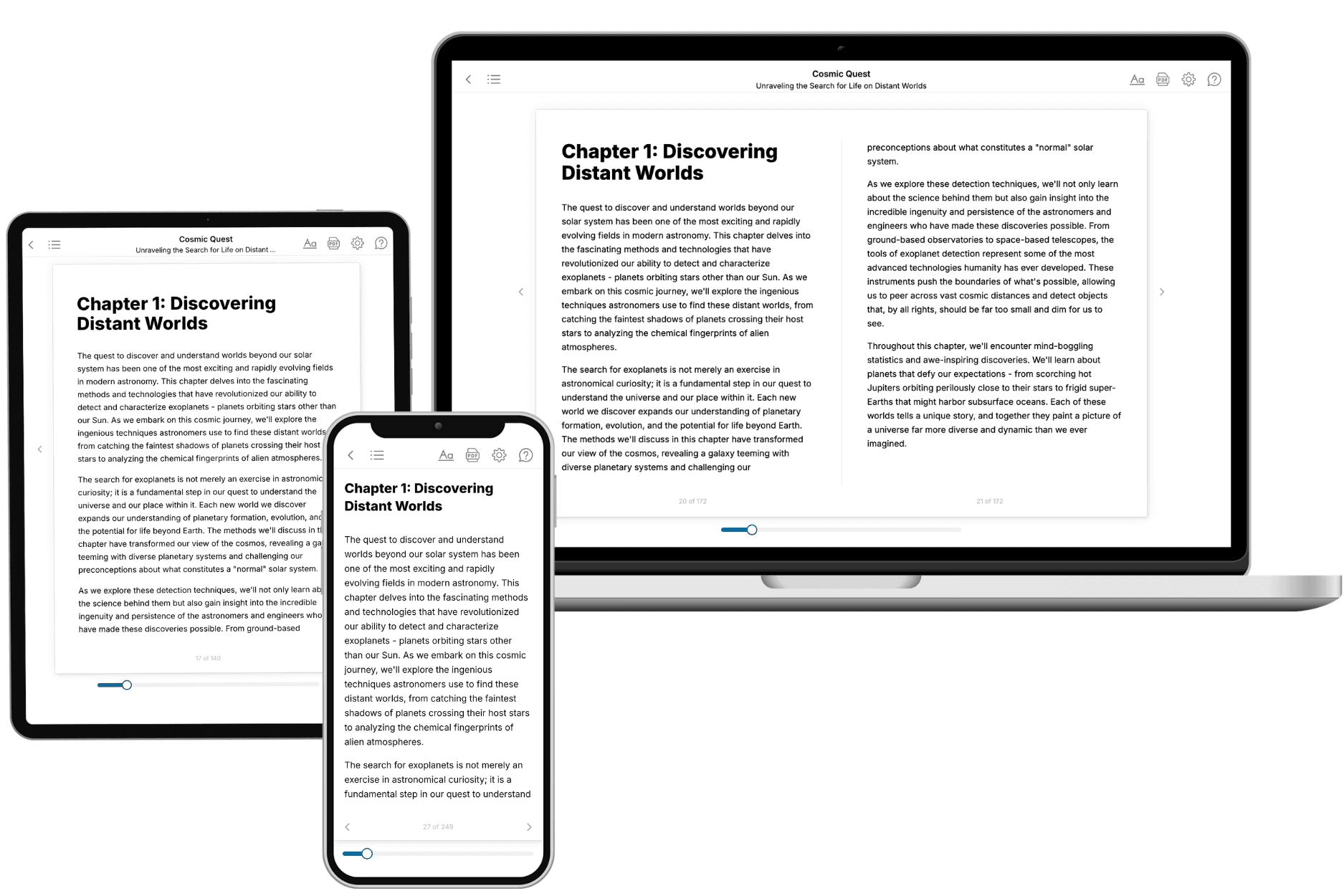
Your book is ready in 10 minutes. Read it online, download as EPUB or PDF, or send to Kindle.

Frequently asked questions
- What is TailoredRead?
TailoredRead creates complete, full-length nonfiction ebooks, written specifically for you. Tell us what you want to learn and why, and TailoredRead writes you a complete ebook on it, with charts, tables, and diagrams throughout. Read it online, on Kindle, or on any e-reader, or download it as a PDF or EPUB. Every book is written fresh the day you order it.
- How is the book tailored to me?
Before anything is written, you answer a few short questions about your goals, your background, and the topics you care about. Your book is then planned around your answers: written at your level, focused on your goals, and covering the topics you chose, instead of the one-size-fits-all book a store sells everyone.
- Will it read like generic AI content?
No. Your book isn't a chat transcript: it's planned chapter by chapter before a single word is written, told in a clear book voice, and explains ideas visually with charts, tables, and diagrams. After writing, every book goes through an editorial pass that polishes chapters so the book reads consistent from start to finish. Judge for yourself: browse thousands of sample books on our Explore Books page.
- How accurate is the content?
Our AI first checks whether your subject needs live research. Niche and fast-moving subjects are researched before writing, and the book plan and chapters are grounded in what it finds. After writing, every book goes through a quality pass that checks its facts and consistency, and researched books list their sources in a Notes section at the back.
- How long is the book?
You choose the length: Comprehensive (250-300 pages), Detailed (150-200 pages), Essential (70-100 pages), or Short (30-50 pages).
- Does the book include visuals?
Yes. Every book includes charts, tables, and diagrams: timelines, checklists, step-by-step guides, decision trees, comparison tables, matrices, and bar charts. A typical book includes dozens of these visual elements.
- Can I read it on Kindle? What formats can I download?
Yes. Every book can be read in our online reader or downloaded as a PDF or EPUB. The EPUB can be opened with Kindle, Apple Books, Kobo, and any e-reader. The Commercial and Author licenses also include an editable Word (DOCX) and Markdown download.
- How much does it cost?
About the price of a regular ebook. The exact price depends on your book's length and complexity, from $2 for the shortest books to $35 for the most comprehensive, and it's shown when you review your book, before you commit to anything. Each book is a one-time purchase, yours to keep, no subscription. Licenses that let you share, teach, or publish your book range from $35.99 to $49.99.
- Can I preview the book before purchasing?
Before you pay, you'll see what your book will cover: the title, a detailed description, the estimated length, and the complete chapter-by-chapter table of contents, so you know what you're getting before you decide. The full text itself is written after you purchase.
- How long does it take to create a book?
About 10 minutes. You can start reading the opening chapters while the rest is still being written.