The Shark's Blueprint
A Complete Guide to the Anatomy and Physiology of Nature's Perfect Predator
Discover how sharks became nature's most efficient predators by exploring the intricate systems that make them biological marvels.
207 pages11 chaptersApr 23, 2026BiologyCreated by Massimiliano
About this book
This comprehensive guide reveals the anatomical and physiological innovations that have allowed sharks to dominate oceans for over 450 million years. From their flexible cartilage skeleton to their extraordinary sensory capabilities, you'll understand how every system in a shark's body works in perfect harmony to create an apex predator. Learn how their continuously regenerating teeth, specialized liver, and hydrodynamic skin give them competitive advantages no other marine animal can match. Whether you're a student, educator, or marine enthusiast, this book provides the scientific knowledge and practical insights needed to truly appreciate why sharks are considered nature's perfect predators. Explore the evolutionary genius behind their design and understand the physiological mechanisms that make them such formidable hunters.
Table of contents
- IntroductionWhy Sharks Matter: Understanding Nature's Apex Predator, 450 Million Years of Evolution: A Brief History, How to Use This Book: A Roadmap to Shark MasteryRead below
- Chapter 1: The Skeletal System: Cartilage Over BoneWhy Cartilage Beats Bone: Flexibility and Efficiency, The Shark Skull: Modular Design for Feeding, The Vertebral Column: Flexibility Meets Strength, Fin Structure: Engineering Precision in Motion
- Chapter 2: Sensory Systems: The Multi-Layered PerceptionElectroreception: Detecting Electrical Fields, The Sense of Smell: Tracking Prey Across Distances, The Lateral Line System: Feeling Vibrations and Movement, Vision and Hearing: Secondary but Important Senses
- Chapter 3: Teeth and Jaws: Weapons of PrecisionTooth Anatomy: Design for Cutting and Crushing, Continuous Replacement: Nature's Infinite Supply, Jaw Mechanics: Bite Force and Feeding Strategies, Tooth Variation Across Species: Specialized Hunting Tools
- Chapter 4: The Muscular System: Power and PrecisionMuscle Fiber Types: Red, White, and Pink Muscles, Swimming Mechanics: The Caudal Fin Engine, Acceleration and Burst Speed: Explosive Power
- Chapter 5: The Cardiovascular System: Oxygen Delivery MasteryHeart Structure: A Four-Chambered Pump, Blood Circulation: Efficient Oxygen Transport, Meeting Metabolic Demands: Energy for Hunting
- Chapter 6: The Respiratory System: Extracting Oxygen from WaterGill Structure: Countercurrent Exchange Efficiency, Ram Ventilation: Breathing While Moving, Oxygen Extraction Rates: Superior to Bony Fish
- Chapter 7: The Digestive System: Processing Prey EfficientlyThe Stomach: Acid and Enzyme Powerhouse, Intestinal Absorption: The Spiral Valve Advantage, Fasting and Metabolism: Surviving Between Meals
- Chapter 8: The Liver and Buoyancy: Floating Without a Swim BladderLiver Composition: Oil-Rich and Buoyant, Buoyancy Control: Maintaining Neutral Density, Energy Storage: The Liver as Fuel Reserve
- Chapter 9: Reproduction and Development: Ensuring SurvivalReproductive Strategies: Oviparity, Viviparity, and Ovoviviparity, Embryonic Development: From Egg to Pup, Parental Investment: Strategies for Offspring Survival
- Chapter 10: Skin and Hydrodynamics: Reducing DragPlacoid Scales: Dermal Denticles and Turbulence Control, Drag Reduction: Engineering Lessons from Sharks, Skin Regeneration and Maintenance: Continuous Renewal
- Chapter 11: The Nervous System: Integration and ResponseBrain Structure: Sensory Processing Centers, Neural Integration: Coordinating Complex Behaviors, Instinctive Responses: Hunting and Survival Behaviors
- ConclusionThe Integrated Design: All Systems Working Together, Conservation Implications: Protecting Evolutionary Masterpieces
Introduction
Few animals on Earth inspire the same mixture of awe, fear, and fascination as the shark. They appear in ancient mythology, dominate modern cinema, and occupy a unique psychological space in the human imagination. Yet for all the cultural weight we place on them, sharks are so much more than symbols of danger. They are biological masterworks, shaped by hundreds of millions of years of evolutionary pressure into organisms of extraordinary efficiency. Every structure in their body, from the tip of their snout to the trailing edge of their tail, serves a precise and often remarkable purpose.
This book is about understanding that design. It is about looking past the teeth and the reputation and asking a more interesting question: how, exactly, does a shark work? What makes its skeleton so uniquely suited to life in the ocean? How does it detect prey it cannot see, smell, or hear? Why does its skin behave more like an engineered surface than a biological covering? These are the kinds of questions that reveal sharks not as monsters, but as marvels. And the answers, as you will discover, are genuinely surprising.
The study of shark anatomy and physiology sits at the intersection of evolutionary biology, biomechanics, and ecology. Understanding how sharks are built helps explain why they have survived mass extinctions that wiped out the majority of life on Earth. It also helps explain why they matter so deeply to the health of marine ecosystems today. This introduction lays the groundwork for everything that follows. It establishes why sharks deserve serious scientific attention, traces the broad arc of their evolutionary history, and gives you a clear map for navigating the chapters ahead.
Why Sharks Matter: Understanding Nature's Apex Predator
Sharks occupy the top of the marine food chain in most ocean environments, and that position carries enormous ecological weight. As apex predators, they regulate the populations of species below them. When shark numbers decline, the effects ripple downward through the food web in a process ecologists call a trophic cascade. Prey species that were once kept in check begin to overpopulate, which then depletes the species they feed on, and so on down the chain. The removal of sharks from an ecosystem does not simply create a gap. It triggers a reorganization of the entire community.[1]
A well-documented example of this dynamic comes from the western North Atlantic, where the decline of large shark species led to a dramatic increase in cownose ray populations. Those rays, no longer controlled by predation, consumed vast quantities of bay scallops, contributing to the collapse of a century-old scallop fishery in North Carolina.[2] This is not an isolated case. Similar patterns have been observed in coral reef systems, kelp forests, and open ocean environments around the world. Sharks are not optional components of marine ecosystems. They are structural ones.
Beyond their ecological role, sharks contribute to ocean health in subtler ways. By targeting weak, sick, or slow-moving prey, they act as a natural selection pressure that keeps prey populations genetically robust. This is sometimes called the sanitation effect, and it helps prevent the spread of disease through fish populations. Healthy prey populations, in turn, support the broader productivity of the ocean. Sharks, in this sense, are not just predators. They are ecosystem engineers.
From a scientific standpoint, sharks are also invaluable research subjects. Their physiology has inspired innovations in medicine, materials science, and engineering. The structure of shark skin has been studied and replicated in competitive swimwear and aircraft coatings. Shark immune systems, which show remarkable resistance to certain diseases, are being investigated for potential medical applications. The electroreceptive organs in their snouts have informed the development of sensitive electromagnetic detection technologies. Studying sharks is not purely academic. It has real-world applications that benefit human society.
There is also a conservation argument that cannot be ignored. Shark populations worldwide are under serious pressure from overfishing, bycatch, and the demand for shark fin soup. The International Union for Conservation of Nature (IUCN) estimates that more than one-third of all shark and ray species are now threatened with extinction.[3] Understanding what sharks are, how they function, and why they matter is the first step toward making a compelling case for their protection. Knowledge builds appreciation, and appreciation builds advocacy.
Finally, sharks matter simply because they are extraordinary. There is intrinsic value in understanding a creature that has refined its design over 450 million years into something so precisely adapted to its environment. The more you learn about how a shark is built, the more remarkable it becomes. That sense of wonder is not a distraction from science. It is one of science's most powerful motivators.
450 Million Years of Evolution: A Brief History
Sharks are among the oldest vertebrates on Earth. Their lineage extends back approximately 450 million years, placing their origins in the Ordovician period, long before dinosaurs, before flowering plants, and before the first vertebrates walked on land. The earliest shark-like creatures were quite different from the animals we recognize today, but they shared the fundamental biological blueprint that would prove so durable across geological time: a cartilaginous skeleton, a streamlined body, and a predatory lifestyle.[4]
The fossil record for early sharks is fragmentary, largely because cartilage does not preserve as well as bone. Most of what scientists know about ancient sharks comes from fossilized teeth and scales, which are far more durable. One of the earliest well-documented shark relatives is Cladoselache, which lived approximately 370 million years ago during the Devonian period. It was a sleek, fast-swimming predator roughly one meter in length, and its body plan already showed many of the hydrodynamic features seen in modern sharks. The Devonian is sometimes called the Age of Fishes
, and sharks were already significant players in that world.
The Carboniferous period, which followed the Devonian, saw an extraordinary diversification of shark forms. This era is sometimes called the Golden Age of Sharks
because the fossil record shows an explosion of different body shapes, tooth types, and ecological niches being explored. Some species developed bizarre fin structures or elaborate head crests whose functions are still debated by paleontologists. This period of experimentation demonstrates that the shark body plan was not fixed from the beginning. It was a platform for ongoing evolutionary innovation.
Sharks survived the Permian-Triassic extinction event approximately 252 million years ago, which wiped out an estimated 96 percent of all marine species. They also survived the Cretaceous-Paleogene extinction event 66 million years ago that ended the dinosaurs. Their survival through these catastrophic events is a testament to the resilience of their fundamental design. A body plan built on cartilage, efficient sensory systems, and flexible reproductive strategies proved adaptable enough to persist through conditions that eliminated far more specialized organisms.
The most famous prehistoric shark, Otodus megalodon, lived between approximately 23 and 3.6 million years ago and is estimated to have reached lengths of 15 to 20 meters. While it is now extinct, its existence illustrates the upper limits of what the shark body plan can achieve. Modern great white sharks, which share some ecological similarities with megalodon, reach lengths of around 6 meters and are considered among the most formidable predators alive today. The lineage that produced both animals has been refining its tools for a very long time.
Today, there are more than 500 recognized species of sharks, ranging from the 17-centimeter dwarf lanternshark to the 12-meter whale shark, the largest fish in the ocean. They inhabit environments from shallow coastal reefs to the deep ocean trenches, from tropical waters to the frigid Arctic. This diversity is the product of millions of years of adaptation to different ecological pressures. Yet despite their variety, all sharks share the core anatomical and physiological features that this book explores. Understanding those shared features is the key to understanding the group as a whole.
What makes the shark evolutionary story so compelling is not just its length, but its consistency. While other animal groups have undergone radical transformations over geological time, the fundamental shark design has remained remarkably stable. This is not because sharks stopped evolving. It is because their basic blueprint was so well-suited to aquatic predation that major structural changes offered little advantage. Evolution, in this case, found a solution and largely kept it.
How to Use This Book: A Roadmap to Shark Mastery
This book is organized as a system-by-system exploration of shark anatomy and physiology. Each chapter focuses on a specific biological system, explaining its structure, its function, and the evolutionary logic behind its design. The chapters are written to build on one another, so reading them in order will give you the most coherent understanding of how all the systems interact. That said, each chapter is also designed to stand on its own, so if you have a specific area of interest, you can navigate directly to it without losing the thread.
Here is a brief overview of what each chapter covers:
- Chapter 1: The Skeletal System examines why cartilage is not a primitive substitute for bone but a sophisticated structural material that gives sharks real advantages in flexibility, weight, and hydrodynamic efficiency.
- Chapter 2: Sensory Systems explores the multi-layered perception network that makes sharks such effective hunters, including electroreception, olfaction, and the lateral line system.
- Chapter 3: Teeth and Jaws looks at the mechanics of shark feeding, from the structure of individual teeth to the biomechanics of bite force and the remarkable system of continuous tooth replacement.
- Chapter 4: The Muscular System covers how different muscle fiber types work together to power both sustained cruising and explosive bursts of speed.
- Chapter 5: The Cardiovascular System explains how the shark heart and circulatory system deliver oxygen efficiently to tissues during the high-energy demands of hunting.
- Chapter 6: The Respiratory System details how sharks extract oxygen from water through their gills, including the countercurrent exchange mechanism that makes this process so efficient.
- Chapter 7: The Digestive System describes how sharks process large meals, the role of the spiral valve intestine, and how some species manage extended periods without food.
- Chapter 8: The Liver and Buoyancy reveals how the shark's oil-rich liver serves as both a buoyancy device and an energy reserve, replacing the swim bladder found in bony fish.
- Chapter 9: Reproduction and Development surveys the remarkable diversity of shark reproductive strategies, from egg-laying to live birth, and what these strategies reveal about evolutionary trade-offs.
- Chapter 10: Skin and Hydrodynamics investigates the structure of placoid scales and how they reduce drag, along with the engineering applications that shark skin has inspired.
- Chapter 11: The Nervous System examines how the shark brain integrates sensory information and coordinates the complex behaviors involved in hunting and survival.
The book closes with a conclusion that brings all these systems together, showing how they function as an integrated whole rather than a collection of independent parts. It also addresses the conservation implications of what you will have learned, connecting biological understanding to the urgent question of shark protection in a changing ocean.
Throughout the book, you will find specific examples drawn from well-studied species. The great white shark (Carcharodon carcharias), the hammerhead shark (Sphyrna spp.), the bull shark (Carcharhinus leucas), and the whale shark (Rhincodon typus) appear frequently because they represent different ends of the shark spectrum and illustrate how the same basic anatomical systems can be adapted for very different lifestyles. Where relevant, less familiar species are also introduced to highlight specific anatomical features or physiological strategies.
A note on terminology: this book assumes a moderate familiarity with biological concepts. Terms like dorsal, ventral, anterior, and posterior are used throughout to describe anatomical positions, and basic concepts from cell biology and physiology are referenced without extensive explanation. If you encounter an unfamiliar term, a brief search will usually provide enough context to continue. The goal is not to oversimplify the science, but to present it in language that is clear and accessible without being condescending to readers who already have a foundation in biology.
You will also notice that each chapter connects anatomy to function and function to ecology. Understanding the structure of a gill is more meaningful when you understand how it enables a shark to sustain a high-speed chase. Understanding the design of a tooth is more interesting when you know how it relates to the specific prey a species hunts. This integrative approach reflects how biologists actually think about organisms: not as collections of parts, but as coherent systems shaped by the pressures of survival and reproduction.
The best way to use this book is actively. When a concept is introduced, pause and think about how it connects to something you already know. When an example is given, consider whether you can think of a parallel in another animal or in human engineering. The comparisons between shark biology and human technology appear throughout the book because they are genuinely illuminating, not just as analogies, but as evidence of how powerful the solutions that evolution has found really are. Engineers do not copy shark designs out of sentiment. They copy them because they work.
The shark is not a simple animal wearing a frightening face. It is a complex, finely tuned biological system that has been tested and refined across geological time. Every chapter of this book is an invitation to look more closely at that system and to appreciate the elegance of what 450 million years of evolution has produced.
By the time you reach the conclusion, the goal is not just that you know more about sharks. The goal is that you see them differently. That when you picture a shark moving through the water, you see not just a predator, but a marvel of integrated biological engineering, every system working in concert, every structure earning its place through millions of years of competitive pressure. That understanding is what this book is built to give you. Let's begin.
Notes
Introduction
- 1. F. Ferretti and others, "Patterns and ecosystem consequences of shark declines in the ocean," Ecology Letters, 2010
- 2. R. A. Myers and others, "Cascading effects of the loss of apex predatory sharks from a coastal ocean," Science, 2007
- 3. N. K. Dulvy and others, "Overfishing drives over one-third of all sharks and rays toward a global extinction crisis," Current Biology, 2021
- 4. J. G. Maisey, "What is an elasmobranch?," The impact of paleontology in understanding elasmobranch phylogeny and evolution. Journal of Fish Biology, 2012
This is the end of the free sample. The full book has 11 chapters.
Want this book written for you?
Tell us your goals and background, and get your own version of this book, tailored by AI to you.


Benefits of AI-tailored books
- Read one book, not ten:
- all the Biology knowledge you need, gathered into a single book.
- Save days of learning:
- tell us your goals, choose your topics, and the whole book is built around them.
- Learn effortlessly:
- Biology book written for your specific background and expertise.
- Understand at a glance:
- includes charts, tables, timelines, checklists, decision trees, and more.
- Stay current:
- written the day you order it, not years ago.
- Trust what you read:
- every book is checked for accuracy, with real research when your subject needs it.
Create your unique book in 3 steps
- 1. Select your focus
Select the focus of your Biology book and share your background
- 2. Personalize your book
Specify your goals and choose sub-topics to include
- 3. Get your tailored book
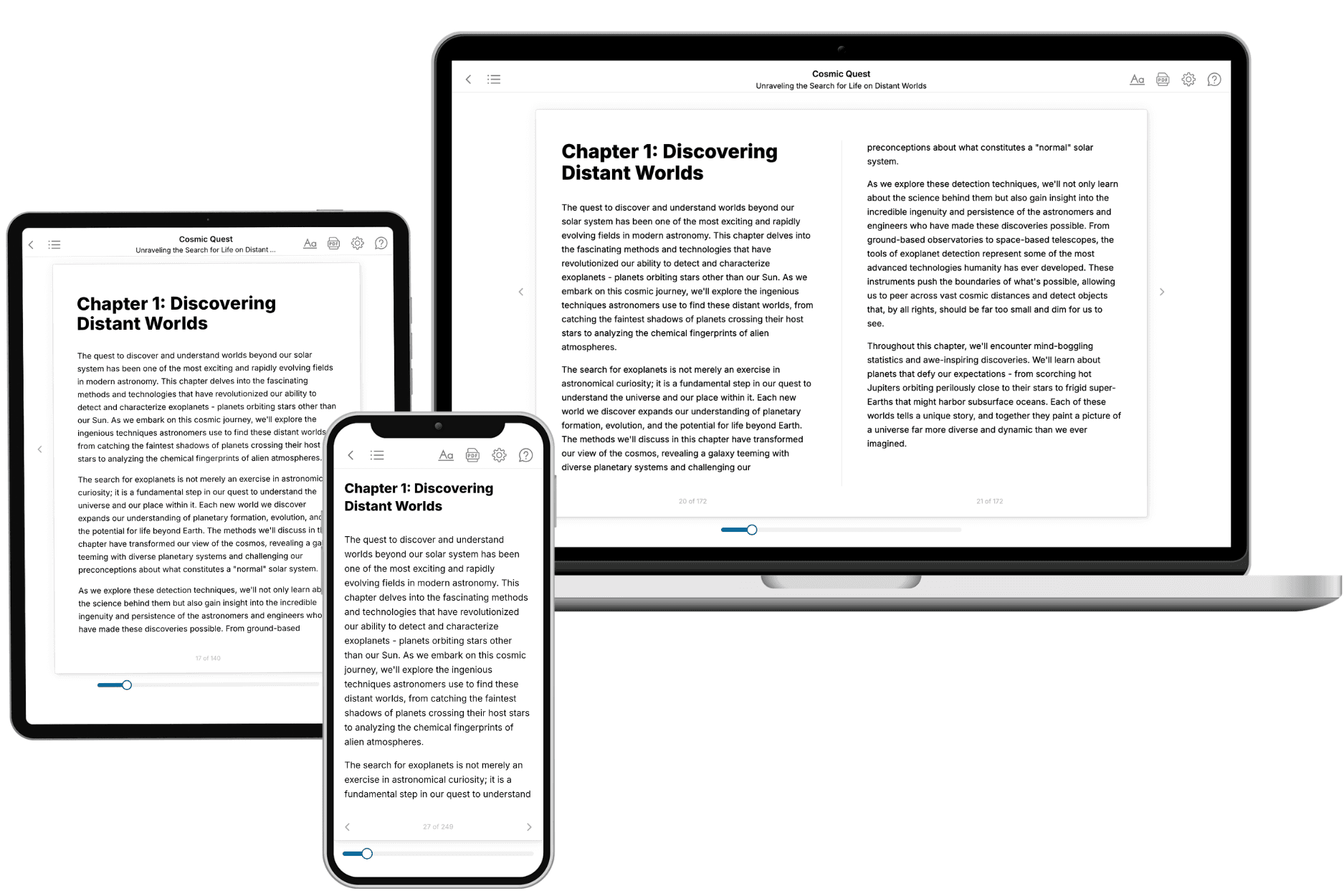
Your book is ready in 10 minutes. Read it online, download as EPUB or PDF, or send to Kindle.

Frequently asked questions
- What is TailoredRead?
TailoredRead creates complete, full-length nonfiction ebooks, written specifically for you. Tell us what you want to learn and why, and TailoredRead writes you a complete ebook on it, with charts, tables, and diagrams throughout. Read it online, on Kindle, or on any e-reader, or download it as a PDF or EPUB. Every book is written fresh the day you order it.
- How is the book tailored to me?
Before anything is written, you answer a few short questions about your goals, your background, and the topics you care about. Your book is then planned around your answers: written at your level, focused on your goals, and covering the topics you chose, instead of the one-size-fits-all book a store sells everyone.
- Will it read like generic AI content?
No. Your book isn't a chat transcript: it's planned chapter by chapter before a single word is written, told in a clear book voice, and explains ideas visually with charts, tables, and diagrams. After writing, every book goes through an editorial pass that polishes chapters so the book reads consistent from start to finish. Judge for yourself: browse thousands of sample books on our Explore Books page.
- How accurate is the content?
Our AI first checks whether your subject needs live research. Niche and fast-moving subjects are researched before writing, and the book plan and chapters are grounded in what it finds. After writing, every book goes through a quality pass that checks its facts and consistency, and researched books list their sources in a Notes section at the back.
- How long is the book?
You choose the length: Comprehensive (250-300 pages), Detailed (150-200 pages), Essential (70-100 pages), or Short (30-50 pages).
- Does the book include visuals?
Yes. Every book includes charts, tables, and diagrams: timelines, checklists, step-by-step guides, decision trees, comparison tables, matrices, and bar charts. A typical book includes dozens of these visual elements.
- Can I read it on Kindle? What formats can I download?
Yes. Every book can be read in our online reader or downloaded as a PDF or EPUB. The EPUB can be opened with Kindle, Apple Books, Kobo, and any e-reader. The Commercial and Author licenses also include an editable Word (DOCX) and Markdown download.
- How much does it cost?
About the price of a regular ebook. The exact price depends on your book's length and complexity, from $2 for the shortest books to $35 for the most comprehensive, and it's shown when you review your book, before you commit to anything. Each book is a one-time purchase, yours to keep, no subscription. Licenses that let you share, teach, or publish your book range from $35.99 to $49.99.
- Can I preview the book before purchasing?
Before you pay, you'll see what your book will cover: the title, a detailed description, the estimated length, and the complete chapter-by-chapter table of contents, so you know what you're getting before you decide. The full text itself is written after you purchase.
- How long does it take to create a book?
About 10 minutes. You can start reading the opening chapters while the rest is still being written.