Shays' Rebellion
How a Farmers' Uprising Exposed the Weakness of the Confederation and Shaped the Constitution
Imagine standing at a crossroads in American history where the young nation's survival hung in the balance.
176 pages8 chaptersDec 1, 2025United States History
About this book
In 1786-1787, Massachusetts farmers, crushed by debt and desperate for relief, took up arms against their own government. This uprising, known as Shays' Rebellion, sent shockwaves through the thirteen states and forced a reckoning with the fundamental question: could the United States survive under its current system of government? This book tells the story of how economic crisis, political paralysis, and armed conflict converged to reshape the American republic. You'll discover how a seemingly local farmers' revolt became the catalyst that convinced the nation's leaders that the Articles of Confederation had failed, ultimately leading to the Constitutional Convention and the creation of the Constitution itself. Through vivid accounts of the rebellion's key figures, battles, and political aftermath, you'll gain insight into the fragile state of the early republic and understand why the Framers chose to build a stronger federal government. This is the story of how crisis became opportunity, and how one rebellion changed the course of American history.
Table of contents
- IntroductionWhy This Rebellion Matters Today, The Question That Changed America, How to Read This BookRead below
- Chapter 1: The Confederation in CrisisVictory and Uncertainty: America After Independence, The Articles of Confederation: A Government Without Power, Economic Collapse and the Debt Crisis
- Chapter 2: Massachusetts in TurmoilThe Farmers' Plight: Debt, Taxes, and Foreclosure, Political Gridlock: Why the State Government Failed, The Rise of Daniel Shays
- Chapter 3: The Road to RebellionEarly Protests and Petitions, The Courts Close: From Petition to Action, Organizing the Uprising
- Chapter 4: The Rebellion UnfoldsThe First Confrontations, The Springfield Arsenal: The Turning Point, The Rebellion Spreads Across Massachusetts
- Chapter 5: The Federal Government's ParalysisCongress Cannot Act: The Confederation's Failure, State Responses and Regional Divisions, The Alarm Spreads: Fear Across the Nation
- Chapter 6: Suppression and AftermathThe Militia Mobilizes: Private Funding for Public Order, The Final Battles and Rebel Defeat, Trials, Pardons, and Reconciliation
- Chapter 7: The Constitutional ConventionThe Call for Reform: From Annapolis to Philadelphia, Shays' Rebellion in the Convention Debates, Designing a Stronger Government
- Chapter 8: Legacy and LessonsThe Constitution Ratified: A New Framework, What Happened to the Rebels, Enduring Questions About Power and Justice
- ConclusionA Rebellion That Built a Nation
- Further Reading
Introduction
On a cold January morning in 1787, roughly twelve hundred farmers marched through the snow toward the federal arsenal in Springfield, Massachusetts. They carried muskets, pitchforks, and clubs. Many wore the tattered remnants of Continental Army uniforms. These men were not foreign invaders or criminals—they were Revolutionary War veterans, small landowners, and ordinary citizens who had helped win American independence just four years earlier. Now they were in open rebellion against the government they had fought to establish. When militia forces fired into their ranks, killing four men and wounding twenty others, the young American republic faced its first major internal crisis. The question that echoed through the thirteen states was simple but terrifying: would the United States survive its first decade?
Shays' Rebellion, named after one of its leaders, Daniel Shays, was more than a local disturbance in rural Massachusetts. It was a symptom of deep structural problems in the American political system and a catalyst for constitutional transformation. The uprising exposed the fatal weakness of the Articles of Confederation, the nation's first governing document, which had created a federal government so feeble it could neither raise an army nor collect taxes. When Massachusetts farmers took up arms to protest crushing debts, foreclosures, and what they saw as unjust taxation, the Confederation Congress could do nothing but watch. State governments scrambled to respond on their own, revealing dangerous divisions between states and raising the specter of civil war. The rebellion forced America's leaders to confront an uncomfortable truth: the system they had created after independence was failing.
This book tells the story of how economic crisis, political paralysis, and armed conflict converged to reshape the American republic. You'll discover how desperate farmers became rebels, how a weak federal government proved unable to maintain order, and how this crisis convinced the nation's leaders that radical reform was necessary. The rebellion's impact extended far beyond the snowy fields of western Massachusetts. It directly influenced the Constitutional Convention of 1787, where delegates designed a new framework of government with enhanced federal powers, a strong executive, and the ability to suppress insurrections. Understanding Shays' Rebellion is essential to understanding why the Constitution looks the way it does—and why the Framers chose to build a government powerful enough to prevent such uprisings in the future.
The story of Shays' Rebellion is also a deeply human drama. It features Revolutionary War heroes turned rebels, wealthy merchants funding private armies, politicians paralyzed by ideology and fear, and ordinary families losing their farms to debt collectors. These were people navigating impossible choices in uncertain times. Some saw the rebellion as a justified resistance to oppression, echoing the spirit of 1776. Others viewed it as dangerous anarchy that threatened property rights and social order. These competing perspectives reveal fundamental tensions in American political culture—tensions between liberty and order, between majority rule and minority rights, between state sovereignty and federal power—that remain relevant today.
The rebellion's legacy extends across American history. It influenced how the nation responded to later uprisings, from the Whiskey Rebellion of 1794 to the Civil War. It shaped debates about federal military power, economic policy, and the proper balance between state and national authority. The questions raised by Shays' Rebellion—when is resistance to government justified? How should a republic respond to civil unrest? What obligations does government owe to citizens facing economic hardship?—continue to resonate in contemporary political discourse. By examining this pivotal moment, you'll gain insight not only into the founding era but also into enduring challenges of democratic governance.
This introduction will prepare you for the journey ahead by explaining why this rebellion matters today, identifying the central question it posed to the American experiment, and providing a roadmap for how to approach the material. Whether you're a student of history, a citizen seeking to understand the Constitution's origins, or simply someone curious about how crisis can drive political change, this book offers a comprehensive, accessible account of one of the most consequential events in American history. The story begins not with the rebellion itself, but with the conditions that made it inevitable—the economic collapse and political dysfunction of the 1780s that left farmers desperate and the nation vulnerable.
Why This Rebellion Matters Today
Shays' Rebellion occupies a unique position in American history as the crisis that transformed the nation's political structure. Without this uprising, the Constitutional Convention might never have occurred, or might have produced a far different document. The rebellion provided concrete evidence that the Articles of Confederation had failed, giving reformers the political ammunition they needed to push for radical change. When delegates gathered in Philadelphia in May 1787, the memory of armed farmers marching on courthouses and arsenals was fresh in their minds. This sense of urgency shaped their deliberations and convinced many skeptics that a stronger federal government was necessary. The Constitution you know today—with its powerful presidency, standing army, and federal supremacy—emerged directly from the lessons learned during this crisis.
The rebellion matters because it reveals the fragility of democratic institutions during their formative period. The United States in 1786 was not the stable, prosperous nation it would later become. It was a loose confederation of states with competing interests, massive war debts, economic depression, and no clear path forward. The federal government existed largely on paper, unable to enforce its decisions or command respect from foreign powers. State governments struggled with their own legitimacy, caught between creditors demanding payment and debtors demanding relief. Shays' Rebellion demonstrated that this system could not survive serious stress. It showed that without effective federal authority, the states might fragment into separate nations or descend into civil conflict. Understanding this vulnerability helps you appreciate why the Framers made the choices they did when designing the Constitution.
Beyond its immediate historical impact, the rebellion illuminates timeless tensions in democratic governance. Consider these enduring questions that emerged from the crisis:
- Economic justice versus property rights: When debt and foreclosure threaten citizens' livelihoods, what obligations does government have to provide relief? How should society balance creditors' rights against debtors' needs?
- Legitimate protest versus dangerous insurrection: Where is the line between justified resistance to unjust laws and rebellion that threatens social order? Who decides when that line has been crossed?
- State sovereignty versus federal power: How much authority should the national government have to intervene in state affairs? When does federal action become tyranny, and when is it necessary for national survival?
- Majority rule versus minority protection: If the majority of citizens support policies that harm a minority, how should a republic respond? What mechanisms protect unpopular groups from oppression?
The rebellion also matters because it challenges simplistic narratives about the founding era. Popular history often portrays the period after independence as a triumphant march toward constitutional government, with wise Founders creating a perfect system. The reality was far messier. The 1780s were a decade of failure, confusion, and near-collapse. The Articles of Confederation, America's first constitution, proved inadequate almost immediately. Economic depression ravaged the countryside. Veterans who had won independence found themselves imprisoned for debt. State governments enacted contradictory policies that undermined interstate commerce. Foreign powers refused to take the United States seriously. Shays' Rebellion was the culmination of these failures, the moment when the system's inadequacy became undeniable. Recognizing this context helps you understand that the Constitution was not the inevitable product of enlightened philosophy, but a pragmatic response to genuine crisis.
For students of political science and constitutional law, the rebellion offers a case study in how institutions evolve under pressure. The transition from the Articles of Confederation to the Constitution represents one of history's most successful examples of peaceful constitutional reform. Rather than descending into prolonged civil war or military dictatorship—common outcomes when governments fail—the United States managed to redesign its political system through deliberation and compromise. The rebellion created the conditions for this transformation by demonstrating the costs of weak government while stopping short of complete collapse. Studying this process reveals how crisis can catalyze institutional innovation and how political leaders can channel fear and uncertainty into constructive reform rather than destructive conflict.
The rebellion's relevance extends to contemporary discussions about economic inequality and political representation. The farmers who joined Shays' Rebellion were not radicals seeking to overthrow capitalism or establish a utopian society. They were ordinary people crushed by debt, facing foreclosure, and unable to get relief through normal political channels. Their grievances were economic and practical: they wanted lower taxes, paper money to ease debt burdens, and courts that wouldn't imprison them for owing money. When the political system proved unresponsive to these demands, they turned to direct action. This pattern—economic hardship leading to political alienation leading to extra-legal resistance—has recurred throughout history. Understanding how the founding generation grappled with these issues provides perspective on similar challenges today, from debates about student loan forgiveness to discussions about wealth inequality and political responsiveness.
Finally, Shays' Rebellion matters because it shaped the American approach to civil unrest for generations. The rebellion and its suppression established precedents about how the federal government would respond to internal threats. The Constitution's provisions allowing federal intervention to suppress insurrections, the creation of a standing army, and the president's role as commander-in-chief all reflect lessons learned from this crisis. Later events—the Whiskey Rebellion, Nat Turner's Rebellion, labor strikes, civil rights protests—would be interpreted through frameworks established during this formative period. By examining the original crisis, you gain insight into why American political culture developed particular attitudes toward protest, rebellion, and the use of force to maintain order. These attitudes continue to influence how the nation responds to civil unrest in the twenty-first century.
The Question That Changed America
At the heart of Shays' Rebellion lay a single, urgent question that would reshape American government: Could a republic survive without the power to enforce its laws and maintain order? This question had haunted political philosophers for centuries. Classical republican theory, which heavily influenced the Founders, warned that republics were inherently fragile. They required civic virtue, economic equality, and social cohesion to function. When these conditions deteriorated, republics typically collapsed into anarchy or tyranny. The American experiment in self-government was barely a decade old when Shays' Rebellion forced the nation to confront this theoretical problem as a practical crisis. The answer that emerged—that republics need strong central authority balanced by constitutional limits—would define American political development for centuries.
The question took on particular urgency because of the specific failures revealed by the rebellion. The Confederation Congress, America's national legislature under the Articles of Confederation, could not raise an army to suppress the uprising. It had no power to tax, no executive to enforce decisions, and no way to compel states to contribute troops or money. When Massachusetts requested federal assistance, Congress could only issue recommendations that states were free to ignore. This paralysis was not accidental—it reflected the deliberate design of the Articles, which had been written to prevent the kind of centralized power that Americans had just fought a war to escape. But the rebellion demonstrated that this design was fatally flawed. A government that could not maintain order, protect property, or enforce its laws was not really a government at all. It was a diplomatic arrangement between sovereign states, and such arrangements historically proved unstable and short-lived.
The question also exposed deep divisions about what kind of nation America should become. Different groups answered the question differently based on their interests and ideologies:
- Creditors and merchants argued that the rebellion proved the need for a strong federal government that could protect property rights, enforce contracts, and maintain social order. They saw the uprising as dangerous anarchy that threatened civilization itself.
- Debtors and farmers countered that the real problem was unresponsive government that served wealthy elites while ignoring ordinary citizens' suffering. They feared that a stronger federal government would become tyrannical, crushing popular resistance to unjust policies.
- State sovereignty advocates insisted that states should handle their own internal affairs without federal interference. They worried that a powerful national government would destroy state autonomy and regional diversity.
- Nationalists believed that only a strong federal government could make the United States respected abroad and prosperous at home. They saw the rebellion as proof that state governments alone could not maintain a stable union.
The question changed America because it forced a fundamental reassessment of revolutionary ideology. The generation that fought for independence had been deeply suspicious of centralized power. They had experienced British tyranny firsthand and designed the Articles of Confederation specifically to prevent any American government from accumulating similar authority. The motto of the Revolution might have been "that government is best which governs least." But Shays' Rebellion revealed the costs of this philosophy. Without effective government, property was insecure, contracts were unenforceable, and civil order depended on private militias funded by wealthy individuals. The rebellion forced Americans to recognize that liberty required order, and order required power. The challenge was to create a government strong enough to function but limited enough to remain republican—a challenge that would occupy the Constitutional Convention for four months.
Consider how the question manifested in specific debates at the Constitutional Convention. When delegates discussed creating a president with executive power, opponents warned of monarchy and tyranny. Supporters responded by invoking Shays' Rebellion, arguing that the lack of executive authority had left Massachusetts vulnerable and the nation paralyzed. When delegates debated giving Congress power to raise armies and suppress insurrections, opponents feared standing armies as threats to liberty. Supporters pointed to the rebellion as evidence that republics need military force to survive. When delegates considered federal supremacy over state laws, opponents defended state sovereignty. Supporters argued that without federal supremacy, states would pursue conflicting policies that would tear the union apart, just as Massachusetts's harsh debt collection had sparked rebellion. In each case, the memory of the rebellion provided concrete justification for enhanced federal power.
The question also changed America by establishing a new framework for thinking about rights and government. Before the rebellion, many Americans believed that individual liberty was best protected by limiting government power. The rebellion suggested a more complex relationship: that liberty actually required effective government to protect property, enforce laws, and maintain the conditions for economic prosperity. This insight would shape the Constitution's structure. Rather than simply limiting federal power, the Framers created a government with substantial authority but divided that authority among competing branches and levels. They built in checks and balances, separation of powers, and federalism—not to make government weak, but to make it powerful yet safe. This represented a sophisticated answer to the question posed by the rebellion: republics can survive if they have sufficient power to govern but that power is structured to prevent tyranny.
The transformation in thinking can be seen in the contrast between two founding documents. The Declaration of Independence, written in 1776, emphasizes government's tendency toward tyranny and the people's right to resist oppression. It lists grievances against concentrated power and celebrates rebellion against unjust authority. The Constitution, written in 1787, emphasizes government's responsibility to maintain order and protect rights. It creates mechanisms for peaceful change while explicitly authorizing federal force to suppress insurrections. This shift from celebrating resistance to authorizing suppression reflects the lessons of Shays' Rebellion. The Framers had learned that while tyranny was dangerous, so was anarchy. The challenge was to create a government that could prevent both—strong enough to maintain order but accountable enough to remain republican. This balance, imperfect as it was, represented a new answer to the age-old question of how free people could govern themselves without descending into chaos or despotism.
How to Read This Book
This book is structured to take you on a chronological journey through Shays' Rebellion and its consequences, while also providing analytical depth about its causes and significance. Each chapter builds on previous ones, so reading sequentially will give you the fullest understanding. However, the book is also designed so that individual chapters can stand alone if you're interested in particular aspects of the story. If you're primarily interested in the rebellion's impact on the Constitution, you might focus on Chapters 7 and 8. If you're more interested in the economic and social conditions that sparked the uprising, Chapters 1 and 2 will be most relevant. The introduction and conclusion frame the entire narrative, providing context and interpretation that will enhance your understanding regardless of which chapters you emphasize.
The book follows a clear organizational structure:
- Chapters 1-2 establish the context by examining the political and economic crisis of the 1780s, both nationally and in Massachusetts specifically. These chapters explain why the rebellion happened when and where it did.
- Chapters 3-4 narrate the rebellion itself, from early protests through armed confrontation. These chapters tell the human story of farmers becoming rebels and the escalation from petition to violence.
- Chapters 5-6 analyze the response to the rebellion, including the federal government's paralysis and the eventual suppression by state forces. These chapters reveal the political crisis the uprising created.
- Chapters 7-8 trace the rebellion's impact on constitutional reform, showing how it influenced the Convention and shaped the new government. These chapters connect the uprising to lasting institutional change.
Throughout the book, you'll encounter several types of content designed to deepen your understanding. Narrative sections tell the story of events and people, bringing the rebellion to life through specific details and human drama. Analytical sections step back to examine causes, consequences, and broader patterns, helping you understand why events unfolded as they did. Comparative discussions place the rebellion in context by comparing it to other events, both contemporary and historical. Primary source material appears in blockquotes, giving you direct access to how participants and observers described events in their own words. Pay special attention to these primary sources—they reveal perspectives and assumptions that might otherwise be invisible, and they allow you to evaluate interpretations against original evidence.
As you read, keep several analytical frameworks in mind that will help you interpret events. First, consider the economic dimension: how did debt, taxation, and monetary policy create conditions for rebellion? Second, examine the political dimension: how did institutional structures and political culture shape both the uprising and the response? Third, think about the ideological dimension: what beliefs about government, rights, and resistance motivated different actors? Fourth, consider the social dimension: how did class, region, and occupation influence people's perspectives and actions? These overlapping frameworks will help you understand the rebellion's complexity and avoid simplistic explanations. The uprising was not simply about economics or politics or ideology—it was about all of these factors interacting in a specific historical moment.
You'll also benefit from approaching the material with certain questions in mind. As you read about the farmers' grievances, ask yourself: were their complaints justified? Could the political system have addressed their concerns without violence? When you read about the rebellion itself, consider: what were the rebels trying to achieve? Did they have a realistic plan, or were they acting out of desperation? As you examine the response, think about: was the suppression necessary and proportionate, or did it represent elite overreaction? When you reach the chapters on constitutional reform, evaluate: did the Framers learn the right lessons from the rebellion, or did they overcompensate by creating too powerful a federal government? These questions don't have simple answers, but wrestling with them will deepen your understanding and help you develop your own interpretations.
The book includes footnotes that provide sources for specific claims and direct you to additional reading. These footnotes serve multiple purposes. They allow you to verify information and evaluate the evidence behind interpretations. They point you toward primary sources and scholarly works if you want to explore particular topics in greater depth. They also reveal historiographical debates—places where historians disagree about interpretation or emphasis. You don't need to follow up every footnote to benefit from the book, but paying attention to them will enhance your understanding and help you distinguish between well-established facts and contested interpretations. The "Further Reading" section at the end provides a curated list of sources organized by topic, offering pathways for continued study.
Finally, approach this book with an awareness that history is interpretation, not just facts. The events of Shays' Rebellion are well-documented, but their meaning remains contested. Was the rebellion a justified resistance to oppression or a dangerous threat to order? Were the rebels heroes or villains? Did the Constitution represent progress or betrayal of revolutionary ideals? Historians have debated these questions for over two centuries, and you'll encounter different perspectives throughout the book. Rather than seeking a single "correct" interpretation, try to understand why reasonable people might disagree. Consider how different values—order versus liberty, property rights versus economic justice, federal power versus state sovereignty—lead to different assessments. By engaging with these interpretive questions, you'll not only learn about Shays' Rebellion but also develop skills in historical thinking that apply far beyond this specific event. The goal is not just to know what happened, but to understand why it mattered and what it reveals about the challenges of democratic governance.
This is the end of the free sample. The full book has 8 chapters.
Want this book written for you?
Tell us your goals and background, and get your own version of this book, tailored by AI to you.


Benefits of AI-tailored books
- Read one book, not ten:
- all the United States History knowledge you need, gathered into a single book.
- Save days of learning:
- tell us your goals, choose your topics, and the whole book is built around them.
- Learn effortlessly:
- United States History book written for your specific background and expertise.
- Understand at a glance:
- includes charts, tables, timelines, checklists, decision trees, and more.
- Stay current:
- written the day you order it, not years ago.
- Trust what you read:
- every book is checked for accuracy, with real research when your subject needs it.
Create your unique book in 3 steps
- 1. Select your focus
Select the focus of your United States History book and share your background
- 2. Personalize your book
Specify your goals and choose sub-topics to include
- 3. Get your tailored book
Your book is ready in 10 minutes. Read it online, download as EPUB or PDF, or send to Kindle.


Frequently asked questions
- What is TailoredRead?
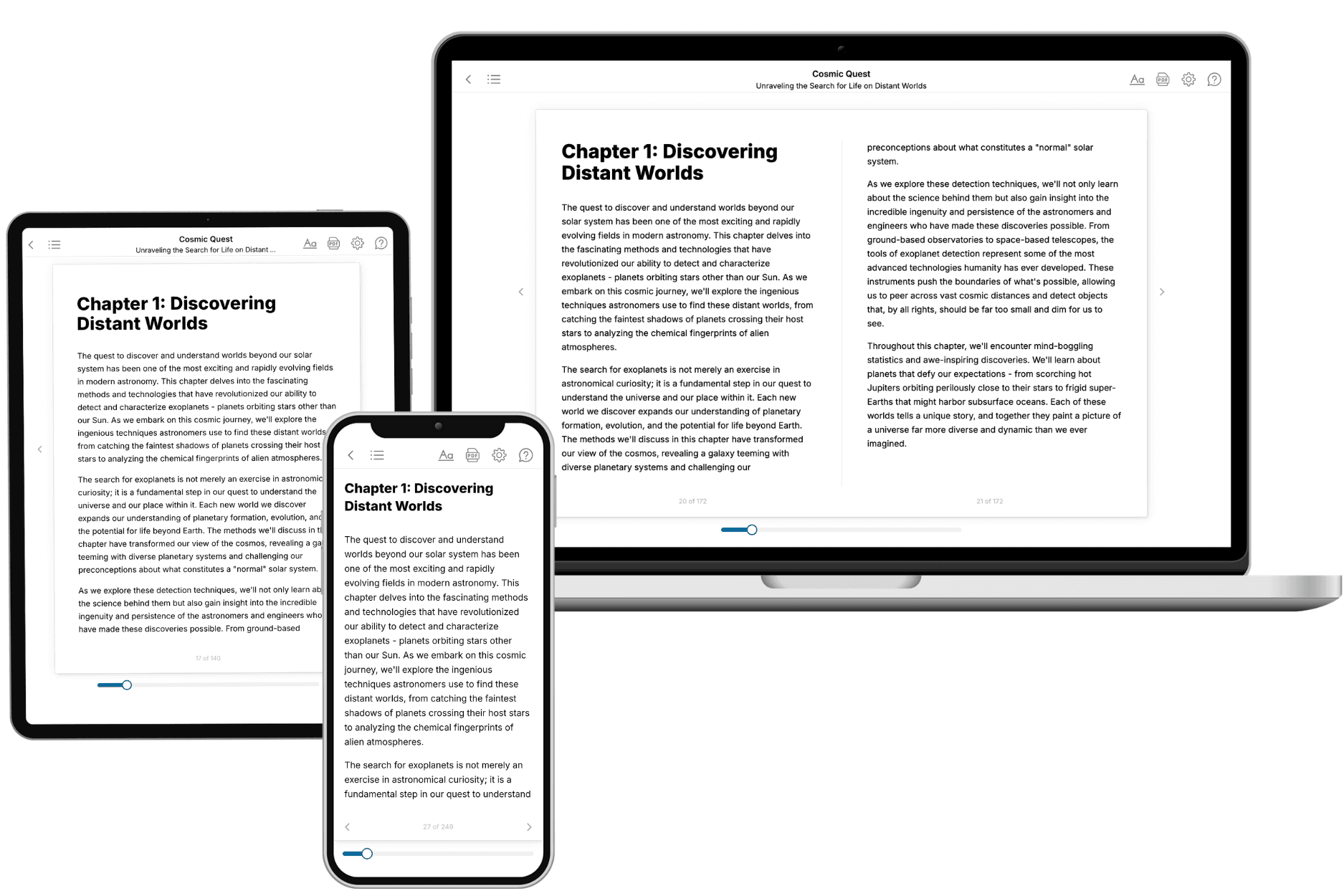
TailoredRead creates complete, full-length nonfiction ebooks, written specifically for you. Tell us what you want to learn and why, and TailoredRead writes you a complete ebook on it, with charts, tables, and diagrams throughout. Read it online, on Kindle, or on any e-reader, or download it as a PDF or EPUB. Every book is written fresh the day you order it.
- How is the book tailored to me?
Before anything is written, you answer a few short questions about your goals, your background, and the topics you care about. Your book is then planned around your answers: written at your level, focused on your goals, and covering the topics you chose, instead of the one-size-fits-all book a store sells everyone.
- Will it read like generic AI content?
No. Your book isn't a chat transcript: it's planned chapter by chapter before a single word is written, told in a clear book voice, and explains ideas visually with charts, tables, and diagrams. After writing, every book goes through an editorial pass that polishes chapters so the book reads consistent from start to finish. Judge for yourself: browse thousands of sample books on our Explore Books page.
- How accurate is the content?
Our AI first checks whether your subject needs live research. Niche and fast-moving subjects are researched before writing, and the book plan and chapters are grounded in what it finds. After writing, every book goes through a quality pass that checks its facts and consistency, and researched books list their sources in a Notes section at the back.
- How long is the book?
You choose the length: Comprehensive (250-300 pages), Detailed (150-200 pages), Essential (70-100 pages), or Short (30-50 pages).
- Does the book include visuals?
Yes. Every book includes charts, tables, and diagrams: timelines, checklists, step-by-step guides, decision trees, comparison tables, matrices, and bar charts. A typical book includes dozens of these visual elements.
- Can I read it on Kindle? What formats can I download?
Yes. Every book can be read in our online reader or downloaded as a PDF or EPUB. The EPUB can be opened with Kindle, Apple Books, Kobo, and any e-reader. The Commercial and Author licenses also include an editable Word (DOCX) and Markdown download.
- How much does it cost?
About the price of a regular ebook. The exact price depends on your book's length and complexity, from $2 for the shortest books to $35 for the most comprehensive, and it's shown when you review your book, before you commit to anything. Each book is a one-time purchase, yours to keep, no subscription. Licenses that let you share, teach, or publish your book range from $35.99 to $49.99.
- Can I preview the book before purchasing?
Before you pay, you'll see what your book will cover: the title, a detailed description, the estimated length, and the complete chapter-by-chapter table of contents, so you know what you're getting before you decide. The full text itself is written after you purchase.
- How long does it take to create a book?
About 10 minutes. You can start reading the opening chapters while the rest is still being written.