Soft Robotics Fundamentals
Understanding Flexible Machines and Their Real-World Applications
Discover how soft robotics is revolutionizing what machines can do by replacing rigid structures with flexible, adaptive systems.
207 pages9 chaptersJun 3, 2026Robotics
About this book
This book guides you through the mechanical principles that make soft robots fundamentally different from traditional robots, exploring how they achieve remarkable capabilities in safety, adaptability, and precision. You'll learn the material science behind flexible actuators, understand the mechanics of compliant systems, and explore real-world applications from surgical instruments to industrial grippers. Whether you're an engineer, researcher, or curious learner, this comprehensive guide breaks down complex concepts into accessible explanations while maintaining technical depth. Gain practical insights into design methodologies, control strategies, and the emerging technologies reshaping robotics. By the end, you'll understand not just how soft robots work, but why they represent the future of human-robot interaction and advanced manufacturing.
Table of contents
- IntroductionWhy Soft Robotics Matters Today, From Rigid to Flexible: A Paradigm Shift, What You'll Learn in This BookRead below
- Chapter 1: Foundations of Soft RoboticsDefining Soft Robotics and Its Core Principles, Historical Evolution and Key Milestones, Advantages and Limitations Compared to Rigid Systems
- Chapter 2: Materials Science for Soft RobotsElastomers and Polymers: The Building Blocks, Critical Material Properties and Performance Metrics, Smart Materials and Shape-Memory Alloys, Selecting Materials for Specific Applications
- Chapter 3: Mechanics of Compliant SystemsUnderstanding Deformation and Stress Distribution, Nonlinear Mechanics and Hyperelasticity, Modeling Compliance and Flexibility
- Chapter 4: Actuation TechnologiesPneumatic Actuation: Principles and Design, Hydraulic Systems for Soft Robots, Electric and Hybrid Actuation Methods, Comparing Actuation Technologies
- Chapter 5: Sensing and Feedback in Soft RobotsTypes of Sensors for Soft Systems, Proprioception and Self-Sensing, Integrating Feedback for Control
- Chapter 6: Control Systems and DynamicsUnique Control Challenges in Soft Robotics, Modeling Soft Robot Dynamics, Control Strategies and Algorithms, Achieving Stability and Performance
- Chapter 7: Design Methodology and PrototypingThe Soft Robot Design Process, Simulation and Computational Tools, Rapid Prototyping and Fabrication Techniques
- Chapter 8: Applications in Industry and MedicineMedical and Surgical Applications, Industrial Automation and Manufacturing, Emerging Applications and Future Possibilities, Real-World Case Studies and Success Stories
- Chapter 9: Advanced Topics and Future DirectionsBio-Inspired Design and Biomimetics, Hybrid Soft-Rigid Systems, Emerging Technologies and Research Frontiers
- ConclusionKey Takeaways and Synthesis, The Future of Soft Robotics
- Glossary of Terms
- Further Reading and Resources
Introduction
Pick up almost any robot from a science fiction film and you'll notice something immediately: it's hard, angular, and metallic. For most of the twentieth century, that image wasn't far from reality. Industrial robots were built from steel and aluminum, designed to be stiff, precise, and powerful. They worked beautifully in controlled factory environments, repeating the same motion thousands of times without deviation. But ask one of those machines to pick up a ripe tomato without crushing it, or navigate a collapsed building to find survivors, and it would fail completely. Rigidity, it turns out, is both a strength and a profound limitation.
Soft robotics emerged as a direct response to that limitation. Instead of fighting against the complexity of the real world with brute mechanical precision, soft robots embrace flexibility, compliance, and adaptability. They are built from materials that bend, stretch, and deform, much like biological tissue. This shift in thinking has opened up entirely new categories of what robots can do and where they can go. A soft robotic gripper can handle a raw egg and a steel bolt using the same hand. A soft robotic endoscope can navigate the curves of the human digestive tract without causing injury. These capabilities were simply not achievable with traditional rigid designs.
This book is written for people who already have a working understanding of mechanics and want to go deeper into the principles, materials, and methods that make soft robotics possible. You don't need a background in biology or advanced materials science to follow along, though both will come up frequently. What you do need is curiosity and a willingness to think about machines in a fundamentally different way. The concepts here build on each other progressively, starting from the foundational ideas and moving toward real-world applications and cutting-edge research. By the time you reach the final chapter, you'll have a solid, practical understanding of how soft robots are designed, built, controlled, and deployed.
The field of soft robotics is moving fast. Research groups around the world are publishing new findings every month, and commercial applications are beginning to appear in hospitals, warehouses, and laboratories. Understanding the fundamentals now puts you in a strong position to follow those developments, contribute to them, or apply them in your own work. This introduction sets the stage by explaining why soft robotics matters, how it differs from traditional robotics at a conceptual level, and what the rest of this book covers in detail.
Why Soft Robotics Matters Today
The world that robots need to operate in is not a factory floor. It's a hospital room, a disaster site, an agricultural field, a kitchen, and a crowded warehouse where humans and machines work side by side. These environments are unpredictable, cluttered, and full of fragile or irregular objects. Traditional rigid robots struggle in all of these settings because they were designed for a different kind of problem: high-speed, high-precision, repetitive tasks in structured environments. Soft robots, by contrast, are designed from the ground up to handle variability and uncertainty.
Safety is one of the most compelling reasons soft robotics matters right now. As robots move out of caged factory cells and into shared spaces with people, the risk of injury from accidental contact becomes a serious concern. A rigid robot arm moving at speed can cause significant harm if it strikes a person. A soft robot, made from compliant materials, absorbs and distributes impact forces rather than concentrating them. This property alone makes soft robots far more suitable for applications in healthcare, elder care, and collaborative manufacturing.[1]
The medical field has been one of the earliest and most enthusiastic adopters of soft robotic technology. Minimally invasive surgery requires instruments that can navigate tight, curved anatomical pathways without damaging surrounding tissue. Soft robotic catheters and endoscopes can bend and flex in ways that rigid instruments simply cannot. Researchers at Harvard University and other institutions have developed soft robotic sleeves that wrap around a failing heart and squeeze rhythmically to assist cardiac function, without the blood-contacting surfaces that traditional mechanical assist devices require.[2]
Agriculture is another area where soft robotics is beginning to make a real difference. Harvesting delicate fruits like strawberries, grapes, and tomatoes has historically resisted automation because the produce is easily bruised and grows in irregular, unpredictable arrangements. Soft robotic grippers can conform to the shape of each piece of fruit, applying just enough force to grasp it without causing damage. Several companies are now deploying soft robotic harvesting systems commercially, reducing labor costs while maintaining produce quality.
Beyond specific industries, soft robotics matters because it represents a broader shift in how engineers think about machines. For decades, the dominant approach was to make robots more precise and more powerful, essentially fighting against uncertainty with better control. Soft robotics takes the opposite approach: design the machine to be inherently tolerant of uncertainty. This philosophy, sometimes called morphological computation, means that the physical structure of the robot does some of the computational work, reducing the burden on sensors and control systems.[3]
The economic case for soft robotics is also strengthening. Many soft robotic components can be manufactured using silicone molding or 3D printing, which are relatively low-cost processes compared to precision machining of metal parts. This makes soft robots more accessible to smaller organizations and research groups. As fabrication techniques improve and materials become more widely available, the cost gap between soft and rigid systems will continue to narrow, accelerating adoption across industries.
Finally, soft robotics matters because it draws inspiration from the most successful machines that have ever existed: living organisms. Biological systems are almost entirely soft. Muscles, tendons, skin, and organs are all compliant materials that work together to produce remarkable capabilities. By studying and mimicking these biological structures, soft robotics researchers are discovering design principles that took millions of years of evolution to develop. This bio-inspired approach is not just philosophically interesting; it produces robots that genuinely outperform rigid alternatives in many real-world tasks.
From Rigid to Flexible: A Paradigm Shift
To understand what makes soft robotics different, it helps to be precise about what makes traditional robotics rigid. A conventional robot arm is built from a series of stiff links connected by discrete joints. Each joint has a motor, a gearbox, and a sensor. Motion happens at the joints; the links themselves don't deform. This architecture gives engineers a clear, well-understood mathematical model of the robot's behavior. You can calculate exactly where the end of the arm will be given a set of joint angles, and you can design controllers that exploit this predictability.
This rigid-body model has served robotics extremely well for decades. It underlies the design of everything from automotive welding robots to precision surgical systems like the da Vinci platform. The mathematics of rigid-body kinematics and dynamics is mature, well-documented, and supported by powerful software tools. Engineers who work with rigid robots have a rich toolkit at their disposal, and the performance of these systems in their intended applications is genuinely impressive.
The problem arises when you try to apply the rigid-body model to a soft system. A soft robot doesn't have discrete joints. Its entire body can deform continuously, and the relationship between applied forces and resulting shape is nonlinear and highly dependent on material properties. There is no simple equation that tells you where the tip of a soft robotic arm will be when you pressurize it to a given level. The system has, in principle, infinite degrees of freedom, because every point along its length can move independently. This is both the source of soft robots' remarkable capabilities and the reason they are significantly harder to model and control.
The paradigm shift from rigid to soft robotics is therefore not just a change in materials. It's a change in the fundamental assumptions that underlie robot design. Consider the following comparison:
- Rigid robots rely on precise joint control to achieve accurate positioning. Compliance is treated as an error to be minimized.
- Soft robots use the compliance of their structure as a functional feature. Deformation is not an error; it's how the robot interacts with its environment.
- Rigid robots require detailed environmental models to avoid collisions and plan safe paths.
- Soft robots can safely make contact with their environment and use that contact to guide their behavior.
- Rigid robots are typically actuated at discrete points (joints) with high-force, high-precision actuators.
- Soft robots are often actuated through distributed mechanisms like pressurized chambers or embedded smart materials.
A useful analogy is the difference between a metal ruler and a rubber band. If you want to measure a straight line, the metal ruler is far superior. It's stiff, predictable, and accurate. But if you want to wrap something around an irregular object, the rubber band is the obvious choice. Neither tool is universally better; they are suited to different problems. The same logic applies to rigid and soft robots. The shift toward soft robotics is not about replacing rigid systems entirely. It's about recognizing that a new class of problems requires a new class of tools.
This paradigm shift also changes how engineers approach the design process itself. In rigid robotics, design typically starts with kinematics: defining the joints, links, and degrees of freedom needed to achieve a desired workspace. In soft robotics, design often starts with the task and the environment, then works backward to determine what material properties, geometry, and actuation method will produce the needed behavior. The material is not just a structural element; it's an active participant in the robot's function.
One of the most striking demonstrations of this shift is the soft robotic gripper developed at Cornell University and iRobot, known as the universal gripper. Rather than designing fingers with specific shapes and joints, the researchers filled a balloon with granular material. When the balloon is pressed against an object, it conforms to the object's shape. When the air is then removed, the granular material jams together and locks the gripper in that shape, holding the object firmly. This design requires no knowledge of the object's geometry in advance and can grasp an enormous variety of shapes.[4] It works precisely because it abandons the rigid-body design philosophy entirely.
Understanding this paradigm shift at a conceptual level is essential before diving into the technical details. Every chapter in this book builds on the idea that compliance is a feature, not a bug. Once that idea is internalized, the design choices, material selections, and control strategies that follow will make intuitive sense. The goal is not to make soft robots behave like rigid ones. The goal is to understand what soft robots can do that rigid ones cannot, and to design systems that exploit those capabilities fully.
It's also worth acknowledging that this shift comes with genuine trade-offs. Soft robots are harder to model, harder to control precisely, and often less capable of exerting large forces than their rigid counterparts. These limitations are real, and this book addresses them honestly. Understanding the trade-offs is just as important as understanding the advantages. A well-designed soft robot is one where the designer has made deliberate, informed choices about where compliance helps and where it creates challenges that need to be managed.
What You'll Learn in This Book
This book is organized to take you from foundational concepts to advanced applications in a logical, progressive sequence. Each chapter builds on the ones before it, so the order matters. That said, if you already have strong background knowledge in a particular area, the chapters are written to be reasonably self-contained, and you can use the glossary at the back to fill in any gaps when jumping ahead.
Chapter 1: Foundations of Soft Robotics establishes the core definitions and principles that the rest of the book depends on. It covers what soft robotics actually means as a technical discipline, traces the historical development of the field from early bio-inspired research to modern systems, and gives an honest assessment of where soft robots outperform rigid systems and where they fall short. This chapter is essential reading if you're new to the field or want to make sure your foundational understanding is solid.
Chapter 2: Materials Science for Soft Robots dives into the physical building blocks of soft robotic systems. You'll learn about elastomers, hydrogels, and other compliant materials, understand the key properties that determine how a material will perform in a robotic application, and explore smart materials like shape-memory alloys and dielectric elastomers that can both sense and actuate. The chapter concludes with a practical framework for selecting materials based on application requirements.
Chapter 3: Mechanics of Compliant Systems addresses the mathematical and physical principles that govern how soft structures deform and respond to forces. This is where the book gets into the technical details of stress, strain, and nonlinear material behavior. You'll learn why the standard linear models used in rigid robotics don't apply to soft systems, and what modeling approaches are used instead. This chapter is particularly important for readers who want to design and analyze soft robotic structures quantitatively.
Chapter 4: Actuation Technologies covers the different ways soft robots are made to move. Pneumatic actuation, which uses pressurized air to inflate chambers and produce motion, is the most widely used approach and receives detailed treatment. Hydraulic systems, which use liquid instead of air, offer different performance characteristics and are covered separately. The chapter also addresses electric actuation methods, including shape-memory alloys and dielectric elastomers, and provides a comparative framework for choosing between actuation technologies.
Chapter 5: Sensing and Feedback in Soft Robots explores how soft robots perceive their environment and their own state. Sensing in soft systems is fundamentally different from sensing in rigid robots because the sensors themselves must be flexible and must survive large deformations. You'll learn about stretchable strain sensors, pressure sensors, and optical fiber-based sensing approaches, as well as the concept of proprioception in soft systems. The chapter also covers how sensor data is integrated into control loops.
Chapter 6: Control Systems and Dynamics tackles one of the most challenging aspects of soft robotics: making these systems do what you want them to do. The infinite degrees of freedom and nonlinear behavior of soft robots make classical control approaches difficult to apply directly. This chapter covers the modeling approaches used to make soft robot dynamics tractable, the control strategies that have proven effective, and the ongoing research into learning-based and model-free control methods.
Chapter 7: Design Methodology and Prototyping brings together the material from earlier chapters into a practical design framework. You'll learn how to approach a soft robotics design problem systematically, from defining requirements through simulation and prototyping to testing and iteration. The chapter covers the computational tools used for soft robot simulation, as well as the fabrication techniques, including silicone molding and multi-material 3D printing, that are most commonly used in practice.
Chapter 8: Applications in Industry and Medicine shifts focus from principles to practice, examining how soft robots are being used in the real world today. Medical and surgical applications receive detailed attention, including soft robotic surgical tools, rehabilitation devices, and assistive technologies. Industrial applications cover soft grippers for food handling and electronics assembly, as well as collaborative robots designed to work safely alongside human workers. The chapter includes several detailed case studies drawn from deployed systems.
Chapter 9: Advanced Topics and Future Directions looks at where the field is heading. Bio-inspired design, which draws directly on biological structures and mechanisms, is one of the most active research areas and is covered in depth. Hybrid soft-rigid systems, which combine the strengths of both approaches, are increasingly common in practical applications. The chapter also surveys emerging technologies including soft robots that can self-heal, reconfigure, or be fabricated using entirely new methods like direct ink writing and embedded 3D printing.
Throughout the book, you'll find several recurring features designed to make the material more accessible and actionable:
- Concrete examples drawn from real research and deployed systems, with specific details about materials, dimensions, and performance metrics where available.
- Design frameworks that give you structured approaches to common soft robotics problems, from material selection to actuator choice to control strategy.
- Trade-off analyses that honestly compare different approaches, helping you understand not just what works but why and under what conditions.
- Footnotes and citations pointing to primary research papers and review articles for readers who want to go deeper into any particular topic.
A note on mathematical depth: this book assumes you are comfortable with basic mechanics, including stress, strain, and force analysis, as well as introductory calculus. Where more advanced mathematics appears, it is introduced with enough context to be understandable even if the specific techniques are new to you. The goal is always to build intuition alongside formal understanding. Equations are tools for thinking, not ends in themselves, and every mathematical concept in this book is connected to a physical reality that you can visualize and reason about.
Soft robotics is a field that rewards curiosity and cross-disciplinary thinking. The best soft robotics researchers draw on biology, materials science, mechanical engineering, computer science, and even art and design. This book tries to reflect that breadth while maintaining the technical rigor that the subject demands. Whether your goal is to design a new soft robotic system, understand the research literature, or simply develop a deeper appreciation for one of the most exciting areas in modern engineering, the chapters ahead have something valuable to offer. The journey from rigid to flexible, from precise to adaptive, from controlled to compliant, starts here.
Notes
Introduction
- 1. D. Rus and M. T. Tolley, "Design, fabrication and control of soft robots," Nature, 2015
- 2. E. T. Roche and others, "Soft robotic sleeve supports heart function," Science Translational Medicine, 2017
- 3. R. Pfeifer and others, "Self-organization, embodiment, and biologically inspired robotics," Science, 2007
- 4. E. Brown and others, "Universal robotic gripper based on the jamming of granular material," Proceedings of the National Academy of Sciences, 2010
This is the end of the free sample. The full book has 9 chapters.
Want this book written for you?
Tell us your goals and background, and get your own version of this book, tailored by AI to you.


Benefits of AI-tailored books
- Read one book, not ten:
- all the Robotics knowledge you need, gathered into a single book.
- Save days of learning:
- tell us your goals, choose your topics, and the whole book is built around them.
- Learn effortlessly:
- Robotics book written for your specific background and expertise.
- Understand at a glance:
- includes charts, tables, timelines, checklists, decision trees, and more.
- Stay current:
- written the day you order it, not years ago.
- Trust what you read:
- every book is checked for accuracy, with real research when your subject needs it.
Create your unique book in 3 steps
- 1. Select your focus
Select the focus of your Robotics book and share your background
- 2. Personalize your book
Specify your goals and choose sub-topics to include
- 3. Get your tailored book
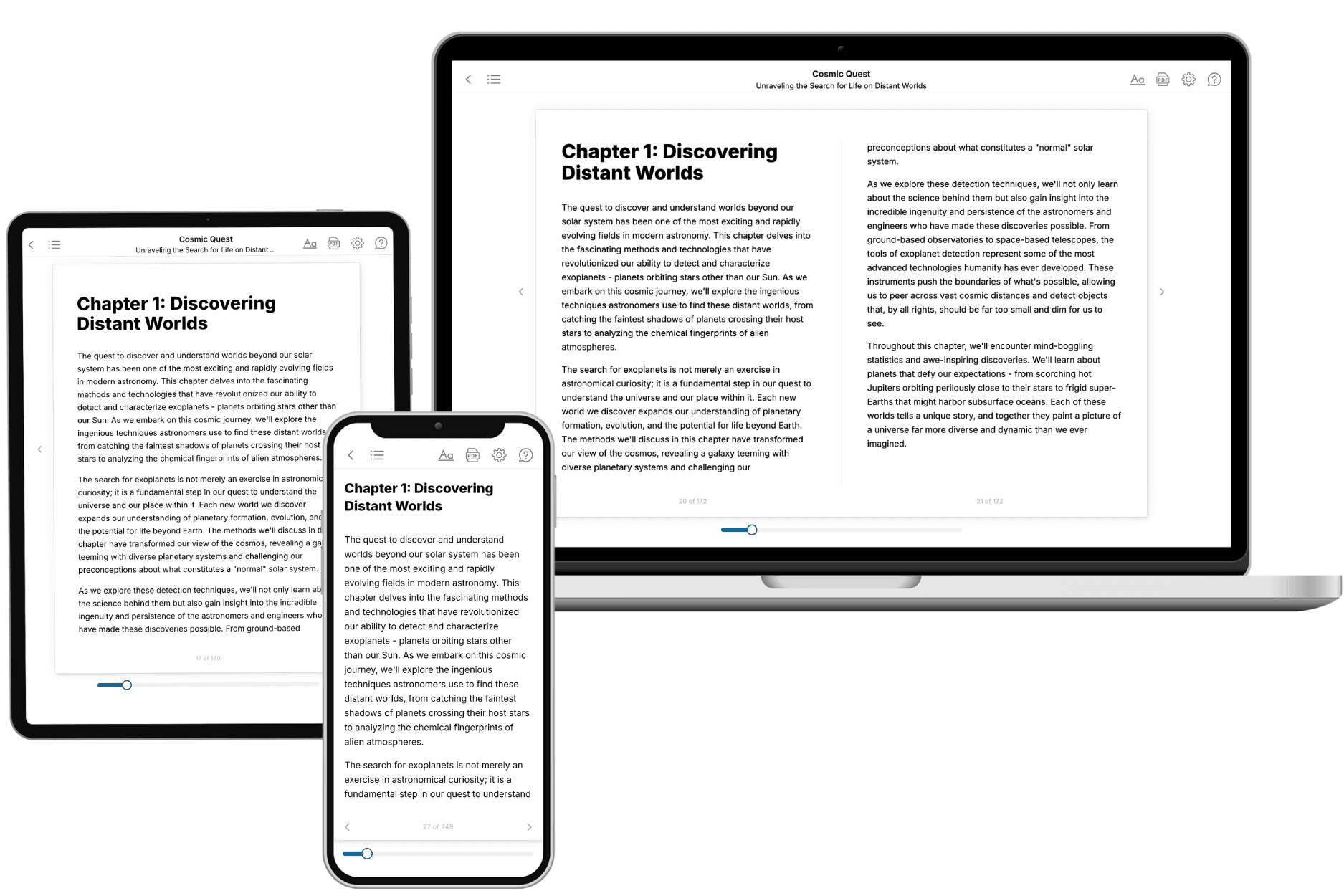
Your book is ready in 10 minutes. Read it online, download as EPUB or PDF, or send to Kindle.

Frequently asked questions
- What is TailoredRead?
TailoredRead creates complete, full-length nonfiction ebooks, written specifically for you. Tell us what you want to learn and why, and TailoredRead writes you a complete ebook on it, with charts, tables, and diagrams throughout. Read it online, on Kindle, or on any e-reader, or download it as a PDF or EPUB. Every book is written fresh the day you order it.
- How is the book tailored to me?
Before anything is written, you answer a few short questions about your goals, your background, and the topics you care about. Your book is then planned around your answers: written at your level, focused on your goals, and covering the topics you chose, instead of the one-size-fits-all book a store sells everyone.
- Will it read like generic AI content?
No. Your book isn't a chat transcript: it's planned chapter by chapter before a single word is written, told in a clear book voice, and explains ideas visually with charts, tables, and diagrams. After writing, every book goes through an editorial pass that polishes chapters so the book reads consistent from start to finish. Judge for yourself: browse thousands of sample books on our Explore Books page.
- How accurate is the content?
Our AI first checks whether your subject needs live research. Niche and fast-moving subjects are researched before writing, and the book plan and chapters are grounded in what it finds. After writing, every book goes through a quality pass that checks its facts and consistency, and researched books list their sources in a Notes section at the back.
- How long is the book?
You choose the length: Comprehensive (250-300 pages), Detailed (150-200 pages), Essential (70-100 pages), or Short (30-50 pages).
- Does the book include visuals?
Yes. Every book includes charts, tables, and diagrams: timelines, checklists, step-by-step guides, decision trees, comparison tables, matrices, and bar charts. A typical book includes dozens of these visual elements.
- Can I read it on Kindle? What formats can I download?
Yes. Every book can be read in our online reader or downloaded as a PDF or EPUB. The EPUB can be opened with Kindle, Apple Books, Kobo, and any e-reader. The Commercial and Author licenses also include an editable Word (DOCX) and Markdown download.
- How much does it cost?
About the price of a regular ebook. The exact price depends on your book's length and complexity, from $2 for the shortest books to $35 for the most comprehensive, and it's shown when you review your book, before you commit to anything. Each book is a one-time purchase, yours to keep, no subscription. Licenses that let you share, teach, or publish your book range from $35.99 to $49.99.
- Can I preview the book before purchasing?
Before you pay, you'll see what your book will cover: the title, a detailed description, the estimated length, and the complete chapter-by-chapter table of contents, so you know what you're getting before you decide. The full text itself is written after you purchase.
- How long does it take to create a book?
About 10 minutes. You can start reading the opening chapters while the rest is still being written.