Soil-Foundation Mastery
The Contractor's Guide to Concrete, Soil Interaction, and Lasting Structural Stability
How confident are you that your foundation design will perform as intended five, ten, or twenty years after construction?
222 pages10 chaptersFeb 20, 2026Civil EngineeringCreated by Rob
About this book
Most contractors rely on assumptions about soil conditions rather than data-driven decisions. This practical guide bridges the gap between field experience and soil mechanics science, giving you the knowledge to design foundations that last. You'll learn how to assess soil bearing capacity, manage differential settlement, prepare subgrades properly, and design concrete slabs and footings that work with your soil rather than against it. Whether you're working with silty loam, clay, or mixed soils, you'll discover the specific techniques that prevent costly failures and ensure structural stability. Packed with real-world examples, testing protocols, and decision-making frameworks, this book transforms soil mechanics from abstract theory into actionable strategies you can apply on every project.
Table of contents
- IntroductionWhy Soil Mechanics Matters to Your Bottom Line, Moving Beyond Assumptions to Data-Driven Decisions, How to Use This Book for Maximum ImpactRead below
- Chapter 1: Soil Properties and ClassificationUnderstanding Soil Composition and Particle Size, Classifying Soils: USCS and Field Identification, Moisture Content and Density: The Critical Relationship, Silty Loam and Clay Soils: Characteristics and Challenges
- Chapter 2: Soil Bearing Capacity FundamentalsBearing Capacity Theory and Calculation Methods, Soil Bearing Pressure Testing: Plate Load Tests and Alternatives, Applying Safety Factors and Design Margins, Site Investigation: Boring, Sampling, and Lab Testing
- Chapter 3: Subgrade Preparation and CompactionSubgrade Preparation Methods and Sequencing, Compaction Standards and Verification Testing, Moisture Control During Preparation and Construction, Material Selection for Base Courses and Fill
- Chapter 4: Differential Settlement: Prediction and ControlSettlement Mechanisms: Elastic, Consolidation, and Collapse, Predicting Settlement Magnitude and Timing, Managing Differential Settlement in Design and Construction, Monitoring and Control Strategies During Construction
- Chapter 5: Shallow Foundation Design and PerformanceTypes of Shallow Foundations and When to Use Each, Reinforced Concrete Footing Design Principles, Shallow Foundation Settlement: Prediction and Limits, Design Examples for Common Soil Conditions
- Chapter 6: Concrete Slabs-On-Grade: Design and ConstructionSlab-On-Grade Types and Applications, Designing Slabs for Soil Conditions and Loads, Construction Practices for Durable Slabs, Preventing Cracking, Curling, and Settlement Issues
- Chapter 7: Clay Soil Consolidation and Long-Term PerformanceConsolidation Theory and Time-Dependent Settlement, Consolidation Testing and Interpretation, Designing for Consolidation Settlement, Managing Challenges Specific to Clay Soils
- Chapter 8: Soil Liquefaction Risk Assessment and MitigationLiquefaction Basics: When and Why It Occurs, Assessing Liquefaction Risk for Your Site, Mitigation Strategies and Design Adjustments, Regional Considerations and Regulatory Requirements
- Chapter 9: Concrete-Soil Interaction and Integrated DesignPrinciples of Concrete-Soil Interaction, Integrated Design Approach: Treating Concrete and Soil as a System, Optimizing Performance Through Coordinated Design
- Chapter 10: Field Decision-Making and TroubleshootingResponding to Unexpected Soil Conditions, Quality Control and Verification During Construction, Troubleshooting Common Foundation and Slab Issues
- ConclusionKey Takeaways for Your Next Project, Continuing Your Foundation Knowledge Journey
- Glossary of Terms
- Further Reading and Resources
Introduction
Picture a commercial warehouse slab you poured three years ago. The concrete mix was right, the reinforcement was placed correctly, and the crew did everything by the book. But today, the floor has a visible crack running diagonally across one corner, and the building owner is calling you. What went wrong? In most cases like this, the answer isn't in the concrete. It's in what's underneath it. The soil shifted, settled unevenly, or simply wasn't prepared to carry the load you placed on it. That gap between what you built and what the ground could support is where foundation failures are born.
Most experienced contractors have seen this scenario play out at least once. You've built dozens, maybe hundreds, of foundations over the years. You know how to read a set of plans, manage a crew, and get concrete placed on schedule. But soil mechanics is a discipline that rarely gets the attention it deserves in the field. It's often treated as someone else's problem, something the engineer handles before the plans arrive on your desk. The reality is that the contractor on the ground makes dozens of decisions every day that directly affect how soil and concrete interact, and those decisions have consequences that can last for decades.
This book was written specifically for contractors who already have deep field experience and want to close the gap between what they know from practice and what soil science can teach them. It's not a textbook full of abstract theory. It's a practical guide that connects soil mechanics principles to the real decisions you face on every project, from subgrade preparation and compaction to footing design and settlement prediction. The goal is straightforward: give you the knowledge to make better decisions, prevent costly failures, and build foundations that perform exactly as intended long after the job is done.
The chapters ahead cover the full spectrum of soil-foundation interaction, starting with soil classification and bearing capacity, moving through subgrade preparation and settlement control, and finishing with concrete-soil interaction as an integrated system. Each chapter is built around practical application, not just theory. You'll find testing protocols, decision frameworks, real-world examples, and specific guidance for the soil types that cause the most trouble on construction sites, particularly silty loam and clay. Whether you're looking to sharpen your technical knowledge or solve a specific problem you're facing right now, this book is designed to meet you where you are.
Why Soil Mechanics Matters to Your Bottom Line
Foundation failures are expensive. A cracked slab that needs to be partially demolished and repoured can cost tens of thousands of dollars. A footing that settles unevenly under a load-bearing wall can trigger structural repairs that dwarf the original construction cost. And beyond the direct repair costs, there's the damage to your reputation, the time spent managing warranty claims, and the legal exposure that comes with structural deficiencies. Understanding soil mechanics isn't just an academic exercise. It's a direct investment in protecting your business.
The numbers tell a clear story. Studies of construction defect litigation consistently show that foundation and slab issues are among the most common and most costly claims contractors face.[1] A significant portion of those failures trace back to inadequate site investigation, poor subgrade preparation, or foundation designs that didn't account for actual soil conditions. These aren't random events. They're predictable outcomes of decisions made without sufficient soil knowledge, and that means they're preventable.
Consider a straightforward example. A contractor builds a residential addition on what appears to be firm, stable ground. No soil testing is done because the site looks fine and the schedule is tight. The footing is sized based on a standard assumed bearing capacity of 1,500 pounds per square foot (psf), which is a common default in residential construction. But the actual soil is a silty clay with a bearing capacity closer to 800 psf when wet. Within two years, the addition has settled nearly an inch more than the original structure, cracking the connection between the two buildings and damaging interior finishes throughout. The repair cost exceeds the original contract value.
That scenario is not unusual. What makes it preventable is a basic plate load test or even a careful hand-auger investigation that would have revealed the soil conditions before design decisions were locked in. The cost of that investigation would have been a fraction of one percent of the total project cost. This is the core economic argument for soil mechanics knowledge: the investment in understanding your soil conditions is always smaller than the cost of getting it wrong.
Beyond avoiding failures, soil knowledge also creates competitive advantages. Contractors who understand soil conditions can make smarter bids. They can identify when a standard footing design is overbuilt for the actual conditions, saving material costs. They can also spot when a site requires more preparation than the plans specify, protecting themselves from scope creep and change order disputes. Knowledge of soil mechanics gives you the ability to evaluate what's in front of you rather than simply executing what's on paper.
There's also a professional dimension worth acknowledging. As a contractor with 20 or more years of experience, you've likely worked alongside engineers and geotechnical consultants. The more you understand their language and their methods, the more effectively you can collaborate with them, push back when something doesn't look right, and advocate for design changes that reflect field realities. Soil mechanics knowledge makes you a better partner on every project team, and that reputation compounds over time into more work and stronger professional relationships.
Finally, consider the long-term performance of your work. Buildings you construct today will be standing in 20, 30, or 50 years. The foundations you build are the most permanent part of any structure. Getting them right means your work holds up over time, your clients stay satisfied, and your reputation for quality grows. Getting them wrong means callbacks, claims, and the kind of problems that follow a contractor's name for years. Soil mechanics is the discipline that separates foundations built on assumptions from foundations built on knowledge.
Moving Beyond Assumptions to Data-Driven Decisions
Every contractor makes assumptions. When you've been building for 20 years, you develop intuitions about soil conditions, footing depths, and slab thicknesses that often serve you well. Experience is genuinely valuable, and nothing in this book is meant to dismiss it. But there's a critical difference between informed judgment built on data and assumptions made in the absence of information. The goal of this section is to help you see where assumptions are costing you, and what it looks like to replace them with better information.
The most common assumption in foundation work is that soil conditions at a new site are similar to conditions at a nearby site where things went well. This assumption fails more often than most contractors realize, because soil conditions can change dramatically over short distances. A site with sandy loam on one end can have soft clay pockets on the other end, separated by just 50 feet. Glacial deposits, old fill areas, buried organic material, and variable water table depths can all create conditions that look uniform on the surface but behave very differently under load.
A practical illustration: Two adjacent commercial lots in the same subdivision. Both appear to have similar surface soils. The contractor builds identical strip footings on both sites using the same assumed bearing capacity. One building performs perfectly. The other develops differential settlement within 18 months because the second lot sits over a former drainage swale that was filled with loose material decades earlier. No surface evidence indicated the difference. A single boring on each lot would have revealed it.
The shift from assumptions to data-driven decisions doesn't require a complete overhaul of how you work. It starts with building a few key habits into your project workflow. The most important of these is treating site investigation as a non-negotiable early step, not an optional add-on. Even a basic investigation, including hand auger borings, visual soil classification, and a simple bearing capacity test, gives you information that changes how you approach design and construction. The cost is low. The value is high.
Data-driven decision-making also means knowing which assumptions are safe and which are dangerous. Some defaults are reasonable starting points. For example, using a conservative bearing capacity assumption for preliminary budgeting is fine, as long as you verify it before finalizing the design. Other assumptions carry much higher risk. Assuming that existing fill is adequately compacted without testing, or that clay soils won't consolidate significantly under a new load, are the kinds of assumptions that lead directly to the failures described earlier in this chapter.
Here's a practical framework for evaluating when to test versus when to rely on experience:
- Always test when the site has any history of fill, grading, or land use change
- Always test when visible soil conditions vary across the footprint of the structure
- Always test when the structure is sensitive to settlement (masonry, large spans, or connections to existing structures)
- Use experience with caution when the site has a well-documented history and conditions match previous nearby projects closely
- Use experience as a starting point for preliminary design, but verify before finalizing footing sizes and depths
One of the most powerful shifts you can make is changing how you think about soil testing costs. Testing is not an overhead expense. It's a risk management tool. A standard geotechnical investigation for a small commercial project might cost $2,000 to $5,000. That investment can prevent a $50,000 repair or a $200,000 legal claim. Framed that way, the question isn't whether you can afford to test. It's whether you can afford not to.
Moving beyond assumptions also means getting comfortable with uncertainty and knowing how to manage it. Soil conditions are never perfectly uniform, and no amount of testing eliminates all unknowns. The goal isn't certainty. It's reducing uncertainty to a level where your design decisions are defensible and your safety margins are appropriate. This book will give you the tools to do exactly that, including how to interpret test results, how to apply safety factors, and how to make conservative design choices when data is limited.
The contractors who consistently build foundations that perform well over time are not necessarily the ones with the most experience. They're the ones who combine experience with a disciplined approach to gathering and using information. That combination is what this book is designed to help you build. Every chapter adds a layer of knowledge that makes your field judgment sharper, your design decisions more defensible, and your projects more likely to succeed over the long term.
How to Use This Book for Maximum Impact
This book is organized to take you from foundational concepts to advanced application in a logical sequence, but it's also designed so you can navigate directly to the topics most relevant to your current work. If you're dealing with a clay soil site right now, you might jump to Chapter 7 on consolidation. If you're preparing a bid on a project with uncertain soil conditions, Chapter 2 on bearing capacity and Chapter 3 on subgrade preparation will be immediately useful. The structure supports both cover-to-cover reading and targeted reference use.
Here's a quick map of what each chapter covers and when it's most relevant:
- Chapter 1 (Soil Properties and Classification): Start here if you want to build a solid foundation in soil science. This chapter gives you the vocabulary and classification tools you'll use throughout the rest of the book.
- Chapter 2 (Bearing Capacity): Essential reading before any footing design decision. Covers how to calculate and test bearing capacity, and how to apply safety factors correctly.
- Chapter 3 (Subgrade Preparation): Directly applicable to every project. Covers compaction standards, moisture control, and material selection for base courses.
- Chapter 4 (Differential Settlement): Critical for any project where uneven settlement is a risk, including additions to existing structures, mixed soil sites, and large footprints.
- Chapter 5 (Shallow Foundations): Covers footing design principles and worked examples for common soil conditions. Useful for both design review and original design work.
- Chapter 6 (Slabs-On-Grade): Focused on concrete slab design and construction, including how to prevent cracking, curling, and settlement-related failures.
- Chapter 7 (Clay Consolidation): Deep dive into clay soil behavior, consolidation theory, and long-term settlement prediction. Essential for any project on clay-dominated sites.
- Chapter 8 (Liquefaction Risk): Relevant for projects in seismically active regions or sites with loose, saturated sandy soils. Covers risk assessment and mitigation strategies.
- Chapter 9 (Concrete-Soil Interaction): Integrates the concepts from earlier chapters into a unified design approach. Useful for understanding how all the pieces fit together.
- Chapter 10 (Field Decision-Making): Practical guidance for responding to unexpected conditions, managing quality control, and troubleshooting problems during construction.
Throughout the book, you'll find several recurring features designed to make the content as useful as possible in real-world situations. Decision frameworks give you structured approaches to common choices, such as when to require additional testing or how to select a footing type for a given soil condition. Worked examples walk through calculations and design decisions step by step, using realistic project scenarios. Warning boxes highlight the most common mistakes and how to avoid them. These features are designed to make the content immediately applicable, not just informative.
A note on the technical content: this book uses standard engineering units and references widely accepted standards, including those from the American Society for Testing and Materials (ASTM), the American Concrete Institute (ACI), and the Unified Soil Classification System (USCS). Where calculations are presented, they are explained in plain language alongside the formulas so you can follow the logic even if you haven't worked with these equations before. The goal is always to build understanding, not to overwhelm with notation.
You'll also notice that this book takes a strong position on the importance of testing and site investigation. That position is grounded in evidence, not preference. The research on foundation failures consistently points to inadequate site investigation as a primary contributing factor.[2] This book will push you to test more, assume less, and design with actual data. That's not a criticism of how you've worked in the past. It's an invitation to work even better going forward.
One of the most effective ways to use this book is to read it alongside an active project. As you work through each chapter, think about how the concepts apply to the site you're currently working on or planning. What soil type are you dealing with? What bearing capacity assumptions are built into the current design? What compaction standard is specified, and how will you verify it? Connecting the content to real work accelerates learning and makes the knowledge stick in a way that abstract reading rarely does.
If you're working with a geotechnical engineer or structural engineer on a project, this book will help you have more productive conversations with them. You'll understand what their reports are telling you, ask better questions, and recognize when their recommendations need to be translated into specific field actions. That kind of informed collaboration is one of the most valuable outcomes of deepening your technical knowledge, and it's something that pays dividends on every project you work on together.
Finally, keep this book accessible on the job. The glossary at the back defines every technical term used in the text, so you can look up unfamiliar language quickly. The further reading section points you toward the most useful reference standards and technical resources for going deeper on any topic. This book is designed to be a working tool, not a shelf decoration. Mark it up, dog-ear the pages, and come back to it whenever a project raises questions that your experience alone doesn't fully answer. That's exactly what it's here for.
This is the end of the free sample. The full book has 10 chapters.
Want this book written for you?
Tell us your goals and background, and get your own version of this book, tailored by AI to you.


Benefits of AI-tailored books
- Read one book, not ten:
- all the Civil Engineering knowledge you need, gathered into a single book.
- Save days of learning:
- tell us your goals, choose your topics, and the whole book is built around them.
- Learn effortlessly:
- Civil Engineering book written for your specific background and expertise.
- Understand at a glance:
- includes charts, tables, timelines, checklists, decision trees, and more.
- Stay current:
- written the day you order it, not years ago.
- Trust what you read:
- every book is checked for accuracy, with real research when your subject needs it.
Create your unique book in 3 steps
- 1. Select your focus
Select the focus of your Civil Engineering book and share your background
- 2. Personalize your book
Specify your goals and choose sub-topics to include
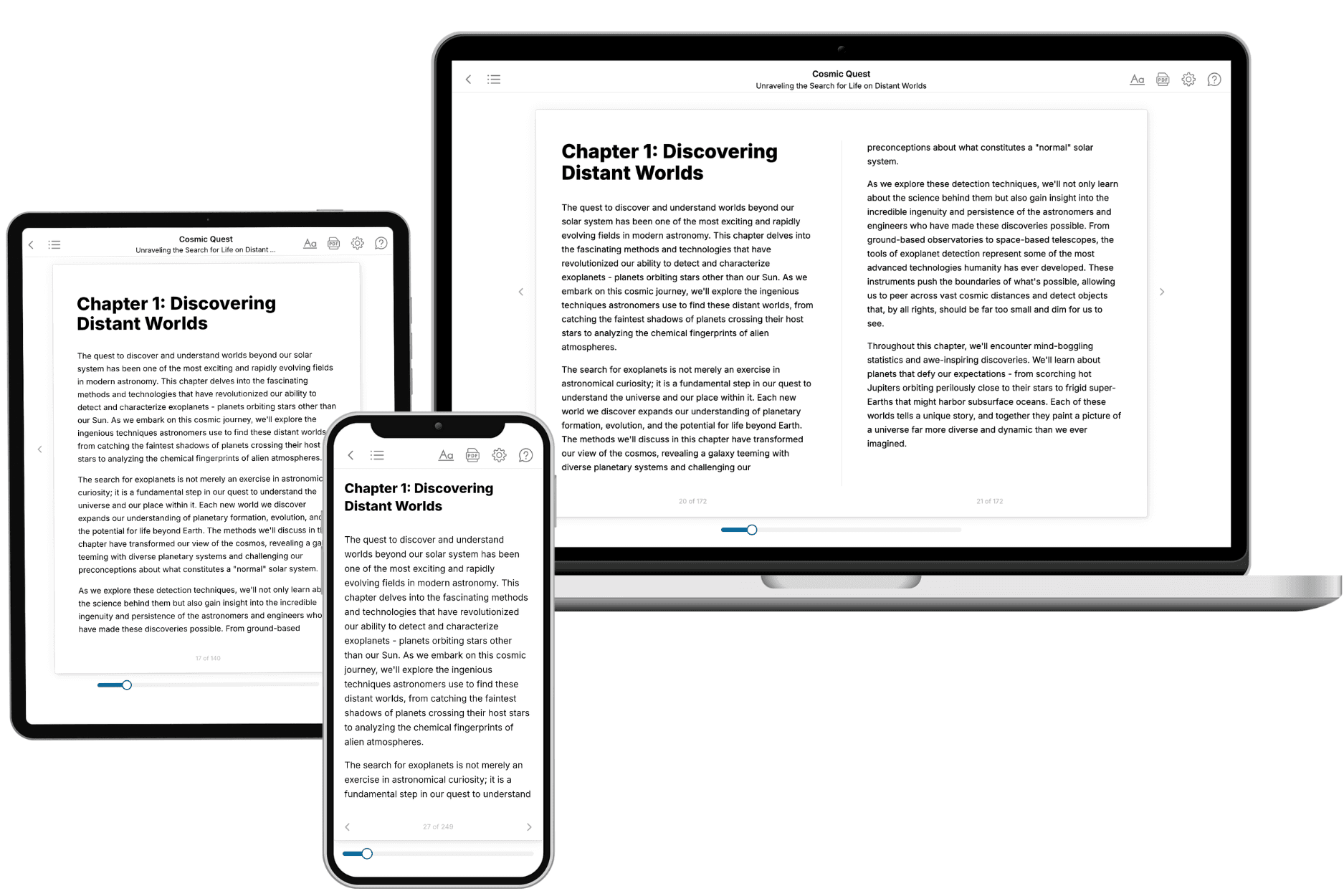
- 3. Get your tailored book
Your book is ready in 10 minutes. Read it online, download as EPUB or PDF, or send to Kindle.
Frequently asked questions
- What is TailoredRead?
TailoredRead creates complete, full-length nonfiction ebooks, written specifically for you. Tell us what you want to learn and why, and TailoredRead writes you a complete ebook on it, with charts, tables, and diagrams throughout. Read it online, on Kindle, or on any e-reader, or download it as a PDF or EPUB. Every book is written fresh the day you order it.
- How is the book tailored to me?
Before anything is written, you answer a few short questions about your goals, your background, and the topics you care about. Your book is then planned around your answers: written at your level, focused on your goals, and covering the topics you chose, instead of the one-size-fits-all book a store sells everyone.
- Will it read like generic AI content?
No. Your book isn't a chat transcript: it's planned chapter by chapter before a single word is written, told in a clear book voice, and explains ideas visually with charts, tables, and diagrams. After writing, every book goes through an editorial pass that polishes chapters so the book reads consistent from start to finish. Judge for yourself: browse thousands of sample books on our Explore Books page.
- How accurate is the content?
Our AI first checks whether your subject needs live research. Niche and fast-moving subjects are researched before writing, and the book plan and chapters are grounded in what it finds. After writing, every book goes through a quality pass that checks its facts and consistency, and researched books list their sources in a Notes section at the back.
- How long is the book?
You choose the length: Comprehensive (250-300 pages), Detailed (150-200 pages), Essential (70-100 pages), or Short (30-50 pages).
- Does the book include visuals?
Yes. Every book includes charts, tables, and diagrams: timelines, checklists, step-by-step guides, decision trees, comparison tables, matrices, and bar charts. A typical book includes dozens of these visual elements.
- Can I read it on Kindle? What formats can I download?
Yes. Every book can be read in our online reader or downloaded as a PDF or EPUB. The EPUB can be opened with Kindle, Apple Books, Kobo, and any e-reader. The Commercial and Author licenses also include an editable Word (DOCX) and Markdown download.
- How much does it cost?
About the price of a regular ebook. The exact price depends on your book's length and complexity, from $2 for the shortest books to $35 for the most comprehensive, and it's shown when you review your book, before you commit to anything. Each book is a one-time purchase, yours to keep, no subscription. Licenses that let you share, teach, or publish your book range from $35.99 to $49.99.
- Can I preview the book before purchasing?
Before you pay, you'll see what your book will cover: the title, a detailed description, the estimated length, and the complete chapter-by-chapter table of contents, so you know what you're getting before you decide. The full text itself is written after you purchase.
- How long does it take to create a book?
About 10 minutes. You can start reading the opening chapters while the rest is still being written.