The Sound Cure
How Music Therapy Rewires Your Brain to Overcome Anxiety
Discover how the power of sound and rhythm can fundamentally change your relationship with anxiety.
191 pages9 chaptersApr 23, 2026Music Therapy
About this book
This guide walks you through the neuroscience of music therapy and shows you exactly how to harness music—both by listening and creating—to calm your nervous system and build emotional resilience. You'll learn why certain tempos reduce heart rate, how rhythm synchronization rewires anxious thought patterns, and which musical elements trigger the deepest relaxation responses. Rather than treating anxiety as something to fight, you'll learn to use music as a direct pathway to nervous system regulation. Whether you're new to music therapy or have some experience, you'll discover practical protocols you can implement immediately, personalized strategies based on your unique anxiety triggers, and the science explaining why these approaches work. This isn't about becoming a musician—it's about becoming fluent in the language your nervous system understands best: music.
Table of contents
- IntroductionWhy Music Matters for Anxiety, How to Use This Book, What You'll Learn and DiscoverRead below
- Chapter 1: Understanding Anxiety and the Nervous SystemThe Anatomy of Anxiety: What Happens in Your Body, Nervous System Basics: Sympathetic vs. Parasympathetic, Common Anxiety Disorders and Their Patterns, Why Traditional Approaches Often Fall Short
- Chapter 2: The Neuroscience of Music and the BrainHow Music Activates Multiple Brain Regions Simultaneously, Neuroplasticity: How Music Rewires Anxious Pathways, Music's Effect on Dopamine, Serotonin, and Cortisol, Sound Frequencies and Brain Wave States
- Chapter 3: The Therapeutic Power of ListeningBeyond Passive Listening: Active Engagement with Sound, Tempo, Heart Rate Variability, and Emotional Regulation, Selecting Music That Works for Your Anxiety, Structured Listening Protocols for Anxiety Relief
- Chapter 4: Music Creation as TherapyWhy Creating Music Heals Differently Than Listening, Building Agency and Control Through Music Making, Getting Started: No Musical Training Required, Creative Expression Techniques for Anxiety Processing
- Chapter 5: Rhythm, Synchronization, and Nervous System RegulationRhythm as an Anchor for Anxious Minds, Entrainment: How Your Body Syncs with Musical Rhythm, Drumming and Percussion: Direct Nervous System Access, Integrating Breath Work with Musical Rhythm
- Chapter 6: Personalized Music Therapy ProtocolsAssessing Your Unique Anxiety Profile and Triggers, Designing Your Personal Music Therapy Protocol, Matching Specific Music to Specific Anxiety Symptoms, Tracking Progress and Adjusting Your Approach
- Chapter 7: Combining Music Therapy with Other TreatmentsMusic Therapy Alongside Cognitive Behavioral Therapy, Music Therapy and Medication: Complementary Approaches, Integrating Music with Mindfulness and Meditation, Building a Holistic Anxiety Management System
- Chapter 8: Practical Tools and Daily PracticesMorning Music Rituals to Start Your Day Calm, Acute Anxiety Interventions: Music for Crisis Moments, Evening Wind-Down Practices for Better Sleep, Building Sustainable Music Therapy Habits
- Chapter 9: Overcoming Common ObstaclesWhen Music Feels Overwhelming or Triggering, Finding Your Musical Preferences and Tastes, Maintaining Consistency and Motivation, Knowing When to Seek Professional Music Therapy
- ConclusionYour Music Therapy Journey Begins Now, Final Thoughts and Encouragement
- Resources and Further ReadingRecommended Listening Lists by Anxiety Type, Music Apps and Tools for Therapy, Finding Certified Music Therapists
Introduction
There is a moment most people with anxiety know well. It arrives without warning: a tightening in the chest, a mind that won't slow down, a body that feels like it's bracing for a collision that never quite comes. You might have tried breathing exercises, journaling, therapy, or medication. Some of those things helped. Some didn't. And yet the anxiety kept finding its way back, like a song stuck on repeat. What if the answer to that stuck song was, in fact, another kind of song entirely? What if sound itself held a key to calming the very system that anxiety hijacks?
This book is built on a simple but powerful idea: music is not just entertainment. It is a biological tool. When you hear a piece of music that moves you, your brain doesn't just process it as pleasant noise. It responds across multiple regions simultaneously, triggering neurochemical changes, shifting your heart rate, and altering your emotional state in ways that are measurable, repeatable, and increasingly well understood by science. Music therapy has moved well beyond the realm of alternative wellness. It now sits at the intersection of neuroscience, psychology, and clinical medicine, backed by decades of peer-reviewed research showing real, lasting effects on anxiety symptoms.[1]
What makes this guide different from a general wellness book about music is its focus on how and why these effects happen, and more importantly, how you can deliberately harness them. You don't need to be a musician. You don't need perfect pitch or years of training. What you need is a willingness to engage with sound in a more intentional way, and a framework for doing so that is grounded in evidence rather than guesswork. That framework is exactly what the chapters ahead provide. Whether your anxiety shows up as generalized worry, social fear, panic, or something else entirely, the tools in this book are designed to meet you where you are and give you something concrete to work with.
The approach here is both practical and personal. Music therapy works best when it is tailored to the individual, because the emotional and neurological responses to music are deeply shaped by personal history, cultural background, and individual nervous system patterns. Throughout this book, you will find frameworks for understanding your own anxiety profile, selecting music that fits your specific needs, and building daily practices that create lasting change. The science explains the mechanism. The practice creates the result. Both matter, and both are covered here in depth.
Why Music Matters for Anxiety
Anxiety is, at its core, a nervous system problem. When the brain perceives a threat, real or imagined, it activates the sympathetic nervous system and floods the body with stress hormones like cortisol and adrenaline. Heart rate climbs. Muscles tense. Breathing becomes shallow. This is the fight-or-flight response, and it is extraordinarily useful when you are facing genuine danger. The problem is that anxious brains tend to trigger this response in situations that don't actually require it: a difficult conversation, a crowded room, an uncertain future. The body is ready to run from a predator that isn't there.
Music has a direct line into this system. Research consistently shows that slow, structured music activates the parasympathetic nervous system, the branch responsible for rest, digestion, and recovery. This is sometimes called the "rest and digest" response, and it is the physiological opposite of the anxiety state. When the parasympathetic system is engaged, heart rate slows, cortisol levels drop, and the body begins to shift out of high alert. This isn't a metaphor or a vague sense of calm. It is a measurable physiological shift that music can reliably produce.[2]
Consider what happens when you hear a piece of music that you associate with safety or comfort. Maybe it's a song from childhood, or a piece of classical music you've always found calming. Within seconds, your body begins to respond. Your breathing may slow. Your shoulders may drop slightly. Your mind may quiet just enough to feel manageable. This isn't coincidence. The brain processes music through the auditory cortex, but it also engages the limbic system, which governs emotion and memory, and the prefrontal cortex, which handles reasoning and regulation. Music reaches the emotional brain directly, bypassing the analytical filters that often make anxiety harder to address through thought alone.
Beyond listening, creating music adds another layer of therapeutic power. When you play an instrument, tap a rhythm, hum a melody, or even improvise with your voice, you engage motor systems, memory networks, and emotional processing centers all at once. This kind of full-brain engagement is associated with neuroplasticity, the brain's ability to form new connections and reorganize existing ones. For people with anxiety, this matters enormously. Anxiety is partly a pattern of neural firing, a well-worn groove in the brain's circuitry. Music creation offers a way to carve new grooves, literally rewiring the pathways that keep anxiety locked in place.
The research supporting music therapy for anxiety is substantial and growing. A 2016 meta-analysis published in the Journal of Affective Disorders reviewed 19 randomized controlled trials and found that music therapy significantly reduced anxiety symptoms across a range of clinical populations.[3] Studies have shown benefits for generalized anxiety disorder, social anxiety, pre-procedural anxiety in medical settings, and anxiety related to chronic illness. The effect sizes are meaningful, not just statistically significant but clinically relevant, meaning people actually feel better in ways that matter to their daily lives.
What makes music particularly valuable as an anxiety tool is its accessibility. Unlike many therapeutic interventions, music requires no prescription, no appointment, and no special equipment beyond a way to hear or make sound. It can be used in the middle of a panic attack, during a stressful commute, before a difficult meeting, or as part of a structured daily practice. It scales from a two-minute intervention in a moment of crisis to a long-term therapeutic protocol that builds resilience over months. This flexibility is one of its greatest strengths, and it is something this book will help you take full advantage of.
It is also worth being clear about what music therapy is not. It is not a replacement for professional mental health care when that care is needed. If you are experiencing severe anxiety, panic disorder, or any condition that significantly impairs your daily functioning, working with a licensed therapist or psychiatrist remains important. Music therapy works best as a complement to other treatments, amplifying their effects and providing tools you can use between sessions, during difficult moments, and as part of a broader self-care system. The chapters ahead will address how to integrate music therapy with other evidence-based approaches in ways that create genuine synergy.
A note on terminology: Throughout this book, "music therapy" refers both to the formal clinical practice conducted by certified music therapists and to the broader set of evidence-based, self-directed musical interventions that individuals can use independently. Where the distinction matters, it will be made clear.
How to Use This Book
This book is designed to be both a learning resource and a practical guide. It moves from foundational science to applied technique, building your understanding layer by layer so that by the time you reach the practical protocols, you know not just what to do but why it works. That understanding matters because it helps you adapt the techniques to your own situation, troubleshoot when something isn't working, and stay motivated when progress feels slow. Knowledge is not separate from practice here. It is part of the practice.
The chapters are organized in a deliberate sequence, but they are also designed to stand on their own. If you already have a solid understanding of anxiety neuroscience, you might move quickly through the early chapters and spend more time with the practical sections. If you are newer to the science of music and the brain, reading in order will give you the strongest foundation. There is no wrong way to engage with this material, as long as you engage with it actively rather than passively. Reading about music therapy is a starting point. Doing it is where the change happens.
Here is a practical map of how the book is structured:
- Chapters 1 and 2 cover the science: how anxiety works in the body and brain, and how music interacts with those systems at a neurological level.
- Chapters 3 and 4 move into application, covering therapeutic listening and music creation as distinct but complementary tools.
- Chapter 5 focuses specifically on rhythm and its unique power for nervous system regulation.
- Chapter 6 helps you build a personalized protocol based on your specific anxiety patterns and preferences.
- Chapter 7 addresses how to combine music therapy with other treatments, including cognitive behavioral therapy, medication, and mindfulness.
- Chapter 8 provides concrete daily practices organized around different times of day and different anxiety scenarios.
- Chapter 9 tackles common obstacles and how to work through them.
- The Resources section at the end offers curated listening lists, app recommendations, and guidance on finding professional music therapists.
Throughout the book, you will find specific exercises, frameworks, and protocols. These are not suggestions to consider someday. They are tools to use now. The most effective approach is to try each technique as you encounter it, even briefly, rather than waiting until you have finished reading. Your nervous system learns through experience, not through information alone. A five-minute listening exercise done today will teach you more than reading three chapters about listening theory.
You will also notice that this book asks you to pay attention to your own responses. Music therapy is not one-size-fits-all. What calms one person may agitate another. What feels grounding to one nervous system may feel boring or even irritating to another. This is not a flaw in the approach. It is a feature of how deeply personal our relationships with sound are. The frameworks here are designed to help you identify what works for your specific nervous system, not to prescribe a universal solution. Treat yourself as the subject of an ongoing, compassionate experiment.
A few practical suggestions before you begin:
- Keep a simple journal nearby. Tracking your responses to different musical interventions will help you identify patterns and refine your approach over time. Even brief notes like "felt calmer after 10 minutes of this" are valuable data.
- Have access to music. A streaming service, a playlist, or even a simple instrument will make the exercises more immediate and effective. You don't need anything expensive or elaborate.
- Set realistic expectations. Music therapy produces real results, but it works through consistent practice over time, not through a single transformative session. Think of it as building a skill rather than taking a pill.
- Be patient with yourself. If a technique doesn't work immediately, that doesn't mean it won't work. Anxiety is a complex system, and changing it takes time, repetition, and a willingness to stay curious.
Finally, this book assumes that you have some familiarity with music therapy concepts and are ready to go deeper. The content is designed for people who are past the "what is music therapy?" stage and ready to engage with the mechanisms, the nuances, and the practical protocols in a more sophisticated way. If you find yourself wanting more background on a particular concept, the footnotes and resources section will point you toward additional reading. The goal is not to overwhelm you with information but to give you exactly what you need to move forward with confidence and clarity.
What You'll Learn and Discover
By the time you finish this book, you will have a fundamentally different relationship with music. Not just as something you enjoy or use as background noise, but as a deliberate, powerful tool for managing your nervous system. You will understand the specific mechanisms by which music affects anxiety, and you will have a personalized set of practices that you can use in real situations, not just in theory. That combination of understanding and practice is what makes lasting change possible.
Here is a preview of the core insights and skills you will develop:
- The neuroscience of music and anxiety. You will learn exactly how music activates the brain's emotional and regulatory systems, why certain tempos and frequencies produce specific physiological effects, and how neuroplasticity makes music a genuine tool for rewiring anxious patterns over time.
- The difference between passive and active listening. Most people listen to music passively. You will learn how to listen actively in ways that maximize therapeutic benefit, including specific techniques for directing your attention during a listening session.
- How rhythm regulates the nervous system. Rhythm is one of the most powerful and underused tools in anxiety management. You will understand the principle of entrainment, how your body naturally synchronizes with external rhythms, and how to use this to shift your physiological state deliberately.
- Music creation as a therapeutic practice. You will discover why making music, even at the most basic level, engages different and complementary healing mechanisms compared to listening, and you will have concrete starting points that require no prior musical training.
- How to build a personalized protocol. Generic approaches to music therapy are less effective than personalized ones. You will learn how to assess your own anxiety patterns, identify the musical elements that work best for your nervous system, and design a protocol that fits your life.
- Integration with other treatments. Music therapy is most powerful when it works alongside other evidence-based approaches. You will learn specific ways to combine it with cognitive behavioral therapy, mindfulness, and other interventions for amplified results.
- Daily practices for different anxiety scenarios. From morning routines that set a calm tone for the day to acute interventions for moments of crisis, you will have a toolkit of specific, time-tested practices ready to use.
One of the most important things you will discover is that anxiety is not the enemy. It is a signal, a system that evolved to protect you, and one that has simply become miscalibrated. Music therapy doesn't fight anxiety. It works with the nervous system's own regulatory mechanisms to help it find its way back to balance. This reframe matters because it changes how you approach the work. Instead of trying to suppress or eliminate anxiety, you are learning to communicate with your nervous system in a language it already understands.
You will also discover that the relationship between music and emotion is not random. There are specific musical elements, tempo, key, mode, rhythm, timbre, and dynamics, that reliably produce specific emotional and physiological responses. Understanding these elements gives you a kind of fluency. Just as learning a language allows you to express nuanced ideas, learning the language of therapeutic music allows you to select and use sound with precision. This book will give you that fluency in practical, accessible terms, without requiring you to read sheet music or understand music theory at a technical level.
Perhaps most importantly, you will discover that you have more agency over your anxiety than you may currently believe. One of the most debilitating aspects of anxiety disorders is the feeling of helplessness, the sense that anxiety happens to you and there is little you can do about it in the moment. Music therapy directly challenges that feeling. When you pick up a drum, hum a melody, or deliberately choose a piece of music to shift your state, you are taking an active role in regulating your own nervous system. That act of agency, repeated consistently, builds a kind of confidence that extends well beyond the music itself.[4]
The science behind all of this is solid, and it is getting stronger every year. Researchers at institutions including Harvard Medical School, the University of Melbourne, and the Royal College of Music have published studies demonstrating measurable changes in cortisol levels, heart rate variability, and self-reported anxiety following structured music therapy interventions.[5] This is not fringe science. It is an emerging field with rigorous methodology and clinically meaningful results. The tools in this book are grounded in that research, translated into practices that are accessible and immediately usable.
What you will not find here is magical thinking or oversimplified promises. Music therapy is powerful, but it is not a cure-all. It works best as part of a broader approach to mental health, one that includes professional support when needed, attention to sleep and physical health, and a commitment to consistent practice. The goal of this book is to give you one of the most effective and underutilized tools available for managing anxiety, and to give it to you in a form that is honest, practical, and grounded in reality.
The journey ahead is genuinely exciting. The intersection of music and neuroscience is one of the most dynamic areas of current research, and the implications for mental health are profound. Every chapter will add to your understanding and your toolkit. By the end, you will not just know more about music therapy. You will be practicing it, feeling its effects, and building the kind of lasting resilience that comes from working with your nervous system rather than against it. That is the promise of this book, and it is one that the science, and the practice, fully supports.
The chapters ahead are not just about learning. They are about changing. And that change begins the moment you decide to listen differently, to create intentionally, and to treat sound as the therapeutic tool it has always been.
Notes
Introduction
- 1. M. V. Thoma and others, "The Effect of Music on the Human Stress Response," PLOS ONEe70156, 2013
- 2. L. Bernardi and others, "Cardiovascular, cerebrovascular, and respiratory changes induced by different types of music in musicians and non-musicians," Heart, 2006
- 3. J. Bradt and others, Music interventions for improving psychological and physical outcomes in cancer patients, Cochrane Database of Systematic Reviews, 2016
- 4. D. Grocke and T. Wigram, Receptive Methods in Music Therapy, Jessica Kingsley Publishers, 2007
- 5. D. Fancourt and S. Finn, What is the Evidence on the Role of the Arts in Improving Health and Well-being?, WHO Regional Office for Europe, 2019
This is the end of the free sample. The full book has 9 chapters.
Want this book written for you?
Tell us your goals and background, and get your own version of this book, tailored by AI to you.


Benefits of AI-tailored books
- Read one book, not ten:
- all the Music Therapy knowledge you need, gathered into a single book.
- Save days of learning:
- tell us your goals, choose your topics, and the whole book is built around them.
- Learn effortlessly:
- Music Therapy book written for your specific background and expertise.
- Understand at a glance:
- includes charts, tables, timelines, checklists, decision trees, and more.
- Stay current:
- written the day you order it, not years ago.
- Trust what you read:
- every book is checked for accuracy, with real research when your subject needs it.
Create your unique book in 3 steps
- 1. Select your focus
Select the focus of your Music Therapy book and share your background
- 2. Personalize your book
Specify your goals and choose sub-topics to include
- 3. Get your tailored book
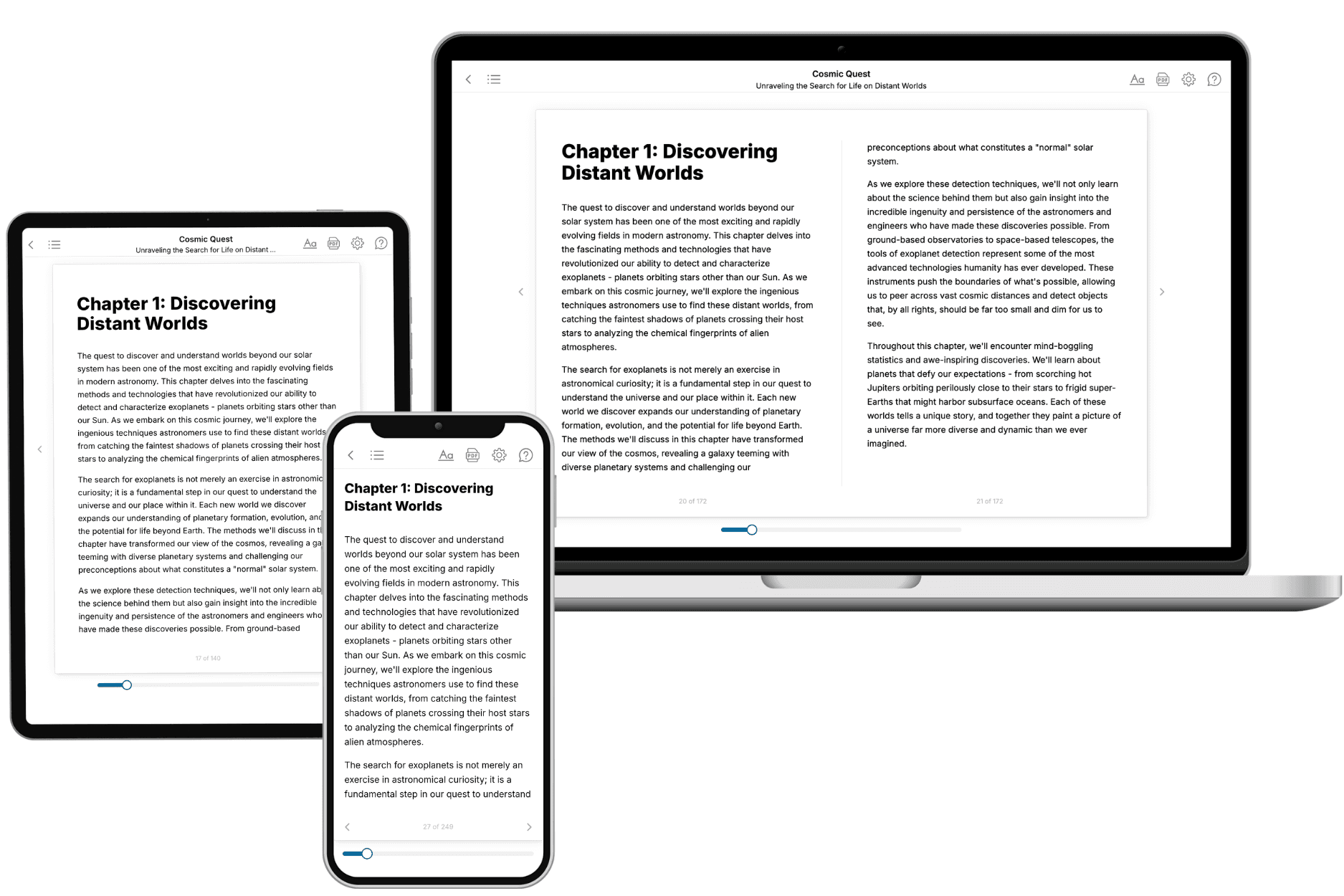
Your book is ready in 10 minutes. Read it online, download as EPUB or PDF, or send to Kindle.
Frequently asked questions
- What is TailoredRead?
TailoredRead creates complete, full-length nonfiction ebooks, written specifically for you. Tell us what you want to learn and why, and TailoredRead writes you a complete ebook on it, with charts, tables, and diagrams throughout. Read it online, on Kindle, or on any e-reader, or download it as a PDF or EPUB. Every book is written fresh the day you order it.
- How is the book tailored to me?
Before anything is written, you answer a few short questions about your goals, your background, and the topics you care about. Your book is then planned around your answers: written at your level, focused on your goals, and covering the topics you chose, instead of the one-size-fits-all book a store sells everyone.
- Will it read like generic AI content?
No. Your book isn't a chat transcript: it's planned chapter by chapter before a single word is written, told in a clear book voice, and explains ideas visually with charts, tables, and diagrams. After writing, every book goes through an editorial pass that polishes chapters so the book reads consistent from start to finish. Judge for yourself: browse thousands of sample books on our Explore Books page.
- How accurate is the content?
Our AI first checks whether your subject needs live research. Niche and fast-moving subjects are researched before writing, and the book plan and chapters are grounded in what it finds. After writing, every book goes through a quality pass that checks its facts and consistency, and researched books list their sources in a Notes section at the back.
- How long is the book?
You choose the length: Comprehensive (250-300 pages), Detailed (150-200 pages), Essential (70-100 pages), or Short (30-50 pages).
- Does the book include visuals?
Yes. Every book includes charts, tables, and diagrams: timelines, checklists, step-by-step guides, decision trees, comparison tables, matrices, and bar charts. A typical book includes dozens of these visual elements.
- Can I read it on Kindle? What formats can I download?
Yes. Every book can be read in our online reader or downloaded as a PDF or EPUB. The EPUB can be opened with Kindle, Apple Books, Kobo, and any e-reader. The Commercial and Author licenses also include an editable Word (DOCX) and Markdown download.
- How much does it cost?
About the price of a regular ebook. The exact price depends on your book's length and complexity, from $2 for the shortest books to $35 for the most comprehensive, and it's shown when you review your book, before you commit to anything. Each book is a one-time purchase, yours to keep, no subscription. Licenses that let you share, teach, or publish your book range from $35.99 to $49.99.
- Can I preview the book before purchasing?
Before you pay, you'll see what your book will cover: the title, a detailed description, the estimated length, and the complete chapter-by-chapter table of contents, so you know what you're getting before you decide. The full text itself is written after you purchase.
- How long does it take to create a book?
About 10 minutes. You can start reading the opening chapters while the rest is still being written.