Spanish Accent Marks Mastery
The Complete Guide to Perfect Punctuation and Stress Patterns
Many Spanish learners believe that accent marks are randomly placed decorations that native speakers just "know" intuitively.
300 pages16 chaptersSep 25, 2025Learning Spanish
About this book
This misconception leads to frustration, inconsistent writing, and the telltale signs of non-native Spanish that can undermine your credibility in academic and professional settings. The truth is that Spanish accent marks follow clear, logical patterns that can be mastered systematically. This comprehensive guide breaks down the mystery of accent placement into digestible rules and practical applications. You'll discover how syllable stress works, why certain words need accents while others don't, and how to use context clues to make accurate decisions even with unfamiliar vocabulary. Through targeted exercises, memory techniques, and real-world examples, you'll develop the confidence to write Spanish with the precision of a native speaker. Whether you're preparing for exams, advancing your career, or simply want to communicate more effectively, this book provides the tools you need to eliminate accent mark anxiety forever. Stop second-guessing every written word and start writing Spanish with the authority and accuracy you deserve. Your journey to accent mark mastery begins here.
Table of contents
- IntroductionWhy Accent Marks Matter More Than You Think, Debunking Common Myths About Spanish Accents, A Systematic Approach to Mastery, How to Use This Book EffectivelyRead below
- Chapter 1: The Foundations of Spanish StressUnderstanding Syllables in Spanish, Natural Stress Patterns in Spanish Words, The Connection Between Pronunciation and Writing, Developing Your Ear for Stress
- Chapter 2: The Three Fundamental RulesAguda Words: When Final Syllables Take Charge, Llana Words: The Most Common Pattern, Esdrújula Words: Always Accented, Applying the Rules in Practice
- Chapter 3: Mastering Vowel CombinationsUnderstanding Diphthongs, Working with Triphthongs, When Vowels Separate: Hiatus Rules, Weak and Strong Vowel Interactions
- Chapter 4: Accents That Change MeaningIntroduction to Diacritical Marks, Essential Word Pairs You Must Know, Using Context to Choose Correctly, Memory Strategies for Tricky Pairs
- Chapter 5: Question and Exclamation WordsMastering Interrogative Accents, Exclamatory Word Patterns, Indirect Questions and Hidden Accents, Recognition and Application Exercises
- Chapter 6: Demonstratives and PronounsWhen Demonstratives Need Accents, Pronoun Accent Patterns, The Este, Ese, Aquel Family, Modern Usage and Style Guidelines
- Chapter 7: Adverbs and ConjunctionsHow Adverbs Inherit Accents, Conjunction Accent Rules, The Solo/Sólo Distinction, High-Frequency Words to Master
- Chapter 8: Verb Conjugation and AccentsPresent Tense Accent Patterns, Preterite and Imperfect Accents, Future and Conditional Forms, Subjunctive Mood Considerations
- Chapter 9: Compound Words and Special CasesHow Compound Words Handle Accents, Hyphenated Word Rules, Abbreviations and Acronyms, Foreign Words in Spanish Text
- Chapter 10: Numbers, Dates, and TimeAccent Rules for Numbers, Ordinal Number Patterns, Dates and Calendar Terms, Time-Related Expressions
- Chapter 11: Proper Nouns and Geographic NamesPersonal Name Accent Rules, Cities, Countries, and Regions, Brand Names and Commercial Terms, Cultural and Historical Terms
- Chapter 12: Technology and Modern UsageAccents in Digital Communication, Social Media and Informal Writing, Using Technology Tools Effectively, Keyboard Shortcuts and Input Methods
- Chapter 13: Regional Variations and DialectsSpain vs. Latin American Differences, Regional Accent Preferences, Formal vs. Informal Writing Standards, Academic and Professional Standards
- Chapter 14: Common Mistakes and How to Avoid ThemThe Most Frequent Accent Errors, Understanding Error Patterns, Developing Self-Correction Skills, Effective Proofreading Techniques
- Chapter 15: Memory Techniques and Learning StrategiesVisual Memory Techniques, Auditory Learning Strategies, Developing Pattern Recognition, Spaced Repetition for Long-term Retention
- Chapter 16: Comprehensive Practice ExercisesFoundation-Building Exercises, Intermediate Challenge Sets, Advanced Application Scenarios, Self-Assessment Tools
- Conclusion
- Quick Reference Guide
Introduction
Spanish accent marks represent one of the most misunderstood aspects of the language, yet they hold the key to writing with native-like precision and confidence. Many intermediate learners find themselves paralyzed when faced with accent placement decisions, often resorting to guesswork or avoiding certain words altogether. This hesitation stems from a fundamental misconception that accent marks are arbitrary decorations sprinkled throughout Spanish text by some mysterious native speaker intuition. The reality is far more encouraging: Spanish accent marks follow logical, systematic patterns that can be learned, practiced, and mastered by anyone willing to understand the underlying principles.
The journey from accent mark confusion to mastery requires more than memorizing isolated rules or word lists. It demands a comprehensive understanding of how Spanish stress patterns work, why certain words break the standard patterns, and how context provides reliable clues for accurate placement. This systematic approach transforms what seems like an insurmountable challenge into a series of manageable, interconnected concepts. When you understand that Spanish has predictable stress patterns and that accent marks simply indicate when words deviate from these patterns, the entire system becomes remarkably clear and logical.
Your current level of Spanish proficiency provides the perfect foundation for mastering accent marks. You already possess the grammatical knowledge and vocabulary base necessary to recognize patterns and apply rules consistently. What you need now is a structured approach that builds upon your existing skills while addressing the specific challenges that accent marks present. This book provides that structure, guiding you through each concept with practical examples, targeted exercises, and proven memory techniques that ensure long-term retention and automatic application.
Why Accent Marks Matter More Than You Think
Accent marks in Spanish serve as far more than decorative elements or academic requirements—they function as essential communication tools that can completely alter meaning, clarity, and professional credibility. Consider the difference between papa (potato) and papá (father), or esta (this) and está (is/he is). These distinctions aren't merely technical details; they represent fundamental differences in meaning that can lead to confusion, misunderstandings, or even embarrassing miscommunications in professional and personal contexts. Native speakers immediately notice when accent marks are missing or misplaced, and these errors can undermine your credibility regardless of how sophisticated your vocabulary or grammar might be.
In academic and professional settings, proper accent mark usage becomes even more critical. University papers, business correspondence, and formal documents require precision that extends beyond basic communication to demonstrate mastery and attention to detail. Research conducted by Spanish language departments across major universities consistently shows that accent mark errors are among the most persistent markers of non-native writing, often persisting even in advanced students who have otherwise achieved high proficiency levels[1]. This persistence occurs not because accent marks are inherently difficult, but because they're often taught as isolated rules rather than as part of an integrated system.
The psychological impact of accent mark mastery extends beyond technical accuracy to influence overall confidence and fluency in written Spanish. When you're uncertain about accent placement, you tend to avoid certain words, simplify your expression, or second-guess your writing choices. This hesitation creates a cascade effect that limits your ability to express complex ideas with precision and nuance. Conversely, when you understand accent patterns and can apply them automatically, your writing becomes more sophisticated, varied, and authentic. You begin choosing words based on their precise meaning rather than their perceived difficulty, leading to more effective and engaging communication.
Modern digital communication has created new challenges and opportunities for accent mark usage. While autocorrect features can help catch obvious errors, they often fail with context-dependent distinctions or less common words. Social media and informal digital communication have also created environments where accent marks are frequently omitted, leading some learners to question their importance. However, professional digital communication—emails, reports, presentations, and formal social media posts—still requires proper accent usage. Understanding when and how to use accents appropriately across different digital contexts has become an essential skill for anyone using Spanish in professional or academic environments.
The cognitive benefits of mastering accent marks extend to overall Spanish language development. Learning to recognize stress patterns and accent placement improves pronunciation, enhances listening comprehension, and strengthens your understanding of Spanish phonology. When you can predict where stress falls in unfamiliar words, you're more likely to pronounce them correctly and understand them when spoken by others. This connection between written accents and spoken stress creates a reinforcing cycle that accelerates overall language acquisition and helps you develop a more native-like feel for Spanish rhythm and intonation patterns.
Perhaps most importantly, accent mark mastery represents a gateway to advanced Spanish proficiency. It's often the skill that separates intermediate learners from advanced speakers, not because it's inherently more difficult than other aspects of the language, but because it requires systematic understanding rather than intuitive acquisition. Once you master accent patterns, you gain access to more sophisticated vocabulary, can read complex texts with greater comprehension, and write with the precision necessary for academic and professional success. This mastery also builds confidence that transfers to other challenging aspects of Spanish, creating momentum for continued improvement across all language skills.
Consider this real-world example: A marketing professional preparing a presentation for Spanish-speaking clients spent hours perfecting the content, graphics, and delivery, only to have the presentation's impact diminished by consistent accent mark errors throughout the slides. The clients, while understanding the message, perceived the errors as indicating insufficient attention to detail—a critical concern in their industry. This scenario illustrates how accent mark accuracy directly impacts professional credibility and business outcomes.
The investment you make in mastering accent marks pays dividends across every aspect of your Spanish usage. Whether you're writing academic papers, composing business emails, creating social media content, or simply journaling in Spanish, proper accent usage enhances clarity, demonstrates competence, and allows your ideas to shine without distraction. More importantly, it frees you from the constant anxiety of wondering whether your accent placement is correct, allowing you to focus on expressing your thoughts with precision and creativity.
Debunking Common Myths About Spanish Accents
One of the most persistent myths about Spanish accent marks is that native speakers simply "know" where to place them through some innate linguistic intuition that non-native speakers can never fully develop. This misconception creates unnecessary anxiety and resignation among learners who believe they're attempting something beyond their reach. The truth is that native Spanish speakers learn accent rules systematically, just as they learn other aspects of grammar and spelling. Children in Spanish-speaking countries spend years in school learning these patterns, practicing them through dictation exercises, and reinforcing them through reading and writing. Native speakers don't possess magical accent-sensing abilities; they've internalized systematic patterns through extensive exposure and practice.
Another common myth suggests that accent marks are optional decorations that can be omitted without significant consequences, especially in informal communication. This belief often stems from observing casual digital communication where accents are frequently dropped due to keyboard limitations or speed considerations. However, accent marks are integral to Spanish orthography and meaning, not optional embellishments. Omitting them can change word meanings, create ambiguity, and mark your writing as non-standard. While some informal contexts may be more forgiving of accent omissions, developing the habit of proper accent usage ensures you're prepared for all communication contexts, from casual texts to formal documents.
Many learners believe that accent mark rules are riddled with exceptions and irregularities that make systematic learning impossible. This myth often develops when learners encounter accent rules presented as isolated facts rather than as part of a coherent system. In reality, Spanish accent rules are remarkably consistent and logical. The vast majority of Spanish words follow predictable patterns based on their ending letters and syllable structure. While exceptions exist, they're far fewer than in many other aspects of Spanish grammar, and they often follow their own sub-patterns that can be learned systematically. Understanding the underlying logic makes even apparent exceptions more manageable and memorable.
A particularly damaging myth is that you need to memorize the accent placement for every individual Spanish word, similar to memorizing spelling in English. This approach leads to overwhelming word lists and rote memorization that quickly becomes unmanageable as vocabulary expands. Spanish accent placement is rule-based, not word-specific. Once you understand the patterns, you can determine accent placement for unfamiliar words by analyzing their structure and applying the appropriate rules. This systematic approach is not only more efficient but also more reliable than memorization, as it provides tools for handling new vocabulary throughout your Spanish learning journey.
Some learners believe that accent marks are a modern invention or academic complication that doesn't reflect "real" Spanish usage. This historical misconception ignores the fact that Spanish accent marks have been part of the language's written system for centuries, evolving to serve essential communicative functions. The current accent system was largely standardized by the Real Academia Española in the 18th and 19th centuries, but accent-like marks have been used in Spanish writing since medieval times. Far from being academic complications, accent marks represent the natural evolution of Spanish orthography to capture the language's stress patterns and meaning distinctions in written form.
The myth that accent marks are less important in certain Spanish-speaking regions or that "Latin American Spanish" doesn't require proper accent usage reflects a misunderstanding of Spanish orthographic standards. While pronunciation may vary between regions, written Spanish maintains consistent orthographic rules across all Spanish-speaking countries. The Real Academia Española works with academies from all Spanish-speaking nations to maintain unified standards that apply globally. Professional and academic writing in Mexico, Argentina, Colombia, or any other Spanish-speaking country requires the same accent mark precision as writing in Spain.
A university student once argued that accent marks weren't necessary because "people understand what you mean anyway." While this might be true in some contexts, it's equivalent to arguing that capitalization or punctuation aren't necessary in English because the meaning is usually clear. Just as proper punctuation demonstrates writing competence in English, proper accent usage demonstrates Spanish writing competence and attention to detail that readers notice and appreciate.
Perhaps the most counterproductive myth is that accent mark mastery requires years of study and practice before showing meaningful improvement. This belief leads many learners to postpone serious accent study, assuming it's an advanced skill that can wait until later stages of learning. In reality, understanding basic accent patterns can be achieved relatively quickly with focused study, and immediate improvement in writing accuracy is possible within weeks of systematic practice. The key is approaching accent marks as a logical system rather than a collection of arbitrary rules, allowing you to build competence progressively and see rapid results.
Technology-related myths also persist, particularly the belief that modern spell-checkers and autocorrect features make accent mark knowledge unnecessary. While these tools can be helpful, they're far from perfect and often fail with context-dependent accent decisions, proper nouns, or less common vocabulary. Relying entirely on technology creates dependency and prevents you from developing the understanding necessary for confident, independent writing. Moreover, many professional and academic contexts require demonstrating personal competence rather than technological assistance, making accent mark knowledge essential for success in these environments.
A Systematic Approach to Mastery
Mastering Spanish accent marks requires a systematic approach that builds understanding progressively, connecting each new concept to previously learned patterns while providing ample opportunity for practice and reinforcement. This methodology differs significantly from traditional approaches that present accent rules as isolated facts to be memorized. Instead, you'll develop a comprehensive understanding of how Spanish stress patterns work, why accent marks exist, and how to apply this knowledge consistently across all types of Spanish words. The systematic approach ensures that each concept reinforces others, creating a robust foundation that supports continued learning and automatic application.
The foundation of this systematic approach rests on understanding Spanish syllable structure and natural stress patterns. Before learning when to add accent marks, you need to understand how Spanish words naturally carry stress and how this stress relates to pronunciation and meaning. This foundational knowledge provides the context necessary for understanding why accent rules exist and how they serve the language's communicative needs. By starting with these fundamentals, you develop intuitive understanding that makes subsequent rules feel logical rather than arbitrary, dramatically improving retention and application.
Pattern recognition forms the core of effective accent mark learning. Rather than memorizing individual words or isolated rules, you'll learn to identify the structural patterns that determine accent placement. These patterns include:
- Word ending patterns that predict natural stress placement
- Syllable combinations that require accent marks
- Morphological patterns in verb conjugations and word formation
- Semantic patterns in words that use accents to distinguish meaning
Progressive complexity ensures that you master fundamental concepts before moving to more challenging applications. The learning sequence moves from basic stress patterns to complex vowel combinations, from common word types to specialized vocabulary, and from recognition exercises to production tasks. Each level builds upon previous knowledge while introducing new challenges at an appropriate pace. This progression prevents overwhelm while ensuring thorough understanding of each concept before advancing to the next level.
Multi-modal learning techniques address different learning styles and reinforce understanding through various channels. Visual learners benefit from pattern charts, color-coded examples, and graphic organizers that illustrate accent relationships. Auditory learners engage with pronunciation exercises, stress pattern recognition activities, and rhythm-based memory techniques. Kinesthetic learners practice through writing exercises, typing activities, and physical stress pattern demonstrations. By incorporating multiple learning modalities, the systematic approach ensures that all learners can access and internalize accent mark patterns effectively.
Contextual application connects accent mark rules to real-world usage, ensuring that theoretical knowledge translates into practical writing skills. Rather than practicing with isolated words or artificial sentences, you'll work with authentic texts, realistic communication scenarios, and meaningful writing tasks. This contextual approach helps you understand not just how accent rules work, but when and why to apply them in actual communication situations. It also develops the judgment necessary for handling ambiguous cases and making appropriate decisions in different writing contexts.
Consider how this systematic approach differs from traditional methods: Instead of memorizing that "médico" has an accent on the first syllable, you learn that three-syllable words ending in vowels typically stress the second syllable, so "médico" needs an accent to indicate its irregular stress on the first syllable. This understanding allows you to handle similar words like "público," "práctico," and "fantástico" using the same logical process.
Error analysis and self-correction skills form essential components of the systematic approach. Rather than simply identifying mistakes, you'll learn to analyze why errors occur and develop strategies for preventing them. This includes understanding common error patterns, recognizing your personal challenge areas, and implementing targeted practice to address specific weaknesses. Self-correction skills ensure that you can continue improving independently, identifying and resolving accent mark issues in your own writing without external assistance.
Spaced repetition and strategic review ensure long-term retention of accent mark patterns. The systematic approach incorporates regular review cycles that reinforce previously learned concepts while introducing new material. This spacing effect, supported by cognitive science research, dramatically improves retention compared to massed practice or cramming approaches[2]. Strategic review focuses attention on concepts that need reinforcement while allowing well-mastered patterns to move into automatic application.
Integration with broader Spanish skills ensures that accent mark learning supports overall language development rather than existing in isolation. As you master accent patterns, you'll notice improvements in pronunciation, reading comprehension, and vocabulary acquisition. The systematic approach explicitly connects accent mark knowledge to these other skills, creating synergistic effects that accelerate overall Spanish proficiency. This integration also helps maintain motivation by demonstrating the practical benefits of accent mark mastery across all aspects of Spanish usage.
How to Use This Book Effectively
This book is designed as a comprehensive learning system that can accommodate different learning styles, time constraints, and proficiency goals while maintaining the systematic progression necessary for thorough accent mark mastery. Each chapter builds upon previous concepts while introducing new material at an appropriate pace, but the structure also allows for flexible usage depending on your specific needs and circumstances. Whether you prefer intensive study sessions or brief daily practice, whether you're preparing for a specific exam or seeking long-term improvement, the book's organization supports your individual learning approach while ensuring comprehensive coverage of all essential concepts.
The chapter sequence follows a carefully planned progression from fundamental concepts to advanced applications. Chapters 1-3 establish the foundational understanding of Spanish stress patterns and basic accent rules that underpin all subsequent learning. These chapters are essential for all readers and should be completed in order, as later concepts depend on this foundational knowledge. Chapters 4-8 cover the major categories of accent usage, including meaning-distinguishing accents, question words, and verb conjugations. These chapters can be studied in order or prioritized based on your immediate needs, though the suggested sequence optimizes learning efficiency.
Advanced chapters (9-13) address specialized topics and complex applications that build upon the fundamental patterns established earlier. These chapters are particularly valuable for learners seeking comprehensive mastery or those working in academic or professional contexts requiring precise accent usage. The final chapters (14-16) focus on error prevention, memory techniques, and extensive practice opportunities that reinforce all previously learned concepts. This structure allows you to customize your learning path while ensuring thorough coverage of all essential material.
Each chapter follows a consistent internal structure designed to optimize learning and retention:
- Concept Introduction: Clear explanation of the chapter's main concepts with relevant examples
- Pattern Analysis: Detailed examination of the underlying patterns and rules
- Practical Application: Guided practice with authentic examples and contexts
- Common Challenges: Discussion of typical difficulties and error patterns
- Reinforcement Activities: Targeted exercises to strengthen understanding and application
Active engagement strategies maximize learning effectiveness and retention. Rather than reading passively, you should interact with the material through the embedded exercises, examples, and reflection questions throughout each chapter. Keep a notebook dedicated to accent mark learning where you can practice examples, note personal insights, and track your progress. Create your own examples using the patterns presented in each chapter, as generating examples reinforces understanding more effectively than simply reading provided examples. Regular self-testing using the chapter review sections helps identify areas needing additional attention.
Pacing recommendations help you maintain steady progress without overwhelming yourself with too much information at once. For intensive study, plan to complete one chapter every 3-4 days, allowing time for thorough reading, practice completion, and concept integration. For moderate-paced learning, one chapter per week provides adequate time for deep understanding and extensive practice. For maintenance learning or review, focus on one subsection per day, spending 15-20 minutes on focused study and practice. Regardless of your chosen pace, regular review of previous chapters prevents forgetting and strengthens long-term retention.
Practice integration ensures that accent mark learning transfers to your actual Spanish usage. As you progress through the book, actively apply new concepts in your regular Spanish writing, whether that's journaling, homework, emails, or social media posts. Keep a list of words you frequently use but struggle with accent-wise, and revisit these words as you learn relevant patterns. Practice typing Spanish with proper accents using the keyboard techniques discussed in Chapter 12, as this builds the muscle memory necessary for efficient accent mark usage in digital communication.
A successful approach used by many learners involves the "daily accent focus" technique: Each day, choose one accent pattern from your current chapter and consciously look for examples of that pattern in your Spanish reading, whether it's news articles, social media, or textbook materials. This active pattern recognition reinforces learning while connecting book concepts to real-world Spanish usage.
Technology integration enhances learning without replacing fundamental understanding. Use the keyboard shortcuts and input methods discussed in Chapter 12 to practice proper accent typing as you work through exercises. Consider using spaced repetition software to review challenging word pairs or patterns, but ensure that you understand the underlying rules rather than simply memorizing individual cases. Online Spanish texts provide excellent opportunities to practice pattern recognition and accent identification in authentic contexts.
Progress tracking helps maintain motivation and identifies areas needing additional attention. Keep a learning journal where you note concepts that click easily, patterns that challenge you, and real-world applications of your growing accent mark knowledge. Regularly revisit earlier chapters to assess your improvement and identify concepts that may need reinforcement. Set specific, measurable goals such as "correctly identify accent placement in 90% of unfamiliar words" or "write a 500-word Spanish text with no accent errors" to maintain focus and measure progress.
Troubleshooting common challenges ensures continued progress when difficulties arise. If you find certain concepts particularly challenging, slow down and spend extra time with the foundational chapters, as advanced concepts depend on solid understanding of basic patterns. If you're making consistent errors in specific areas, focus on the relevant chapters and complete additional practice exercises. If motivation wanes, remind yourself of the practical benefits of accent mark mastery and consider finding a study partner or Spanish conversation group where you can apply your improving skills in social contexts.
This is the end of the free sample. The full book has 16 chapters.
Want this book written for you?
Tell us your goals and background, and get your own version of this book, tailored by AI to you.


Benefits of AI-tailored books
- Read one book, not ten:
- all the Learning Spanish knowledge you need, gathered into a single book.
- Save days of learning:
- tell us your goals, choose your topics, and the whole book is built around them.
- Learn effortlessly:
- Learning Spanish book written for your specific background and expertise.
- Understand at a glance:
- includes charts, tables, timelines, checklists, decision trees, and more.
- Stay current:
- written the day you order it, not years ago.
- Trust what you read:
- every book is checked for accuracy, with real research when your subject needs it.
Create your unique book in 3 steps
- 1. Select your focus
Select the focus of your Learning Spanish book and share your background
- 2. Personalize your book
Specify your goals and choose sub-topics to include
- 3. Get your tailored book
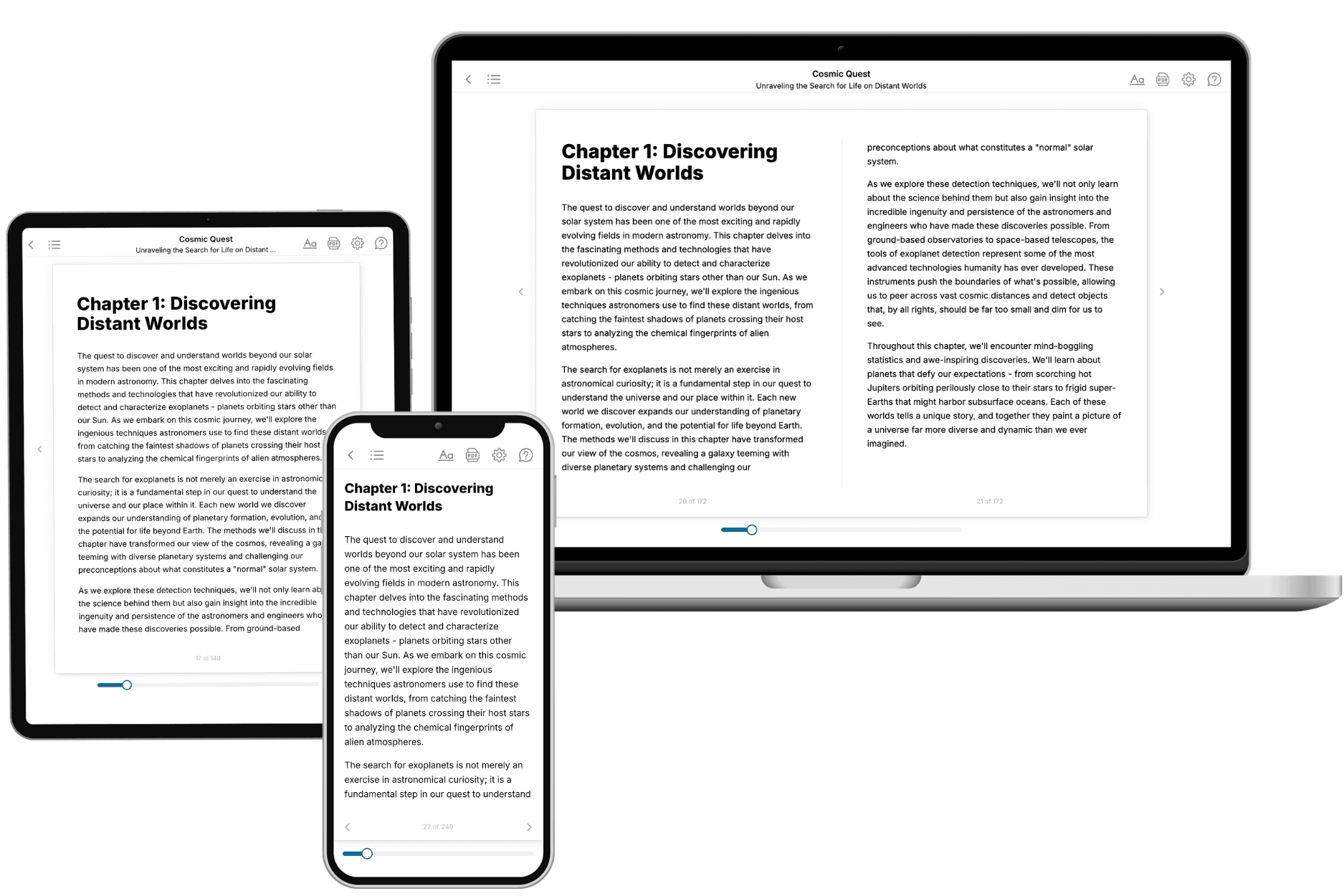
Your book is ready in 10 minutes. Read it online, download as EPUB or PDF, or send to Kindle.
Frequently asked questions
- What is TailoredRead?
TailoredRead creates complete, full-length nonfiction ebooks, written specifically for you. Tell us what you want to learn and why, and TailoredRead writes you a complete ebook on it, with charts, tables, and diagrams throughout. Read it online, on Kindle, or on any e-reader, or download it as a PDF or EPUB. Every book is written fresh the day you order it.
- How is the book tailored to me?
Before anything is written, you answer a few short questions about your goals, your background, and the topics you care about. Your book is then planned around your answers: written at your level, focused on your goals, and covering the topics you chose, instead of the one-size-fits-all book a store sells everyone.
- Will it read like generic AI content?
No. Your book isn't a chat transcript: it's planned chapter by chapter before a single word is written, told in a clear book voice, and explains ideas visually with charts, tables, and diagrams. After writing, every book goes through an editorial pass that polishes chapters so the book reads consistent from start to finish. Judge for yourself: browse thousands of sample books on our Explore Books page.
- How accurate is the content?
Our AI first checks whether your subject needs live research. Niche and fast-moving subjects are researched before writing, and the book plan and chapters are grounded in what it finds. After writing, every book goes through a quality pass that checks its facts and consistency, and researched books list their sources in a Notes section at the back.
- How long is the book?
You choose the length: Comprehensive (250-300 pages), Detailed (150-200 pages), Essential (70-100 pages), or Short (30-50 pages).
- Does the book include visuals?
Yes. Every book includes visual elements such as timelines, checklists, step-by-step guides, decision trees, comparison tables, and matrices, and many include bar charts. A typical book includes dozens of these visual elements.
- Can I read it on Kindle? What formats can I download?
Yes. Every book can be read in our online reader or downloaded as a PDF or EPUB. The EPUB can be opened with Kindle, Apple Books, Kobo, and any e-reader. The Commercial and Author licenses also include an editable Word (DOCX) and Markdown download.
- How much does it cost?
About the price of a regular ebook. The exact price depends on your book's length and complexity, from $5 for the shortest books to $35 for the most comprehensive, and it's shown when you review your book, before you commit to anything. Each book is a one-time purchase, yours to keep, no subscription. Licenses that let you share, teach, or publish your book range from $35.99 to $49.99.
- Can I preview the book before purchasing?
Before you pay, you'll see what your book will cover: the title, a detailed description, the estimated length, and the complete chapter-by-chapter table of contents, so you know what you're getting before you decide. The full text itself is written after you purchase.
- How long does it take to create a book?
10 minutes. You can start reading the opening chapters while the rest is still being written.