Spanish Verb Conjugation Mastery
The Complete Guide to Conjugating Spanish Verbs with Confidence
Struggling with Spanish verb conjugation?
207 pages10 chaptersMar 5, 2026Learning Spanish
About this book
You're not alone—it's the biggest hurdle intermediate learners face when trying to speak and write with confidence. The problem isn't that conjugation is inherently difficult; it's that most resources overwhelm you with endless tables and exceptions without showing you the underlying patterns that make everything click. This guide cuts through the confusion by revealing the logical structure behind Spanish verbs. You'll discover how regular verbs follow predictable patterns, how irregular verbs group into manageable families, and how tenses build on each other in a coherent system. Rather than memorizing isolated rules, you'll understand why verbs conjugate the way they do, making retention effortless. Whether you're preparing for conversations, exams, or professional communication, this book provides practical conjugation strategies, real-world examples, and targeted exercises that transform verb conjugation from your weakest skill into a genuine strength. By the end, you'll conjugate Spanish verbs automatically and accurately.
Table of contents
- IntroductionWhy Verb Conjugation Matters in Spanish, How to Use This Book for Maximum Results, The Big Picture: Understanding Spanish Verb StructureRead below
- Chapter 1: The Foundation: Regular Verb ConjugationThe Three Conjugation Groups: -ar, -er, and -ir Verbs, Present Tense Patterns and Pronoun Agreement, Building Your First Conjugation Table
- Chapter 2: Mastering the Present TensePresent Indicative: The Most Essential Tense, Stem-Changing Verbs: Understanding the Vowel Shifts, Practice Strategies for Present Tense Mastery
- Chapter 3: Irregular Verbs: Finding the PatternsThe Most Common Irregular Verbs and Their Patterns, Grouping Irregular Verbs by Similarity, Irregular Verb Families: Ser, Estar, Tener, and Hacer
- Chapter 4: Past Tense Mastery: Preterite and ImperfectPreterite Tense: Expressing Completed Actions, Imperfect Tense: Describing Ongoing and Habitual Past Actions, Choosing Between Preterite and Imperfect in Context
- Chapter 5: Future and Conditional TensesSimple Future Tense: Expressing What Will Happen, Conditional Tense: Expressing Hypothetical Situations, Irregular Patterns in Future and Conditional Forms
- Chapter 6: Perfect Tenses: Building on Auxiliary VerbsPresent Perfect: Recent Actions and Life Experiences, Past Perfect and Other Compound Tenses, Past Participles: Formation and Agreement Rules
- Chapter 7: The Subjunctive Mood: Purpose and ConjugationUnderstanding the Subjunctive: Purpose Over Uncertainty, Present Subjunctive Formation and Patterns, Subjunctive Triggers: When and Why to Use It
- Chapter 8: Reflexive Verbs and Pronoun SystemsReflexive Pronouns and Verb Structure, Conjugating Reflexive Verbs Across All Tenses, Common Reflexive Verbs and Real-World Usage
- Chapter 9: Advanced Conjugation: Rare Tenses and Special CasesPast Subjunctive and Conditional Perfect Tenses, Imperative Mood: Giving Commands and Instructions, Gerunds and Infinitives: Non-Conjugated Verb Forms
- Chapter 10: Practical Application: Real-World Conjugation StrategiesUsing Conjugation Naturally in Conversation, Writing with Correct Conjugation: From Emails to Essays, Common Conjugation Mistakes and How to Avoid Them
- ConclusionYour Conjugation Journey: From Confusion to Confidence, Next Steps for Continued Growth
- Appendix: Quick Reference Conjugation TablesRegular Verb Conjugation Tables, Irregular Verb Reference Guide, Tense Summary Charts and Comparison
Introduction
There is a moment every intermediate Spanish learner knows well. You are in a conversation, you know exactly what you want to say, and then the verb arrives. Suddenly, your brain freezes. Do you say fui or iba? Is it hablo or habla? The thought you wanted to express slips away while you scramble for the right ending. That moment of hesitation is not a sign that you lack talent for languages. It is a sign that you have not yet been given the right system for understanding how Spanish verbs actually work.
Spanish verb conjugation has a reputation for being one of the most intimidating parts of learning the language. Textbooks pile on table after table of endings, exceptions pile on top of exceptions, and before long it feels like you are memorizing a phone book rather than learning to communicate. The frustration is real, and it is completely understandable. But here is the truth that most resources fail to make clear: Spanish conjugation is not a collection of random rules. It is a logical, organized system with patterns that repeat across tenses, moods, and verb families. Once you see those patterns, everything changes.
This book was built around one core idea: understanding beats memorization every time. When you understand why a verb conjugates the way it does, you stop relying on rote recall and start using genuine linguistic intuition. You will still need to practice, and you will still need to put in the work. But the work becomes far more efficient and far more rewarding when it is guided by a clear map of the territory. That is exactly what this guide provides: a clear, structured, and practical map of Spanish verb conjugation from the ground up.
Whether your goal is to hold confident conversations, write accurate emails, pass a language exam, or simply stop second-guessing yourself every time you open your mouth in Spanish, this book will get you there. The chapters ahead move in a deliberate sequence, building each new concept on the foundation of the last. By the time you reach the final pages, verb conjugation will feel less like a wall standing between you and fluency and more like a tool you know how to use with precision and confidence.
Why Verb Conjugation Matters in Spanish
In English, verbs do relatively little heavy lifting. You say I run,
you run,
we run,
and the verb barely changes. Spanish works very differently. The verb ending carries enormous amounts of information: who is performing the action, when it happened, whether it was completed or ongoing, and even the speaker's attitude toward the event. In Spanish, the verb is not just part of the sentence. In many cases, it is the sentence. A single word like comieron tells you that a group of people ate something in the past, and it does so without needing any pronoun at all.
This is why conjugation is not a technicality you can skip or approximate. When you use the wrong conjugation, you do not just sound slightly off. You can change the meaning of what you are saying entirely. Consider the difference between habló (he/she spoke) and hablo (I speak). One letter and one accent mark separate a completed past action from a present one. In a real conversation, that distinction matters enormously. Getting conjugation right is not about being grammatically perfect for its own sake. It is about being understood accurately and communicating with precision.
Conjugation also signals fluency in a way that vocabulary alone cannot. Native speakers and advanced learners can immediately tell the difference between someone who has internalized verb patterns and someone who is guessing. When your conjugations flow naturally, the conversation flows naturally. When they do not, even a rich vocabulary cannot fully compensate. Research in second language acquisition consistently shows that grammatical accuracy in verb morphology is one of the strongest predictors of perceived fluency by native speakers.[1]
Beyond communication, conjugation mastery opens doors to more advanced language skills. Reading Spanish literature, watching films without subtitles, understanding regional dialects, and writing professionally all depend on a solid command of verb forms. The subjunctive mood, for example, appears constantly in formal writing, polite requests, and emotional expression. Without it, your Spanish will always feel incomplete, like a painting with large sections left blank. Mastering conjugation is not the end of your Spanish journey. It is the point where the journey genuinely begins.
It is also worth noting that Spanish is the second most spoken language in the world by native speakers, with over 485 million people using it as their first language.[2] The practical value of communicating accurately in Spanish extends across business, travel, healthcare, education, and personal relationships on a global scale. Every improvement in your conjugation accuracy is a direct investment in your ability to connect with hundreds of millions of people more effectively.
Finally, there is a deeply satisfying cognitive reward to getting conjugation right. When you produce a complex sentence in the subjunctive or correctly choose between the preterite and imperfect without hesitating, you feel it. That sense of competence builds confidence, and confidence accelerates learning. The goal of this book is not just to teach you rules. It is to give you enough understanding that using the right conjugation starts to feel natural, automatic, and even enjoyable.
How to Use This Book for Maximum Results
This book is designed for intermediate learners at roughly the A2 to B1 level. That means you already know some Spanish. You can form basic sentences, you recognize common verbs, and you have probably encountered conjugation tables before. What you may not have is a clear, unified system that ties everything together. This guide provides exactly that. It is not a beginner's introduction to Spanish, and it is not an advanced academic grammar. It sits in the space where most learners actually live: knowing enough to get by, but wanting to do much better.
The chapters are organized in a deliberate learning sequence. Here is how the progression works:
- Chapters 1 and 2 cover regular verbs and the present tense, which form the absolute foundation of everything else.
- Chapter 3 tackles irregular verbs by grouping them into families, making them far more manageable than they appear at first.
- Chapters 4 and 5 move into past, future, and conditional tenses, building directly on the patterns you learned earlier.
- Chapter 6 introduces compound tenses, which use the auxiliary verb haber combined with past participles.
- Chapter 7 demystifies the subjunctive mood by focusing on its purpose rather than its rules.
- Chapter 8 covers reflexive verbs and the pronoun system that makes them work.
- Chapter 9 addresses advanced and less common forms for learners who want complete coverage.
- Chapter 10 brings everything together with practical, real-world application strategies.
You can read this book straight through from beginning to end, and that is the recommended approach if you want the most coherent learning experience. Each chapter assumes familiarity with the concepts in the chapters before it. However, if you have a specific gap you want to address, such as the subjunctive or the preterite versus imperfect distinction, you can jump directly to that chapter and use the earlier chapters as reference when needed. The appendix at the back provides quick-reference conjugation tables for exactly this purpose.
To get the most out of this book, active engagement is essential. Reading about conjugation is useful, but it is not enough on its own. After each section, pause and try to construct your own example sentences using the patterns you just learned. Do not just read the example sentences provided. Modify them, replace the verbs, change the subject pronouns, and see if the pattern holds. This kind of active manipulation is what moves knowledge from short-term recognition to long-term production ability.[3]
A practical daily routine will dramatically accelerate your progress. Consider the following approach:
- Read one section of the book carefully, noting the core pattern being explained.
- Write out the conjugation table for the featured verb or verb type from memory.
- Write five original sentences using that conjugation in a context that is meaningful to you.
- Review the previous day's material briefly before starting new content.
- Once a week, revisit the appendix tables and test yourself without looking at the answers first.
Consistency matters far more than intensity. Thirty minutes of focused daily practice will outperform a three-hour weekend session every time. The brain consolidates language patterns during sleep and rest, so spreading your practice across multiple days is not just more sustainable. It is more effective from a neurological standpoint.[4]
Finally, pair this book with real Spanish input whenever possible. Watch Spanish-language television, listen to podcasts, read simple articles, or find a conversation partner. Every time you encounter a verb form in the wild that matches something you studied, your brain reinforces the pattern. This book gives you the framework. Real-world exposure fills that framework with living, breathing language.
The Big Picture: Understanding Spanish Verb Structure
Before diving into specific tenses and conjugation rules, it helps enormously to step back and look at the overall architecture of Spanish verbs. Think of it like looking at a map of a city before you start navigating the streets. Once you understand how the system is organized at the highest level, every individual rule you learn will have a clear place to fit into.
Every Spanish verb in its base form, called the infinitive, ends in one of three ways: -ar, -er, or -ir. Examples include hablar (to speak), comer (to eat), and vivir (to live). These three endings define the three main conjugation groups in Spanish. The infinitive has two parts: the stem (also called the root) and the ending. For hablar, the stem is habl- and the ending is -ar. When you conjugate a verb, you generally keep the stem and replace the infinitive ending with a new ending that reflects the subject, tense, and mood. This is the core mechanic of Spanish conjugation.
Spanish verbs are organized along three key dimensions, and understanding all three is essential:
- Person and number: Who is performing the action? Spanish has six subject positions: yo (I), tú (you, informal), él/ella/usted (he/she/formal you), nosotros (we), vosotros (you all, used in Spain), and ellos/ellas/ustedes (they/you all). Each requires a different verb ending.
- Tense: When does the action occur? Spanish has a rich tense system covering present, past, and future time frames, with multiple tenses within each category to express different nuances.
- Mood: What is the speaker's relationship to the action? The three main moods are the indicative (stating facts), the subjunctive (expressing desires, doubts, or hypotheticals), and the imperative (giving commands).
The distinction between regular and irregular verbs is the other major organizing principle you need to understand from the start. Regular verbs follow the standard conjugation patterns for their group without any changes to the stem. If you know the pattern for one regular -ar verb, you know the pattern for all of them. Irregular verbs deviate from these standard patterns in some way, either in the stem, the ending, or both. However, and this is the key insight that this book will return to repeatedly, most irregular verbs are irregular in predictable, grouped ways. They are not random. They follow their own internal logic, and once you learn the logic, the irregularities become just as manageable as the regular patterns.
Here is a simplified overview of the major tenses and moods you will encounter in this book:
- Present Indicative: Current actions and general truths (Hablo español — I speak Spanish)
- Preterite: Completed past actions (Hablé con ella ayer — I spoke with her yesterday)
- Imperfect: Ongoing or habitual past actions (Hablaba mucho de niño — I used to talk a lot as a child)
- Future: Actions that will happen (Hablaré mañana — I will speak tomorrow)
- Conditional: Hypothetical or polite actions (Hablaría si pudiera — I would speak if I could)
- Present Perfect: Recent or life-experience actions (He hablado con el director — I have spoken with the director)
- Present Subjunctive: Desires, doubts, and hypotheticals (Quiero que hables — I want you to speak)
- Imperative: Commands (¡Habla más despacio! — Speak more slowly!)
One concept worth addressing immediately is the role of subject pronouns in Spanish. In English, you always need the subject pronoun because the verb form does not change enough to identify the subject on its own. In Spanish, the verb ending usually makes the subject clear, so pronouns are often dropped. You say hablo rather than yo hablo because the -o ending already tells the listener that the subject is yo. Pronouns are included for emphasis or clarity, not as a grammatical requirement. This is why mastering the endings is so important: in Spanish, the ending does the work that the pronoun does in English.
It is also worth understanding from the outset that Spanish has two verbs meaning to be
: ser and estar. Both are highly irregular and both are used constantly. They are not interchangeable. Ser is used for permanent or defining characteristics, while estar is used for temporary states and locations. This distinction will come up repeatedly throughout the book, and both verbs will be covered in detail in Chapter 3. For now, simply knowing that this distinction exists will help you avoid one of the most common sources of confusion for English-speaking learners.
Think of the chapters ahead as a series of building blocks. The present tense is the first block, and everything else rests on it. The past tenses build on the present. The subjunctive builds on the present tense endings. The compound tenses build on the past participle. Nothing in this system is truly isolated. Every new concept connects to something you already know, and that connectivity is what makes the whole system learnable. The goal is not to memorize a mountain of disconnected rules. The goal is to understand a coherent system well enough that you can navigate it confidently, even in situations you have never encountered before.
A note on regional variation: Spanish is spoken across dozens of countries, and there are real differences in vocabulary, pronunciation, and even some grammatical conventions between regions. This book uses standard Castilian Spanish as its reference point, which is widely understood across all Spanish-speaking regions. Where significant regional differences exist, such as the use of vosotros in Spain versus ustedes in Latin America, those differences are noted clearly so you can adapt to the variety of Spanish most relevant to your goals.
You are now ready to begin. The foundation starts in Chapter 1 with regular verbs and the three conjugation groups. Everything you learn there will echo through every chapter that follows. Take your time with it, practice the patterns until they feel familiar, and trust the process. Verb conjugation mastery is not a destination you arrive at all at once. It is a skill that deepens with every conversation, every sentence you write, and every page you turn. Let's get started.
Notes
Introduction
- 1. B. VanPatten and J. Williams, Theories in Second Language Acquisition, Routledge, 2015
- 2. Instituto Cervantes, El español: una lengua viva, Informe 2023. Instituto Cervantes, 2023
- 3. I. S. P. Nation, Learning Vocabulary in Another Language, Cambridge University Press, 2001
- 4. R. Stickgold and M. P. Walker, "Sleep-dependent memory triage," Nature Neuroscience, 2013
This is the end of the free sample. The full book has 10 chapters.
Want this book written for you?
Tell us your goals and background, and get your own version of this book, tailored by AI to you.


Benefits of AI-tailored books
- Read one book, not ten:
- all the Learning Spanish knowledge you need, gathered into a single book.
- Save days of learning:
- tell us your goals, choose your topics, and the whole book is built around them.
- Learn effortlessly:
- Learning Spanish book written for your specific background and expertise.
- Understand at a glance:
- includes charts, tables, timelines, checklists, decision trees, and more.
- Stay current:
- written the day you order it, not years ago.
- Trust what you read:
- every book is checked for accuracy, with real research when your subject needs it.
Create your unique book in 3 steps
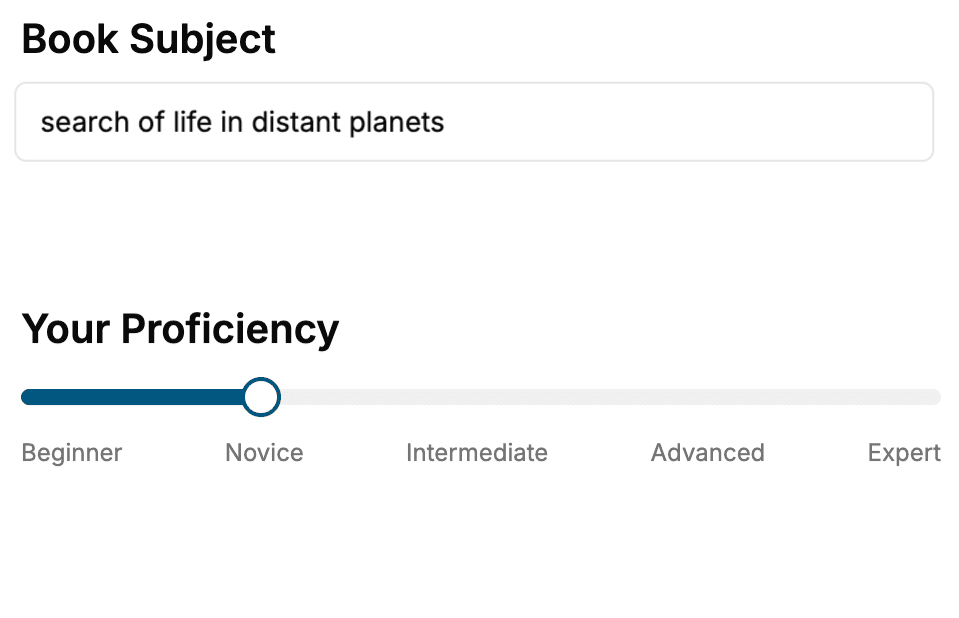
- 1. Select your focus
Select the focus of your Learning Spanish book and share your background
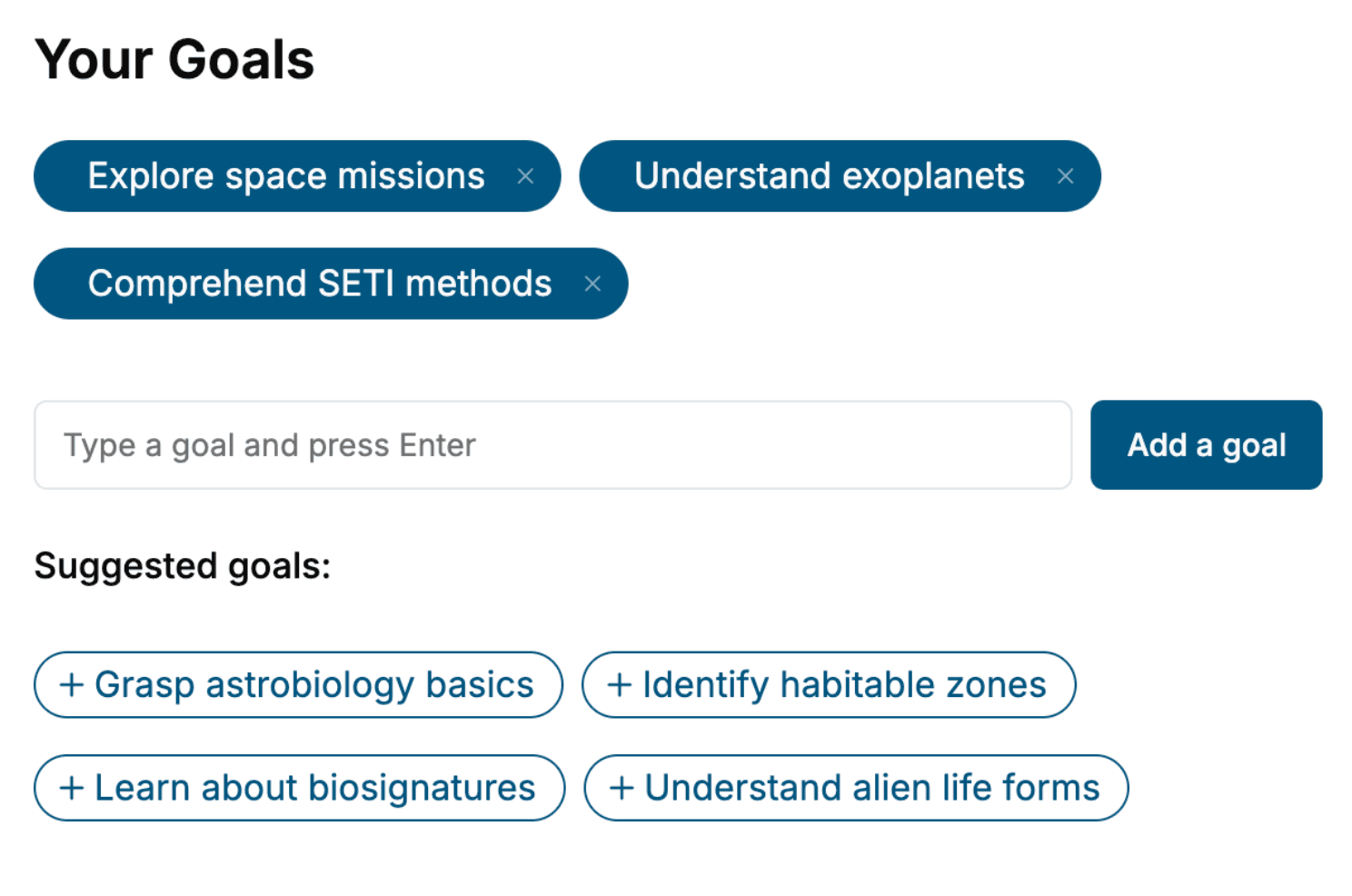
- 2. Personalize your book
Specify your goals and choose sub-topics to include
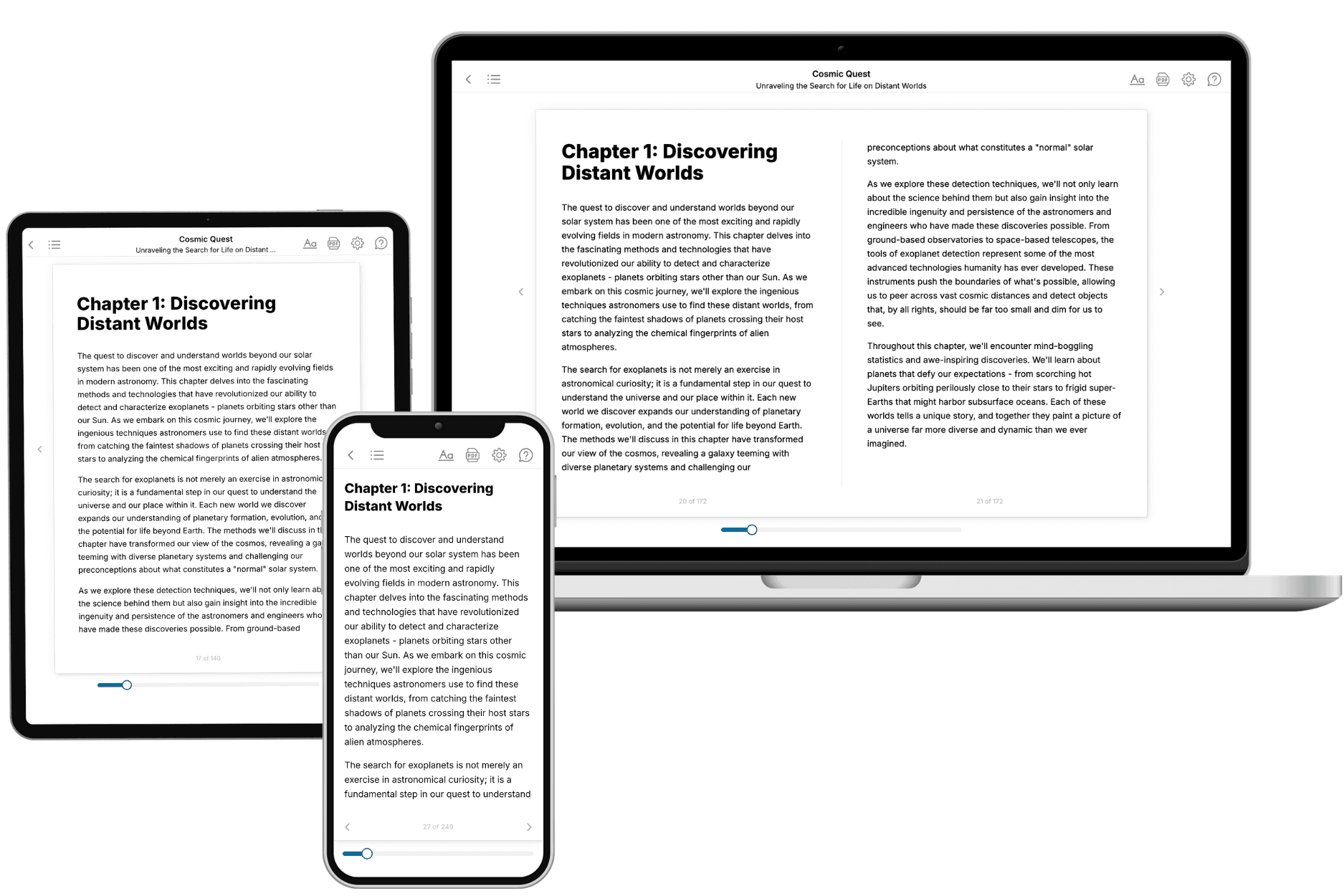
- 3. Get your tailored book
Your book is ready in 10 minutes. Read it online, download as EPUB or PDF, or send to Kindle.
Frequently asked questions
- What is TailoredRead?
TailoredRead creates complete, full-length nonfiction ebooks, written specifically for you. Tell us what you want to learn and why, and TailoredRead writes you a complete ebook on it, with charts, tables, and diagrams throughout. Read it online, on Kindle, or on any e-reader, or download it as a PDF or EPUB. Every book is written fresh the day you order it.
- How is the book tailored to me?
Before anything is written, you answer a few short questions about your goals, your background, and the topics you care about. Your book is then planned around your answers: written at your level, focused on your goals, and covering the topics you chose, instead of the one-size-fits-all book a store sells everyone.
- Will it read like generic AI content?
No. Your book isn't a chat transcript: it's planned chapter by chapter before a single word is written, told in a clear book voice, and explains ideas visually with charts, tables, and diagrams. After writing, every book goes through an editorial pass that polishes chapters so the book reads consistent from start to finish. Judge for yourself: browse thousands of sample books on our Explore Books page.
- How accurate is the content?
Our AI first checks whether your subject needs live research. Niche and fast-moving subjects are researched before writing, and the book plan and chapters are grounded in what it finds. After writing, every book goes through a quality pass that checks its facts and consistency, and researched books list their sources in a Notes section at the back.
- How long is the book?
You choose the length: Comprehensive (250-300 pages), Detailed (150-200 pages), Essential (70-100 pages), or Short (30-50 pages).
- Does the book include visuals?
Yes. Every book includes charts, tables, and diagrams: timelines, checklists, step-by-step guides, decision trees, comparison tables, matrices, and bar charts. A typical book includes dozens of these visual elements.
- Can I read it on Kindle? What formats can I download?
Yes. Every book can be read in our online reader or downloaded as a PDF or EPUB. The EPUB can be opened with Kindle, Apple Books, Kobo, and any e-reader. The Commercial and Author licenses also include an editable Word (DOCX) and Markdown download.
- How much does it cost?
About the price of a regular ebook. The exact price depends on your book's length and complexity, from $2 for the shortest books to $35 for the most comprehensive, and it's shown when you review your book, before you commit to anything. Each book is a one-time purchase, yours to keep, no subscription. Licenses that let you share, teach, or publish your book range from $35.99 to $49.99.
- Can I preview the book before purchasing?
Before you pay, you'll see what your book will cover: the title, a detailed description, the estimated length, and the complete chapter-by-chapter table of contents, so you know what you're getting before you decide. The full text itself is written after you purchase.
- How long does it take to create a book?
About 10 minutes. You can start reading the opening chapters while the rest is still being written.