Spiking Neural Networks for Creative AI
Harnessing Temporal Dynamics in Machine Learning and Generative Applications
The complexity of implementing spiking neural networks in practical AI applications often leaves developers struggling to bridge the gap between theoretical understanding and real-world implementation.
315 pages16 chaptersSep 29, 2025Neural Networks
About this book
While traditional neural networks have dominated the AI landscape, the unique temporal dynamics and energy efficiency of spiking networks offer untapped potential for creative applications like Midjourney and other generative systems. This comprehensive guide demystifies spiking neural networks and shows you how to leverage their biological inspiration for cutting-edge AI applications. You'll discover how temporal coding and spike timing create new possibilities for processing sequential data, enabling more natural and efficient computation. Through practical examples and clear explanations, you'll learn to integrate spiking networks with existing deep learning frameworks and understand when and why to choose them over conventional approaches. From neuromorphic computing principles to event-driven processing, this book provides the knowledge you need to implement spiking networks in creative AI projects. You'll explore plasticity mechanisms that enable continuous learning, discover encoding strategies that maximize performance, and understand how the stochastic nature of spiking networks can enhance generative applications. Whether you're working on next-generation AI art tools, developing efficient edge computing solutions, or pushing the boundaries of machine learning research, this book equips you with the practical skills and theoretical foundation to harness the full potential of spiking neural networks in your creative AI endeavors.
Table of contents
- IntroductionThe Evolution of Neural Networks in AI, Unlocking Creative Potential with Spiking Networks, How This Book Will Guide Your Journey, What You Need to Know Before StartingRead below
- Chapter 1: Foundations of Spiking Neural NetworksBiological Inspiration and Neural Computation, Three Generations of Neural Networks, Understanding Spike Generation and Propagation, Temporal Dynamics vs Static Processing
- Chapter 2: Neuron Models and DynamicsIntegrate-and-Fire Models, Hodgkin-Huxley and Conductance-Based Models, Izhikevich Model for Computational Efficiency, Choosing the Right Model for Your Application
- Chapter 3: Information Encoding in SpikesRate Coding and Frequency Representation, Temporal Coding and Precise Timing, Population Coding Strategies, Comparing Encoding Methods for Different Tasks
- Chapter 4: Network Architectures and ConnectivityFeedforward Spiking Networks, Recurrent Networks and Memory, Reservoir Computing with Spiking Networks, Hierarchical and Modular Architectures
- Chapter 5: Learning and Plasticity MechanismsSpike-Timing-Dependent Plasticity (STDP), Unsupervised Learning Rules, Supervised Learning in Spiking Networks, Reinforcement Learning with Temporal Rewards
- Chapter 6: Neuromorphic Computing PrinciplesEvent-Driven Processing Paradigms, Energy Efficiency and Power Consumption, Hardware Implementations and Chips, Software Simulation Environments
- Chapter 7: Implementation Frameworks and ToolsBrian Simulator for Python Development, NEST Simulator for Large-Scale Networks, SpiNNaker Platform and Real-Time Processing, Choosing the Right Framework for Your Project
- Chapter 8: Integration with Deep Learning FrameworksPyTorch and Spiking Network Libraries, TensorFlow Implementation Strategies, Hybrid Spiking-Deep Learning Architectures, Gradient Computation in Spiking Networks
- Chapter 9: Creative AI and Generative ApplicationsGenerative Modeling with Spiking Networks, Artistic Creation and Style Transfer, Music Generation and Audio Processing, Interactive Creative Systems
- Chapter 10: Spiking Networks in Image Generation ContextImage Processing with Temporal Dynamics, Feature Extraction and Representation, Attention Mechanisms in Spiking Networks, Integration with Generation Pipelines
- Chapter 11: Temporal Processing and Sequential DataTime Series Analysis and Prediction, Sequence Learning and Pattern Recognition, Memory Mechanisms and State Persistence, Real-Time Processing Capabilities
- Chapter 12: Optimization and Performance TuningParameter Tuning and Hyperoptimization, Network Pruning and Compression, Computational Efficiency Strategies, Scalability and Large Network Design
- Chapter 13: Debugging and Network AnalysisVisualization Tools and Techniques, Spike Train Analysis and Statistics, Network Diagnostics and Health Monitoring, Common Issues and Troubleshooting
- Chapter 14: Advanced Topics and Research FrontiersMulti-Compartment Neuron Models, Stochastic Dynamics and Noise, Continual Learning and Adaptation, Emerging Research Directions
- Chapter 15: Practical Projects and Case StudiesBuilding a Spiking Image Classifier, Creating a Pattern Generation System, Real-Time Data Processing Application, Developing a Creative AI Tool
- Chapter 16: Future Directions and ApplicationsEmerging Applications in AI, Hardware Evolution and Neuromorphic Chips, Integration with Other AI Technologies, Research Opportunities and Open Problems
- ConclusionKey Takeaways and Insights, Your Next Steps in Spiking Neural Networks
- Glossary
- Further Reading
Introduction
The landscape of artificial intelligence has undergone remarkable transformations over the past decade, with neural networks evolving from simple perceptrons to sophisticated deep learning architectures that power today's most impressive AI applications. Yet despite these advances, a fundamental limitation persists in how conventional neural networks process information. Traditional artificial neural networks operate on static inputs and produce instantaneous outputs, lacking the temporal dynamics that characterize biological neural systems. This temporal dimension represents not just a missing feature, but a profound opportunity to unlock new capabilities in AI applications, particularly in creative and generative contexts where timing, rhythm, and sequential patterns play crucial roles.
Spiking neural networks represent the next evolutionary step in neural computation, offering a bridge between the biological reality of how brains process information and the computational needs of modern AI systems. Unlike their predecessors, spiking networks communicate through discrete events called spikes, creating a temporal language that can encode information in ways that traditional networks simply cannot achieve. This temporal coding opens doors to more efficient processing, natural handling of sequential data, and novel approaches to creative AI applications. The implications extend far beyond theoretical interest, touching on practical concerns like energy efficiency, real-time processing capabilities, and the ability to create AI systems that can adapt and learn continuously in dynamic environments.
The creative AI revolution, exemplified by systems like Midjourney, DALL-E, and other generative models, has demonstrated the incredible potential of neural networks to produce artistic and creative content. However, these systems still rely on conventional architectures that process information in fundamentally static ways. Spiking neural networks offer unique advantages for creative applications through their inherent stochasticity, temporal dynamics, and event-driven processing capabilities. The natural variability and timing-dependent behavior of spiking networks can introduce novel forms of creativity and expression that are difficult to achieve with traditional approaches, while their energy efficiency makes them particularly attractive for real-time creative applications and edge computing scenarios.
This book serves as your comprehensive guide to understanding, implementing, and applying spiking neural networks in creative AI contexts. Rather than focusing solely on theoretical foundations, this guide emphasizes practical implementation strategies, real-world applications, and the specific considerations needed to integrate spiking networks with existing AI frameworks and creative workflows. You will discover how to harness the unique properties of spiking networks to enhance generative models, create more efficient processing pipelines, and develop AI systems that can operate in real-time with minimal computational overhead. The journey ahead will transform your understanding of neural computation and equip you with the tools needed to push the boundaries of what's possible in creative AI applications.
The Evolution of Neural Networks in AI
The history of artificial neural networks can be understood through three distinct generations, each representing a fundamental shift in how we model neural computation. The first generation, exemplified by the perceptron and its variants, relied on simple threshold activation functions that produced binary outputs. These networks could solve linearly separable problems but were severely limited in their computational capabilities. The famous XOR problem, which demonstrated the limitations of single-layer perceptrons, highlighted the need for more sophisticated approaches. Despite their simplicity, first-generation networks established the foundational concepts of weighted connections, activation functions, and learning through weight adjustment that continue to influence neural network design today.
The second generation of neural networks introduced continuous activation functions, most notably the sigmoid and later the rectified linear unit (ReLU). This seemingly simple change unlocked tremendous computational power, enabling the development of multilayer perceptrons and eventually deep learning architectures. These networks process real-valued inputs and produce continuous outputs, allowing them to approximate complex nonlinear functions with remarkable accuracy. The backpropagation algorithm provided an efficient method for training these networks, leading to the deep learning revolution that has transformed fields ranging from computer vision to natural language processing. Modern architectures like convolutional neural networks, transformers, and generative adversarial networks all belong to this second generation.
However, second-generation networks have inherent limitations that become apparent when we consider biological neural systems. Real neurons communicate through discrete spikes, not continuous values, and the timing of these spikes carries crucial information. Biological neural networks exhibit complex temporal dynamics, with neurons integrating inputs over time and producing outputs based on their temporal history. This temporal dimension is largely absent from conventional artificial neural networks, which process inputs instantaneously and lack memory of their temporal context. The energy efficiency of biological neural systems also far exceeds that of artificial networks, partly due to their event-driven, sparse communication patterns.
The third generation of neural networks, spiking neural networks, addresses these limitations by incorporating temporal dynamics directly into the computational model. These networks communicate through discrete spikes, similar to biological neurons, and exhibit complex temporal behaviors including memory, adaptation, and event-driven processing. The information encoding in spiking networks can utilize not just the rate of spikes but also their precise timing, creating a richer representational space than conventional networks. This temporal richness enables new forms of computation that are particularly well-suited to processing sequential data, implementing memory mechanisms, and achieving energy-efficient operation through sparse, event-driven communication.
The transition from second to third-generation networks represents more than just an incremental improvement; it constitutes a paradigm shift in how we think about neural computation. While second-generation networks excel at pattern recognition and function approximation tasks, third-generation networks offer unique advantages for temporal processing, online learning, and energy-efficient computation. The event-driven nature of spiking networks means that computation only occurs when spikes are present, leading to significant energy savings compared to conventional networks that must process all inputs continuously. This efficiency advantage becomes particularly important in mobile and edge computing applications where power consumption is a critical constraint.
Understanding this evolutionary context is crucial for appreciating why spiking neural networks represent such a significant opportunity for creative AI applications. Creative processes often involve temporal dynamics, sequential patterns, and the kind of stochastic variability that emerges naturally from spiking network dynamics. The ability to process information in real-time with minimal energy consumption makes spiking networks particularly attractive for interactive creative applications, while their temporal processing capabilities open new possibilities for generating content with complex temporal structures. As we explore the practical implementation of spiking networks throughout this book, keep in mind that we are not just learning a new type of neural network, but embracing a fundamentally different approach to neural computation that more closely mirrors the principles underlying biological intelligence.
The implications of this evolutionary progression extend beyond technical considerations to philosophical questions about the nature of intelligence and computation. Biological neural systems achieve remarkable capabilities through temporal dynamics, sparse coding, and event-driven processing—principles that are only beginning to be explored in artificial systems. By understanding and implementing spiking neural networks, we are not just building more efficient AI systems, but also gaining deeper insights into the computational principles that underlie natural intelligence. This understanding becomes particularly valuable in creative AI applications, where the goal is often to produce novel, surprising, and aesthetically pleasing outputs that exhibit the kind of variability and temporal richness characteristic of human creativity.
The practical benefits of this evolutionary step are already becoming apparent in various application domains. Neuromorphic computing platforms based on spiking neural network principles are demonstrating orders-of-magnitude improvements in energy efficiency for certain tasks. Real-time processing capabilities enabled by event-driven computation are opening new possibilities for responsive AI systems. The natural handling of temporal sequences in spiking networks is proving valuable for time-series analysis, robotics control, and other applications where timing matters. As we delve deeper into the specifics of spiking neural networks in the following chapters, you will discover how these evolutionary advantages translate into practical benefits for your creative AI projects.
Unlocking Creative Potential with Spiking Networks
Creative AI applications present unique challenges that conventional neural networks struggle to address effectively. Traditional deep learning models, while powerful for pattern recognition and function approximation, operate in a fundamentally deterministic manner that can limit their creative potential. When generating artistic content, music, or other creative outputs, the temporal dynamics and stochastic variability inherent in spiking neural networks offer distinct advantages. The discrete, event-driven nature of spike communication introduces natural randomness and temporal structure that can enhance the creative process. Unlike conventional networks that produce smooth, continuous outputs, spiking networks generate content through sequences of discrete events, creating opportunities for novel forms of artistic expression that mirror the temporal nature of many creative domains.
The energy efficiency of spiking neural networks becomes particularly valuable in creative applications that require real-time interaction or continuous operation. Consider an interactive art installation that responds to viewer movements, or a music generation system that creates compositions in real-time during a performance. Conventional neural networks would require significant computational resources to operate continuously, making such applications impractical for many deployment scenarios. Spiking networks, with their event-driven processing paradigm, only consume energy when spikes are present, enabling creative AI systems that can operate for extended periods on limited power budgets. This efficiency advantage opens possibilities for mobile creative applications, embedded art installations, and other scenarios where power consumption is a critical constraint.
The temporal processing capabilities of spiking networks align naturally with many creative domains that have inherent temporal structure. Music generation, for example, involves complex temporal patterns, rhythms, and sequences that unfold over time. While conventional networks can generate musical sequences, they typically do so by processing fixed-length windows or using recurrent architectures that struggle with long-term dependencies. Spiking networks, with their natural temporal dynamics and memory mechanisms, can maintain context over extended time periods and generate content with complex temporal structures. The precise timing of spikes can encode rhythmic information directly, while the temporal evolution of network states can capture the long-term structure of musical compositions.
Visual art generation also benefits from the unique properties of spiking networks, particularly in applications that involve temporal or sequential elements. Consider the generation of animated artwork, where the temporal evolution of visual elements is as important as their spatial arrangement. Spiking networks can naturally encode both spatial and temporal information, enabling the generation of dynamic visual content with complex temporal patterns. The stochastic nature of spike generation can introduce controlled randomness that enhances artistic variability, while the event-driven processing can enable real-time generation of visual content that responds to external stimuli or user interactions.
The integration of spiking networks with existing creative AI pipelines presents both opportunities and challenges. Many current creative AI systems, such as those used in image generation platforms like Midjourney, rely on transformer architectures and diffusion models that operate on continuous representations. However, spiking networks can be integrated at various stages of these pipelines to enhance their capabilities. For example, spiking networks could be used for preprocessing input data to extract temporal features, for generating control signals that guide the creative process, or for post-processing outputs to add temporal dynamics or stochastic variations. The key is understanding how to effectively interface between the discrete, temporal world of spiking networks and the continuous, static world of conventional deep learning models.
One particularly promising application area is the development of adaptive creative systems that can learn and evolve their creative style over time. The plasticity mechanisms inherent in spiking networks, such as spike-timing-dependent plasticity (STDP), enable continuous learning and adaptation without the need for explicit retraining. This capability allows creative AI systems to gradually adapt their output style based on user feedback, environmental changes, or other temporal factors. For instance, a music generation system could slowly evolve its compositional style based on listener preferences, or a visual art system could adapt its aesthetic choices based on seasonal changes or cultural trends. This adaptive capability represents a significant advantage over conventional networks that typically require explicit retraining to modify their behavior.
The collaborative potential between human creators and spiking neural networks also deserves special attention. The temporal nature of spiking networks makes them particularly well-suited for real-time collaboration with human artists. Unlike conventional networks that typically operate in batch mode, spiking networks can process inputs and generate outputs continuously, enabling fluid interaction between human creativity and artificial intelligence. A musician could improvise with a spiking network-based system that responds in real-time to their playing, or a visual artist could collaborate with a system that generates dynamic visual elements based on their brush strokes or movements. This real-time collaborative capability opens new possibilities for human-AI creative partnerships that go beyond simple tool usage to genuine creative collaboration.
The scalability and modularity of spiking networks also offer advantages for complex creative applications. Large creative projects often involve multiple interacting components, such as visual elements, audio tracks, narrative structures, and interactive elements. Spiking networks can be organized into modular architectures where different network components handle different aspects of the creative process, communicating through spike-based interfaces. This modular approach enables the development of complex creative systems that can be easily modified, extended, or reconfigured for different applications. The event-driven nature of spike communication also facilitates asynchronous processing, allowing different components of a creative system to operate at their own natural time scales while maintaining coordination through spike-based communication protocols.
How This Book Will Guide Your Journey
This book is structured as a progressive journey from fundamental concepts to advanced practical applications, designed to build your expertise systematically while maintaining focus on real-world implementation. The early chapters establish the theoretical foundation you need to understand spiking neural networks, but always with an eye toward practical application. You will begin by exploring the biological inspiration behind spiking networks and understanding how they differ from conventional neural networks. This foundation is crucial because the temporal dynamics and event-driven nature of spiking networks require a different mindset than traditional deep learning approaches. Each theoretical concept is immediately connected to practical implications, ensuring that you understand not just what spiking networks do, but why these capabilities matter for your creative AI projects.
The middle chapters focus on the core technical skills you need to implement spiking neural networks effectively. You will learn about different neuron models and when to use each one, explore various information encoding strategies, and understand how to design network architectures that leverage the unique properties of spiking computation. These chapters include extensive practical examples, code snippets, and step-by-step implementation guides using popular frameworks like Brian, NEST, and PyTorch-based spiking network libraries. Rather than presenting abstract algorithms, each chapter provides concrete examples that you can run, modify, and adapt for your own projects. The goal is to give you hands-on experience with the tools and techniques that will form the foundation of your spiking network implementations.
A key feature of this book's structure is the integration of creative AI applications throughout the technical content, rather than relegating them to separate chapters. As you learn about temporal coding, you will see how it applies to music generation. When exploring network architectures, you will discover how different topologies affect creative output. This integrated approach ensures that you always understand the creative implications of technical decisions, helping you make informed choices when designing your own systems. The book includes numerous case studies drawn from real creative AI projects, showing how theoretical concepts translate into practical creative applications.
The later chapters focus on advanced topics and practical implementation strategies that will help you tackle complex creative AI projects. You will learn how to integrate spiking networks with existing deep learning frameworks, optimize performance for real-time applications, and debug complex temporal behaviors. These chapters also explore cutting-edge research directions and emerging applications, giving you insight into where the field is heading and how you can position your projects to take advantage of future developments. The emphasis throughout is on practical skills that you can apply immediately, with detailed examples and troubleshooting guides to help you overcome common challenges.
Each chapter includes multiple hands-on exercises and projects designed to reinforce your learning and provide practical experience with the concepts being discussed. These range from simple implementations that help you understand basic principles to complex projects that demonstrate real-world applications. The exercises are carefully designed to build upon each other, creating a coherent learning progression that takes you from basic spike generation to sophisticated creative AI systems. You will implement everything from simple neuron models to complete generative systems, gaining practical experience with all aspects of spiking network development.
The book's structure also recognizes that readers may have different backgrounds and interests. Clear prerequisites are provided for each chapter, and alternative learning paths are suggested for readers who want to focus on specific applications or skip certain theoretical sections. Cross-references throughout the text help you navigate between related concepts, while a comprehensive glossary ensures that you can quickly look up unfamiliar terms. The goal is to make the book useful both as a linear learning resource and as a reference guide that you can return to when working on specific projects.
Special attention is given to the integration challenges that arise when working with spiking networks in practical applications. Many existing creative AI systems are built using conventional deep learning frameworks, and successfully incorporating spiking networks often requires careful consideration of interface design, data conversion, and hybrid architectures. The book provides detailed guidance on these integration challenges, with specific examples showing how to combine spiking networks with popular frameworks like TensorFlow and PyTorch. You will learn strategies for converting between different data representations, designing hybrid architectures that leverage the strengths of both spiking and conventional networks, and optimizing performance across different computational paradigms.
The final chapters of the book look toward the future, exploring emerging research directions and speculating on how spiking neural networks might evolve to better serve creative AI applications. This forward-looking perspective is important because the field is rapidly evolving, with new hardware platforms, software frameworks, and theoretical insights appearing regularly. By understanding current research trends and future possibilities, you will be better positioned to make strategic decisions about your own projects and to anticipate how the tools and techniques you learn today might evolve in the coming years. The book concludes with a comprehensive set of resources for continued learning, including recommended papers, software tools, and online communities where you can connect with other practitioners and researchers working in this exciting field.
What You Need to Know Before Starting
To get the most out of this book, you should have a solid foundation in machine learning and neural networks, equivalent to having completed at least one comprehensive course or having practical experience with deep learning frameworks. You should be comfortable with concepts like gradient descent, backpropagation, and common network architectures such as feedforward networks, convolutional neural networks, and recurrent neural networks. While you don't need to be an expert in these areas, you should understand how conventional neural networks learn and process information, as this knowledge will provide important context for understanding how spiking networks differ. If you find yourself struggling with basic neural network concepts, consider reviewing introductory machine learning resources before diving into the spiking network material.
Programming proficiency in Python is essential, as most of the practical examples and exercises in this book use Python-based frameworks and libraries. You should be comfortable with NumPy for numerical computing, matplotlib for visualization, and at least one deep learning framework such as PyTorch or TensorFlow. Experience with object-oriented programming concepts will be helpful, as many spiking network simulators use class-based architectures to model neurons and networks. While the book provides code examples and explanations, you will need to be able to read, understand, and modify Python code to complete the exercises and adapt the examples to your own projects. Basic familiarity with Jupyter notebooks is also recommended, as many examples are presented in this format.
Mathematical background requirements include linear algebra, calculus, and basic probability theory. You should be comfortable with matrix operations, derivatives, and probability distributions, as these concepts appear frequently in the description of neuron models, learning algorithms, and network dynamics. While the book avoids unnecessarily complex mathematical derivations, understanding the mathematical foundations is important for implementing and debugging spiking networks effectively. If you need to refresh your mathematical background, focus particularly on differential equations, as many neuron models are described using ordinary differential equations that govern their temporal dynamics.
Some familiarity with neuroscience concepts will enhance your understanding, though it is not strictly required. Basic knowledge of how biological neurons work, including concepts like action potentials, synapses, and neural plasticity, will help you understand the biological inspiration behind spiking neural networks. However, the book provides sufficient background on relevant neuroscience concepts, so don't worry if your biology knowledge is limited. The key is to approach spiking networks with an appreciation for their biological inspiration while maintaining focus on their computational applications.
Experience with time-series data and temporal processing will be valuable, as spiking networks are inherently temporal systems. If you have worked with recurrent neural networks, time-series forecasting, or signal processing, you will find many familiar concepts in spiking network applications. Understanding concepts like temporal correlation, frequency analysis, and sequence modeling will help you appreciate the unique advantages that spiking networks offer for temporal processing tasks. However, the book covers these concepts as they relate to spiking networks, so prior experience is helpful but not essential.
For the creative AI applications covered in this book, some familiarity with generative models and creative computing will be beneficial. Experience with generative adversarial networks (GANs), variational autoencoders (VAEs), or diffusion models will provide useful context for understanding how spiking networks can enhance generative applications. Similarly, experience with creative coding frameworks, digital art tools, or music generation systems will help you appreciate the practical applications discussed throughout the book. However, the creative applications are presented with sufficient background that you can follow along even without extensive prior experience in these areas.
Hardware considerations are also worth mentioning, as some of the more advanced examples and exercises may require significant computational resources. While basic spiking network simulations can run on standard laptops, larger networks and real-time applications may benefit from GPU acceleration or specialized neuromorphic hardware. The book provides guidance on computational requirements for different types of projects and suggests alternatives for readers with limited hardware resources. Cloud computing platforms can also be used for more demanding computations, and the book includes guidance on setting up appropriate computing environments.
Finally, this book assumes a growth mindset and willingness to experiment with new concepts and approaches. Spiking neural networks represent a different paradigm from conventional deep learning, and some concepts may initially seem counterintuitive or challenging. The key is to approach the material with curiosity and patience, working through the examples and exercises systematically. Don't expect to master everything immediately; spiking networks involve complex temporal dynamics that take time to understand fully. The book is designed to support your learning journey with plenty of examples, exercises, and practical guidance, but your active engagement and experimentation will be crucial for developing true expertise in this exciting field.
This is the end of the free sample. The full book has 16 chapters.
Want this book written for you?
Tell us your goals and background, and get your own version of this book, tailored by AI to you.


Benefits of AI-tailored books
- Read one book, not ten:
- all the Neural Networks knowledge you need, gathered into a single book.
- Save days of learning:
- tell us your goals, choose your topics, and the whole book is built around them.
- Learn effortlessly:
- Neural Networks book written for your specific background and expertise.
- Understand at a glance:
- includes charts, tables, timelines, checklists, decision trees, and more.
- Stay current:
- written the day you order it, not years ago.
- Trust what you read:
- every book is checked for accuracy, with real research when your subject needs it.
Create your unique book in 3 steps
- 1. Select your focus
Select the focus of your Neural Networks book and share your background
- 2. Personalize your book
Specify your goals and choose sub-topics to include
- 3. Get your tailored book
Your book is ready in 10 minutes. Read it online, download as EPUB or PDF, or send to Kindle.


Frequently asked questions
- What is TailoredRead?
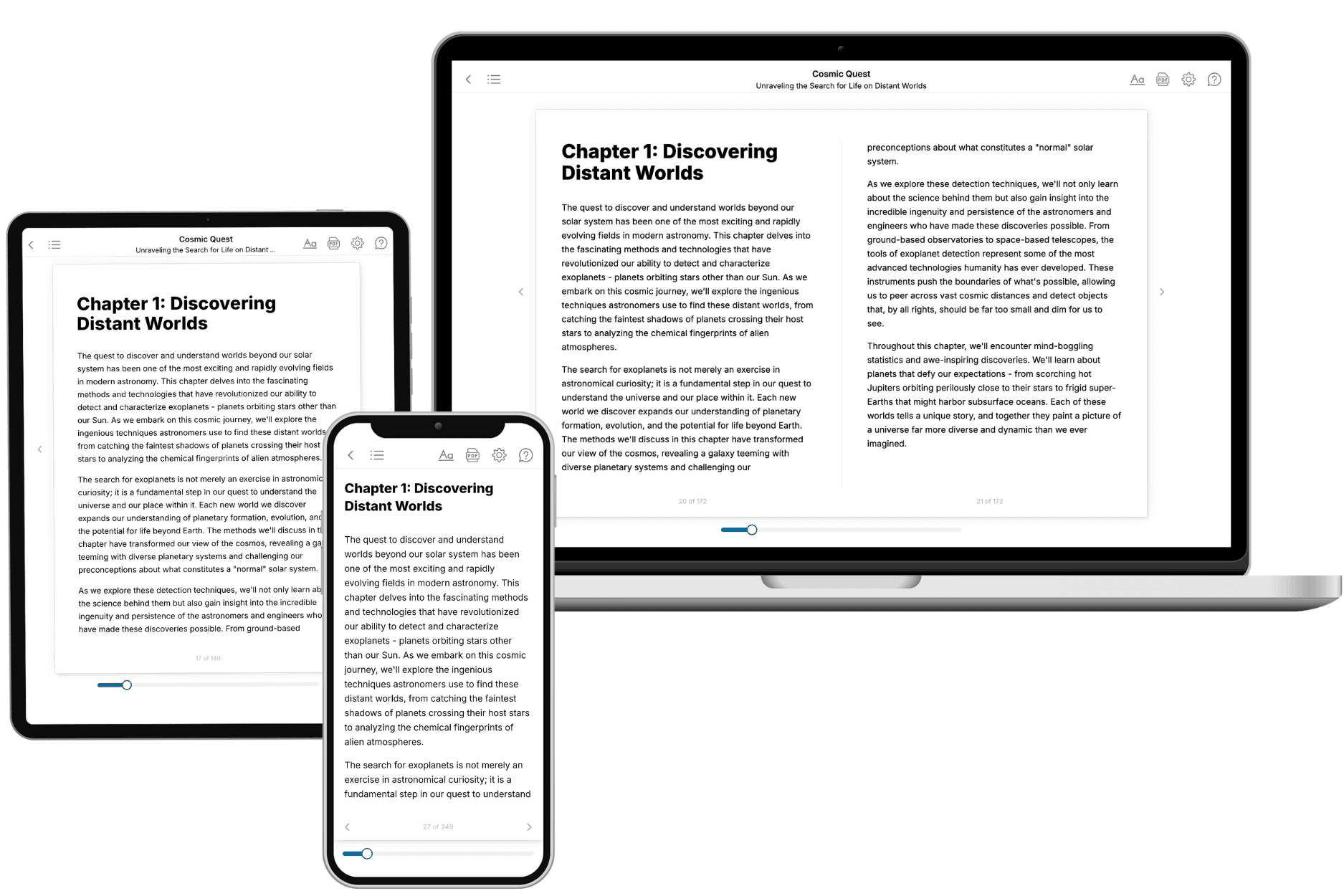
TailoredRead creates complete, full-length nonfiction ebooks, written specifically for you. Tell us what you want to learn and why, and TailoredRead writes you a complete ebook on it, with charts, tables, and diagrams throughout. Read it online, on Kindle, or on any e-reader, or download it as a PDF or EPUB. Every book is written fresh the day you order it.
- How is the book tailored to me?
Before anything is written, you answer a few short questions about your goals, your background, and the topics you care about. Your book is then planned around your answers: written at your level, focused on your goals, and covering the topics you chose, instead of the one-size-fits-all book a store sells everyone.
- Will it read like generic AI content?
No. Your book isn't a chat transcript: it's planned chapter by chapter before a single word is written, told in a clear book voice, and explains ideas visually with charts, tables, and diagrams. After writing, every book goes through an editorial pass that polishes chapters so the book reads consistent from start to finish. Judge for yourself: browse thousands of sample books on our Explore Books page.
- How accurate is the content?
Our AI first checks whether your subject needs live research. Niche and fast-moving subjects are researched before writing, and the book plan and chapters are grounded in what it finds. After writing, every book goes through a quality pass that checks its facts and consistency, and researched books list their sources in a Notes section at the back.
- How long is the book?
You choose the length: Comprehensive (250-300 pages), Detailed (150-200 pages), Essential (70-100 pages), or Short (30-50 pages).
- Does the book include visuals?
Yes. Every book includes charts, tables, and diagrams: timelines, checklists, step-by-step guides, decision trees, comparison tables, matrices, and bar charts. A typical book includes dozens of these visual elements.
- Can I read it on Kindle? What formats can I download?
Yes. Every book can be read in our online reader or downloaded as a PDF or EPUB. The EPUB can be opened with Kindle, Apple Books, Kobo, and any e-reader. The Commercial and Author licenses also include an editable Word (DOCX) and Markdown download.
- How much does it cost?
About the price of a regular ebook. The exact price depends on your book's length and complexity, from $2 for the shortest books to $35 for the most comprehensive, and it's shown when you review your book, before you commit to anything. Each book is a one-time purchase, yours to keep, no subscription. Licenses that let you share, teach, or publish your book range from $35.99 to $49.99.
- Can I preview the book before purchasing?
Before you pay, you'll see what your book will cover: the title, a detailed description, the estimated length, and the complete chapter-by-chapter table of contents, so you know what you're getting before you decide. The full text itself is written after you purchase.
- How long does it take to create a book?
About 10 minutes. You can start reading the opening chapters while the rest is still being written.