Spinning Through Physics
Mastering Angular Momentum Conservation in Classical Mechanics
Have you ever wondered why figure skaters spin faster when they pull their arms in?
284 pages14 chaptersJan 15, 2025Physics
About this book
Or how galaxies maintain their spiral shape over billions of years? Angular momentum conservation is the key to unlocking these mysteries and many more. In "Spinning Through Physics," you'll dive deep into the fascinating world of angular momentum, discovering how this fundamental principle shapes the behavior of everything from subatomic particles to celestial bodies. Through clear explanations, practical examples, and thought-provoking problems, you'll gain a solid grasp of this essential concept in classical mechanics. By the end of this book, you'll be equipped with the knowledge and skills to analyze complex rotational systems, predict their behavior, and appreciate the elegant symmetry that angular momentum conservation brings to the physical world.
Table of contents
- IntroductionThe Importance of Angular Momentum in Physics, Overview of the Book, Historical Context of Angular Momentum, Preview of Real-World ApplicationsRead below
- Chapter 1: Foundations of Angular MomentumDefinition of Angular Momentum, Linear vs. Angular Momentum, The Vector Nature of Angular Momentum, Units and Dimensions
- Chapter 2: Mathematical Formulation of Angular MomentumPosition and Velocity Vectors, The Cross Product in Angular Momentum, Moment of Inertia, Angular Velocity
- Chapter 3: The Conservation PrincipleNoether's Theorem and Angular Momentum, Closed Systems and Conservation, Symmetry and Conservation Laws, Examples of Angular Momentum Conservation
- Chapter 4: Torque and Angular MomentumDefinition of Torque, The Torque Equation, Net Torque and Angular Momentum Change, Torque-Free Motion
- Chapter 5: Rotational Motion and Angular MomentumRigid Body Rotation, The Parallel Axis Theorem, Rotational Kinetic Energy, Precession and Nutation
- Chapter 6: Reference Frames and Angular MomentumInertial Reference Frames, Non-Inertial Reference Frames, Rotating Reference Frames, The Coriolis Effect
- Chapter 7: Orbital Motion and Angular MomentumCentral Force Motion, Kepler's Laws and Angular Momentum, Orbital Elements and Angular Momentum, The Gravitational Slingshot Effect
- Chapter 8: Collisions and Angular MomentumElastic Collisions, Inelastic Collisions, Center of Mass Frame, Scattering and Angular Momentum
- Chapter 9: Gyroscopes and Angular MomentumPrinciples of Gyroscopic Motion, Precession Rate Calculation, Applications of Gyroscopes, Gyrocompasses and Navigation
- Chapter 10: Fluid Dynamics and Angular MomentumVortices and Angular Momentum, Circulation in Fluids, Tornados and Hurricanes, Angular Momentum in Stirred Fluids
- Chapter 11: Quantum Angular MomentumSpin Angular Momentum, Orbital Angular Momentum in Quantum Mechanics, Angular Momentum Addition Rules, Selection Rules and Conservation
- Chapter 12: Astrophysical ApplicationsStellar Rotation and Angular Momentum, Accretion Disks and Angular Momentum Transport, Galaxy Formation and Angular Momentum, Black Holes and Angular Momentum
- Chapter 13: Angular Momentum in Everyday LifeAngular Momentum in Sports, Transportation and Angular Momentum, Technological Applications, Angular Momentum in Nature
- Chapter 14: Problem-Solving TechniquesApplying Conservation Laws, Torque Analysis in Complex Systems, Energy Methods in Angular Momentum Problems, Numerical Techniques for Angular Momentum
- ConclusionSummary of Key Concepts, Future Directions in Angular Momentum Research
- AppendixReview of Vector Algebra, Calculus Review for Angular Momentum
- Glossary
Introduction
Welcome to "Spinning Through Physics: Mastering Angular Momentum Conservation in Classical Mechanics." This book is designed to take you on a fascinating journey through one of the most fundamental and elegant principles in physics: the conservation of angular momentum. Whether you're a physics student looking to deepen your understanding or an enthusiast eager to explore the intricacies of rotational motion, this book will provide you with a comprehensive and engaging exploration of angular momentum and its far-reaching implications in the physical world.
Angular momentum conservation is a cornerstone of classical mechanics, playing a crucial role in explaining a wide range of phenomena, from the graceful pirouettes of ballet dancers to the majestic spirals of galaxies. Throughout this book, you'll discover how this principle underpins countless aspects of the universe around us, offering insights into the behavior of systems both large and small. By mastering the concepts presented here, you'll gain a powerful tool for analyzing and predicting the behavior of rotating objects and systems, opening up new avenues for understanding the physical world.
As we embark on this exploration together, it's important to note that while this book assumes an intermediate understanding of classical mechanics, every effort has been made to present the material in a clear, accessible manner. Each chapter builds upon the previous ones, gradually increasing in complexity while reinforcing core concepts. By the end of this journey, you'll not only have a solid grasp of angular momentum conservation but also the ability to apply this knowledge to solve real-world problems and appreciate the beauty of this fundamental principle.
The Importance of Angular Momentum in Physics
Angular momentum is a physical quantity that plays a pivotal role in our understanding of rotational motion and the behavior of spinning objects. Its importance in physics cannot be overstated, as it provides a powerful framework for analyzing and predicting the behavior of rotating systems across a vast range of scales, from subatomic particles to celestial bodies. The concept of angular momentum conservation, in particular, stands as one of the most fundamental and far-reaching principles in physics, alongside the conservation of energy and linear momentum.
At its core, angular momentum is a measure of the rotational motion of an object or system. It takes into account not only the mass and velocity of the rotating body but also its distribution in space relative to the axis of rotation. This makes angular momentum a more complex and nuanced quantity than linear momentum, but also one that offers deeper insights into the behavior of rotating systems. The conservation of angular momentum, which states that the total angular momentum of a closed system remains constant in the absence of external torques, provides a powerful tool for analyzing and predicting the behavior of rotating objects and systems[1].
The importance of angular momentum in physics extends far beyond its role in describing simple rotational motion. It is a fundamental concept that underpins our understanding of phenomena across multiple branches of physics, including classical mechanics, quantum mechanics, and astrophysics. In classical mechanics, angular momentum conservation explains phenomena such as the changing rotation speed of figure skaters as they pull in their arms, the stability of spinning tops, and the motion of planets around the sun. In quantum mechanics, angular momentum takes on a quantized nature, playing a crucial role in determining the electronic structure of atoms and the behavior of subatomic particles. In astrophysics, angular momentum conservation helps explain the formation and evolution of celestial bodies, from the rotation of planets to the spiral structure of galaxies.
Moreover, the practical applications of angular momentum are ubiquitous in our daily lives and in technology. From the gyroscopes used in navigation systems and smartphones to the design of efficient wind turbines and the mechanics of sports techniques, understanding angular momentum is essential for engineers, designers, and scientists across various fields. The principle of angular momentum conservation is also crucial in fields such as fluid dynamics, where it helps explain the formation and behavior of vortices, and in the study of climate systems, where it influences global wind patterns and ocean currents.
The study of angular momentum also provides a beautiful example of the symmetry and elegance inherent in physical laws. The conservation of angular momentum is directly linked to the rotational symmetry of space, as demonstrated by Emmy Noether's theorem, which connects conservation laws to symmetries in nature[2]. This deep connection between symmetry and conservation laws not only provides a powerful tool for understanding physical systems but also offers a glimpse into the fundamental structure of the universe itself.
As you progress through this book, you'll come to appreciate how the concept of angular momentum serves as a unifying principle across various areas of physics. It provides a common language for describing rotational motion, whether in the context of a spinning ice skater or a rotating neutron star. By mastering the principles of angular momentum conservation, you'll gain a powerful analytical tool that can be applied to a wide range of physical systems, enhancing your ability to understand and predict complex rotational behaviors.
Furthermore, the study of angular momentum offers valuable insights into the nature of physical laws and the fundamental symmetries of the universe. As you delve deeper into this subject, you'll discover how the conservation of angular momentum emerges from the rotational invariance of physical laws, providing a beautiful example of the deep connections between symmetry and conservation principles in nature. This understanding not only enhances your grasp of physics but also cultivates a deeper appreciation for the elegant mathematical structures underlying our physical reality.
In the chapters that follow, we will explore the multifaceted nature of angular momentum, from its basic definition and mathematical formulation to its applications in various fields of physics and everyday life. By the end of this journey, you'll have gained not only a comprehensive understanding of angular momentum conservation but also a new perspective on the rotational aspects of the world around you. Whether you're analyzing the spin of a subatomic particle or contemplating the rotation of a galaxy, the principles you learn here will provide you with a solid foundation for understanding and appreciating the role of angular momentum in shaping our universe.
Overview of the Book
"Spinning Through Physics: Mastering Angular Momentum Conservation in Classical Mechanics" is structured to provide you with a comprehensive and logical progression through the concept of angular momentum and its conservation. The book is designed to build your understanding from the ground up, starting with fundamental concepts and gradually advancing to more complex applications and real-world examples. This approach ensures that you develop a solid foundation in the basics before tackling more challenging topics, allowing for a deeper and more intuitive grasp of the subject matter.
We begin our journey in Chapter 1, "Foundations of Angular Momentum," where we lay the groundwork for your understanding of this crucial concept. Here, you'll explore the definition of angular momentum, comparing and contrasting it with linear momentum to highlight its unique characteristics. We'll delve into the vector nature of angular momentum, which is essential for understanding its behavior in three-dimensional space. This chapter also covers the units and dimensions associated with angular momentum, providing you with the necessary tools to work with this quantity in various contexts.
Chapter 2, "Mathematical Formulation of Angular Momentum," takes a deeper dive into the mathematical underpinnings of angular momentum. You'll learn about position and velocity vectors, and how they contribute to the calculation of angular momentum. The cross product, a fundamental operation in vector algebra, will be introduced and explained in the context of angular momentum. This chapter also covers the crucial concepts of moment of inertia and angular velocity, which are essential for understanding the rotational behavior of objects. By the end of this chapter, you'll have a solid mathematical foundation for working with angular momentum in various physical scenarios.
In Chapter 3, "The Conservation Principle," we explore one of the most fundamental aspects of angular momentum: its conservation. This chapter introduces Noether's Theorem, a powerful concept that links conservation laws to symmetries in nature. You'll learn about closed systems and how they relate to the conservation of angular momentum. Through various examples, you'll see how the principle of angular momentum conservation can be applied to predict and explain the behavior of rotating systems. This chapter will deepen your appreciation for the elegance and power of conservation laws in physics.
Chapter 4, "Torque and Angular Momentum," explores the crucial relationship between torque and changes in angular momentum. You'll learn the definition of torque and how it's mathematically related to angular momentum through the torque equation. The concept of net torque and its effect on angular momentum change will be thoroughly examined. This chapter also introduces the fascinating world of torque-free motion, where objects can exhibit complex rotational behaviors even in the absence of external torques.
As we progress to Chapter 5, "Rotational Motion and Angular Momentum," you'll apply your knowledge to the specific case of rigid body rotation. This chapter introduces the parallel axis theorem, a powerful tool for calculating moments of inertia for complex objects. You'll also explore rotational kinetic energy and its relationship to angular momentum. The phenomena of precession and nutation, which are often observed in rotating objects like tops and gyroscopes, will be explained in the context of angular momentum conservation.
Chapter 6, "Reference Frames and Angular Momentum," delves into the crucial topic of how angular momentum behaves in different reference frames. You'll learn about inertial and non-inertial reference frames, with a particular focus on rotating reference frames. This chapter also covers the Coriolis effect, a consequence of analyzing motion in rotating frames that has significant implications for understanding large-scale phenomena on Earth, such as weather patterns and ocean currents.
In Chapter 7, "Orbital Motion and Angular Momentum," we apply our understanding of angular momentum to celestial mechanics. You'll explore central force motion and how it relates to the orbits of planets and satellites. Kepler's laws of planetary motion will be examined through the lens of angular momentum conservation. This chapter also covers orbital elements and how they're influenced by angular momentum, as well as the fascinating gravitational slingshot effect used in space exploration.
Chapter 8, "Collisions and Angular Momentum," brings our attention to the behavior of angular momentum during interactions between objects. You'll learn about elastic and inelastic collisions and how angular momentum is conserved in these processes. The concept of the center of mass frame will be introduced as a powerful tool for analyzing collisions. This chapter also touches on scattering processes and how they relate to angular momentum conservation.
Chapter 9, "Gyroscopes and Angular Momentum," focuses on one of the most intriguing applications of angular momentum: the gyroscope. You'll learn about the principles of gyroscopic motion and how to calculate precession rates. The wide-ranging applications of gyroscopes in technology, from navigation systems to stabilization devices, will be explored. This chapter also covers gyrocompasses and their use in navigation, demonstrating the practical importance of understanding angular momentum.
In Chapter 10, "Fluid Dynamics and Angular Momentum," we extend our study of angular momentum to the realm of fluids. You'll learn about vortices and how they embody angular momentum in fluid systems. The concept of circulation in fluids will be introduced and related to angular momentum. This chapter also explores how angular momentum conservation helps explain the formation and behavior of large-scale atmospheric phenomena like tornados and hurricanes.
Chapter 11, "Quantum Angular Momentum," takes us to the frontier of modern physics, exploring how the principles of angular momentum extend into the quantum realm. You'll learn about spin angular momentum, a purely quantum mechanical phenomenon with no classical analogue. The chapter covers orbital angular momentum in quantum mechanics and how it differs from its classical counterpart. You'll also explore angular momentum addition rules and selection rules, which are crucial for understanding atomic spectra and particle interactions.
Chapter 12, "Astrophysical Applications," demonstrates the far-reaching implications of angular momentum conservation in the cosmos. From stellar rotation to the formation of accretion disks around black holes, you'll see how angular momentum shapes the universe on the grandest scales. This chapter also explores the role of angular momentum in galaxy formation and evolution, providing a cosmic perspective on the principles you've learned.
In Chapter 13, "Angular Momentum in Everyday Life," we bring our exploration back down to Earth, examining how angular momentum manifests in familiar settings. You'll discover the role of angular momentum in sports, from the spins of figure skaters to the curves of soccer balls. The chapter also covers applications in transportation, technology, and nature, demonstrating the ubiquity of angular momentum in our daily lives.
Finally, Chapter 14, "Problem-Solving Techniques," equips you with practical tools for applying your knowledge of angular momentum to real-world problems. You'll learn strategies for applying conservation laws, analyzing torques in complex systems, and using energy methods to solve angular momentum problems. This chapter also introduces numerical techniques for tackling more complex scenarios that may not have analytical solutions.
Throughout the book, you'll find numerous examples, illustrations, and practice problems to reinforce your understanding and develop your problem-solving skills. By the time you reach the conclusion, you'll have gained a comprehensive understanding of angular momentum conservation and its wide-ranging applications, preparing you for further study in advanced physics or for applying these principles in your own field of interest.
Historical Context of Angular Momentum
The concept of angular momentum, like many fundamental principles in physics, has a rich and fascinating history that spans centuries of scientific inquiry. Understanding this historical context not only provides a deeper appreciation for the development of the concept but also illuminates the process of scientific discovery and the evolution of our understanding of the physical world. The journey of angular momentum from a vague notion to a precisely defined and universally accepted principle is a testament to the collaborative nature of scientific progress and the power of mathematical formalism in describing natural phenomena.
The roots of angular momentum can be traced back to ancient times, where early astronomers and philosophers observed and pondered the circular motions of celestial bodies. However, the formal study of rotational motion and the quantities associated with it didn't begin in earnest until the scientific revolution of the 16th and 17th centuries. One of the earliest contributions came from Galileo Galilei, who, in his study of pendulums and falling bodies, laid the groundwork for understanding the relationship between force, motion, and rotation[3].
The concept of angular momentum began to take shape more concretely in the work of Sir Isaac Newton. In his seminal work "Philosophiæ Naturalis Principia Mathematica" (1687), Newton formulated the laws of motion and universal gravitation. While he didn't explicitly define angular momentum, his second law of motion, when applied to rotational systems, implicitly contained the essence of what we now recognize as the conservation of angular momentum. Newton's work on planetary motion, particularly his explanation of Kepler's laws, relied heavily on principles that we now understand in terms of angular momentum conservation.
The 18th century saw further developments in the understanding of rotational motion. Leonhard Euler, building on Newton's work, developed the mathematical framework for rigid body dynamics. His equations of motion for rigid bodies, published in 1765, implicitly incorporated the concept of angular momentum, though not yet named as such. Euler's work laid the foundation for the modern treatment of rotational dynamics and was crucial in the eventual formulation of angular momentum conservation.
The term "moment of momentum," which later evolved into "angular momentum," was introduced by Louis Poinsot in the early 19th century. Poinsot's work on the theory of rotation provided a more geometrical approach to understanding rotational motion. Around the same time, Pierre-Simon Laplace and Siméon Denis Poisson were making significant contributions to celestial mechanics, further refining the mathematical treatment of rotational motion in astronomical contexts.
A major breakthrough came with the work of William Rowan Hamilton in the 1830s. Hamilton's formulation of classical mechanics, known as Hamiltonian mechanics, provided a powerful new framework for understanding physical systems. Within this framework, angular momentum emerged as a natural consequence of the rotational symmetry of space. This connection between symmetry and conservation laws, later formalized by Emmy Noether in the early 20th century, provided a deep and elegant explanation for the conservation of angular momentum.
The late 19th and early 20th centuries saw the concept of angular momentum extend beyond classical mechanics. The discovery of electron spin by George Uhlenbeck and Samuel Goudsmit in 1925 introduced a new form of angular momentum with no classical analogue. This discovery, along with the development of quantum mechanics, led to a profound reexamination of angular momentum at the atomic and subatomic scales.
Paul Dirac's work in the late 1920s provided a relativistic quantum mechanical treatment of angular momentum, unifying the concepts of orbital and spin angular momentum. This work was crucial in developing a complete understanding of atomic spectra and laid the groundwork for modern particle physics. The concept of isospin, introduced by Werner Heisenberg in 1932, extended the idea of angular momentum to describe internal symmetries of particles, further demonstrating the far-reaching applicability of angular momentum concepts.
In the realm of astrophysics, angular momentum played a crucial role in developing theories of stellar evolution and galaxy formation. The work of Subrahmanyan Chandrasekhar in the 1930s on the structure and dynamics of stars incorporated angular momentum as a key factor. Later, in the 1960s and 1970s, scientists like Alar Toomre used angular momentum conservation to explain the formation and stability of galactic structures.
The latter half of the 20th century saw angular momentum concepts applied to an ever-widening range of phenomena. In condensed matter physics, angular momentum became crucial in understanding the behavior of superfluids and superconductors. In particle physics, the discovery of quarks and the development of the Standard Model relied heavily on angular momentum concepts to explain particle properties and interactions.
Today, angular momentum continues to be a vibrant area of research across multiple disciplines. From the study of black holes and their angular momentum (described by the Kerr metric) to the manipulation of angular momentum in quantum information science, this fundamental concept continues to provide insights into the nature of the physical world. The historical journey of angular momentum from a simple observation of spinning objects to a fundamental principle underlying diverse phenomena across all scales of the universe is a testament to the power and beauty of physics.
As you progress through this book, keep in mind that the concepts you're learning are the result of centuries of scientific inquiry, debate, and discovery. The principles of angular momentum conservation that we now take for granted were hard-won insights that revolutionized our understanding of the physical world. By mastering these concepts, you're not only gaining valuable knowledge for your studies or career but also participating in a grand intellectual tradition that continues to shape our understanding of the universe.
Preview of Real-World Applications
As we embark on our exploration of angular momentum conservation, it's important to understand that this principle is not just an abstract concept confined to the pages of physics textbooks. Rather, it's a fundamental law of nature that manifests itself in countless ways in the world around us. From the graceful movements of athletes to the design of advanced technologies, from the formation of weather patterns to the exploration of outer space, angular momentum conservation plays a crucial role in shaping our world and our understanding of it. In this section, we'll preview some of the fascinating real-world applications of angular momentum that we'll explore in more depth throughout the book.
One of the most visually striking demonstrations of angular momentum conservation can be found in the world of sports and performing arts. Figure skaters, for example, utilize the principle of angular momentum conservation to execute their spectacular spins. As a skater pulls their arms and legs close to their body during a spin, their moment of inertia decreases, causing their angular velocity to increase dramatically to conserve angular momentum. This same principle is at work when divers tuck into a tight ball to increase their rotation speed, or when gymnasts control their rotations on various apparatus. Understanding angular momentum allows athletes and coaches to optimize techniques and push the boundaries of human performance[4].
In the realm of technology, angular momentum conservation is a key principle in the design and operation of numerous devices. Gyroscopes, which maintain their orientation based on the conservation of angular momentum, are used in a wide range of applications. In navigation systems, from those in ships and aircraft to the gyroscopes in your smartphone, these devices provide crucial orientation information. The stability of satellites and space stations also relies on gyroscopic effects. Even the hard drives in computers use the principle of angular momentum conservation in their operation, with the precise control of rotating platters allowing for the storage and retrieval of data.
The field of robotics heavily relies on understanding and manipulating angular momentum. Bipedal robots, for instance, must carefully manage their angular momentum to maintain balance and execute complex movements. In more advanced applications, robots designed for space exploration use reaction wheels - essentially, rapidly spinning flywheels - to control their orientation without the need for external thrusters. This application of angular momentum conservation is crucial in environments where conventional propulsion methods are impractical or impossible.
On a larger scale, angular momentum conservation plays a vital role in our understanding of weather patterns and climate systems. The Coriolis effect, a consequence of analyzing motion in the rotating frame of the Earth, influences the direction of wind patterns and ocean currents. This effect, fundamentally linked to the conservation of angular momentum, is responsible for the characteristic swirl of hurricanes and the formation of large-scale atmospheric circulation patterns. Climate scientists and meteorologists rely on a deep understanding of angular momentum conservation to model and predict these complex systems.
In the field of astrophysics, angular momentum conservation is a cornerstone principle used to explain a wide range of cosmic phenomena. The formation and evolution of stars, planets, and entire galaxies are governed by the conservation of angular momentum. For instance, the flattened shape of our solar system, with planets orbiting in roughly the same plane, is a direct consequence of angular momentum conservation during its formation from a rotating cloud of gas and dust. The extreme rotational speeds of neutron stars, some of which can spin hundreds of times per second, are also explained by the conservation of angular momentum during the collapse of a massive star.
Space exploration and spacecraft design rely heavily on the principles of angular momentum conservation. The gravitational slingshot maneuver, used to accelerate spacecraft by utilizing the orbital energy and angular momentum of planets, is a clever application of these principles. The stability and control of spacecraft, including their ability to change orientation using momentum wheels, are all based on the conservation of angular momentum. Even the design of solar panels on satellites must take into account the torques produced by solar radiation pressure, which can affect the spacecraft's angular momentum over time.
In the world of energy production, angular momentum conservation plays a crucial role in the design and operation of various technologies. Wind turbines, for example, must be carefully designed to efficiently convert the angular momentum of moving air into rotational energy. The blades of these turbines are shaped and angled to optimize this transfer of angular momentum. Similarly, in hydroelectric power plants, the flow of water is directed to transfer its angular momentum to turbines, generating electricity. Understanding and manipulating angular momentum is key to improving the efficiency of these renewable energy technologies.
Even in fields that might seem far removed from physics, such as biology, angular momentum conservation can provide valuable insights. The locomotion of animals, from the efficient flight of birds to the swimming patterns of fish, involves complex manipulations of angular momentum. Evolutionary biologists and biomechanics researchers study these natural examples to gain insights that can be applied to fields like robotics and prosthetic design.
In the realm of materials science and nanotechnology, angular momentum plays a crucial role in understanding and manipulating matter at the smallest scales. The behavior of electrons in materials, including phenomena like superconductivity, often involves considerations of angular momentum. In emerging fields like spintronics, which seeks to use the spin of electrons (a form of angular momentum) for information processing, a deep understanding of angular momentum at the quantum level is essential.
As we progress through this book, we'll delve deeper into many of these applications, exploring how the fundamental principle of angular momentum conservation manifests in diverse and often surprising ways. By understanding these applications, you'll gain not only a deeper appreciation for the power and elegance of this physical law but also insight into how it can be applied to solve real-world problems and drive technological innovation. Whether you're interested in pursuing a career in physics, engineering, or any field that deals with motion and energy, a solid grasp of angular momentum conservation will prove to be an invaluable tool in your intellectual toolkit.
Notes
Introduction
- 1. H. Goldstein and others, Classical Mechanics (3rd ed.), Addison Wesley, 2002
- 2. D. E. Neuenschwander, Emmy Noether's Wonderful Theorem, Johns Hopkins University Press, 2017
- 3. S. Drake, Galileo at Work, University of Chicago Press, 1978
- 4. J. G. Hay, The Biomechanics of Sports Techniques (4th ed.), Prentice Hall, 1993
This is the end of the free sample. The full book has 14 chapters.
Want this book written for you?
Tell us your goals and background, and get your own version of this book, tailored by AI to you.


Benefits of AI-tailored books
- Read one book, not ten:
- all the Physics knowledge you need, gathered into a single book.
- Save days of learning:
- tell us your goals, choose your topics, and the whole book is built around them.
- Learn effortlessly:
- Physics book written for your specific background and expertise.
- Understand at a glance:
- includes charts, tables, timelines, checklists, decision trees, and more.
- Stay current:
- written the day you order it, not years ago.
- Trust what you read:
- every book is checked for accuracy, with real research when your subject needs it.
Create your unique book in 3 steps
- 1. Select your focus
Select the focus of your Physics book and share your background
- 2. Personalize your book
Specify your goals and choose sub-topics to include
- 3. Get your tailored book
Your book is ready in 10 minutes. Read it online, download as EPUB or PDF, or send to Kindle.


Frequently asked questions
- What is TailoredRead?
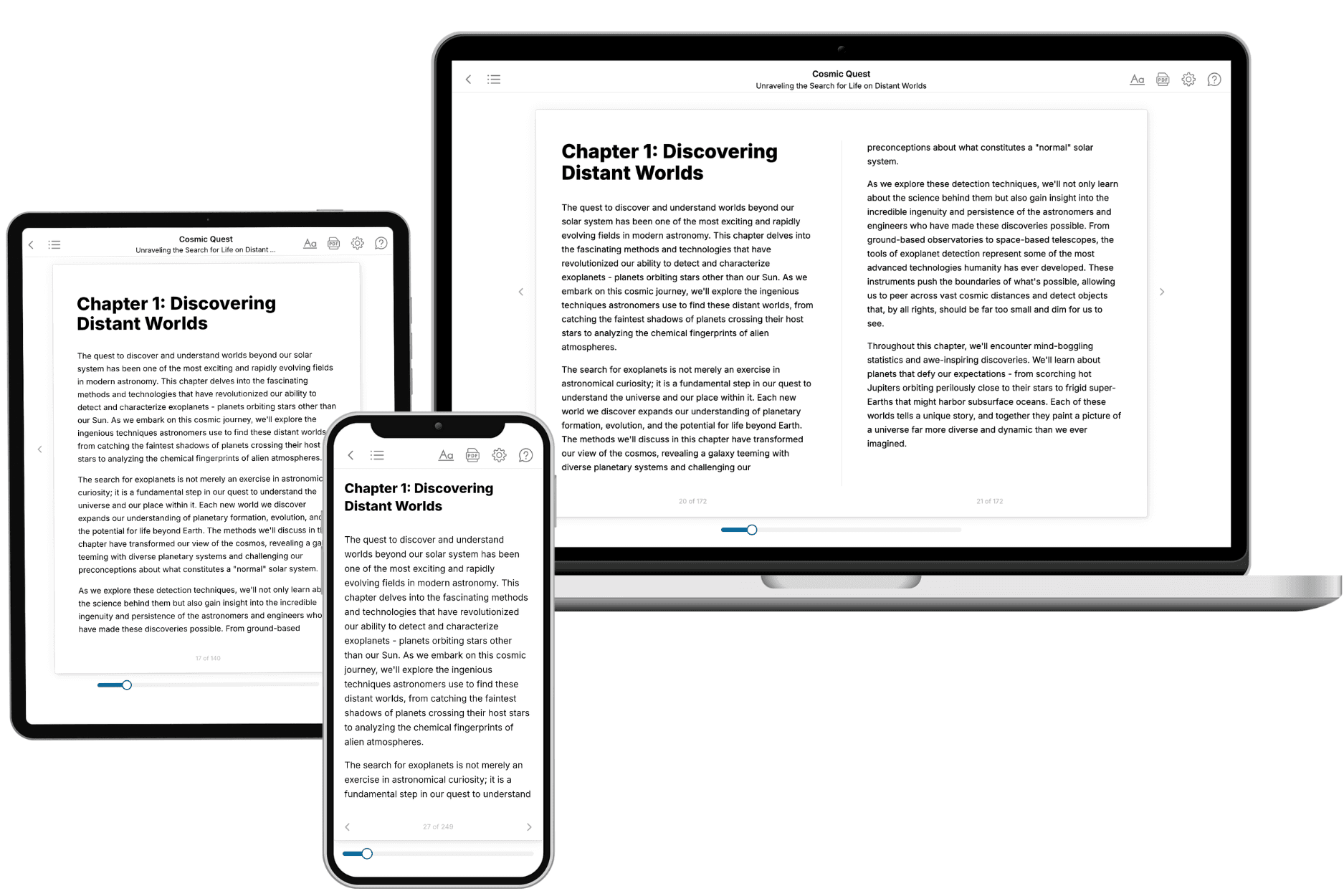
TailoredRead creates complete, full-length nonfiction ebooks, written specifically for you. Tell us what you want to learn and why, and TailoredRead writes you a complete ebook on it, with charts, tables, and diagrams throughout. Read it online, on Kindle, or on any e-reader, or download it as a PDF or EPUB. Every book is written fresh the day you order it.
- How is the book tailored to me?
Before anything is written, you answer a few short questions about your goals, your background, and the topics you care about. Your book is then planned around your answers: written at your level, focused on your goals, and covering the topics you chose, instead of the one-size-fits-all book a store sells everyone.
- Will it read like generic AI content?
No. Your book isn't a chat transcript: it's planned chapter by chapter before a single word is written, told in a clear book voice, and explains ideas visually with charts, tables, and diagrams. After writing, every book goes through an editorial pass that polishes chapters so the book reads consistent from start to finish. Judge for yourself: browse thousands of sample books on our Explore Books page.
- How accurate is the content?
Our AI first checks whether your subject needs live research. Niche and fast-moving subjects are researched before writing, and the book plan and chapters are grounded in what it finds. After writing, every book goes through a quality pass that checks its facts and consistency, and researched books list their sources in a Notes section at the back.
- How long is the book?
You choose the length: Comprehensive (250-300 pages), Detailed (150-200 pages), Essential (70-100 pages), or Short (30-50 pages).
- Does the book include visuals?
Yes. Every book includes charts, tables, and diagrams: timelines, checklists, step-by-step guides, decision trees, comparison tables, matrices, and bar charts. A typical book includes dozens of these visual elements.
- Can I read it on Kindle? What formats can I download?
Yes. Every book can be read in our online reader or downloaded as a PDF or EPUB. The EPUB can be opened with Kindle, Apple Books, Kobo, and any e-reader. The Commercial and Author licenses also include an editable Word (DOCX) and Markdown download.
- How much does it cost?
About the price of a regular ebook. The exact price depends on your book's length and complexity, from $2 for the shortest books to $35 for the most comprehensive, and it's shown when you review your book, before you commit to anything. Each book is a one-time purchase, yours to keep, no subscription. Licenses that let you share, teach, or publish your book range from $35.99 to $49.99.
- Can I preview the book before purchasing?
Before you pay, you'll see what your book will cover: the title, a detailed description, the estimated length, and the complete chapter-by-chapter table of contents, so you know what you're getting before you decide. The full text itself is written after you purchase.
- How long does it take to create a book?
About 10 minutes. You can start reading the opening chapters while the rest is still being written.