SSD Driver Mastery
Navigating the Intricacies of Solid State Drive Drivers
Are you ready to dive deep into the world of Solid State Drive drivers?
269 pages13 chaptersApr 27, 2025Device Drivers
About this book
In today's fast-paced computing environment, SSDs have become the cornerstone of high-performance storage solutions. But do you truly understand the intricate dance between hardware and software that makes these lightning-fast drives tick? SSD Driver Mastery: Navigating the Intricacies of Solid State Drive Drivers is your comprehensive guide to unraveling the complexities of SSD driver development. This book bridges the gap between theoretical knowledge and practical implementation, providing you with the tools and insights needed to create robust, efficient drivers that fully leverage the potential of solid state technology. From the fundamentals of SSD architecture to advanced optimization techniques, this book covers it all. You'll explore the nuances of NAND flash memory, delve into command queuing mechanisms, and master the art of wear leveling. Real-world examples and hands-on exercises will solidify your understanding, allowing you to tackle the challenges of SSD driver development with confidence. Whether you're looking to enhance system performance, improve data reliability, or push the boundaries of storage technology, SSD Driver Mastery is your roadmap to success in the exciting field of solid state drive software development.
Table of contents
- IntroductionThe Importance of SSDs in Modern Computing, The Critical Role of Drivers in SSD Performance, Overview of the Book's Contents, How to Use This Book: Your Learning PathRead below
- Chapter 1: Fundamentals of Solid State DrivesSSD Architecture Overview, Understanding NAND Flash Memory, SSD Controller Functions, Comparing SSDs to Traditional Hard Drives
- Chapter 2: Basics of Device DriversThe Role of Device Drivers in Operating Systems, Types of Device Drivers, Driver Architecture and Components, Driver Lifecycle and Management
- Chapter 3: Introduction to SSD DriversPurpose and Functions of SSD Drivers, Key Components of an SSD Driver, Interactions with OS and Hardware, Unique Challenges in SSD Driver Development
- Chapter 4: NAND Flash Memory ManagementCharacteristics of NAND Flash, Wear Leveling Techniques, Garbage Collection Processes, Bad Block Management
- Chapter 5: Command Queuing and ExecutionCommand Queue Structures, Command Scheduling Algorithms, Parallel Command Execution, Optimizing Queue Performance
- Chapter 6: Error Handling and CorrectionTypes of Errors in SSDs, Error Correction Code (ECC) Techniques, Error Recovery Procedures, Ensuring Data Integrity
- Chapter 7: Performance Optimization TechniquesOptimizing Read and Write Operations, Caching Strategies for SSDs, Implementing TRIM Support, Over-Provisioning and Its Benefits
- Chapter 8: SSD Interfaces and ProtocolsSATA Interface and Protocol, NVMe Interface and Protocol, PCIe Interface for SSDs, Comparing SSD Interfaces
- Chapter 9: Power Management in SSD DriversSSD Power States, Power Optimization Techniques, Thermal Management Considerations, Power Management for Mobile Devices
- Chapter 10: Security Features in SSD DriversImplementing Encryption Support, Secure Erase Functionality, Access Control Mechanisms, Compliance with Security Standards
- Chapter 11: Debugging and Testing SSD DriversDebugging Techniques for SSD Drivers, Performance Profiling Tools, Stress Testing and Reliability Assessment, Compatibility Testing Across Platforms
- Chapter 12: Advanced Topics in SSD Driver DevelopmentMulti-Stream SSD Support, Zoned Namespaces (ZNS) Implementation, AI and Machine Learning Integration, Emerging SSD Technologies and Their Impact on Drivers
- Chapter 13: Future Trends in SSD TechnologyStorage Class Memory and Its Implications, Computational Storage Devices, Quantum Computing and Storage, Future Challenges and Opportunities in SSD Driver Development
- ConclusionKey Takeaways, The Future of SSD Driver Development
- Glossary
- Further Reading
Introduction
Welcome to the world of Solid State Drive (SSD) drivers, a realm where the boundaries of storage technology are constantly being pushed. As you embark on this journey through "SSD Driver Mastery: Navigating the Intricacies of Solid State Drive Drivers," you're taking a significant step towards becoming an expert in one of the most critical components of modern computing systems. This book is designed to be your comprehensive guide, illuminating the path from understanding the fundamental concepts of SSDs to mastering the intricacies of driver development for these high-performance storage devices.
In today's rapidly evolving technological landscape, SSDs have revolutionized data storage and access, offering unprecedented speeds, improved reliability, and enhanced energy efficiency compared to their mechanical predecessors. As a software developer or computer engineer with an intermediate understanding of device drivers and software development, you're well-positioned to dive deep into this specialized field. The knowledge and skills you'll gain from this book will not only enhance your expertise but also open up new opportunities in an industry that's constantly seeking innovative solutions to meet the ever-growing demands for faster, more efficient data storage and retrieval.
Throughout this book, you'll explore the intricate dance between hardware and software that makes SSDs the powerhouses they are. From the nuances of NAND flash memory management to the complexities of command queuing and execution, from wear leveling algorithms to advanced error correction techniques, each chapter will build upon your existing knowledge, introducing new concepts and practical applications that are essential for developing robust, efficient SSD drivers.
As we progress through the various topics, you'll find that this book goes beyond mere theory. It's packed with real-world examples, practical insights, and hands-on exercises that will help you translate concepts into code. By the time you reach the final chapter, you'll have gained not just knowledge, but the confidence and skills to tackle complex SSD driver development projects, optimize storage system performance, and contribute to the cutting edge of storage technology.
So, fasten your seatbelt and prepare for an exhilarating journey into the heart of SSD technology. Whether your goal is to enhance system performance, improve data reliability, or push the boundaries of what's possible with solid state storage, this book will equip you with the tools and knowledge you need to succeed. Let's begin our exploration of the fascinating world of SSD drivers.
The Importance of SSDs in Modern Computing
Solid State Drives have emerged as a cornerstone of modern computing, fundamentally transforming the landscape of data storage and retrieval. Their rise to prominence is not merely a trend but a paradigm shift that has reshaped expectations for system performance across a wide spectrum of applications. To truly appreciate the significance of SSDs, it's essential to understand their impact on various aspects of computing and why they have become indispensable in today's digital ecosystem.
At the heart of the SSD revolution is speed. Traditional Hard Disk Drives (HDDs), with their spinning platters and moving read/write heads, have long been the bottleneck in system performance. SSDs, leveraging NAND flash memory, have shattered these limitations. With no moving parts, SSDs can achieve read and write speeds that are orders of magnitude faster than their mechanical counterparts. This translates to significantly reduced boot times, near-instantaneous application launches, and dramatically improved file transfer rates. In practical terms, a system equipped with an SSD can boot in seconds rather than minutes, load complex applications in the blink of an eye, and handle large file operations with ease[1].
Beyond raw speed, SSDs offer enhanced reliability and durability. The absence of moving parts eliminates the risk of mechanical failure, a common issue with HDDs. This makes SSDs particularly valuable in mobile devices, where they can better withstand the shocks and vibrations of everyday use. Moreover, SSDs generate less heat and consume less power than HDDs, contributing to longer battery life in laptops and more energy-efficient data centers. These characteristics have made SSDs the storage medium of choice for a wide range of devices, from ultrabooks and tablets to high-performance workstations and enterprise servers.
In the realm of data centers and cloud computing, SSDs have been nothing short of revolutionary. The ability to process vast amounts of data at unprecedented speeds has enabled new levels of performance for databases, virtualization, and cloud services. This has, in turn, facilitated the growth of data-intensive applications and services that were previously impractical or prohibitively expensive. For instance, real-time analytics, high-frequency trading, and AI-driven applications have all benefited immensely from the low latency and high throughput capabilities of SSDs[2].
The impact of SSDs extends to software development as well. Faster compile times, quicker testing cycles, and more responsive development environments have significantly enhanced programmer productivity. This has accelerated the pace of software innovation, allowing developers to iterate more rapidly and tackle more complex projects. Furthermore, the performance characteristics of SSDs have influenced software design, with many applications and operating systems now optimized to take full advantage of SSD capabilities.
In the consumer space, SSDs have transformed user expectations for device performance. Smartphones, tablets, and laptops that use SSDs offer a level of responsiveness that has become the new standard. This has not only improved user experience but has also enabled new categories of applications and services that rely on quick access to large amounts of data. From high-definition video editing on mobile devices to seamless cloud storage integration, SSDs have expanded the possibilities of what can be achieved on personal computing devices.
The healthcare industry has also seen significant benefits from SSD adoption. Medical imaging systems, which deal with large, complex files, have become more efficient, allowing for faster diagnosis and improved patient care. In research settings, SSDs have accelerated data analysis in fields such as genomics and drug discovery, potentially speeding up the development of new treatments and therapies[3].
As we look to the future, the importance of SSDs in modern computing is only set to grow. Emerging technologies such as 5G networks, Internet of Things (IoT) devices, and edge computing all rely on fast, reliable storage to function effectively. SSDs are well-positioned to meet these demands, with ongoing advancements in NAND flash technology promising even greater capacities and faster speeds. The development of new interfaces and protocols, such as NVMe (Non-Volatile Memory Express), is further enhancing the capabilities of SSDs, allowing them to more fully utilize the bandwidth of modern systems.
However, with the increasing importance of SSDs comes a greater responsibility for those involved in their development and implementation. As a future SSD driver developer, you will play a crucial role in ensuring that these powerful storage devices are utilized to their full potential. Your work will directly impact system performance, reliability, and efficiency across a wide range of applications and industries. Understanding the broader context of SSDs in modern computing will inform your approach to driver development, helping you create solutions that not only meet current needs but also anticipate future requirements.
In conclusion, SSDs have become an integral part of modern computing, driving improvements in performance, reliability, and energy efficiency across a wide range of applications. Their impact extends far beyond simple speed improvements, enabling new technologies, enhancing productivity, and transforming user experiences. As we delve deeper into the intricacies of SSD driver development in the coming chapters, keep in mind the critical role these devices play in shaping the future of computing. Your expertise in this field will contribute to the ongoing evolution of storage technology, helping to unlock new possibilities and push the boundaries of what's achievable in the digital realm.
The Critical Role of Drivers in SSD Performance
While the hardware components of Solid State Drives are undoubtedly crucial to their performance, it's the software layer - specifically, the SSD drivers - that truly unlocks their potential. SSD drivers serve as the vital link between the operating system and the SSD hardware, orchestrating the complex operations that enable the remarkable speed and efficiency of these storage devices. Understanding the critical role of drivers in SSD performance is essential for anyone looking to master the art of SSD driver development and optimization.
At its core, an SSD driver is responsible for translating the high-level commands from the operating system into the low-level instructions that the SSD controller can understand and execute. This translation process is far more complex than it might initially appear. It involves managing data transfer, handling error correction, implementing wear leveling algorithms, and coordinating various other operations that are crucial to the SSD's performance and longevity. The efficiency with which a driver performs these tasks can significantly impact the overall performance of the SSD and, by extension, the entire system[4].
One of the primary ways in which SSD drivers influence performance is through command queuing and scheduling. Modern SSDs are capable of handling multiple read and write operations simultaneously, thanks to their parallel architecture. However, it's the driver's responsibility to organize and prioritize these commands to maximize throughput and minimize latency. A well-designed driver will implement sophisticated algorithms to reorder and combine commands, taking into account factors such as the physical layout of the NAND flash memory, the current workload, and the specific characteristics of the SSD controller. This intelligent command management can lead to significant performance improvements, particularly in scenarios with high I/O concurrency.
Another critical aspect of SSD driver performance is the implementation of the TRIM command. TRIM allows the operating system to inform the SSD which blocks of data are no longer in use and can be safely erased. This seemingly simple operation has profound implications for SSD performance and longevity. By efficiently implementing TRIM support, drivers can help maintain the SSD's write performance over time, prevent unnecessary wear on the NAND flash cells, and reduce the overhead of garbage collection processes. The effectiveness of TRIM implementation can make a noticeable difference in long-term SSD performance, especially in systems with heavy write workloads[5].
SSD drivers also play a crucial role in error handling and data integrity. While modern SSDs incorporate sophisticated error correction code (ECC) mechanisms at the hardware level, it's often the driver that must manage higher-level error detection and recovery processes. This includes handling read errors, managing bad blocks, and implementing strategies to prevent data loss in case of sudden power failures. The robustness of these error-handling mechanisms can significantly impact both the reliability and the performance of the SSD, as efficient error management can prevent performance degradation and ensure data consistency even under challenging conditions.
Power management is another area where SSD drivers can have a substantial impact on overall system performance and efficiency. SSDs typically support various power states, allowing them to conserve energy when not actively in use. The driver is responsible for managing these power state transitions, balancing the need for energy efficiency with the requirement for quick response times. Effective power management can extend battery life in mobile devices and reduce energy consumption in data centers, all while maintaining responsive storage performance when needed.
The role of SSD drivers becomes even more critical when considering the diverse range of SSD interfaces and protocols available today. From SATA to NVMe, each interface has its own set of commands and optimizations. A well-designed driver must not only support these different interfaces but also take full advantage of their unique capabilities. For instance, NVMe drivers can leverage the protocol's support for high queue depths and low-latency operations to achieve performance levels that far exceed what's possible with traditional SATA interfaces. The ability of the driver to fully utilize the underlying hardware and protocol features can make a significant difference in real-world performance[6].
Furthermore, SSD drivers are instrumental in implementing and managing advanced features such as over-provisioning, wear leveling, and garbage collection. These features are essential for maintaining SSD performance over time and extending the lifespan of the device. The driver's algorithms for managing these processes can significantly impact both short-term performance and long-term reliability. For example, efficient garbage collection algorithms can minimize write amplification, preserving the SSD's write performance and endurance.
The importance of SSD drivers extends beyond just performance optimization. They also play a crucial role in ensuring compatibility across different operating systems and hardware configurations. A well-designed driver must be able to adapt to various system architectures, handle different workload patterns, and provide consistent performance across a wide range of scenarios. This adaptability is particularly important in enterprise environments, where SSDs may be deployed in diverse systems with varying requirements.
As SSDs continue to evolve, incorporating new technologies such as 3D NAND, QLC (Quad-Level Cell) storage, and zoned namespaces, the role of drivers in managing these advancements becomes even more critical. Drivers must be continually updated and optimized to take full advantage of new hardware capabilities while maintaining backward compatibility with existing systems. This ongoing development process ensures that SSDs can continue to deliver improved performance and functionality even as the underlying technology changes.
In conclusion, the critical role of drivers in SSD performance cannot be overstated. They are the unsung heroes that enable SSDs to deliver their remarkable speed and efficiency. As an SSD driver developer, your work will directly impact the performance, reliability, and functionality of these essential storage devices. By mastering the intricacies of SSD driver development, you'll be well-positioned to contribute to the ongoing evolution of storage technology, helping to push the boundaries of what's possible in data storage and retrieval. As we delve deeper into the specifics of SSD driver development in the coming chapters, keep in mind the profound impact that well-designed drivers can have on overall system performance and user experience.
Overview of the Book's Contents
"SSD Driver Mastery: Navigating the Intricacies of Solid State Drive Drivers" is structured to provide you with a comprehensive understanding of SSD driver development, starting from the fundamentals and progressing to advanced topics. This carefully crafted learning journey will equip you with the knowledge and skills necessary to excel in the field of SSD driver development. Let's take a closer look at what each chapter has to offer and how they collectively build your expertise in this critical area of computer engineering.
The book begins with Chapter 1, "Fundamentals of Solid State Drives," which lays the groundwork for your journey into SSD driver development. This chapter provides a thorough exploration of SSD architecture, delving into the intricacies of NAND flash memory, the role of SSD controllers, and the key differences between SSDs and traditional hard drives. Understanding these fundamental concepts is crucial as they form the basis upon which all subsequent knowledge is built. By the end of this chapter, you'll have a solid grasp of the underlying technology that powers SSDs, setting the stage for more advanced topics.
Chapter 2, "Basics of Device Drivers," shifts the focus to the software side of things. Here, you'll explore the general principles of device driver development, including their role in operating systems, different types of drivers, and the typical lifecycle of a driver. This chapter provides essential context for those who may be new to driver development or need a refresher on these concepts. It sets the stage for the specific challenges and considerations involved in SSD driver development.
With the foundations laid, Chapter 3, "Introduction to SSD Drivers," brings together the hardware knowledge from Chapter 1 and the software concepts from Chapter 2. This chapter focuses on the unique aspects of SSD drivers, their key components, and how they interact with both the operating system and the SSD hardware. You'll gain insights into the specific challenges that SSD driver developers face and begin to appreciate the complexity of creating efficient drivers for these high-performance storage devices.
Chapter 4, "NAND Flash Memory Management," delves into one of the most critical aspects of SSD driver development. You'll explore techniques for wear leveling, garbage collection, and bad block management - all essential for maintaining SSD performance and longevity. This chapter provides both theoretical understanding and practical approaches to implementing these crucial functions within an SSD driver.
Moving on to Chapter 5, "Command Queuing and Execution," you'll learn about the intricacies of managing I/O operations in SSDs. This chapter covers command queue structures, scheduling algorithms, and techniques for optimizing parallel execution. Understanding these concepts is key to developing drivers that can fully leverage the performance capabilities of modern SSDs.
Chapter 6, "Error Handling and Correction," addresses the critical topic of maintaining data integrity in SSDs. You'll explore various types of errors that can occur in SSDs, learn about Error Correction Code (ECC) techniques, and understand how to implement robust error recovery procedures in your drivers. This knowledge is essential for developing reliable SSD drivers that can handle real-world challenges.
In Chapter 7, "Performance Optimization Techniques," you'll dive into advanced strategies for squeezing every bit of performance out of SSDs. Topics include optimizing read and write operations, implementing effective caching strategies, and leveraging features like TRIM and over-provisioning. This chapter will equip you with the tools to create high-performance SSD drivers that can meet the demands of even the most challenging applications.
Chapter 8, "SSD Interfaces and Protocols," covers the various ways SSDs connect to computer systems. You'll explore SATA, NVMe, and PCIe interfaces, understanding their strengths, limitations, and how to develop drivers that can take full advantage of each protocol. This knowledge is crucial for creating versatile drivers that can work across different SSD types and system configurations.
Chapter 9, "Power Management in SSD Drivers," addresses the important topic of energy efficiency. You'll learn about SSD power states, techniques for optimizing power consumption, and considerations for thermal management. This chapter is particularly relevant for developing drivers for mobile devices and energy-conscious data center applications.
Security is the focus of Chapter 10, "Security Features in SSD Drivers." Here, you'll explore how to implement encryption support, secure erase functionality, and access control mechanisms in SSD drivers. With data security becoming increasingly critical, the knowledge gained from this chapter will be invaluable in developing drivers that meet modern security standards and requirements.
Chapter 11, "Debugging and Testing SSD Drivers," provides practical guidance on ensuring the reliability and performance of your SSD drivers. You'll learn about debugging techniques specific to SSD drivers, tools for performance profiling, and strategies for comprehensive testing. This chapter will help you develop the skills necessary to troubleshoot issues and optimize your drivers effectively.
In Chapter 12, "Advanced Topics in SSD Driver Development," you'll explore cutting-edge concepts such as multi-stream SSD support, zoned namespaces, and the integration of AI and machine learning in SSD management. This chapter looks ahead to emerging technologies and how they might impact future SSD driver development.
The book concludes with Chapter 13, "Future Trends in SSD Technology," which provides a forward-looking perspective on the field. You'll learn about upcoming technologies like storage class memory, computational storage devices, and the potential impact of quantum computing on storage. This chapter will help you anticipate future challenges and opportunities in SSD driver development.
Throughout the book, you'll find practical examples, code snippets, and case studies that illustrate key concepts and provide hands-on experience. Each chapter builds upon the knowledge gained in previous sections, creating a comprehensive learning experience that takes you from the basics to advanced topics in SSD driver development.
By the time you reach the end of this book, you'll have gained a deep understanding of SSD technology, mastered the intricacies of driver development for these complex devices, and be well-prepared to tackle real-world challenges in this exciting field. Whether you're looking to specialize in SSD driver development, enhance your overall skills as a software engineer, or stay ahead of the curve in storage technology, this book provides the knowledge and insights you need to succeed.
How to Use This Book: Your Learning Path
To get the most out of "SSD Driver Mastery: Navigating the Intricacies of Solid State Drive Drivers," it's important to approach the material with a structured learning strategy. This book is designed to be both comprehensive and practical, catering to your needs as a software developer or computer engineer looking to specialize in SSD driver development. Here's a guide on how to effectively use this book and chart your learning path to become proficient in SSD driver development.
First and foremost, it's recommended that you read the book sequentially from start to finish. Each chapter builds upon the knowledge presented in previous chapters, creating a logical progression from fundamental concepts to advanced topics. This structured approach ensures that you have a solid foundation before tackling more complex subjects. However, if you're already familiar with certain topics, feel free to skim those sections and focus more on the areas that are new to you.
As you begin each chapter, take a moment to review the chapter objectives and key concepts outlined at the beginning. This will give you a clear idea of what to expect and help you focus on the most important takeaways. Pay special attention to the real-world examples and case studies presented throughout the book. These practical illustrations demonstrate how theoretical concepts apply to actual SSD driver development scenarios, helping you bridge the gap between theory and practice.
One of the most effective ways to reinforce your learning is through hands-on practice. Throughout the book, you'll find code snippets and programming exercises. It's highly recommended that you type out these code examples yourself, rather than simply copying and pasting. This active engagement with the material will help solidify your understanding and improve your coding skills. Additionally, try to experiment with the code, making modifications and observing the results. This exploratory approach can lead to deeper insights and a more intuitive grasp of SSD driver development concepts.
At the end of each chapter, you'll find a summary of key points and a set of review questions. Take the time to go through these carefully. The summary will help reinforce the main concepts covered in the chapter, while the review questions will allow you to assess your understanding and identify any areas that may require further study. Don't hesitate to revisit sections of the chapter if you find certain concepts challenging - thorough understanding is more important than rapid progress.
As you progress through the book, it's a good idea to keep notes on important concepts, techniques, and insights. These notes will not only help you review the material later but can also serve as a quick reference guide when you're working on actual SSD driver development projects. Consider creating your own glossary of terms and acronyms specific to SSD technology and driver development. This can be an invaluable resource as you navigate the complex terminology in this field.
The book includes numerous references to external resources, research papers, and industry standards. While it's not necessary to read all of these in depth, exploring some of these references can provide additional context and deeper insights into specific topics. Choose the ones that align most closely with your interests or areas where you want to gain more in-depth knowledge.
As you near the end of each major section or chapter, try to apply what you've learned to a small project or coding exercise of your own design. This could involve writing a simple driver module, implementing a specific SSD management algorithm, or creating a tool to analyze SSD performance. These self-directed projects will help solidify your understanding and give you practical experience in applying the concepts you've learned.
Don't hesitate to seek out additional resources to complement your learning. Online forums, developer communities, and open-source SSD driver projects can provide valuable insights and allow you to engage with other professionals in the field. Participating in these communities can also help you stay up-to-date with the latest developments in SSD technology and driver development practices.
As you work through the more advanced chapters, start thinking about how the concepts you're learning could be applied to real-world scenarios. Consider the challenges faced by different industries or applications that rely heavily on SSD performance. This forward-thinking approach will help you develop a more holistic understanding of SSD driver development and its impact on various computing environments.
Finally, remember that becoming proficient in SSD driver development is an ongoing journey. Technology in this field evolves rapidly, and there's always more to learn. Use this book as a foundation, but continue to build upon this knowledge through ongoing research, experimentation, and practical application. Stay curious, keep exploring new concepts, and don't be afraid to push the boundaries of what's possible with SSD technology.
By following this learning path and fully engaging with the material presented in "SSD Driver Mastery," you'll be well on your way to becoming an expert in SSD driver development. Whether your goal is to enhance your career prospects, contribute to cutting-edge storage solutions, or simply satisfy your curiosity about this fascinating technology, this book provides the knowledge and tools you need to succeed. Embrace the journey, enjoy the learning process, and get ready to make your mark in the world of SSD driver development.
Notes
Introduction
- 1. F. Chen and others, "Understanding intrinsic characteristics and system implications of flash memory based solid state drives," ACM SIGMETRICS Performance Evaluation Review, 2009
- 2. M. Nanavati and others, "Decibel: Isolation and sharing in disaggregated rack-scale storage," In 14th USENIX Symposium on Networked Systems Design and Implementation (NSDI 17) (), 2015
- 3. J. W. Hsieh and others, "Configurable flash-aware storage system for mobile devices," ACM Transactions on Embedded Computing Systems (TECS), 2017
- 4. J. Yang and others, "Don't stack your log on my log," Proceedings of the 2nd Workshop on Interactions of NVM/FLASH with Operating Systems and Workloads (INFLOW 14), 2014
- 5. N. Agrawal and others, "Design tradeoffs for SSD performance," USENIX Annual Technical Conference (), 2008
- 6. M. Walker, "Solid-state storage architecture: NVMe vs. SATA and SAS," TechTarget Storage Magazine, 2012
This is the end of the free sample. The full book has 13 chapters.
Want this book written for you?
Tell us your goals and background, and get your own version of this book, tailored by AI to you.


Benefits of AI-tailored books
- Read one book, not ten:
- all the Device Drivers knowledge you need, gathered into a single book.
- Save days of learning:
- tell us your goals, choose your topics, and the whole book is built around them.
- Learn effortlessly:
- Device Drivers book written for your specific background and expertise.
- Understand at a glance:
- includes charts, tables, timelines, checklists, decision trees, and more.
- Stay current:
- written the day you order it, not years ago.
- Trust what you read:
- every book is checked for accuracy, with real research when your subject needs it.
Create your unique book in 3 steps
- 1. Select your focus
Select the focus of your Device Drivers book and share your background
- 2. Personalize your book
Specify your goals and choose sub-topics to include
- 3. Get your tailored book
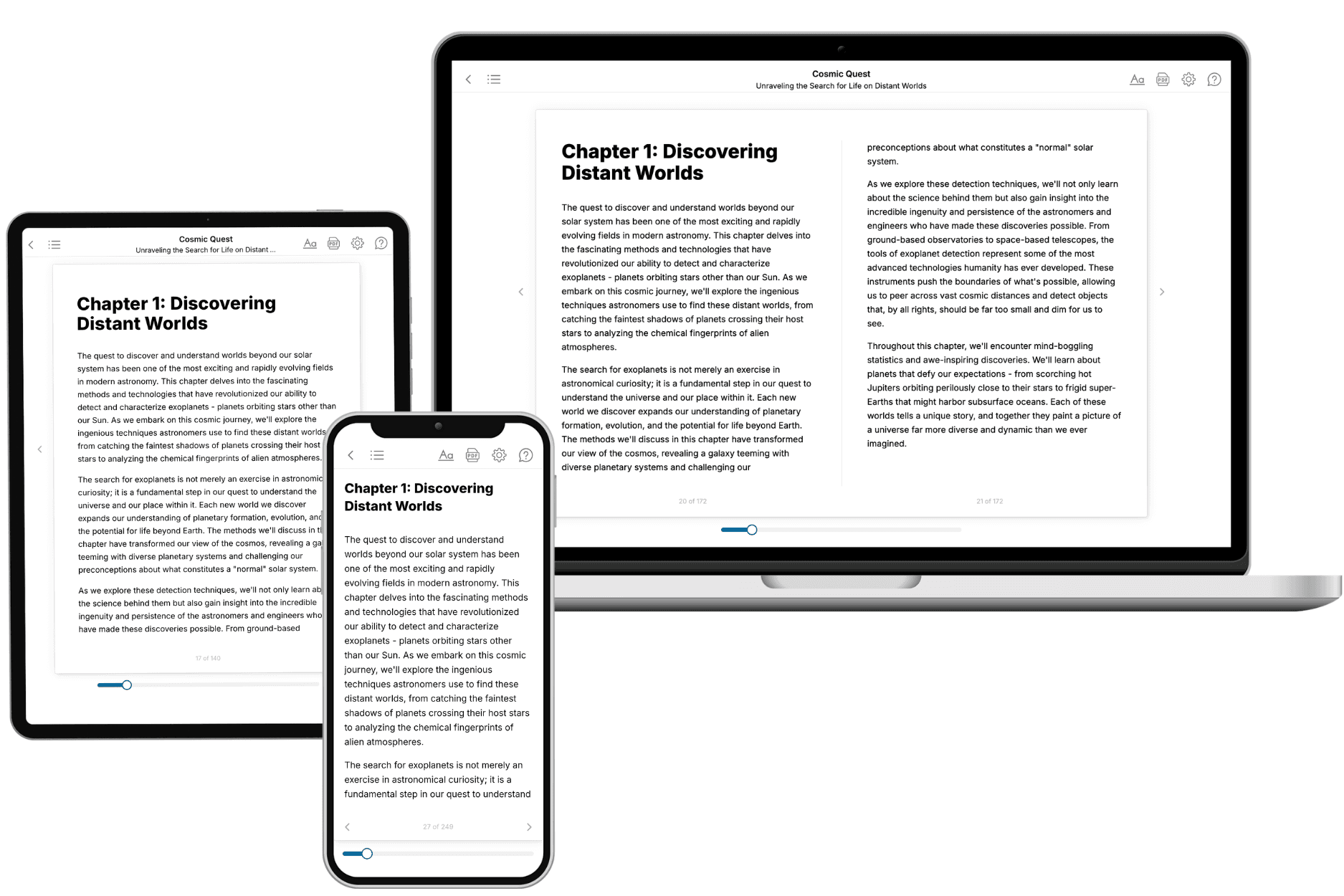
Your book is ready in 10 minutes. Read it online, download as EPUB or PDF, or send to Kindle.


Frequently asked questions
- What is TailoredRead?
TailoredRead creates complete, full-length nonfiction ebooks, written specifically for you. Tell us what you want to learn and why, and TailoredRead writes you a complete ebook on it, with charts, tables, and diagrams throughout. Read it online, on Kindle, or on any e-reader, or download it as a PDF or EPUB. Every book is written fresh the day you order it.
- How is the book tailored to me?
Before anything is written, you answer a few short questions about your goals, your background, and the topics you care about. Your book is then planned around your answers: written at your level, focused on your goals, and covering the topics you chose, instead of the one-size-fits-all book a store sells everyone.
- Will it read like generic AI content?
No. Your book isn't a chat transcript: it's planned chapter by chapter before a single word is written, told in a clear book voice, and explains ideas visually with charts, tables, and diagrams. After writing, every book goes through an editorial pass that polishes chapters so the book reads consistent from start to finish. Judge for yourself: browse thousands of sample books on our Explore Books page.
- How accurate is the content?
Our AI first checks whether your subject needs live research. Niche and fast-moving subjects are researched before writing, and the book plan and chapters are grounded in what it finds. After writing, every book goes through a quality pass that checks its facts and consistency, and researched books list their sources in a Notes section at the back.
- How long is the book?
You choose the length: Comprehensive (250-300 pages), Detailed (150-200 pages), Essential (70-100 pages), or Short (30-50 pages).
- Does the book include visuals?
Yes. Every book includes visual elements such as timelines, checklists, step-by-step guides, decision trees, comparison tables, and matrices, and many include bar charts. A typical book includes dozens of these visual elements.
- Can I read it on Kindle? What formats can I download?
Yes. Every book can be read in our online reader or downloaded as a PDF or EPUB. The EPUB can be opened with Kindle, Apple Books, Kobo, and any e-reader. The Commercial and Author licenses also include an editable Word (DOCX) and Markdown download.
- How much does it cost?
About the price of a regular ebook. The exact price depends on your book's length and complexity, from $2 for the shortest books to $35 for the most comprehensive, and it's shown when you review your book, before you commit to anything. Each book is a one-time purchase, yours to keep, no subscription. Licenses that let you share, teach, or publish your book range from $35.99 to $49.99.
- Can I preview the book before purchasing?
Before you pay, you'll see what your book will cover: the title, a detailed description, the estimated length, and the complete chapter-by-chapter table of contents, so you know what you're getting before you decide. The full text itself is written after you purchase.
- How long does it take to create a book?
About 10 minutes. You can start reading the opening chapters while the rest is still being written.