The Stage of Antiquity
Unveiling the Power and Legacy of Greek Theatre and Drama
In a world saturated with fleeting entertainment, you find yourself yearning for something deeper, more profound.
269 pages13 chaptersJan 24, 2025Greece Ancient History
About this book
The rich tapestry of Greek theatre and drama remains largely unexplored, its timeless wisdom and artistry waiting to be rediscovered. "The Stage of Antiquity" is your gateway to the captivating world of ancient Greek performance. As you delve into its pages, you'll witness the birth of Western theatre and uncover the enduring influence it holds over our modern cultural landscape. From the grand amphitheaters of Athens to the compelling characters of Sophocles and Euripides, this book brings the ancient stage to life before your eyes. Immerse yourself in the historical context that gave rise to these masterpieces, understanding how societal shifts and philosophical movements shaped the evolution of Greek drama. You'll gain insights into the innovative techniques of ancient playwrights and the profound themes they explored, which continue to resonate with audiences today. By the time you turn the final page, you'll possess a newfound appreciation for the power of storytelling and the universal truths revealed through the Greek theatrical tradition.
Table of contents
- IntroductionThe Enduring Importance of Greek Theatre, Overview of the Book's Journey, Greek Drama's Relevance in the Modern WorldRead below
- Chapter 1: The Origins of Greek TheatreReligious Roots and Dionysian Festivals, Early Forms of Performance in Ancient Greece, Thespis and the Birth of Drama, The Role of Theatre in Greek Society
- Chapter 2: The Art of Greek TragedyDefining Greek Tragedy, Structure and Elements of Tragic Plays, The Major Tragedians: Aeschylus, Sophocles, and Euripides, Common Themes and Motifs in Greek Tragedy
- Chapter 3: Greek Comedy: Laughter and CritiqueOld Comedy and Aristophanes, The Evolution to Middle and New Comedy, Satire and Social Commentary in Greek Comedy, Comic Techniques and Character Types
- Chapter 4: Satyr Plays: The Lesser-Known GenreOrigins and Purpose of Satyr Plays, Characteristics and Themes of Satyr Plays, Surviving Examples and Their Significance
- Chapter 5: The Great Playwrights of Ancient GreeceAeschylus: The Father of Tragedy, Sophocles: Perfecting the Tragic Form, Euripides: The Great Innovator, Aristophanes: Master of Old Comedy, Menander and New Comedy
- Chapter 6: The Theatrical Space in Ancient GreeceThe Design and Evolution of Greek Amphitheaters, Acoustics and Visibility in Greek Theatres, Stage Machinery and Special Effects, Famous Theatres: Epidaurus, Dionysus, and Others
- Chapter 7: Elements of Greek Theatrical PerformanceMasks and Costumes in Greek Theatre, The Role and Function of the Chorus, Music and Dance in Greek Drama, Acting Techniques and Conventions
- Chapter 8: Themes and Motifs in Greek DramaFate vs. Free Will, Hubris and Nemesis, The Relationship Between Gods and Mortals, Family, Duty, and Honor, Gender Roles and Power Dynamics
- Chapter 9: Greek Theatre in Historical ContextTheatre During the Golden Age of Athens, The Impact of the Peloponnesian War on Drama, Greek Theatre in the Hellenistic Period, The Influence of Greek Theatre on Roman Drama
- Chapter 10: Philosophical Connections in Greek DramaPre-Socratic Philosophy and Early Tragedy, Socrates, Plato, and Their Views on Theatre, Aristotle's Poetics and Dramatic Theory, Stoicism and Its Reflection in Later Drama
- Chapter 11: Women in Greek TheatrePortrayal of Female Characters in Greek Plays, The All-Male Actor Tradition, Women as Audience Members and Patrons, Modern Feminist Interpretations of Greek Drama
- Chapter 12: The Legacy and Influence of Greek TheatreGreek Drama's Revival in the Renaissance, Modern Adaptations of Greek Plays, Greek Theatrical Techniques in Contemporary Theatre, The Broader Cultural Impact of Greek Drama
- Chapter 13: Preservation and Transmission of Greek PlaysThe Manuscript Tradition, Lost Plays and Fragmentary Evidence, Challenges in Translating Greek Drama, Greek Theatre in the Digital Age
- ConclusionThe Enduring Relevance of Greek Theatre, Future Directions in Greek Theatre Studies
- Glossary of Greek Theatrical Terms
- Suggested Further Reading
Introduction
Welcome to the captivating world of Greek theatre and drama, a realm where ancient stories continue to resonate with modern audiences and where the foundations of Western theatrical tradition were laid over two millennia ago. As you embark on this journey through "The Stage of Antiquity," you are about to uncover the power and legacy of one of the most influential art forms in human history. This introduction serves as your gateway to understanding the enduring importance of Greek theatre, provides an overview of the exploration that lies ahead, and illuminates the surprising relevance of Greek drama in our contemporary world.
Greek theatre emerged as a unique and powerful form of artistic expression in the 5th century BCE, during what is often referred to as the Golden Age of Athens. This was a time of remarkable cultural, philosophical, and political development in ancient Greece, and theatre played a central role in the civic and religious life of the Athenian polis. The dramatic works created during this period continue to be performed, studied, and admired to this day, testament to their enduring quality and universal themes.
As you delve deeper into the pages of this book, you will discover how Greek theatre was not merely entertainment, but a complex art form that served multiple functions in ancient society. It was a means of exploring fundamental questions about human nature, morality, and the relationship between mortals and gods. It was a platform for political discourse and social commentary. And it was a communal experience that brought citizens together to reflect on their shared values and challenges.
The journey through Greek theatre and drama that this book offers is not just a historical exploration, but an invitation to engage with ideas and artistic techniques that continue to shape our understanding of storytelling, performance, and the human condition. Whether you are a theatre enthusiast, a student of classical literature, or simply curious about the roots of Western culture, this book aims to deepen your appreciation for the richness and complexity of Greek drama.
The Enduring Importance of Greek Theatre
The significance of Greek theatre extends far beyond its historical context, influencing countless generations of playwrights, actors, and audiences. Its enduring importance can be attributed to several key factors that continue to resonate in the modern world. First and foremost, Greek theatre introduced and refined dramatic forms that remain fundamental to Western literature and performance arts. The concepts of tragedy and comedy, as developed by ancient Greek playwrights, continue to shape our understanding of dramatic structure and emotional catharsis.
The power of Greek theatre lies in its ability to explore universal themes that transcend time and culture. The plays of Aeschylus, Sophocles, Euripides, and Aristophanes grapple with fundamental aspects of the human experience: the nature of justice, the consequences of hubris, the complexities of family relationships, the tension between individual desire and societal expectations. These themes continue to resonate with modern audiences, offering insights into our own lives and societies. For instance, Sophocles' "Antigone" raises questions about civil disobedience and the conflict between moral and legal obligations that remain relevant in contemporary political discourse[1].
Greek theatre also pioneered innovative storytelling techniques that have had a lasting impact on dramatic arts. The use of the chorus as a narrative and commentary device, the incorporation of masks to represent character types, and the development of complex plot structures have all influenced subsequent theatrical traditions. The concept of dramatic irony, where the audience possesses knowledge that the characters do not, was perfected in Greek tragedy and remains a powerful tool in modern storytelling across various media.
Furthermore, Greek theatre played a crucial role in the development of Western philosophy and rhetoric. The plays often served as vehicles for exploring philosophical ideas, and the agonistic structure of Greek drama, with its emphasis on debate and argumentation, influenced the development of rhetorical techniques. The close relationship between theatre and philosophy in ancient Greece is exemplified by Plato's critique of poetry and drama in "The Republic," which sparked a debate about the role of art in society that continues to this day[2].
The physical spaces in which Greek plays were performed have also left a lasting legacy. The design of ancient Greek amphitheaters, with their remarkable acoustics and sight lines, continues to influence modern theatre architecture. The concept of the theatrical space as a place for communal gathering and shared experience remains central to our understanding of live performance.
Moreover, Greek theatre has proven to be a fertile ground for reinterpretation and adaptation. Throughout history, playwrights and directors have returned to Greek texts, finding in them a rich source of inspiration for addressing contemporary issues. From Jean Anouilh's adaptation of "Antigone" as a commentary on Nazi-occupied France to Luis Alfaro's reimagining of Greek myths in Chicano communities, these ancient stories continue to be reinvented for new audiences and contexts.
The enduring importance of Greek theatre is also evident in its influence on other art forms. The narrative techniques and character archetypes developed in Greek drama have influenced literature, film, and television. The concept of the tragic hero, for instance, can be traced from Sophocles' Oedipus to Shakespeare's Hamlet and on to modern characters like Walter White in "Breaking Bad."
In education, Greek theatre remains a cornerstone of literary and dramatic studies. The plays continue to be taught in schools and universities worldwide, not only for their historical significance but for their literary merit and their ability to provoke critical thinking about ethical and social issues.
Finally, the ritual and communal aspects of Greek theatre continue to resonate in our modern world. In ancient Athens, theatrical performances were part of religious festivals and civic events, bringing the community together in a shared experience. While the religious context has changed, the idea of theatre as a space for collective reflection and catharsis remains powerful. In an age of increasing digitalization and individualization, the communal experience offered by live theatre, rooted in the traditions of ancient Greece, offers a unique and valuable form of human connection.
As you continue through this book, you will discover in greater detail how these various aspects of Greek theatre have shaped our cultural landscape and continue to offer insights into the human condition. The enduring importance of Greek theatre lies not just in its historical significance, but in its continued ability to move, challenge, and inspire audiences across the centuries.
Overview of the Book's Journey
"The Stage of Antiquity" is designed to take you on a comprehensive journey through the world of Greek theatre and drama. This book aims to provide you with a deep understanding of this influential art form, its historical context, and its lasting impact on Western culture. As you progress through the chapters, you will explore various aspects of Greek theatre, from its origins to its legacy in the modern world.
The book begins by delving into the origins of Greek theatre in Chapter 1. Here, you will discover how theatrical performances emerged from religious rituals, particularly those associated with the cult of Dionysus. You'll learn about the early forms of performance in ancient Greece and how they gradually evolved into the more structured dramatic forms we recognize today. This chapter also introduces you to Thespis, the legendary figure credited with introducing the first actor separate from the chorus, a pivotal moment in the birth of drama. Additionally, you'll gain insights into the crucial role theatre played in Greek society, serving not just as entertainment but as a form of civic engagement and cultural expression.
Chapters 2, 3, and 4 focus on the three major genres of Greek drama: tragedy, comedy, and satyr plays. In Chapter 2, you'll explore the art of Greek tragedy, learning about its defining characteristics, structure, and the major playwrights who shaped this genre. You'll be introduced to the works of Aeschylus, Sophocles, and Euripides, and discover the common themes and motifs that run through Greek tragic plays. Chapter 3 turns to Greek comedy, tracing its evolution from Old Comedy, exemplified by Aristophanes, to the later forms of Middle and New Comedy. You'll learn about the satirical nature of Greek comedy and how it served as a vehicle for social and political commentary. Chapter 4 introduces you to the lesser-known genre of satyr plays, exploring their origins, characteristics, and significance in the context of Greek dramatic festivals.
Chapter 5 provides in-depth profiles of the great playwrights of ancient Greece. You'll learn about the lives and works of Aeschylus, Sophocles, Euripides, Aristophanes, and Menander, understanding their unique contributions to the development of Greek drama and their lasting influence on Western literature. This chapter will help you appreciate the individual styles and innovations of these master dramatists.
The physical context of Greek theatre is explored in Chapter 6, which focuses on the theatrical space in ancient Greece. You'll learn about the design and evolution of Greek amphitheaters, their remarkable acoustic properties, and the stage machinery used in productions. This chapter also introduces you to some of the most famous theatres of the ancient world, such as the Theatre of Epidaurus and the Theatre of Dionysus in Athens.
Chapter 7 delves into the elements of Greek theatrical performance, including the use of masks and costumes, the role of the chorus, and the incorporation of music and dance. You'll gain an understanding of the acting techniques and conventions that shaped performances in ancient Greece, providing you with a vivid picture of what attending a play in 5th century BCE Athens might have been like.
The thematic content of Greek drama is explored in depth in Chapter 8. Here, you'll examine recurring themes and motifs in Greek plays, such as the tension between fate and free will, the concept of hubris and its consequences, the relationship between gods and mortals, and the exploration of family dynamics and gender roles. This chapter will help you appreciate the philosophical depth and psychological insight of Greek drama.
Chapter 9 places Greek theatre in its broader historical context, examining how dramatic productions were influenced by and reflected the political and social changes in ancient Greece. You'll learn about theatre during the Golden Age of Athens, the impact of the Peloponnesian War on drama, and the evolution of Greek theatre in the Hellenistic period and under Roman influence.
The philosophical connections of Greek drama are explored in Chapter 10, which examines how theatrical works engaged with and influenced Greek philosophical thought. You'll learn about the impact of pre-Socratic philosophy on early tragedy, the views of Socrates and Plato on theatre, Aristotle's seminal work on dramatic theory in his "Poetics," and the reflection of Stoic ideas in later drama.
Chapter 11 focuses on the role of women in Greek theatre. While women were not allowed to perform on stage, female characters played crucial roles in many Greek plays. This chapter examines the portrayal of women in Greek drama, the tradition of male actors playing female roles, and the participation of women as audience members and patrons. It also introduces modern feminist interpretations of Greek plays, demonstrating how these ancient texts continue to provoke thought and debate about gender roles and power dynamics.
The lasting impact of Greek theatre is the subject of Chapter 12, which traces the legacy and influence of Greek drama from the Renaissance to the present day. You'll learn about the revival of interest in Greek plays during the Renaissance, explore modern adaptations of Greek dramas, and discover how ancient Greek theatrical techniques continue to influence contemporary theatre. This chapter also examines the broader cultural impact of Greek drama on literature, art, and popular culture.
Chapter 13 addresses the crucial topic of how Greek plays have been preserved and transmitted through the centuries. You'll learn about the manuscript tradition that has allowed these ancient texts to survive, the challenges involved in translating Greek drama, and the ongoing efforts to study and disseminate these works in the digital age.
The book concludes with a reflection on the enduring relevance of Greek theatre and a look at future directions in Greek theatre studies. A glossary of Greek theatrical terms and suggestions for further reading are provided to support your continued exploration of this fascinating subject.
Throughout this journey, you'll encounter not just historical facts and literary analysis, but also vivid descriptions of performances, explorations of the social and political context of the plays, and discussions of how these ancient works continue to speak to modern audiences. By the end of the book, you'll have gained a comprehensive understanding of Greek theatre and drama, appreciating both its historical significance and its continued relevance in the contemporary world.
Greek Drama's Relevance in the Modern World
Despite the passage of over two millennia since the golden age of Greek drama, the plays of ancient Athens continue to resonate powerfully in our modern world. This enduring relevance is not merely a matter of historical interest or academic study; Greek drama continues to speak to contemporary audiences, addressing timeless human concerns and providing a lens through which we can examine our own society and personal experiences. The relevance of Greek drama in the modern world manifests in various ways, from its influence on contemporary theatre and literature to its ability to illuminate current social and political issues.
One of the most striking aspects of Greek drama's modern relevance is its exploration of universal themes that continue to preoccupy humanity. The ethical dilemmas, moral conflicts, and psychological insights presented in these ancient plays remain remarkably pertinent to our contemporary experiences. For instance, Sophocles' "Antigone" grapples with the conflict between individual conscience and state authority, a tension that resonates strongly in our era of civil disobedience and political activism. The play raises questions about the limits of power, the nature of justice, and the role of the individual in society that are as relevant today as they were in ancient Athens[3].
Similarly, Euripides' "Medea" explores themes of gender, power, and revenge that continue to provoke thought and debate in our discussions of feminism and gender roles. The play's portrayal of a woman driven to extreme acts by a patriarchal society that has wronged her offers a powerful commentary on gender dynamics that remains disturbingly relevant. Modern productions and adaptations of "Medea" often draw explicit connections to contemporary issues of gender inequality and domestic violence, demonstrating the play's capacity to address current social concerns.
The political commentary inherent in many Greek plays, particularly in the comedies of Aristophanes, finds echoes in modern political satire. The biting wit and social criticism of plays like "Lysistrata" or "The Clouds" can be seen as precursors to contemporary forms of political humor and commentary. The ability of these ancient works to skewer political figures and societal norms demonstrates the enduring power of theatre as a medium for social critique.
Greek drama's exploration of the human psyche and the complexities of family relationships continues to offer insights relevant to modern psychology and family dynamics. The Oedipus cycle, for instance, has been influential in the development of psychoanalytic theory and continues to provide a rich source for exploring concepts of identity, fate, and family conflict. The portrayal of dysfunctional families in plays like Euripides' "Electra" or "Iphigenia in Aulis" resonates with modern audiences grappling with their own family tensions and generational conflicts.
The formal innovations of Greek drama continue to influence modern theatrical practice. The use of the chorus, for example, has been adapted and reimagined by modern playwrights and directors as a means of providing commentary, creating atmosphere, or representing collective voices. The concept of dramatic irony, perfected in Greek tragedy, remains a powerful tool in contemporary storytelling across various media, from theatre to film and television.
Moreover, Greek drama's engagement with questions of citizenship, democracy, and political participation speaks directly to ongoing debates about the nature of civic engagement and the responsibilities of citizens in a democratic society. Plays like Aeschylus' "Oresteia" trilogy, which dramatizes the transition from a system of blood vengeance to one of civic justice, offer a compelling exploration of the foundations of democratic governance that remains relevant to contemporary political discourse.
The adaptability of Greek drama to different cultural contexts demonstrates its continued relevance across diverse societies. Playwrights and directors around the world have found in Greek plays a vehicle for exploring their own cultural concerns. For example, Wole Soyinka's "The Bacchae of Euripides: A Communion Rite" reinterprets Euripides' play through the lens of Yoruba mythology, creating a powerful commentary on colonialism and cultural identity. Such adaptations demonstrate the capacity of Greek drama to speak to a wide range of cultural experiences and to serve as a medium for cross-cultural dialogue.
In education, Greek drama continues to play a vital role in introducing students to key concepts in literature, theatre, and cultural studies. The study of these plays provides a foundation for understanding dramatic structure, character development, and thematic analysis that can be applied to a wide range of literary and dramatic works. Furthermore, engaging with Greek drama encourages critical thinking about ethical issues, societal norms, and the human condition, fostering skills that are valuable across various academic disciplines and in life beyond the classroom.
The philosophical questions raised in Greek drama continue to provoke thought and debate in modern philosophical discourse. The exploration of concepts such as fate, free will, justice, and the nature of the divine in these plays offers a rich source for ongoing philosophical inquiry. The way Greek tragedies grapple with the limits of human knowledge and the consequences of hubris resonates with contemporary discussions about the ethical implications of scientific and technological advancements.
Finally, the communal aspect of Greek theatrical performances, where citizens gathered to witness and reflect on shared stories, offers a model for theatre as a space for collective experience and social cohesion. In an age of increasing digitalization and individualization, the idea of theatre as a place for community engagement and shared reflection on societal issues remains powerfully relevant.
As you delve deeper into the world of Greek theatre and drama through this book, you will discover numerous ways in which these ancient works continue to speak to our modern condition. The enduring relevance of Greek drama lies in its ability to address fundamental aspects of the human experience, to provoke thought and emotion, and to serve as a mirror in which we can examine our own society and ourselves. By engaging with these timeless works, we gain not only a deeper understanding of our cultural heritage but also valuable insights into the challenges and questions that continue to shape our world today.
This is the end of the free sample. The full book has 13 chapters.
Want this book written for you?
Tell us your goals and background, and get your own version of this book, tailored by AI to you.


Benefits of AI-tailored books
- Read one book, not ten:
- all the Greece Ancient History knowledge you need, gathered into a single book.
- Save days of learning:
- tell us your goals, choose your topics, and the whole book is built around them.
- Learn effortlessly:
- Greece Ancient History book written for your specific background and expertise.
- Understand at a glance:
- includes charts, tables, timelines, checklists, decision trees, and more.
- Stay current:
- written the day you order it, not years ago.
- Trust what you read:
- every book is checked for accuracy, with real research when your subject needs it.
Create your unique book in 3 steps
- 1. Select your focus
Select the focus of your Greece Ancient History book and share your background
- 2. Personalize your book
Specify your goals and choose sub-topics to include
- 3. Get your tailored book
Your book is ready in 10 minutes. Read it online, download as EPUB or PDF, or send to Kindle.

Frequently asked questions
- What is TailoredRead?
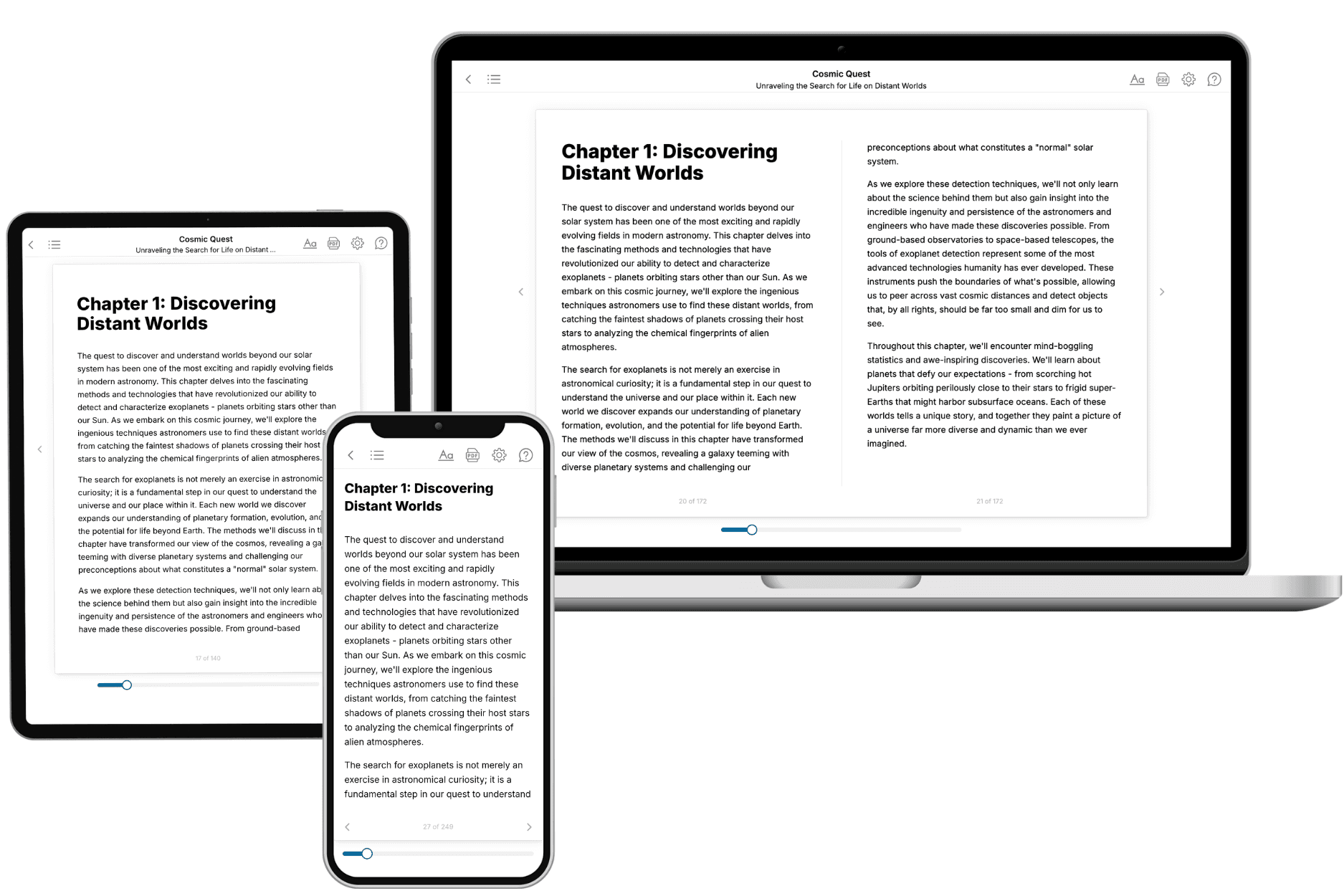
TailoredRead creates complete, full-length nonfiction ebooks, written specifically for you. Tell us what you want to learn and why, and TailoredRead writes you a complete ebook on it, with charts, tables, and diagrams throughout. Read it online, on Kindle, or on any e-reader, or download it as a PDF or EPUB. Every book is written fresh the day you order it.
- How is the book tailored to me?
Before anything is written, you answer a few short questions about your goals, your background, and the topics you care about. Your book is then planned around your answers: written at your level, focused on your goals, and covering the topics you chose, instead of the one-size-fits-all book a store sells everyone.
- Will it read like generic AI content?
No. Your book isn't a chat transcript: it's planned chapter by chapter before a single word is written, told in a clear book voice, and explains ideas visually with charts, tables, and diagrams. After writing, every book goes through an editorial pass that polishes chapters so the book reads consistent from start to finish. Judge for yourself: browse thousands of sample books on our Explore Books page.
- How accurate is the content?
Our AI first checks whether your subject needs live research. Niche and fast-moving subjects are researched before writing, and the book plan and chapters are grounded in what it finds. After writing, every book goes through a quality pass that checks its facts and consistency, and researched books list their sources in a Notes section at the back.
- How long is the book?
You choose the length: Comprehensive (250-300 pages), Detailed (150-200 pages), Essential (70-100 pages), or Short (30-50 pages).
- Does the book include visuals?
Yes. Every book includes charts, tables, and diagrams: timelines, checklists, step-by-step guides, decision trees, comparison tables, matrices, and bar charts. A typical book includes dozens of these visual elements.
- Can I read it on Kindle? What formats can I download?
Yes. Every book can be read in our online reader or downloaded as a PDF or EPUB. The EPUB can be opened with Kindle, Apple Books, Kobo, and any e-reader. The Commercial and Author licenses also include an editable Word (DOCX) and Markdown download.
- How much does it cost?
About the price of a regular ebook. The exact price depends on your book's length and complexity, from $2 for the shortest books to $35 for the most comprehensive, and it's shown when you review your book, before you commit to anything. Each book is a one-time purchase, yours to keep, no subscription. Licenses that let you share, teach, or publish your book range from $35.99 to $49.99.
- Can I preview the book before purchasing?
Before you pay, you'll see what your book will cover: the title, a detailed description, the estimated length, and the complete chapter-by-chapter table of contents, so you know what you're getting before you decide. The full text itself is written after you purchase.
- How long does it take to create a book?
About 10 minutes. You can start reading the opening chapters while the rest is still being written.