The Startup Mindset
Master the Mental Framework That Turns Ideas Into Thriving Businesses
Building a successful startup requires more than a great idea—it demands a fundamentally different way of thinking.
191 pages9 chaptersAug 2, 2026Entrepreneurship
About this book
This book teaches you the entrepreneurial mindset that separates founders who scale from those who stall. You'll discover how to reframe failure as your greatest teacher, make decisions with incomplete information, and maintain unwavering focus while staying flexible enough to adapt. Learn the mental models that help you identify real customer problems before investing months in the wrong solution. Understand how to build psychological resilience, lead through uncertainty, and attract the right people to your mission. Whether you're preparing for an accelerator program, launching your first venture, or scaling your second, this book provides the frameworks and strategies that successful entrepreneurs use daily. Move beyond motivation and inspiration to develop the practical, durable mindset that turns ambitious ideas into thriving businesses.
Table of contents
- IntroductionWhy Mindset Matters More Than You Think, What You'll Learn in This Book, How to Use This Book for Maximum ImpactRead below
- Chapter 1: The Entrepreneurial Mindset DefinedBeyond Business School: What Makes Entrepreneurs Different, The Five Core Characteristics of Entrepreneurial Thinkers, Mindset vs. Skills: Why One Matters More
- Chapter 2: Embracing Uncertainty and Calculated RiskMoving Beyond Your Comfort Zone, How to Evaluate Risk Without Paralysis, Making Decisions With Incomplete Information
- Chapter 3: Failure as Your Greatest TeacherReframing Failure From Defeat to Feedback, Building Rapid Learning Loops From Setbacks, Developing Psychological Resilience
- Chapter 4: Customer Obsession and Problem DiscoveryShifting From Solution-First to Customer-First Thinking, The Art of Deep Customer Listening, Validating Problems Before Building Solutions
- Chapter 5: Resourcefulness and Creative Problem-SolvingHow Constraints Become Your Competitive Advantage, Generating Innovative Solutions With Limited Resources, The Bootstrapping Mindset: Doing More With Less
- Chapter 6: Vision, Focus, and Strategic FlexibilityCrafting a Compelling Vision That Inspires, Maintaining Laser Focus While Staying Flexible, Knowing When to Pivot and When to Persist
- Chapter 7: Building and Leading Your TeamAssembling a Founding Team That Complements Your Strengths, Creating Psychological Safety for Innovation, Leading Through Uncertainty and Change
- Chapter 8: Emotional Intelligence and Self-AwarenessDeveloping Self-Awareness as a Founder, Managing Your Emotions Under Pressure, Building Stronger Relationships With Investors and Partners
- Chapter 9: Accelerator Mindset: Thriving in High-Pressure EnvironmentsUnderstanding Accelerator Program Dynamics, Integrating Feedback From Mentors and Investors, Preparing Your Mindset for Demo Day and Beyond
- ConclusionYour Entrepreneurial Mindset Journey Starts Now, Daily Practices to Reinforce Your Entrepreneurial Thinking
- Further Reading and Resources
Introduction
Most startups don't fail because the founder lacked technical skills or ran out of money first. They fail because the person at the top wasn't thinking like an entrepreneur. They were thinking like an employee, a perfectionist, or a dreamer who never learned to test assumptions against reality. The gap between a promising idea and a thriving business is almost always a gap in mindset, not a gap in resources or market opportunity. That distinction is the entire premise of this book.
The word "mindset" gets thrown around so often in startup culture that it has started to lose its meaning. Motivational posters tell you to "think big" and "embrace failure," but nobody explains the specific mental habits that make those phrases actionable. What does it actually look like to evaluate risk without freezing up? How do you stay committed to a vision while remaining genuinely open to changing direction? How do you lead a team through a crisis when you're not sure yourself what comes next? These are the real questions, and they deserve real answers.
This book was built around those questions. It draws on research in behavioral psychology, decision science, and organizational behavior, as well as the documented experiences of founders who have navigated accelerator programs, early-stage chaos, and the pressure of building something from nothing. The goal isn't to inspire you. The goal is to give you a durable, practical mental framework that you can apply the moment you close the last page and get back to work.
Whether you're preparing to apply to an accelerator, working through your first customer discovery conversations, or trying to figure out whether to pivot or push forward, the chapters ahead address the specific mental challenges that show up at each stage. Each one builds on the last, moving from the foundational question of what an Entrepreneurial Mindset actually is, through the daily disciplines of Customer Obsession, Resourcefulness, and Emotional Intelligence, all the way to the compressed, high-stakes environment of Demo Day Preparation. The progression is deliberate. Mindset isn't a single switch you flip. It's a set of interlocking habits that reinforce each other over time.
Why Mindset Matters More Than You Think
Consider two founders who both launch a food-tech startup in the same city, in the same year, targeting the same customer segment. One has an MBA, a polished pitch deck, and a detailed five-year financial model. The other has a rough prototype, a handful of paying customers, and a habit of calling those customers every week to ask what's broken. Within eighteen months, the second founder has a product people actually want. The first is still refining the deck. The difference isn't intelligence or preparation. It's the mental model each person brought to the problem.
Research on entrepreneurial success consistently points away from credentials and toward cognitive patterns. Specifically, founders who succeed tend to share a cluster of thinking habits: they tolerate ambiguity without shutting down, they treat new information as an asset rather than a threat, and they make decisions quickly with whatever data is available rather than waiting for certainty that never arrives.[1] These aren't personality traits you're born with. They're learnable patterns that develop through deliberate practice and repeated exposure to high-stakes situations.
The Mindset vs. Skills Distinction matters here because skills are domain-specific and can become obsolete. The coding language you master today may be irrelevant in five years. The fundraising tactics that worked in one market cycle may fail in the next. But the underlying mental habits of an entrepreneur, the ability to reframe setbacks, to listen deeply to customers, to lead through uncertainty, remain useful across every stage, every industry, and every economic environment. Skills get you started. Mindset keeps you going.
This is especially true in accelerator environments, where the pace of feedback is compressed and the pressure to perform is constant. Founders who enter those programs with strong technical skills but fragile mental frameworks often crack under the weight of rapid iteration cycles and blunt mentor feedback. Those who enter with a well-developed Entrepreneurial Mindset tend to absorb that feedback, adapt quickly, and emerge stronger. The program doesn't change them. It reveals what was already there.
There's also a compounding effect worth understanding. Each time you practice a mindset habit, such as reframing a failed experiment as a data point rather than a personal defeat, you make it slightly easier to do the same thing next time. Over months and years, these small repetitions accumulate into a fundamentally different way of processing the world. Founders who have been building for five or ten years don't just have more experience. They have a more refined mental operating system, one that was built one decision at a time.
The practical implication is straightforward: investing in your mindset is not a soft, optional add-on to the real work of building a startup. It is the real work, especially in the early stages when almost everything else is uncertain. The market hasn't validated your idea yet. Your team is still forming. Your product doesn't exist. In that environment, the quality of your thinking is the only competitive advantage you reliably control.
That's why this book starts here, with the foundational argument that mindset is the primary lever. Not because skills, capital, and timing don't matter. They do. But they matter far less than most early-stage founders assume, and mindset matters far more. Getting that priority right from the beginning changes everything that follows.
What You'll Learn in This Book
The book is organized as a progressive journey through the mental framework of a successful entrepreneur. Each chapter addresses a specific domain of thinking, from how you evaluate risk to how you manage your emotions under pressure. Together, they form a complete picture of what it means to think like a founder who builds something that lasts.
The journey begins with a precise definition of the Entrepreneurial Mindset itself. Before you can develop something, you need to know exactly what you're developing. The opening chapter breaks down the Five Core Characteristics that distinguish entrepreneurial thinkers from everyone else, and it draws a clear line between mindset and skills so you understand which one to prioritize and when.
From there, the book moves into the territory most early-stage founders find most uncomfortable: uncertainty and risk. You'll work through a practical Risk Evaluation Framework that helps you assess downside without becoming paralyzed by it. You'll also explore how to make good decisions when the information you need simply isn't available yet, which is the normal condition for almost every important startup decision.
The middle section of the book covers three of the most operationally important mindset domains:
- Failure Reframing and Rapid Learning Loops: How to extract maximum signal from setbacks and build Psychological Resilience that holds up under repeated pressure.
- Customer Obsession and Problem Discovery: How to escape Solution-First Bias and develop the Deep Customer Listening habits that lead to genuine Problem Validation before you build anything.
- Resourcefulness and Constraint-Driven Innovation: How to treat limited resources as a creative forcing function rather than a reason to wait, and what the Bootstrapping Mindset looks like in practice.
The second half of the book shifts toward the strategic and relational dimensions of entrepreneurship. You'll explore how to craft a Compelling Vision that attracts talent and investment, how to maintain Strategic Focus without becoming rigid, and how to navigate the Pivot vs. Persist Decision with clarity rather than panic. Then the book moves into team dynamics, covering Founding Team Composition, Psychological Safety, and what Leading Through Uncertainty actually requires from a founder on a difficult day.
The final two chapters address the inner game of entrepreneurship. Founder Self-Awareness and Emotional Intelligence aren't soft skills. They're the operating layer beneath every other capability in this book. A founder who can't regulate their own emotions under pressure will make worse decisions, damage key relationships, and struggle to lead effectively no matter how strong their strategy is. These chapters give you concrete tools for developing both.
The book closes with a dedicated chapter on Accelerator Program Dynamics, covering the specific mental demands of high-pressure environments: how to integrate rapid mentor feedback without losing your own judgment, how to manage the psychological arc of an accelerator cohort, and how to prepare your mindset specifically for Demo Day and the investor conversations that follow. If you're heading into an accelerator, this chapter alone is worth the read.
Throughout every chapter, the focus stays on the practical. Concepts are illustrated with specific scenarios, frameworks are given in usable form, and the common failure modes are named so you can recognize them before they cost you. The goal is not to give you a theory of entrepreneurship. The goal is to give you a mental toolkit you can use tomorrow morning.
How to Use This Book for Maximum Impact
Reading this book straight through from start to finish is a perfectly valid approach, and the chapters are sequenced to build on each other in a logical progression. But the book is also designed to work as a reference you return to at specific moments in your startup journey. The chapter on the Pivot vs. Persist Decision, for example, will hit differently when you're actually facing that decision than it will during a casual first read. Keep that in mind as you go.
The most effective way to use this material is to read actively, not passively. That means pausing at the end of each subchapter to ask yourself one question: Where does this show up in my current situation? Every concept in this book has a direct application to something you're either doing right now or will face within the next few months. The founders who get the most out of books like this are the ones who treat reading as a diagnostic exercise, not an entertainment one.
Here's a simple framework for active reading that works well with this book:
- Read the subchapter once for understanding. Don't stop to take notes. Just absorb the core idea.
- Read it again with a pen or a notes app open. Write down one specific situation in your startup where this concept applies.
- Write one action you'll take in the next 48 hours based on what you just read. Keep it small and concrete.
This three-step loop takes an extra ten minutes per subchapter, but it converts passive reading into active behavior change. The difference between a founder who reads about Deep Customer Listening and one who actually practices it comes down to whether they translated the concept into a specific action. The reading alone doesn't change anything. The action does.
If you're currently in an accelerator program or preparing to enter one, a slightly different reading sequence may serve you better. Start with the introduction and the first chapter to establish the foundational framework. Then jump directly to the chapter on Accelerator Program Dynamics to get the context-specific guidance you need right now. After that, work through the remaining chapters in order, applying each one to your current program experience as you go. The concepts will be more vivid and more immediately useful when you're living the environment they describe.
For founders who are earlier in their journey, perhaps still in the idea stage or just beginning customer discovery, the chapters on Customer Obsession and Problem Discovery and on Resourcefulness and Constraint-Driven Innovation deserve extra attention. These are the areas where early-stage founders most commonly go wrong, and getting them right early saves enormous amounts of time, money, and emotional energy later.
The single most common mistake founders make with books like this is reading them for validation rather than challenge. They highlight the parts that confirm what they already believe and skim past the parts that make them uncomfortable. The uncomfortable parts are almost always the most valuable ones.
Each chapter ends with a set of reflection questions and a short action checklist. These aren't decorative. They're the mechanism by which the ideas in the chapter get converted into actual behavior. Skipping them is the equivalent of going to the gym, sitting in the parking lot for an hour, and then driving home. The value is in the reps, not the proximity.
Finally, consider sharing what you're learning with a co-founder, a mentor, or a peer in your cohort. Teaching a concept to someone else is one of the fastest ways to deepen your own understanding of it. If you can explain the Pivot vs. Persist Decision framework to a colleague clearly enough that they could use it, you've internalized it in a way that passive reading never achieves. The conversations that come out of that kind of sharing also tend to surface blind spots that solo reading misses entirely.
The chapters ahead are dense with frameworks, examples, and specific guidance. But none of it matters unless you bring your own situation to the material. The book provides the mental models. Your startup provides the context that makes them real. Bring both to every page, and what follows will be genuinely useful in ways that most business books never manage to be.
Notes
Introduction
- 1. Saras Sarasvathy, Effectuation: Elements of Entrepreneurial Expertise, Edward Elgar Publishing, 2008
This is the end of the free sample. The full book has 9 chapters.
Want this book written for you?
Tell us your goals and background, and get your own version of this book, tailored by AI to you.


Benefits of AI-tailored books
- Read one book, not ten:
- all the Entrepreneurship knowledge you need, gathered into a single book.
- Save days of learning:
- tell us your goals, choose your topics, and the whole book is built around them.
- Learn effortlessly:
- Entrepreneurship book written for your specific background and expertise.
- Understand at a glance:
- includes charts, tables, timelines, checklists, decision trees, and more.
- Stay current:
- written the day you order it, not years ago.
- Trust what you read:
- every book is checked for accuracy, with real research when your subject needs it.
Create your unique book in 3 steps
- 1. Select your focus
Select the focus of your Entrepreneurship book and share your background
- 2. Personalize your book
Specify your goals and choose sub-topics to include
- 3. Get your tailored book
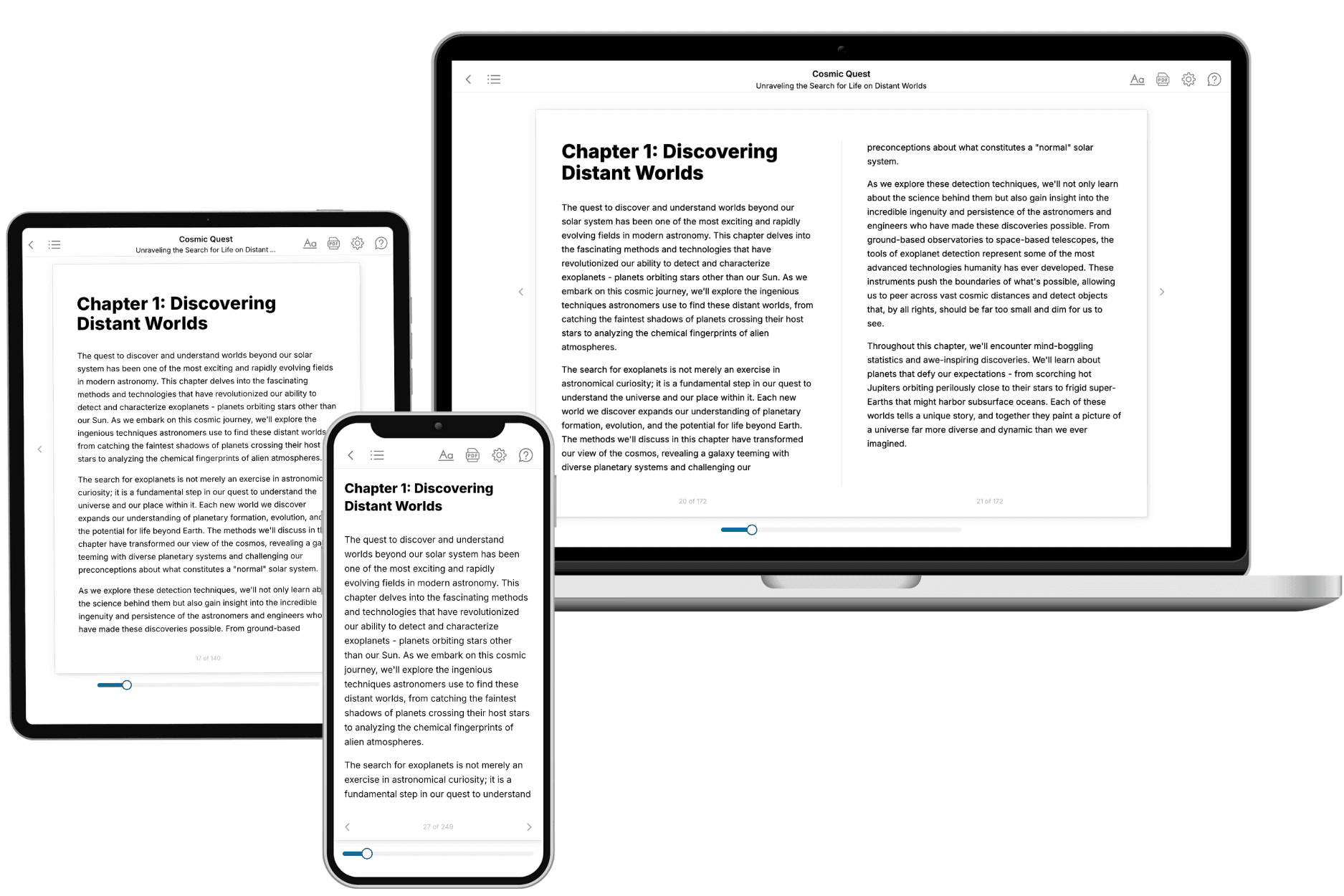
Your book is ready in 10 minutes. Read it online, download as EPUB or PDF, or send to Kindle.
Frequently asked questions
- What is TailoredRead?
TailoredRead creates complete, full-length nonfiction ebooks, written specifically for you. Tell us what you want to learn and why, and TailoredRead writes you a complete ebook on it, with charts, tables, and diagrams throughout. Read it online, on Kindle, or on any e-reader, or download it as a PDF or EPUB. Every book is written fresh the day you order it.
- How is the book tailored to me?
Before anything is written, you answer a few short questions about your goals, your background, and the topics you care about. Your book is then planned around your answers: written at your level, focused on your goals, and covering the topics you chose, instead of the one-size-fits-all book a store sells everyone.
- Will it read like generic AI content?
No. Your book isn't a chat transcript: it's planned chapter by chapter before a single word is written, told in a clear book voice, and explains ideas visually with charts, tables, and diagrams. After writing, every book goes through an editorial pass that polishes chapters so the book reads consistent from start to finish. Judge for yourself: browse thousands of sample books on our Explore Books page.
- How accurate is the content?
Our AI first checks whether your subject needs live research. Niche and fast-moving subjects are researched before writing, and the book plan and chapters are grounded in what it finds. After writing, every book goes through a quality pass that checks its facts and consistency, and researched books list their sources in a Notes section at the back.
- How long is the book?
You choose the length: Comprehensive (250-300 pages), Detailed (150-200 pages), Essential (70-100 pages), or Short (30-50 pages).
- Does the book include visuals?
Yes. Every book includes charts, tables, and diagrams: timelines, checklists, step-by-step guides, decision trees, comparison tables, matrices, and bar charts. A typical book includes dozens of these visual elements.
- Can I read it on Kindle? What formats can I download?
Yes. Every book can be read in our online reader or downloaded as a PDF or EPUB. The EPUB can be opened with Kindle, Apple Books, Kobo, and any e-reader. The Commercial and Author licenses also include an editable Word (DOCX) and Markdown download.
- How much does it cost?
About the price of a regular ebook. The exact price depends on your book's length and complexity, from $2 for the shortest books to $35 for the most comprehensive, and it's shown when you review your book, before you commit to anything. Each book is a one-time purchase, yours to keep, no subscription. Licenses that let you share, teach, or publish your book range from $35.99 to $49.99.
- Can I preview the book before purchasing?
Before you pay, you'll see what your book will cover: the title, a detailed description, the estimated length, and the complete chapter-by-chapter table of contents, so you know what you're getting before you decide. The full text itself is written after you purchase.
- How long does it take to create a book?
About 10 minutes. You can start reading the opening chapters while the rest is still being written.