The Stoic Path
Ancient Wisdom for Modern Living
You face constant pressure to control outcomes beyond your reach—your career trajectory, others' opinions, unexpected setbacks.
191 pages9 chaptersApr 6, 2026Philosophy
About this book
This struggle creates anxiety, frustration, and a sense of powerlessness. Stoic philosophy offers a radically different approach: by learning to distinguish between what you can control and what you cannot, you reclaim your peace of mind and personal power. This book guides you through the essential teachings of ancient Stoic philosophers like Marcus Aurelius, Epictetus, and Seneca, translating their wisdom into practical strategies for modern life. You'll discover how to manage difficult emotions, build unshakeable resilience, and align your actions with your values. Rather than seeking happiness through external success, Stoicism teaches you to cultivate virtue and inner freedom—the only reliable sources of lasting fulfillment. Whether facing professional challenges, personal relationships, or life's inevitable hardships, these time-tested principles provide a clear framework for living with intention and dignity.
Table of contents
- IntroductionWhy Stoicism Matters Today, A Brief History of Stoic Philosophy, How to Use This BookRead below
- Chapter 1: The Foundation: Understanding Stoic PhilosophyThe Core Principles of Stoicism, The Ancient Stoic Schools, Stoicism vs. Common Misconceptions
- Chapter 2: The Dichotomy of ControlWhat Is the Dichotomy of Control?, Identifying Your Sphere of Control, Releasing What You Cannot Control, Practical Applications in Daily Life
- Chapter 3: Virtue as the Highest GoodWhat Is Virtue in Stoic Philosophy?, The Four Cardinal Virtues, Choosing Virtue Over External Rewards
- Chapter 4: Managing Your Judgments and PerceptionsImpressions and the Power of Assent, Recognizing Cognitive Distortions, Reframing Techniques for Difficult Situations, Practicing Stoic Mindfulness
- Chapter 5: Negative Visualization and PreparationPremeditatio Malorum: Negative Visualization, Mental Rehearsal for Challenges, Cultivating Gratitude Through Loss Contemplation
- Chapter 6: Building Emotional ResilienceUnderstanding Stoic Views on Emotions, Managing Anger and Frustration, Overcoming Fear and Anxiety, Dealing with Grief and Loss
- Chapter 7: Daily Stoic Practice and DisciplineMorning Reflection and Intention Setting, Evening Review and Self-Examination, Essential Stoic Exercises and Practices
- Chapter 8: Stoicism in Relationships and CommunityYour Duty to Others and Society, Navigating Relationships with Stoic Principles, Handling Difficult People and Conflict
- Chapter 9: Stoicism for Modern ChallengesCareer, Ambition, and Professional Success, Financial Security and Material Concerns, Health, Aging, and Mortality, Technology, Social Media, and Distraction
- ConclusionYour Stoic Journey Begins, Final Reflections on Living Stoically
- Further Reading and Resources
Introduction
There is a particular kind of exhaustion that comes from trying to control everything. You refresh your email obsessively, waiting for news that may never arrive. You replay a difficult conversation in your head, wishing you had said something different. You lie awake at night running through worst-case scenarios, as if worrying hard enough might somehow prevent them. This is not a character flaw. It is a deeply human response to a world that feels increasingly unpredictable, fast-moving, and indifferent to your plans.
What if there were a better way? Not a way to control more, but a way to need to control less. That is precisely what Stoic philosophy offers. Developed in ancient Greece and refined across centuries by some of history's most remarkable thinkers, Stoicism is a practical philosophy built for people living under pressure. It does not promise that life will become easier. It promises something far more valuable: that you can become more capable of handling whatever life brings your way.
The Stoics were not ivory-tower academics. Marcus Aurelius governed the Roman Empire during plague and war. Epictetus was born into slavery. Seneca navigated the treacherous politics of Nero's court. These were people who faced genuine hardship, and they developed their philosophy in direct response to it. Their writings have survived for nearly two thousand years because the problems they addressed, anxiety, loss, anger, ambition, mortality, are the same problems you face today. The names of the challenges have changed. The nature of the struggle has not.
This book is a guide to understanding Stoic philosophy and putting it to work in your actual life. It is not a dry academic survey. It is a practical companion designed to help you think more clearly, respond more wisely, and live with greater intention. Each chapter builds on the last, moving from foundational concepts to specific applications in relationships, work, health, and the daily rhythms of modern existence. By the end, you will have a coherent framework for navigating difficulty and a set of concrete practices to carry forward.
Why Stoicism Matters Today
Stoicism has experienced a remarkable revival in recent decades, and the timing is not accidental. Rates of anxiety and burnout have climbed steadily across the developed world. A 2023 Gallup report found that 44% of adults globally reported experiencing significant stress the previous day.[1] Social media has created an environment of constant comparison, where your sense of worth is perpetually measured against curated highlights of other people's lives. The pace of change in technology, economics, and culture has accelerated to a point where the skills that made you successful yesterday may not be sufficient tomorrow. In this environment, a philosophy centered on inner stability and clear thinking is not a luxury. It is a necessity.
What makes Stoicism particularly well-suited to modern life is its emphasis on the distinction between what you can and cannot control. This single idea, which the Stoics called the dichotomy of control, cuts through an enormous amount of modern anxiety. Most of what you worry about falls outside your direct control: other people's opinions, economic conditions, your company's decisions, the behavior of your family members. Stoicism does not ask you to be indifferent to these things. It asks you to be clear-eyed about where your actual power lies, and to invest your energy there rather than in futile resistance to what you cannot change.
Stoicism also offers a compelling answer to one of the central confusions of contemporary culture: the belief that happiness comes from acquiring the right things, achieving the right status, or being seen in the right way. This belief drives enormous amounts of human behavior, and it consistently fails to deliver what it promises. Research on hedonic adaptation shows that people return to roughly the same baseline level of wellbeing after both positive and negative life events, meaning that the promotion, the new house, and the relationship you thought would finally make you happy tend to lose their emotional charge faster than you expect.[2] The Stoics diagnosed this problem two thousand years ago and offered a different target: virtue, or the quality of your character and choices, as the only reliable source of lasting fulfillment.
Beyond individual wellbeing, Stoicism speaks directly to questions of purpose and meaning. Many people today feel a nagging sense that they are busy but not purposeful, productive but not fulfilled. Stoicism provides a framework for asking the right questions. What kind of person do you want to be? What do your actions say about your values? Are you living in alignment with what you claim to believe? These are not comfortable questions, but they are the ones that lead somewhere worth going.
It is also worth noting that Stoicism is not in conflict with modern psychology. In fact, Cognitive Behavioral Therapy (CBT), one of the most evidence-backed therapeutic approaches available, draws directly from Stoic ideas. The CBT principle that it is not events themselves but your interpretations of events that cause emotional distress is a near-direct translation of Epictetus's teaching that men are disturbed not by the things which happen, but by the opinions about the things.
[3] Stoicism and modern science are pointing in the same direction.
Finally, Stoicism matters today because it is genuinely accessible. You do not need a philosophy degree to benefit from it. You do not need to adopt a particular religious belief or abandon your existing values. Stoicism is a set of practical tools and perspectives that can be layered onto whatever life you are already living. The goal is not to become a different person. It is to become a clearer, steadier, more intentional version of who you already are.
A Brief History of Stoic Philosophy
Stoicism was founded around 300 BCE by a merchant named Zeno of Citium, who arrived in Athens after surviving a shipwreck that cost him his entire cargo. According to the ancient biographer Diogenes Laërtius, Zeno visited a bookseller in Athens and became captivated by accounts of Socrates. He asked where he could find men like that, and the bookseller pointed him toward a philosopher named Crates walking by in the street. Zeno followed Crates and began his philosophical education on the spot.[4] It is a fitting origin story for a philosophy that prizes practical wisdom over theoretical abstraction.
Zeno eventually established his own school, teaching in a public colonnade in Athens called the Stoa Poikile, or Painted Porch. This is where the name "Stoicism" comes from. His followers were called Stoics, literally "people of the porch." Zeno taught that the goal of life was to live in accordance with nature and reason, and that virtue was the only true good. His school attracted serious thinkers, and Stoicism quickly became one of the dominant philosophical movements of the ancient world.
The philosophy developed through several generations of thinkers. Cleanthes succeeded Zeno as head of the school and is remembered for his Hymn to Zeus, one of the few complete Stoic texts from the early period to survive. Chrysippus followed Cleanthes and is often credited with systematizing Stoic doctrine into a comprehensive philosophical framework covering logic, physics, and ethics. Ancient sources suggest he wrote over 700 works, though none have survived intact.[5] These early Stoics are known as the Old Stoa, and their work laid the intellectual foundation for everything that followed.
Stoicism reached its greatest cultural influence during the Roman period, when it was adopted by thinkers across the social spectrum. The three figures whose work survives most completely, and whose ideas form the backbone of this book, represent a remarkable range of life experience:
- Epictetus (c. 50–135 CE) was born a slave in Hierapolis, in what is now Turkey. He was owned by a freedman of Emperor Nero and reportedly had his leg broken by his master as a demonstration of power. After gaining his freedom, he established a school of philosophy in Nicopolis and became one of the most influential teachers of his era. His lectures were recorded by his student Arrian in two works: the Discourses and the shorter Enchiridion (or Handbook).
- Seneca (c. 4 BCE–65 CE) was a Roman statesman, playwright, and advisor to Emperor Nero. He was one of the wealthiest men in Rome, which created an obvious tension with his Stoic teachings about the unimportance of material wealth. He wrote extensively in the form of letters and essays, and his works are among the most readable and psychologically astute in the Stoic canon.
- Marcus Aurelius (121–180 CE) was Roman Emperor for nearly two decades, ruling during a period of military conflict and devastating plague. His private journal, known as the Meditations, was never intended for publication. It is a record of a man working to apply Stoic principles to the pressures of governing an empire, and it remains one of the most widely read philosophical texts in history.
After the fall of the Roman Empire, Stoicism faded as a formal school but continued to influence Christian theology, Renaissance humanism, and Enlightenment thought. Philosophers like Descartes, Spinoza, and Kant all engaged with Stoic ideas. In the twentieth century, Stoic concepts found their way into psychotherapy through the work of Albert Ellis, who founded Rational Emotive Behavior Therapy (REBT) and explicitly credited Epictetus as a foundational influence.[6]
The modern Stoicism revival began gaining momentum in the early 2000s, driven partly by the internet's ability to connect people interested in practical philosophy and partly by a cultural hunger for frameworks that could handle genuine adversity. Books like Ryan Holiday's The Obstacle Is the Way (2014) introduced Stoic ideas to a new generation of readers, particularly in business and athletic communities. Today, Stoicism is studied in universities, practiced in boardrooms, and discussed in online communities with millions of members. The philosophy has traveled a long way from a painted porch in ancient Athens, and it has lost none of its relevance along the way.
Understanding this history matters because it grounds the philosophy in real human experience. These were not armchair theorists. They were people who faced exile, slavery, political persecution, and the weight of governing millions. Their ideas were tested under conditions far more extreme than most people will ever encounter. That is precisely what gives those ideas their authority.
How to Use This Book
This book is organized to take you from foundational understanding to practical application in a logical sequence. The early chapters establish the core concepts of Stoic philosophy: what it actually teaches, where it came from, and how it differs from common misunderstandings. The middle chapters go deeper into specific Stoic tools and practices, covering the dichotomy of control, virtue ethics, the management of judgments and emotions, and the practice of negative visualization. The later chapters apply these principles to the specific challenges of modern life, including work, relationships, financial pressure, health, and the particular difficulties posed by technology and social media.
You can read this book straight through from beginning to end, and that is the recommended approach for a first reading. Each chapter builds on concepts introduced earlier, so reading in sequence will give you the most coherent understanding of how the pieces fit together. However, the book is also designed to be useful as a reference. If you are facing a specific challenge, such as a difficult relationship or a career setback, you can turn directly to the relevant chapter and find practical guidance without needing to re-read everything that came before.
At the end of each chapter, you will find a short set of reflection questions and practical exercises. These are not optional extras. They are the most important part of the book. Stoicism is not a philosophy you can absorb by reading alone. It requires practice, repetition, and honest self-examination. The Stoics themselves were emphatic about this. Epictetus compared philosophical training to athletic training: you do not become strong by reading about exercise. You become strong by doing the work, consistently, over time.[7]
Here is a practical approach to getting the most from this material:
- Read one chapter at a time. Resist the urge to rush through the whole book in a weekend. Give each chapter a few days to settle. Think about how the ideas apply to your current situation before moving on.
- Keep a journal. The Stoics were prolific writers, and for good reason. Writing forces clarity of thought. Use a notebook or a simple document to respond to the reflection questions, record your observations, and track how your thinking evolves over time.
- Pick one practice and commit to it. Each chapter introduces specific exercises. Rather than trying to implement everything at once, choose one practice per chapter and focus on it until it becomes habitual before adding another.
- Return to the primary sources. This book draws heavily on the writings of Marcus Aurelius, Epictetus, and Seneca. Reading their original words, even in translation, adds a dimension that no secondary source can fully replicate. The Further Reading section at the back of this book includes recommended editions and translations.
- Be patient with yourself. Stoic practice is a lifelong project, not a quick fix. You will have days when you respond to difficulty with exactly the kind of clarity and equanimity the Stoics describe, and days when you fall completely short. Both are part of the process.
It is also worth being honest about what this book is not. It is not a comprehensive academic treatment of Stoic philosophy. Scholars have written entire careers' worth of material on the nuances of Stoic logic, physics, and metaphysics. This book focuses on the ethical and psychological dimensions of Stoicism because those are the dimensions most directly relevant to living well in the modern world. Where academic debates exist, they are acknowledged but not dwelt upon. The goal is practical wisdom, not scholarly completeness.
This book also does not claim that Stoicism is the only valid philosophical framework or that it answers every question about how to live. Stoicism has genuine limitations, and some of its ancient assumptions about nature, society, and human psychology do not translate cleanly into the twenty-first century. Where those tensions exist, they are addressed honestly. A philosophy worth taking seriously is one that can withstand honest scrutiny.
What Stoicism does offer, and what this book aims to deliver, is a coherent, tested, and genuinely useful set of principles for navigating a difficult world with greater clarity and less unnecessary suffering. The Stoics believed that philosophy was not an academic exercise but a form of medicine for the soul. The measure of good philosophy, in their view, was not how sophisticated it sounded but how much it actually helped you live better. That is the standard this book holds itself to as well.
Waste no more time arguing about what a good man should be. Be one.— Marcus Aurelius, Meditations, Book 10
That instruction from Marcus Aurelius captures the spirit of everything that follows. The point is not to become an expert in Stoic theory. The point is to become a steadier, wiser, more intentional person. The ancient Stoics spent their lives working toward that goal, imperfectly and persistently. You can do the same. The path begins here.
Notes
Introduction
- 1. Gallup, State of the Global Workplace, Gallup Press, 2023
- 2. P. Brickman and others, "Lottery winners and accident victims," Journal of Personality and Social Psychology, 1978
- 3. Epictetus. Enchiridion, Chapter 5. Translated by George Long.
- 4. "Diogenes Laërtius. Lives of the Eminent Philosophers," Book VII. Translated by R.D. Hicks. Loeb Classical Library, 1925
- 5. Diogenes Laërtius. Lives of the Eminent Philosophers, Book VII.
- 6. A. Ellis, Reason and Emotion in Psychotherapy, Lyle Stuart, 1962
- 7. Epictetus. Discourses, Book 2, Chapter 9.
This is the end of the free sample. The full book has 9 chapters.
Want this book written for you?
Tell us your goals and background, and get your own version of this book, tailored by AI to you.


Benefits of AI-tailored books
- Read one book, not ten:
- all the Philosophy knowledge you need, gathered into a single book.
- Save days of learning:
- tell us your goals, choose your topics, and the whole book is built around them.
- Learn effortlessly:
- Philosophy book written for your specific background and expertise.
- Understand at a glance:
- includes charts, tables, timelines, checklists, decision trees, and more.
- Stay current:
- written the day you order it, not years ago.
- Trust what you read:
- every book is checked for accuracy, with real research when your subject needs it.
Create your unique book in 3 steps
- 1. Select your focus
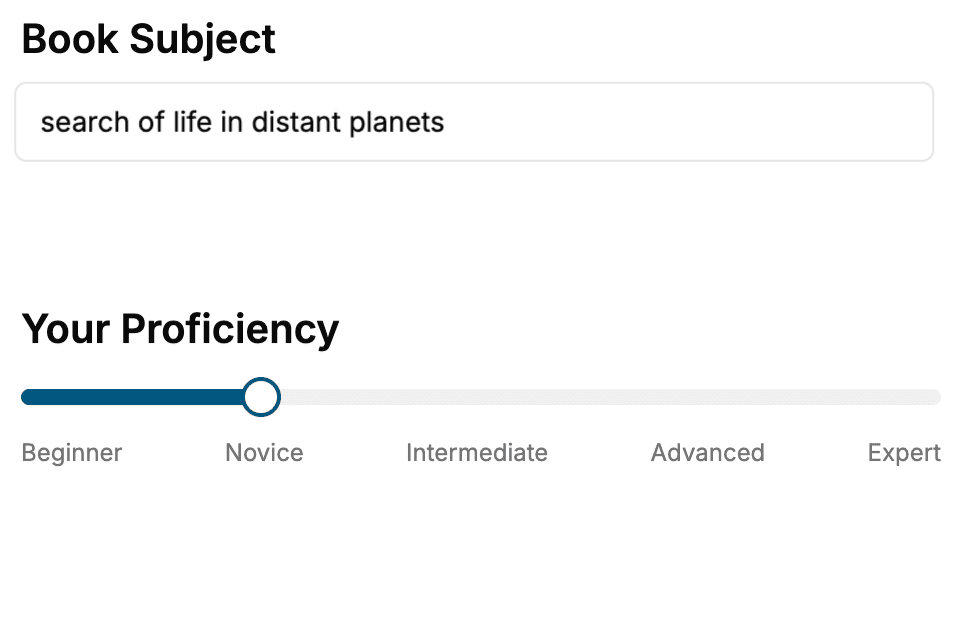
Select the focus of your Philosophy book and share your background
- 2. Personalize your book
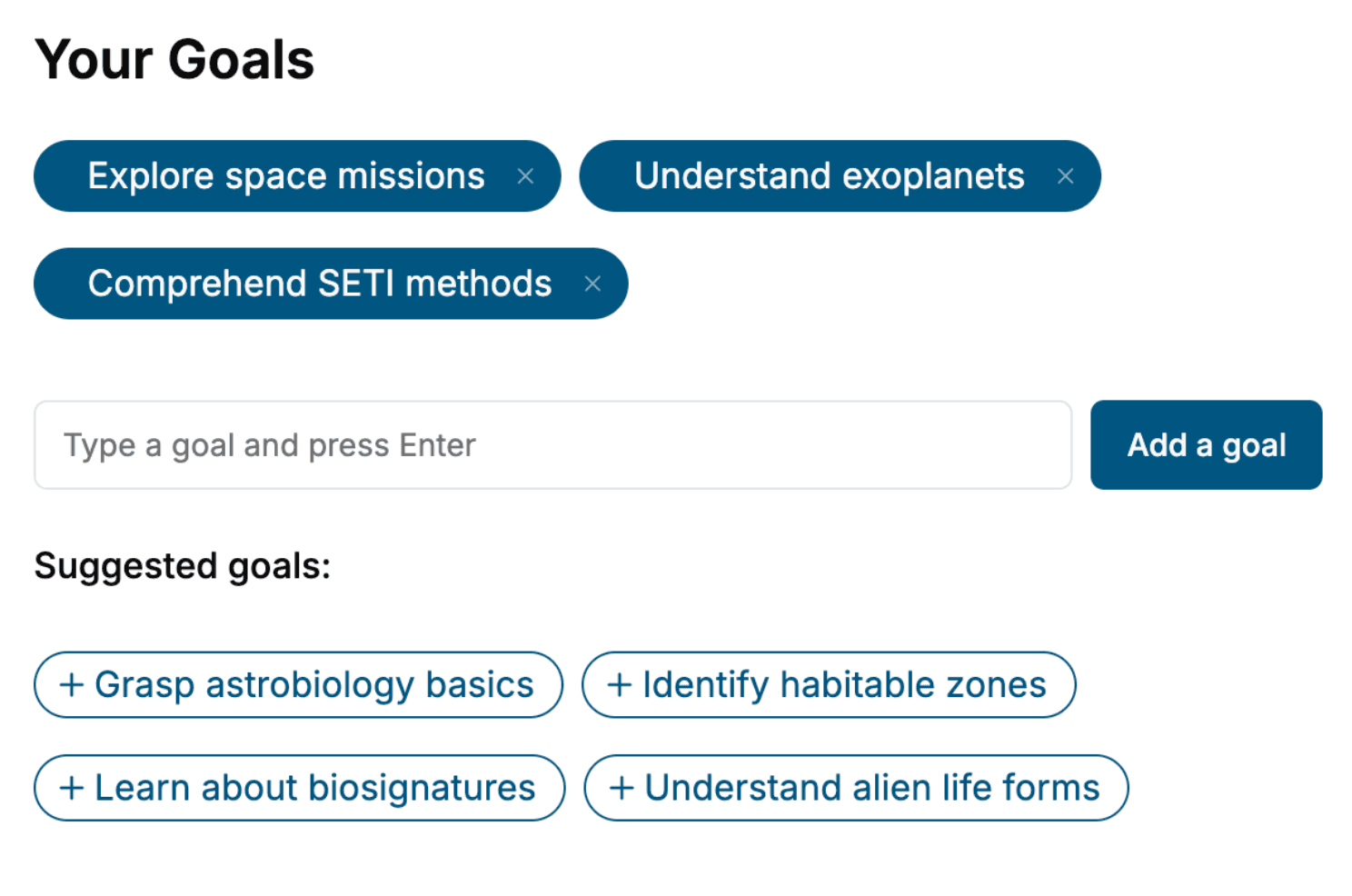
Specify your goals and choose sub-topics to include
- 3. Get your tailored book
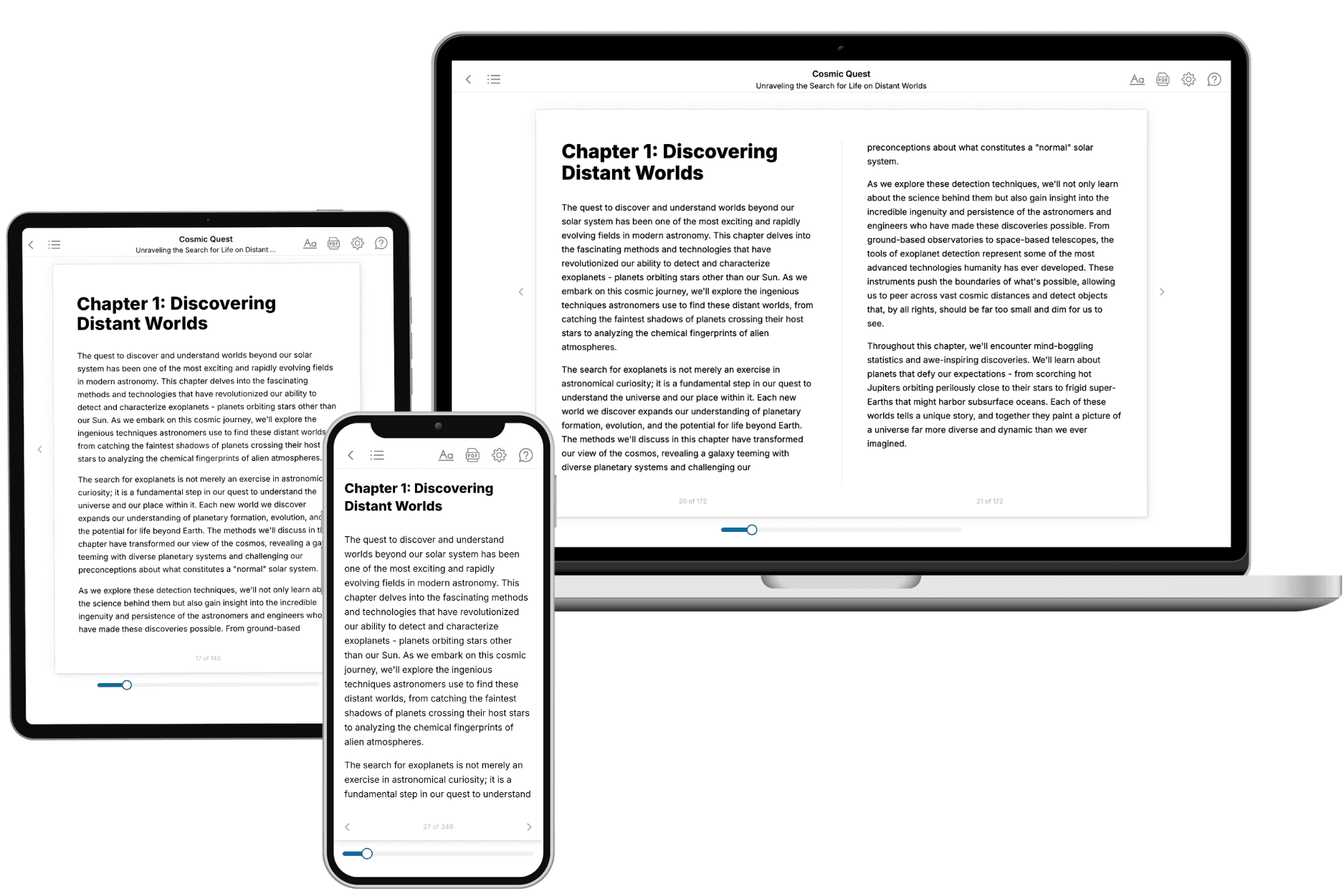
Your book is ready in 10 minutes. Read it online, download as EPUB or PDF, or send to Kindle.
Frequently asked questions
- What is TailoredRead?
TailoredRead creates complete, full-length nonfiction ebooks, written specifically for you. Tell us what you want to learn and why, and TailoredRead writes you a complete ebook on it, with charts, tables, and diagrams throughout. Read it online, on Kindle, or on any e-reader, or download it as a PDF or EPUB. Every book is written fresh the day you order it.
- How is the book tailored to me?
Before anything is written, you answer a few short questions about your goals, your background, and the topics you care about. Your book is then planned around your answers: written at your level, focused on your goals, and covering the topics you chose, instead of the one-size-fits-all book a store sells everyone.
- Will it read like generic AI content?
No. Your book isn't a chat transcript: it's planned chapter by chapter before a single word is written, told in a clear book voice, and explains ideas visually with charts, tables, and diagrams. After writing, every book goes through an editorial pass that polishes chapters so the book reads consistent from start to finish. Judge for yourself: browse thousands of sample books on our Explore Books page.
- How accurate is the content?
Our AI first checks whether your subject needs live research. Niche and fast-moving subjects are researched before writing, and the book plan and chapters are grounded in what it finds. After writing, every book goes through a quality pass that checks its facts and consistency, and researched books list their sources in a Notes section at the back.
- How long is the book?
You choose the length: Comprehensive (250-300 pages), Detailed (150-200 pages), Essential (70-100 pages), or Short (30-50 pages).
- Does the book include visuals?
Yes. Every book includes charts, tables, and diagrams: timelines, checklists, step-by-step guides, decision trees, comparison tables, matrices, and bar charts. A typical book includes dozens of these visual elements.
- Can I read it on Kindle? What formats can I download?
Yes. Every book can be read in our online reader or downloaded as a PDF or EPUB. The EPUB can be opened with Kindle, Apple Books, Kobo, and any e-reader. The Commercial and Author licenses also include an editable Word (DOCX) and Markdown download.
- How much does it cost?
About the price of a regular ebook. The exact price depends on your book's length and complexity, from $2 for the shortest books to $35 for the most comprehensive, and it's shown when you review your book, before you commit to anything. Each book is a one-time purchase, yours to keep, no subscription. Licenses that let you share, teach, or publish your book range from $35.99 to $49.99.
- Can I preview the book before purchasing?
Before you pay, you'll see what your book will cover: the title, a detailed description, the estimated length, and the complete chapter-by-chapter table of contents, so you know what you're getting before you decide. The full text itself is written after you purchase.
- How long does it take to create a book?
About 10 minutes. You can start reading the opening chapters while the rest is still being written.